

The BFSI CBO compliance risk management landscape is becoming increasingly complex as financial institutions operate in a highly regulated, technology-driven environment. Banking, Financial Services, and Insurance organizations must comply with evolving global regulations while maintaining operational efficiency, security, and customer trust. Chief Business Officers (CBOs) play a strategic role in ensuring that compliance risk frameworks align with business objectives, especially as institutions accelerate digital transformation initiatives, adopt AI-driven analytics, and expand digital payment ecosystems.
As regulatory scrutiny intensifies and cyber threats become more sophisticated, CBOs must integrate compliance risk management into enterprise-wide decision-making. Modern BFSI organizations increasingly rely on advanced technologies such as automated testing, API security validation, and AI-based risk intelligence to detect vulnerabilities before they impact operations. Establishing a resilient compliance framework requires collaboration between risk, technology, and operations teams, ensuring continuous monitoring, real-time reporting, and adaptive control mechanisms. Institutions that successfully embed risk culture into their strategy can improve operational resilience, enhance customer confidence, and achieve sustainable growth in an evolving regulatory landscape.
Introduction to BFSI CBO Compliance Risk Management
What Is CBO Risk Management in BFSI?
CBO risk management refers to the Chief Business Officer’s responsibility to ensure business growth aligns with regulatory compliance, operational stability, and enterprise risk governance. In the BFSI sector, this role has expanded beyond commercial performance to include oversight of compliance frameworks, digital risk exposure, and cross-functional accountability. As outlined in Risk management strategies for CBOs in a volatile market, CBOs must balance profitability with regulatory obligations in increasingly complex financial environments.
Key responsibilities typically include:
- Aligning business strategy with regulatory requirements
- Identifying operational and technology-related risk exposure
- Strengthening governance and internal control structures
- Coordinating with compliance, legal, and IT teams
- Ensuring readiness for audits and regulatory reviews
Guidance from BFSI compliance regulatory framework best practices emphasizes the importance of structured governance models and continuous monitoring to maintain compliance integrity. Additionally, insights from Operational risk management in banking highlight how centralized risk visibility enables faster response to compliance issues and improves institutional resilience.
Why Compliance Risk Management Is Critical in BFSI
Compliance risk in BFSI is directly linked to financial stability, customer trust, and institutional reputation. Regulatory violations can result in financial penalties, operational restrictions, and reputational damage that impact long-term profitability. As explained in What is BFSI domain definition industry overview, financial institutions operate under strict supervision due to their systemic importance in the global economy.
Key factors increasing compliance complexity include:
- Rapid evolution of digital financial services and payment platforms
- Expansion of cross-border financial operations
- Increasing regulatory scrutiny around data privacy and cybersecurity
- Growing reliance on third-party vendors and cloud infrastructure
The rise of digital ecosystems is further explored in Digital transformation for BFSI, which highlights how financial institutions must adapt compliance frameworks to support innovation without increasing exposure to operational risks.
Key Drivers Increasing CBO Compliance Responsibilities
Several industry trends are expanding the scope of CBO compliance risk management:
1. Digital transformation initiatives
Organizations are modernizing legacy infrastructure to support mobile banking, digital wallets, and API-driven ecosystems. Insights from BFSI payments demonstrate how real-time payment technologies require enhanced monitoring controls to prevent fraud and ensure regulatory compliance.
2. Adoption of AI and machine learning technologies
AI-driven analytics improve risk prediction but introduce governance concerns related to model transparency and bias. As outlined in AI in BFSI complete technology guide, financial leaders must implement explainable AI frameworks to ensure regulatory acceptance.
3. Growing cybersecurity threats
Financial platforms are prime targets for cyberattacks. Security validation strategies described in Best practices for automated security testing in BFSI highlight the importance of continuous vulnerability testing.
4. Expansion of API ecosystems
Open banking frameworks increase integration complexity and require strong API governance. According to API testing platforms for BFSI enhancing API efficacy, robust API testing reduces integration failures and compliance breaches.
Regulatory Landscape Impacting BFSI Compliance Risk Management
Global Regulatory Frameworks Governing BFSI Operations
The BFSI industry operates under a complex network of global regulatory frameworks designed to ensure financial stability, transparency, and consumer protection. These frameworks establish guidelines for capital adequacy, risk exposure, data protection, and operational resilience. Financial institutions must comply with international standards while also adapting to national supervisory requirements, making regulatory management a strategic priority for Chief Business Officers.
Regulatory frameworks increasingly emphasize digital resilience as financial services migrate to cloud environments and API-based ecosystems. For CBOs, understanding global regulatory structures helps align business expansion with compliance obligations. Institutions expanding into new markets must evaluate licensing requirements, capital thresholds, and data residency rules before launching services. Strong regulatory awareness reduces operational disruptions and supports long-term scalability.
Key Compliance Standards Financial Institutions Must Follow
Financial institutions must adhere to a broad range of compliance standards covering financial transactions, customer data protection, and risk governance. These standards aim to prevent fraud, protect sensitive information, and ensure fair market practices. Compliance obligations apply across digital banking platforms, payment systems, lending services, and insurance operations.
Core compliance areas typically include:
- Data protection and privacy governance
- Anti-money laundering (AML) controls
- Know Your Customer (KYC) requirements
- Financial reporting accuracy
- Cybersecurity risk management
As digital transformation accelerates, technology infrastructure becomes a key component of compliance readiness. Insights from Software testing for BFSI methodologies best practices show that structured testing strategies help financial organizations detect vulnerabilities early and maintain compliance with evolving regulatory expectations. Similarly, Best practices for automated security testing in BFSI highlights how automated validation improves system reliability and reduces exposure to cyber threats.
Regional Variations in Financial Regulatory Requirements
Regulatory requirements vary significantly across regions due to differences in economic policies, legal frameworks, and supervisory priorities. Financial institutions operating internationally must adapt compliance programs to meet local regulatory expectations while maintaining consistent risk governance standards.
For example, data protection regulations may differ in scope and enforcement mechanisms across jurisdictions. Payment regulations, open banking requirements, and reporting obligations also vary widely between markets. According to What is BFSI in banking complete industry guide, regulatory diversity creates operational complexity, particularly for organizations managing cross-border financial transactions.
Regional differences often impact:
- Data storage and transfer requirements
- Licensing and operational approvals
- Consumer protection regulations
- Digital identity verification standards
- Transaction monitoring obligations
CBOs must collaborate with compliance teams to ensure localized regulatory requirements are addressed without disrupting operational efficiency.
The Impact of Regulatory Changes on CBO Risk Strategy
Regulatory frameworks continue to evolve in response to financial innovation, emerging risks, and global economic shifts. Changes in digital payment regulations, cybersecurity expectations, and AI governance standards require financial institutions to continuously adapt their compliance strategies.
Insights from Digital transformation for BFSI indicate that modernization initiatives often introduce new regulatory considerations related to cloud computing, third-party integrations, and data processing transparency. As regulatory scrutiny increases, CBOs must ensure risk management strategies remain flexible and responsive to change.
Common strategic adjustments include:
- Updating internal control frameworks
- Enhancing risk monitoring tools
- Implementing real-time compliance reporting
- Improving vendor risk oversight
Organizations that adopt proactive compliance strategies are better prepared to respond quickly to regulatory updates without disrupting business operations.
Aligning Compliance Programs with Business Objectives
Effective compliance programs should support business innovation rather than limit growth. CBOs play a critical role in aligning regulatory requirements with strategic objectives, ensuring new products and services meet compliance standards from the early development stages.
A risk-aligned business strategy improves decision-making and reduces costly compliance remediation efforts. According to Driving risk culture through collaborative project management, organizations that integrate risk awareness into project planning improve accountability and reduce implementation delays.
Key alignment strategies include:
- Embedding compliance requirements into product design
- Encouraging collaboration between compliance and innovation teams
- Using risk data to guide strategic decisions
- Implementing continuous monitoring mechanisms
By integrating compliance into business strategy, BFSI organizations can innovate confidently while maintaining regulatory integrity. This balanced approach enables sustainable growth in increasingly complex financial ecosystems.
Core Risk Categories in BFSI Compliance Management
1. Operational and Process Risk
Operational risk refers to potential losses caused by failures in internal processes, systems, or human factors. In BFSI organizations, operational complexity increases as institutions integrate legacy infrastructure with modern digital platforms, mobile banking applications, and automated workflows. Inefficient processes, system downtime, or inadequate internal controls can disrupt financial services and lead to regulatory violations.
According to Operational risk management in banking, financial institutions must establish structured risk monitoring frameworks to identify process vulnerabilities early. Common operational risks include transaction errors, data inconsistencies, system outages, and compliance reporting failures. These risks often arise when digital transformation initiatives are implemented without adequate governance controls.
CBOs can reduce operational risk by standardizing workflows, implementing continuous testing strategies, and improving cross-department collaboration. Resources such as Software testing for BFSI methodologies best practices emphasize the importance of quality assurance processes in maintaining operational stability and ensuring regulatory alignment.
2. Financial and Market Risk Factors
Financial and market risks arise from fluctuations in interest rates, liquidity conditions, credit exposure, and macroeconomic volatility. These risks directly impact profitability and regulatory capital requirements, making them a critical focus area for CBOs managing enterprise-wide compliance risk. Market uncertainty, geopolitical instability, and inflation pressures can significantly influence lending performance and investment portfolios.
Insights from Risk management strategies for CBOs in a volatile market highlight the importance of scenario analysis and predictive modeling in managing financial uncertainty. Institutions must evaluate stress scenarios and maintain adequate capital buffers to comply with regulatory expectations.
Digital innovation also affects financial risk exposure. As described in Digital transformation for BFSI, real-time data analytics enables organizations to improve forecasting accuracy and enhance decision-making processes. Strong financial risk governance helps ensure stability while supporting strategic growth initiatives.
3. Cybersecurity and Data Privacy Risk
Cybersecurity risk is one of the fastest-growing concerns in the BFSI sector due to the increasing volume of digital transactions and sensitive customer data processed across interconnected platforms. Financial institutions are prime targets for cyberattacks, including phishing, ransomware, API exploitation, and identity theft. Data privacy regulations further increase the importance of secure data handling practices.
Guidelines from Best practices for automated security testing in BFSI show that continuous vulnerability assessment and penetration testing help detect security gaps before they impact customers. Additionally, BFSI app testing mobile web guide highlights the need for comprehensive validation across mobile and web applications to prevent unauthorized access.
CBOs must ensure cybersecurity risk management includes encryption protocols, identity access controls, real-time monitoring tools, and incident response strategies. Strengthening cybersecurity resilience improves customer trust and supports regulatory compliance requirements.
4. Third-Party and Vendor Risk
Third-party risk emerges when financial institutions rely on external vendors for cloud services, payment processing, data analytics, or software development. While outsourcing improves operational efficiency, it also introduces compliance vulnerabilities related to data security, service reliability, and regulatory accountability.
As highlighted in BFSI testing company how to select the right QA partner, selecting vendors with strong compliance practices reduces the likelihood of security incidents and operational disruptions. Third-party vendors must meet strict regulatory standards, particularly when handling sensitive financial information.
Key vendor risk considerations include service-level agreements, data protection policies, incident response capabilities, and regulatory certifications. Institutions adopting API-based ecosystems must also validate integration reliability, as explained in API testing platforms for BFSI enhancing API efficacy.
CBOs can mitigate third-party risk by implementing structured vendor evaluation frameworks, continuous monitoring procedures, and contractual compliance requirements that align with regulatory expectations.
Technology-Driven Risk and Compliance Transformation
1. Digital Transformation in BFSI Risk Management
Digital transformation is reshaping how BFSI institutions identify, monitor, and mitigate compliance risks. As financial services increasingly shift toward cloud-based platforms, mobile banking, and digital payment ecosystems, traditional risk management approaches are no longer sufficient. Modern compliance strategies must incorporate real-time monitoring, data-driven decision-making, and scalable governance frameworks.
According to Digital transformation for BFSI, financial institutions are investing in modern infrastructure to improve operational transparency and strengthen risk visibility across departments. Digital tools enable centralized risk dashboards, faster regulatory reporting, and improved traceability of transactions. For CBOs, digital transformation supports proactive risk identification while ensuring compliance requirements are embedded directly into operational workflows.
2. AI and Machine Learning for Risk Intelligence
Artificial intelligence and machine learning technologies are transforming compliance risk management by enabling predictive analytics and automated anomaly detection. AI-driven systems can analyze large volumes of transactional and behavioral data to identify unusual patterns that may indicate fraud, policy violations, or operational weaknesses.
Insights from AI in BFSI complete technology guide for financial leaders show that AI improves decision accuracy and reduces manual compliance workloads. Machine learning models can continuously adapt to new data, helping financial institutions detect emerging risks faster than traditional rule-based systems.
AI also supports intelligent risk scoring, automated document verification, and real-time transaction monitoring. These capabilities enable CBOs to improve risk forecasting accuracy while maintaining regulatory transparency.
3. API Security and Platform Reliability
API-driven architecture plays a critical role in modern BFSI ecosystems, supporting open banking, digital wallets, and third-party service integration. While APIs improve interoperability and customer experience, they also introduce new attack surfaces and compliance risks.
As discussed in API testing platforms for BFSI enhancing API efficacy, structured API testing helps ensure secure data exchange and stable system performance. API vulnerabilities can expose sensitive financial data or disrupt transaction flows, potentially leading to regulatory violations.
Robust API governance includes authentication protocols, encryption standards, traffic monitoring, and continuous validation processes. Strong API security frameworks enable institutions to innovate confidently while maintaining compliance integrity.
4. Automation in Compliance Monitoring
Automation technologies help financial institutions streamline compliance processes, reduce manual errors, and improve reporting efficiency. Automated monitoring tools can continuously track transactions, user activities, and system logs to detect compliance deviations in real time.
Guidance from Best practices for automated security testing in BFSI highlights how automation improves vulnerability detection and reduces response times. Automated compliance checks also ensure consistent policy enforcement across digital platforms.
By integrating automation into compliance workflows, CBOs can reduce operational complexity and improve regulatory readiness. Automated reporting systems provide accurate audit trails and enable faster response to regulatory inquiries, strengthening overall risk management effectiveness.
Explore how SmartDev partners with BFSI teams through a focused AI sprint to validate use cases, align stakeholders, and define a clear path forward before AI development begins.
SmartDev helps BFSI organizations clarify AI use cases and assess feasibility, enabling confident decisions and reducing risks before committing to AI development.
Learn how SmartDev accelerates AI initiatives, ensuring rapid deployment and reduced time to market.
Strengthen Your BFSI Security Testing with UsBest Practices for CBOs Managing Compliance Risk
1. Building a Risk-Aware Organizational Culture
A strong risk-aware culture ensures that compliance is not limited to a single department but embedded across the entire organization. Employees at all levels must understand how their decisions impact regulatory exposure, operational resilience, and data security. CBOs play a key role in promoting accountability, transparency, and consistent adherence to compliance standards.
According to Driving risk culture through collaborative project management, organizations with integrated risk awareness frameworks improve decision-making consistency and reduce compliance violations. Training programs, internal communication initiatives, and leadership alignment help reinforce shared responsibility for managing risk.
2. Integrating Compliance into Enterprise Strategy
Compliance risk management should support innovation rather than restrict business growth. CBOs must ensure regulatory considerations are integrated into strategic planning, digital transformation initiatives, and product development processes. Embedding compliance early reduces the likelihood of costly redesigns or regulatory remediation later.
Insights from BFSI compliance regulatory framework best practices highlight the importance of aligning governance frameworks with long-term business objectives. When compliance requirements are incorporated into enterprise architecture, organizations can scale operations more confidently while maintaining regulatory integrity.
3. Cross-Functional Collaboration Between Risk Teams
Effective compliance risk management requires collaboration between multiple departments, including legal, IT, cybersecurity, operations, and product development. Siloed decision-making often creates visibility gaps that increase exposure to operational and regulatory risks.
As financial ecosystems become more technology-driven, cross-functional coordination becomes increasingly important. Resources such as Software testing for BFSI methodologies best practices emphasize the importance of collaboration between development and risk teams to ensure compliance requirements are validated throughout the software lifecycle.
CBOs should encourage shared accountability and implement communication frameworks that improve coordination across departments.
4. Continuous Monitoring and Audit Readiness
Continuous monitoring helps organizations identify compliance gaps before they escalate into regulatory violations. Automated risk monitoring tools, audit logs, and real-time reporting dashboards improve visibility into operational and technical risk indicators.
Guidance from Operational risk management in banking shows that institutions with structured monitoring systems are better prepared for regulatory audits. Maintaining accurate documentation, standardized reporting processes, and consistent control validation improves audit readiness and reduces disruption during regulatory reviews.
5. Establishing Measurable Risk KPIs
Measurable risk indicators enable organizations to track compliance performance and evaluate the effectiveness of risk mitigation strategies. Key risk indicators (KRIs) help CBOs identify emerging threats, assess control effectiveness, and prioritize risk remediation initiatives.
Typical compliance KPIs may include incident response time, regulatory reporting accuracy, vulnerability resolution speed, and audit findings frequency. As highlighted in Risk management strategies for CBOs in a volatile market, measurable performance metrics improve decision-making transparency and strengthen governance accountability.
By defining clear KPIs, CBOs can align risk management performance with strategic business outcomes and support continuous improvement initiatives.
Testing and Quality Assurance Strategies for BFSI Risk Mitigation
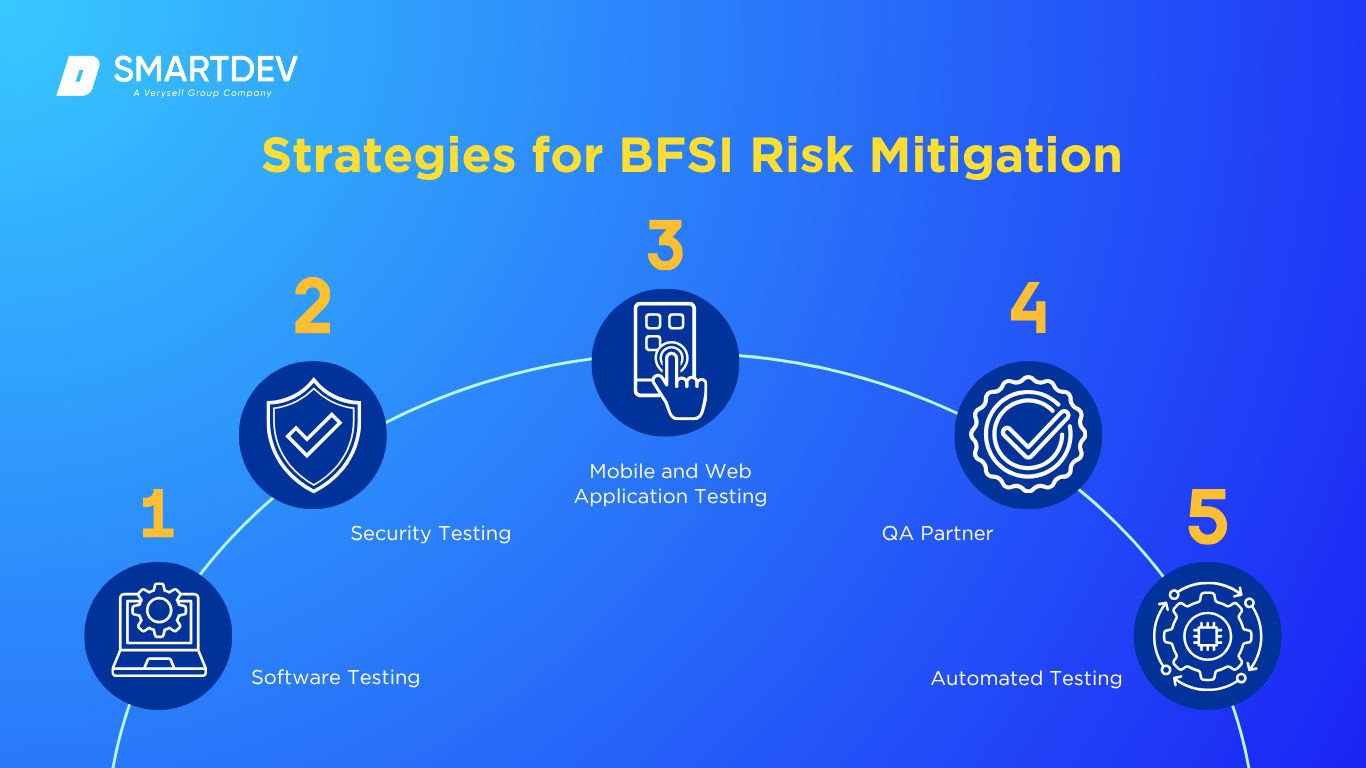 1. Importance of Software Testing in Financial Compliance
Software testing plays a critical role in ensuring BFSI platforms meet regulatory requirements while maintaining system reliability and security. Financial institutions process large volumes of sensitive customer data, transactions, and financial records, making accuracy and stability essential. Even small system defects can lead to compliance violations, financial losses, or reputational damage.
According to Software testing for BFSI methodologies best practices, structured testing frameworks help organizations detect vulnerabilities early in the development lifecycle. Testing ensures that applications meet regulatory standards related to data protection, transaction accuracy, and operational performance. By embedding testing into development processes, CBOs can reduce risk exposure and improve audit readiness.
2. Security Testing Best Practices for BFSI Platforms
Security testing helps identify vulnerabilities that could expose financial systems to cyber threats or unauthorized access. BFSI platforms are frequent targets for attacks due to the high value of financial and personal data stored within digital ecosystems. Security testing ensures systems comply with data protection regulations and cybersecurity best practices.
Guidance from Best practices for automated security testing in BFSI highlights the importance of vulnerability scanning, penetration testing, and secure code review. These practices help organizations detect weaknesses before attackers can exploit them. Encryption validation, authentication testing, and access control reviews are also critical components of secure BFSI platforms.
Strong security testing frameworks improve regulatory compliance and enhance customer trust by ensuring sensitive data is properly protected.
3. Mobile and Web Application Testing Considerations
Modern financial services rely heavily on mobile apps and web platforms to deliver convenient digital experiences. However, these channels introduce additional compliance and security risks, particularly related to authentication, data transmission, and user session management.
As explained in BFSI app testing mobile web guide, mobile and web testing must evaluate performance, usability, and security under real-world conditions. Testing ensures applications function consistently across devices, operating systems, and network environments. It also verifies that sensitive data is encrypted and protected from unauthorized access.
CBOs should ensure testing strategies cover functional performance, security validation, and user experience reliability to maintain compliance standards across digital channels.
4. Selecting the Right QA Partner for BFSI Risk Reduction
Choosing a qualified QA partner helps financial institutions strengthen compliance processes and improve testing efficiency. BFSI environments require specialized expertise due to strict regulatory requirements and complex system integrations.
According to BFSI testing company how to select the right QA partner, organizations should evaluate vendors based on technical capability, industry knowledge, and compliance experience. A reliable QA partner should understand regulatory expectations related to data protection, cybersecurity, and operational resilience.
Strong collaboration between internal teams and QA providers improves testing coverage and ensures compliance requirements are consistently validated throughout development cycles.
5. Automated Testing for Continuous Compliance Validation
Automated testing enables financial institutions to validate compliance requirements continuously without slowing down development speed. Automation tools can execute repetitive test cases efficiently, reducing human error and improving testing consistency. Continuous testing is especially important for BFSI organizations adopting agile or DevOps development models.
Insights from API testing platforms for BFSI enhancing API efficacy show that automated API validation helps ensure stable integrations and secure data exchange across digital ecosystems. Automation also supports regression testing, compliance checks, and performance validation.
By implementing automated testing frameworks, CBOs can improve system reliability, detect compliance gaps faster, and support ongoing digital innovation while maintaining regulatory alignment.
Building a Resilient BFSI Compliance Risk Framework
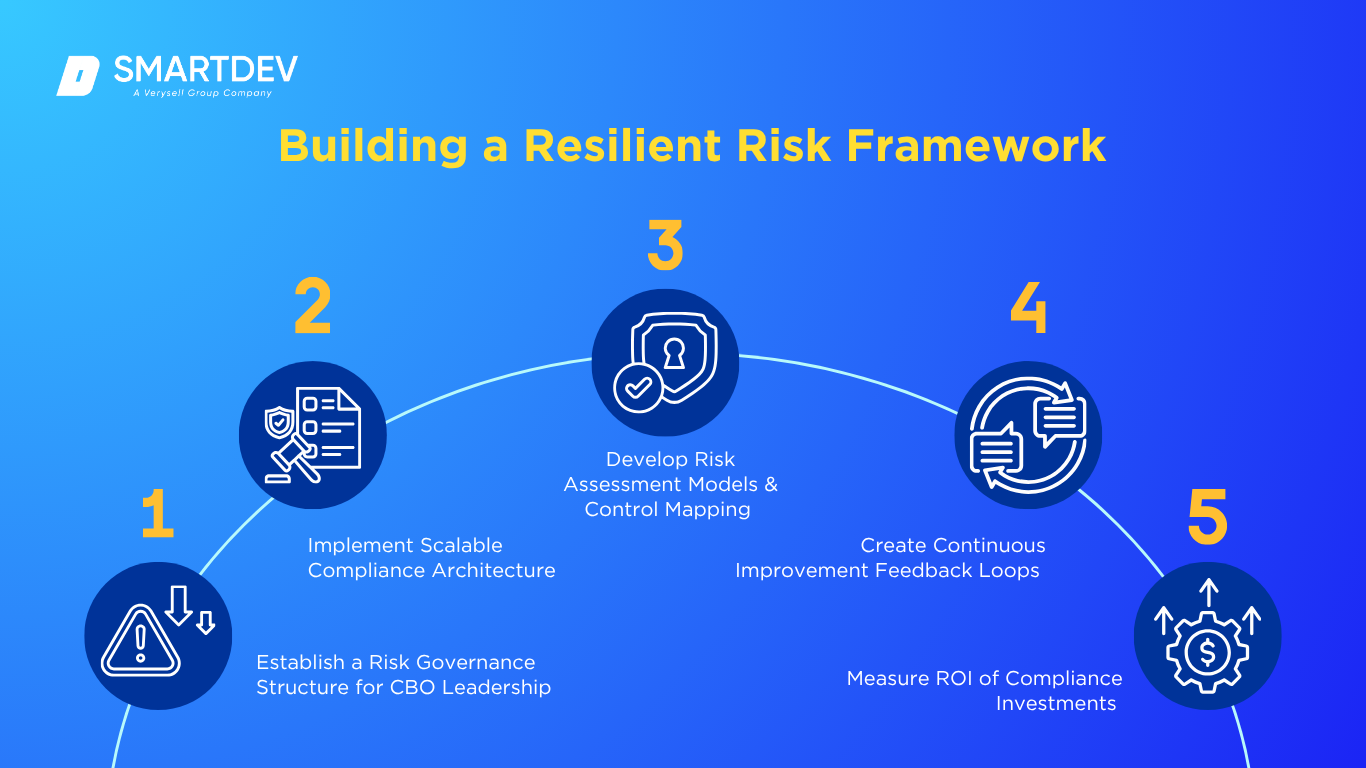 Step 1. Establish a Risk Governance Structure for CBO Leadership
Start by defining a clear governance structure that assigns ownership of compliance risk across departments. CBOs should ensure responsibilities are distributed among risk, legal, IT, and operational leaders to avoid accountability gaps. A structured governance model enables faster response to regulatory changes and improves decision transparency.
According to BFSI compliance regulatory framework best practices, organizations with well-defined governance hierarchies experience fewer compliance breakdowns. Key actions include establishing risk committees, defining escalation protocols, and ensuring internal audits are conducted regularly.
Step 2. Implement Scalable Compliance Architecture
Compliance systems must scale alongside digital growth. As BFSI organizations adopt cloud computing, APIs, and digital payment infrastructure, compliance controls must remain consistent across all platforms. Scalable architecture ensures regulatory requirements are maintained even when new products or markets are introduced.
Insights from Digital transformation for BFSI highlight the importance of flexible infrastructure that supports real-time monitoring and reporting. CBOs should prioritize interoperable systems, centralized compliance dashboards, and standardized data governance frameworks.
Step 3. Develop Risk Assessment Models and Control Mapping
Risk assessment models help identify potential threats and determine their impact on financial operations and compliance status. Control mapping connects identified risks with appropriate mitigation measures, ensuring each risk category is addressed through structured safeguards.
As explained in Operational risk management in banking, organizations should continuously evaluate risk exposure using measurable indicators and performance tracking tools. Risk scoring models allow CBOs to prioritize mitigation efforts based on likelihood and severity.
Step 4. Create Continuous Improvement Feedback Loops
Compliance frameworks must evolve as regulations change and new risks emerge. Continuous feedback loops allow organizations to refine policies, improve controls, and strengthen operational resilience over time. Feedback can be collected from audits, testing processes, incident reports, and regulatory updates.
According to Driving risk culture through collaborative project management, organizations that integrate feedback into governance processes improve accountability and long-term risk maturity. Continuous improvement ensures compliance programs remain effective and adaptable.
Step 5. Measure ROI of Compliance Investments
Compliance initiatives require investment in technology, training, and governance processes. Measuring return on investment helps CBOs determine whether compliance programs effectively reduce risk exposure and improve operational efficiency.
Insights from Risk management strategies for CBOs in a volatile market emphasize tracking measurable indicators such as reduced incident frequency, faster audit completion, and improved reporting accuracy. Evaluating ROI helps organizations prioritize high-impact compliance initiatives and optimize resource allocation.
Why Companies Should Choose SmartDev for BFSI Risk Management
 Organizations in the BFSI sector require technology partners who understand both regulatory complexity and the operational risks associated with digital transformation. SmartDev provides specialized expertise in compliance-oriented software development, testing, and security validation, helping financial institutions reduce exposure to regulatory penalties and operational disruptions. With a strong focus on risk management, SmartDev supports CBOs in building resilient systems that align with evolving compliance requirements.
1. Deep Expertise in BFSI Compliance Requirements
SmartDev demonstrates strong domain knowledge across banking, financial services, and insurance technology ecosystems. Insights from What is BFSI domain definition industry overview highlight the complexity of regulatory environments and the need for structured governance frameworks. SmartDev supports organizations in implementing compliance-ready architectures that meet security, data protection, and operational resilience requirements.
2. End-to-End Risk Reduction Through Quality Engineering
Quality assurance plays a critical role in minimizing compliance failures and operational disruptions. SmartDev provides structured testing methodologies designed specifically for BFSI environments. According to Software testing for BFSI methodologies best practices, comprehensive validation processes improve system reliability and reduce vulnerabilities.
Capabilities include:
- Functional testing for transaction accuracy
- Security testing for data protection compliance
- Performance testing for system stability
- Regression testing to prevent disruption after updates
These services help organizations maintain compliance integrity while accelerating digital innovation.
3. Strong Security Testing and Compliance Validation Capabilities
Cybersecurity risk is a major concern for BFSI institutions due to the sensitive nature of financial data. SmartDev applies advanced testing techniques to identify vulnerabilities across digital platforms. As described in Best practices for automated security testing in BFSI, continuous security validation helps organizations detect weaknesses before they impact operations.
SmartDev’s security-focused approach supports:
- Data encryption validation
- API security testing
- Vulnerability scanning and penetration testing
- Identity and access control verification
These capabilities help reduce cybersecurity risks and support regulatory compliance requirements.
4. Proven Experience Supporting Digital Transformation Initiatives
Digital transformation introduces new compliance challenges related to cloud computing, API integrations, and data governance. SmartDev helps organizations modernize legacy infrastructure while maintaining risk visibility. Insights from Digital transformation for BFSI show how scalable technology architecture improves operational transparency and regulatory readiness.
SmartDev also provides expertise in emerging technologies such as AI-driven analytics, as discussed in AI in BFSI complete technology guide for financial leaders. These capabilities enable financial institutions to innovate safely while maintaining compliance alignment.
Conclusion
BFSI CBO compliance risk management has evolved into a strategic function that enables financial institutions to innovate while maintaining regulatory integrity. As digital transformation, AI adoption, and API-driven ecosystems continue to reshape the industry, CBOs must ensure that governance frameworks, testing strategies, and risk controls are aligned with both regulatory expectations and business objectives. A structured approach to compliance risk management helps organizations reduce operational disruptions, strengthen data protection practices, and improve resilience in an increasingly complex regulatory environment.
By combining strong governance structures, technology-enabled monitoring, and continuous testing practices, BFSI organizations can proactively manage risk while supporting sustainable growth. Partnering with experienced technology providers such as SmartDev enables institutions to implement scalable compliance architectures and maintain high levels of security assurance. Organizations that embed risk awareness into strategic decision-making will be better positioned to adapt to regulatory change, enhance customer trust, and achieve long-term competitive advantage.