

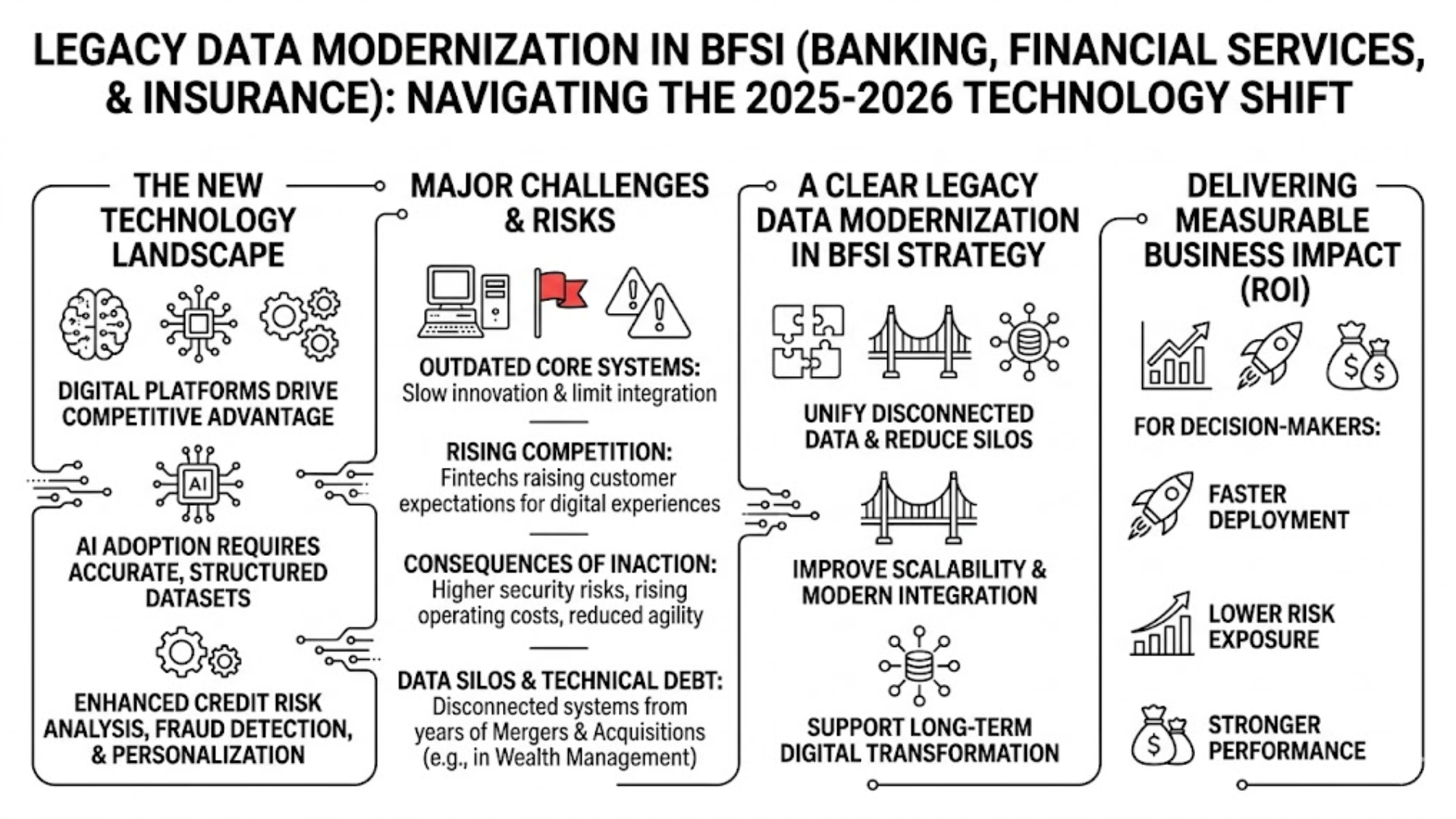
The Banking, Financial Services, and Insurance (BFSI) industry is entering a major technology shift between 2025 and 2026. Digital platforms are no longer just operational tools; they directly shape competitive advantage. As Artificial Intelligence (AI) adoption grows, data becomes the most valuable asset. Strong AI performance depends on accurate, structured datasets to support credit risk analysis, fraud detection, and personalized financial services.
However, many financial institutions still rely on outdated core systems built decades ago. These systems slow innovation and limit integration with modern applications. At the same time, fintech competitors continue raising customer expectations for faster and smoother digital experiences. Without legacy data modernization in BFSI, banks face rising security risks, higher operating costs, and reduced agility in launching new services.
The challenge is even greater in sectors like wealth management, where years of mergers and acquisitions have created disconnected data systems. These silos increase technical debt and reduce operational efficiency. A clear legacy data modernization in BFSI strategy helps unify data, improve scalability, and support long-term digital transformation. For decision-makers evaluating ROI, modernization delivers faster deployment, lower risk exposure, and stronger performance.
Reassessing TCO in Legacy Data Modernization in BFSI
One major reason banks delay transformation is fear of disrupting core systems. Core banking platforms sit at the center of operations, connecting channels, workflows, and customer data. In the past, modernization often meant full replacement, which felt risky and expensive. As a result, many leaders hesitate to move forward with legacy data modernization in BFSI, assuming the cost outweighs the benefits.
However, this hesitation often comes from misunderstanding Total Cost of Ownership (TCO). Many institutions only calculate licensing or maintenance fees, ignoring hidden costs such as integration complexity, security risks, and operational inefficiencies. Research shows that financial organizations frequently underestimate the true cost of legacy environments. When indirect costs are included, maintaining outdated systems becomes significantly more expensive than expected.
A structured legacy data modernization in BFSI strategy helps reduce long-term expenses while improving flexibility. Modern architectures lower maintenance costs, simplify integrations, and support faster innovation cycles. Instead of viewing modernization as a high-risk investment, financial institutions increasingly recognize it as a strategic move to optimize TCO and strengthen competitive advantage.
| Legacy System TCO Allocation Category | Detailed Cost Components | Competitive Capacity Degradation (Invisible Impact) |
|---|---|---|
| Hardware and Infrastructure | Physical server clusters, on-premise data center maintenance costs, massive energy consumption, and fixed asset depreciation. | Lack of auto-scaling capabilities during peak transaction periods, leading to network congestion and system crashes. |
| Maintenance, Operations, and Support | Compensation for increasingly scarce legacy IT experts, premium support fees from vendors for End-of-Life versions. | Consuming the entire technology budget on “keeping the lights on” instead of investing in Research & Development (R&D). |
| Integration Efforts (Middleware) | Developing custom APIs, building temporary connectors so old systems can communicate with new web/mobile apps. | Creating a brittle architecture, prone to chain-reaction failures whenever a new application update occurs. |
| Compliance and Security Costs | Time-consuming manual regulatory report extraction, costs of patching security vulnerabilities on unsupported platforms. | Increasing the risk of fines from regulatory bodies and losing core customer trust due to data breaches. |
| Opportunity Cost | Severe delays in Time-to-Market, limiting the ability to launch AI-driven personalized features. | Losing market share among young, dynamic customers to fintech super-apps and next-generation digital banks. |
From Compliance to Value Creation in Legacy Data Modernization in BFSI
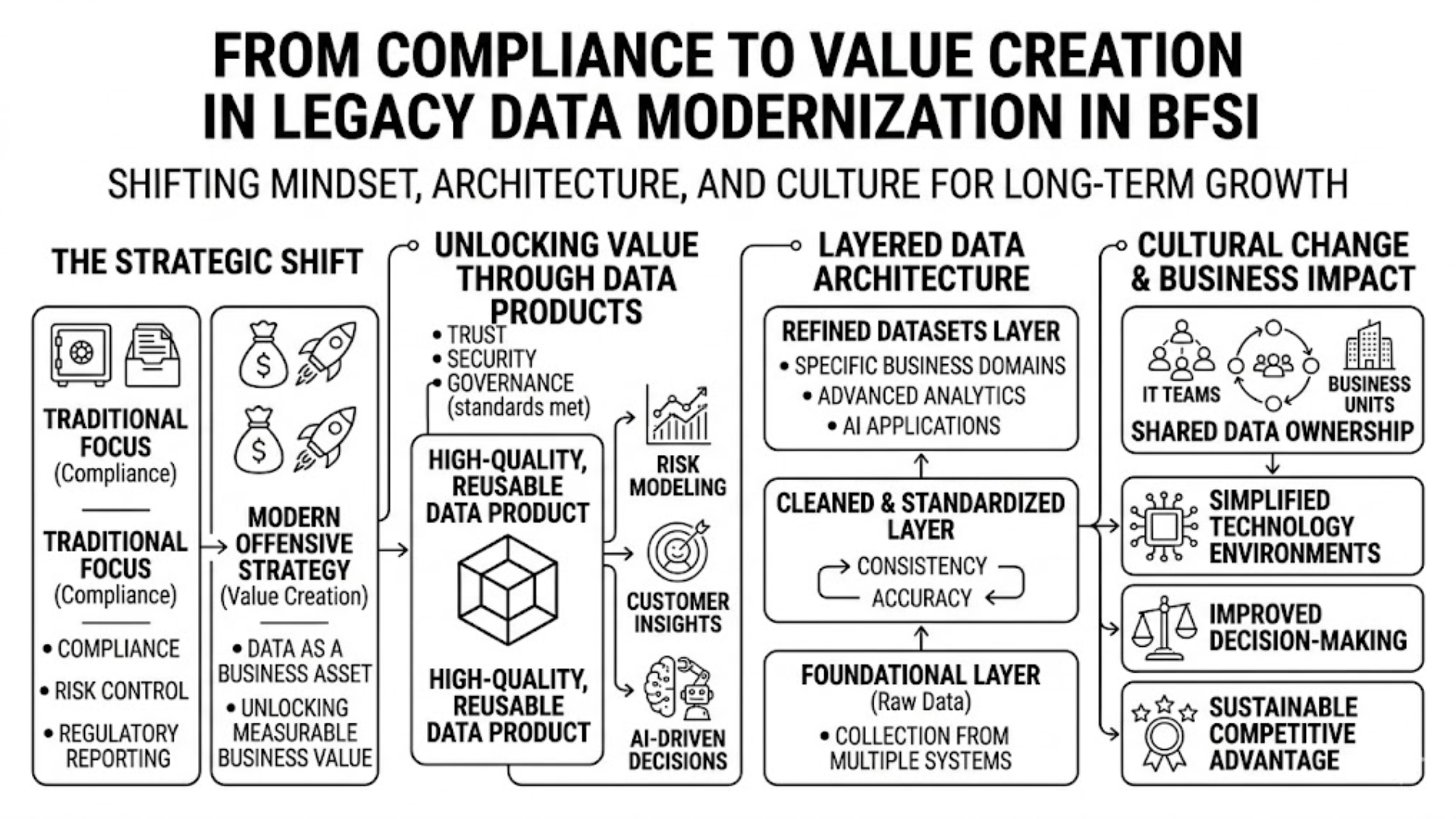
To reduce technical debt and optimize long-term costs, financial institutions must rethink how they view data. Traditionally, data management focused on compliance, risk control, and regulatory reporting. Today, leaders are shifting toward an offensive strategy that treats data as a business asset. In this context, legacy data modernization in BFSI is not only about migrating databases but also about unlocking measurable business value.
Modern organizations increasingly structure information into reusable data products. A data product transforms raw data into a reliable, structured asset that supports multiple use cases such as risk modeling, customer insights, and AI-driven decision-making. High-quality data products must meet key standards across trust, security, and governance. When properly managed, they enable faster innovation and more accurate analytics across departments.
To support this approach, many institutions adopt a layered data architecture. Raw information first enters a foundational layer where data is collected from multiple systems. It is then cleaned and standardized to ensure consistency and accuracy.
Finally, refined datasets are organized around specific business domains, enabling advanced analytics and AI applications. This structured approach to legacy data modernization in BFSI improves scalability, simplifies governance, and accelerates time-to-market.
The transformation also requires cultural change. Data ownership is increasingly shared between IT teams and business units to ensure alignment with strategic goals. With strong governance and collaboration, organizations can simplify technology environments, improve decision-making, and build sustainable competitive advantage through high-quality data assets.
Choosing the Right Roadmap for Legacy Data Modernization in BFSI
Data migration is a complex process driven by multiple goals, including system upgrades, scalability, mergers and acquisitions (M&A), and regulatory compliance. In banking environments, sensitive data such as Know Your Customer (KYC) records requires strict governance and clear accountability. A poorly planned migration can disrupt operations and expose institutions to compliance risks.
For this reason, legacy data modernization in BFSI requires structured planning across architecture, security, and data management tools.
Modern technology leaders increasingly avoid risky “big bang” replacements. Instead, they adopt controlled and incremental migration approaches that reduce operational disruption. Phased strategies allow organizations to test performance, validate data quality, and maintain business continuity throughout the transition. This approach also enables better alignment between IT teams and business stakeholders during transformation programs.
Industry research shows that institutions using phased migration frameworks achieve significantly higher success rates than those attempting full system replacement at once. Gradual migration improves system performance, lowers operational costs, and reduces technical risk. By selecting the right roadmap for legacy data modernization in BFSI, CIOs can optimize resource allocation, protect critical data assets, and ensure stable long-term modernization outcomes.
| Data Migration Strategy | Core Mechanism | Strategic Advantages | Disadvantages & Risks | Best Fit Context in BFSI |
|---|---|---|---|---|
| Phased / Incremental Migration | Data and business modules are migrated independently and sequentially over a long period. | Minimizes severe operational risks; allows for the detection, isolation, and fixing of errors in small blocks without disrupting the larger system. | Prolongs the project timeline; complex to maintain synchronization between the old and new systems running in parallel. | Large-scale, complex core banking systems where maintaining continuous operations without major disruption is mandatory. |
| Parallel / Pilot Migration | Both the legacy system and the new architecture operate simultaneously. Data is routed and validated in real-time across both environments. | Risk level is nearly zero due to the available backup system; provides an ideal environment for comprehensive real-world testing. | Requires massive resources (hardware, personnel, licenses) to maintain two systems; difficult to manage consistency. | Extremely high-risk platforms requiring flawless validation before full rollout (e.g., foreign exchange trading systems). |
| Hybrid Migration | Combines the fast Big Bang approach for non-critical data and the phased approach for core information. | Achieves an optimal balance between deployment speed and risk control for each data level. | Requires meticulous planning to categorize data streams; demands expert-level project coordination capabilities. | Data migration in M&A projects, where blocks of information have vastly different levels of urgency and criticality. |
Explore how SmartDev partners with BFSI teams through a focused AI sprint to validate use cases, align stakeholders, and define a clear path forward before AI development begins.
SmartDev helps BFSI organizations clarify AI use cases and assess feasibility, enabling confident decisions and reducing risks before committing to AI development.
Learn how SmartDev accelerates AI initiatives, ensuring rapid deployment and reduced time to market.
Strengthen Your BFSI Security Testing with UsZero-Downtime Architecture in Legacy Data Modernization in BFSI
In modern banking environments, continuous system availability is mandatory. Platforms such as online banking, fraud detection, payment processing, and customer data systems must operate 24/7. Even short downtime can disrupt transactions, impact compliance obligations, and create significant financial losses. Because of this, Zero-Downtime architecture has become a core requirement in legacy data modernization in BFSI, ensuring upgrades can occur without interrupting critical operations.
Cloud infrastructure enables Zero-Downtime through elastic scalability, High Availability configurations, and real-time replication capabilities. Financial institutions typically rely on three controlled migration methods: offline copy migration for less critical datasets, master–replica switch migration to gradually redirect traffic, and master–master migration for real-time synchronization across environments. These approaches allow banks to maintain operational continuity while improving system performance and resilience.
A common implementation pattern is the Blue-Green Deployment model. The existing production system (Blue) runs simultaneously with the new environment (Green) hosted on cloud platforms such as AWS. Traffic is gradually shifted to the new system, reducing risk during the transition.
If performance issues occur, rollback mechanisms allow immediate restoration to the previous environment. This layered strategy supports secure legacy data modernization in BFSI while protecting customer experience and regulatory compliance.
Automation tools also play a key role in reducing migration complexity. Continuous Integration and Continuous Deployment (CI/CD) pipelines help deploy updates safely, while feature flags allow hidden changes to be tested before full activation. Online schema migration tools enable database structure updates without service interruption.
Together, these technologies help financial institutions move away from rigid monolithic architectures toward more flexible, scalable systems that support long-term innovation.
| Success Metrics | Target Value | Strategic Significance to the Bank |
|---|---|---|
| System Downtime | 0 minutes for customers (Zero customer-facing downtime). | Ensures the continuity of revenue streams and institutional reputation. |
| Data Integrity | 100% data consistency between source and target systems. | Completely eliminates the risk of account information loss and transaction discrepancies. |
| Processing Performance | Response time ≤ legacy system baseline. | Improves or maintains a seamless user experience. |
| Availability Commitment (SLA) | Upgrade from 99.9% to 99.99% uptime. | Meets global enterprise-grade service standards. |
| Cost Reduction | Achieve a 40% infrastructure cost savings target (via Reserved Instances & Auto-scaling). | Frees up cash flow to invest directly in AI product innovation. |
EDA Approach in Legacy Data Modernizatizon in BFSI
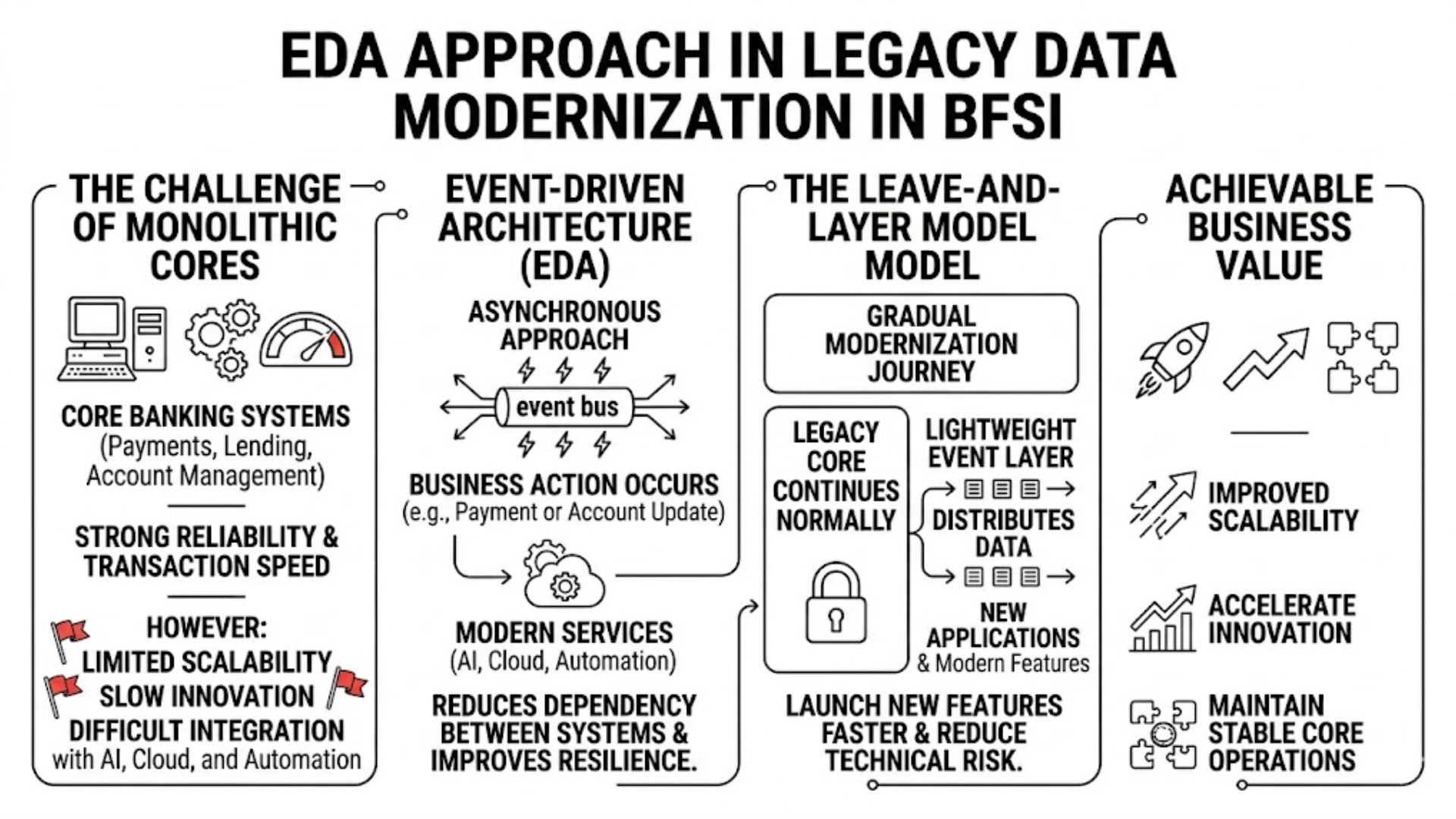
Core banking systems process critical operations such as payments, lending, and account management. Many institutions still rely on mainframe environments because they deliver strong reliability and transaction speed. However, these systems often use monolithic architectures that limit scalability and slow innovation. This creates integration challenges when connecting with AI, cloud, and automation platforms. As a result, legacy data modernization in BFSI focuses on improving system flexibility without disrupting core stability.
Event-Driven Architecture (EDA) enables real-time communication between systems without requiring direct changes to the core platform. When a business action occurs, such as a payment or account update, an event is triggered and shared across connected applications. This asynchronous approach allows modern services to access data without interrupting legacy workflows. It also reduces dependency between systems and improves overall resilience.
The Leave-and-Layer model supports gradual modernization. The legacy system continues operating normally while a lightweight event layer distributes data to new applications. This allows organizations to launch new features faster and reduce technical risk. By applying EDA within legacy data modernization in BFSI, financial institutions can improve scalability, accelerate innovation, and maintain stable core operations.
Strengthening Governance in Legacy Data Modernization in BFSI
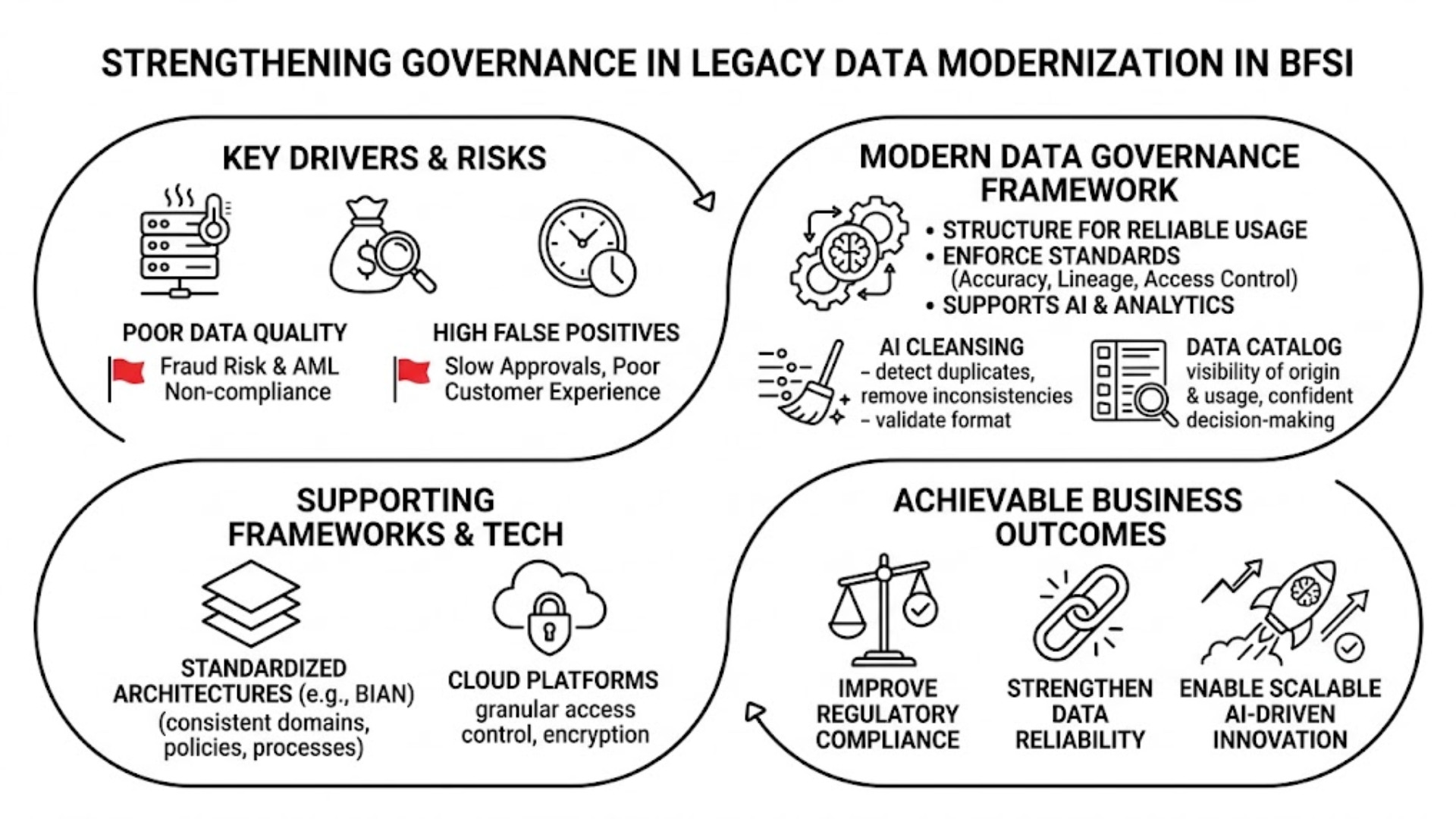
Poor data quality creates serious risks in financial services, especially when organizations must detect fraud and comply with anti-money laundering regulations. High volumes of false positives can slow transaction approvals and negatively affect customer experience. Traditional data warehouses and reporting tools often struggle to handle real-time monitoring and complex regulatory requirements.
For this reason, legacy data modernization in BFSI increasingly focuses on improving data quality, consistency, and transparency across systems.
Modern Data Governance frameworks provide the structure needed to ensure reliable and secure data usage. Governance now supports AI and analytics initiatives by enforcing standards for data accuracy, lineage, and access control. AI-powered data cleansing tools can automatically detect inconsistencies, remove duplicates, and validate information formats. Data Catalog platforms further improve visibility by documenting where data originates and how it is used across the organization, enabling more confident decision-making.
Many financial institutions adopt standardized architecture models such as BIAN (Banking Industry Architecture Network) to guide governance design. These frameworks help define consistent data domains, access policies, and compliance processes. Cloud platforms also support granular access control and encryption to protect sensitive financial information.
By combining strong governance practices with structured frameworks, legacy data modernization in BFSI improves regulatory compliance, strengthens data reliability, and enables scalable AI-driven innovation.
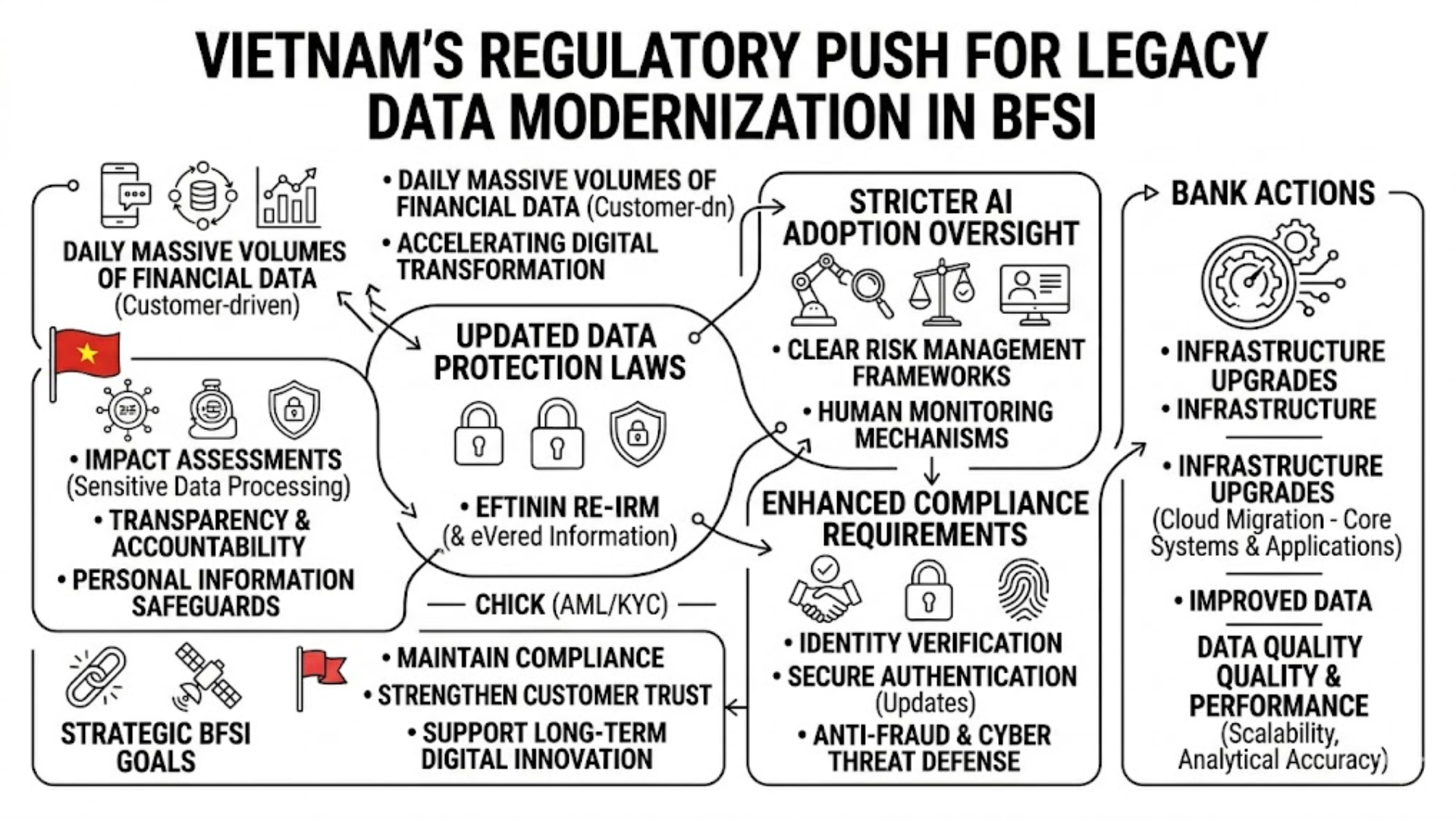
Vietnam’s Regulatory Push for Legacy Data Modernization in BFSI
The Vietnamese banking sector is accelerating digital transformation under strong direction from regulators. Recent industry data shows that most customers now transact through digital channels, creating massive volumes of financial data every day. To handle this scale securely and efficiently, banks are prioritizing legacy data modernization in BFSI to improve data quality, system performance, and analytical accuracy.
Major institutions have already begun upgrading infrastructure by migrating core systems and applications to cloud environments, helping improve scalability during peak transaction periods.
Regulation is a key driver behind this shift. New compliance requirements increasingly demand stronger identity verification, stricter data protection standards, and improved system transparency.
Financial institutions must ensure secure authentication when customers update personal information, while maintaining strong safeguards against fraud and cyber threats. As regulators introduce stricter oversight for AI adoption in financial services, organizations must also demonstrate clear risk management frameworks and human monitoring mechanisms.
Vietnam’s updated data protection laws further reinforce the importance of modern data architecture. Financial institutions must conduct impact assessments when processing or transferring sensitive information, ensuring transparency and accountability. These requirements encourage banks to adopt flexible infrastructure, strong governance frameworks, and secure data management practices.
As a result, legacy data modernization in BFSI is becoming a strategic priority for Vietnamese financial institutions seeking to maintain compliance, strengthen customer trust, and support long-term digital innovation.
SmartDev’s Approach to Legacy Data Modernization in BFSI
Successfully executing legacy data modernization in BFSI requires both strategic planning and deep technical expertise. Financial institutions often face complex challenges involving system architecture, regulatory compliance, and cost optimization. Working with an experienced technology partner helps reduce risk while ensuring modernization initiatives align with long-term business goals.
With strong experience in fintech and enterprise environments, SmartDev supports organizations in transforming legacy platforms into scalable digital ecosystems.
SmartDev focuses on AI-powered software engineering to accelerate modernization across banking and financial services. Their capabilities cover system migration, data transformation, and cloud adoption, enabling organizations to move from rigid legacy environments to flexible and secure architectures.
By preserving data integrity and minimizing operational disruption, SmartDev ensures that modernization projects maintain business continuity. In parallel, user-centered design improvements help enhance digital experience quality, supporting higher engagement and retention across financial platforms.
A key differentiator lies in SmartDev’s structured discovery methodology. Engineering teams conduct detailed technical assessments to identify dependencies, risks, and modernization priorities before implementation begins. This preparation helps define clear architecture roadmaps and ensures efficient resource allocation.
Through real-world BFSI transformation projects, SmartDev demonstrates how legacy data modernization in BFSI can improve system performance, strengthen compliance readiness, and enable scalable innovation aligned with evolving market demands.
| Client / Segment | Core Legacy Challenge | Technology Architecture & Key Solutions | Operational Impact & Business Outcomes |
| Financial Advisory Firm (Singapore) – AI Invoice Processing | Risky reliance on the tacit knowledge of senior staff for KYC checks. Manual processing led to bottlenecks, severe month-end congestion, and susceptibility to fraud. | Deployed an Intelligent Document Processing (IDP) workflow using AI Models (OpenAI, Docling). Applied LLM models for automated extraction, 3-way matching, and flagging with a Human-in-the-Loop mechanism. | Achieved 90% Straight-Through Processing. Increased accuracy to 93%, cut review time by 40%, and increased processing capacity by 60% without adding headcount. |
| Fintech Company (UK) – Intelligence Platform | Needed to consolidate a traditional APEX search system, fragmented documents, and conversational AI into a unified Contours platform while lacking specialized R&D personnel. | A specialized team (13 headcounts) established a.NET/Azure architecture, integrating RAG (Retrieval-Augmented Generation) and Knowledge Graphs to optimize hybrid search and semantic reranking. | Rapid completion in 2 months. Successfully launched an enterprise-grade AI-applied financial research marketplace, ready for venture capital rounds. |
| Fintech Company (Switzerland) – AI Agent Support Transformation | Explosive user growth caused support system collapse. Policy knowledge was dispersed, multi-channel requests were fragmented, and operational costs surged. | Built a 24/7 Multi-Agent Architecture. Integrated React, FastAPI, LangGraph, Kafka, and Qdrant (vector search) for intelligent classification and routing. | Drastically reduced first-response times. Automated the resolution of mass repetitive inquiries, establishing a centralized internal knowledge gateway for organizational employees. |
| International Non-Profit (South Korea) – Asset Modernization | Lacked technology human resources to rebuild the entire internal operational platform serving global capital flows. | Provided talented cross-border development teams, directly participating in the rebuilding of internal systems to drive IT readiness. | Unleashed the organization’s development capacity by over 40%, reshaped the core system, and ensured readiness for future technology initiatives. |
By combining strong architecture expertise with advanced technologies such as AI, Retrieval-Augmented Generation (RAG), and distributed event streaming, SmartDev enables financial institutions to modernize systems without disrupting critical operations. This approach ensures data remains secure, accessible, and ready for advanced analytics, supporting faster innovation across digital banking, payments, and risk management.
Through structured implementation frameworks, SmartDev helps organizations align technical architecture with evolving business priorities.
Rather than acting as a traditional outsourcing vendor, SmartDev operates as a long-term technology partner. Their methodology focuses on building scalable foundations that support compliance, performance optimization, and continuous improvement.
By strengthening governance structures and integrating modern AI capabilities, SmartDev ensures that legacy data modernization in BFSI delivers measurable business value while reducing operational risk.
With a balanced focus on system resilience, regulatory alignment, and customer experience, SmartDev supports financial institutions in turning legacy infrastructure into a strategic advantage. This enables organizations to protect critical data assets, adapt quickly to market changes, and achieve sustainable digital growth in an increasingly competitive financial landscape.
Conclusion
Clean, real-time data is now the foundation of competitive advantage in financial services. Legacy systems with high technical debt increase costs and slow innovation. Implementing legacy data modernization in BFSI helps reduce TCO, improve scalability, and enable faster digital transformation.
Modern architectures such as cloud migration, Zero-Downtime deployment, and Event-Driven Architecture (EDA) allow banks to modernize without disrupting operations. At the same time, stricter regulations on data protection and AI governance require stronger data management standards.
With proven expertise in AI-powered engineering and cloud transformation, SmartDev helps organizations execute legacy data modernization in BFSI securely and efficiently, turning legacy systems into a foundation for long-term growth.