 AI transformation refers to the strategic integration of artificial intelligence across business processes, operating models, and decision-making frameworks to fundamentally improve how organizations create value.
Rather than simply adopting isolated AI tools, AI transformation involves reshaping workflows, skills, technology architecture, and organizational culture to leverage AI at scale. It typically includes embedding AI into customer experience, operations, product development, analytics, and strategic planning.
AI transformation often requires companies to build strong data foundations, modernize infrastructure, and develop new capabilities such as machine learning engineering, AI governance, and automation workflows. It is not only a technology shift but also a business and workforce transformation that changes how teams collaborate, make decisions, and deliver outcomes.
Warum ist das für Unternehmen wichtig?
AI transformation enables organizations to improve productivity, accelerate innovation, and create competitive advantage in increasingly digital markets. Companies that effectively integrate AI can unlock new revenue streams, enhance operational efficiency, and improve decision accuracy through data-driven insights.
Business impact includes:
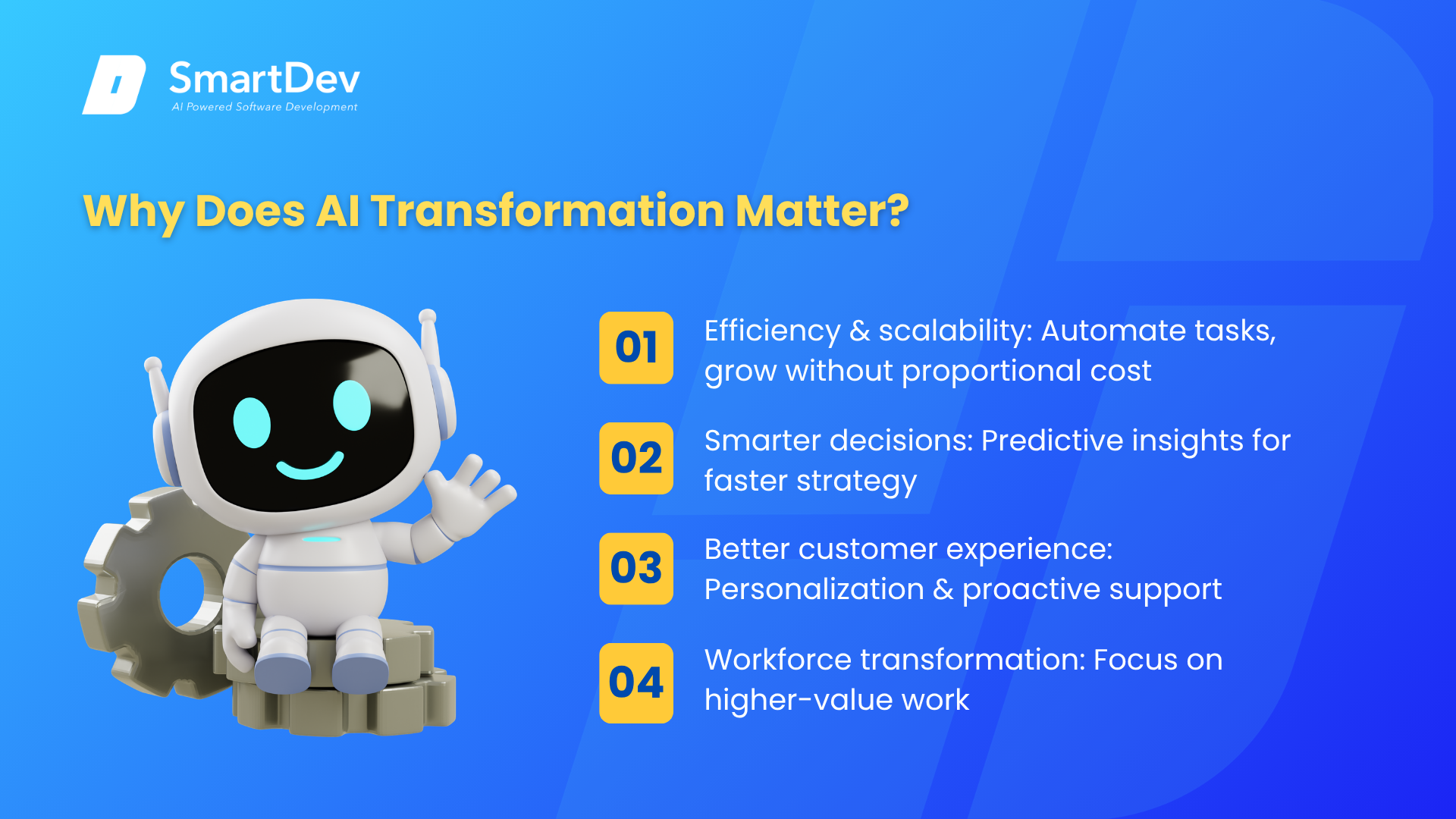
- Operational efficiency: AI automates repetitive tasks, reducing manual workload and improving productivity.
- Improved decision-making: Advanced analytics and predictive models help leaders make faster, more accurate strategic decisions.
- Customer experience innovation: AI enables personalization, intelligent recommendations, and proactive support.
- Scalable growth: AI-powered processes allow organizations to scale operations without proportional increases in cost.
- Workforce transformation: Employees shift from manual execution to higher-value strategic and creative work.
Without a structured AI transformation strategy, organizations risk fragmented AI adoption, low ROI, and limited long-term impact.
How does AI Transformation happen?
AI transformation typically begins with defining a clear AI vision aligned with business goals. Organizations assess current data maturity, technology infrastructure, and talent capabilities to identify gaps that need to be addressed.
Companies then prioritize high-impact AI use cases, such as automation, predictive analytics, or intelligent customer engagement. These initiatives often require modern data pipelines, machine learning models, and integration with existing systems.
Successful transformation also includes building governance frameworks, reskilling employees, and establishing cross-functional collaboration between business and technical teams. Over time, AI becomes embedded into everyday workflows, enabling continuous optimization and innovation.
Who is involved in AI Transformation?
AI transformation requires collaboration across leadership, technical teams, and operational stakeholders. Executives define strategic direction and investment priorities, while data scientists, AI engineers, and software developers design and deploy AI solutions.
Business teams play a critical role in identifying real-world use cases and ensuring AI initiatives align with customer needs and operational goals. HR and learning teams often support workforce reskilling to help employees adapt to AI-enabled workflows.
Successful organizations treat AI transformation as an enterprise-wide initiative rather than a standalone IT project.
Weitere verwandte Begriffe
- AI Strategy: Defines how organizations align AI initiatives with business objectives, investment priorities, and long-term innovation goals.
- AI Readiness: Measures whether an organization has the necessary data infrastructure, talent, governance, and culture to successfully adopt AI technologies.
- KI-Governance: Refers to the policies, processes, and controls used to ensure AI systems operate ethically, securely, and in compliance with regulations.