Kurz zusammengefasst
- A fixed price contract sets a predetermined total cost for a project, with the vendor absorbing any cost overruns beyond the agreed scope.
- It gives clients budget certainty but requires exceptionally clear requirements upfront, as scope changes typically trigger expensive contract amendments.
- Fixed price contracts are best suited for well-defined projects with stable requirements; they are a poor fit for exploratory, complex, or frequently changing engagements.
Fixed price contracts are one of the most common arrangements in IT outsourcing, favored by clients who want cost predictability. But the certainty they provide comes with trade-offs that catch many businesses off guard. This article explains what fixed price contracts are, when to use them, and how they compare to alternative pricing models.
What is a Fixed Price Contract?
A fixed price contract is a type of agreement in which the client and vendor agree on a single total price for a defined scope of work before the project begins. Regardless of how much time or effort the vendor actually expends to complete the work, the total payment to the client remains the same as the amount agreed in the contract.
In IT outsourcing and software development, fixed price contracts define the deliverables, timeline, and total cost in advance. If the vendor underestimates the effort required, the additional cost falls on the vendor. If the client wants to add features or change requirements mid-project, a change order process is triggered, typically adding both cost and time to the engagement.
Fixed price contracts contrast with two other common pricing models:
- Time and materials (T&M): The client pays for actual hours worked at agreed rates, giving flexibility but less cost predictability
- Dedicated team model: The client pays a monthly rate for a dedicated team they direct, combining flexibility with cost transparency
Warum ist das für Unternehmen wichtig?
Budget predictability is the primary reason businesses choose fixed price contracts. Finance teams can book the project cost with confidence, and executives can approve projects without fear of runaway spending. This makes fixed price arrangements particularly attractive for projects with strict budget constraints or for companies procuring software development services for the first time.
- Reduce financial risk for clients: Cost overruns from vendor inefficiency or underestimation become the vendor’s problem, not the client’s, protecting project budgets from unexpected expenditure.
- Improve project governance: Detailed upfront scoping required for fixed price contracts forces both sides to document requirements precisely, which can improve clarity and reduce misaligned expectations.
- Accelerate procurement approval: A defined total cost simplifies the internal approval process compared to open-ended budgets, enabling faster project initiation in organizations with strict procurement governance.
- Protect against vendor inflation: Clients are shielded from mid-project rate increases or unexpected resource additions that can expand costs in time-and-materials arrangements.
For example, a retail company commissioning a customer-facing mobile app with clearly defined screens and features contracted a fixed price engagement with a software development vendor for $280,000. The vendor’s actual cost exceeded this by 15% due to underestimated backend complexity, but the client paid only the agreed amount, delivering the project within budget.
When to Use a Fixed Price Contract?
Fixed price contracts work well when specific conditions are met. Use them when:
- Requirements are fully defined and unlikely to change significantly during development
- The project scope is discrete and deliverable-based rather than open-ended or exploratory
- Your organization prioritizes budget certainty over flexibility
- The vendor has deep experience with the specific type of project being contracted
When NOT to use a fixed price contract:
- Requirements are unclear, evolving, or expected to change as the product is built, which is typical in early-stage product development or digital transformation programs
- The project involves emerging technology where accurate estimation is difficult, as vendors must price in significant risk buffers that inflate the contract price
- You need ongoing, iterative development where the backlog evolves based on user feedback
- A long engagement duration makes the cost of change orders prohibitive compared to the flexibility of a time-and-materials model
How Much Does a Fixed Price Contract Cost?
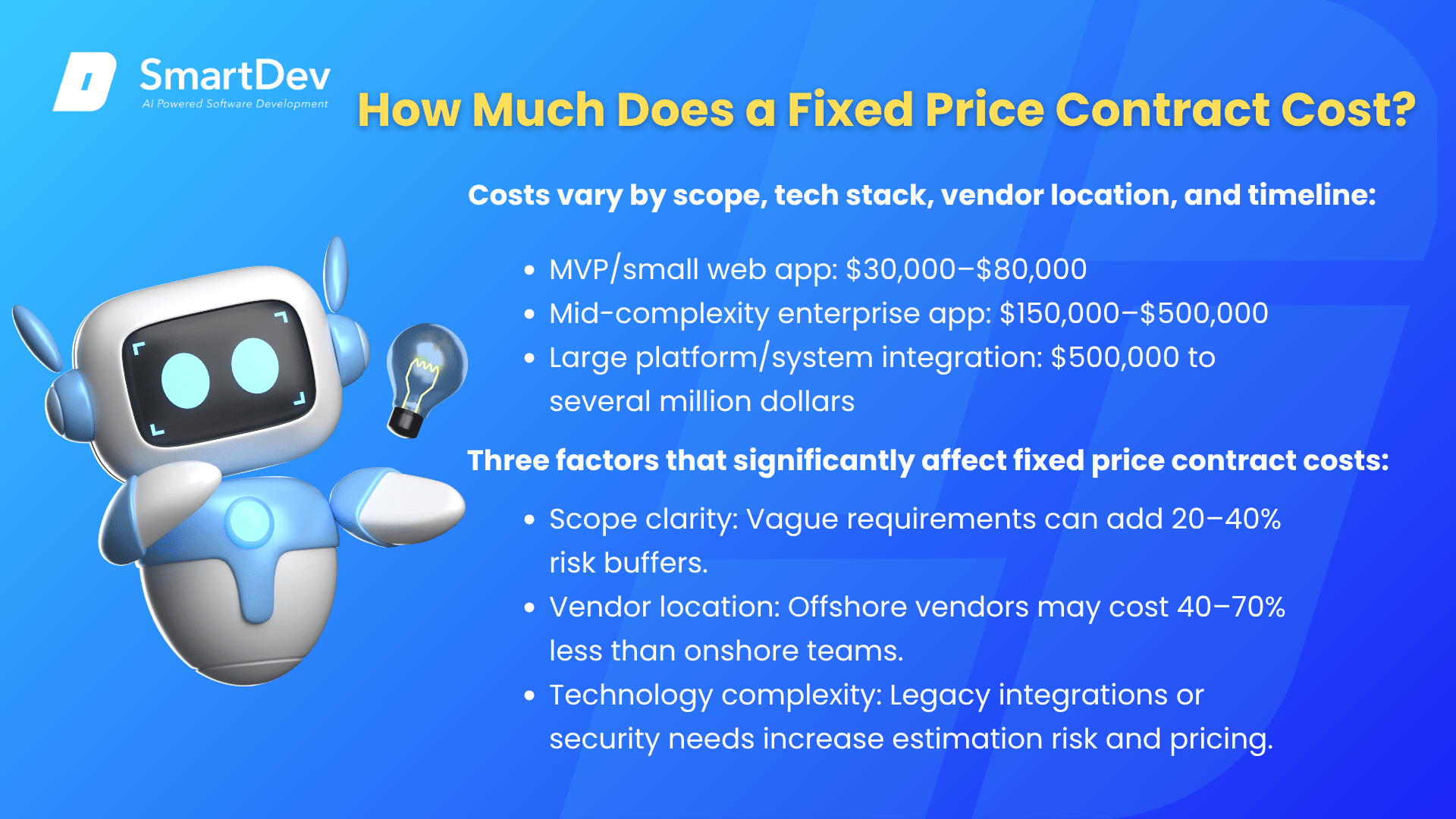
The total cost of a fixed price contract varies enormously based on scope, technology stack, vendor location, and timeline. Indicative ranges for common project types:
- MVP or small web application: $30,000 to $80,000 with a nearshore or offshore vendor
- Mid-complexity enterprise application: $150,000 to $500,000 depending on integration requirements and customization
- Large-scale platform or system integration: $500,000 to several million dollars for complex enterprise systems
Three factors that significantly affect fixed price contract costs:
- Scope clarity: Ambiguous or poorly documented requirements cause vendors to add risk buffers of 20 to 40% to protect themselves from scope creep
- Vendor location: Offshore vendors in Vietnam, Eastern Europe, or Latin America typically price 40 to 70% lower than onshore counterparts for the same scope
- Technology complexity: Projects requiring unusual integrations, legacy system connectivity, or specialized security requirements carry higher fixed prices due to estimation uncertainty
Compared to a dedicated team model, fixed price contracts often cost more in total because vendors price in risk. For well-defined projects, the certainty justifies the premium; for evolving ones, it usually does not.
Weitere verwandte Begriffe
- Technical Architecture: Acts as the foundational blueprint for a company’s software systems, defining how all technical components interact and function.
- Cloud-Migration: The process of transferring digital assets such as applications, databases, and IT resources from local servers or legacy infrastructure to cloud-based platforms.
- Datensicherheit: A set of practices and technologies designed to protect sensitive data from unauthorized access, corruption, or theft.