
Kurz zusammengefasst
- A product backlog is a prioritized list of everything a development team needs to build, fix, or improve in a software product, ordered by business value.
- It serves as the single source of truth for what the team will work on next, replacing ad hoc requests with a structured, visible queue.
- A well-managed backlog keeps development aligned with strategic priorities and prevents teams from building features nobody asked for.
Every software team has more ideas, requests, and bugs than it can handle at any given time. The product backlog is the tool that brings order to that chaos. By listing, prioritizing, and maintaining all potential work in one place, businesses ensure that engineering effort flows toward the features and fixes that matter most, rather than the loudest request or the most recent conversation.
What is a Product Backlog?
A product backlog is a prioritized, dynamic list of all features, user stories, bug fixes, improvements, and technical tasks that a software development team intends to work on, ordered so that the highest-value items are always at the top and ready to be picked up in the next development cycle.
The concept originates from the Scrum agile framework and is managed by the Product Owner, who is responsible for defining, ordering, and continuously refining the backlog based on business priorities, user feedback, and stakeholder input. However, the backlog itself is visible to and understood by the entire team.
Items in the backlog are typically written as user stories, which describe a desired feature from the end user’s perspective, or as tasks and bugs with clear acceptance criteria. As the product evolves, items are added, removed, reordered, and refined in a process called backlog grooming or backlog refinement.
Warum ist das für Unternehmen wichtig?
Without a managed backlog, development teams operate reactively, chasing the latest stakeholder request without visibility into strategic priorities. This leads to wasted effort, missed deadlines, and features that do not move business metrics.
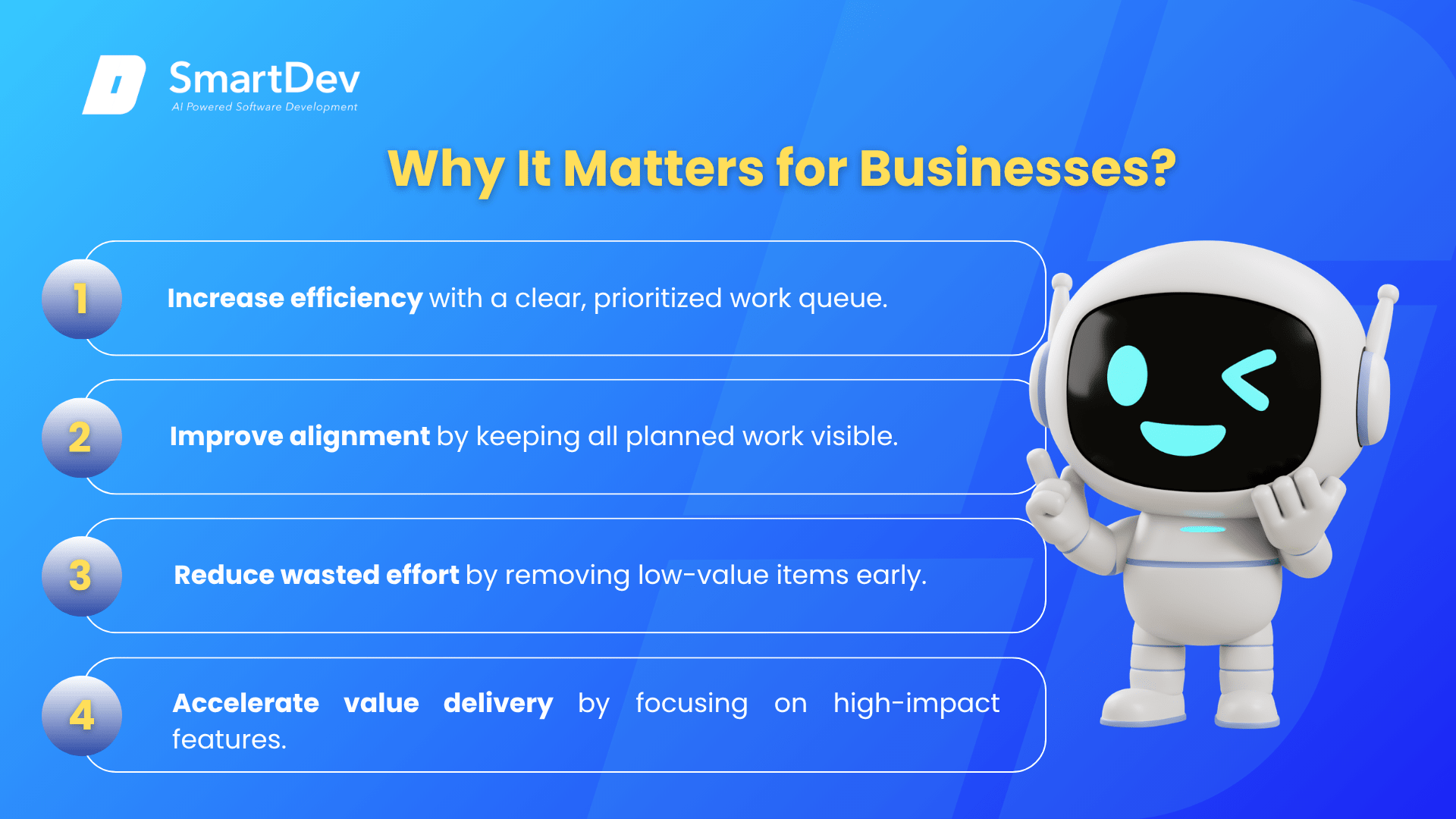
- Increase development efficiency by giving teams a clear, pre-prioritized queue that eliminates time spent debating what to work on next.
- Verbessern stakeholder alignment by making all planned and requested work visible in one place, reducing competing demands and priority conflicts.
- Reduzieren wasted development effort by regularly pruning low-value items before they consume engineering time.
- Beschleunigen delivery of business value by keeping the team’s focus on high-impact features rather than low-priority improvements.
For example, a SaaS company that implemented a formal backlog management process reduced the percentage of engineering time spent on underprioritized features by 40% in two quarters. By having the Product Owner score and rank all incoming requests against a consistent set of business value criteria, the team shipped three major revenue-driving features that had previously been buried under smaller requests.
How Does a Product Backlog Work?
- Capture All Work Items: Every request, from stakeholders, customers, support tickets, and the engineering team, is added to the backlog rather than directly to a sprint or task board. Nothing falls through the cracks.
- Prioritize by Value: The Product Owner ranks items by their expected business impact, effort required, and strategic alignment. High-value, low-effort items rise to the top.
- Refine Regularly: In backlog grooming sessions (typically every sprint), the team reviews upcoming items, adds acceptance criteria, estimates complexity, and removes items that are no longer relevant.
- Pull into Sprints: At the start of each sprint, the team selects the top items from the backlog and commits to delivering them within the sprint timeframe.
The result is a continuous, transparent system where everyone from engineers to executives can see what is being built, why, and in what order, creating accountability and alignment across the organization.
Who Uses a Product Backlog?
Product backlogs are used by any organization that builds or maintains software using agile methodologies. Technology companies use them to manage the ongoing development of their core products. Enterprise IT teams use them to prioritize internal systems development, infrastructure upgrades, and integration projects. Outsourcing clients use shared backlogs with their development partners to maintain transparency and control over what gets built during each delivery cycle.
The roles most directly involved are the Product Owner or Product Manager, who owns and prioritizes the backlog, the development team that estimates and executes backlog items, and business stakeholders who submit requests and review priorities. Senior leadership typically reviews the backlog roadmap in quarterly planning sessions to ensure development aligns with company strategy.
Weitere verwandte Begriffe
Backlog Grooming: The regular process of reviewing, refining, estimating, and reprioritizing items in the product backlog to ensure the team always has a clear and ready queue of work.
Solution Architecture: The process of defining how the components of a specific technology solution (applications, data flows, integrations, infrastructure, and security controls) will work together to meet defined business requirements within constraints of cost, time, performance, and existing technology standards.
Agile Entwicklung: The iterative software development methodology within which the product backlog is the central planning artifact, driving every sprint and release cycle.