

TL, DR:
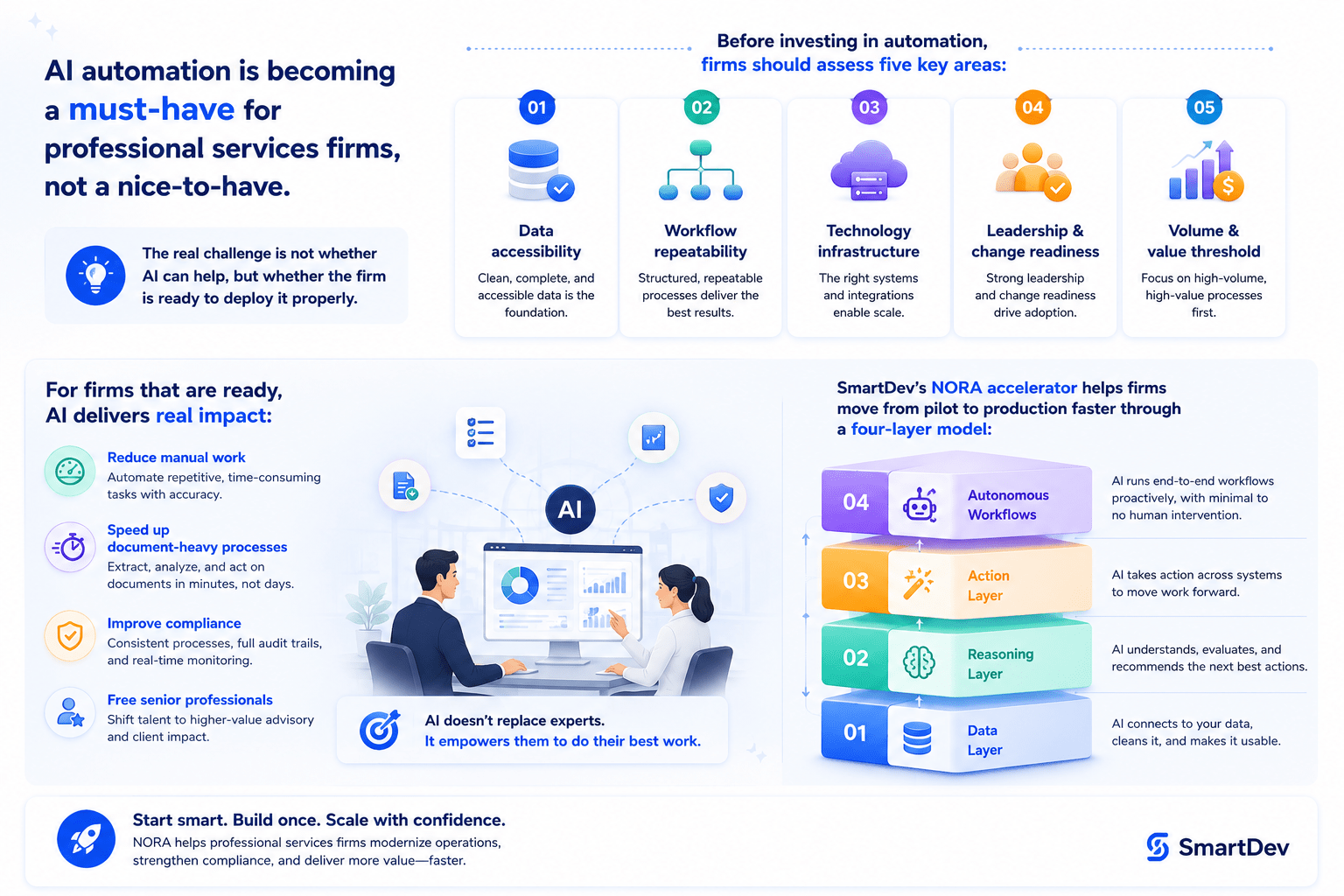
AI automation is becoming a must-have for professional services firms, not a nice-to-have. The real challenge is not whether AI can help, but whether the firm is ready to deploy it properly.
Before investing in automation, firms should assess five key areas:
- Data accessibility
- Workflow repeatability
- Technology infrastructure
- Leadership and change readiness
- Volume and value threshold
For firms that are ready, AI can reduce manual work, speed up document-heavy processes, improve compliance, and free senior professionals to focus on higher-value advisory work. SmartDev’s NORA accelerator helps firms move from pilot to production faster through a four-layer model: data, reasoning, action, and autonomous workflows.
Introduction: The Automation Opportunity in Professional Services
The pressure every firm already feels
Your clients expect a faster turnaround. Your partners want to spend time on advice, not administration. Meanwhile, your team is still manually screening alerts, reformatting reports, and chasing document approvals through email chains. This tension, between the high-value work your firm is built to deliver and the low-value tasks consuming the hours that should deliver it, is not unique to your organization. It is the defining operational challenge across professional services right now.
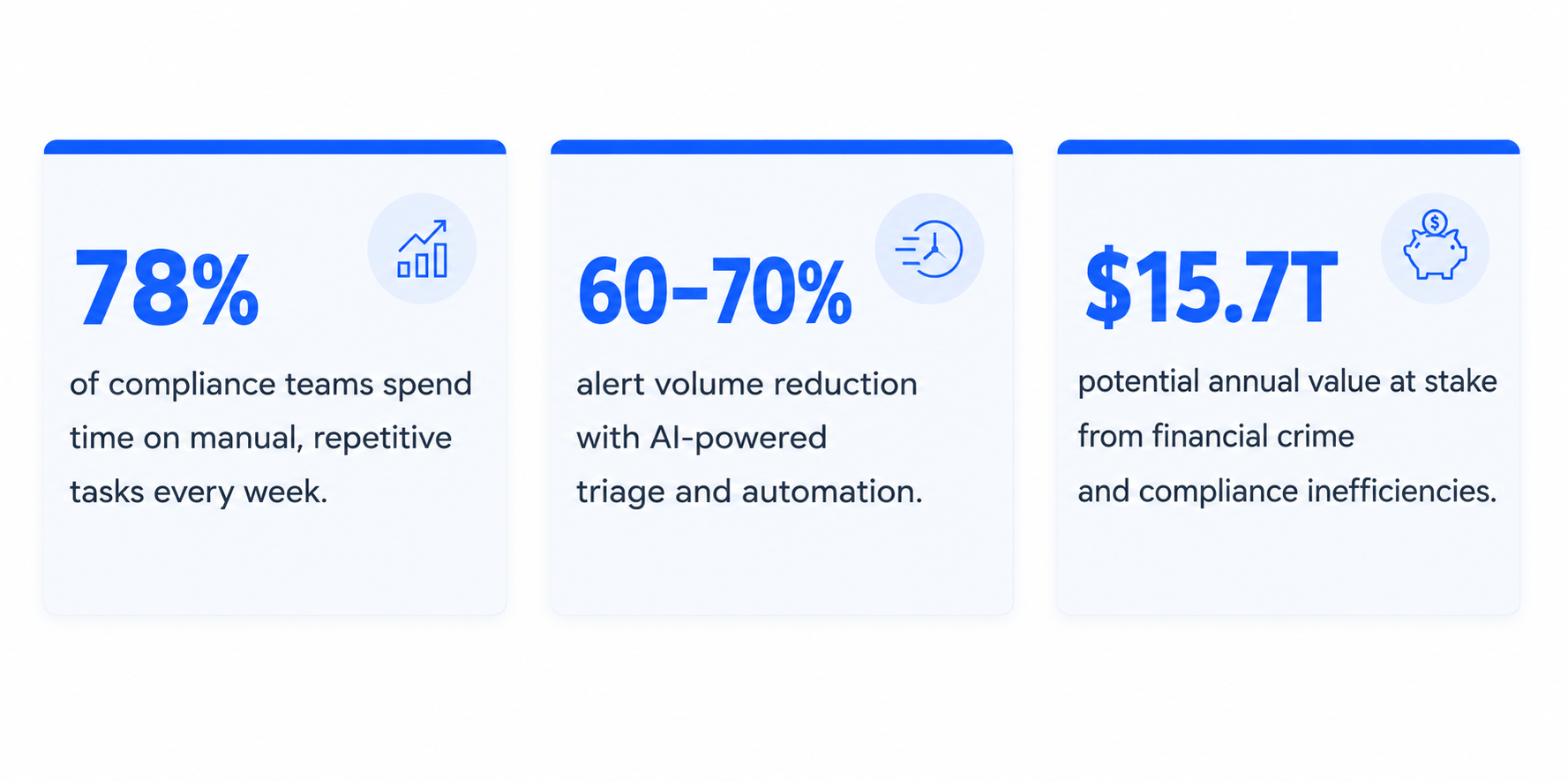
Law firms track thousands of contract deadlines manually. Accounting practices reconcile client data across disconnected spreadsheets each quarter close. Compliance teams at financial institutions review hundreds of false-positive alerts every single morning before any substantive work begins. In each case, the bottleneck is not expertise; it is bandwidth. According to McKinsey Global Institute, generative AI alone could automate tasks that currently account for 60–70% of employee time in knowledge-intensive industries. In a profession where time is the primary product, that number demands action.
Why AI adoption decisions are harder than they look
The market response to this pressure has been a flood of AI tools, platforms, and vendor promises. As a result, many professional services leaders find themselves in a more difficult position than before: too much choice, too little clarity on where to start, and real concern about committing resources to an implementation that fails to stick. Failures are real. Firms have invested in automation that never reached production, pilots that could not scale, and tools that disrupted workflows more than they improved them.
The difference between those outcomes and a successful automation program almost always comes down to readiness, not technology. AI and machine learning solutions are mature enough to deliver in professional services environments today. But they only deliver when the internal conditions, clean data, repeatable processes, and leadership alignment, are genuinely in place before deployment begins.
What this readiness check gives you
This article gives B2B decision-makers professional services a structured, five-dimension readiness assessment they can complete before committing to a program. It is practical, specific, and directly actionable. It also introduces NORA, SmartDev’s AI Adoption Accelerator, and explains how SmartDev’s AI consulting services translate a positive readiness score into a live, value-generating automation, in weeks, not quarters.
What the Data Says: AI in Professional Services Right Now
Adoption has crossed the majority threshold
AI is no longer an early-adopter initiative in professional services. According to McKinsey’s 2025 State of AI global survey, 78% of organizations now use AI in at least one business function, up from 55% in 2023. In professional services, the leading use cases are legal document review, financial risk assessment, and compliance screening. Furthermore, Thomson Reuters’ Future of Professionals Report found that 79% of legal and tax professionals expect AI to significantly impact their work within three years, with 90% of those expecting a net positive effect on productivity.
Regulatory pressure is making automation a compliance imperative
Beyond productivity, automation is increasingly a regulatory expectation. The EU AI Act, now in phased enforcement, sets explicit transparency and documentation obligations for high-risk AI applications in financial services and legal advisory. Meanwhile, the FATF’s guidance on technology-assisted AML compliance explicitly endorses automation as a mechanism for strengthening risk-based screening. In short, regulators are no longer neutral on whether firms use AI for compliance processes; they are beginning to expect it.
In practice, the volume of false positives in compliance screening has become an operational crisis: analysts at many firms spend the majority of their working day triaging alerts that AI can resolve in milliseconds. The cost is not just efficiency; it is the regulatory risk that creeps under sustained alert fatigue.
The competitive cost of waiting
Professional services firms that defer automation do not stand still; they fall behind peers who automate and redeploy senior talent toward advisory growth. The World Economic Forum’s Future of Jobs Report 2025 projects that while automation will displace 85 million roles by 2030, it will simultaneously create 97 million new ones, with the net gain concentrated at firms that invest in AI-augmented talent now. Additionally, Gartner research finds that 58% of the current workforce needs new skills to perform their existing roles effectively, a gap that well-deployed AI tools actively close. Firms that build this capability first attract better professionals and retain them longer.
Why Professional Services Is the Ideal AI Automation Environment
The structural case: high volume, defined rules, low tolerance for error
AI automation performs best in environments with three key characteristics: high task volume, consistent decision logic, and measurable outcomes. Notably, professional services firms operate in this environment. For example, document review, alert triage, invoice reconciliation, contract analysis, onboarding verification, and report generation all fit this profile. As a result, these processes are strong candidates for automation.
According to Accenture AI in Professional Services study, firms that automate document-intensive workflows achieve significant efficiency gains. Specifically, they reduce average task completion times by 30–50%. Consequently, senior professionals can spend more time on client-facing activities that generate revenue. Similarly, SmartDev’s insurance document processing case study demonstrates these benefits in practice. In that case, a manual classification process handling hundreds of documents daily was fully automated. As a result, review cycles decreased from days to hours while maintaining operational consistency.
The compounding benefit in regulated sectors
Firms operating in BFSI, legal, and healthcare advisory environments gain an additional advantage from AI automation. Specifically, automation can reduce costs, improve auditability, and strengthen compliance simultaneously. As a result, organizations benefit across multiple operational dimensions at once. Unlike many process improvements, a well-deployed AI system delivers value in all three areas. Furthermore, these benefits align closely with the priorities of regulators and internal risk teams. To explore this further, learn how SmartDev serves BFSI and fintech firms with AI solutions designed for regulated environments. In addition, discover how AI is redefining the role of compliance teams across financial institutions worldwide.
The 5-Dimension AI Readiness Check
How to use this assessment
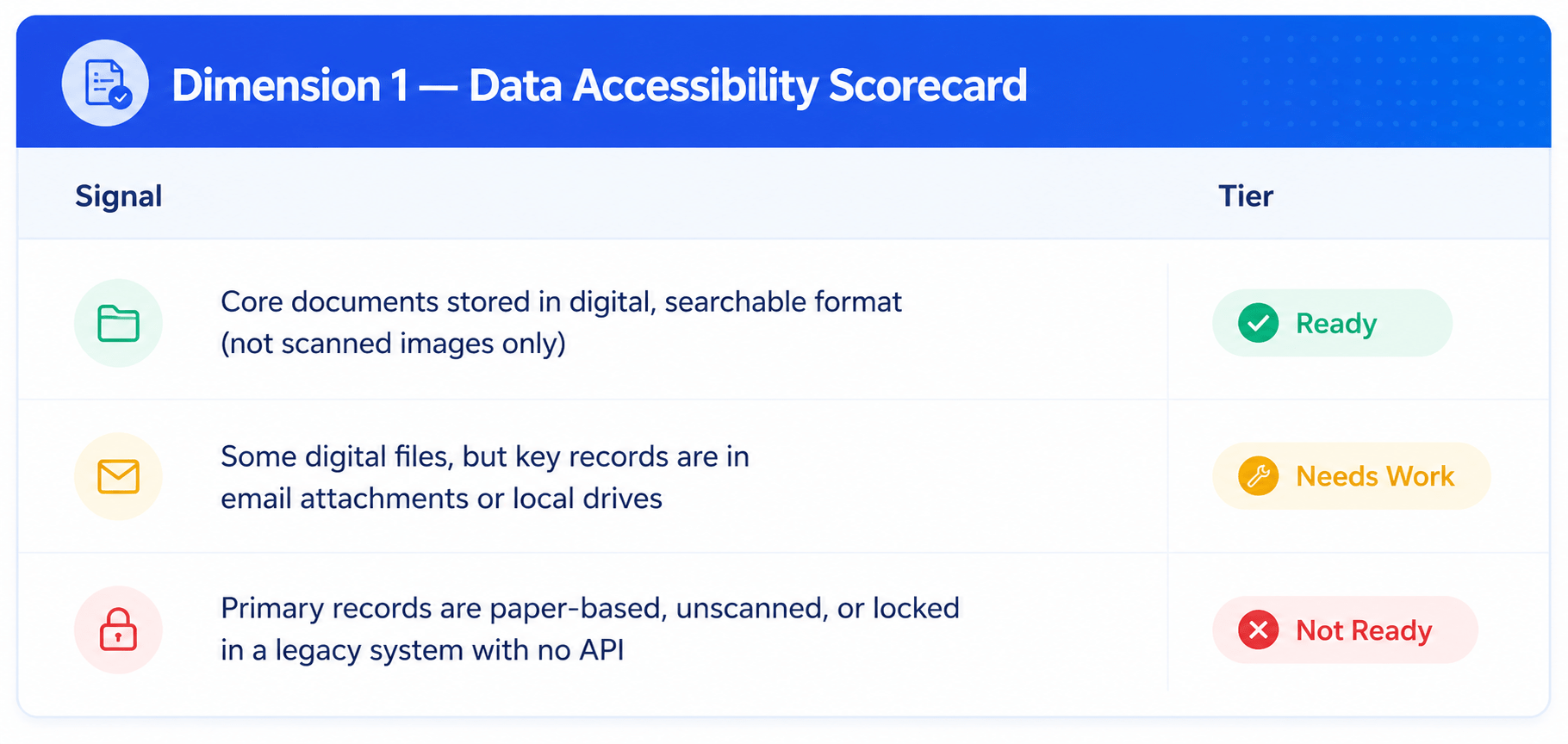
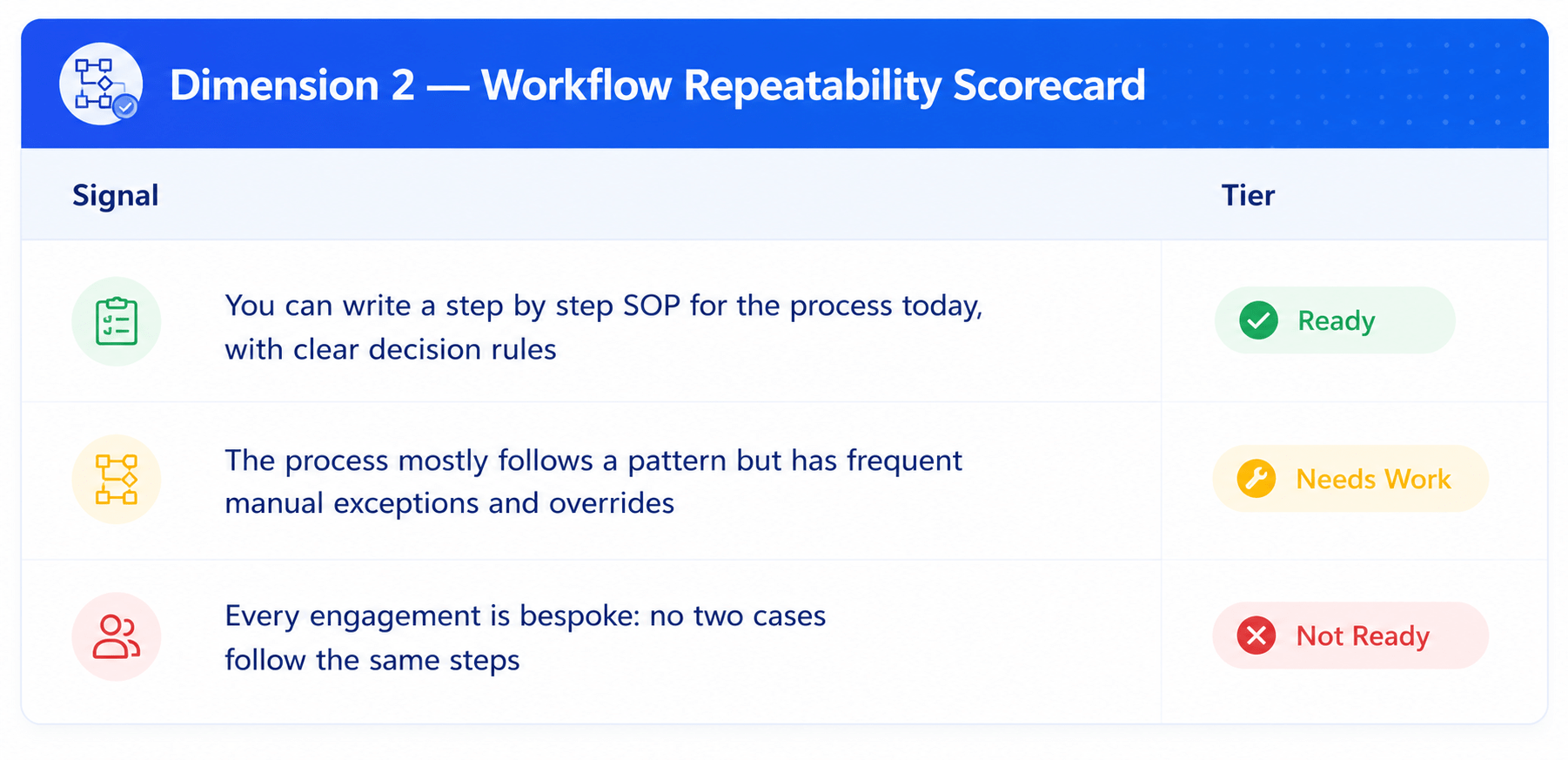
Score your firm on each dimension using three tiers: Ready, Needs, Work, or Not Ready. Most green scores indicate strong readiness for a first automation sprint. Mixed scores point to targeted preparation steps. Predominantly red scores signal a discovery phase is needed before any automation commitment.
Dimension 1: Data Accessibility
AI automation requires data it can actually read. Many professional services firms store critical information inside legacy systems, scanned PDFs, or siloed departmental drives that no integration currently touches. Before automation can begin, that data must be extractable and structurally consistent enough for an AI model to learn from it.
Dimension 2: Workflow Repeatability
Automation thrives on repetition. The clearer and more consistent with your existing workflow steps are, the faster an AI reaches production-level accuracy. Conversely, processes that rely on tacit partner knowledge or that change significantly with every client are poor first-round automation candidates. A useful test: can you write a step-by-step SOP for the process today, with clear decision rules for every branch?
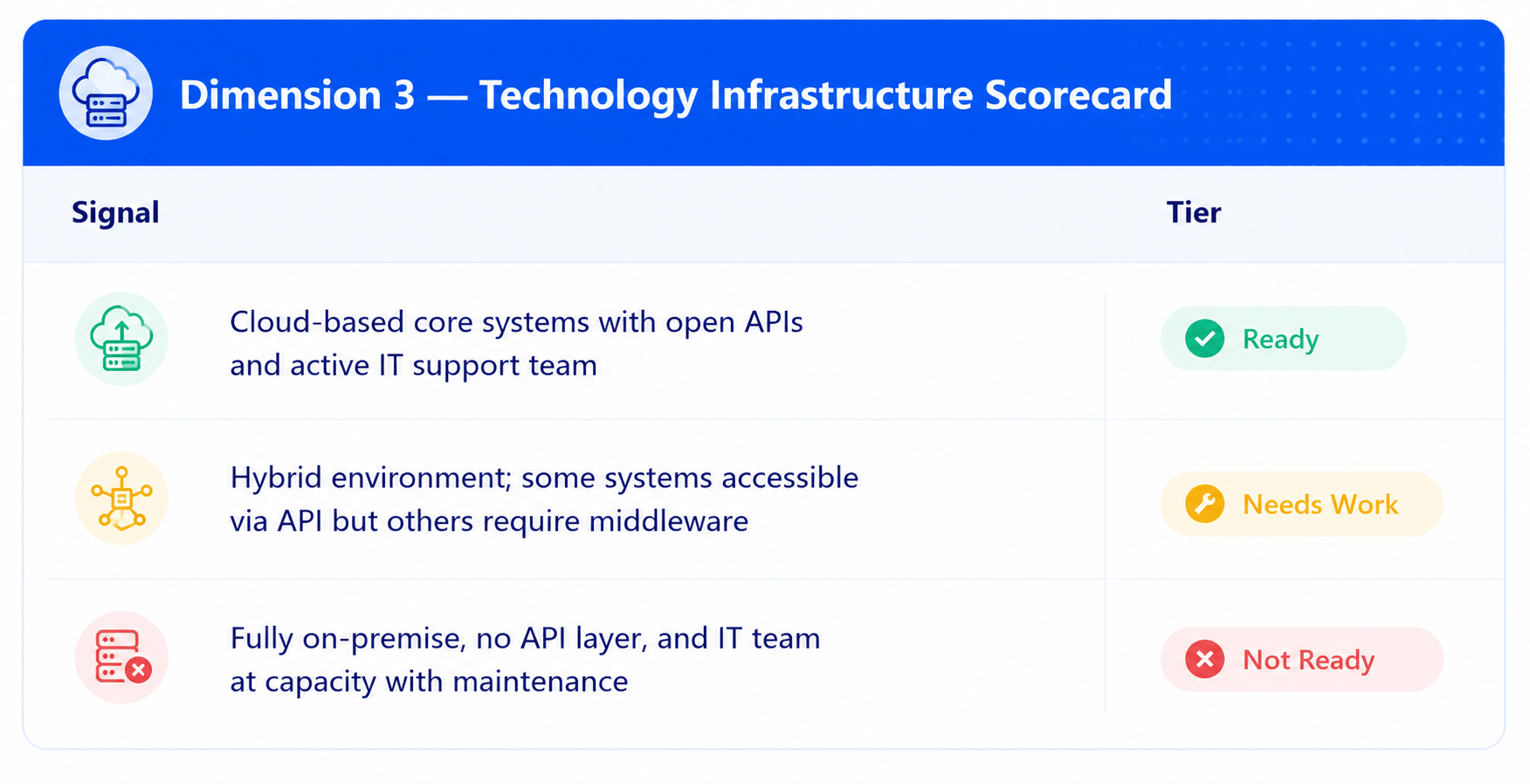
Dimension 3: Technology Infrastructure
AI automation does not replace your existing systems; it connects to them. Therefore, firms with cloud-based practice management, ERP, or CRM platforms are significantly easier to integrate with than firms running on-premises servers with restricted API access. In addition, data security standards (ISO 27001, SOC 2) must already be present or in-progress, because automation expands your data surface area.
SmartDev holds ISO 27001:2022 and SOC 2 Type 2 certifications, ensuring every integration meets enterprise security requirements. Explore our cloud solutions and DevOps-as-a-Service capabilities that underpin secure AI deployment.
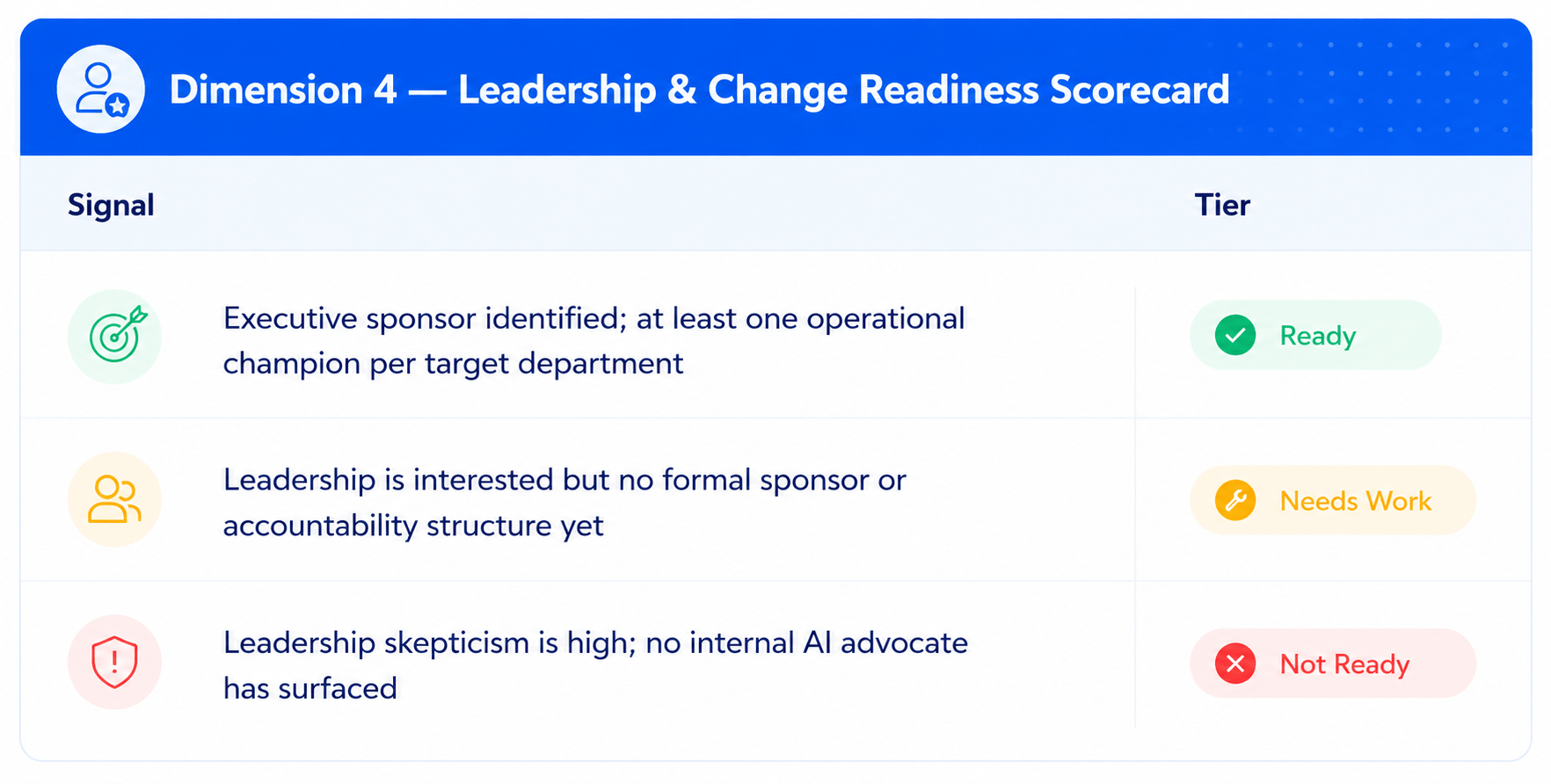
Dimension 4: Leadership and Change Readiness
Technology implementation fails most often due to organizational resistance, not technical deficiency. Accordingly, leadership alignment and a clear internal champion are non-negotiable prerequisites. Partners who view AI as a threat to billable-hour models will slow or block adoption. In contrast, partners who understand that automation frees senior talent for higher-value work become their strongest advocates.
Consider reviewing SmartDev’s AI Adoption & ITO Glossary to align your leadership team on shared terminology before committing to a program.
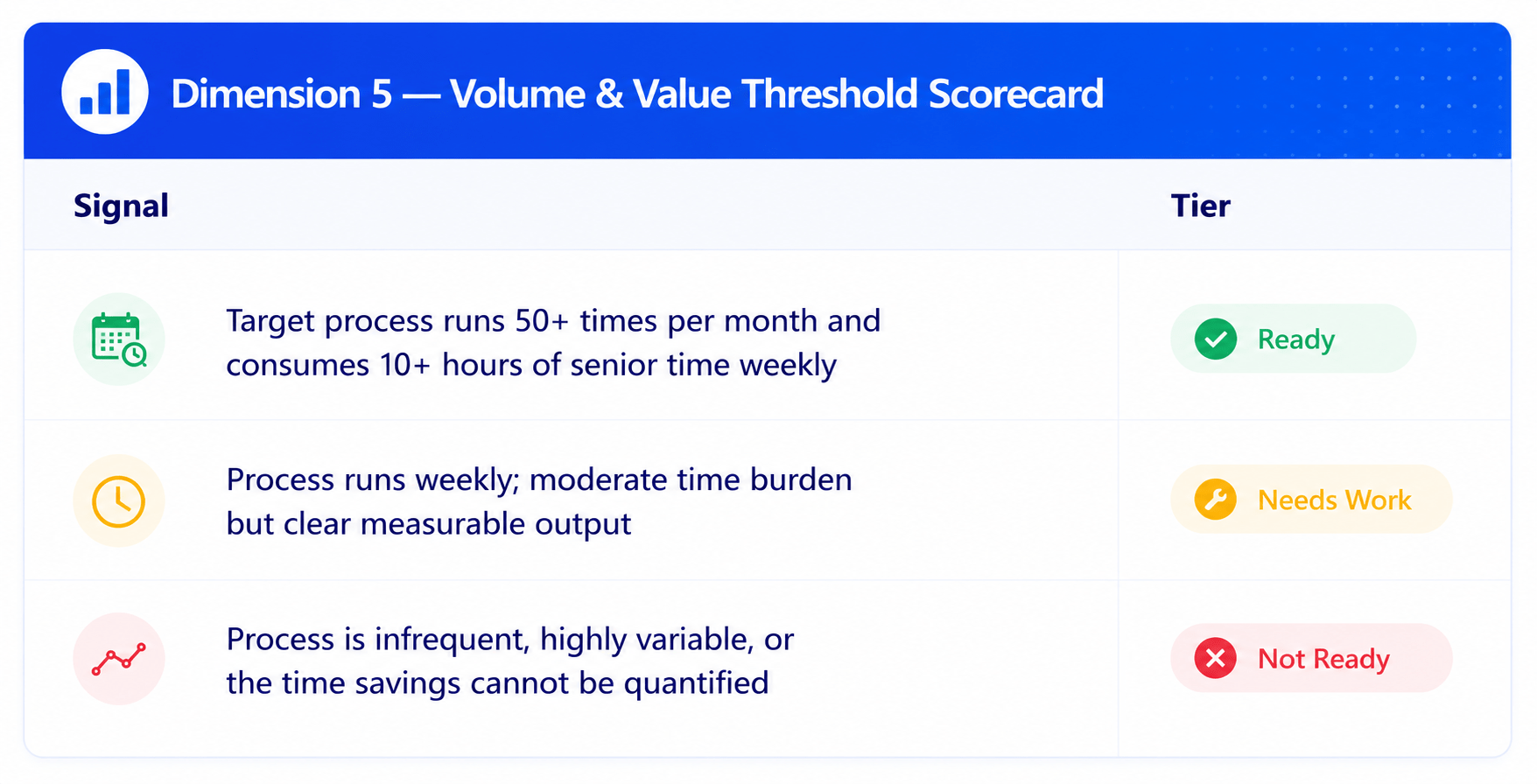
Dimension 5: Volume and Value Threshold
Automation generates ROI through volume. A process that runs 50 times per month justifies AI; five executions per month rarely does. Prioritize workflows that run daily, involve multiple sequential manual steps, and consume disproportionate senior time relative to the complexity of the underlying decision. If you cannot define a measurable before-and-after metric, hours saved, error rate reduced, cycle time shortened, the ROI case will be difficult to defend to a skeptical board or partnership group.
Interpreting Your Score: What to Do Next
Majority green – Launch a sprint now
Your firm has the foundational conditions for a successful first automation. The optimal next step is a structured discovery engagement, typically one to three weeks, that maps your highest-volume workflow in detail and produces a scoped pilot specification. SmartDev’s 3-Week AI Discovery Program is designed precisely for this starting point: it ends with a deployment-ready specification, not a slide deck.
Mixed results – Prepare and pilot simultaneously
Mixed scores do not mean waiting. Instead, address yellow-tier gaps in parallel with a small proof-of-concept on a workflow that scores green across all five dimensions. Running both tracks simultaneously preserves momentum and builds internal confidence before full program commitment. SmartDev’s AI Proof of Concept service validates feasibility with a working prototype before any significant budget is committed.
Majority red – Begin with strategy and infrastructure
A predominantly red score does not mean AI is not suitable for your firm; it means the sequencing matters. Infrastructure and change management work must precede automation investment. Start with AI strategy consulting to build a realistic 12–24-month roadmap and use their AI Delivery Blueprint to sequence every investment in the correct order before committing budget to tooling.
Common Traps Professional Services Firms Must Avoid
Trap 1: Automating an already broken process
AI amplifies volume, including errors. If your intake process produces inconsistent outputs today, automation will produce inconsistent outputs at a significantly higher speed. Therefore, document and standardize the target process first, then automate. Read how AI is redefining compliance teams that invested in process clarity before deployment, and the measurably different outcomes they achieved.
Trap 2: Choosing tooling before defining the problem
Many firms begin with a vendor demo and then work backwards to a use case. Consequently, they purchase capabilities they never fully deploy. The more effective sequence starts with a specific business problem, for example, reducing contract review backlog by 60% within two quarters, and then selecting the minimum viable toolset that solves it. SmartDev’s AI Development Services follow this problem-first approach on every engagement, regardless of firm size.
Trap 3: Underestimating change management costs
Implementation budgets almost always cover technology. The primary failure mode, however, is adoption, not functionality. Professional services firms should build at least 30% of their program budget around training, internal communication, and process redesign. SmartDev’s AI Automation: Document & Data Processing whitepaper provides a practical framework for managing this transition in document-heavy environments without disrupting billable output during the rollout period.
Trap 4: Scaling a pilot that hasn’t proven itself
A pilot that performs in a controlled environment will often surface data quality issues, edge cases, or integration gaps when scaled across the full organization. Rushing to enterprise rollout before validating ROI metrics simultaneously burns goodwill and budget, and hands skeptical partners the evidence they need to kill the program. Use the AI Development Sprint Audit framework to verify performance benchmarks and stakeholder confidence before any expansion is approved.
Meet NORA: The Faster Path from Pilot to Production
Most professional services firms understand the destination, a set of AI-automated workflows that free their best people for their highest-value work. The challenge is the distance between that destination and where they stand today: untouched legacy data, no integration layer, and a leadership team that has seen one too many failed pilots. NORA is SmartDev’s answer to that gap.
NORA – SmartDev’s AI Adoption Accelerator, is a structured, four-layer platform of pre-built, reusable AI components combined with a proven delivery methodology. Instead of building AI infrastructure from scratch on every engagement, NORA gives professional services firms a fast, low-disruption path from raw enterprise data to autonomous, audited action. The platform is designed specifically for firms that need measurable results within weeks, not the multi-year timelines that traditional AI build projects typically require.
How NORA is structured: the four layers
NORA works as a progressive capability stack. Each layer builds on the one below it, which means firms start at the level their readiness score supports, and expand upward as confidence and capability grow. There is no rework required when moving from one layer to the next. For a full technical walkthrough of this architecture, see SmartDev’s AI & Machine Learning solutions page.
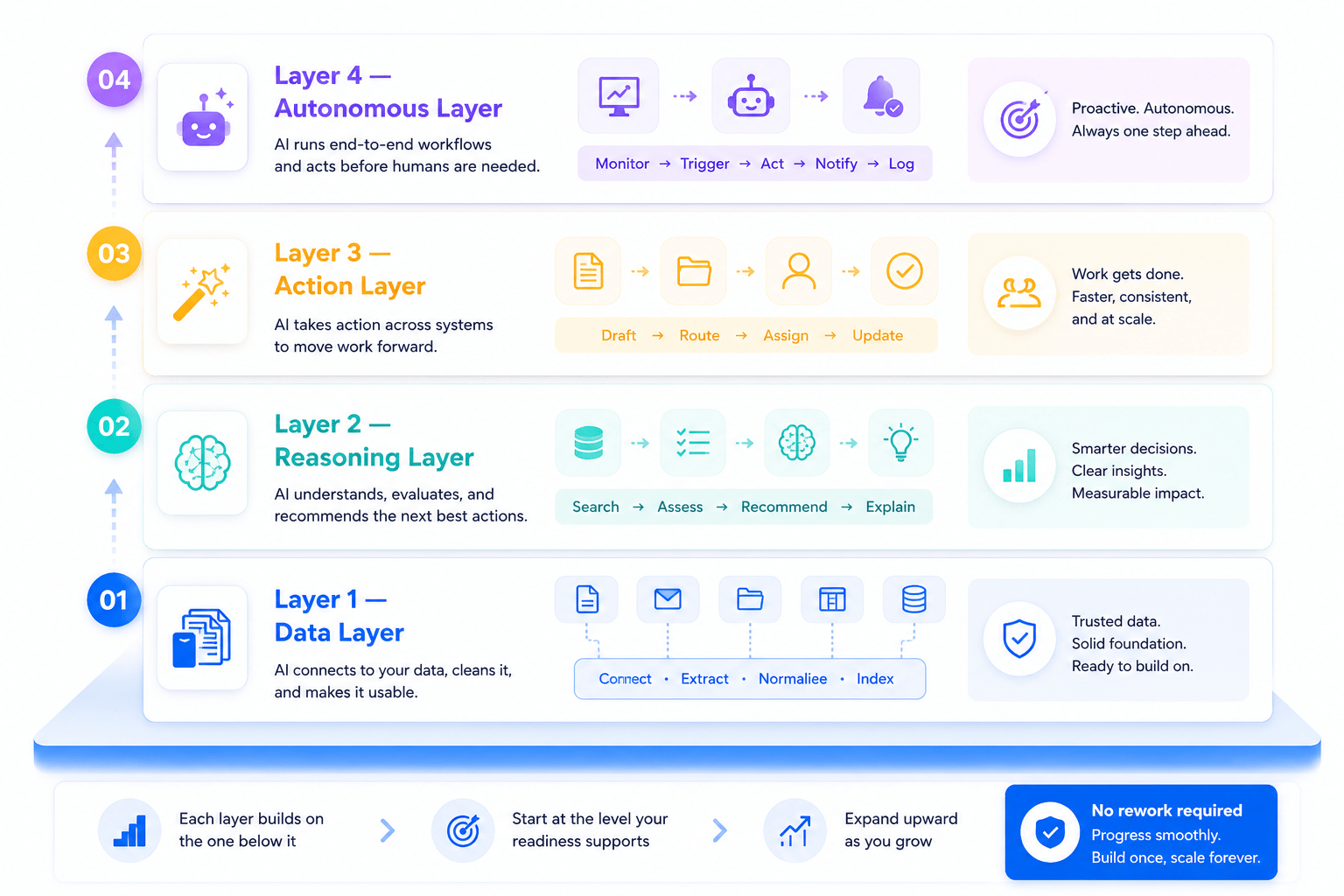
Layer 1 – Data Layer
Extracts, screens, normalizes, and indexes raw enterprise data from invoices, contracts, emails, and compliance alerts, always the starting point for any NORA deployment. Without clean, accessible data, no subsequent layer can function reliably. NORA’s Data Layer handles both structured and semi-structured inputs and connects to existing cloud document management systems via API, without requiring full data migration. It also integrates with DevOps pipelines for firms already running CI/CD workflows. For a deeper look at how AI handles document extraction at scale, see SmartDev’s AI Automation: Document & Data Processing whitepaper.
Layer 2 – Reasoning Layer
Searches your firm’s knowledge base, assesses risk against defined rule sets, and recommends next actions with explainable logic, transforming raw indexed data into contextual insight a professional can act on immediately. Most firms see their fastest and clearest ROI in this layer. This is where machine learning models learn your firm’s specific risk vocabulary and decision patterns. For compliance-heavy environments, this layer directly addresses the false-positive crisis explored in SmartDev’s analysis of why compliance teams are drowning in false positives. External research from McKinsey’s State of AI confirms that reasoning-layer automation delivers the highest measurable productivity gains in knowledge-work environments.
Layer 3 – Action Layer
Take direct action across your connected systems: drafting client communications, routing documents, creating case records, assigning tasks, and updating workflow status, all without requiring human initiation. Layer 3 is where time savings become most visible to end users. It is also where adoption resistance tends to peak, which is why NORA’s change management methodology is built directly into the 10-Week AI Product Factory delivery model. SmartDev’s case study on transitioning from manual support to intelligent automation shows exactly how this layer changes day-to-day operations for client-facing teams. The Gartner workforce skills research also supports building structured upskilling programs alongside Layer 3 deployment.
Layer 4 – Autonomous Layer
Monitors conditions across your connected systems and triggers entire workflows proactively, without any human prompt. A compliance threshold breach, for example, automatically initiates a staged review request, notifies the responsible partner, and opens a timestamped audit record, all before anyone has logged in that morning. This is where NORA shifts a firm from AI-assisted to AI-driven operations, fully aligned with the EU AI Act’s transparency and auditability requirements for high-risk automated systems. Read how AI is redefining compliance teams that have reached this autonomous operating model and explore SmartDev’s Generative AI Development Services for the next-generation capabilities that extend Layer 4 into client communication and advisory content.
What NORA delivers for professional services firms specifically
NORA is purpose-built for professional services, not a generic AI platform retrofitted to the sector. It handles high document volume, meets regulatory audit requirements, and deploys without disrupting billable output. For sector context, see SmartDev’s BFSI and fintech industry page and the AI Adoption & ITO Glossary.
Speed to deployment
Pre-built components mean SmartDev teams skip foundational rebuilds on every engagement. A typical Layer 1–2 pilot deploys in four to eight weeks, versus four to six months for a custom build. The 3-Week AI Discovery Program produces a deployment-ready specification before any build begins. Full delivery timelines are documented in the AI Delivery Blueprint.
Compliance and governance, built in
NORA logs every AI action in an immutable, timestamped audit trail. All deployments are GDPR-aligned and certified to ISO 27001:2022, consistent with EU AI Act transparency obligations and FATF AML guidance. SmartDev’s DevOps-as-a-Service team manages the secure CI/CD pipeline that keeps each deployment continuously compliant.
Minimal IT lift to get started
A Layer 1–2 pilot needs only API access to your core system. There is no infrastructure build, no data migration, and no dedicated IT project team required. SmartDev’s cloud solutions team handles environment setup and integration. Use the IT Outsourcing Due Diligence Checklist to evaluate vendor readiness before your first conversation.
Scale without rebuilding
Each NORA layer connects architecturally to the next. A Layer 1 pilot carries forward into Layers 2, 3, and 4 without rework. The 10-Week AI Product Factory takes a validated pilot to live production in a single sprint. The AI Development Sprint Audit framework governs layer readiness before any expansion is approved.
Typical NORA use cases in professional services
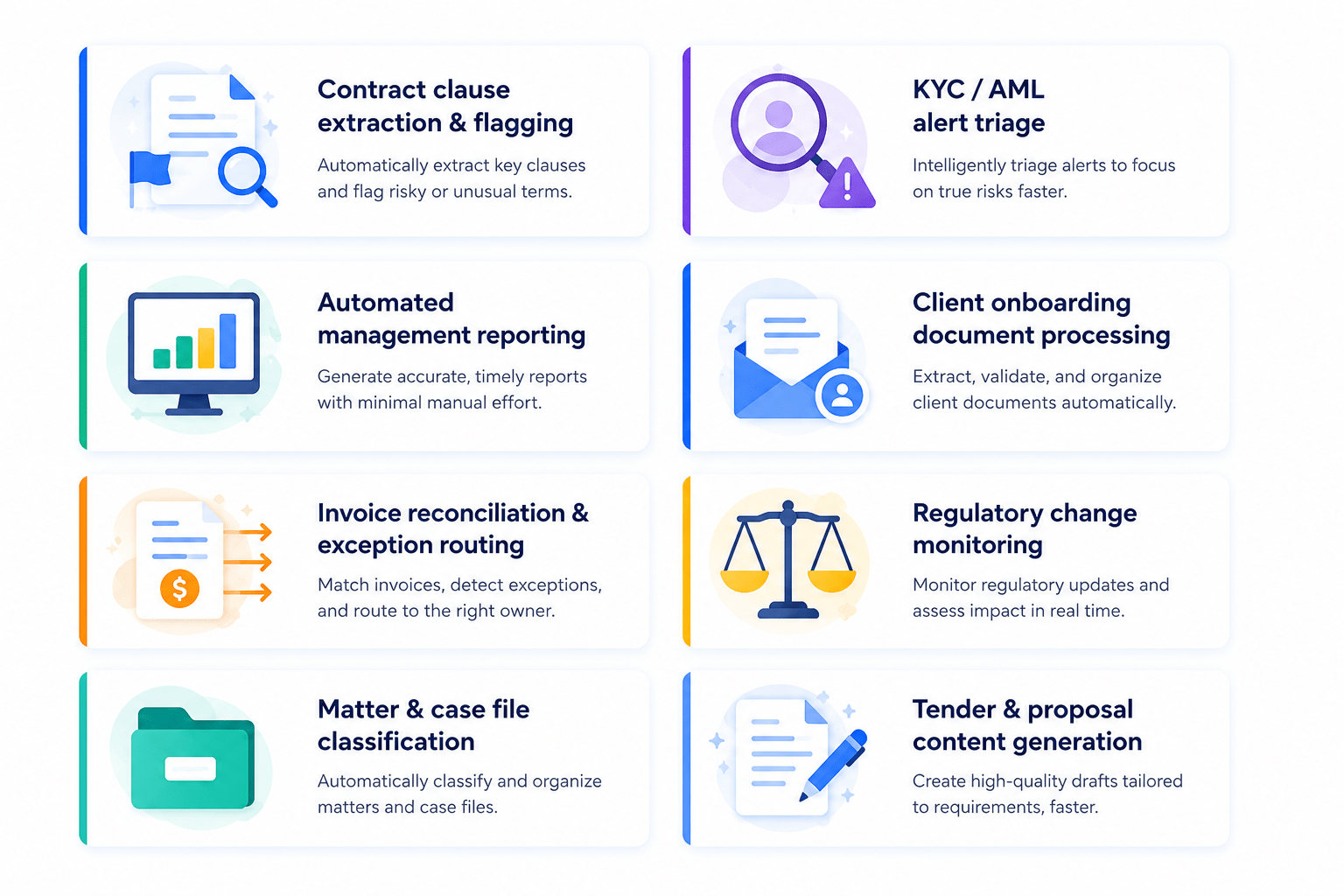
The following workflow types are the most common entry points for NORA deployments across law firms, accounting practices, and financial compliance teams:
Learn more about NORA
For a deeper technical walkthrough of NORA’s architecture and deployment methodology, read SmartDev’s full explainer: What is an AI Adoption Accelerator?, including how NORA compares to building AI capability from scratch, and how the four-layer structure maps to different organizational readiness levels.
How SmartDev Helps You Act on Your Readiness Score
Structured engagement models, not open-ended retainers
SmartDev’s professional services engagements follow defined, time-boxed sequences with clear deliverables at every stage. The 3-Week AI Discovery Program maps your highest-value workflow and produces a deployment-ready pilot specification, not a strategy deck. The 10-Week AI Product Factory takes that specification to a live, production-grade automation with validated KPIs. Together, these two programs take a firm from readiness assessment to measurable production automation in under 13 weeks.
Proven outcomes across regulated industries
SmartDev’s case studies demonstrate the same pattern across different professional services contexts: a well-scoped first automation, measured ROI, and then phased expansion using NORA’s layer architecture. Relevant examples include accelerating insurance document processing accuracy, transitioning fintech support from manual to intelligent automation, and improving tender interpretation and proposal accuracy for complex multi-stakeholder workflows.
Extended capabilities when your program scales
As automation programs mature beyond their initial workflow, SmartDev’s broader capability suite provides the next tier of value. This includes Data Analytics Services for performance insight and reporting, Generative AI Development for client communication and document drafting at scale, and ongoing AI consulting to maintain strategic alignment as your automation portfolio grows. Download the AI-Powered Delivery Toolkit or the IT Outsourcing Due Diligence Checklist to prepare your internal evaluation framework before the first conversation.
Conclusion: Readiness Is a Decision, not a Discovery
The question has shifted from “whether” to “when and where”
AI automation is no longer an emerging capability for professional services firms. It is an operational necessity for those competing on efficiency, compliance speed, and the quality of talent deployment. The difference between transformation and wasted investment comes down to one thing: whether the internal conditions are genuinely present before the program begins.
Use the five-dimension readiness check in this article as your first filter. Then engage SmartDev’s team to stress-test your self-assessment, identify your highest-value first workflow, and use NORA’s accelerator architecture to compress the path from pilot to production. The firms that move from assessment to action in 2026 will have a measurable operational advantage by 2027, one that compounds as each new automation layer builds on the last.
Readiness is not a state you are waiting to discover. It is a condition you actively build. The tools, the methodology, and the track record already exist. The decision is yours. Contact us for a no-commitment readiness conversation or explore SmartDev’s full AI & Machine Learning suite to understand the full range of what is deployable in your environment today.