

TL, DR:
- AI bias is a systematic, repeatable pattern of unfair outcomes – not a one-off model error, and not proof of intentional discrimination.
- Fairness has no single universal definition; teams must choose a fairness objective that fits the specific decision, affected group, and legal context.
- Bias can enter at every stage: problem framing, data collection, labeling, model design, deployment, and post-launch feedback loops.
- Fairness metrics such as demographic parity, equal opportunity, equalized odds, and disparate impact often conflict with one another, so metric choice requires a documented rationale.
- Regulatory requirements increasingly apply risk-based obligations in some jurisdictions, the EU AI Act classifies systems by risk tier, while voluntary frameworks like the NIST AI Risk Management Framework remain important elsewhere.
- Mitigation works best as a lifecycle discipline – prevent, detect, respond, and monitor – combining technical controls with human oversight and clear ownership.
- Treat fairness as risk management and product quality, not only as a compliance checkbox, and document every assumption so an audit trail exists when questions arise.
Introduction
AI systems can scale good decisions across thousands of customers in seconds. They can also scale unfair ones just as fast. When data, design choices, or deployment conditions embed bias, an algorithm does not make one bad call, it repeats that call at the speed and volume of the business it runs.
This risk sits alongside the opportunity. Lenders use AI to score credit applications, hospitals use it to triage patients, and employers use it to screen resumes. Each use case carries real stakes for the people on the receiving end, and real legal, financial, and reputational exposure for the organization behind the system.
Bias can enter an AI system before a single line of code is written, and it can keep entering after the system goes live. Fairness is not a fixed property either, it depends on the decision, the affected group, and the context in which the system operates. Responsible AI therefore requires ongoing governance, not a one-time test before launch.
This guide connects the concepts businesses need: clear definitions, where bias originates, how organizations measure fairness, what regulators expect, and how to mitigate risk across the AI lifecycle. It closes with a practical seven-step assessment framework that teams can apply to a live or planned AI system.
1. What Are AI Bias and AI Fairness?
Business and policy leaders need working definitions before they can manage risk or build trustworthy systems. This section defines both terms plainly, distinguishes them from each other, and explains why fairness resists a single universal standard.
What is AI bias?
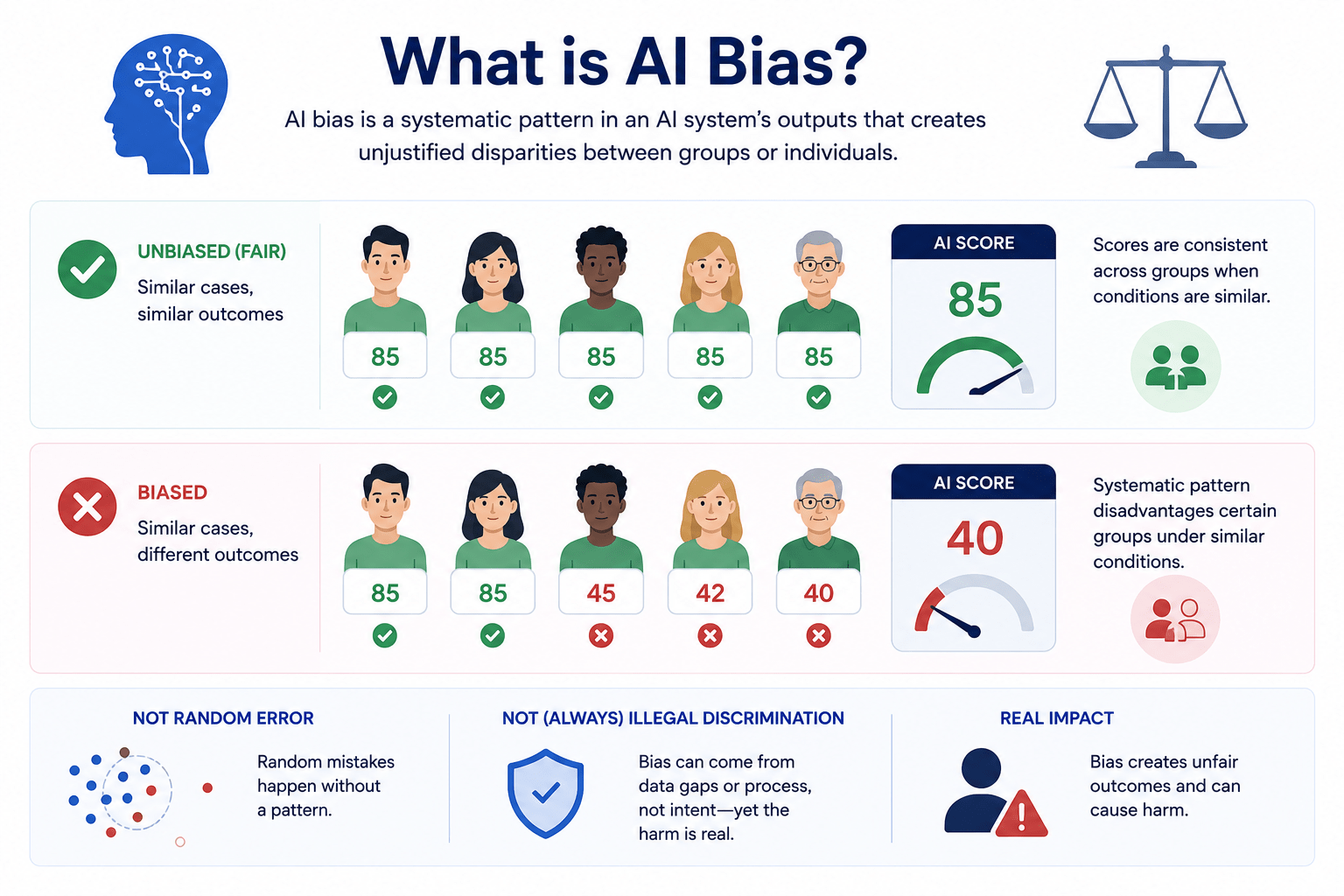
AI bias is a systematic pattern in an AI system’s outputs that creates unjustified disparities between groups or individuals. The pattern is systematic because it repeats consistently across similar cases, not because it appears once in a single prediction. Bias differs from a random error: a model that occasionally misclassifies a data point at random is inaccurate, but a model that consistently scores one demographic group lower under comparable conditions is biased.
Bias also differs from illegal discrimination, even though the two can overlap. A biased outcome may result from a genuine data gap rather than intent, but the harm to affected people can be identical either way. That is why organizations should treat bias as a risk to manage continuously, rather than an accusation to defend against once.
What does fairness in AI mean?
AI fairness is an agreed standard for evaluating whether outcomes or treatment are equitable in a specific decision context. Fairness is not a single number a model either passes or fails; it is a choice among competing, mathematically defined properties, such as equal approval rates or equal error rates across groups. Two fairness definitions can both be reasonable and still produce different decisions for the same applicant.
Bias versus fairness at a glance
| Dimension | AI Bias | AI Fairness |
| What it is | A systematic, measurable disparity in outcomes or treatment | A chosen standard for judging whether outcomes are equitable |
| Where it comes from | Data, model design, or deployment conditions | Ethical, legal, and business judgment about the decision context |
| How it is identified | Statistical testing and outcome analysis | Selecting and applying a fairness metric or framework |
| Can it be eliminated entirely? | Reduced significantly, rarely to zero | Never absolute – fairness definitions can conflict with each other |
Why bias and fairness are difficult to define universally
Fairness definitions can be mutually exclusive. A lender that enforces equal approval rates across groups (demographic parity) may sacrifice equal accuracy across those same groups (equalized odds), because the two properties rest on different assumptions about the underlying population. This is not just a design trade-off, computer scientists Jon Kleinberg, Sendhil Mullainathan, and Manish Raghavan, in a widely cited 2016 paper, proved mathematically that calibration and error-rate balance across groups cannot both hold except in narrow special cases. This is why Section 4 of this guide treats metric selection as a judgment call tied to context, not a default setting.
Why AI bias matters for people, businesses, and public trust
Unfair AI outcomes affect real people first: a qualified applicant loses a loan, a job, or a healthcare referral because a system favored a different group under similar conditions. These effects compound over time, since automated systems apply the same pattern to every case they touch, unlike a single biased human reviewer whose influence is limited to the cases they personally handle.
Businesses face parallel exposure. Biased systems can trigger regulatory investigations, litigation, and customer attrition, and they can quietly erode the accuracy the business relies on, since a system optimized around flawed data usually underperforms on the population it was meant to serve. Public trust in AI is also fragile and collective: one widely reported failure shapes how audiences judge every other AI system, including systems that work well.
The ethical, legal, and business consequences of unfair AI
Ethically, unfair AI can reinforce disadvantages that already exist in society, particularly when training data reflects decades of unequal access to credit, healthcare, or employment. Legally, unfair automated decisions can trigger obligations under data-protection law, for example, Article 22 of the EU’s GDPR gives individuals rights around decisions based solely on automated processing that significantly affects them, as well as sector-specific anti-discrimination statutes. Commercially, the cost of remediation after deployment (retraining models, notifying regulators, rebuilding trust) is almost always higher than the cost of testing for fairness before launch.
SmartDev’s business-oriented guide to responsible AI and its ethical AI development guide expand on how these consequences play out across different governance maturity levels.
Key takeaway: Bias is a measurable, systematic disparity; fairness is the chosen standard used to judge it. Because fairness definitions can mathematically conflict, the useful question is never “is this system biased?” but “which fairness objective fits this decision, and who decided that?”
2. How Bias Enters AI Systems
Bias is not limited to datasets. It can arise from objectives, labels, features, modeling choices, decision thresholds, operating conditions, and feedback loops. This section maps the main entry points across the AI lifecycle.
Data bias: collection, representation, labeling, and sampling
Data bias begins with what gets collected and what gets left out. A dataset can under-represent a demographic group, over-sample certain regions, or rely on labels that reflect a labeler’s subjective judgment rather than an objective ground truth. Sampling bias occurs when the data collection process systematically favors certain cases, for instance, a fraud-detection dataset built only from flagged transactions will miss the patterns of fraud that was never caught.
Historical and societal bias in training data
Even a technically well-sampled dataset can encode historical inequities. If a company’s past hiring decisions favored one group, a model trained on those decisions will learn to replicate that preference, even without ever using a protected attribute directly. The model treats the historical pattern as the target to predict, not as a problem to correct.
Human and organizational bias in AI development
Development teams make hundreds of judgment calls, which features to include, how to define the prediction target, which edge cases to test, and each choice reflects the team’s own assumptions. A team that lacks domain diversity or affected-community input is more likely to miss blind spots, simply because no one in the room experienced the failure mode firsthand.
Model and algorithmic bias
Even balanced data can produce unfair outcomes once it passes through a model. An algorithm optimizing purely for overall accuracy can still learn to sacrifice accuracy for a minority group if that trade-off improves the aggregate score. Proxy variables compound this risk: a feature such as zip code or school name can correlate strongly with a protected attribute like race or national origin, letting bias back in even when the protected attribute itself is excluded.
Bias introduced during deployment, feedback loops, and decision use
A model that tested fair in the lab can still drift once deployed. Operating conditions change, user populations shift, and downstream decisions built on the model’s output can create feedback loops, a hiring model that screens out a group produces fewer successful hires from that group, and the next training cycle “learns” the group is a weaker fit.
Deployment bias also includes how staff use a model’s recommendation: a tool built for advisory use only can become a de facto decision-maker if reviewers rubber-stamp its output.
A practical lifecycle map: where to look for bias
The diagram below maps the AI lifecycle from intended use through continuous monitoring, highlighting where different forms of bias can emerge and where organizations have opportunities to detect and mitigate them.
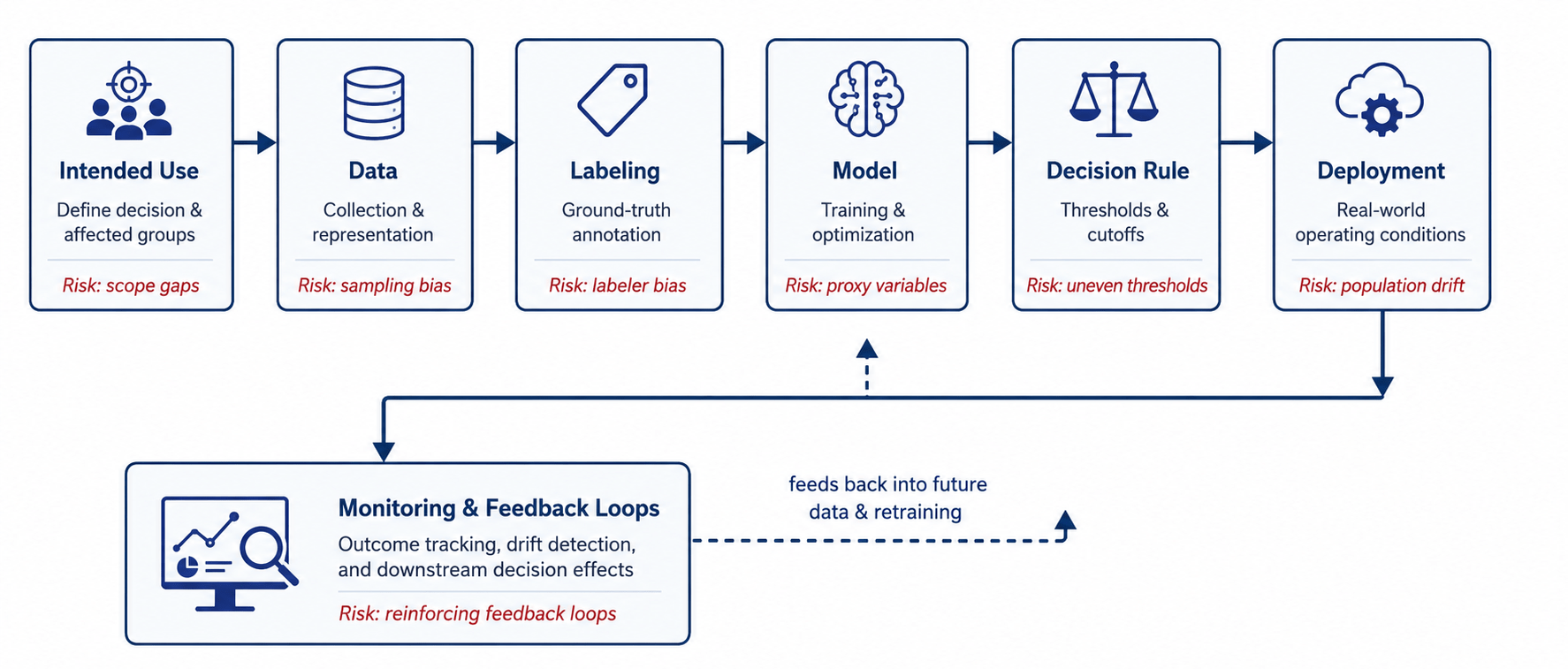
- Intended Use – Define the AI system’s purpose, decision context, and affected groups. Poor problem framing or overlooked stakeholders can introduce bias from the outset.
- Data – Collect and prepare representative training data. Underrepresented groups or scenarios can lead to sampling bias and reduced model performance.
- Labeling – Create ground-truth annotations for model training. Inconsistent guidelines or subjective judgments can introduce labeler bias.
- Model – Train and optimize the model using the selected algorithms. Proxy variables or optimization choices may unintentionally reinforce existing biases.
- Decision Rules – Set thresholds, confidence scores, or business rules that determine model outputs. Inappropriate thresholds can create unfair outcomes even when the model performs well.
- Deployment – Deploy the model in real-world environments. Changes in users or data over time can reduce accuracy and fairness through population drift.
- Monitoring & Feedback Loops – Monitor outcomes, detect model drift, and assess downstream impacts. Without ongoing oversight, biased predictions can feed into future retraining and reinforce unfair outcomes.
The feedback loop from monitoring to retraining shows that AI fairness is a continuous process. Ongoing monitoring helps prevent production biases from carrying into future model versions.
For a deeper look at the technical controls available throughout this lifecycle, explore SmartDev’s AI Development Life Cycle guide and AI model training guide.
3. Understanding the Real-World Impact of AI Bias
The severity of harm from AI bias depends on the decision context, the affected population, how reversible the outcome is, the scale of deployment, and whether a human reviews the result. This section treats documented cases as evidence of failure patterns, not as anecdotes.
Who can be harmed and how unfair outcomes occur
People are harmed when a system denies them an opportunity or resource they would have received under fair treatment — a loan, a job interview, a medical referral, or a favorable bail recommendation. Harm severity rises sharply when a decision is high-stakes, hard to appeal, applied at scale, and made with little or no human review.
 AI bias in hiring and workforce decisions
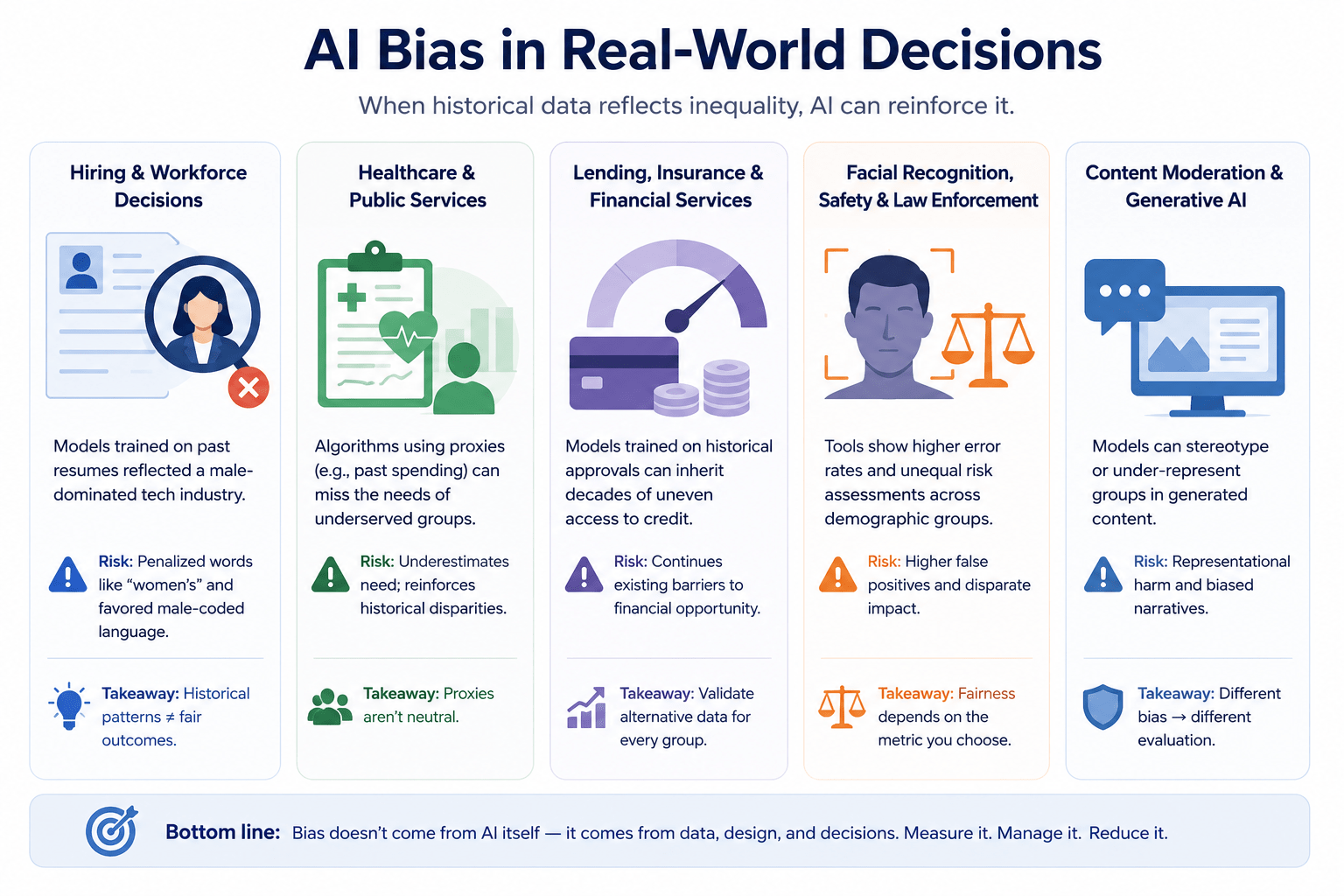
The clearest documented case remains Amazon’s internal recruiting-engine experiment. According to Reuters’ 2018 investigation, Amazon’s experimental hiring tool used machine learning trained on ten years of submitted resumes, most of which came from men because the tech industry itself skews male. The system consequently penalized resumes containing the word “women’s” and favored resumes that used male-coded verbs common on men’s engineering resumes.
Amazon engineers reportedly edited the program to stop it from weighting those specific terms, but the company ultimately could not guarantee the model was neutral in other, less visible ways and scrapped the project. The lesson for any hiring-AI deployment: historical hiring data reflects historical hiring patterns, and a model trained on it will optimize toward those same patterns unless a team actively intervenes.
AI bias in healthcare and public services
Healthcare algorithms often rely on proxy variables such as past healthcare spending to estimate patient need. Because access to care itself varies by income and demographic group, spending-based proxies can systematically underestimate the needs of historically underserved patients, even when the algorithm never uses race or income directly.
Public-service deployments carry a similar risk: predictive tools trained on historical enforcement data can disproportionately flag communities that were already over-policed or over-monitored, independent of any current risk difference. For more on this pattern, see SmartDev’s overview of AI use cases in the public sector.
AI bias in lending, insurance, and financial services
Credit-scoring models trained on historical approval data can inherit decades of uneven access to credit. A model that uses alternative data such as rent payment history or utility bills can improve fairness for applicants with thin credit files, but only if that data is validated for predictive accuracy across groups rather than assumed to be neutral by default.
AI bias in facial recognition, safety, and law enforcement contexts
Facial recognition and criminal-risk-assessment tools carry some of the most closely studied disparities in the AI fairness literature. ProPublica’s 2016 “Machine Bias” investigation analyzed the COMPAS recidivism risk tool used in Broward County, Florida, comparing risk scores against actual two-year reoffending outcomes for over 7,000 individuals. The analysis found the tool misclassified 45% of Black defendants who did not reoffend as high-risk, compared with 23% of white defendants who did not reoffend.
Northpointe, the tool’s developer, disputed the framing, arguing the model was equally accurate for both groups when measured by a different fairness criterion – a disagreement that illustrates directly why Section 4 treats metric selection as a genuine trade-off rather than a solved problem.
AI bias in content moderation and generative AI
Content-moderation and generative AI systems introduce a newer bias surface: representational harm, where a model’s outputs stereotype or under-represent certain groups even when no individual decision is being made. Because generative systems produce open-ended content rather than a single classification, testing for this kind of bias requires different evaluation methods than a fairness metric built for a binary decision like loan approval. Section 8 covers this distinction in more depth.
Case-study lessons: data, model, process, and governance failures
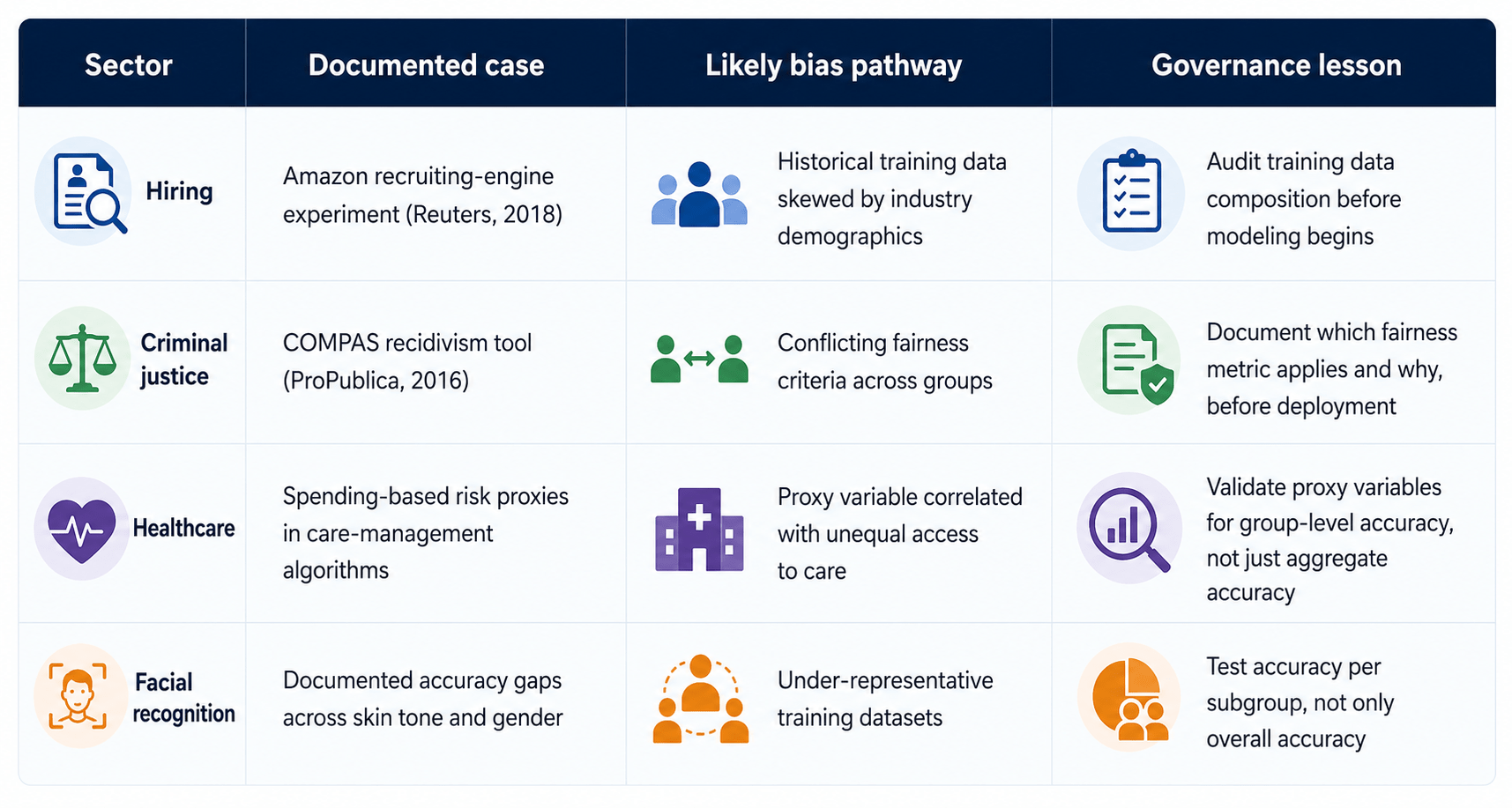
The examples below illustrate how AI bias can emerge across different industries through different pathways. While the use cases vary, each highlights a governance challenge that organizations should address before deployment.
In hiring, Amazon’s recruiting experiment reflected bias inherited from historical workforce data. The COMPAS recidivism tool showed how different fairness metrics can lead to conflicting outcomes. In healthcare, spending-based risk proxies created unequal results, while facial recognition systems exposed the impact of under-representative training datasets.
Together, these examples demonstrate that bias is rarely caused by a single factor. Effective AI governance requires reviewing data, model design, and decision-making throughout the AI lifecycle. For a broader catalog of failure patterns and mitigations, see SmartDev’s responsible AI guide.
4. How to Measure AI Fairness and Detect Bias
Fairness measurement turns an abstract principle into a testable claim. This section explains what teams should assess, the main quantitative metrics, and the tools available for evaluation.
Fairness measurement: what should be assessed?
A fairness assessment should examine three layers together: the input data’s representativeness, the model’s error rates broken down by group, and the real-world decision outcomes those errors produce. Testing only overall accuracy hides group-level disparities, since a model can score 95% accurate overall while performing far worse for one subgroup.
Group fairness and individual fairness
Group fairness compares outcomes across defined groups, such as approval rates by gender or age band. Individual fairness instead asks whether similar individuals receive similar treatment, regardless of group membership. Both lenses matter: a system can satisfy a group-level fairness metric while still treating two nearly identical individuals very differently, so a complete assessment checks both.
Core fairness metrics
Each metric below answers a different fairness question, and choosing the wrong one for the context can create a false sense of security.
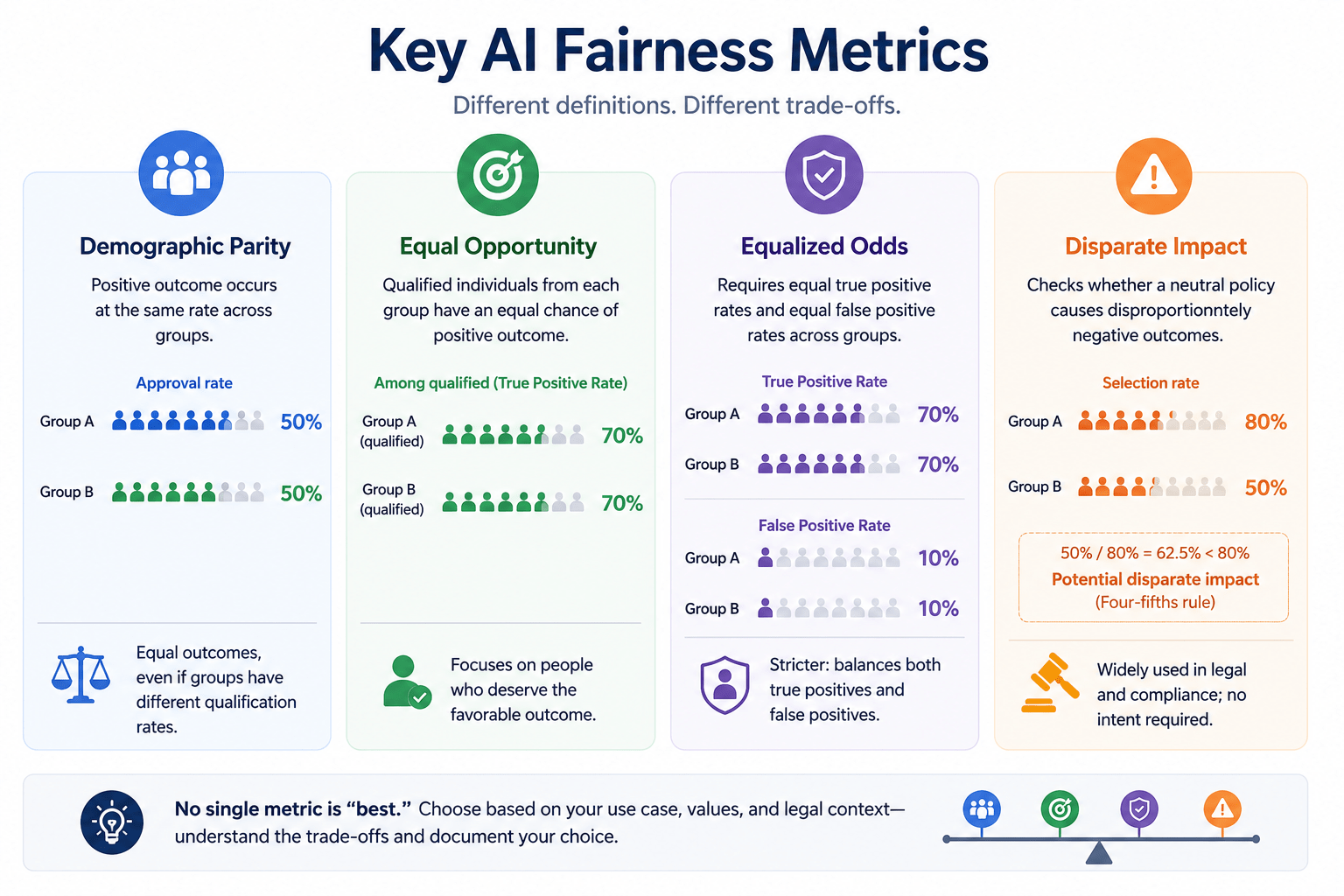
Demographic parity
Demographic parity requires that a positive outcome – a loan approval, a job interview – occurs at the same rate across groups, regardless of each group’s actual qualification rate in the underlying population. It is easy to communicate but can force equal outcomes even when the groups differ on legitimate, non-discriminatory factors.
Equal opportunity
Equal opportunity requires that qualified individuals from each group have an equal chance of receiving the positive outcome, in statistical terms, equal true positive rates. This metric focuses fairness scrutiny specifically on people who deserve the favorable outcome.
Equalized odds
Equalized odds extends equal opportunity by also requiring equal false positive rates across groups. It is a stricter standard than equal opportunity alone, and it is often mathematically incompatible with demographic parity when groups have different base rates.
Disparate impact
Disparate impact measures whether a facially neutral policy produces disproportionately negative outcomes for a protected group, commonly using the “four-fifths rule” from U.S. employment law as a screening threshold. It is widely used in legal and compliance contexts precisely because it does not require proof of discriminatory intent.
Choosing the right fairness metric for the use case
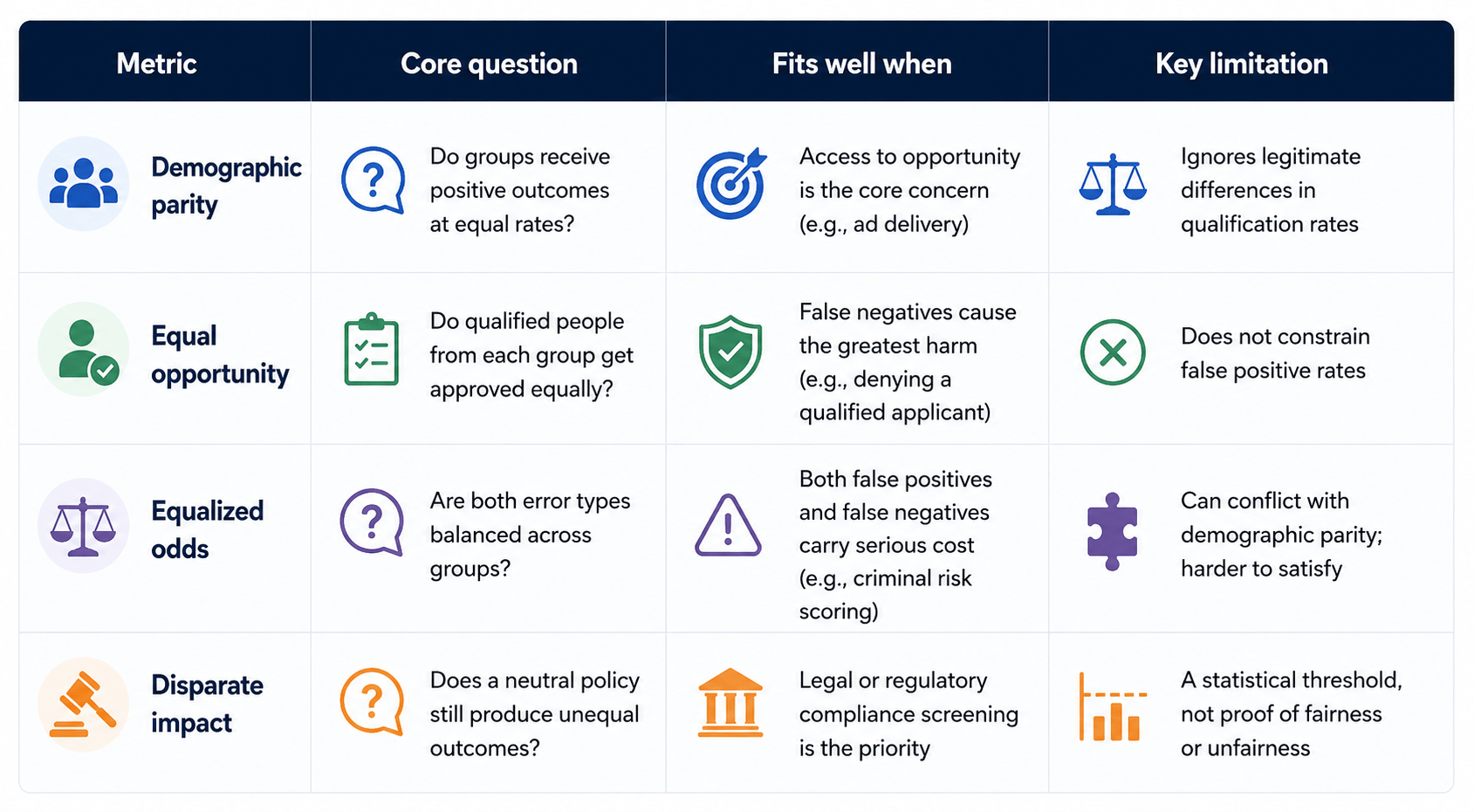
The diagram summarizes four widely used fairness metrics, each designed to evaluate AI systems from a different perspective:
- Demographic Parity – Measures whether different groups receive positive outcomes at similar rates, making it useful when equitable access to opportunities is the primary objective.
- Equal Opportunity – Evaluates whether qualified individuals across groups have an equal chance of receiving a positive outcome, particularly in scenarios where false negatives carry the greatest impact.
- Equalized Odds – Compares both false positive and false negative rates across groups, making it well suited to high-risk decisions where balancing both types of errors is essential.
- Disparate Impact – Assesses whether a seemingly neutral policy results in disproportionate outcomes across groups and is commonly used to support governance and regulatory compliance.
No single fairness metric is appropriate for every AI system. Organizations should select the metric that best aligns with the intended use case, risk profile, and regulatory requirements, while clearly documenting the rationale to support governance, audits, and future model reviews.
Bias audits: scope, evidence, testing, and reporting
A bias audit combines quantitative testing with qualitative review. Scope defines which decisions and groups the audit covers; evidence collection gathers the data, model documentation, and outcome logs; testing applies the chosen fairness metrics; and reporting documents findings, limitations, and remediation steps for stakeholders and, where relevant, regulators.
Explainability and transparency in bias investigation
Explainability tools help investigators understand why a model produced a specific output, which supports bias investigation but does not substitute for it. A model can be highly explainable and still biased, because explainability describes the mechanism behind a decision without independently confirming the decision was fair.
Tools and frameworks for fairness evaluation
IBM AI Fairness 360
IBM’s open-source AI Fairness 360 toolkit provides a library of fairness metrics and bias-mitigation algorithms that engineering teams can apply across the model lifecycle, from pre-processing through post-processing.
Google What-If Tool and comparable evaluation tools
Google’s What-If Tool, part of its People + AI Research (PAIR) initiative, lets teams visually probe model behavior across hypothetical inputs and slice performance by subgroup without writing custom evaluation code. Comparable evaluation tooling from Microsoft’s Fairlearn and other open-source projects serves similar purposes.
Documentation, model cards, and assessment records
Model cards document a model’s intended use, evaluation results, and known limitations in a standardized format, giving reviewers a fast way to check whether a model was tested for the fairness concerns relevant to their use case. Retaining these records, along with audit findings and decision logs, creates the evidence trail that governance and legal teams need.
SmartDev’s AI Model Testing Guide covers the broader validation process these fairness checks fit into, including accuracy and reliability testing.
5. AI Governance, Regulation, and Accountability
Fairness principles only reduce risk once an organization translates them into accountable governance. This section distinguishes binding laws from voluntary standards and maps responsibility across teams.
Ethics principles: fairness, transparency, accountability, and human oversight
Most governance frameworks converge on the same core principles: fairness in outcomes, transparency about how a system works, accountability for who owns each decision, and human oversight for high-impact cases. The OECD AI Principles, first adopted in 2019 and updated in 2024, organize these ideas into five value-based pillars: inclusive growth and well-being, respect for human rights and democratic values including fairness and privacy, transparency and explainability, robustness and safety, and accountability.
Data governance and bias controls for high-risk AI
High-risk AI systems need documented data governance: where training data came from, how it was cleaned and labeled, and what representativeness checks were run before training began. These records matter as much for internal quality control as for external audits, since they let a team trace an unexpected outcome back to its likely source.
Key regulatory and standards landscape
Regulatory requirements vary by jurisdiction and use case, so organizations should separate binding law from voluntary guidance before building a compliance plan.
European AI regulation and data-governance expectations
Scope note: the obligations below apply within the EU/EEA regulatory framework and to providers placing systems on that market; other jurisdictions have separate rules. Verify current phase-in dates against the official source before publishing or relying on this summary.
The EU AI Act is the first comprehensive AI law and takes a risk-based approach. It defines four categories: unacceptable risk, which is prohibited; high risk, which carries strict compliance obligations before market entry; limited risk, which requires transparency disclosures; and minimal risk, which carries no mandatory obligations.
High-risk classification, defined largely in the Act’s Annex III, covers areas such as biometric identification, employment, and credit scoring, and requires conformity assessments, technical documentation, and human oversight mechanisms. Separately, Article 22 of the GDPR gives individuals certain rights around automated decisions that significantly affect them, subject to specific conditions and exceptions set out in the regulation.
U.S. policy and sectoral obligations
The United States relies more heavily on sector-specific rules, such as fair-lending and employment anti-discrimination law, alongside voluntary federal guidance. The NIST AI Risk Management Framework, released January 26, 2023 and developed through an open, consensus-driven process, remains voluntary but is widely referenced by U.S. organizations building internal governance programs. Its core organizes work into four functions – Govern, Map, Measure, and Manage – that apply across the AI lifecycle.
International guidance: UNESCO, OECD, ISO, and IEEE
UNESCO’s Recommendation on the Ethics of Artificial Intelligence calls for governance frameworks that prioritize human rights and sustainability across its member states. ISO/IEC standards, including guidance on bias in AI systems, and IEEE’s Ethically Aligned Design initiative both provide technical, voluntary reference points that organizations can adopt ahead of binding regulation. These sit alongside, rather than replace, the OECD principles described above.
Assigning accountability across product, data, engineering, legal, risk, and leadership teams
Fairness fails when everyone assumes someone else owns it. The matrix below outlines a starting point for assigning responsibility; organizations should adapt roles to their own structure.
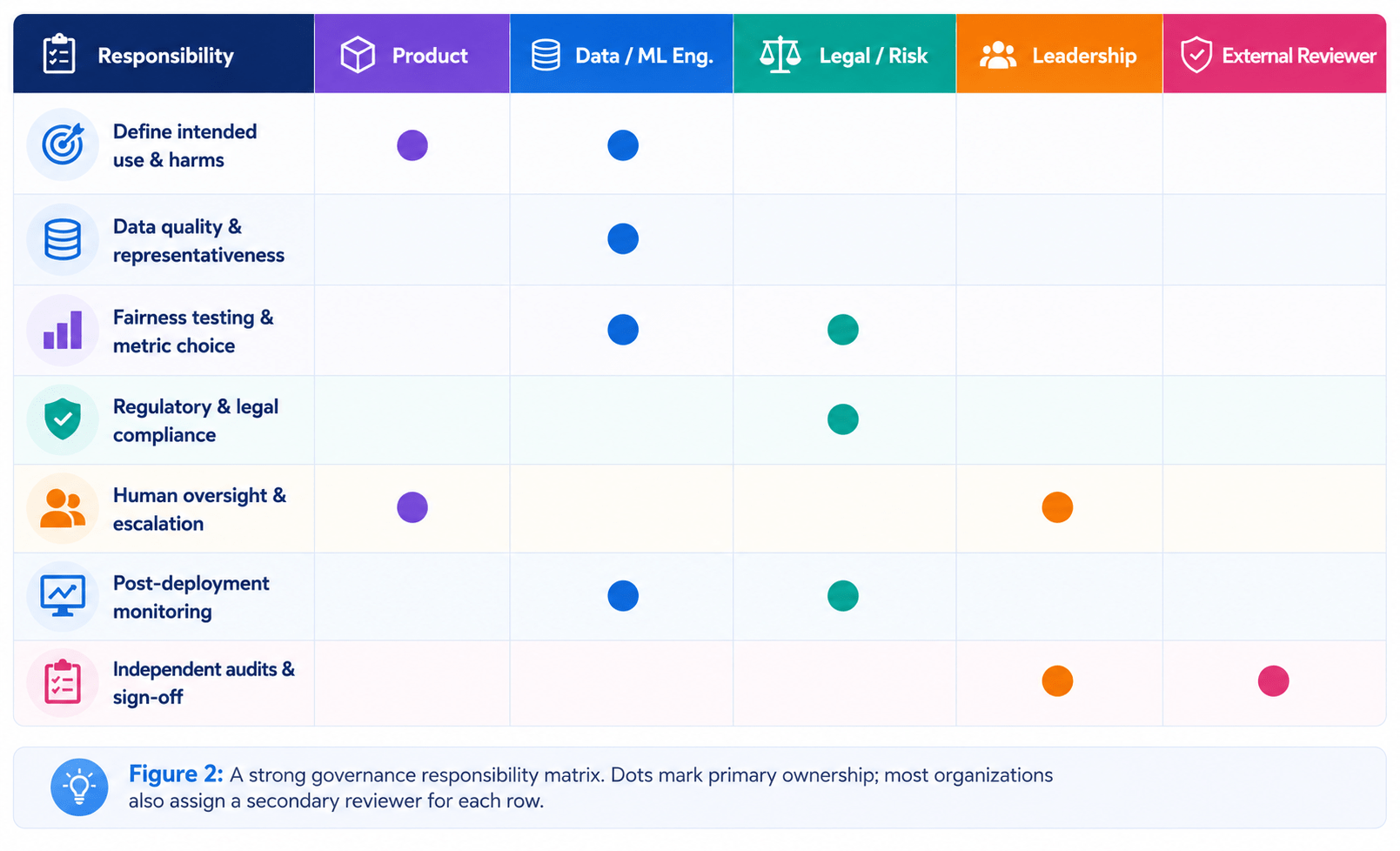
The matrix assigns primary ownership for key AI governance activities across five functions: Product, Data/ML Engineering, Legal/Risk, Leadership, and an External Reviewer.
| Fairness responsibility | Product | Data / ML Engineering | Legal / Risk | Leadership | External reviewer |
| Define intended use, affected groups, and potential harms | Primary owner | Contributor | Reviewer for high-risk use cases | — | — |
| Assess data quality, provenance, and representativeness | Contributor | Primary owner | — | — | — |
| Select fairness metrics and run fairness testing | Contributor | Primary owner | Reviewer | — | — |
| Interpret regulatory and legal obligations | — | Contributor | Primary owner | — | — |
| Define human oversight and escalation paths | Primary owner | Contributor | — | Executive sponsor | — |
| Monitor post-deployment performance, drift, and disparities | Contributor | Primary owner | Reviewer | — | — |
| Conduct independent audit and approve high-risk sign-off | — | Contributor | Reviewer | Executive sponsor | Independent reviewer |
How to use this matrix: Assign each primary-owner role to a named individual, not just a team or department. For high-impact AI systems, record the accountable owner, review date, supporting evidence, unresolved risks, and approval decision. This creates a clear governance record that supports accountability, audits, and continuous improvement.
A practical rule is simple: Product owns the business context and intended use, Data and ML Engineering own the technical evidence, Legal and Risk interpret regulatory obligations, Leadership accepts organizational risk, and independent reviewers provide objective challenge when the potential impact justifies additional oversight.
Common mistake: Treating fairness as an engineering responsibility alone. A model can satisfy technical fairness metrics yet still create unacceptable outcomes if it is deployed for the wrong purpose, lacks effective human oversight, or operates outside the organization’s risk tolerance. Effective AI governance requires technical, business, and compliance teams to share responsibility throughout the AI lifecycle.
Third-party review, independent audits, and stakeholder engagement
Independent reviewers catch blind spots that internal teams tend to miss, precisely because they were not involved in the original design decisions. Structured stakeholder engagement, including input from groups the system affects, surfaces context that a purely technical review can overlook. SmartDev’s AI Consulting Services support organizations building this kind of independent governance layer.
6. Strategies to Mitigate AI Bias Across the Lifecycle
Effective mitigation begins before modeling starts, combines technical and organizational controls, documents trade-offs honestly, and continues well after launch. No technique guarantees a fully unbiased system.
Start with the intended use, affected groups, and potential harms
Before writing any code, teams should document who the system will affect, what a wrong decision costs each group, and which fairness objective matches that harm profile. This step shapes every downstream mitigation choice, so skipping it tends to produce technically sound models that still miss the real fairness risk.
Improve data quality, representativeness, and documentation
Improving data quality means actively checking whether the dataset represents every group the model will affect, not simply collecting more data of the same kind. Documentation – recording data sources, collection methods, and known gaps – turns this work into an artifact that later reviewers can actually inspect.
Use appropriate technical mitigation methods
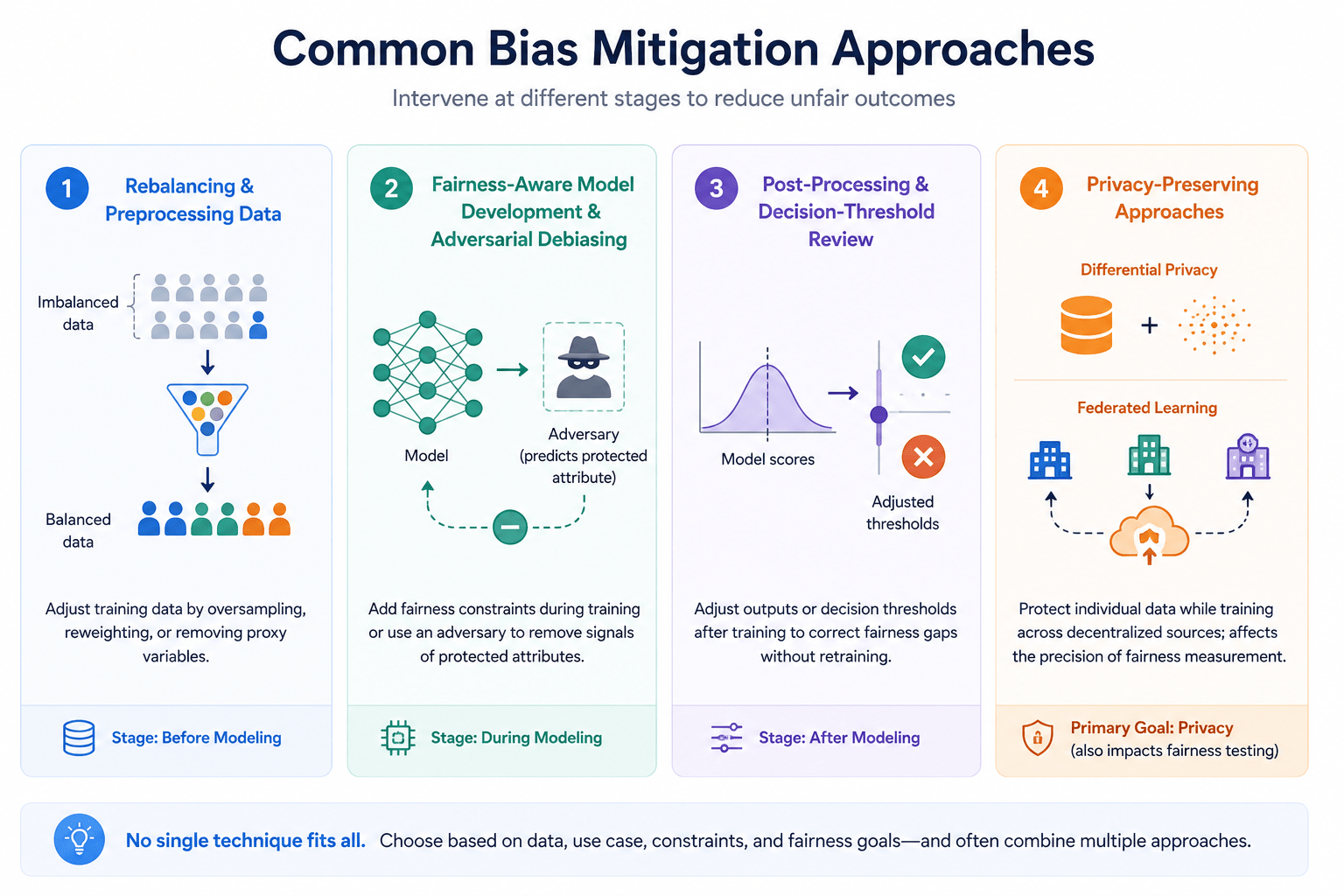
Technical mitigation techniques intervene at different points in the pipeline and each carries trade-offs in accuracy, privacy, interpretability, or complexity.
Rebalancing and preprocessing data
Rebalancing techniques adjust the training data before modeling, oversampling under-represented groups, reweighting examples, or removing proxy variables correlated with protected attributes. This intervenes earliest in the pipeline and is often the simplest to explain to stakeholders.
Fairness-aware model development and adversarial debiasing
Fairness-aware training adds a fairness constraint directly into the model’s optimization objective, alongside its accuracy target. Adversarial debiasing trains a second model to try to predict the protected attribute from the primary model’s outputs, then penalizes the primary model when that adversary succeeds, pushing the model toward outputs that do not encode the protected attribute.
Post-processing and decision-threshold review
Post-processing adjusts a trained model’s outputs or decision thresholds after training, without touching the model itself. This approach is useful when a team cannot retrain a model quickly but needs to correct a fairness gap identified during testing or monitoring.
Privacy-preserving approaches, including differential privacy and federated learning
Differential privacy adds carefully calibrated noise to protect individual records while preserving overall statistical patterns, and federated learning trains models across decentralized data without moving raw data to a central server. Both techniques primarily target privacy risk, but they also affect fairness testing, since they can limit how precisely a team can measure subgroup performance.
Build diverse, multidisciplinary development and review teams
Teams that include diverse backgrounds and disciplines – engineering, domain expertise, ethics, and affected-community perspectives – catch more failure modes earlier, because more lived experience is represented in the room where decisions get made.
Apply human oversight to high-impact decisions
High-impact decisions need a human in the loop who can override the system, not just review its output after the fact. “Human in the loop” is easy to state and hard to make real: it requires the reviewer to have actual authority to override, enough training and context to spot a wrong recommendation, enough time to review properly, a clear escalation path, and ongoing monitoring for automation bias – the tendency to defer to the system simply because it is automated.
Monitor for drift, emerging disparities, and feedback-loop harms
Continuous monitoring tracks whether fairness metrics that passed at launch still hold as the population and operating conditions change. Feedback-loop harms are especially hard to catch without monitoring, because each individual decision can look reasonable while the aggregate pattern quietly narrows opportunity for one group over time.
Respond to identified bias: remediation, communication, and re-evaluation
When monitoring or an audit finds bias, an organization needs a defined response path, treated with the same discipline as a security incident: contain the immediate harm (pause or adjust the system), investigate the root cause, notify affected stakeholders, remediate the underlying issue, revalidate against the fairness metrics chosen for the use case, and monitor to confirm the fix holds after redeployment.
SmartDev’s Machine Learning Development Services and Data Analytics Services support these mitigation steps end to end, from data pipeline design through ongoing monitoring.
7. A Practical AI Fairness Assessment Framework
The seven steps below convert this guide’s concepts into a reusable process any organization can apply to a live or planned AI system. Treat it as a practical starting framework, not a legal or technical certification.
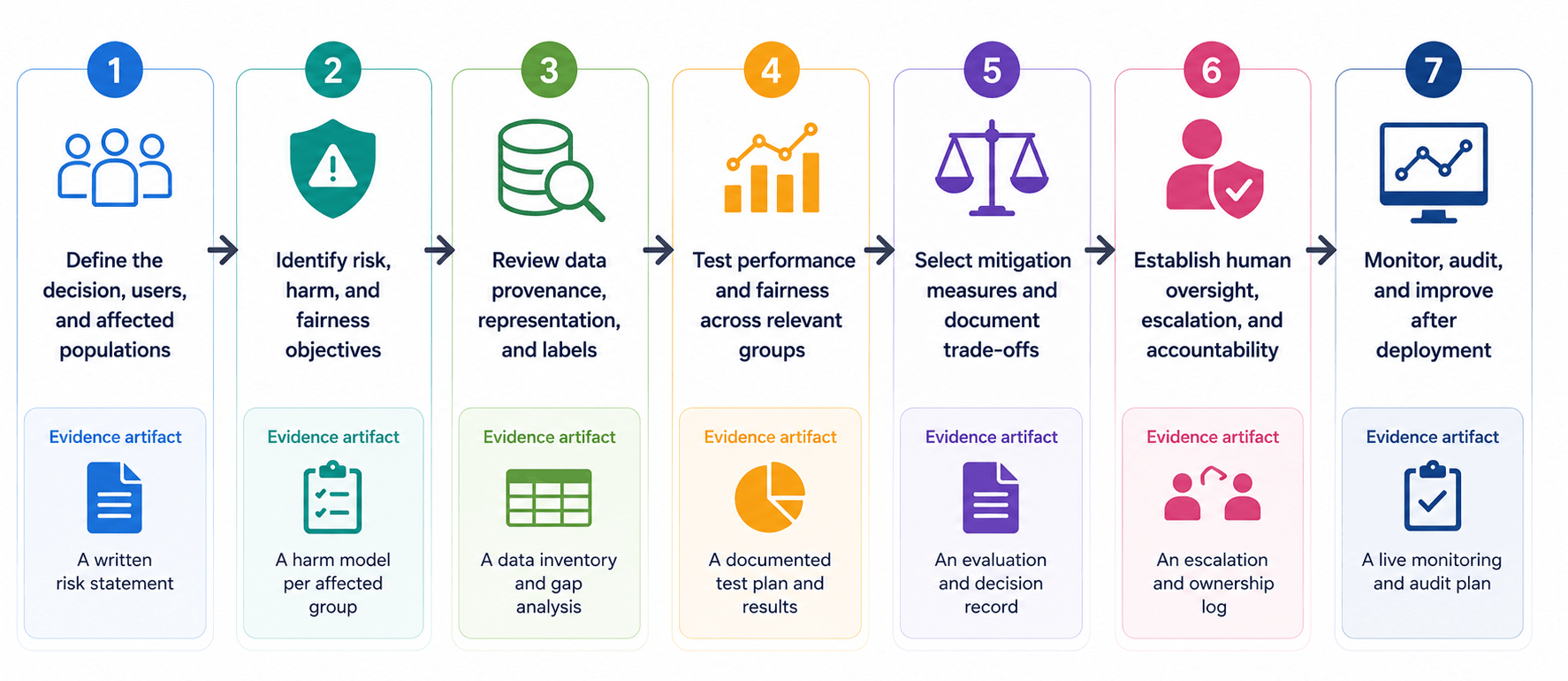
Step 1: Define the decision, users, and affected populations
Name the exact decision the system makes, who uses its output, and every population group the decision touches, including groups outside the primary target market.
Step 2: Identify risk, harm, and fairness objectives
Map what happens to each affected group when the system is wrong, then choose a fairness objective from Section 4 that matches the most serious harm identified.
Step 3: Review data provenance, representation, and labels
Trace every data source, check representation against the affected populations from Step 1, and review labeling methodology for consistency and bias.
Step 4: Test performance and fairness across relevant groups
Run the fairness metrics chosen in Step 2 against real subgroup data, not just aggregate accuracy, and document every result, including the ones that fail.
Step 5: Select mitigation measures and document trade-offs
Choose mitigation techniques from Section 6 based on the specific gap Step 4 revealed, and record the accuracy, privacy, or complexity cost each choice introduces.
Step 6: Establish human oversight, escalation, and accountability
Assign a named owner for the system’s fairness performance, define when a human must review or override an output, and set an escalation path for disputes.
Step 7: Monitor, audit, and improve after deployment
Schedule recurring fairness testing, track population and performance drift, and re-run this framework whenever the system, its data, or its user base changes materially.
8. Emerging Challenges: Generative AI and the Future of Fairness
Generative AI introduces fairness risks that traditional classification metrics were not built to measure. This section separates proven current risks from open research questions, without speculative predictions.
Bias risks in large language models and generative AI applications
Large language models learn patterns from enormous, largely uncurated text corpora, which means they can reproduce stereotypes and representational imbalances present in that data. Unlike a loan-approval model with one binary output, a generative model produces open-ended text or images, so a single fairness metric cannot fully capture its bias risk.
Evaluation instead typically combines targeted prompt testing, output-pattern analysis across demographic references, and human review.
Predictive AI versus generative AI: a fairness comparison
| Dimension | Predictive AI | Generative AI |
|---|---|---|
| Output | A score, class, or single decision | Open-ended text, image, audio, or code |
| Main fairness risk | Allocation harm and error-rate disparity | Representational harm, stereotyping, or omission |
| Evaluation approach | Subgroup performance metrics | Prompt suites, output-pattern analysis, human review |
| Monitoring focus | Drift in decisions and outcomes | Prompt drift, retrieval drift, model/version drift |
Synthetic data, automated decision systems, and new evaluation challenges
Synthetic data can help fill representation gaps in a training set, but it inherits and can even amplify biases present in the model that generated it, so teams should validate synthetic data against real-world distributions rather than treating it as automatically neutral. Automated decision systems built on generative components also complicate auditing, since the same prompt can produce different outputs on different runs.
Fairness in autonomous systems, smart cities, and robotics
Autonomous systems that operate in physical environments — vehicles, smart-city sensors, robotics — raise fairness questions that extend beyond data, including whether a system’s sensors and safety responses perform equally well across the full range of people and environments it will encounter.
The role of explainable AI in trustworthy decision-making
Explainable AI remains important for generative and autonomous systems, but as noted in Section 4, it clarifies mechanism rather than confirming fairness on its own. Teams should pair explainability tooling with outcome-based testing rather than relying on it as a standalone fairness check.
Why fairness must remain a continuous governance practice
Generative and autonomous systems evolve faster than most traditional software, through fine-tuning, retrieval updates, and shifting usage patterns. That pace makes continuous governance – not a one-time review – the only realistic way to keep fairness testing current with how the system actually behaves in production.
SmartDev’s Generative AI Development Services build these evaluation practices into custom LLM and GenAI implementations from the outset.
Key takeaway: Classification fairness metrics don’t transfer cleanly to generative AI, there’s no single “approval rate” to check. Evaluate open-ended outputs with prompt suites, pattern analysis across demographic references, and human review, then keep re-testing as the model changes.
9. FAQ: AI Bias and Fairness
What are the main types of AI bias?
The main types are data bias (unrepresentative or poorly labeled training data), historical bias (data that encodes past inequities), algorithmic bias (model design or optimization choices that produce disparities), and deployment bias (drift, feedback loops, or misuse after launch). Most real-world cases involve more than one type at once, which is why Section 2’s lifecycle map treats them as connected rather than isolated risks.
Can an AI system ever be completely unbiased?
No fairness metric or mitigation technique guarantees a fully unbiased system, and different fairness definitions can mathematically conflict with each other. The realistic goal is to identify the fairness objective that matters most for a given decision, measure performance against it consistently, and keep reducing disparities through the lifecycle practices in Section 6 – not to claim zero bias.
What is the difference between AI bias and AI fairness?
AI bias describes a measurable, systematic disparity in a system’s outputs. AI fairness describes the standard used to judge whether that disparity is acceptable in a given context. Section 1 covers this distinction with a direct comparison table.
How do organizations audit an AI system for bias?
A bias audit scopes which decisions and groups it covers, gathers data and model documentation as evidence, applies fairness metrics appropriate to the use case, and reports findings with recommended remediation. Section 4 details this process, and Section 7’s seven-step framework shows how an audit fits into a broader assessment cycle.
Which fairness metric should a business use?
There is no universally correct metric. The right choice depends on the decision’s harm profile, whether false positives or false negatives cause more damage, and the relevant legal framework. Section 4’s comparison table maps demographic parity, equal opportunity, equalized odds, and disparate impact to the contexts each fits best.
What should a company do after it detects bias?
Treat it as an operational incident: contain, investigate, notify affected stakeholders, remediate the root cause, revalidate against the chosen fairness metric, and monitor after redeployment. Section 6 outlines this response cycle in detail.
What evidence should an AI fairness audit produce?
At minimum: a written risk statement, a harm model per affected group, a data provenance and representation review, subgroup test results against a named fairness metric, a documented mitigation and trade-off decision, and an ownership and escalation record. Section 7’s seven-step framework maps each of these to the step that should produce it.
Conclusion
Fair AI is not a single tool, metric, or one-time test. Organizations that treat it that way tend to discover gaps only after a system has already caused harm. Managing fairness as a continuous system, spanning definition, data, measurement, governance, and mitigation, is what actually keeps risk under control.
This guide connected those pieces: what bias and fairness mean, where bias enters the AI lifecycle, how to measure it, what selected regulations and governance frameworks expect, and how to reduce it through the seven-step assessment framework in Section 7. The quality of an AI system ultimately includes how reliably and fairly it serves the people affected by its decisions, in its actual operating context, not just in a lab environment.
Next Steps: Build a More Responsible AI System
1. Run the self-assessment first
The most useful next step is the one you can do today: take the seven-step framework in Section 7 and apply it to one live or planned AI system. Even a rough first pass, a written risk statement plus a subgroup test, surfaces most of the gaps a formal audit would later find.
2. Go deeper on validation
For the technical side of testing a model beyond fairness, accuracy, reliability, robustness, see SmartDev’s AI Model Testing Guide. For broader context on responsible AI practice, see the business-oriented guide to responsible AI.
3. Bring in outside support if you need it
If the self-assessment turns up gaps your team doesn’t have the bandwidth or independence to close – a full bias audit, an independent review, or ongoing monitoring infrastructure – SmartDev’s AI Consulting Services and AI Development Services teams work from the same framework used in this guide. No fairness review can guarantee compliance or a specific outcome; it can give you a documented, defensible basis for the decisions you make.
Ready to evaluate your AI system for bias and fairness?
Whether you’re building a new AI solution or reviewing an existing one, SmartDev can help you identify potential fairness risks, strengthen governance, and improve confidence in your AI-driven decisions.
Contact us for a practical discussion tailored to your use case, focused on your data, your decisions, and your risk, not a generic sales pitch.