
TL;DR:
- AI in finance is not one capability. Machine learning, generative AI, and agentic workflows differ in their data needs, risk profiles, and oversight requirements. Know which type you are deploying.
- The most proven use cases — fraud detection, credit scoring, AML monitoring, and document processing — share a common trait: they improve measurable operating outcomes, not just process speed.
- No use case is viable without data readiness. Poor data quality is the single most common reason AI projects underdeliver. Audit your data before you choose a model.
- Regulatory exposure varies by use case. A customer chatbot and an automated credit decision carry fundamentally different explainability and audit requirements.
- Prioritization should follow three criteria: business value, implementation readiness, and risk level — in that order.
- Governance is not a post-launch concern. Human oversight, model monitoring, and audit trail requirements must be designed into the system before pilot.
- ROI must be measured against a defined baseline. “We saved time” is not a result. Set specific metrics — false positive rate, processing time, error rate — before deployment and track them through a defined monitoring interval.
Introduction
Financial institutions are not short of AI pilots. What they lack is a disciplined way to move from experiment to production — and a clear-eyed view of where AI actually creates value versus where it introduces new risk.
This article is written for finance leaders, product owners, and implementation teams who need to make concrete decisions: which use case to prioritize, what governance their organization must have in place before going live, and how to measure whether deployment delivered anything real.
AI in finance is not one technology. It spans traditional machine learning for credit and fraud, generative AI for document and knowledge workflows, and emerging agentic systems that chain multiple AI actions together. Each carries different data requirements, regulatory implications, and oversight standards. Treating them interchangeably is a common and costly mistake.
By the end of this article, you will be able to identify which AI applications are viable for your operating context, apply a structured prioritization framework, and define the governance controls your use case actually requires.
1. What AI Means for Financial Services
AI in financial services is the application of computational models that learn from data to perform tasks — such as classification, prediction, generation, and decision support — across banking, payments, lending, insurance, investment, and finance operations.
This definition matters because “AI” is used loosely across vendors, regulators, and the press. Finance leaders need to distinguish between capability types before selecting a solution.
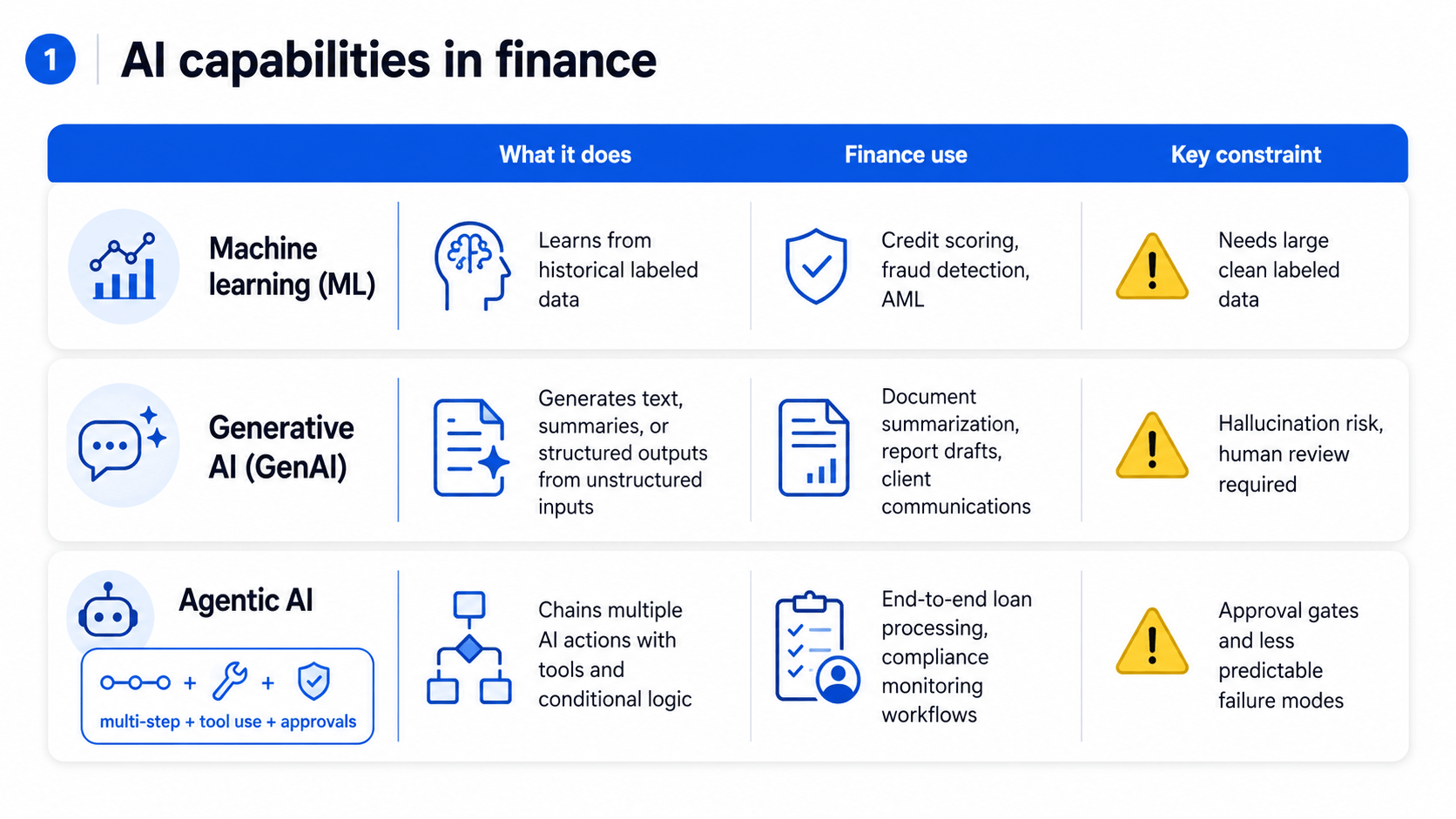
AI, Machine Learning, Generative AI, and Agentic Workflows in Finance
The three AI paradigms operating in financial services today differ significantly in what they do, what data they need, and where human oversight is required.
| Capability | What it does | Finance application | Key constraint |
|---|---|---|---|
| Machine learning (ML) | Learns patterns from labeled historical data to classify or predict | Credit scoring, fraud detection, AML, churn prediction | Requires large, clean, labeled datasets; output is a score or classification |
| Generative AI (GenAI) | Produces text, summaries, or structured output from unstructured inputs | Document summarization, regulatory reporting drafts, client communications | Outputs require human review; hallucination risk in high-stakes contexts |
| Agentic AI | Chains multiple AI actions with tool use and conditional logic | End-to-end loan processing, compliance monitoring workflows | Requires approval gates; failure modes are less predictable than single-model systems |
Traditional ML remains the backbone of production finance AI. GenAI is scaling into knowledge work. Agentic systems are early-stage and require more rigorous human-in-the-loop design. For a deeper look at how AI agent systems are being built, see SmartDev’s AI agent development services.
Where AI Fits Across Financial Workflows
AI applications are not evenly distributed across finance. The highest-maturity deployments are concentrated in four domains:
- Risk and fraud: real-time transaction monitoring, anomaly detection, AML
- Credit and lending: application scoring, document verification, underwriting support
- Operations: document intelligence, settlement prediction, reporting automation
- Customer engagement: virtual assistants, personalization, advisor support
Investment management and treasury forecasting are active deployment areas but carry higher model risk. Sustainability and climate-risk analysis is emerging, not yet production-ready at scale. SmartDev works across BFSI and fintech implementations, helping institutions identify where AI fits their specific operating context.
2. Business Benefits of AI in Finance
AI’s business value in finance comes from four measurable domains: decision quality, operational throughput, risk control, and customer experience. Generic efficiency claims are not useful. The question is which operating outcomes improve, by how much, and for which function.
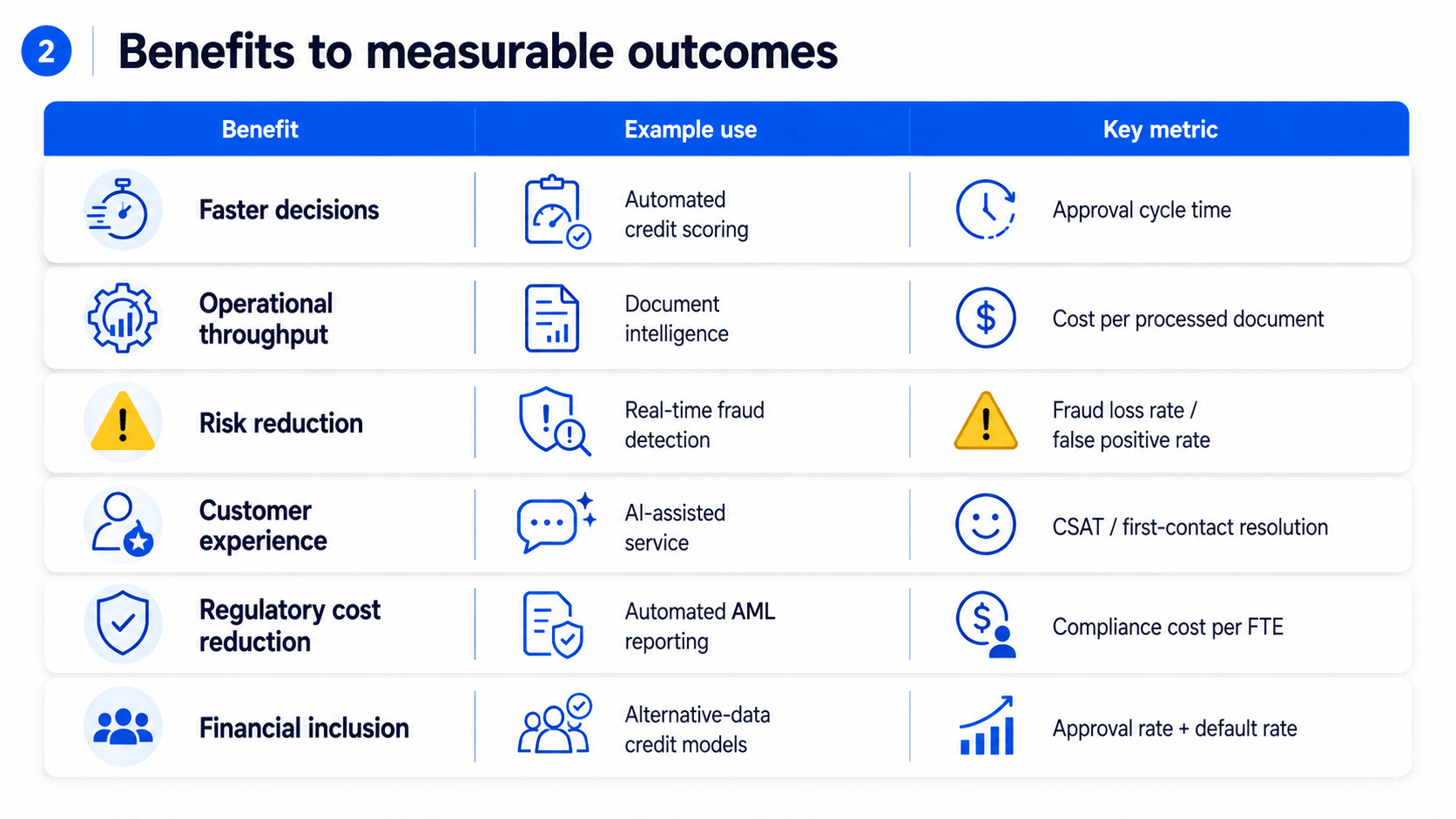
Benefit-to-Metric Matrix
| Benefit | Use case example | Leading indicator | Outcome metric |
|---|---|---|---|
| Faster, more consistent decisions | Automated credit scoring | Application processing time | Approval cycle time reduction |
| Operational throughput | Document intelligence for onboarding | Manual review hours per file | Cost per processed document |
| Risk reduction | Real-time fraud detection | False positive rate | Fraud loss rate |
| Customer experience | AI-assisted service | First-contact resolution rate | CSAT / NPS |
| Regulatory cost reduction | Automated AML reporting | Exception handling time | Compliance cost per FTE |
| Financial inclusion | Alternative data credit models | Approval rate for thin-file applicants | Default rate in approved cohort |
Each benefit is observable and measurable. Institutions that define these metrics before deployment are in a position to actually demonstrate ROI. Institutions that don’t are left making qualitative claims.
3. The Most Valuable AI Use Cases in Finance
The highest-value AI use cases in financial services share three characteristics: a well-defined decision or task, access to sufficient labeled data, and a measurable operating outcome. Below are the eight use case categories with the strongest production track record.
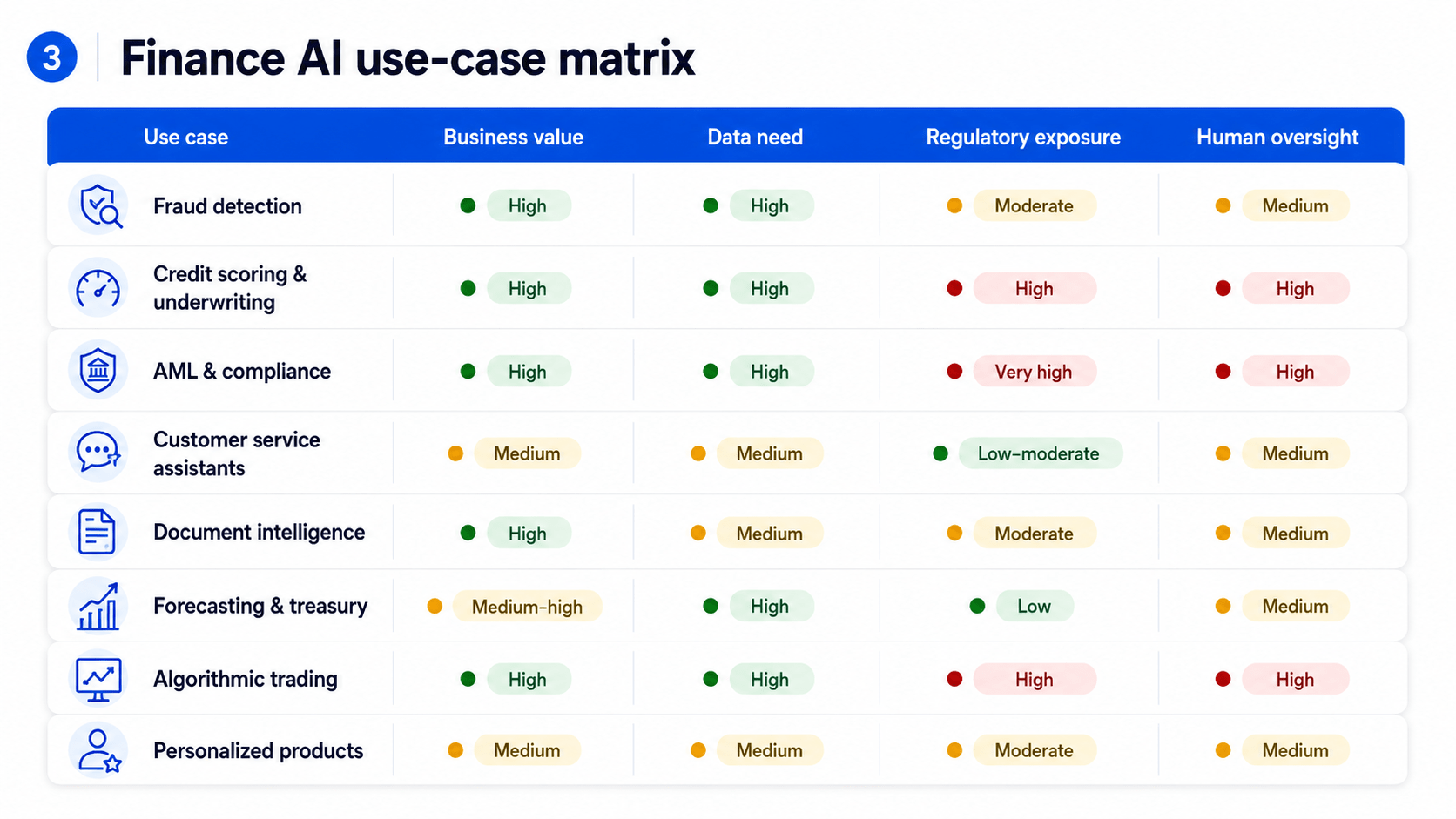
Use-Case Matrix
| Use case | Business value | Data requirements | Regulatory exposure | Human oversight needed |
|---|---|---|---|---|
| Fraud detection | High — direct loss prevention | Transaction history, behavioral signals | Moderate — flagging, not final decision | Exception review; dispute resolution |
| Credit scoring & underwriting | High — portfolio quality, inclusion | Credit history, alternative data | High — adverse action, explainability required | Manual review for edge cases and appeals |
| AML & regulatory compliance | High — avoids fines, reputational risk | Transaction data, counterparty data | Very high — SAR filing, audit trail required | Human sign-off on all escalations |
| Customer service & virtual assistants | Medium — cost and availability | Interaction logs, product data | Low–moderate | Escalation path to human agent required |
| Document intelligence | High — throughput and accuracy | Unstructured documents, labeled extraction samples | Moderate | Validation on consequential outputs |
| Forecasting & treasury | Medium-high — cash management, planning | Time series financial data | Low | Analyst review of model outputs |
| Algorithmic trading | High — return optimization | Market data, alternative data | High — market conduct rules | Execution limits; circuit breakers |
| Personalized products | Medium | Customer behavioral data | Moderate — fair lending considerations | Governance on offer eligibility logic |
Fraud Detection and Financial Crime Monitoring
Fraud detection is the most mature AI application in financial services. ML models — primarily gradient boosting and neural networks — analyze transaction patterns, device signals, and behavioral data to score each event in real time.
The core challenge is the false positive rate. Overly aggressive models block legitimate transactions and damage customer trust. Mastercard’s Decision Intelligence Pro, launched in 2024, evaluates over 1,000 data points per transaction and has improved fraud detection rates by an average of 20%, while reducing false positives by up to 200% in specific scenarios — directly lowering the cost of fraud operations for card issuers.
What makes fraud AI viable: high-volume labeled data, clear ground truth (confirmed fraud vs. legitimate), and a measurable loss metric.
Credit Scoring, Underwriting, and Loan Decision Support
Traditional credit scoring relies on a narrow set of variables — payment history, utilization, account age. ML models expand this to include transaction behavior, employment patterns, and in some markets, alternative data signals. This improves both accuracy and access.
Upstart, a lending platform, uses ML models that incorporate education and employment history. The result: approval rates increased for thin-file applicants, with the platform reporting a 75% reduction in defaults relative to traditional scoring benchmarks.
Critical constraint: Credit decisions in most jurisdictions require explainability. Applicants have the right to understand why credit was denied. Black-box models are not compliant in this context. Explainable AI or model documentation is mandatory, not optional.
Regulatory Compliance, AML, and Regulatory Reporting
Anti-money laundering monitoring generates enormous volumes of alerts. The majority — in some institutions, over 95% — are false positives, consuming compliance analyst time without producing actionable results. ML models trained on confirmed typologies can materially reduce this noise.
HSBC, in partnership with Google Cloud, deployed a Dynamic Risk Assessment (DRA) system in 2023. Processing over 1.35 billion monthly transactions, the system reduced false positives by 20% and won the Celent Model Risk Manager Award for that year.
GenAI is also being applied to regulatory reporting: drafting Suspicious Activity Reports (SARs), summarizing audit findings, and synthesizing regulatory changes. These outputs require human review before filing.
Customer Service, Virtual Assistants, and Advisor Support
AI-powered virtual assistants handle routine customer queries — balance inquiries, payment status, product information — at scale and around the clock. The business case is cost reduction and availability, not relationship replacement.
Bank of America’s virtual assistant Erica has handled over 2 billion client interactions since launch, with approximately 2 million daily engagements. The design constraint: a clear escalation path to a human agent must exist. AI assistants that trap customers in automated loops generate complaints and regulatory attention.
Document Intelligence for Onboarding, Lending, and Operations
Document intelligence — extracting structured data from unstructured documents such as contracts, financial statements, identity documents, and forms — is one of the highest-ROI AI applications in financial operations.
JP Morgan’s COiN (Contract Intelligence) platform, documented in public filings, reduced the time required to review credit agreements from approximately 360,000 manual hours annually to seconds, by using ML and image recognition to extract around 150 data points per contract automatically. For more on how document automation applies to finance workflows, see SmartDev’s AI Automation: Document & Data Processing whitepaper.
Forecasting, Treasury, Liquidity, and Financial Planning
Time-series ML models improve cash flow forecasting accuracy for treasury teams by incorporating seasonal patterns, macroeconomic signals, and transaction history. The practical benefit is tighter liquidity buffers and reduced emergency funding costs.
Key constraint: Forecasting models must be backtested against defined error metrics. A model that appears accurate during stable market conditions may perform poorly during volatility. Stress testing the model against historical disruption periods is a deployment requirement, not an optional exercise.
Algorithmic Trading, Portfolio Management, and Investment Research
Algorithmic trading uses ML to execute trades at defined conditions — exploiting pricing inefficiencies, managing execution quality, or hedging positions. Two Sigma Investments uses ML across data sources including market indicators and alternative data, and has generated over $15 billion in cumulative net gains, representing one of the most publicly documented ML-driven investment track records.
GenAI is increasingly used for investment research summarization — synthesizing earnings calls, regulatory filings, and news into analyst-ready briefings. These outputs are research support tools; they are not autonomous investment decisions.
4. How to Prioritize an AI Use Case
When choosing where to start with AI in finance, evaluate each candidate use case across three dimensions: business value, implementation readiness, and risk level. This is the Value–Readiness–Risk framework.
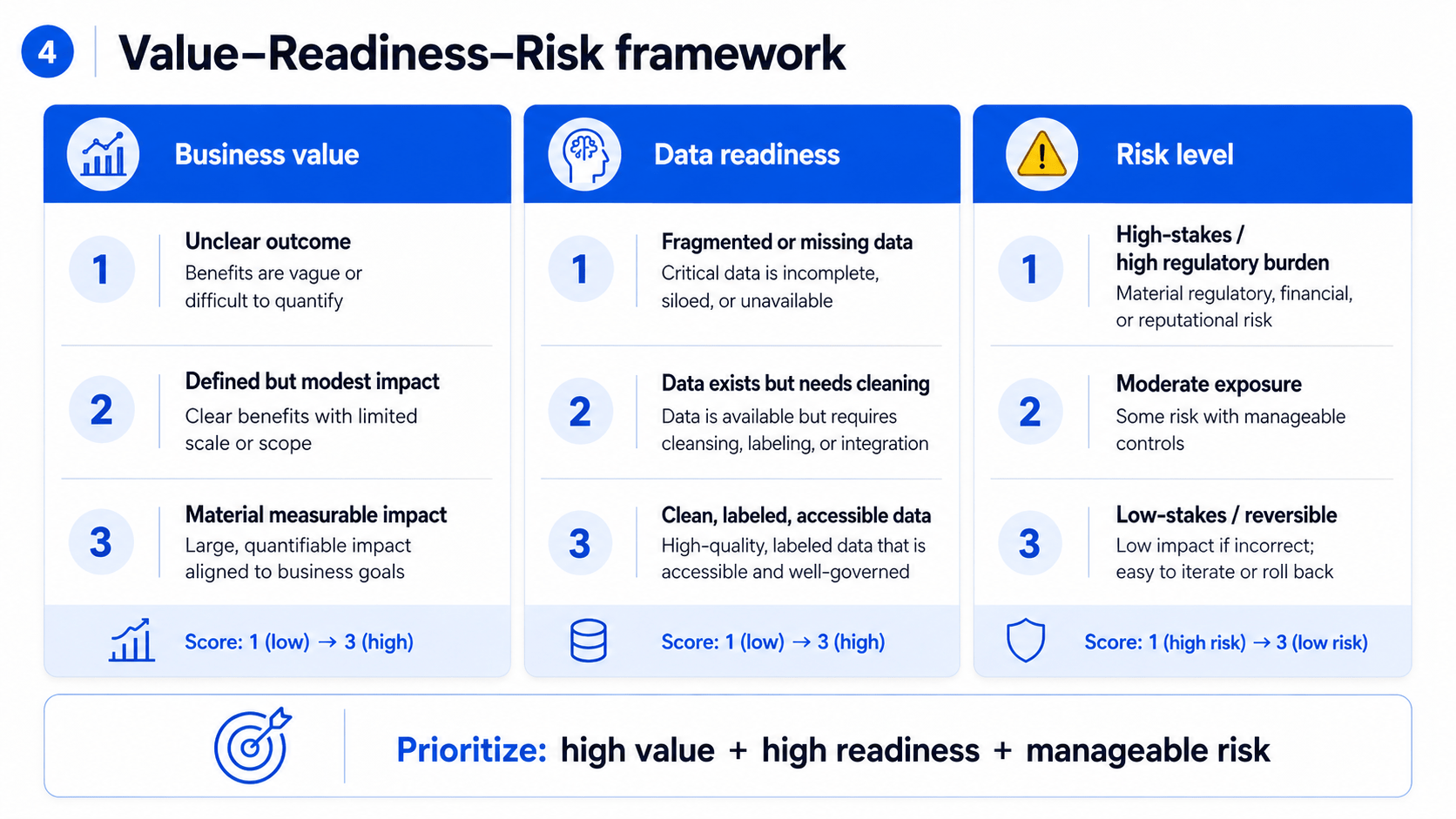
The Value–Readiness–Risk Prioritization Framework
Score each candidate use case on a 1–3 scale for each dimension. Prioritize use cases with high value, high readiness, and manageable risk. Deprioritize high-value, low-readiness cases until data and infrastructure conditions improve.
| Dimension | Score 1 | Score 2 | Score 3 |
|---|---|---|---|
| Business value | Unclear outcome, no baseline | Defined outcome, modest impact | Measurable outcome tied to a material cost or risk metric |
| Data readiness | Data does not exist or is fragmented | Data exists but requires significant cleaning | Clean, labeled, accessible data in sufficient volume |
| Risk level | Consequential decisions, high explainability and audit requirements | Moderate regulatory exposure | Low stakes, easily reversible, no adverse-action implications |
Business Value and Measurable Outcomes
A use case has business value if — and only if — you can state the baseline metric before deployment, the expected direction of change, and the mechanism by which AI will cause that change. “We will reduce fraud losses by improving detection accuracy from 84% to 90%, measured against confirmed fraud events in the prior 12 months” is a value statement. “AI will help us be more efficient” is not.
Data Readiness, Integration, and Operating Feasibility
Data readiness is the most underestimated constraint in financial AI. Assess: volume (is there enough labeled data?), quality (are records consistent and accurate?), accessibility (can the model access data at inference time?), and recency (does historical data reflect current behavior?).
Legacy core banking systems frequently create integration bottlenecks. If data must be batch-extracted, transformed, and loaded before the model can run, real-time applications are not feasible on that infrastructure without additional engineering.
Regulatory Exposure, Model Risk, and Customer Impact
High-regulatory-exposure use cases — credit decisions, AML filing, insurance underwriting — require explainability, documentation, validation, and human accountability. In the US, the Equal Credit Opportunity Act and Fair Housing Act impose adverse action notice requirements. In the EU, GDPR Article 22 restricts fully automated decisions affecting individuals. In Singapore, MAS guidelines on model risk management establish validation and governance requirements. These are not optional inputs; they determine whether your use case is legal to deploy.
Pilot Scope, Time-to-Value, and Scale Potential
A well-scoped pilot is narrow enough to complete in 8–12 weeks and produces a clear pass/fail result. “Pilot on 5% of loan applications in a single product line, comparing AI-assisted decision time against the manual baseline” is a pilot. “Pilot AI across the whole bank” is not a pilot; it is an unscoped rollout with limited accountability.
For implementation support across the pilot-to-production lifecycle, SmartDev’s AI Consulting Services team works with financial institutions to scope, validate, and operationalize AI deployments.
5. Real-World Examples of AI in Finance
The most instructive implementation examples share a common structure: a specific operational problem, a defined AI approach, explicit governance controls, and a measurable outcome. Name-dropping without operational context is not a case study.
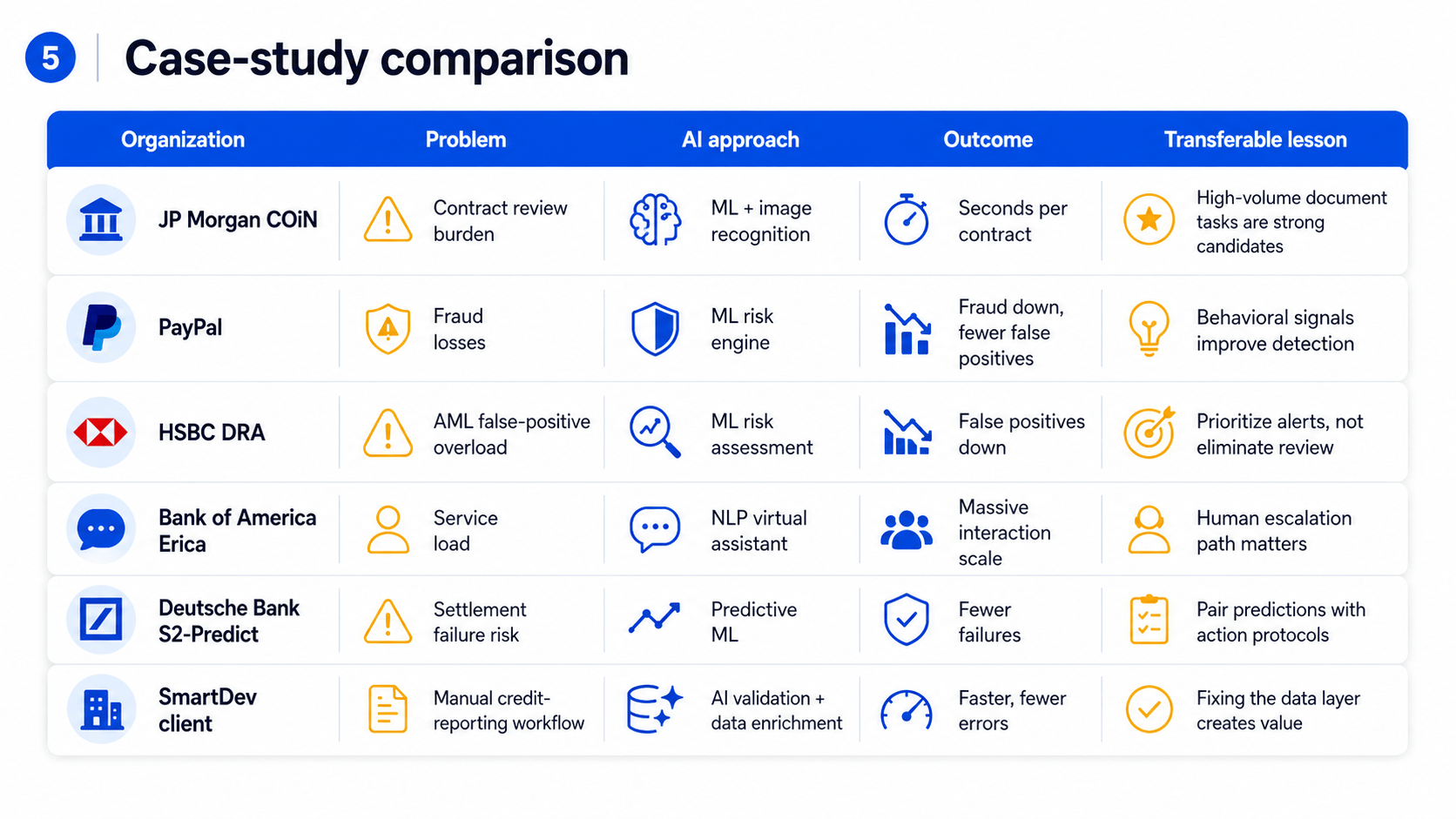
Case-Study Comparison Table
| Organization | Problem | AI approach | Governance control | Measurable outcome | Transferable lesson |
|---|---|---|---|---|---|
| JP Morgan (COiN) | 360,000 hours/year in contract review | ML + image recognition for data extraction | Human validation on extracted fields | Seconds per contract vs. hours | High-volume document tasks are strong ML candidates when output can be validated at scale |
| PayPal | Rising fraud losses across 400M+ users | ML risk engine with behavioral and device signals | Risk scoring; human review above threshold | Fraud losses down ~20%; false positives down 30% | Behavioral signals improve fraud models more than transaction data alone |
| HSBC (DRA) | AML false positive volume consuming compliance capacity | ML-based risk assessment replacing rule-based alerts | Human sign-off on all escalated cases; audit trail | False positives reduced 20%; batch processing time shortened | Alert prioritization is a better pilot scope than alert elimination |
| Bank of America (Erica) | Customer service load and 24/7 availability gap | NLP-based virtual assistant | Defined escalation path to human agent | 2B+ interactions; 2M daily | Availability and scale, not relationship replacement, is the virtual assistant value proposition |
| Deutsche Bank (S2-Predict) | Settlement failure creating operational and financial risk | Predictive ML on historical transaction and risk-factor data | Proactive client notification; human decision on corrective action | Reduced settlement failure rates; lower associated penalties | Predictive failure prevention requires a defined client-facing action protocol |
| SmartDev / credit-reporting client | Manual data processing, fragmented workflows, weak security | AI-driven validation, data enrichment, automated reporting workflows | Encryption, access controls, compliance audit trail | Reduced error rates; faster credit evaluation; extended access to underserved populations | Automation of validation logic is high-value when data inputs are diverse and inconsistent |
SmartDev Case Study: Credit-Reporting Automation
SmartDev partnered with a financial services provider to rebuild a legacy credit-reporting system. The client faced manual data processing bottlenecks, fragmented workflows across data sources, and inadequate security controls for sensitive customer information.
SmartDev implemented real-time data validation engines, AI-powered data enrichment, and automated reporting workflows. Security was rebuilt around advanced encryption and role-based access controls to meet compliance requirements.
Operational outcomes: reduced error rates in credit evaluation, faster turnaround on assessments, and expanded access to credit for applicants previously excluded by data gaps in traditional scoring systems. The transferable lesson: re-engineering the data layer — not just adding a model — is often the highest-value intervention in legacy finance environments.
6. Risks, Governance, and Responsible AI
Governance is not an add-on to AI implementation. It is part of the design. A credit model without an explainability mechanism, a fraud system without a dispute process, or an AML tool without an audit trail are not production-ready, regardless of model performance.
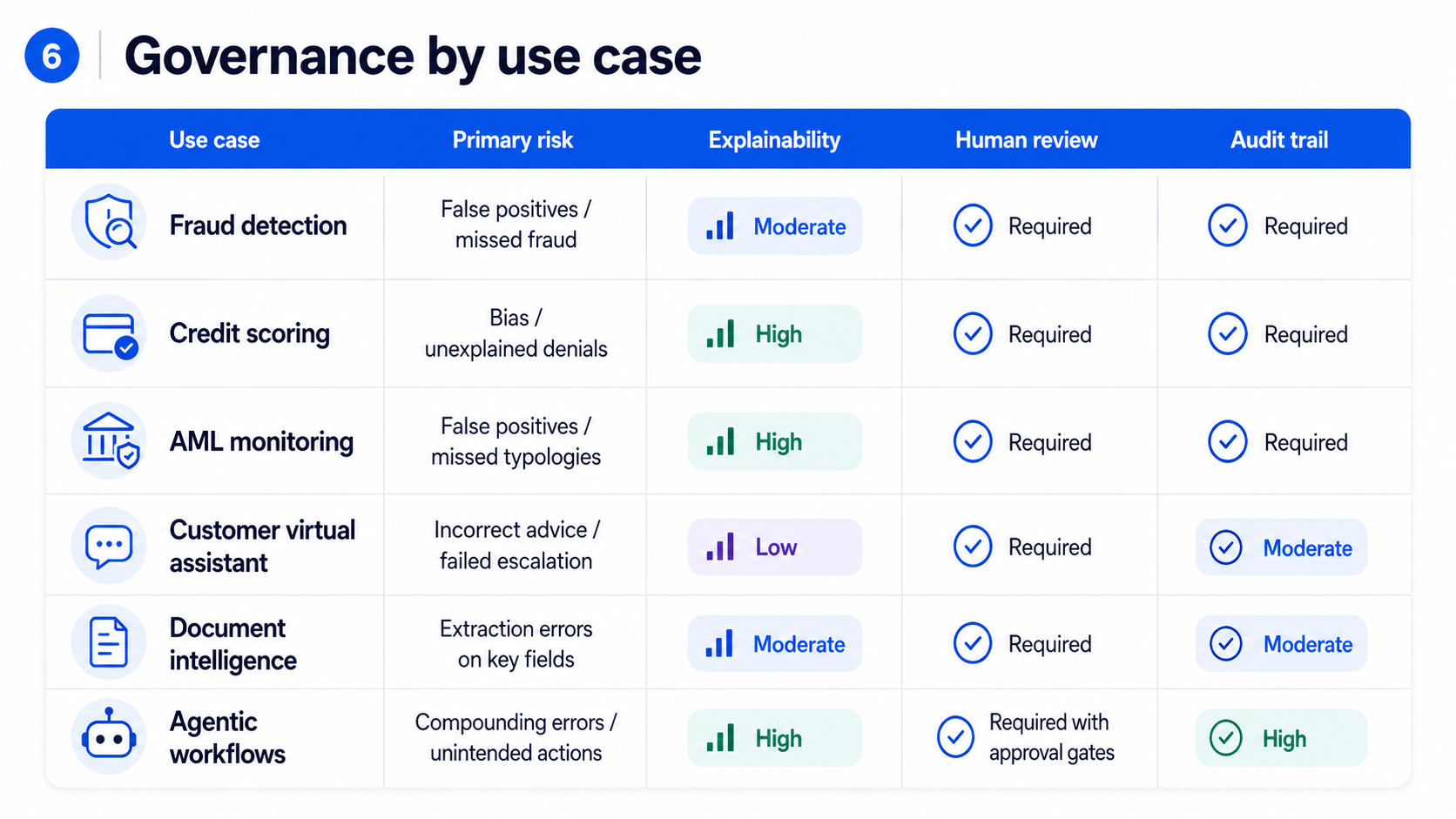
Governance-by-Use-Case Matrix
| Use case | Primary risk | Explainability required | Human review required | Audit trail required |
|---|---|---|---|---|
| Fraud detection | False positives blocking legitimate customers; false negatives missing fraud | Moderate — for dispute resolution | Yes — exception and dispute review | Yes — for dispute and regulatory response |
| Credit scoring | Bias against protected classes; unexplained denials | High — adverse action notice required | Yes — edge cases and appeals | Yes — regulatory audit |
| AML monitoring | False positives consuming compliance capacity; missed typologies | High — SAR documentation | Yes — all escalations before filing | Yes — regulatory requirement |
| Customer virtual assistant | Incorrect advice; failure to escalate high-risk queries | Low | Yes — escalation path required | Moderate |
| Document intelligence | Extraction errors on consequential fields | Moderate | Yes — validation on high-stakes outputs | Moderate |
| Agentic workflows | Compounding errors across chained actions; unintended actions | High | Yes — approval gates at consequential steps | High |
Data Privacy, Security, and Cyber Risk
AI systems in finance process sensitive personal and financial data. Compliance with GDPR, CCPA, and sector-specific data protection requirements is a minimum standard. AI systems also represent an expanded attack surface: adversarial inputs, model inversion attacks, and data poisoning are real threat vectors that must be addressed in system design, not retrospectively.
Bias, Fairness, and Explainability in Consequential Decisions
ML models trained on historical data can encode historical inequities. A credit model trained on data from a period when certain demographic groups were systematically underserved will reproduce those patterns unless actively audited and corrected. Bias testing — across protected characteristics defined by applicable law — must be a standard part of model validation before production deployment.
Explainability is not only an ethical requirement; it is a regulatory one. For credit, insurance, and employment decisions, affected individuals have a right to understand the factors that drove an automated decision. SHAP values, LIME, or model documentation are practical tools for meeting this requirement.
Human Oversight, Accountability, and Audit Trails
Human oversight is non-negotiable in three contexts: (1) decisions that affect individual rights or financial access, (2) AML and fraud escalation, and (3) agentic systems performing multi-step automated actions. “Human in the loop” does not mean a human theoretically could review an output. It means a defined person with defined authority reviews before a consequential action is taken.
Audit trails must record what data the model used, what decision or recommendation it produced, who reviewed it, and what action was taken. This is both a governance and a regulatory requirement.
Model Monitoring, Validation, and Third-Party Vendor Governance
Models degrade. A fraud model calibrated on pre-pandemic transaction data will drift as spending patterns change. Model monitoring — tracking performance against baseline metrics on a defined schedule — is a production requirement, not a post-launch nice-to-have.
Third-party AI vendors must be evaluated on the same model risk management standards applied to internally built systems. Contractual access to model documentation, performance data, and validation reports is a procurement requirement in regulated financial services environments.
For a practical framework on responsible AI deployment, SmartDev’s AI ethics and responsible AI resources provide guidance on governance design across use case types.
7. How to Implement AI in Finance
AI implementation in finance follows a defined sequence: readiness assessment, data and governance foundation, use case selection, pilot, validation, production, and monitoring. Skipping steps does not accelerate timelines; it creates downstream failures.
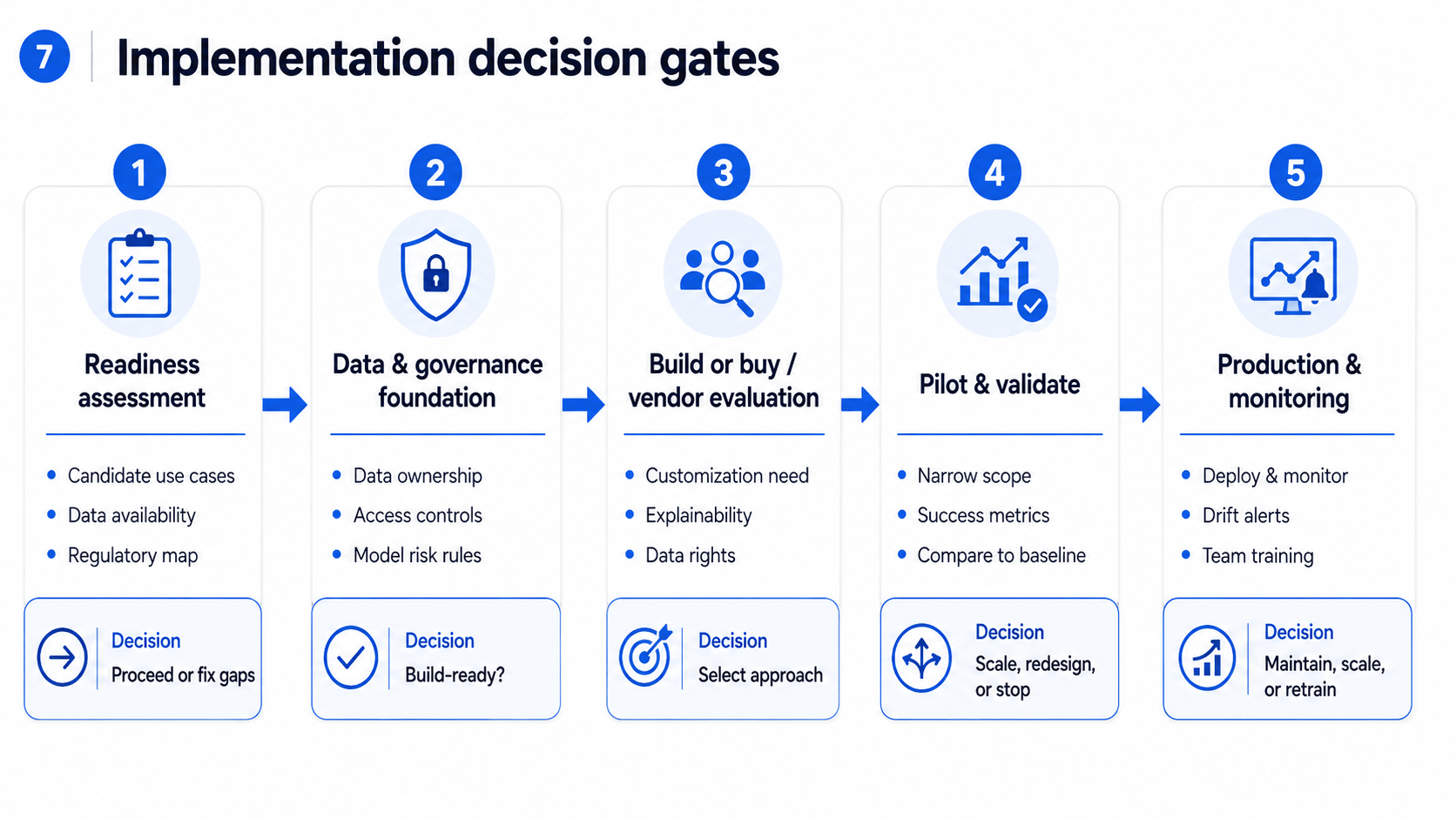
Implementation Decision-Gate Sequence
Gate 1: Readiness Assessment
- Identify candidate use cases with defined business owners
- Assess data availability, quality, and accessibility per use case
- Map regulatory requirements for each candidate
- Decision: proceed to design, or address data/infrastructure gaps first
Gate 2: Data and Governance Foundation
- Establish data governance: ownership, quality standards, access controls
- Define model risk management standards: validation requirements, documentation, approval process
- Assign cross-functional ownership: business owner, data owner, compliance owner, technical owner
- Decision: proceed to build, or pause to complete governance design
Gate 3: Build or Buy and Vendor Evaluation
- Define build-vs-buy criteria: data sensitivity, customization need, total cost, vendor risk
- Evaluate vendors on regulatory alignment, explainability features, data access rights, and performance track record
- For AI-powered software development capabilities, SmartDev’s AI-powered development services support build decisions across the finance stack
- Decision: proceed to pilot with selected approach
Gate 4: Pilot and Validate
- Scope pilot narrowly: single product line, defined user cohort, 8–12 weeks
- Define success criteria before pilot begins: specific metric targets against the pre-deployment baseline
- Run evaluation against a control group where operationally possible
- Decision: proceed to production, redesign, or discontinue
Gate 5: Production and Monitoring
- Deploy with defined monitoring intervals and alert thresholds
- Establish model retraining triggers: performance drift below defined threshold
- Train teams on model outputs, escalation protocols, and override authority
- Decision: scale, maintain, or retrain
Train Teams and Define Cross-Functional Ownership
AI systems require human operators who understand model limitations. A compliance analyst using an AI-generated alert must understand what the model can and cannot detect. A credit officer reviewing an ML-assisted application must understand what variables drove the score and when manual judgment should override it.
Training is not optional. It is a deployment dependency. For team upskilling across AI implementations, SmartDev’s AI Development Services include knowledge transfer as part of project delivery.
8. Measuring AI ROI in Finance
AI ROI in finance is measured against a defined pre-deployment baseline. Without a baseline, there is no result — only a claim. The framework below applies across use cases.
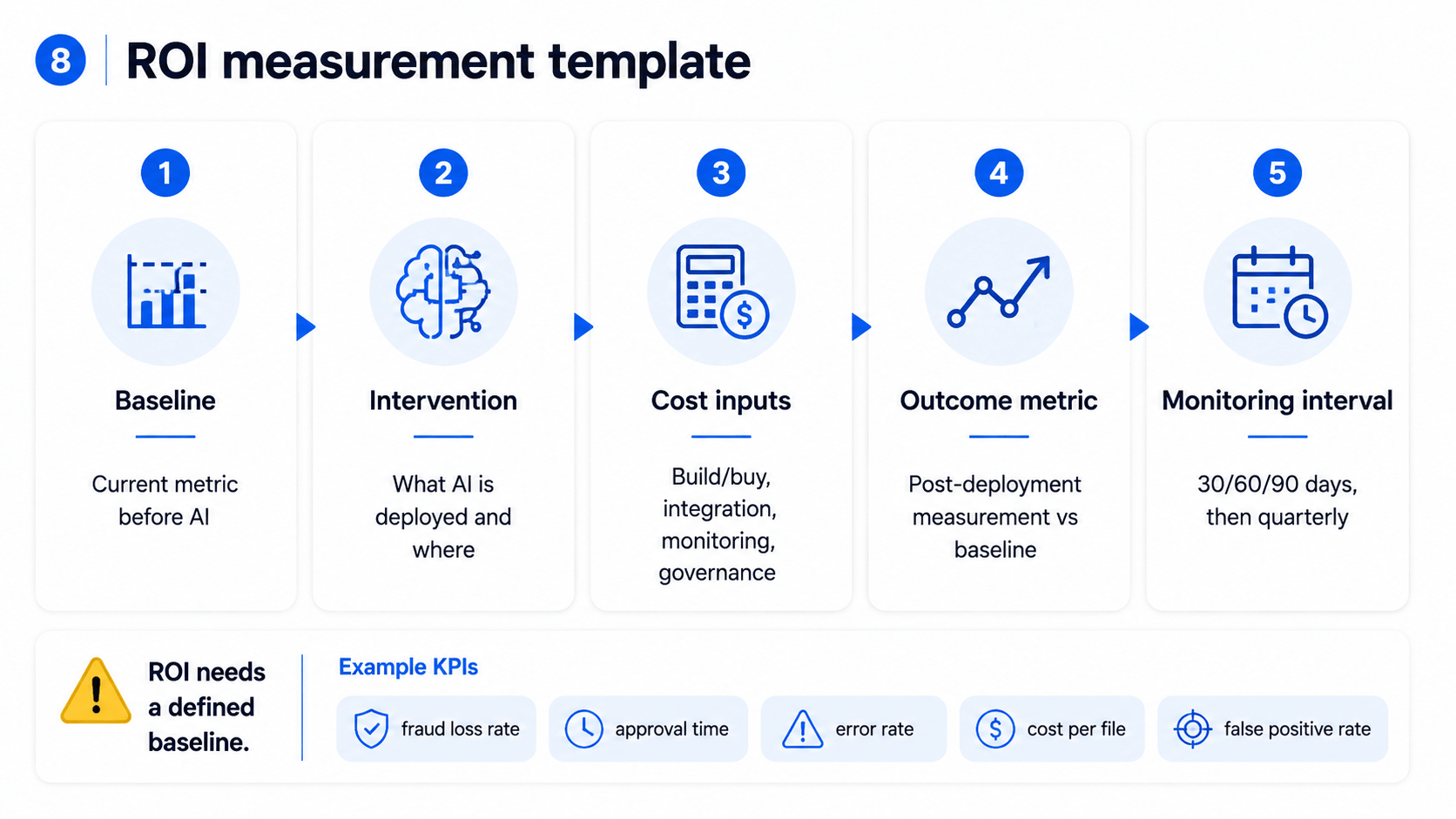
ROI Measurement Template
| Step | What to define |
|---|---|
| 1. Baseline | Current metric value before AI deployment (e.g., fraud loss rate: 0.18% of transaction volume; contract review time: 4.5 hours per file) |
| 2. Intervention | Which AI capability is being deployed and to what scope (e.g., ML fraud scoring applied to all card-present transactions above $50) |
| 3. Cost inputs | Implementation cost (build/buy, integration, data preparation); ongoing cost (infrastructure, monitoring, governance, retraining); change management |
| 4. Outcome metric | Post-deployment measurement of same metric against baseline (e.g., fraud loss rate: 0.14%; contract review time: 12 minutes per file) |
| 5. Monitoring interval | Defined period for next performance review (e.g., 30/60/90 days post-launch; quarterly thereafter) |
Operational, Risk, Customer, and Financial Outcome Metrics
Operational metrics: processing time per unit, error rate, throughput volume, FTE hours per function.
Risk metrics: fraud detection rate, false positive rate, AML alert-to-SAR conversion rate, model accuracy on holdout data, default rate in approved cohort.
Customer metrics: first-contact resolution rate, CSAT, average handling time, digital channel adoption.
Financial metrics: cost per transaction, loss rate, compliance cost per FTE, net interest margin on AI-assisted approvals.
Measure Value by Use Case
- Fraud: baseline and track fraud loss rate, false positive volume, and cost per investigation
- Credit: baseline and track processing time, approval rate by segment, and 90-day default rate on approved applications
- Operations/document: baseline and track hours per document, error rate on extracted fields, and cost per processed file
- Customer service: baseline and track first-contact resolution, escalation rate, and agent handling time
Account for Full Implementation Costs
ROI claims that omit implementation cost, governance overhead, change management, and ongoing monitoring are misleading. A model that reduces fraud losses by $2M but costs $3M to build, operate, and govern annually does not have a positive ROI in year one. Full cost accounting is not pessimism — it is the only way to make a credible investment case. For AI development cost considerations, see SmartDev’s AI development cost resource.
A 2024 Bain & Company survey found that financial institutions adopting generative AI reported an average 20% productivity improvement in customer service, compliance, and IT functions. These gains are real, but they are averages across organizations with mature data infrastructure. Organizations at earlier maturity stages should not apply benchmark figures from mature adopters to their own planning.
9. Emerging Developments Shaping AI in Finance
The most important distinctions for finance leaders evaluating emerging AI are not between vendors or model architectures — they are between what is production-ready, what is scaling, and what is genuinely experimental.
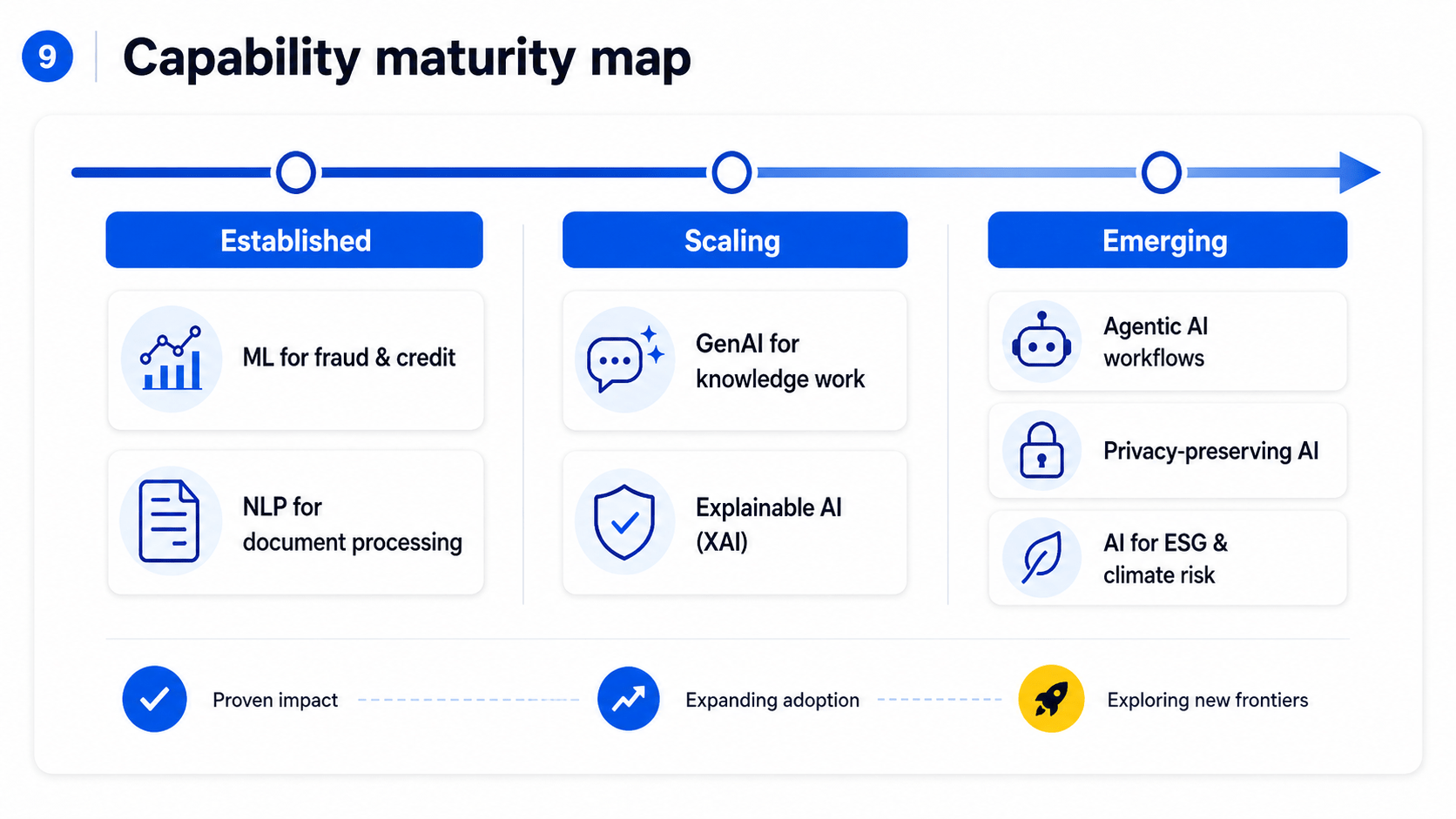
AI Capability Maturity Map
| Capability | Maturity stage | Finance application | Primary constraint |
|---|---|---|---|
| ML for fraud and credit | Established | Fraud scoring, credit modeling, AML alert prioritization | Data quality and model drift management |
| NLP for document processing | Established | Contract extraction, onboarding document review, reporting | Validation requirements on extracted fields |
| GenAI for knowledge work | Scaling | Regulatory report drafting, research summarization, client communication | Hallucination risk; human review required |
| Agentic AI workflows | Emerging | Multi-step compliance workflows, end-to-end loan processing | Approval gate design; compounding error risk |
| Explainable AI (XAI) | Scaling | Credit decision transparency, model audit | Integration with existing model architecture |
| Privacy-preserving AI | Emerging | Federated learning across institutions, synthetic data | Significant technical complexity; not yet mainstream |
| AI for ESG and climate risk | Emerging | Portfolio carbon exposure, green asset evaluation | Data availability and standardization |
Generative AI for Finance Knowledge Work and Document Workflows
GenAI is productive today in bounded, reviewable tasks: summarizing earnings filings, drafting regulatory reports from structured data inputs, or generating first-draft client communications from template data. It is not reliable for autonomous high-stakes decisions.
The key design principle: GenAI output in finance must have a defined human review step before any consequential action. “Reviewed by AI” is not a control. “Reviewed by AI and signed off by [named role]” is a control.
Agentic Workflows with Human Approval Controls
Agentic AI — systems that chain multiple AI steps, use external tools, and make conditional decisions — is being prototyped in financial services for workflows such as: onboarding document collection and verification, loan application processing, and compliance monitoring. For context on how SmartDev builds agentic systems, see our AI agent development capabilities.
The critical design requirement is approval gates. An agentic system that can send communications, file regulatory documents, or initiate transactions without human approval is not production-ready in a regulated financial environment. The architecture must define: at what steps does the system pause for human review? Who has override authority? What happens if the system cannot complete a task?
Explainable AI, Privacy-Preserving AI, and Resilient Systems
XAI tools — SHAP, LIME, attention visualization — are maturing and increasingly expected by regulators for credit and insurance models. They are not a replacement for model documentation, but they make documentation more auditable.
Privacy-preserving techniques including federated learning (training models on distributed data without centralizing it) and synthetic data generation are promising for multi-institution collaboration on fraud typologies and AML models. These remain technically complex and are not yet standard practice.
FAQ: AI in Finance
What are the most common uses of AI in finance?
The most production-proven applications are fraud detection and prevention, credit scoring and loan underwriting, AML monitoring, customer-facing virtual assistants, and document intelligence for onboarding and operations. Each of these has a clear decision or task, measurable outcomes, and an established implementation track record across major financial institutions.
How is AI used in fraud detection and credit scoring?
In fraud detection, ML models assign a risk score to each transaction in real time by comparing behavioral patterns, device signals, and transaction attributes against historical fraud data. In credit scoring, ML models supplement traditional credit bureau data with alternative signals — transaction behavior, employment patterns — to improve accuracy and expand access. Both use cases require defined monitoring and, for credit, explicit explainability mechanisms.
What are the main risks of AI in financial services?
The primary risks are: (1) model bias encoding historical discrimination into automated decisions, (2) explainability gaps creating regulatory liability in adverse-action contexts, (3) data privacy breaches from centralized sensitive data, (4) model drift reducing accuracy as behavior patterns change, and (5) third-party vendor risk when institutions deploy AI they do not own or fully understand. Each has a defined governance response; none is acceptable as an unmanaged residual risk.
How should a financial institution choose its first AI use case?
Apply the Value–Readiness–Risk framework described in Section 4. Choose a use case where: the outcome is measurable and tied to a material business metric, the required data is available and of sufficient quality, and the regulatory exposure is manageable within your current governance capabilities. Fraud alert prioritization and document extraction are commonly strong first-use-case choices because they are high-value, data-rich, and have low adverse-action exposure.
How can finance teams measure AI ROI?
Set a baseline metric before deployment. Define the cost of implementation, ongoing operation, and governance. Measure the same metric post-deployment. Compare. A fraud model that improves detection rate by 6 percentage points and reduces false positives by 25% against a defined baseline has a result. A system described as “making the team more efficient” does not. ROI measurement works only if baseline, cost, and outcome are defined in advance.
Conclusion
The finance leaders who extract durable value from AI are not those who deploy the most models. They are those who define the problem before choosing a solution, audit their data before selecting a model, design governance before going to pilot, and measure outcomes against a real baseline.
The Value–Readiness–Risk framework in Section 4 is the decision tool. Use it before committing to a use case, not after.
AI in financial services is not early-stage. Fraud detection, credit scoring, document intelligence, and AML monitoring are proven applications with documented operating outcomes. Generative AI for knowledge work is scaling. Agentic workflows are emerging. Deploying established applications well — with the right data, governance, and measurement — delivers more value than chasing frontier capability without those foundations.
Next Steps: Explore AI Development for Financial Services
If you have identified a viable use case and are ready to move from opportunity to implementation, the next decision is whether to build, buy, or partner.
SmartDev works with financial services organizations across the pilot-to-production lifecycle — from use case scoping and data readiness assessment through model development, governance design, and production monitoring.