TL;DR
- Start from the problem, not the technology. Readiness beats opportunity size – a high-value use case with weak data or an unstable process will underperform a lower-profile one that’s actually ready to run.
- Demand forecasting and predictive maintenance are the strongest first bets for most operators. Both typically run on data you already collect and don’t require the safety-critical governance that quality inspection or traceability use cases need before they can scale.
- A use case isn’t pilot-ready just because it’s high-value. It’s ready when the data exists in usable form, the process is stable enough to model, and a business KPI is already defined – not something to figure out after the pilot starts.
- Anything touching food safety or a recall decision needs a human reviewing every flagged exception, with real authority to override. That’s a design requirement for safety-adjacent AI, not an optional safeguard layered on later.
- Every pilot should be scoped narrow and measured against a documented baseline – one line, one SKU category, or one site, run long enough to cover a full operating cycle before anyone talks about scaling it.
- Pick the KPI before the vendor. If a use case doesn’t have a trackable metric attached to it, it isn’t a pilot yet. It’s still a hypothesis.
- Scaling only happens after a pilot clears four dimensions at once – performance, safety, adoption, and economics – not after a strong accuracy number alone.
Introduction
Food businesses lose value in predictable places. Product spoils before it sells. A defect gets missed on the line and turns into a recall. Equipment fails without warning and stops a shift. A safety issue gets caught, but scoping the recall takes days instead of hours. None of these losses are exotic. They’re operational, and they’re measurable.
AI’s role in food operations isn’t to modernize a brand or keep pace with a trend. It’s to move a small set of numbers operators already track: how much product goes to waste, how consistently quality holds on the line, how much unplanned downtime costs, and how fast a business can trace and contain a safety issue once one is flagged. Food safety alone shows what’s at stake. The FDA estimates that roughly 48 million Americans get sick from foodborne illness every year, and manual inspection can’t scale to the throughput of a modern processing line.
That’s the frame this guide holds throughout. AI in food operations is a decision about quality, waste, uptime, traceability, and speed. It is not a technology to adopt because competitors are experimenting with it. The sections that follow separate the applications with a proven, measurable track record from the ones still better suited to a narrow pilot or a watch list – starting with where AI actually fits across the food value chain, covered next.
What AI Means for Food Businesses
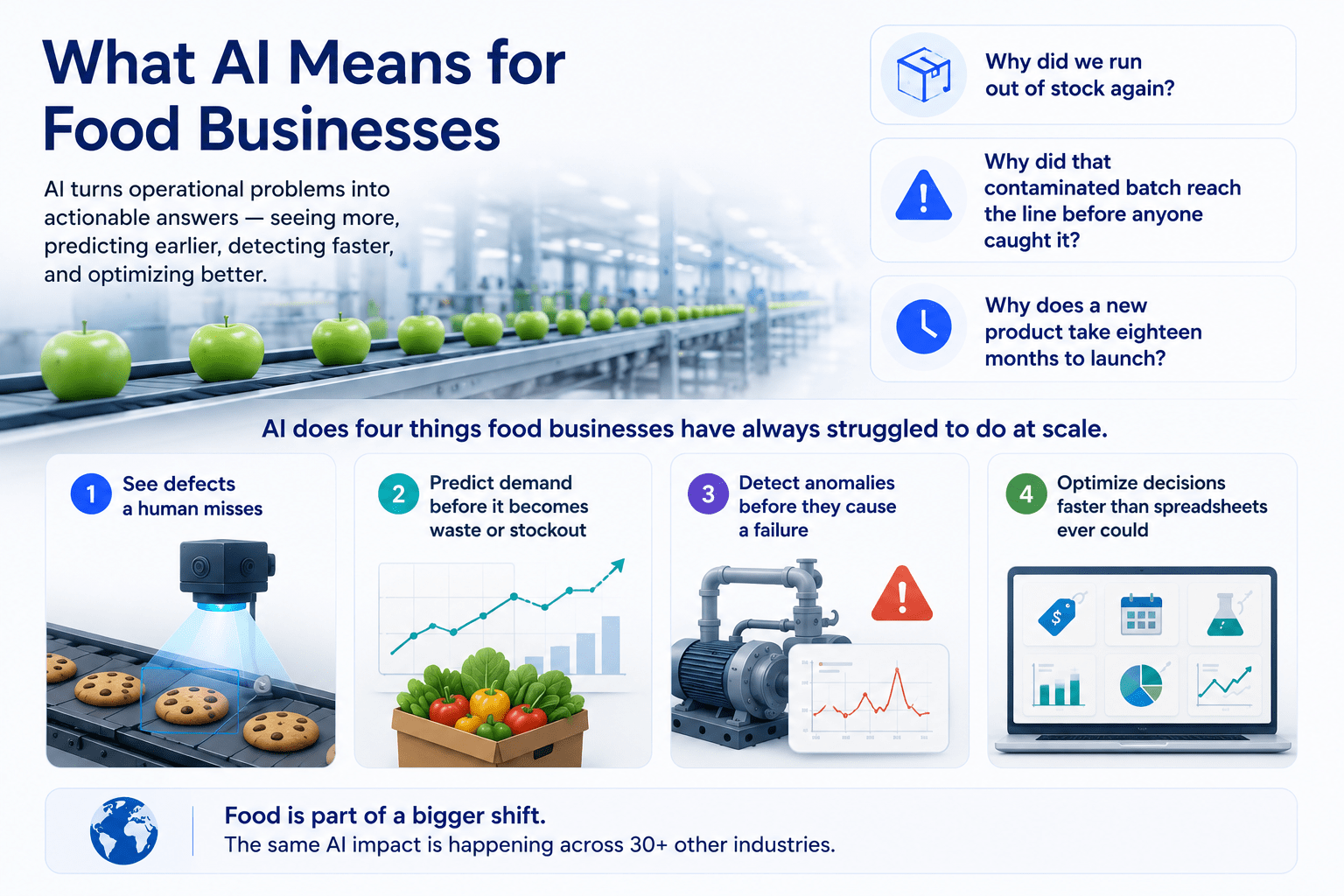
Food businesses don’t need AI in the abstract. They need answers to operational problems. Why did we run out of stock again? Why did that contaminated batch reach the line before anyone caught it? Why does a new product take eighteen months to launch?
AI matters here for a specific reason. It’s now the most reliable way to do four things food businesses have always struggled to do at scale. It can see defects a human inspector misses. It can predict demand before it turns into waste or a stockout. It can detect anomalies in equipment or temperature before they cause a failure. And it can optimize decisions – pricing, scheduling, formulation – faster than a person working from spreadsheets ever could. Food is only one part of this shift; SmartDev’s AI use cases hub tracks the same pattern playing out across more than 30 other industries.
The food-industry problems AI is built to address
Three structural pressures explain why AI adoption in food has accelerated, rather than staying stuck at the pilot stage.
- Waste and thin margins. Food is perishable. Small forecasting errors compound quickly into spoilage, markdowns, and write-offs. Net margins in this industry are frequently in the low single digits. A 5-10% improvement in demand accuracy can be the difference between a profitable SKU and a discontinued one.
- Safety risk with zero tolerance for error. The FDA estimates that roughly 48 million Americans get sick from foodborne illness every year. Manual inspection can’t scale to the throughput of modern processing lines. A single missed contamination event can trigger a recall that costs far more than the inspection system that would have caught it.
- Supply chain and sourcing complexity. Ingredients, weather, labor, and consumer preference all shift independently, and increasingly fast. A business relying on manual planning cycles can’t process that many moving variables quickly enough to stay ahead of them.
AI doesn’t remove these pressures. It gives operators a faster, more consistent way to detect and respond to them. That’s why the highest-value use cases in this guide cluster around exactly these three pressures: safety-critical inspection, demand and inventory, and equipment or cold-chain reliability. If you’re mapping out where to start, SmartDev’s guide on how to integrate AI into your business walks through the same readiness questions in more general terms.
Core AI technologies used across the food value chain
“AI” in a food operation is rarely one system. It’s a small set of underlying technologies, each applied to a different job – for a broader breakdown of how these types of AI models differ and where each one fits, it’s worth understanding the categories before mapping them to your own operation.
| Technology | What it does | Typical job in food operations |
|---|---|---|
| Machine learning (ML) | Learns patterns from historical data to predict outcomes | Demand forecasting, shelf-life prediction, equipment failure prediction |
| Computer vision | Interprets images or video in real time | Defect detection, label and fill-level checks, packaging integrity, sorting and grading |
| Natural language processing (NLP) | Extracts meaning from text and speech | Analyzing reviews and social data for product trends, processing compliance documents, powering customer-facing chat and voice ordering |
| IoT sensors and connectivity | Streams real-time condition data from equipment and environments | Cold-chain temperature and humidity monitoring, equipment vibration and performance data |
| Optimization algorithms | Finds the best decision among many constraints | Route planning, production scheduling, recipe and ingredient optimization under cost, nutrition, and allergen constraints |
None of these technologies is useful in isolation. They matter because of the operational job they’re paired with. A camera on a bottling line is just a camera until a computer vision model is trained to recognize a misaligned label. A sensor in a freezer is just a thermometer until an ML model learns what “normal” looks like and can flag what isn’t – the freezer example matters more than it sounds, since connected sensors are also the backbone of the IoT infrastructure that makes real-time monitoring possible in the first place, along with its own cost and integration trade-offs.
Where AI creates value: safety, quality, waste, speed, and resilience
Across every use case in this guide, AI’s business value in food operations concentrates in five places:
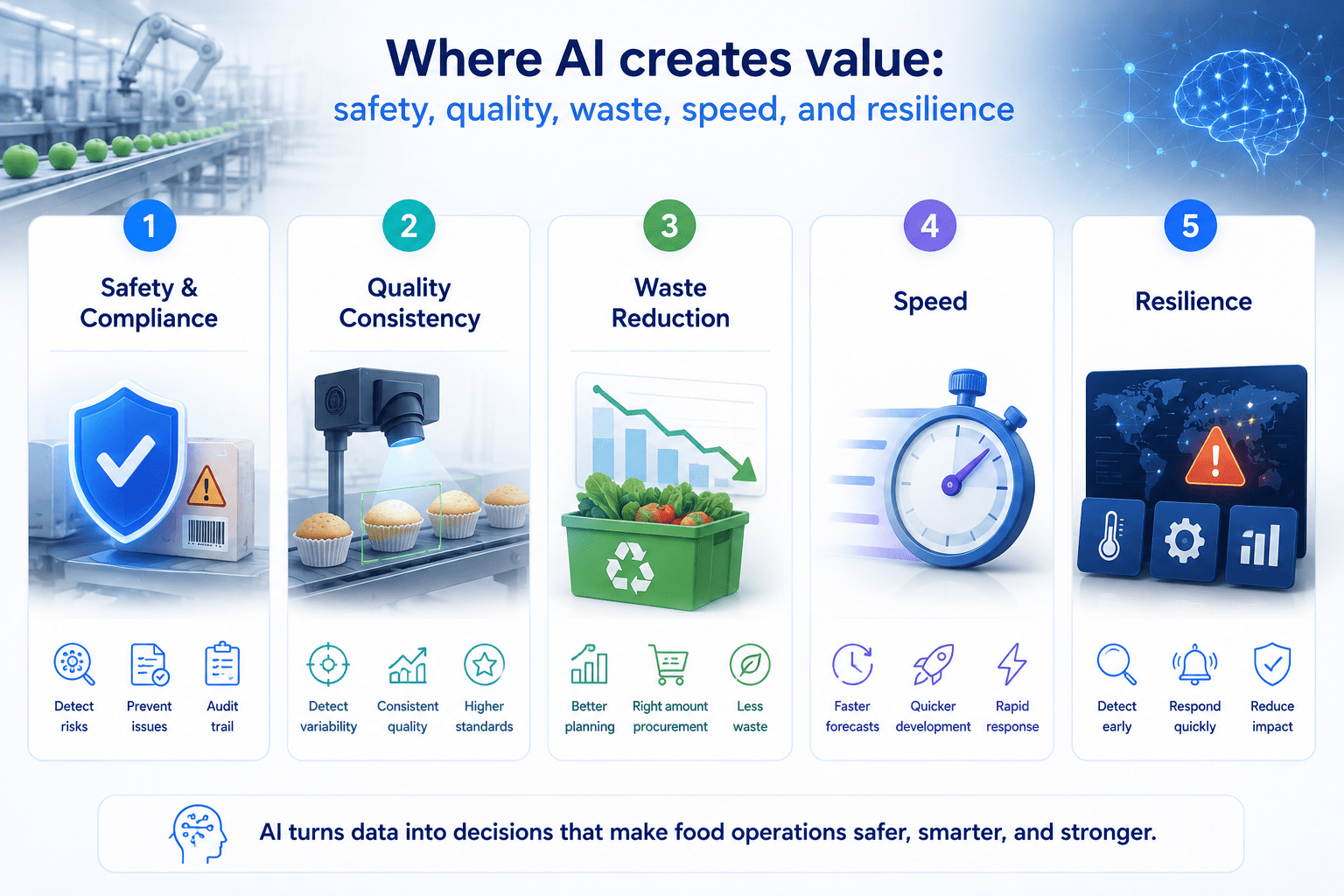
- Safety and compliance – catching contamination, mislabeling, and allergen risk before product ships. Also generating the audit trail regulators require.
- Quality consistency – reducing the variability that comes from manual, fatigue-prone inspection.
- Waste reduction – aligning production and procurement with what will actually be sold or used, not with what was planned weeks in advance.
- Speed – compressing forecasting cycles, product development timelines, and issue-response times from weeks down to hours.
- Resilience – giving operations the ability to detect and respond to disruption before it cascades into a larger loss. That includes equipment failure, temperature excursions, and demand shocks.
The market reflects this. Precedence Research projects the global AI-in-food-and-beverage market will reach $48.9 billion by 2032. That’s a 45.4% CAGR from 2023. This growth isn’t driven by novelty. It’s driven by operators who have quantified the return on their AI investment in exactly these five areas – examples of which run throughout the rest of this guide.
How AI Is Used Across the Food Value Chain
Not every AI use case belongs to the same part of the business. Treating them as interchangeable is where many adoption strategies lose focus. A vision-inspection system on a bottling line and a recommendation engine on a delivery app solve completely different problems. They sit with different owners. They draw on different data. Mapping AI to the value chain, rather than to a generic list of “AI use cases,” makes it easier to see where your organization actually has a problem worth solving.
Farm, sourcing, and ingredient intake
- Owner: Agronomy, procurement, and quality-assurance teams closest to raw material intake.
- Core data: Satellite and sensor imagery, soil and weather data, supplier quality records.
- Typical outcome: Fewer crop losses. Earlier detection of quality issues before they enter the plant.
AI-powered precision agriculture helps growers optimize planting schedules, irrigation, and pesticide use. Satellite imagery and AI-based sensors can flag crop stress or disease early enough to intervene. Robotics are also moving into the field directly. Companies like FarmWise deploy ML-guided robotic weeders that identify and remove weeds with precision, cutting chemical use and labor costs in vegetable production. For food businesses further downstream, the relevant application is usually supplier-side quality scoring – using AI to flag ingredient batches likely to fail spec before they ever reach the plant, the same upstream discipline covered in SmartDev’s supply chain management use cases guide.
Food processing and manufacturing
- Owner: Plant operations, quality control, and manufacturing engineering.
- Core data: Line-camera video and images, sensor telemetry from processing equipment, batch and production records.
- Typical outcome: Fewer defects and recalls. Higher throughput. Less manual rework.
This is where computer vision and robotics have the most mature track record, and it’s a pattern that shows up across AI use cases in manufacturing far beyond food specifically. AI models trained on production-line imagery detect foreign objects, discoloration, bruising, and packaging defects at line speed. That’s work manual inspection struggles to sustain consistently over a full shift. Robotics integrated with computer vision are automating sorting, grading, and packaging tasks, which reduces both labor dependency and human error. Sensor data from the same equipment also feeds predictive-maintenance models, flagging developing issues before they cause unplanned downtime.
Cold chain, warehousing, and distribution
- Owner: Supply chain, logistics, and cold-storage operations.
- Core data: IoT temperature and humidity sensors, fleet and warehouse telemetry, historical spoilage and delivery records.
- Typical outcome: Fewer temperature excursions. Less spoilage. Better on-time delivery.
Temperature-sensitive products depend on tightly monitored cold-chain infrastructure across multiple handoffs – plant to warehouse to truck to retailer. AI models trained on sensor and equipment data can detect abnormal patterns and predict failures before a breakdown occurs, rather than after spoilage has already happened. Unilever’s Swedish operations are a good example. They used AI to correlate weather patterns with inventory demand. Forecast accuracy improved by roughly 10%, and the result was a 12% U.S. sales improvement in ice cream lines, driven by less downtime and spoilage. Warehouse operators like Lineage Logistics and Americold apply similar AI-driven optimization to minimize temperature deviations and improve efficiency in sub-zero storage environments.
Retail, foodservice, and consumer experience
- Owner: Marketing, retail operations, and foodservice management.
- Core data: Point-of-sale transactions, loyalty and app data, social and review data, delivery logistics data.
- Typical outcome: Higher forecast accuracy at the store or restaurant level. More relevant recommendations. Faster, more consistent delivery.
At the consumer-facing end of the chain, AI does two main jobs. First, it personalizes meal and nutrition recommendations based on dietary preferences or health goals – the same kind of AI-driven customer experience work retailers and foodservice brands are applying across nearly every purchase decision.
Second, it analyzes social media, reviews, and purchase data to spot emerging taste trends. Fast-food and quick-service chains have adopted AI heavily for this. McDonald’s, Domino’s, Starbucks, and Yum Brands all use AI platforms – often through partners like Google Cloud, Microsoft, Nvidia, and IBM – for inventory ordering, labor optimization, and menu personalization. Yum Brands reported a 15% increase in digital same-store sales in 2024, tied in part to these systems. Delivery is also increasingly automated. Coco Robotics and Serve Robotics operate autonomous sidewalk delivery in U.S. cities. Zipline and Wing run aerial delivery services. Together, these extend AI’s reach from the plant floor all the way to the customer’s door.
The Highest-Value AI Use Cases in the Food Industry
Each use case below follows the same structure. First, the problem it solves. Then, what data it needs. Then the operating constraints that make food different from other industries, the KPI that proves it’s working, the main risk to manage, and what a reasonable first pilot looks like. Use this structure to compare use cases against your own operation, rather than judging them by novelty alone.
AI-powered quality inspection and food-safety monitoring
Problem: Manual inspection can’t consistently catch every defect, contamination event, or packaging error at line speed. And the cost of missing one – a recall, a safety incident, lost consumer trust – is disproportionately high.
Computer vision for defects, foreign objects, labels, fill levels, and packaging integrity. These systems use convolutional neural networks trained on thousands of labeled images. They recognize anomalies in real time: foreign objects, discoloration, bruising, label misalignment, incorrect fill levels. Non-conforming products get flagged or rejected before they leave the line. One large beverage and snack producer deployed vision AI on its bottling lines specifically to catch label misalignment and liquid-level discrepancies. The result was a 30% reduction in defects and a 20% drop in manual rework time.
Human oversight, validation, and auditability in safety-critical decisions. False negatives in food safety carry public-health consequences. Because of that, these systems aren’t deployed to fully replace inspectors. They run with human-in-the-loop verification instead – flagged exceptions get reviewed by trained staff, and the model’s decisions stay auditable for regulators. This is the same principle SmartDev’s business-oriented guide to responsible AI covers in more depth: fairness, transparency, and accountability need to be built into the pipeline, not bolted on after deployment. Training data diversity also matters here. Models trained on narrow product variations or lighting conditions can develop blind spots. Ongoing validation against real production variation has to be part of the operating model, not a one-time setup step.
- KPI: Defect and recall rate, false-negative rate on safety-critical flags, manual rework time.
- Risk: Over-trusting an unvalidated model in a safety-critical decision. Insufficiently diverse training data.
- Pilot fit: One line, one product category, with human review on every flagged exception before scaling.
Demand forecasting, inventory optimization, and food-waste reduction
Problem: Over-ordering leads to spoilage and markdowns. Under-ordering leads to stockouts and lost sales. Food’s perishability means the margin for forecasting error is narrower than in most other industries.
Signals that improve forecasts: sales, seasonality, weather, promotions, and events. AI demand-forecasting systems combine historical point-of-sale data with external signals – weather, local events, promotional calendars – to generate forecasts at the SKU and daily level. That’s far more granular than manual planning allows, and it’s the same forecasting discipline that shows up across AI use cases in consumer goods, where demand prediction and supply chain optimization are consistently the highest-value starting points. McKinsey has reported that AI-driven demand forecasting can improve service levels by up to 65% while cutting inventory costs by 20-30%. Results at individual operators back this up. Juici Patties combined POS and weather data to boost U.S. sales by 12% while reducing stockouts. Church Brothers Farms worked with ThroughPut AI to improve short-term forecast accuracy by up to 40%.
Business outcomes: waste, stockouts, service level, and inventory turns. The measurable outcomes of better forecasting are consistent across operators: less spoilage, fewer markdowns, higher inventory turns, better fill rates. Zest’s AI trial with Nestlé in the UK is one of the more striking examples. Over a two-week test, it delivered an 87% reduction in edible food waste, saving an estimated 700 tonnes of surplus and cutting CO₂ emissions by roughly 1,400 tonnes. The associated cost savings came to around £14M.
- KPI: Forecast accuracy (MAPE), waste and spoilage rate, stockout rate, inventory turns, fill rate.
- Risk: Feeding the model incomplete or siloed data. This produces confident but wrong forecasts. (See the fragmented-data note below.)
- Pilot fit: A single product category or distribution center, run in parallel with existing planning for one full seasonal cycle before cutover.
Predictive maintenance and production performance optimization
Problem: Unplanned equipment downtime on a food production line doesn’t just stop output. It can compromise product held mid-process. Reactive maintenance is consistently more expensive than planned maintenance.
Equipment, sensor, and anomaly data. These systems ingest continuous telemetry from processing and packaging equipment – vibration, temperature, pressure, run-time. They learn what normal operation looks like, then flag deviations before those deviations become failures. This is the same anomaly-detection approach used in cold-chain monitoring (Section 3.4), just applied to processing and packaging machinery on the plant floor instead – and it’s one of the most common entry points into AI documented across AI use cases in operations, where predictive maintenance alone has cut downtime by 30% for some manufacturers.
Availability, performance, quality, and OEE as operational measures. Mature implementations don’t track maintenance activity in isolation. They tie predictive maintenance to Overall Equipment Effectiveness (OEE) – the combination of equipment availability, performance speed, and output quality. This framing keeps the initiative accountable to production outcomes, not just to fewer breakdowns. A plant can reduce downtime incidents and still lose ground if performance or quality dips elsewhere.
- KPI: OEE, unplanned downtime hours, mean time between failures, maintenance cost per unit produced.
- Risk: Sensor data quality and coverage. Predictive models are only as good as the telemetry feeding them, and legacy equipment often lacks adequate instrumentation.
- Pilot fit: A single high-value or high-failure-cost machine or line. Instrument it first, model it second.
Cold-chain intelligence and end-to-end traceability
Problem: Temperature-sensitive products move through multiple handoffs – plant, warehouse, truck, retailer. A single unmonitored excursion anywhere in that chain can spoil product, or worse, create a safety issue that isn’t caught until much later.
Temperature-risk monitoring and exception response. AI systems monitor sensor and equipment data across refrigeration units, vehicles, and storage environments. They learn normal operating ranges, then flag deviations for immediate response – often before a breakdown or spoilage event actually occurs. Unilever’s Swedish operation is a representative example: it used AI to correlate weather data with cold-chain demand, improving forecast accuracy by around 10% and contributing to reduced downtime and spoilage.
Traceability, recall-scope decisions, and data continuity. The same sensor and batch data that supports temperature monitoring is what makes traceability possible. When a safety issue is identified, AI-processed traceability data lets a business scope a recall precisely – which batches, which distribution points, which retailers – instead of pulling far more product than necessary out of caution. This depends on data continuity across every handoff in the chain, the same end-to-end visibility problem covered in SmartDev’s supply chain AI use cases guide. A gap at any single point, like a warehouse without connected sensors or a carrier without integrated telemetry, breaks the chain of evidence needed to scope a recall accurately.
- KPI: Temperature-excursion incidents, spoilage rate, recall scope and precision, time-to-detect for cold-chain anomalies.
- Risk: Partial instrumentation. Traceability is only as strong as its weakest, least-connected link.
- Pilot fit: One distribution lane or one product category with full sensor coverage end-to-end, before expanding to partially instrumented lanes.
AI-assisted product development, formulation, and sensory innovation
Problem: Traditional recipe and product development cycles run months to years. They involve repeated rounds of formulation, lab testing, and consumer panels before a product is launch-ready.
Ingredient, nutrition, cost, allergen, taste, and shelf-life constraints. Generative and optimization-based AI platforms simulate ingredient combinations against multiple constraints at once – nutrition targets, cost ceilings, allergen exclusions, taste-preference data, shelf-life requirements. This narrows a much larger possibility space down to a short list of viable candidate recipes, before any physical testing even begins – a use of AI that mirrors what SmartDev’s product development use cases guide documents across other industries, where generative models are similarly used to compress concept-to-prototype timelines. Mondelez International worked with Fourkind to apply this approach across more than 70 product projects, including a gluten-free Golden Oreo. Development time dropped by 4–5×, and products developed this way saw a sales lift of roughly 5.4%.
Human sensory validation and product governance. AI narrows the field. It doesn’t replace the final decision. Human sensory teams still validate taste, texture, and brand fit on the shortlisted candidates. Product governance processes still confirm regulatory, labeling, and cultural-appropriateness requirements before launch. This hybrid model is what makes the speed gain sustainable. It removes the slowest, most repetitive part of the cycle – broad-based trial and error – without removing human judgment from the parts that require it.
- KPI: Time-to-launch, number of physical iterations required, post-launch sales lift, R&D cost per launched product.
- Risk: Treating AI-ranked candidates as launch-ready without adequate sensory and regulatory validation.
- Pilot fit: One product line or category extension, run alongside a traditional-process control group to measure the speed and cost difference directly.
Smart automation, robotics, and packaging operations
Problem: High-volume sorting, packaging, grading, and freshness monitoring are labor-intensive. They’re error-prone when done manually at scale, and increasingly hard to staff consistently.
Sorting, handling, packaging, grading, and inspection. Robotics integrated with computer vision now handle much of the physical sorting and packaging work on modern lines. They grade produce, pack consistent case configurations, and perform final inspection before product ships. FarmWise’s robotic weeders, mentioned in Section 2, extend this same approach upstream into the field itself. In-plant, these systems reduce labor dependency, improve throughput consistency, and maintain hygiene standards more reliably than fully manual processes running at the same volume.
Smart packaging and shelf-life monitoring. Intelligent packaging embeds sensor data and connects it to real-time analytics. It tracks temperature, humidity, and time-in-transit at the unit or case level, relying on the same IoT sensor and connectivity trade-offs – cost, integration complexity, data volume – that apply to any connected-device rollout. AI processes this stream to validate that product integrity has been maintained, and it triggers alerts when a shelf-life-relevant threshold is crossed. It can catch early warming during transit, for example, before that becomes a spoilage or safety issue further down the chain. This combines IoT-enabled tags, decentralized sensors, and cloud analytics, and it feeds the same traceability infrastructure described in Section 3.4.
- KPI: Throughput per labor hour, packaging and grading error rate, shelf-life-related waste, alert response time.
- Risk: Sensor and infrastructure cost at the unit-packaging level can be high relative to product value. Smart packaging tends to make the most sense for higher-value or higher-risk categories first.
- Pilot fit: One packaging line or one high-value SKU category for smart packaging, expanded once alert-response workflows are proven.
Consumer intelligence, personalization, and foodservice optimization
Problem: Consumer preferences shift faster than traditional market research can track. Foodservice operators need to translate that shifting demand into menu, staffing, and delivery decisions in near real time.
Menu, recommendation, and consumer-signal applications. AI does two things here. It personalizes meal and nutrition recommendations based on individual dietary restrictions or health goals. And it analyzes social media, reviews, and purchase data to identify emerging taste trends before they show up in sales figures – the same signal-driven approach behind AI use cases in retail, where purchase history and browsing behavior feed the same kind of recommendation and demand-prediction models. Foodservice chains apply similar signal analysis to menu personalization and localized promotions, using the same underlying forecasting and pattern-recognition techniques used for inventory (Section 3.2), just applied to what a specific customer or location is likely to want instead. Last-mile delivery belongs in this consumer-facing layer too. Coco Robotics and Serve Robotics run autonomous delivery robots. Zipline and Wing run aerial delivery. Together, they extend AI-driven consumer experience all the way through to the final handoff.
Data privacy and responsible personalization considerations. Personalization at this level depends on customer data – purchase history, dietary information, sometimes health-related preferences. That raises privacy and consent questions that don’t apply in the same way to plant-floor or supply-chain use cases. Responsible implementation means being transparent about what data is used. It means giving customers meaningful control over that data. And it means avoiding personalization approaches that infer sensitive information, such as health conditions, beyond what a customer has explicitly shared – the kind of risk SmartDev’s guide to AI bias and fairness addresses directly, since personalization models trained on incomplete or skewed customer data can quietly discriminate against groups they weren’t designed to serve well.
- KPI: Recommendation engagement and conversion, menu-item performance versus forecast, delivery time and reliability, customer opt-in and consent rates.
- Risk: Data-privacy exposure and consumer trust erosion, if personalization is perceived as invasive rather than helpful.
- Pilot fit: One channel – an app, a loyalty program, or a single restaurant format – with explicit opt-in, before extending personalization across the full customer base.
Choosing the Right First AI Use Case
The use cases above cover seven areas where AI creates value in food operations. Not all seven are a good place to start. The right first project isn’t necessarily the one with the biggest headline number. It’s the one your organization is actually ready to run, measure, and act on. This section gives you a repeatable way to make that call.
Match the use case to the operational problem
Start from the problem, not the technology. Earlier, we named three structural pressures: waste and thin margins, safety risk, and supply chain complexity. Go back to those three. Ask which one is costing your business the most right now. A plant with a clean safety record but chronic overstock has a different first use case than one that’s had two near-miss recalls this year. If you can’t name the operational problem in one sentence, and point to the number that proves it’s a problem, you’re not ready to pick a use case yet. You’re still at the “what’s actually going wrong here” stage. That’s fine. It just comes first.
Assess data availability, process maturity, and integration complexity
A use case can be high-value on paper and still be a poor first pilot. The gating factor is usually readiness, not opportunity size. Three questions determine readiness:
- Data availability. Does the data this use case needs already exist, in a usable form? Vision inspection needs labeled image data. Demand forecasting needs clean, consistent POS history. If the data doesn’t exist yet, the first project is building the data pipeline, not deploying the model.
- Process maturity. Is the underlying process stable enough to model? Think about how often the process actually changes – a new supplier, a new SKU mix, a new line layout. AI trained on a process that shifts every few weeks will struggle to find a stable pattern. Mature, repeatable processes are easier first candidates than ones still being redesigned.
- Integration complexity. How many existing systems does this use case need to talk to? A use case that only needs one camera and one alert dashboard is simpler to pilot than one that needs real-time data from ERP, POS, and a third-party logistics platform simultaneously.
Define the business KPI before selecting the technology
Pick the metric before you pick the vendor or the model architecture. State the KPI in one line: defect rate, forecast accuracy, OEE, spoilage percentage. If you can’t do that, you don’t yet have a pilot. You have a demo. The KPI also has to be something your organization already tracks, or can start tracking cheaply. A metric no one currently measures can’t establish a “before” baseline. Without that baseline, you have no way to prove the “after” was actually better.
Identify high-risk or low-readiness use cases
Some use cases should be pushed later in the roadmap even if they’re high-value, because getting them wrong is expensive in ways that are hard to undo. Two flags are worth watching for:
- High risk. Anything touching food safety, allergen labeling, or a public-facing recall decision carries consequences well beyond a failed pilot. These use cases need the tightest human-in-the-loop design, covered in the benefits-and-risks section below, and should only move forward once your organization has run at least one lower-stakes pilot successfully.
- Low readiness. If the data doesn’t exist, the process isn’t stable, or no one owns the KPI, that use case isn’t ready. That’s true regardless of how much value it could theoretically create. Low readiness isn’t a reason to abandon a use case, though. It’s a reason to make “fix the readiness gap” the actual first project, and treat the AI deployment as the second one.
Selection matrix. Use this to compare candidate use cases side by side before committing to a pilot:
| Use case | Problem severity | Data readiness | Process stability | Time to measurable KPI | Risk level | First-pilot fit? |
|---|---|---|---|---|---|---|
| e.g., QC vision inspection | High (recent defect incidents) | Medium (imagery exists, unlabeled) | High (stable line) | 8-12 weeks | High (safety-adjacent) | Only after a lower-risk pilot |
| e.g., demand forecasting | High (chronic stockouts) | High (clean POS data) | High | 4-8 weeks | Low | Strong first-pilot candidate |
| e.g., smart packaging | Medium | Low (no sensor infrastructure yet) | Medium | 6+ months (infra build first) | Medium | Not ready – fix infrastructure first |
Fill this in with your own candidate use cases before choosing. In most food organizations, the strongest first pilot turns out to be demand forecasting or predictive maintenance. Both tend to have high data readiness, moderate risk, and a KPI the business already tracks. That makes them stronger starting points than the safety-critical or infrastructure-heavy use cases that tend to generate the most attention.
If you’re formalizing this decision, SmartDev’s AI Proof of Concept guide walks through the same idea in more depth: a PoC exists specifically to test these readiness assumptions cheaply, before committing budget to a production build.
Business Benefits and Risks of AI Adoption
Every use case covered above has an upside. None of them are free of prerequisites or risk. This section puts both sides on the same page, so a business case doesn’t get built on the benefit column alone.
Expected business outcomes: quality, waste, throughput, margin, and service
Across the use cases already covered, the measurable business outcomes cluster into five categories:
- Quality – fewer defects, fewer recalls, more consistent product (quality inspection and food-safety monitoring).
- Waste – less spoilage, fewer markdowns, better inventory turns (demand forecasting; cold-chain intelligence and traceability).
- Throughput – more output per labor hour, less unplanned downtime (predictive maintenance; smart automation and packaging).
- Margin – faster product development, lower R&D cost per launch (product development and formulation).
- Service – better fill rates, more relevant recommendations, faster delivery (consumer intelligence and personalization).
These aren’t independent. A forecasting improvement that reduces waste also tends to improve margin and service at the same time. It’s the same underlying accuracy gain, just showing up in three places. That’s worth knowing when you’re building a business case. A single well-chosen pilot can often justify itself across more than one line item.
Data, integration, and implementation-cost constraints
The most common reason an AI pilot underperforms isn’t the model. It’s the data feeding it. Food operations generate data across farms, processing lines, logistics, and retail. That data frequently sits in incompatible formats and disconnected systems. A model trained on incomplete or siloed data produces forecasts and defect flags that look confident and are wrong. Fixing this means investing in standardization, integration pipelines, and clear data ownership. That work has to happen before the AI project starts, not after.
Implementation cost follows a similar pattern. Vision systems, sensor networks, and integration work carry real upfront cost. The ROI timeline is often longer than a single budget cycle, particularly for smaller operators. The practical mitigation is the same one covered under choosing the right first use case: pilot narrowly, on one line or one SKU category. Let the measured outcome justify the next round of investment, not a projected one.
Food safety, regulatory, privacy, and governance requirements
Food-safety-adjacent AI carries a different risk profile than a forecasting or scheduling tool. A missed defect or a false negative in an inspection system has public-health consequences. It’s not just an accuracy score. That raises the bar in three ways:
- Auditability. Regulators and auditors need to see why a model made a given decision, not just that it made one. Models deployed in safety-critical roles should log their reasoning and flagged exceptions in a form a human auditor can review.
- Validation against real variation. A model validated only against its original training data can develop blind spots as products, lighting, or suppliers change. Ongoing revalidation, not a one-time sign-off, is what keeps a safety-critical model trustworthy.
- Privacy and data governance, especially in consumer-facing use cases. The personalization use case covered under consumer intelligence and foodservice optimization depends on customer data most other use cases in this guide don’t touch: purchase history, dietary information, sometimes health-related preferences. That data needs clear consent. It needs clear limits on inference, and clear ownership. Handle it carelessly, and the trust you lose outweighs the personalization benefit. SmartDev’s guide to responsible AI and its companion piece on AI bias and fairness both cover this governance layer in more depth than fits here.
Workforce adoption and human-in-the-loop operating models
AI in food operations works best as an assistant to trained staff, not a replacement for them. That’s not just a change-management preference. For anything safety-adjacent, it’s a design requirement. Two things determine whether workforce adoption succeeds:
- Clear framing. Staff who understand that a vision system is there to catch what they might miss on hour seven of a shift, not to replace their judgment, adopt the system faster and trust its flags more.
- A real human-in-the-loop workflow. Exceptions the model flags need an actual person reviewing them. That person needs the authority to override, not just a report no one reads. Without this, the model’s exceptions either get rubber-stamped, which defeats the purpose, or get ignored, which defeats the purpose a different way.
Reskilling matters too. So do “superuser” champions: staff who understand the system well enough to mentor peers and liaise with vendors. These consistently show up in successful rollouts. Skipping this step doesn’t just slow adoption. It’s often the actual reason a technically successful pilot fails to scale.
Sustainability and energy trade-offs
High-throughput AI systems carry a real energy and infrastructure cost. Think vision inspection running continuously across multiple lines, large-scale sensor networks, cloud compute for forecasting at scale. This isn’t a reason to avoid AI. It is a design constraint worth planning for deliberately, particularly for operators running multiple facilities in regions with very different power and connectivity infrastructure.
Two levers help manage this trade-off: edge computing, which processes data locally near the sensor instead of routing everything to the cloud, and energy-efficient hardware. Most food operators lean on both as they scale from one pilot line to a multi-facility rollout. The same IoT infrastructure trade-offs discussed earlier apply here directly. More connected sensors mean more real-time visibility, but also more devices to power, secure, and maintain.
Benefit / dependency / failure mode / mitigation, at a glance:
| Benefit | What it depends on | How it fails | Mitigation |
|---|---|---|---|
| Fewer defects, lower recall risk | Diverse, representative training imagery; human review of flags | Blind spots on new products, lighting, or suppliers; false negatives go unnoticed | Ongoing revalidation; human-in-the-loop on every flagged exception |
| Less waste, better inventory turns | Clean, integrated POS and external data | Siloed or incomplete data produces confident, wrong forecasts | Data governance and integration work before scaling the model |
| Higher throughput, less downtime | Adequate sensor coverage on equipment | Legacy equipment lacks instrumentation; model has no signal to learn from | Instrument the highest-value line first, then model |
| Faster product development | Human sensory and regulatory validation of AI-ranked candidates | Treating AI output as launch-ready without validation | Keep sensory and compliance sign-off in the loop, every time |
| Better personalization and service | Customer consent and clear data-use limits | Privacy erosion, inferred sensitive data, loss of trust | Explicit opt-in; avoid inferring health or sensitive attributes |
From Pilot to Scale: A Food AI Implementation Framework
Sections 4 and 5 gave you a way to choose and evaluate a use case. This section is the operating sequence for actually running it, from a first narrow pilot through to a scaled, governed deployment. Each step below has a go/no-go condition. That’s a reason not to move to the next step until it’s satisfied.
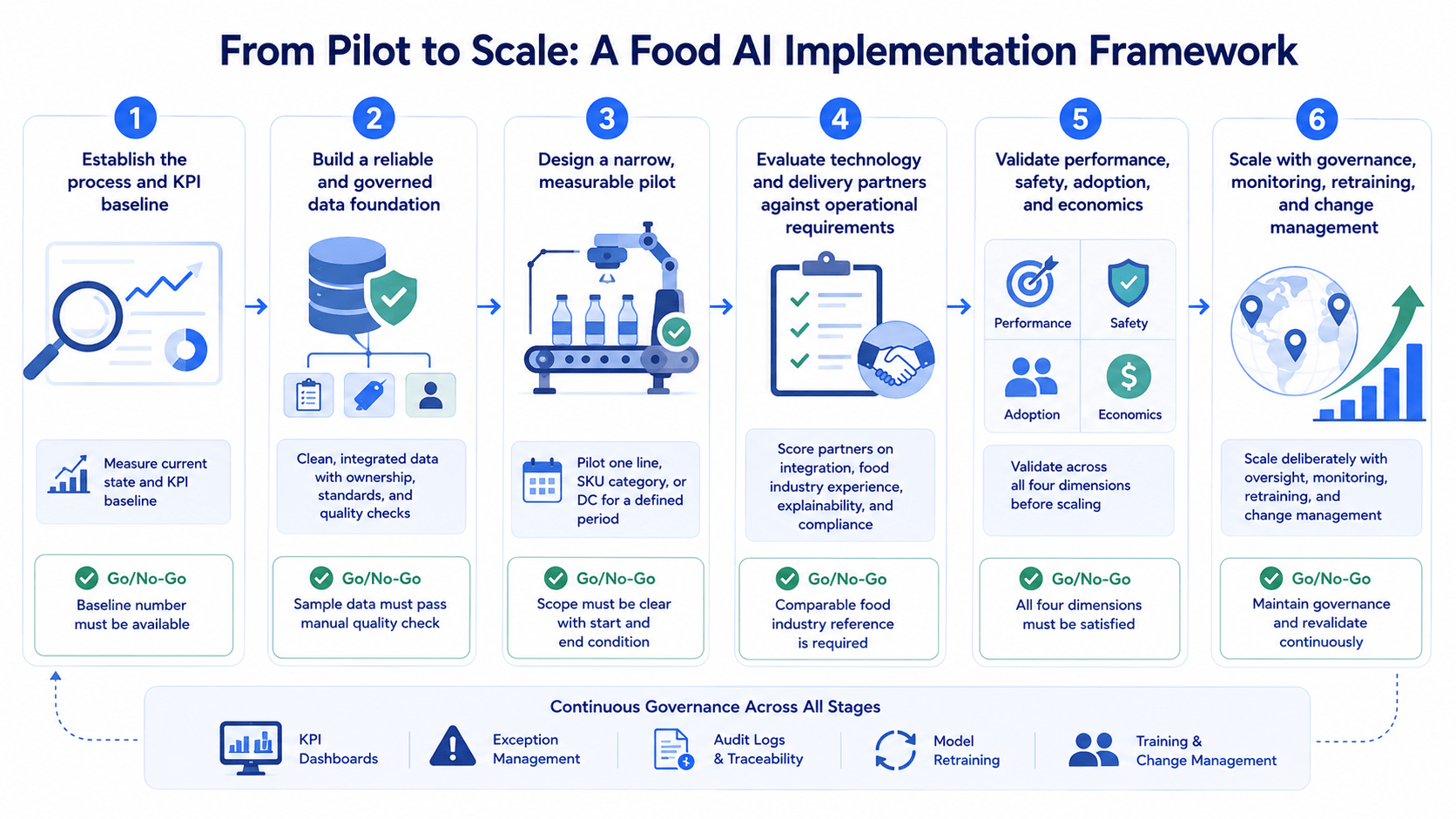
Step 1: Establish the process and KPI baseline
Before any technology is selected, measure the current state of the process you’re targeting. That means current defect rate, current forecast accuracy, or current OEE, using whatever manual or legacy method you have today. This baseline is what every later result gets compared against.
Go/no-go: if you can’t produce this baseline number, you’re not ready to start a pilot. You’re still at the readiness-assessment stage covered under choosing the right first use case.
Step 2: Build a reliable and governed data foundation
High-performing models depend on clean, integrated data. That spans everything from raw material batch records to sales and spoilage data across channels. Establish clear data ownership, consistent formats, and labeling standards before feeding data into a model. This is also where SmartDev’s AI use cases in data engineering guide is relevant if you’re mapping out the underlying pipeline work. Data engineering and integration is consistently the most underestimated part of an AI project’s effort, not the model itself.
Go/no-go: if a sample data pull doesn’t hold up under a quick manual quality check, fix the pipeline before touching the model.
Step 3: Design a narrow, measurable pilot
Scope the pilot to one line, one SKU category, or one distribution center. Not a full rollout. The pilot should run long enough to cover natural variation in the process – a full seasonal cycle for demand forecasting, a few weeks of production variation for vision inspection. It should be measured against the Step 1 baseline the whole time, not just at the end.
Go/no-go: if the pilot scope can’t be described in one sentence with a clear start and end condition, it’s too broad to be a pilot.
Step 4: Evaluate technology and delivery partners against operational requirements
Score vendors and delivery partners against the requirements this specific use case actually has. That means integration capability with your existing ERP/POS/DMS, food-industry track record, explainability, and compliance support. Don’t score them against a generic feature list. A vendor with strong general AI credentials but no food-safety validation experience is a weaker fit for a quality-inspection use case than a narrower vendor who’s done exactly that before.
Go/no-go: if a vendor can’t produce a comparable food-industry reference case, treat that as a real gap, not a formality.
Step 5: Validate performance, safety, adoption, and economics. Before scaling past the pilot, check all four dimensions – not just model accuracy:
- Performance: Did the pilot beat the Step 1 baseline on the KPI you defined when choosing this use case?
- Safety: For safety-adjacent use cases, has the human-in-the-loop workflow covered in the benefits-and-risks section actually been exercised, with real flagged exceptions reviewed by a real person?
- Adoption: Are the staff who interact with the system actually using it and trusting its output, or working around it?
- Economics: Does the measured outcome – not the projected one – justify the cost of scaling to the next line, facility, or region?
Go/no-go: a pilot that passes on performance but fails on adoption or safety validation is not ready to scale. Fix the failing dimension before expanding scope, regardless of how good the accuracy number looks.
Step 6: Scale with governance, monitoring, retraining, and change management
Once a pilot clears Step 5, scale deliberately rather than all at once. Maintain centralized oversight of exceptions, KPI dashboards, and audit logs as you add lines, facilities, or regions. Models drift as products, suppliers, and conditions change. Build in periodic retraining and revalidation from the start, rather than treating the model as a one-time deployment. Change management continues here too. New sites need the same “superuser” and training investment the original pilot site got.
Don’t assume success will transfer automatically. If you’re structuring this as a broader organizational shift rather than a single deployment, SmartDev’s overview of what AI transformation involves covers the governance and change-management layer at the organizational level, beyond a single use case.
Pre-pilot checklist
Before Step 3 begins, confirm you can check every box below:
- The operational problem is stated in one sentence, with a number attached (see choosing the right first use case)
- A business KPI is defined and already trackable, or cheaply able to become so (see choosing the right first use case)
- A baseline measurement of that KPI exists using the current process (Step 1)
- The data this use case needs exists, or a plan exists to build it (Step 2)
- The pilot scope is one line, one SKU category, or one site – not a full rollout (Step 3)
- For safety-adjacent use cases, a human-in-the-loop review workflow is designed, not just assumed (see business benefits and risks)
- A go/no-go owner is named who will decide whether the pilot scales, based on Step 5’s four dimensions
Measuring ROI From AI in Food Operations
Choosing the right use case and running a disciplined pilot only pays off if you can prove it paid off. This section covers how to measure that, using the KPIs already named throughout this guide, plus how to avoid the two most common measurement mistakes: no baseline, and no way to isolate AI’s actual contribution.
Use-case KPI framework
Each use case category has a different primary metric. Trying to measure all of them the same way – say, judging everything by cost savings alone – hides the mechanism that’s actually driving the result. Use this framework instead:
| Use case category | Primary KPIs to track |
|---|---|
| Quality inspection | Defect rate, false-negative risk on safety-critical flags, manual rework time, recall exposure |
| Forecasting and inventory | Waste and spoilage rate, stockout rate, forecast accuracy (MAPE), inventory turns |
| Predictive maintenance | Unplanned downtime hours, maintenance cost per unit, throughput, OEE |
| Traceability | Time-to-detect and time-to-respond on flagged incidents, number of compliance events, scope of affected batches per recall |
Notice that none of these are generic efficiency metrics. Each one ties directly to the operational problem the use case was chosen to solve, which is what makes it possible to say, specifically, what improved and by how much.
Establishing baselines and attributing outcomes
A result is only meaningful next to a baseline. Without a clear pre-AI baseline for defect rates, forecast accuracy, or downtime, you cannot prove that AI actually improved performance. As highlighted in Step 1 of the implementation framework, establishing this baseline remains one of the most common gaps in AI ROI claims.
Attribution is the second gap. A pilot that runs during the same quarter as a new ERP rollout, a supplier change, or a seasonal shift can’t cleanly credit its results to AI alone. The more reliable approach is a parallel run: keep the existing manual or legacy process running alongside the AI system for part of the pilot window, on a comparable subset of lines or SKUs, so you have a like-for-like comparison rather than a before/after number that’s tangled up with everything else that changed in the meantime.
Case-study evidence and source-verification standards
The case studies below are held to a specific standard: a claim is presented as confirmed only when it traces to the company’s own disclosure (a press release, an official blog, an earnings statement) or to reporting that clearly cites that primary source. Where a number only appears in vendor marketing or in aggregator sites without a clear original source, it’s labeled as such rather than stated as fact – the same standard the next section applies to case studies.
Two examples that meet this bar:
- ThroughPut AI’s engagement with Church Brothers Farms improved short-term forecast accuracy by up to 40%, reducing overstock and better aligning supply with customer demand in perishable operations.
- McKinsey’s research on AI-driven demand forecasting found it can improve service levels while cutting inventory costs by 20–30%, a range consistently cited across multiple independent food and distribution operators, not just one company’s marketing claim.
Emerging AI Trends Shaping Food Operations
Not every emerging technology deserves the same response. Some are ready to run in production today. Some are worth a narrow, careful pilot. Some are only worth watching for now. This section sorts six trends into those three categories, so you can calibrate effort to actual readiness instead of hype.
Generative AI for formulation, knowledge access, and operational support
Recipe formulation with generative AI, covered earlier through the Mondelez case, is already proven in production. The newer piece is different: using the same underlying technology to let plant staff query compliance documents, HACCP plans, and SOPs in plain language. Instead of searching a shared drive, a worker could ask “what’s our allergen protocol for this line” and get a direct answer. SmartDev’s guides on generative AI in business and on building an AI agent cover this pattern in more depth, since conversational access to internal documents is one of the more mature generative AI applications outside food specifically.
Category: operationalize now for formulation. Pilot selectively for knowledge-access assistants – the underlying technology is mature, but food-specific SOPs and compliance documents need careful validation before staff rely on an AI-generated answer during an audit or a safety incident.
Digital twins, edge AI, and connected production environments
A digital twin is a live, data-fed model of a physical system – a cold-storage facility, a production line, a distribution network – used to simulate changes before making them for real. Unilever’s Swedish cold-chain work and Lineage Logistics’ warehouse optimization, both covered earlier, are early examples, but narrowly scoped to temperature and demand modeling. Full-facility digital twins, where a change to one part of the system gets simulated end-to-end before it touches the floor, are still emerging. Edge AI – processing data locally at the sensor instead of routing everything to the cloud – is what makes that practical, since a twin waiting on a cloud round-trip for every sensor reading isn’t fast enough for real-time decisions.
Category: pilot selectively. Single-facility, narrowly scoped digital twins (one cold-storage room, one production line) are viable now. Full-facility, multi-site digital twins are still a monitor-and-wait technology for most food operators.
Advanced traceability and smart-packaging systems
Blockchain-backed traceability is the most mature example in this section. Walmart’s collaboration with IBM Food Trust is one of the best-documented examples. After moving traceability data from scattered paper records to a shared ledger, Walmart cut the time needed to trace produce back to its source from roughly seven days to 2.2 seconds. Layering AI on top of that ledger is the newer piece – an AI system that scopes affected batches automatically the moment an anomaly is flagged, instead of a person querying the ledger by hand. Smart packaging that actively communicates freshness and expiry to the next link in the chain, rather than passively holding sensor data, is a related but earlier-stage trend.
Category: operationalize now for blockchain-based traceability at scale – this pattern is well-proven. Pilot selectively for AI-automated batch-scoping on top of it. Monitor for active, freshness-communicating smart packaging – the sensor-based shelf-life monitoring covered earlier in this guide is mature; packaging that actively communicates that data forward is not yet common outside pilots.
Personalized nutrition and consumer intelligence
This is the most consumer-facing, and most privacy-sensitive, trend in this section. Recommendation systems are moving from broad dietary-preference matching toward more individualized nutrition guidance, drawing on a wider range of signals than purchase history alone. That shift raises the stakes on the privacy and consent standards covered under business benefits and risks earlier in this guide. The more personal the signal – approaching health data rather than a stated dietary preference – the more explicit the consent needs to be, and the tighter the limits on inference.
Category: pilot selectively, with explicit opt-in. The underlying personalization technology is mature. The governance and consent norms around health-adjacent signals are not, which is why this belongs in monitor-and-pilot territory rather than broad rollout.
Maturity versus business impact, at a glance
| Trend | Maturity today | Business impact if it works | Recommended posture |
|---|---|---|---|
| Generative AI for recipe formulation | High | High | Operationalize now |
| Generative AI for knowledge access (SOPs, compliance) | Medium | Medium | Pilot selectively |
| Single-facility digital twins | Medium | Medium-high | Pilot selectively |
| Full-facility, multi-site digital twins | Low | High | Monitor |
| Blockchain-based traceability | High | High | Operationalize now |
| AI-automated batch-scoping on traceability data | Medium | Medium | Pilot selectively |
| Active, freshness-communicating smart packaging | Low | Medium | Monitor |
| Individualized nutrition personalization | Medium | Medium | Pilot selectively, with explicit opt-in |
What remains uncertain: adoption, regulation, cost, and operating maturity
None of the above should be read as a certainty. A few things are worth stating plainly instead of implying they’re settled:
- Adoption and maturity aren’t the same thing. An organization can have an AI pilot running somewhere and still be years from governed, monitored, retrained deployment. SmartDev’s 2025 enterprise AI adoption benchmark documents this gap directly, and food operations aren’t exempt from it.
- Regulation is still forming, not finished. Explainable AI is often called essential future infrastructure for food-safety auditability. But what counts as “sufficiently explainable,” and who audits it, is still being worked out in most jurisdictions.
- Cost trends are directional, not guaranteed. Sensor, compute, and connectivity costs have been falling. That’s part of why edge AI and smart packaging are becoming more viable. But large-scale digital twin and traceability deployments still carry real integration cost, and how fast that comes down for mid-sized operators, versus the large enterprises in this section’s examples, isn’t yet clear.
- Operating maturity varies by company size and region. Everything in this section assumes an organization has already cleared the fundamentals covered earlier in this guide: a clean data foundation, a validated pilot, a governed scaling process. Without those, these trends are a multi-year horizon, not a next-pilot decision.
FAQ: AI in the Food Industry
Which food-industry AI use cases are most practical to start with?
Demand forecasting and predictive maintenance are usually the strongest starting points. Both run on data most operators already collect, don’t require new sensor infrastructure, and can prove a KPI improvement within one seasonal cycle. Safety-critical use cases like quality inspection add real value too, but need a validated human-in-the-loop workflow first. See “The Highest-Value AI Use Cases in the Food Industry” and “Choosing the Right First AI Use Case” for the full framework.
How does AI support food safety and traceability?
Computer vision flags contamination, mislabeling, or packaging defects in real time, always paired with human review of flagged exceptions. For traceability, AI processes sensor and batch data to scope a recall precisely – which batches, which distribution points – instead of pulling more product than necessary out of caution. See “AI-powered quality inspection and food-safety monitoring” and “Cold-chain intelligence and end-to-end traceability” for the full breakdown.
What data is needed for AI demand forecasting in food operations?
At minimum, clean historical point-of-sale data at the SKU level. Accuracy improves further with external signals layered on top – weather, local events, promotional calendars. That data needs to be consistent and integrated, not scattered across disconnected systems; fragmented data is the most common reason forecasting pilots underperform. See “Demand forecasting, inventory optimization, and food-waste reduction” for the full use case.
How should a food business measure AI ROI?
Tie ROI to the specific KPI the use case was chosen to move – defect rate for inspection, forecast accuracy for demand, OEE for maintenance – measured against a documented baseline from before the AI system went live. Isolate AI’s actual contribution with a parallel run alongside the existing process, rather than crediting every change to AI by default. See “Measuring ROI From AI in Food Operations” for the full framework.
Why do food-industry AI pilots fail to scale?
Most stall for the same three reasons: no clean baseline to prove improvement against, a data foundation too fragmented for the model to trust, or a human-in-the-loop workflow that exists on paper but isn’t actually used day to day. Scaling also fails when governance and retraining aren’t planned from the start. See “Business Benefits and Risks of AI Adoption” and “From Pilot to Scale: A Food AI Implementation Framework” for the full breakdown.
Conclusion
Every use case in this guide creates value somewhere: quality, waste, throughput, margin, or service. None of them create that value automatically. The businesses that see a real return tend to follow the same order every time. They start from the operational problem, not the technology. They check whether the data and process are actually ready before committing to anything. They define the KPI before they pick a vendor. And they scale only after a narrow pilot has passed on performance, safety, adoption, and economics together – not on a strong accuracy number alone.
If there’s one rule to take from all of this, it’s that readiness beats opportunity size. A high-value use case sitting on weak data or an unstable process will underperform a lower-profile one that’s actually ready to run today. Start with what you can measure and prove, not with what looks most impressive on a slide.
That prioritization rule is also where the next step begins.
Next Steps: Assessing an AI Opportunity in Your Food Operation
If you’re ready to move from reading this guide to evaluating an actual initiative, three actions come before any vendor conversation:
- Name the operational bottleneck. State it in one sentence, with a number attached – a defect rate, a stockout frequency, a downtime figure. If you can’t do this yet, that’s the real first task, not the AI project itself.
- Check whether your data and process are ready. Confirm the data this use case needs already exists in usable form, and that the underlying process is stable enough to model reliably.
- Scope a pilot you can actually measure. One line, one SKU category, or one distribution center, with a defined KPI and a baseline already recorded before anything changes.
Once those three are in place, you have enough to start a real conversation with a technology partner, rather than a speculative one. If you want a structured way to work through this assessment, SmartDev’s AI Consulting Services walk through use-case identification and data-readiness assessment directly, and the AI Proof of Concept guide covers how to scope a pilot narrow enough to test cheaply but rigorous enough to prove value before committing to a full build.