
TL;DR
- OCR performance drops sharply when documents contain handwriting, poor scan quality, complex layouts, or mixed languages — conditions that are the norm, not the exception, in real operations.
- Accuracy errors at the extraction stage compound downstream: a misread field in an invoice or an onboarding form creates rework, compliance risk, and failed automation.
- A more reliable approach layers OCR with document classification, contextual validation, confidence scoring, and human-in-the-loop review — rather than treating character recognition as a finished solution.
Introduction
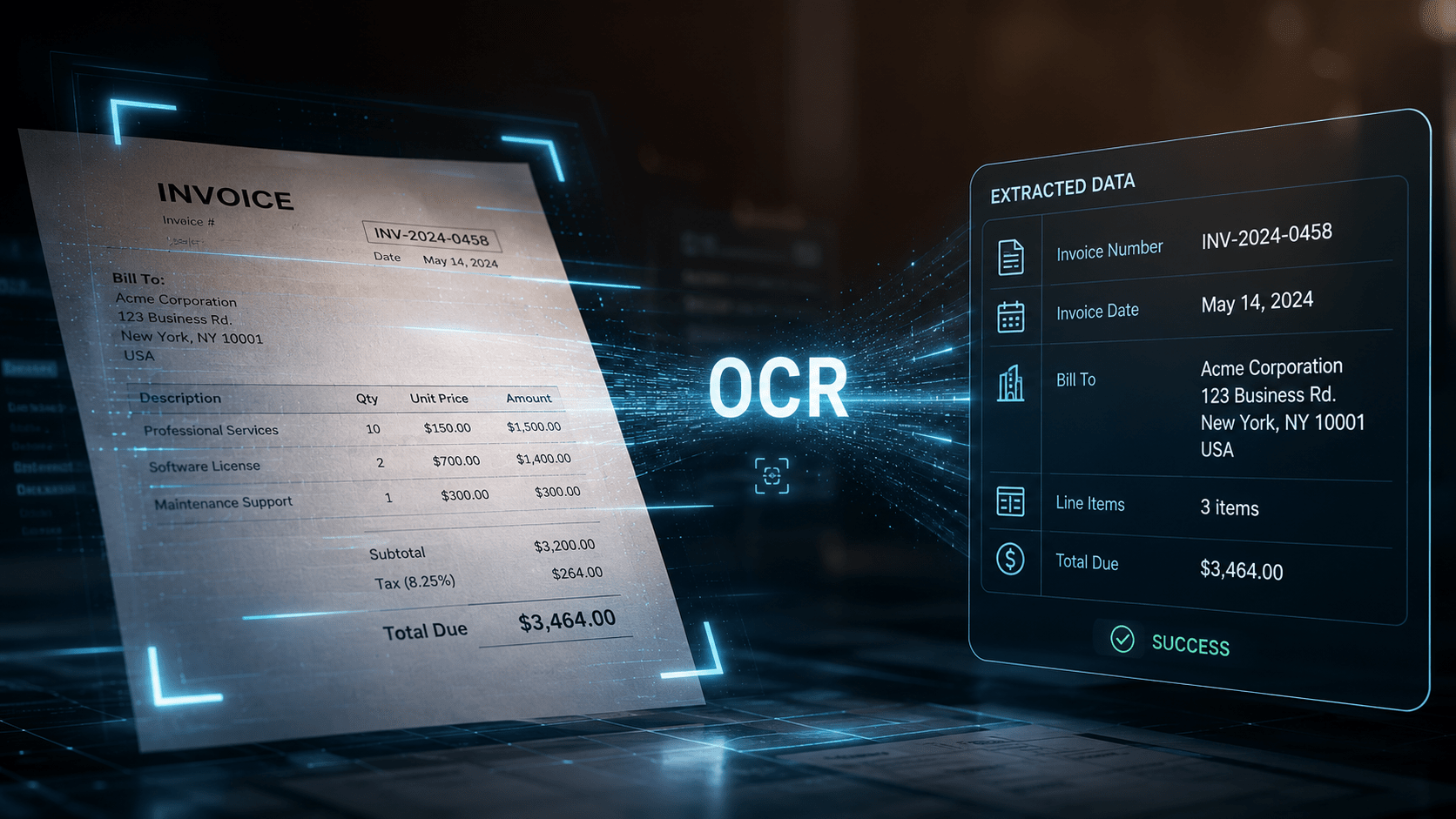
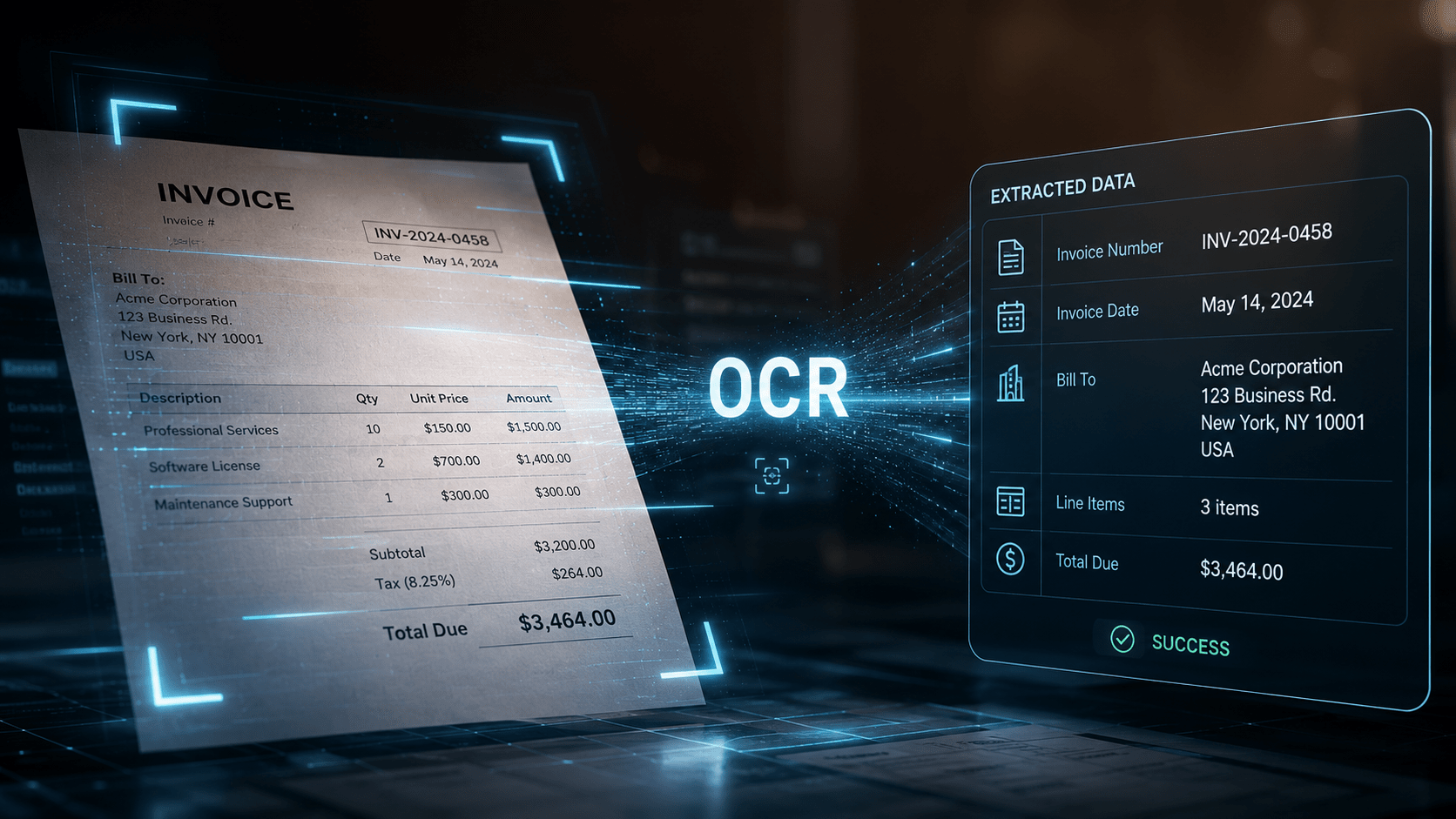
Optical Character Recognition (OCR) is a technology that uses automated data extraction to quickly convert images of text into a machine-readable format.The ability to convert a scanned image into machine-readable text was, and remains, genuinely useful. It reduced manual re-entry, accelerated digitization, and opened up automation possibilities that weren’t available when every document had to be processed by hand.
But enterprise document processing has moved on, and OCR’s foundational design hasn’t kept pace. Document volumes are higher. Formats are more diverse. The regulatory bar for data accuracy has risen across financial services, healthcare, logistics, and virtually every sector that processes documents at scale. And the expectation for what “automated” means has shifted from “we have digital text” to “we have accurate, validated, decision-ready data that flows directly into our systems.”
In that context, OCR-only approaches are showing their limits in ways that carry real operational cost — not just in benchmark scores, but in the downstream document processing workflows that depend on what OCR produces. This article examines where those limits are, why the errors OCR introduces are harder to contain than they appear, and what a more reliable architecture looks like in practice.
What OCR Was Built to Do — and Where Its Scope Ends
Before addressing the limitations, it helps to be precise about what OCR actually does. OCR is a character recognition technology. It takes an image — a scan, a photo, a fax — and converts what it sees into text strings. That’s the full scope of the job. It doesn’t understand the document. It doesn’t know whether the number it extracted is a price, a policy number, or a reference code. It doesn’t validate whether the output is internally consistent or contextually correct. It reads pixels and produces characters.
For a long time, that was sufficient, because the downstream systems doing the interpreting were human beings. A clerk would receive the extracted text, apply judgment, and act. OCR was a time-saver layered in front of human cognition — not an autonomous processing pipeline.
The problem begins when organizations use OCR as the foundation for AI workflow automation — expecting that if OCR converts a document to text, the rest of the process can run without human involvement. That assumption doesn’t hold, and the reasons why are worth working through carefully. Understanding the distinction between character recognition and genuine document intelligence is also well-covered in SmartDev’s AI Adoption & ITO Glossary, which explains the underlying concepts for non-technical audiences.
Why Small Error Rates Create Large Operational Problems
A natural response to accuracy statistics is to treat a 95% or 97% rate as acceptable. The math works against that intuition, especially at scale.
If an OCR system processes a document with 200 fields and achieves 97% character-level accuracy, that doesn’t mean 97% of fields are correctly extracted. Errors distribute across characters, and a single misrecognized character in a critical field — a vendor tax ID, a medication dosage, a contract payment date — produces an entirely wrong value. Research on OCR error propagation has demonstrated that character recognition errors substantially degrade downstream processing, with cascading effects on document understanding and on any AI systems built on top of that extracted data</a>.
The financial services sector understands this particularly well. A misread policy number in a claims workflow can result in a payment going to the wrong account. A misread reference number on an invoice triggers a failed three-way match and delays a supplier payment. Errors in KYC document processing carry regulatory consequences: if extracted identity data is inaccurate and the downstream screening process acts on it, the organization may have a compliance exposure it isn’t even aware of.
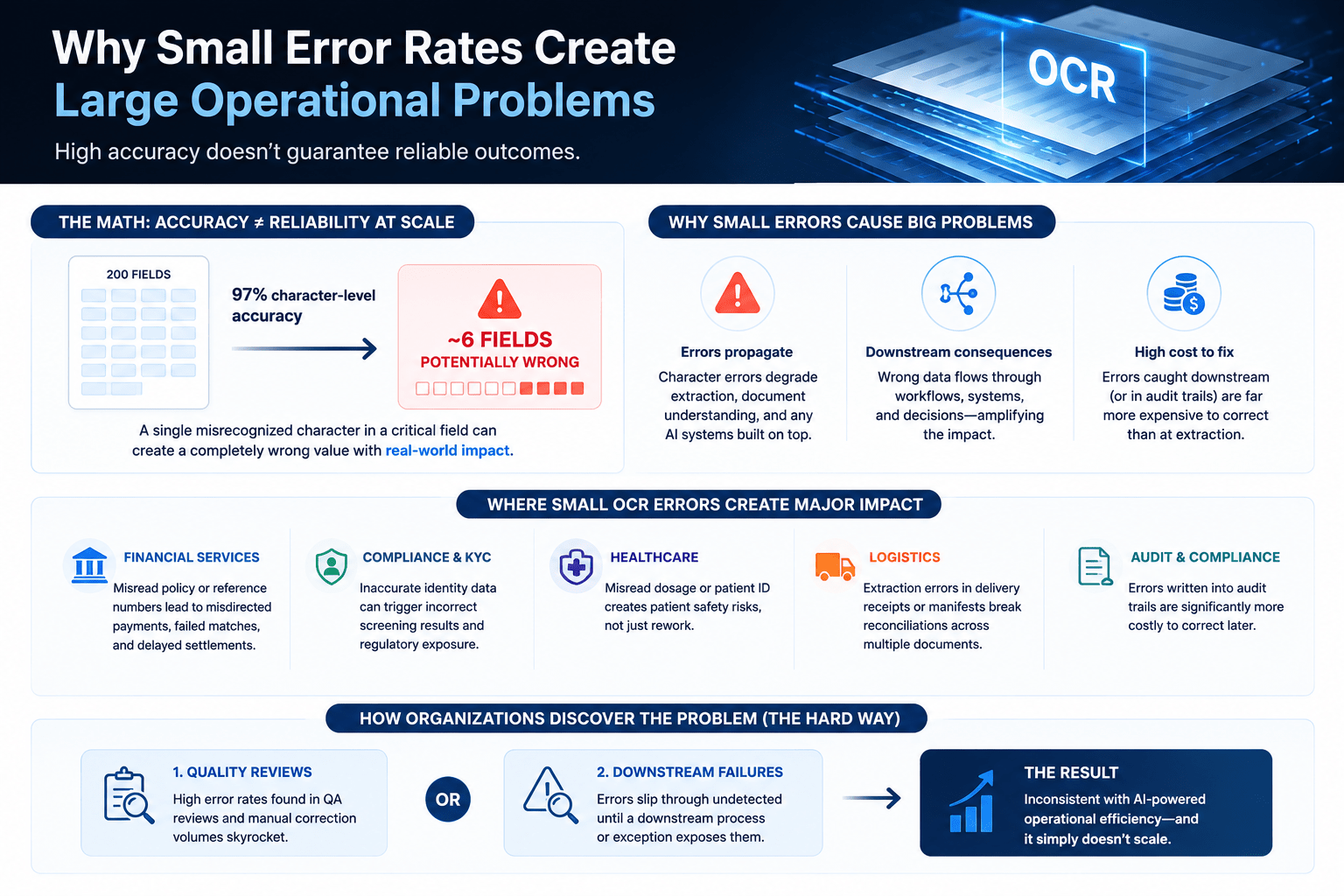
Healthcare presents similar risks, where a misread dosage or patient identifier doesn’t create a rework task — it creates a patient safety issue. In logistics, an extraction error in a delivery receipt or shipping manifest breaks a reconciliation process that depends on exact field matching across three documents. And in compliance-sensitive workflows, a data error that gets written into an audit trail is far more expensive to correct than one caught at the extraction stage.
When organizations rely on OCR-only pipelines, they typically discover the accuracy problem through one of two routes: quality review catches a high error rate and manual correction volume climbs, or errors pass through undetected until a downstream failure surfaces them. Neither is consistent with the AI-powered operational efficiency most enterprises are trying to build — and neither scales.
The Capabilities Missing from an OCR-Only Workflow
The accuracy problem is real, but it’s a symptom of something more fundamental: OCR was never designed to do what enterprise document workflows now require it to do. The gaps aren’t things that can be fixed by switching to a better OCR engine. They’re structural — built into what character recognition is and isn’t.
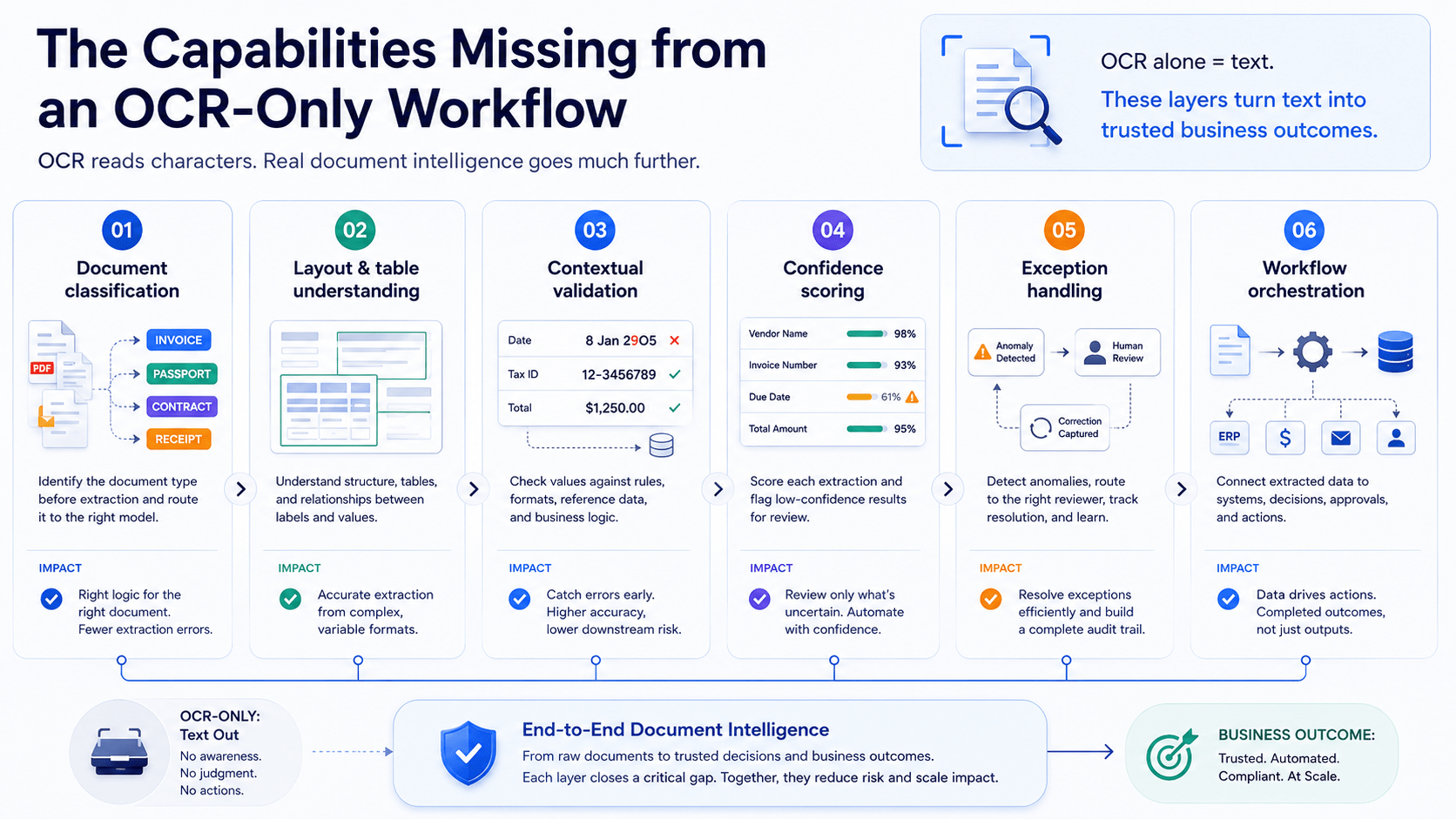
Document classification
OCR takes whatever arrives and produces text. It has no awareness of what type of document it’s reading, which means it can’t apply different logic to an invoice versus a passport versus a delivery receipt. In practice, this forces teams to either pre-sort documents manually before they reach OCR, or accept a flat, undifferentiated output that needs to be interpreted downstream. For organizations processing multiple document types at volume, neither option scales. Intelligent document processing addresses this by routing each incoming document to the correct extraction model based on what it actually is — before extraction begins.
Layout and table understanding
Documents aren’t just text; they’re structured artifacts where the position of a value relative to its label carries meaning. A table of invoice line items, a two-column form, a contract with numbered clauses — OCR reads these in linear reading order and produces a text stream that loses the spatial relationships entirely. The result is that a line-item amount might land in the same output as a vendor address several fields away, with no reliable way to tell which field it belongs to. Gartner’s IDP category</a> exists largely to solve this: extraction models that understand layout, not just characters, are what make it possible to reliably pull structured data from the variable-format documents most organizations actually receive.
Contextual validation
OCR produces output but doesn’t evaluate it. A date field containing “8 January 29O5” — where a degraded zero was read as the letter O — passes through without comment. A tax ID with one transposed digit looks identical to a correct one in the raw output. Contextual validation checks extracted values against what’s plausible given the field type, the document context, and reference data from connected enterprise systems. This single layer catches a large proportion of the errors that OCR introduces but cannot detect — and it’s what allows IDP platforms to reach data accuracy rates above 99.9%</a> in production on the same document types where OCR alone falls significantly short.
Confidence scoring
Standard OCR output assigns the same status to every character — whether it was cleanly recognized from a high-resolution scan or inferred from a smudged, skewed image. There’s no signal about which extractions are reliable and which aren’t. Without confidence scoring, teams face an all-or-nothing choice: review everything (defeating the purpose of automation) or review nothing (accepting all errors silently). Confidence scoring breaks that binary by flagging only the results the model is genuinely uncertain about, making it possible to route low-confidence extractions to human review while letting high-confidence ones proceed automatically. This is the architectural mechanism that makes human-in-the-loop document processing efficient rather than a bottleneck.
Exception handling
Every document workflow encounters exceptions: documents that arrive in unexpected formats, that contain internally inconsistent data, or that fall outside the patterns the system was trained on. OCR has no concept of an exception — it produces output regardless of quality. A proper exception-handling layer identifies anomalies, routes them to the right reviewer with the relevant context, tracks their resolution, and feeds corrections back as a training signal. This is also what builds the audit trail that compliance and regulatory frameworks increasingly require — a record not just of what was extracted, but of what was flagged, reviewed, corrected, and by whom.
Downstream workflow orchestration
Perhaps the most consequential gap: OCR produces text, but it has no mechanism for turning that text into a completed business outcome. Extracted invoice data doesn’t pay itself. An extracted KYC document doesn’t screen itself against a watchlist. Structured data sitting in an output file still requires someone to move it into the right system, trigger the next step, route it for approval, and confirm the process is complete. Workflow orchestration is the layer that connects extracted data to the downstream systems, decisions, and actions the business actually depends on — and it’s entirely absent from an OCR-only approach.
Where Document-Processing Errors Create the Highest Business Risk
The cost of an extraction error isn’t uniform across industries or use cases. In some contexts, a misread field creates a correction task. In others, it creates a regulatory breach, a patient safety incident, or a financial loss that surfaces weeks after the fact. Understanding where the risk is highest explains why the move away from OCR-only approaches has accelerated fastest in certain sectors.
Financial services and compliance
Customer onboarding, KYC, and AML screening depend on accurate extraction from ID documents, proof of address, bank statements, and financial records — materials that arrive from dozens of countries in inconsistent formats, often at low scan quality. An extraction error that passes unvalidated into a screening process can mean an organization has run an incomplete AML check without knowing it. Regulatory frameworks including MAS AML guidelines</a> and FCA anti-money laundering regulations</a> require not just accuracy but traceability — documented evidence of what was reviewed and how. An OCR-only pipeline produces neither. SmartDev’s breakdown of KYC document review automation and AI use cases across the BFSI sector cover this in depth.
Healthcare administration
The document types in healthcare — handwritten clinical notes, mixed-format intake forms, prescriptions, prior authorization requests — are among the hardest for OCR to read accurately, and the fields being extracted are among the highest-stakes: medication names, dosages, patient identifiers, procedure codes. A transposed digit in a dosage isn’t a data quality issue; it’s a patient safety issue.
The WHO estimates unsafe medical care causes 3.9 million years of healthy life lost annually</a>, with medication errors a significant contributing factor. Layered document intelligence with validation and confidence scoring exists precisely to catch the extraction errors that would otherwise reach clinical workflows unchecked. SmartDev’s overview of AI in healthcare operations explores how this applies in practice.
Insurance and claims
Claims processing requires reading FNOL forms, damage reports, medical bills, repair estimates, and supporting evidence — then cross-referencing that data against policy terms to determine coverage, eligibility, and payout. OCR can digitize each of those documents individually. It cannot reconcile data across them, flag inconsistencies between a claimed amount and supporting evidence, or identify when extracted values conflict with policy conditions.
Errors compound at every subsequent step: a misread claim number routes the file to the wrong adjuster; a misread coverage date changes the eligibility outcome; a misread amount affects the reserve calculation. SmartDev’s breakdown of AI use cases across the insurance sector shows how layered extraction and validation reduce manual touchpoints in claims workflows without increasing error rates.
Logistics and trade documentation
Three-way invoice matching — reconciling an invoice against its purchase order and delivery receipt — is one of the highest-volume, most error-sensitive document workflows in procurement. It requires exact field matching across three documents that often come from different vendors in different formats. OCR can extract text from each document separately. It cannot perform the cross-document match, flag quantity or price discrepancies, or update the ERP when everything aligns.
A misread line-item quantity or unit price breaks the match entirely and routes the exception to manual review. Proof-of-delivery automation and procurement workflows are where the ROI of moving beyond OCR tends to be most immediately measurable. McKinsey’s research on supply chain AI</a> consistently identifies document processing accuracy as a primary bottleneck in logistics automation.
Accounts payable and procurement
AP teams processing high volumes of supplier invoices face a version of the same problem that compounds with scale: OCR accuracy that looks acceptable at low volume becomes a significant manual correction burden when invoice counts are in the thousands per month. The fields that matter most — invoice number, vendor ID, line-item amounts, payment terms, due dates — are exactly the fields where a single misread character produces an entirely wrong value.
A duplicate payment, a missed early-payment discount, or a late payment fee all trace back to extraction errors that weren’t caught before the invoice entered the approval workflow. The combination of AI-powered extraction, validation against purchase orders, and workflow automation for financial compliance addresses this not by adding reviewers, but by making errors visible before they reach the payment stage.
The Structural Gaps in an OCR-Only Approach
Beyond raw character accuracy, OCR-only solutions have structural limitations that become increasingly visible as document processing scales.
- No document classification. OCR reads whatever it receives and produces text. It doesn’t identify whether it’s processing an invoice, a contract, a passport, or a shipping manifest — so it can’t apply different extraction logic to different document types. Organizations processing multiple document types either route documents manually before OCR, or receive a flat text output that requires separate classification logic downstream. Neither is an efficient architecture for high-volume document automation.
- No contextual validation. OCR has no mechanism for checking whether the values it extracted are plausible. A date field containing “8 January 29O5” — with a capital letter O instead of a zero — passes through as extracted text. A validation layer catches that the year is implausible and flags it for review. OCR won’t.
- No confidence scoring. Standard OCR output is a flat text file where every character has the same apparent status — whether it was cleanly recognized from a high-resolution scan or guessed from a degraded, skewed image. Without confidence scores, there’s no basis for automatically routing uncertain results to human review. Everything either gets reviewed (eliminating the efficiency gain) or nothing does (accepting whatever errors were produced). This is a fundamental architectural limitation that a better OCR engine alone cannot fix.
- No layout understanding. Many documents carry meaning in their structure — a table of invoice line items, a form where field values are positioned relative to labels, a contract where clause headings organize obligations. OCR reads text in reading order but doesn’t understand the spatial relationship between a label and its corresponding value. Extracting the right data from a complex layout requires more than recognizing which characters are present — it requires understanding the document’s structure, which is a separate capability that Gartner’s Intelligent Document Processing category</a> was specifically built to address.
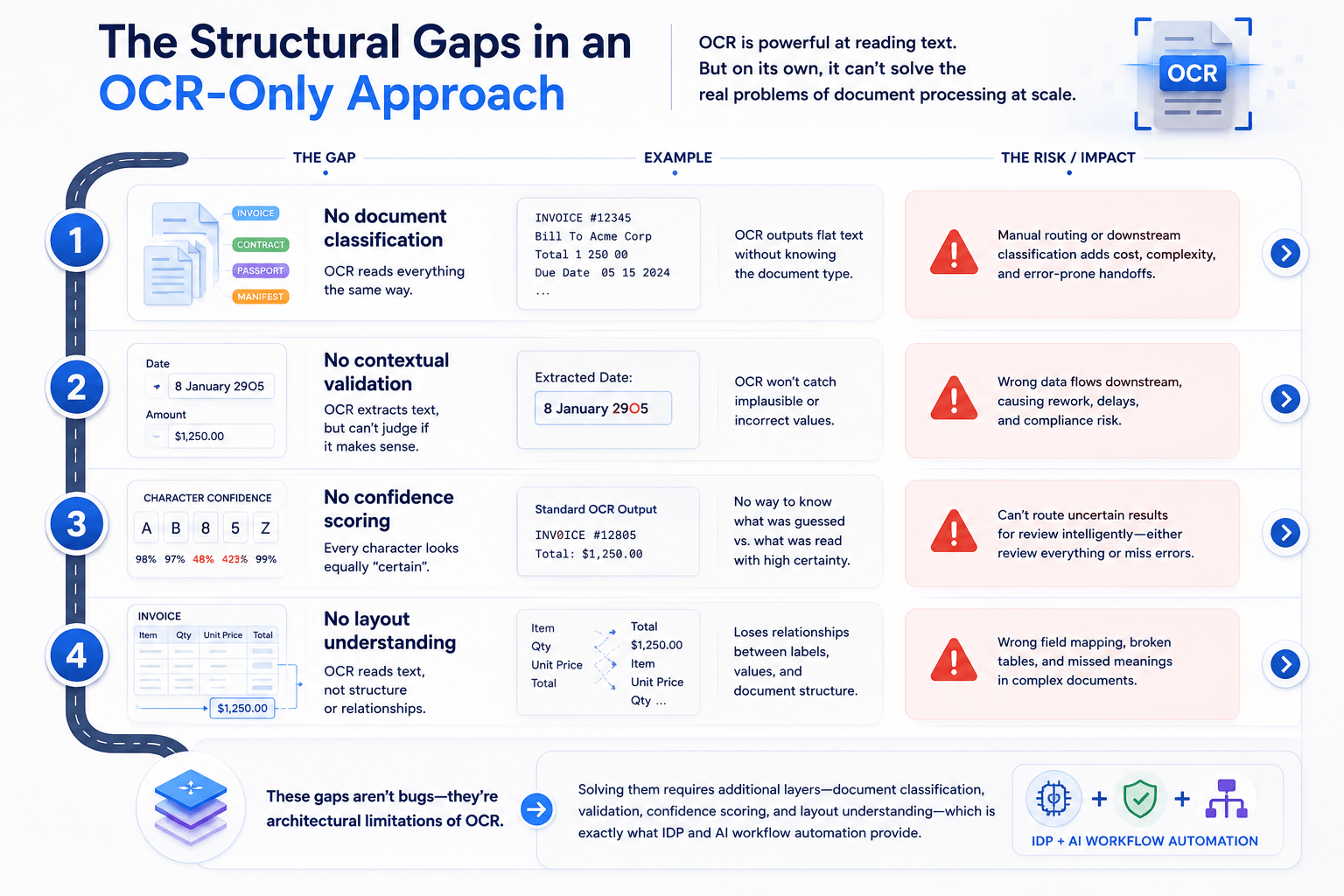
These gaps aren’t deficiencies that can be patched by choosing a better OCR engine. They’re inherent to what OCR is designed to do. Addressing them requires additional layers — which is precisely what IDP and AI workflow automation provide.
Industry Contexts Where OCR Limitations Carry the Highest Cost
The accuracy gap between OCR-only and layered document intelligence is not uniform across industries. Some sectors combine high document complexity with high consequences for errors — which makes the case for moving beyond OCR particularly clear.
1. Financial services and banking
Customer onboarding requires processing ID documents, proof of address, pay stubs, and bank statements — often from dozens of countries with different formats, scripts, and scan quality levels. Errors in KYC documents carry regulatory consequences under frameworks like FCA anti-money laundering regulations</a>, which require demonstrably accurate and traceable document review. SmartDev’s detailed breakdown of KYC document review automation covers how layered document intelligence replaces OCR-only approaches in this context, along with broader AI use cases in the BFSI sector.
2. Healthcare
Handwritten clinical notes, mixed printed and handwritten forms, and high-stakes field values — medication names, dosages, patient identifiers — create conditions where OCR error rates that would be tolerable in lower-stakes contexts become patient safety issues. The WHO estimates that unsafe medical care causes 3.9 million years of healthy life lost annually</a>, with medication errors among the significant contributing factors — which raises the stakes considerably for any system extracting dosage or prescription data. SmartDev’s overview of AI applications in healthcare operations explores how document intelligence is being applied to reduce these risks.
3. Logistics and manufacturing
Three-way invoice matching requires not just extracting line items from an invoice, but reconciling them against purchase order and delivery receipt data across three separate documents. OCR can produce text from all three. It cannot perform the cross-document reconciliation logic that flags a discrepancy between an invoiced quantity and a delivered quantity. This is why proof-of-delivery automation involves both document extraction and business-rule orchestration as distinct but connected layers. McKinsey’s research on AI in supply chains</a> consistently identifies document processing accuracy as a primary bottleneck in procurement and logistics automation.
4. Compliance and regulatory workflows
Audit trails require not just accurate data but traceable extraction — what was extracted, from which document, at what confidence level, with what validation result. The Basel Committee on Banking Supervision’s principles for operational risk</a> and similar frameworks are increasingly specific about the auditability of automated decision-support processes. SmartDev has examined this challenge in depth in the context of AI compliance audit trails and MAS regulatory change monitoring — regulators expect organizations to explain not just what decision was made, but how the underlying data was produced and verified, which is a structural requirement OCR-only pipelines cannot satisfy.
Building a More Reliable Approach: The Layers That Matter
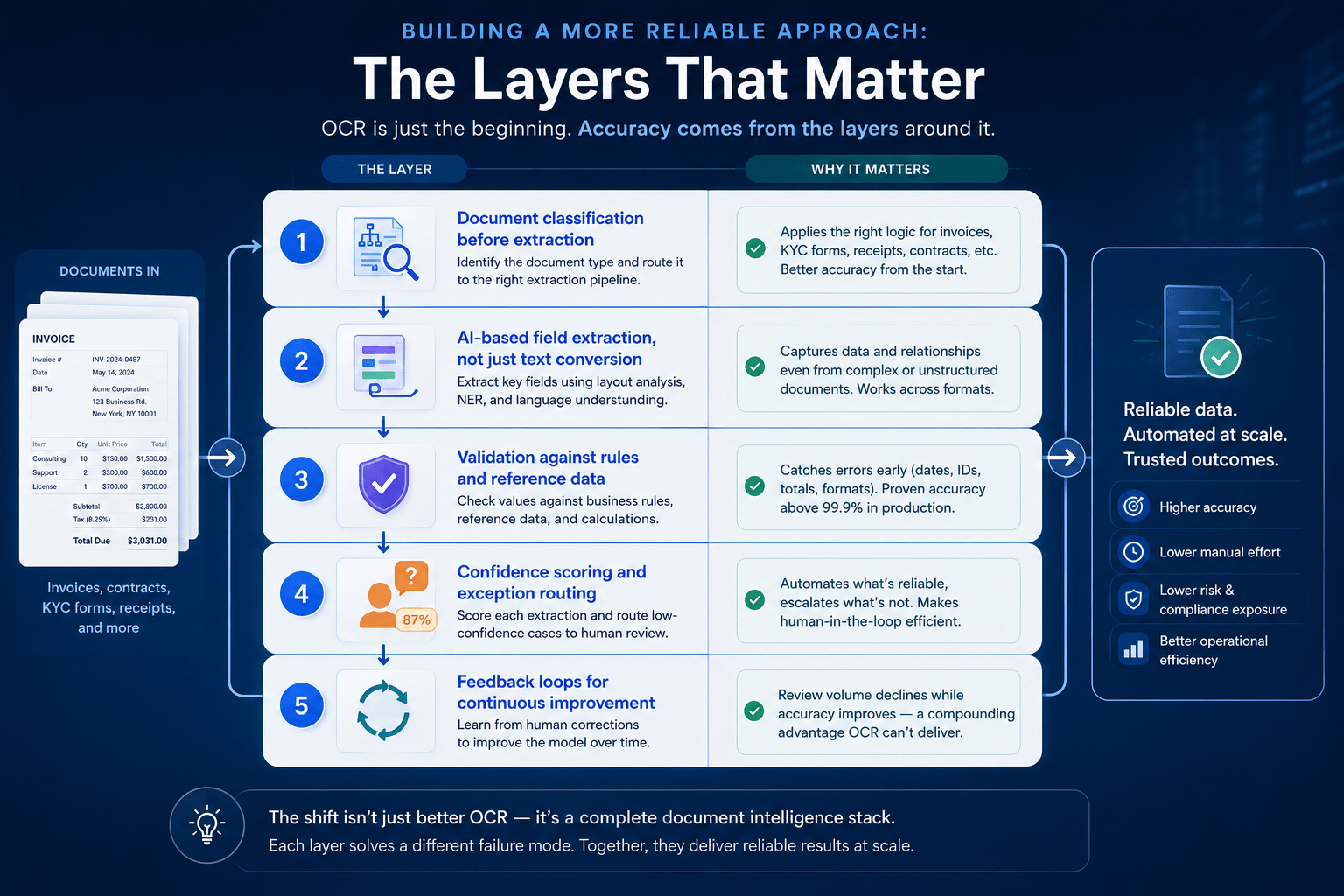
The organizations that have moved past OCR-only pipelines have done so by treating OCR as one component in a broader document intelligence stack — not the stack itself. Here is what the additional layers actually do in practice, and why each one matters.
Document classification before extraction
Knowing what type of document you’re processing before you try to extract data from it allows the system to apply the right extraction model. An invoice needs different logic than a KYC onboarding form or a delivery receipt. Classification — typically handled by machine learning models trained on document type patterns — routes each document to the correct extraction pipeline rather than applying a generic approach to everything. Modern vision-language models combine classification, layout analysis, and text recognition in a single pass</a>, which is a significant architectural improvement over the multi-step pipelines that separate OCR tools relied on.
AI-based field extraction, not just text conversion
Modern extraction models go well beyond what OCR produces. Rather than accepting a flat text stream and trying to parse fields from it, they apply named entity recognition, layout analysis, and language understanding to identify specific values and their relationships within the document structure. The AI and machine learning development services that underpin these capabilities make it possible to extract line items from an invoice regardless of vendor format, or pull named parties from a contract without knowing its exact template — something template-based OCR could never do reliably. Forrester’s 2024 research on document mining platforms</a> found that 58% of enterprise data is unstructured — precisely the format where AI-powered extraction outperforms OCR most clearly.
Validation against rules and reference data
Extracted values should be checked before they’re trusted. A date field should contain a plausible date. A tax ID should match the expected format for its jurisdiction. An invoice total should reconcile with the sum of its line items. Validation logic — whether rules-based or driven by reference data from integrated enterprise systems — catches a significant proportion of extraction errors before they enter downstream workflows. IDP platforms with validation logic have demonstrated data accuracy rates above 99.9%</a> in production environments where OCR alone delivered far lower effective accuracy on the same document types.
Confidence scoring and exception routing
When an extraction model is uncertain about a value — because scan quality was poor, the font unusual, or the layout non-standard — it flags that uncertainty rather than silently passing a low-confidence result through. Confidence scoring lets teams set thresholds: extractions above the threshold proceed automatically, while those below route to human review. This is fundamentally different from an OCR-only pipeline, and it’s the mechanism that makes the human-in-the-loop efficient rather than a bottleneck. In a well-designed AI workflow automation architecture, human review becomes a targeted quality gate — not a blanket fallback covering everything the system can’t handle.
Feedback loops for continuous improvement
Every human correction of a flagged extraction is a training signal. Systems that capture reviewer corrections and feed them back into the model improve over time — progressively narrowing the range of documents requiring human intervention as the model learns from edge cases. Over time, well-designed systems see review volume decline even as document volume grows. This is a compounding accuracy gain that static OCR deployments structurally can’t replicate.
If your organization currently relies on an OCR-based document processing pipeline, a few questions help locate where accuracy risk is highest — without requiring a full technical audit.
What a Layered Document Intelligence System Looks Like in Practice
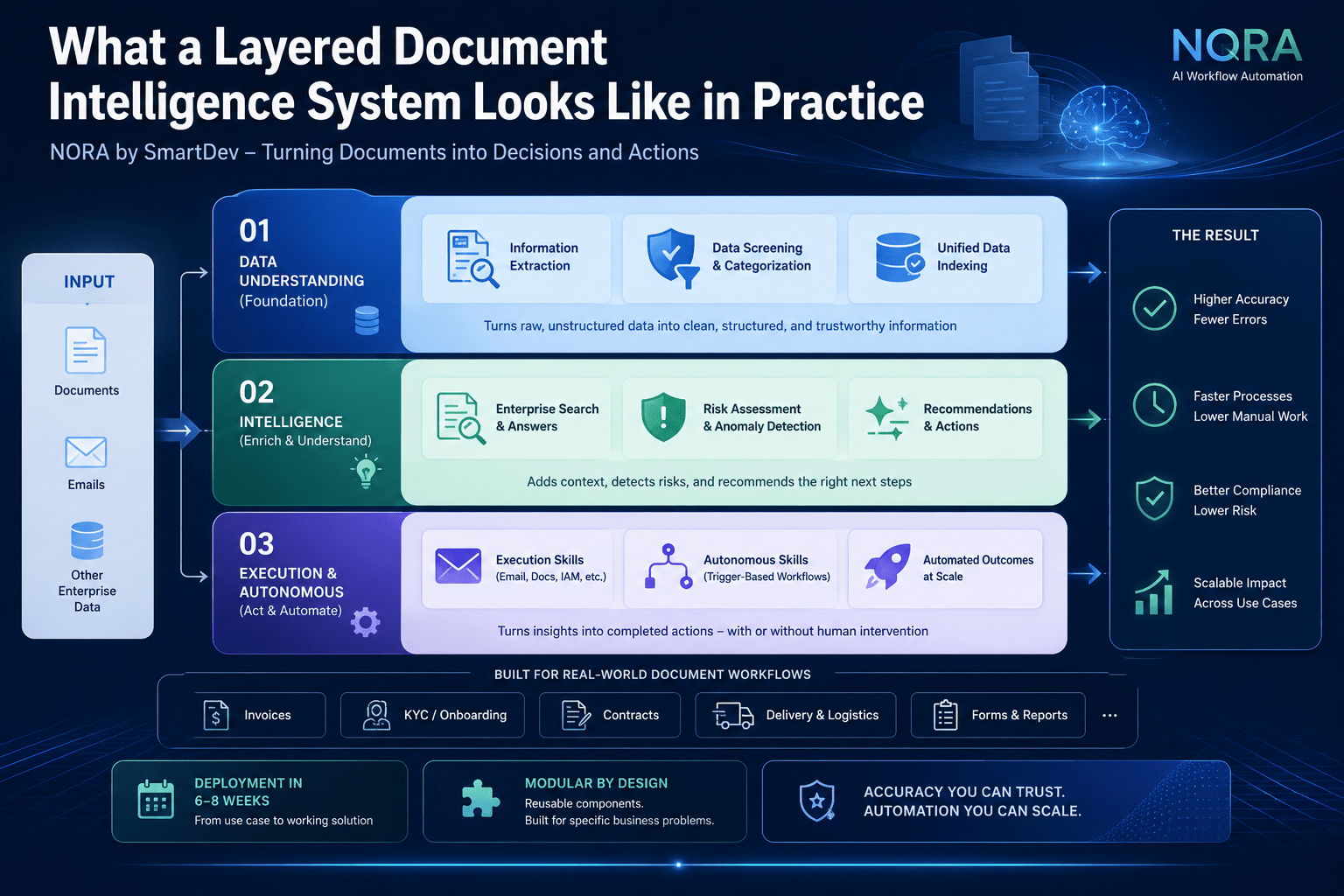
Describing the layers in the abstract is useful, but it helps to see how they fit together in a working system. NORA, SmartDev’s AI workflow automation platform, is built around exactly this layered logic — and its architecture maps directly onto the accuracy problem that OCR-only approaches leave unsolved.
Starting at the foundation
NORA’s data understanding layer is where raw, unstructured data gets made usable. This covers information extraction from documents and emails, data screening that filters and categorizes content before it reaches any decision layer, and unified data indexing that standardizes enterprise data into a consistent, queryable format. In document-heavy workflows, this is the layer that replaces the OCR-plus-manual-correction pattern: rather than producing a flat text output that someone has to verify, it extracts structured data, validates it, and makes it ready for the next step.
Making sense of what was extracted
Once the data is clean and indexed, NORA’s intelligence layer applies reasoning rather than just pattern matching. Enterprise search and answer capabilities let users query internal knowledge directly and trace results back to source documents — the kind of transparency that compliance and audit workflows require.
Risk assessment analyzes extracted data to surface anomalies and potential issues before they become downstream problems. Recommendation logic suggests relevant actions based on what the data shows, rather than waiting for a human to interpret it and decide what comes next. A risk assessment built on correctly extracted, validated data produces a meaningfully different output than one built on raw OCR text that may contain misread fields.
Turning data into completed work
The execution and autonomous layers are where document intelligence connects to actual business processes. Execution skills handle the concrete tasks that currently sit between document extraction and system update: email automation, document drafting, and identity and access management.
A practical example from NORA’s demos: when a new employee joins, NORA carries out the IT helpdesk workflow of creating email accounts and setting passwords — tasks that currently require a person to receive a request, act on it, and confirm completion. Autonomous skills take this further, with trigger-based workflows that act on predefined conditions without waiting for a human to initiate them. When inventory falls below a threshold, for instance, NORA identifies the condition and initiates a procurement request immediately.
What this means for the accuracy problem specifically
The reason this architecture matters for document accuracy is that it separates concerns in a way that OCR-only pipelines don’t. OCR produces text. NORA’s foundation layer makes that text trustworthy. The intelligence layer makes it meaningful. The execution layer acts on it. Each step has a defined job, and errors at any step are caught before they propagate to the next one — rather than flowing silently downstream until they surface as a failed match, a wrong payment, or a compliance gap.
NORA is designed to be deployed as reusable components against specific business problems, not as an enterprise-wide transformation. The same foundational data skills that underpin a KYC document review workflow can apply to invoice processing or contract extraction in a different department. This is also why the deployment timeline is 6–8 weeks to a working solution on a specific use case, rather than months of scoping before anything runs in production.
Conclusion
OCR technology hasn’t stopped improving. Vision-language models and multimodal AI are driving meaningful gains in recognition quality</a>, particularly for documents that previously fell into OCR’s hard-to-read categories. The trajectory is positive. But the fundamental point remains: character recognition accuracy is not the same as document processing accuracy, and document processing accuracy is not the same as workflow reliability.
A reliable approach treats OCR as one input into a document intelligence stack — combining it with classification, AI-powered extraction, contextual validation, confidence scoring, exception routing, and human review applied precisely where it adds value. This is not a marginal improvement over OCR alone. It’s a different architectural model with meaningfully different accuracy outcomes in real operating conditions, and it’s what the emergence of IDP and the broader shift toward AI-powered software development reflect at an industry level.
SmartDev helps enterprises move from OCR-only pipelines to document intelligence architectures designed for the documents they actually receive — not the idealized clean scans that benchmark figures are based on. If accuracy errors, manual correction backlogs, or downstream failures are limiting what your current document workflows can deliver, our AI and Machine Learning team can help identify where the structural gaps are and what a more reliable approach looks like for your specific document types and processes. Talk to our team to start the conversation.
FAQ
What proportion of the documents you process fall outside the clean-printed-text, standard-format condition? For most enterprise operations, the honest answer is “many.” If that’s true, the gap between OCR’s quoted accuracy rates and real-world performance in your specific environment is likely larger than vendor numbers suggest.
What happens operationally when an OCR extraction is wrong? If the answer is “someone catches it in downstream review” or “we find out when a payment fails or a match breaks,” errors are being caught reactively rather than at the point of extraction — which is both more expensive and more likely to allow some errors to pass through undetected.
Do you have visibility into which document types or specific vendors generate the most extraction errors? Without confidence scoring and error logging at the extraction stage, that data simply doesn’t exist. The accuracy problem is invisible until it surfaces downstream, which is consistently the worst moment to discover it.
How much manual correction work sits between OCR extraction and your downstream systems? If data entry correction is a defined role or a recurring time allocation in your operations, that’s a direct signal that OCR output isn’t trusted enough to flow automatically — but that the manual correction is absorbing the cost of the gap rather than closing it structurally.