
TL;DR
- Containerization packages software and all its dependencies into a portable, self-contained unit that runs consistently across any environment or cloud platform.
- It eliminates environment-specific deployment failures, speeds up application releases, and makes software easier and cheaper to scale in the cloud.
- Gartner estimates that 90% of global organizations will run containerized applications in production by 2026, making it a mainstream business technology today.
Containerization solves one of software development’s oldest frustrations: applications that work perfectly in testing but break unexpectedly in production. By packaging software into standardized containers, businesses achieve consistent deployments, faster scaling, and lower infrastructure costs. This article explains what containerization is, why it matters for your business, and what it costs to adopt.
What is Containerization?
Containerization is a method of packaging a software application together with all the code, libraries, configuration files, and dependencies it needs to run into a single portable unit called a container. Unlike virtual machines, which emulate an entire operating system for each application, containers share the host system’s operating system kernel, making them significantly lighter, faster to start, and more resource-efficient.
Docker is the most widely used containerization tool. Containers built with Docker can run on any server, laptop, or cloud platform that supports it, from a developer’s local machine to an AWS production environment. Kubernetes is the leading platform for managing and orchestrating large numbers of containers at enterprise scale.
Key types of containerization setups include:
- Single-container applications: One container runs the entire application, suitable for simple or stateless services.
- Multi-container applications: Different components such as the database, web server, and background job processor each run in separate containers that communicate with each other.
- Microservices architectures: Each microservice runs in its own container, enabling teams to scale and deploy each application component completely independently.
Pourquoi c'est important pour les entreprises
For business leaders, containerization is primarily a speed, cost, and reliability story. Shipping software faster, with fewer deployment failures and lower infrastructure bills, directly impacts competitive position and operational efficiency across the organization.
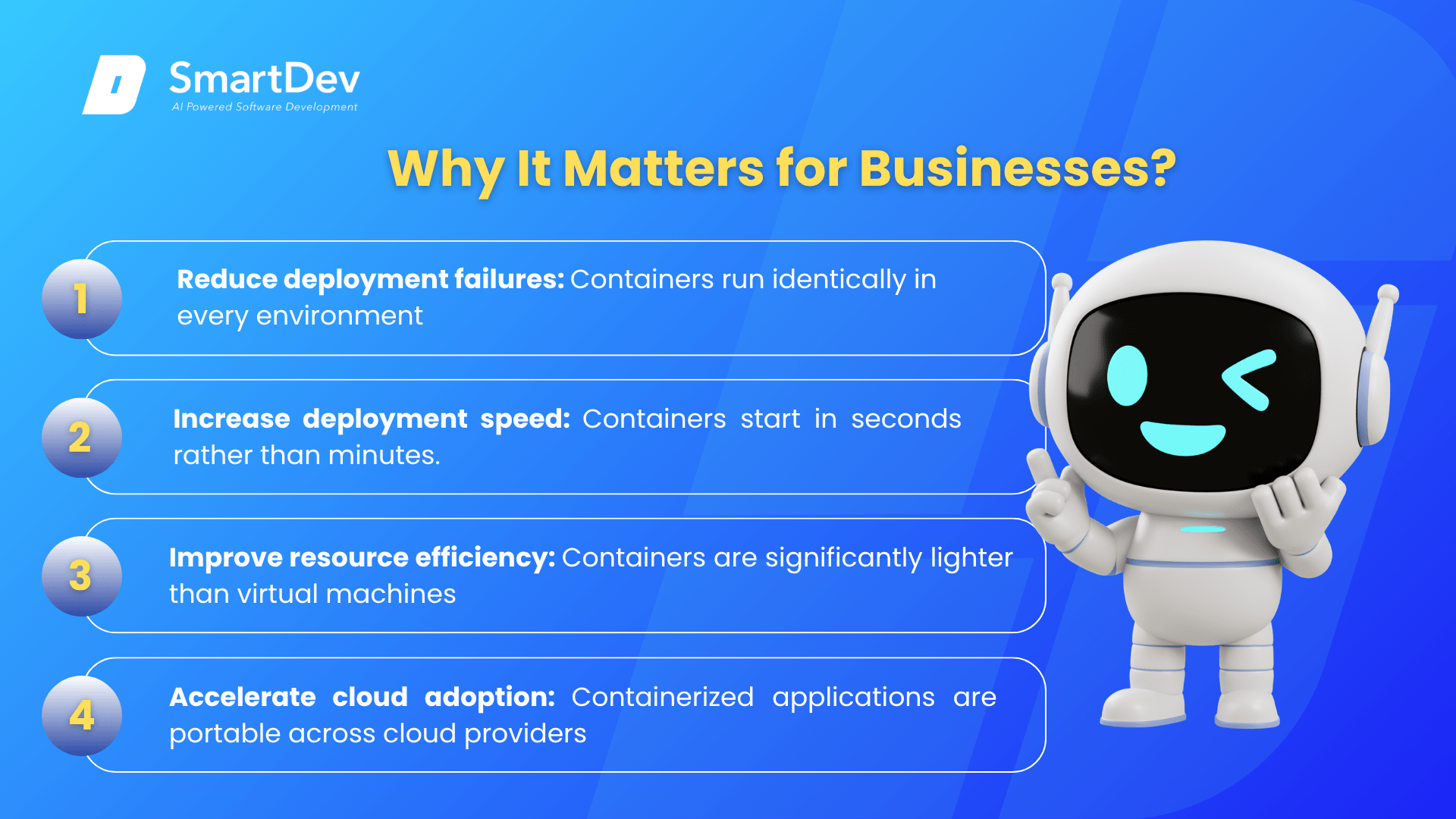
- Reduce deployment failures: Containers run identically in every environment, eliminating environment-specific bugs that create delays between development and production and frustrate both teams and customers.
- Increase deployment speed: Containers start in seconds rather than minutes. Deployments that previously took hours of manual preparation can be completed in minutes with a single command.
- Improve resource efficiency: Containers are significantly lighter than virtual machines, allowing more workloads to run on the same hardware and reducing infrastructure costs by 20 to 50% in many enterprise deployments.
- Accelerate cloud adoption: Containerized applications are portable across cloud providers, reducing vendor lock-in and enabling organizations to move workloads between AWS, Azure, and Google Cloud without major rearchitecting.
For example, a software company managing an outsourced development team deployed their application using containers, ensuring that what the offshore team built and tested locally ran identically in staging and production. This eliminated a persistent source of deployment failures and dramatically reduced the time spent diagnosing environment-related bugs between releases.
How Does Containerization Work?
- Define the container: Developers write a Dockerfile, a simple text file specifying what the container should include: the base operating system layer, application code, required libraries, and configuration settings needed to run.
- Build the container image: The Dockerfile is used to build a container image, a snapshot of the fully packaged application. This image is stored in a container registry such as Docker Hub or AWS ECR for distribution.
- Run the container: The image is pulled from the registry and run as a container on any server or cloud environment that supports Docker. The container starts in seconds and runs in isolation from other containers on the same host machine.
- Orchestrate at scale: For production deployments managing many containers simultaneously, an orchestration platform like Kubernetes automatically assigns containers to servers, handles traffic load balancing, and restarts failed containers without human intervention.
- Monitor and update: New versions of the application are packaged as updated container images and deployed without downtime using rolling update strategies that replace old containers gradually as new ones become healthy.
The result is a software deployment process that is faster, more consistent, and far easier to scale than traditional approaches based on manual server configuration or virtual machines.
How Much Does Containerization Cost?
Containerization tooling is largely open source, so direct licensing costs are minimal. The primary investment is in engineering time and cloud infrastructure:
- Tooling: Docker is free for most use cases. Managed Kubernetes services on major cloud platforms such as AWS EKS, Google GKE, or Azure AKS cost approximately $70 to $150 per month per cluster, plus compute costs for the workloads running inside.
- Migration and setup: Containerizing an existing application typically takes one to four weeks of engineering time depending on complexity and how tightly the application is coupled to its existing environment. At outsourced development rates of $25 to $80 per hour, expect $4,000 to $25,000 for initial containerization of a typical application.
- Infrastructure savings: Most organizations report 20 to 50% reductions in infrastructure costs after containerization, as containers allow significantly more efficient use of cloud compute resources compared to running separate virtual machines per application.
The total cost of containerization is typically recovered within one to two years through infrastructure savings and faster development cycles. Organizations that outsource containerization work often accelerate this payback by avoiding the cost of hiring and training specialized in-house DevOps engineers in a competitive talent market.
Autres termes associés
Continuous delivery: A software practice where every code change is automatically built, tested, and staged so the team can release to production at any time with a single approval.
Kubernetes: An open-source orchestration platform that automates the deployment, scaling, and management of containerized applications across clusters of servers or cloud infrastructure at enterprise scale.
Cloud Native Development: A software development approach that builds applications specifically for cloud environments, using containers, microservices, and CI/CD pipelines as core foundational components of the architecture.