
TL;DR
- Continuous delivery is a software practice where every code change is automatically built, tested, and staged so the team can release to production at any time with a single approval.
- It reduces deployment risk, accelerates time to market, and gives businesses the ability to respond to customer feedback and market changes within hours rather than weeks.
- Continuous delivery sits between continuous integration (which validates code) and continuous deployment (which releases automatically), giving teams speed with controlled release decisions.
Continuous delivery is about making software releases predictable and low-risk. When done well, deploying new software to your customers becomes a routine, controlled event rather than a stressful, high-stakes operation that teams dread. This article explains what continuous delivery is, why it matters for businesses, and when to use it.
What is Continuous Delivery?
Continuous delivery (CD) is a software development practice where every code change, after passing automated testing, is automatically built, validated, and staged so it can be released to production at any time. The actual deployment to production still requires a deliberate manual trigger or approval, giving the team control over release timing.
This is what distinguishes continuous delivery from continuous deployment, where every passing change is automatically released to end users with no human approval step. Continuous delivery gives teams the confidence that their code is always in a deployable state while retaining control over when exactly the release happens, for example avoiding releases on Friday afternoons or ahead of major events.
Continuous delivery is the natural extension of continuous integration (CI). Where CI focuses on automatically merging and testing code changes throughout the day, CD takes those validated changes and automates all remaining steps to get them production-ready and waiting for approval. Together they form the CI/CD pipeline that modern software teams depend on for reliable delivery.
Pourquoi c'est important pour les entreprises
Traditional software release processes are slow, manual, and filled with risk. Teams accumulate weeks or months of changes, then deploy everything at once. When something breaks, diagnosing the cause is complex, rollback is painful, and customers experience extended disruption. Continuous delivery changes this dynamic entirely by making releases small, frequent, and automated.
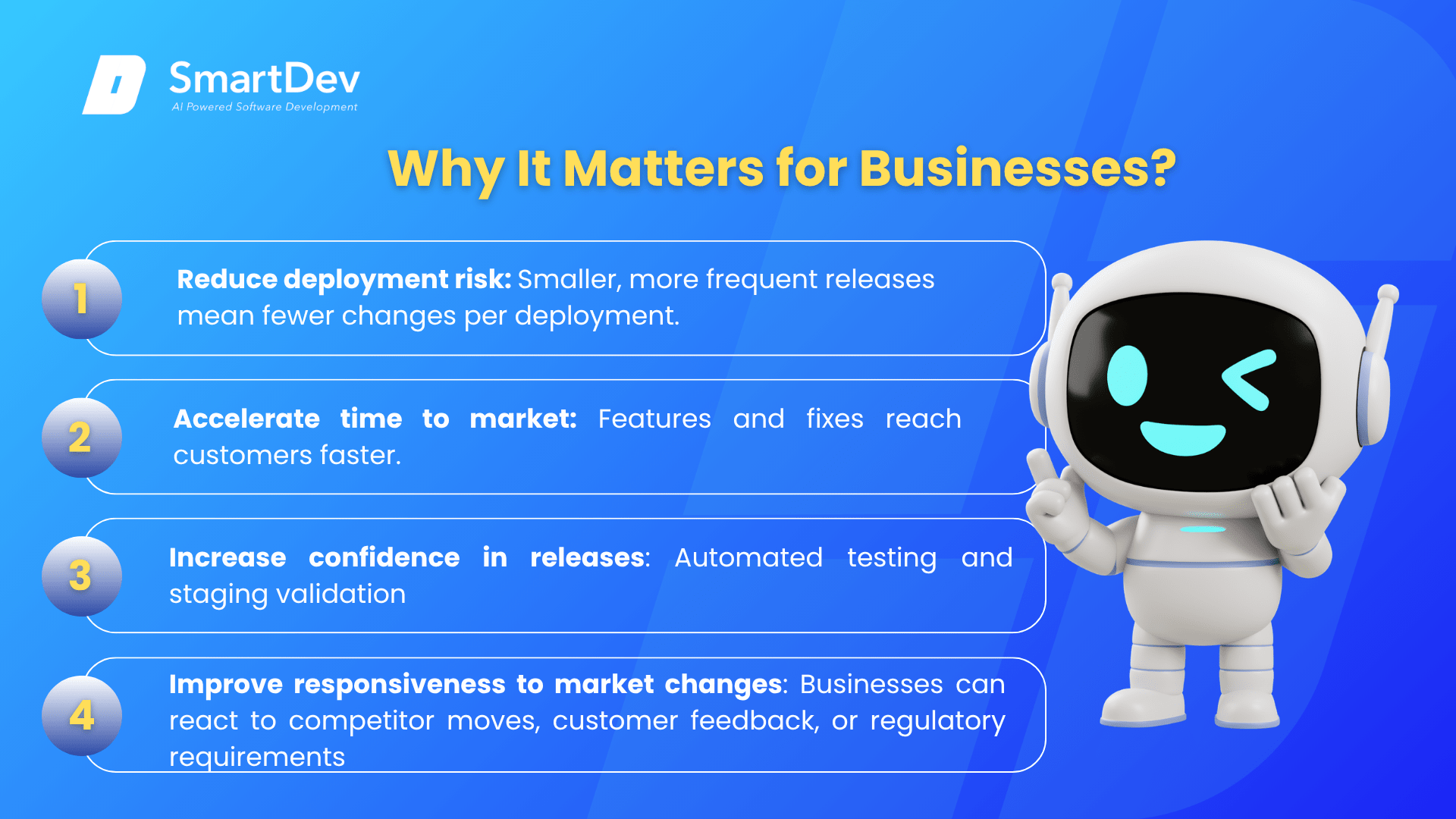
- Reduce deployment risk: Smaller, more frequent releases mean fewer changes per deployment. When something goes wrong, the cause is easy to identify and rollback is fast and safe.
- Accelerate time to market: Features and fixes reach customers faster. Instead of waiting for a monthly or quarterly release cycle, teams can ship improvements in hours or days on business demand.
- Increase confidence in releases: Automated testing and staging validation ensure that code is thoroughly checked in a production-like environment before going live, dramatically reducing the frequency of production incidents.
- Improve responsiveness to market changes: Businesses can react to competitor moves, customer feedback, or regulatory requirements faster when software can be released on demand rather than on a fixed schedule.
For example, a healthcare software company reduced its release cycle from quarterly to biweekly by implementing continuous delivery. Production incidents decreased after each release, and the team could respond to critical regulatory requirement changes within days rather than waiting for the next scheduled release window months away.
How Does Continuous Delivery Work?
- Code integration: Developers commit code changes to the shared repository, which triggers the continuous integration stage. The CI system runs automated builds and tests to validate that the change does not break existing functionality.
- Automated testing: A comprehensive suite of automated tests, including unit tests, integration tests, and end-to-end tests, validates the change against the full application behavior. Only fully passing builds move forward in the pipeline.
- Build and package: The validated code is compiled, packaged, and stored as a deployable artifact such as a container image or compiled binary in an artifact repository, ready for deployment at any time.
- Staging deployment: The packaged build is automatically deployed to a staging environment that mirrors production closely. Smoke tests and performance checks run automatically to confirm the release is ready for production.
- Manual release trigger: A team member reviews the staged release summary and triggers deployment to production with a single click or command. The deployment itself is fully automated. Only the decision to release requires a human.
The result is a pipeline where software is always ready to ship, and the effort required to release it is reduced to a single deliberate decision by the appropriate person.
When to Use Continuous Delivery?
Continuous delivery is the right approach when your organization wants faster, more reliable software releases. It is especially valuable when:
- Your release frequency is too low: If your team releases monthly or less often, you are accumulating too much change risk in each deployment. Continuous delivery enables smaller, safer, and more frequent releases.
- Deployment failures are common: Manual release processes are prone to human error, misconfiguration, and missed steps. Automating the deployment pipeline eliminates most manual failure points.
- You work with an outsourced or distributed team: Continuous delivery enforces consistent build and testing standards across geographically distributed teams, ensuring code quality without depending on manual checks at every handoff point.
- You need faster response to customer feedback: When business decisions depend on real user data from production, shipping features quickly and iterating on feedback creates a measurable competitive advantage over slower-moving competitors.
When NOT to adopt continuous delivery yet:
- If your automated test coverage is insufficient, continuous delivery is premature. Without reliable automated tests, the pipeline cannot confidently validate that code is safe to release.
- If your team lacks foundational DevOps knowledge, start with continuous integration before building toward delivery. Establish the quality foundation before automating the release process.
Autres termes associés
Continuous Integration: The practice of automatically merging and testing code changes from multiple developers throughout the day, forming the first and foundational stage of the CI/CD pipeline that feeds into continuous delivery.
CI/CD Pipeline: The complete automated workflow that takes code from a developer’s commit through build, test, staging, and deployment preparation, of which continuous delivery is the final and most business-visible stage.
DevOps: A set of practices combining software development and IT operations teams, with continuous delivery as a central capability that enables the fast, reliable, and repeatable software releases that DevOps culture aims to achieve.