TL;DR
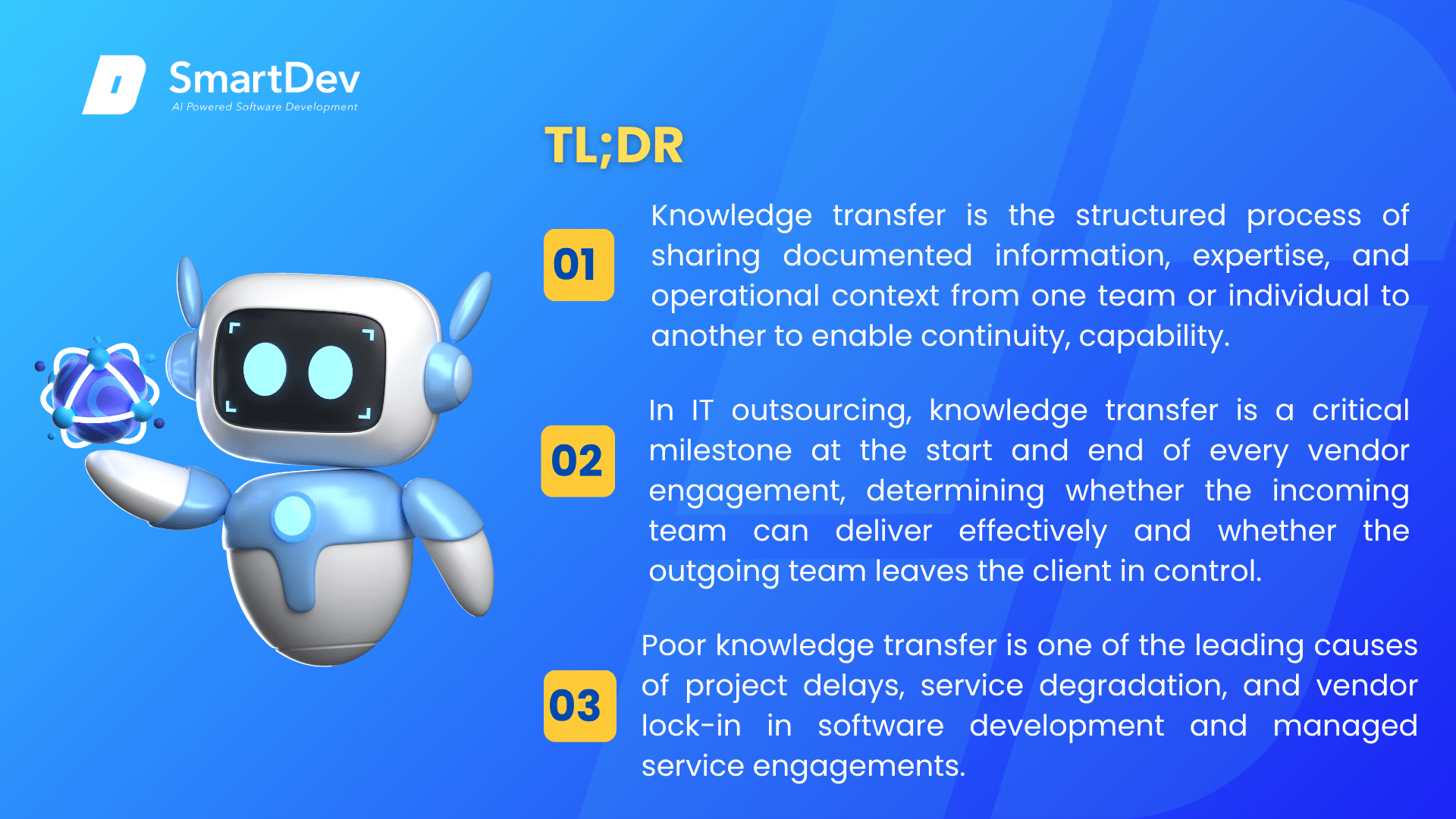
- Knowledge transfer is the structured process of sharing documented information, expertise, and operational context from one team or individual to another to enable continuity, capability, and independence.
- In IT outsourcing, knowledge transfer is a critical milestone at the start and end of every vendor engagement, determining whether the incoming team can deliver effectively and whether the outgoing team leaves the client in control.
- Poor knowledge transfer is one of the leading causes of project delays, service degradation, and vendor lock-in in software development and managed service engagements.
Knowledge transfer is what determines whether a new team can hit the ground running or spends months reverse-engineering what the previous team built. It is the often-underestimated operational step that separates smooth vendor transitions from costly chaos. This article explains what knowledge transfer is, how it works, and when to invest in it deliberately.
What is Knowledge Transfer?
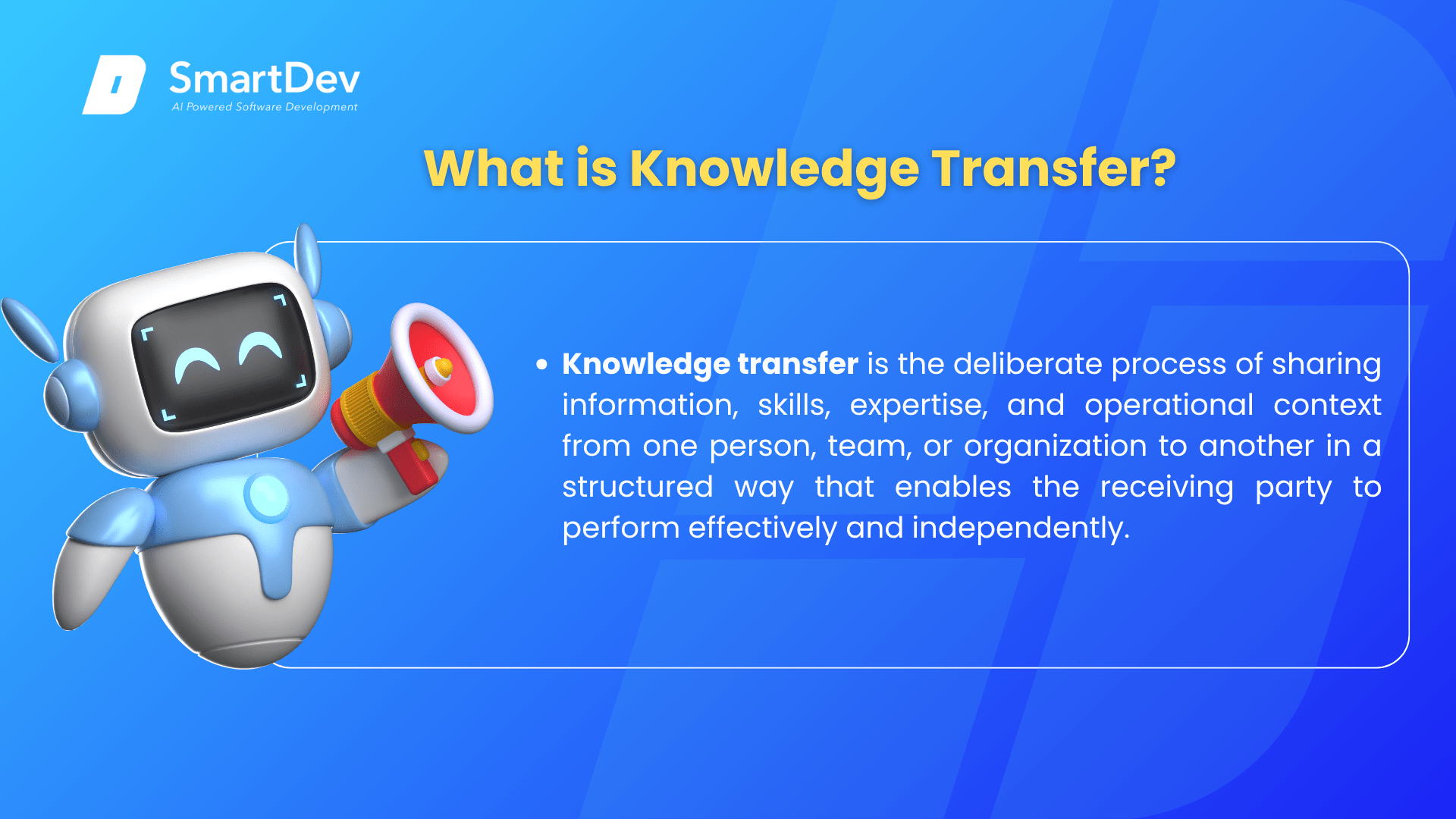
Knowledge transfer is the deliberate process of sharing information, skills, expertise, and operational context from one person, team, or organization to another in a structured way that enables the receiving party to perform effectively and independently.
In technology contexts, knowledge transfer typically involves sharing:
- Technical documentation: Architecture diagrams, codebase documentation, API references, database schemas, and infrastructure runbooks that describe how systems are built and how they operate
- Operational procedures: Step-by-step processes for deployment, monitoring, incident response, and routine maintenance that a new team needs to manage the system safely
- Business context: The domain knowledge, business rules, and stakeholder relationships that explain why the system works the way it does, not just what it does technically
- Tacit knowledge: The undocumented expertise and judgment accumulated by experienced team members, typically transferred through shadowing, pair working, and structured question-and-answer sessions
Pourquoi c'est important pour les entreprises
Organizations depend on their technology systems, and those systems depend on people who understand them. When that understanding is concentrated in individuals or teams who leave, without a deliberate transfer process, it leaves with them. The business then faces re-learning costs, delivery slowdowns, and operational risks that a well-planned knowledge transfer would have prevented entirely.
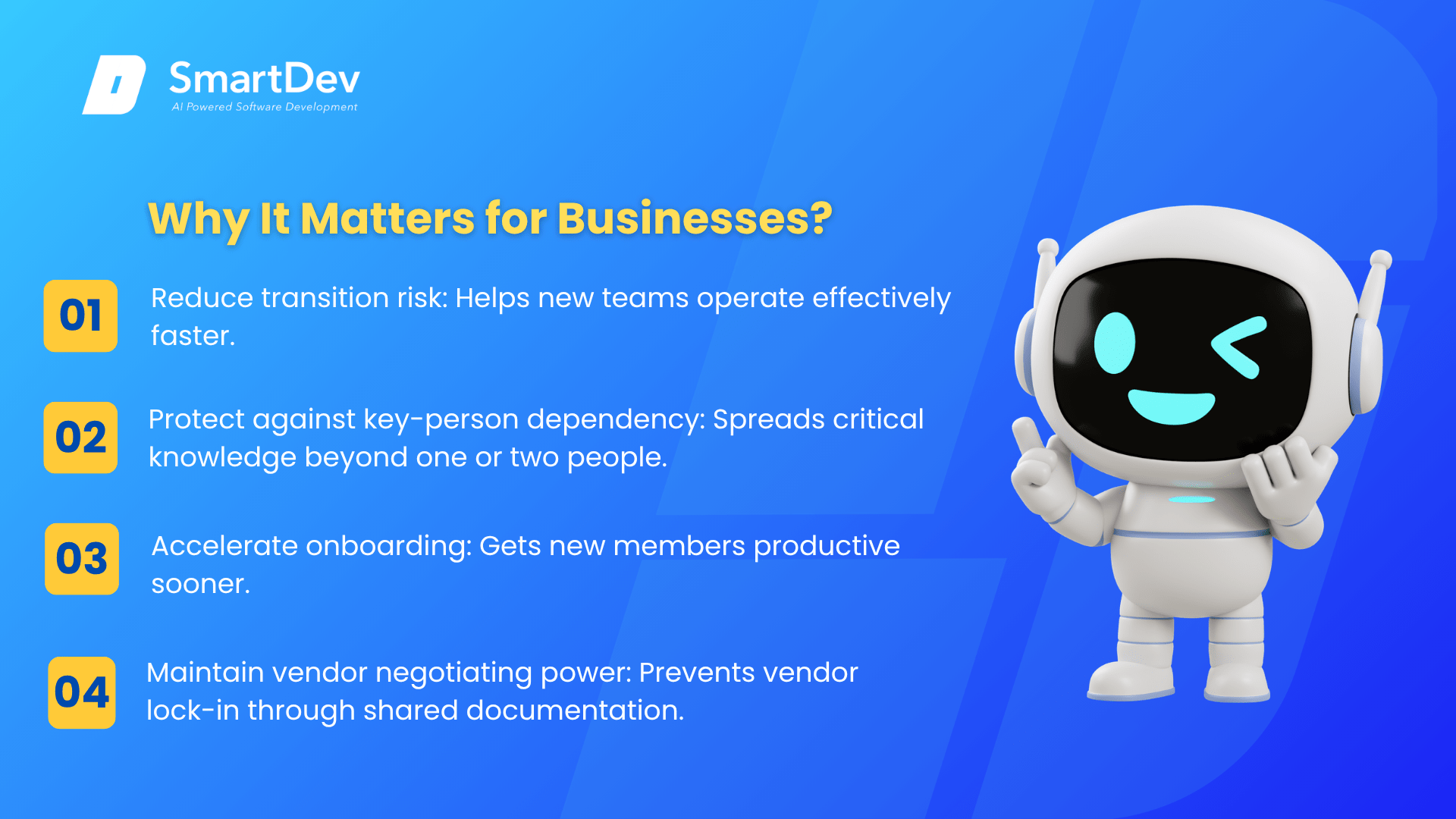
- Reduce transition risk: When an IT outsourcing engagement begins or ends, the quality of knowledge transfer directly determines whether the incoming team can operate effectively from day one or requires months of expensive investigation to reach productivity.
- Protect against key person dependency: Organizations where critical system knowledge resides with one or two individuals face significant operational risk when those people leave. Knowledge transfer programs distribute expertise across the team and into documentation, reducing single points of failure.
- Accelerate onboarding: New team members who receive structured knowledge transfer reach productive contribution significantly faster than those who learn through trial and error, improving team output and reducing the cost and frustration of extended ramp-up periods.
- Maintain vendor negotiating power: When a vendor holds unique, undocumented knowledge about your systems, switching becomes prohibitively expensive, creating vendor lock-in. Systematic knowledge transfer ensures the client retains control of their technology assets regardless of which vendor is operating them.
For example, a financial services company switching IT outsourcing vendors for its core payment processing system invested 8 weeks in a structured knowledge transfer program between the outgoing and incoming teams. Despite the complexity of the system, the new vendor reached full operational capacity within 6 weeks of taking over responsibility, compared to an industry benchmark of 4 to 6 months for unstructured transitions of similar complexity.
How Does Knowledge Transfer Work?
- Audit what knowledge exists and where it lives: Begin with an inventory of existing documentation, systems, and processes, and map which knowledge is documented versus tacit. Identify the highest-risk knowledge gaps where undocumented expertise could cause problems if the holder were unavailable.
- Create or update documentation: Address documentation gaps with a targeted documentation sprint, prioritizing operational runbooks, architecture overviews, and business rule documentation that the receiving team needs to operate independently. Documentation should be written for the audience who will use it, not just to exist.
- Plan structured handover sessions: Design a handover program that includes walkthroughs of key systems, shadowing sessions, and knowledge-check exercises where the receiving team demonstrates capability before the outgoing team withdraws. Do not rely on documentation alone; tacit knowledge requires direct interaction to transfer effectively.
- Run parallel operations: Where feasible, operate both teams in parallel for a defined period during which the receiving team takes increasing responsibility while the outgoing team provides support and correction. This is the most reliable model for complex operational handovers.
- Verify and accept: Define acceptance criteria for the knowledge transfer, such as the receiving team independently completing specific operational procedures and passing scenario-based assessments. Formal sign-off ends the transfer phase and establishes that the client accepts responsibility for the receiving team’s readiness.
The result is a receiving team that operates with confidence and competence from the start, and a client organization that retains full control and understanding of its technology, regardless of vendor changes.
When to Use Knowledge Transfer?
Knowledge transfer should be planned deliberately in these situations:
- At the start of an outsourcing engagement, to bring the new vendor team up to speed on business context, system architecture, and operational procedures before they take on delivery responsibility
- At the end of a vendor contract or when switching providers, to ensure the exiting vendor transfers all operational knowledge before they disengage
- When key team members leave the organization or are reassigned, to capture and distribute their expertise before it walks out the door
- When creating backup capability for critical functions that are currently single-point-of-failure dependencies on specific individuals
When NOT to underinvest in knowledge transfer:
- Never treat knowledge transfer as optional in outsourcing transitions. The cost of a poor transition almost always exceeds the cost of thorough knowledge transfer planning by a large margin.
Autres termes associés
IT Outsourcing: The practice of contracting external providers to deliver IT services, where knowledge transfer is a critical operational milestone at both the beginning and end of every outsourcing relationship.
Revenue Model: A revenue model explains how a business earns money from the value it provides to customers.
Pilot Project: A pilot project is a small-scale trial implementation of a new technology, process, or solution before rolling it out across the entire organization.