
TL;DR
- Net Promoter Score (NPS) measures customer loyalty by asking how likely customers are to recommend your business to others, on a scale of 0 to 10.
- NPS ranges from -100 to +100, and scores above 30 are considered strong for enterprise B2B technology companies.
- Regular NPS tracking gives leadership an early warning system for customer dissatisfaction before it leads to churn.
Net Promoter Score (NPS) has become one of the most widely used metrics in enterprise business because it condenses customer loyalty into a single, comparable number. For IT companies and outsourcing providers, where long-term client relationships are the foundation of recurring revenue, NPS is a direct signal of whether your service delivery is building or eroding trust.
What is Net Promoter Score (NPS)?
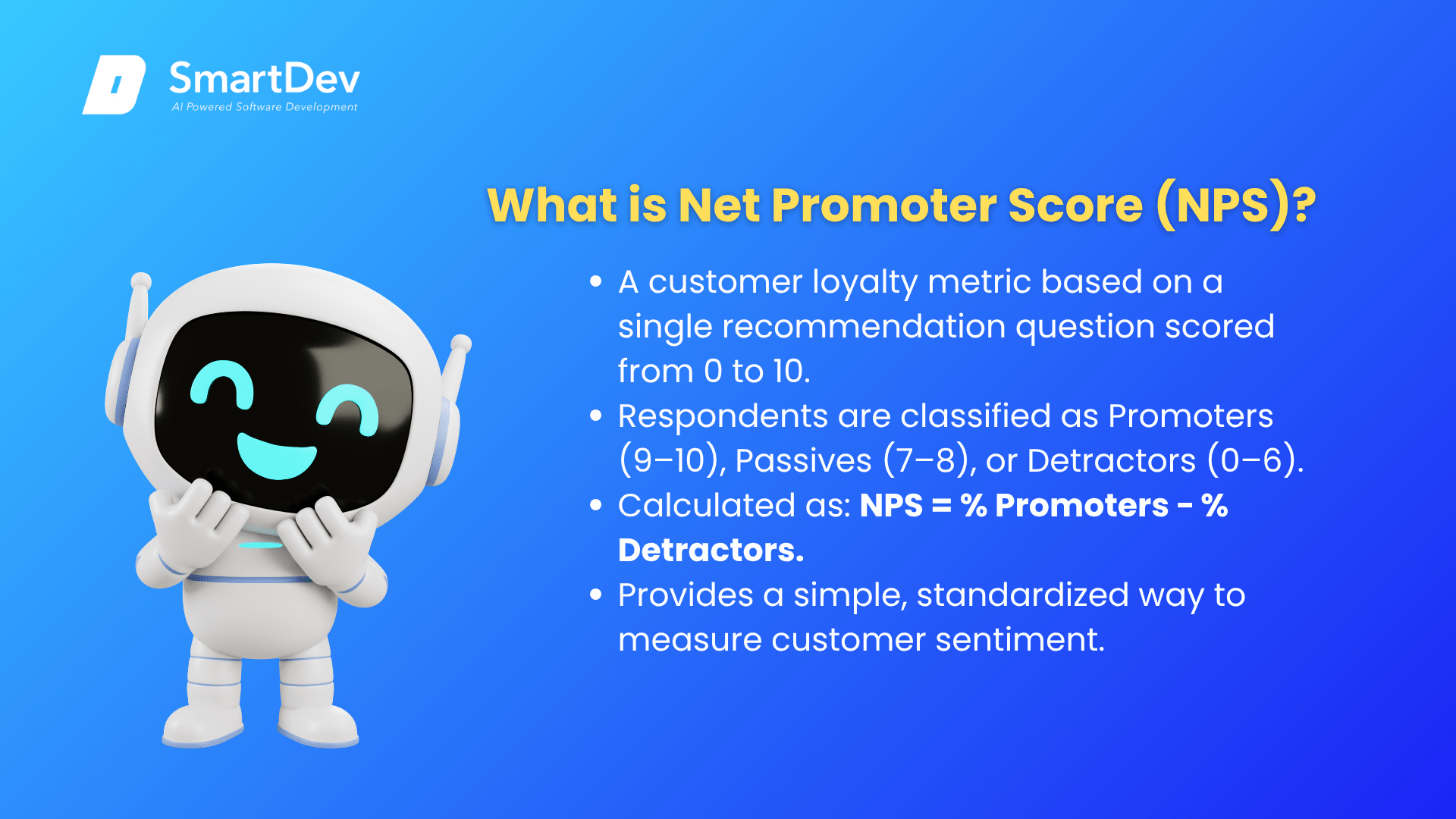
Net Promoter Score (NPS) is a customer loyalty metric that measures the likelihood of customers recommending your business to others, calculated by subtracting the percentage of detractors from the percentage of promoters based on responses to a single survey question.
The survey asks one question: “On a scale of 0 to 10, how likely are you to recommend us to a friend or colleague?” Respondents are grouped into three categories. Promoters (scores 9 to 10) are loyal enthusiasts who actively refer others. Passives (scores 7 to 8) are satisfied but not enthusiastic enough to advocate. Detractors (scores 0 to 6) are unhappy customers who may warn others away.
The NPS formula is simple: NPS = % Promoters minus % Detractors. The resulting score ranges from -100 (all detractors) to +100 (all promoters).
Pourquoi c'est important pour les entreprises
Revenue churn is one of the most costly problems a business can face, and by the time a customer cancels a contract, it is usually too late to fix the relationship. NPS gives businesses an earlier signal.
- Increase retention by identifying at-risk accounts before dissatisfaction turns into churn.
- Improve service quality by using feedback from detractors to pinpoint recurring pain points in your delivery process.
- Reduce customer acquisition costs by cultivating promoters who refer new business organically.
- Accelerate revenue growth by benchmarking NPS over time and correlating score improvements with retention and expansion metrics.
For example, a managed IT services company that introduced quarterly NPS surveys discovered that clients with scores below 6 had an 80% churn rate within 12 months. By creating an intervention workflow for low-scoring accounts, they reduced churn in that segment by 35% in under a year.
How Does NPS Work?
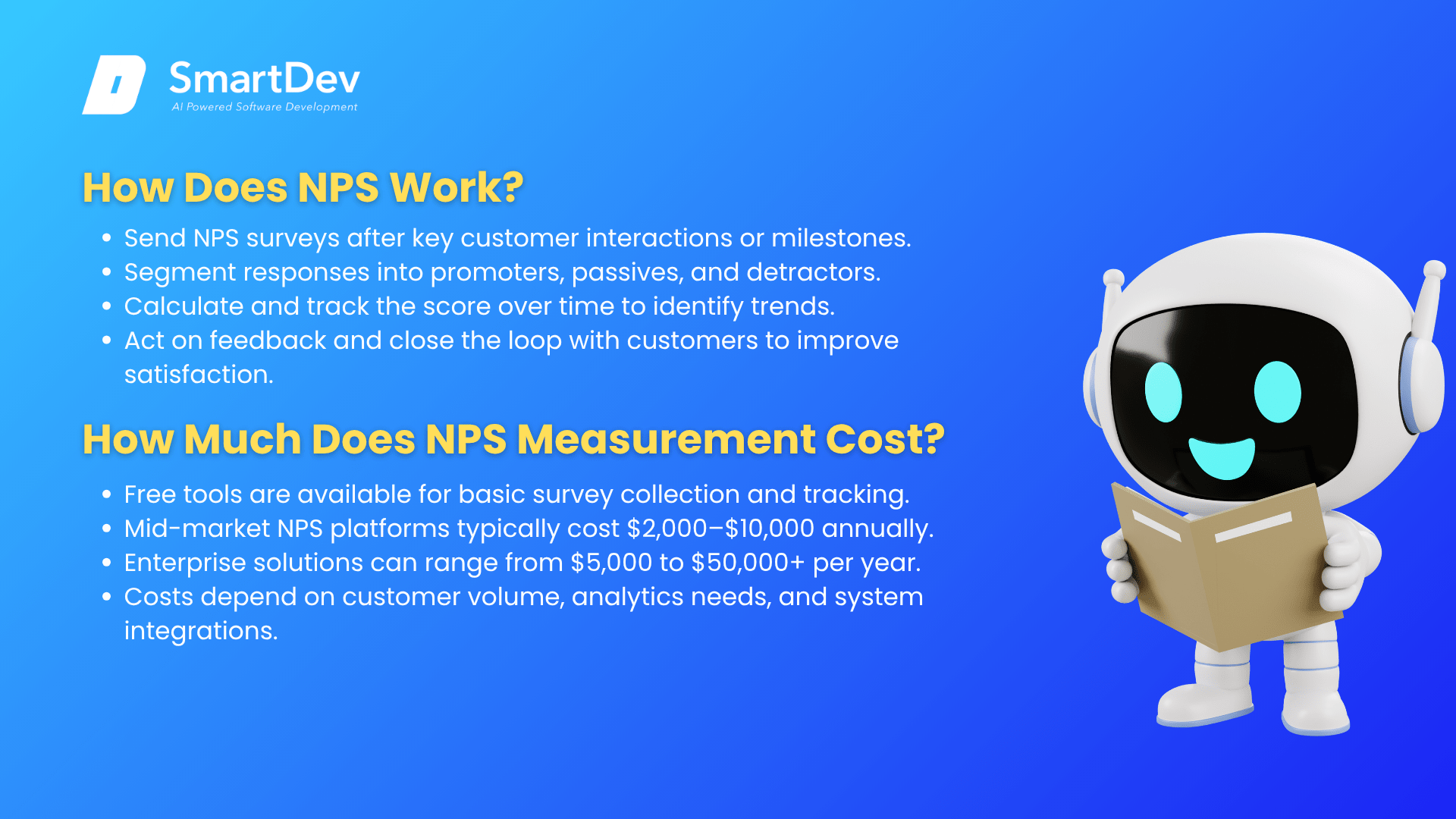
- Send the Survey: Distribute the single-question NPS survey via email, in-app, or through your customer success platform. Timing matters: send it after a key milestone like a product launch, project delivery, or quarterly review.
- Collect and Segment Responses: Categorize respondents as promoters, passives, or detractors. Follow up detractors with an open-text question asking what could be improved.
- Calculate the Score: Apply the NPS formula. Track the score over time to identify trends rather than reacting to single data points.
- Act on the Feedback: Route detractor feedback to account managers for immediate outreach. Use promoter insights to understand what is driving satisfaction and replicate it.
- Close the Loop: Inform respondents of actions taken based on their feedback. This practice alone has been shown to improve subsequent NPS scores.
The result is a continuous feedback loop that turns customer sentiment into actionable intelligence for the leadership team.
How Much Does NPS Measurement Cost?
NPS tools range from free basic plans (SurveyMonkey, Google Forms) to enterprise platforms like Medallia or Qualtrics, which run from $5,000 to $50,000+ per year depending on user count and features. Mid-market solutions such as Delighted or CustomerGauge typically cost $2,000 to $10,000 annually.
Three factors that influence cost include the scale of your customer base (more contacts require higher tier plans), the depth of analytics required (basic NPS tracking is inexpensive; closed-loop case management and CRM integration add cost), and whether you need industry benchmarking data against competitors.
Compared to the cost of losing a single enterprise client, even a premium NPS platform is a fraction of the churn prevention value it delivers.
Autres termes associés
Customer Success Management: The function responsible for ensuring customers achieve their goals with your product or service, and the primary team that acts on NPS feedback to improve retention.
Key Performance Indicators (KPI): The broader set of business metrics within which NPS sits as one of the most important customer-facing indicators of account health.
Escalation Management: The process of addressing customer issues before they escalate to churn, which NPS detractor feedback often triggers as part of a structured intervention workflow.