
En bref :
- Probabilistic output means AI systems generate responses based on statistical likelihood rather than fixed rules, so the same input may produce slightly different answers each time.
- This makes AI more flexible and human-like, but it also means businesses need governance processes to verify AI outputs before acting on them.
- Understanding probabilistic output helps business leaders set realistic expectations for AI tools and build appropriate oversight into AI-powered workflows.
Probabilistic output is one of the most important concepts for any business leader adopting AI tools. It explains why AI does not always give the same answer twice, and why that is both a feature and a management challenge. This guide covers what probabilistic output is, why it matters, how it works, and who needs to understand it most.
What is Probabilistic Output?
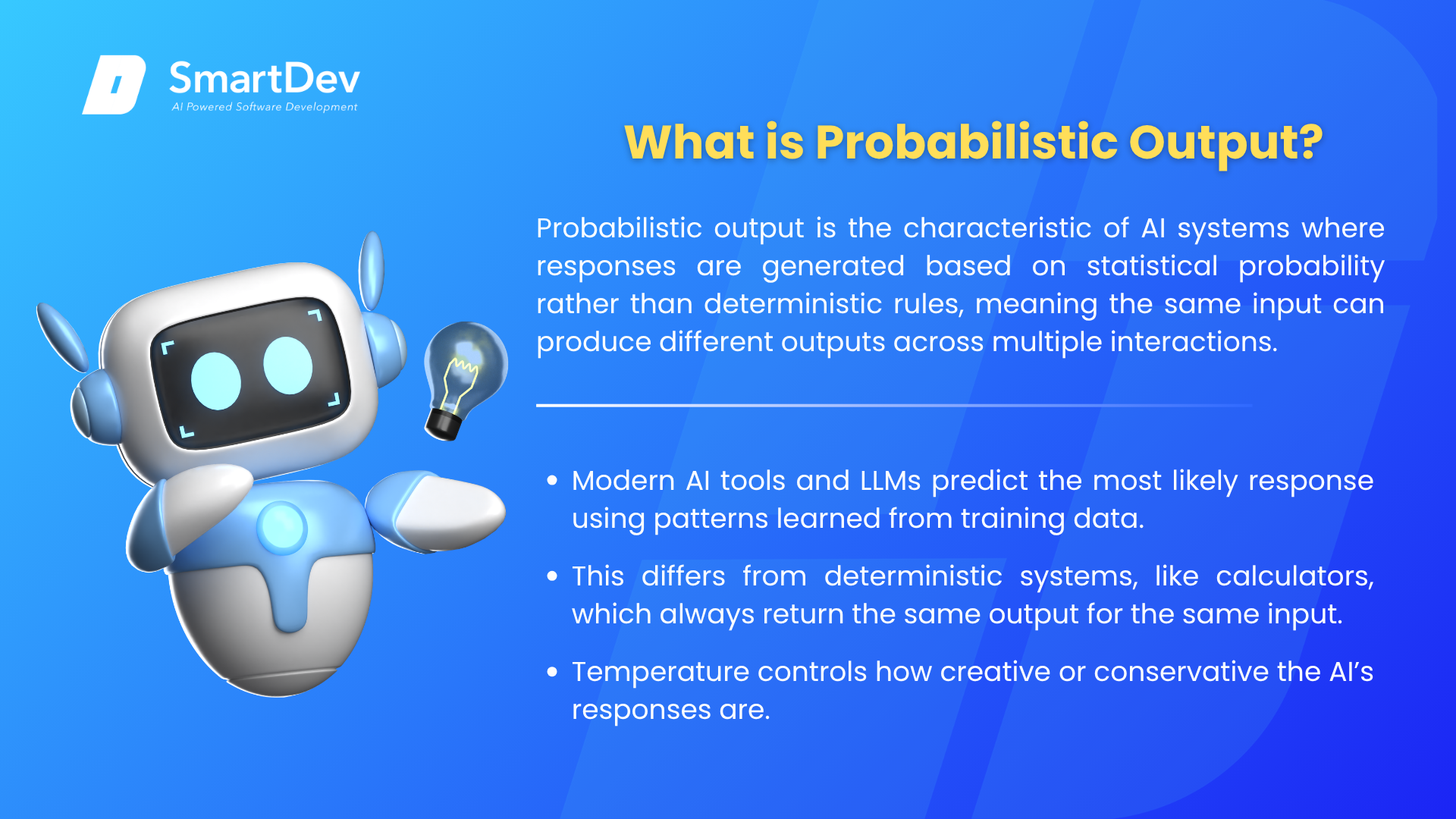
Probabilistic output is the characteristic of AI systems where responses are generated based on statistical probability rather than deterministic rules, meaning the same input can produce different outputs across multiple interactions. Most modern AI tools, including large language models (LLMs) used for text generation, code writing, and data analysis, are probabilistic by design. They do not look up a fixed answer from a database. Instead, they calculate the most likely response given the input, drawing on patterns learned from vast amounts of training data. This differs from deterministic systems, such as a calculator or a rule-based automation, which always produce the exact same output from the same input. The degree of variation in probabilistic systems is controlled by a setting called “temperature,” which determines how creative or conservative the model is in selecting its response.
Pourquoi c'est important pour les entreprises
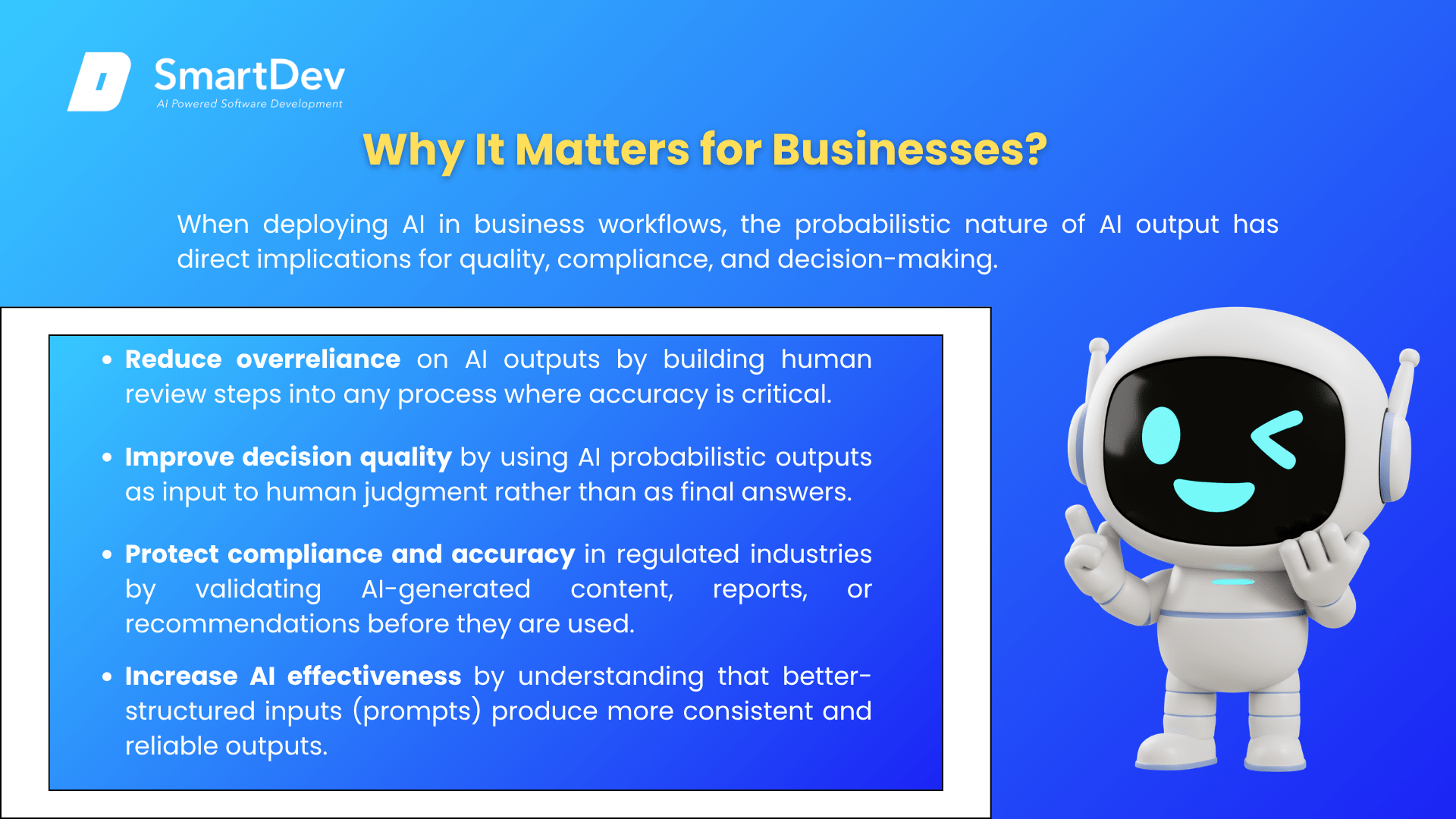
When deploying AI in business workflows, the probabilistic nature of AI output has direct implications for quality, compliance, and decision-making.
- Reduce overreliance on AI outputs by building human review steps into any process where accuracy is critical.
- Improve decision quality by using AI probabilistic outputs as input to human judgment rather than as final answers.
- Protect compliance and accuracy in regulated industries by validating AI-generated content, reports, or recommendations before they are used.
- Increase AI effectiveness by understanding that better-structured inputs (prompts) produce more consistent and reliable outputs.
For example, a legal services firm using an AI tool to draft contract clauses found that without clear, structured prompts and a review process, the same request sometimes produced clauses with subtly different terms. After implementing structured prompt templates and a mandatory human review step, consistency improved significantly and the team could use AI outputs confidently within compliance requirements.
How Does Probabilistic Output Work?
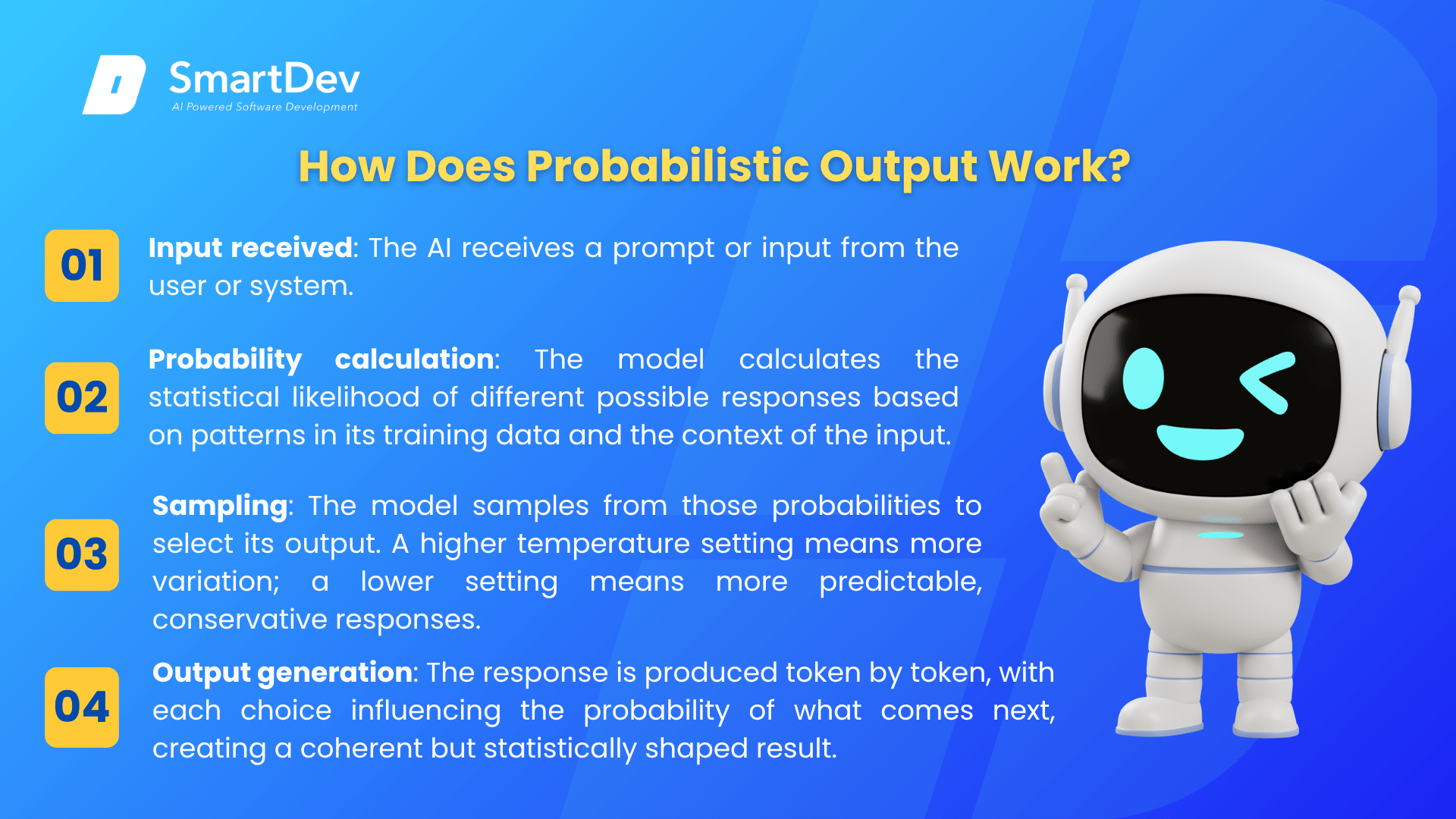
- Input received: The AI receives a prompt or input from the user or system.
- Probability calculation: The model calculates the statistical likelihood of different possible responses based on patterns in its training data and the context of the input.
- Sampling: The model samples from those probabilities to select its output. A higher temperature setting means more variation; a lower setting means more predictable, conservative responses.
- Output generation: The response is produced token by token, with each choice influencing the probability of what comes next, creating a coherent but statistically shaped result.
The result is an output that is contextually relevant and often highly useful, but not guaranteed to be identical across repeated requests with the same input.
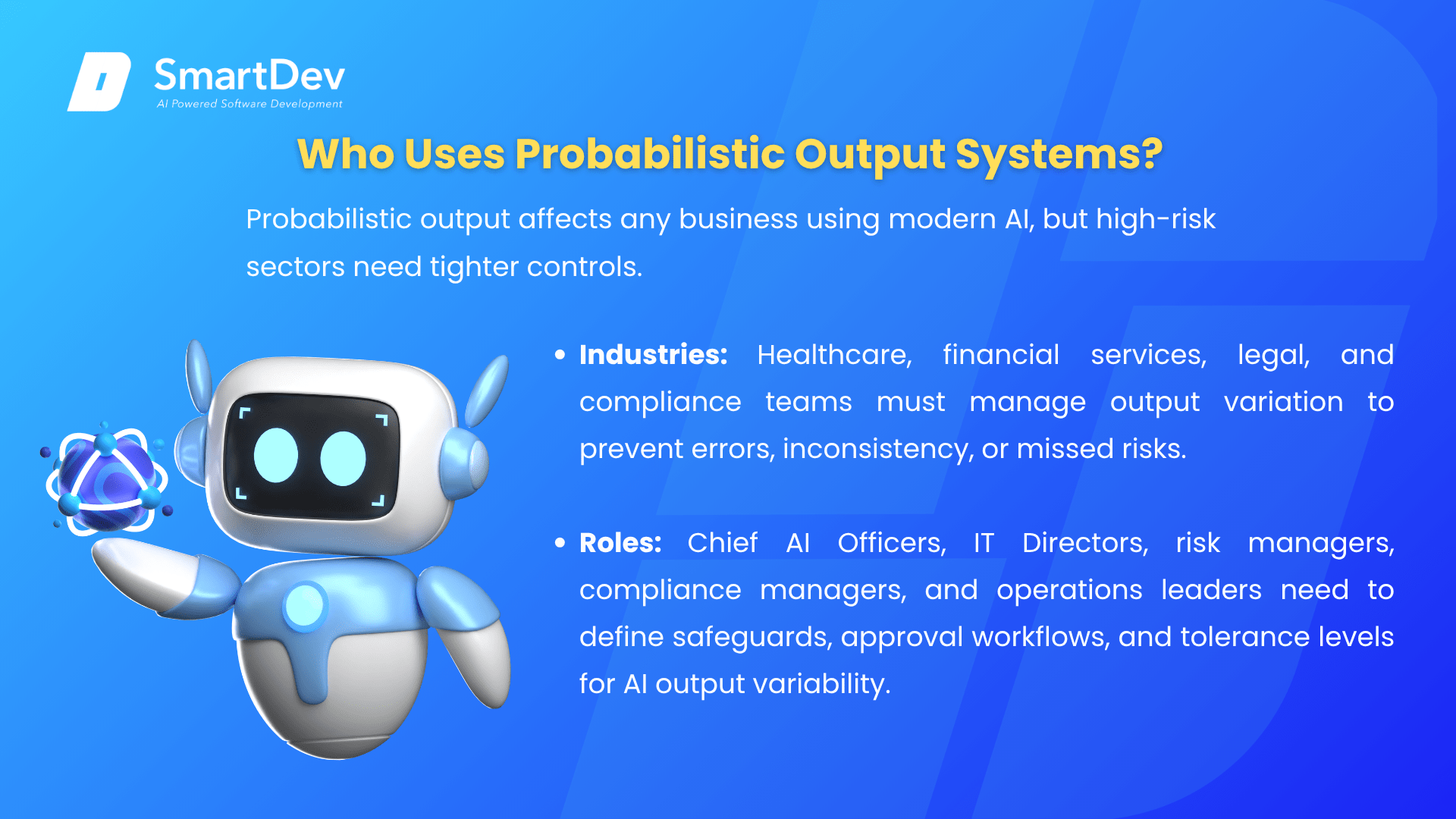
Who Uses Probabilistic Output Systems?
Probabilistic AI output affects every business that uses modern AI tools, but certain industries and roles need to manage it most carefully.
Industries: Healthcare organizations using AI for documentation or triage support must manage probabilistic outputs carefully to avoid clinical errors. Financial services firms using AI for report generation or customer communication need consistency and accuracy controls. Legal and compliance teams using AI to draft or review documents require structured validation processes to catch variation in AI-generated text.
Roles: Chief AI Officers and IT Directors defining AI governance frameworks must account for probabilistic behavior when designing approval workflows. Risk and compliance managers need to understand probabilistic output to build appropriate safeguards around AI-assisted processes. Operations leaders evaluating AI tools for process automation should assess how much output variability a given workflow can tolerate before selecting a tool.
Autres termes associés
- Deterministic Output is the ability of an AI system to produce consistent, predictable results given the same input every time. It sits at the opposite end of the spectrum from probabilistic output — while probabilistic systems offer flexibility and adaptability, deterministic systems prioritize reliability and auditability, making them the preferred choice for compliance-sensitive workflows.
- Prompt Engineering: The practice of designing precise, structured inputs to guide AI models toward more consistent and accurate probabilistic outputs, reducing unwanted variation.
- Agent IA: A software that can analyze data, make decisions, and perform tasks automatically with minimal human input.
- Apprentissage automatique: A branch of AI that allows systems to learn from data and make predictions or decisions without explicit programming.