
TL;DR
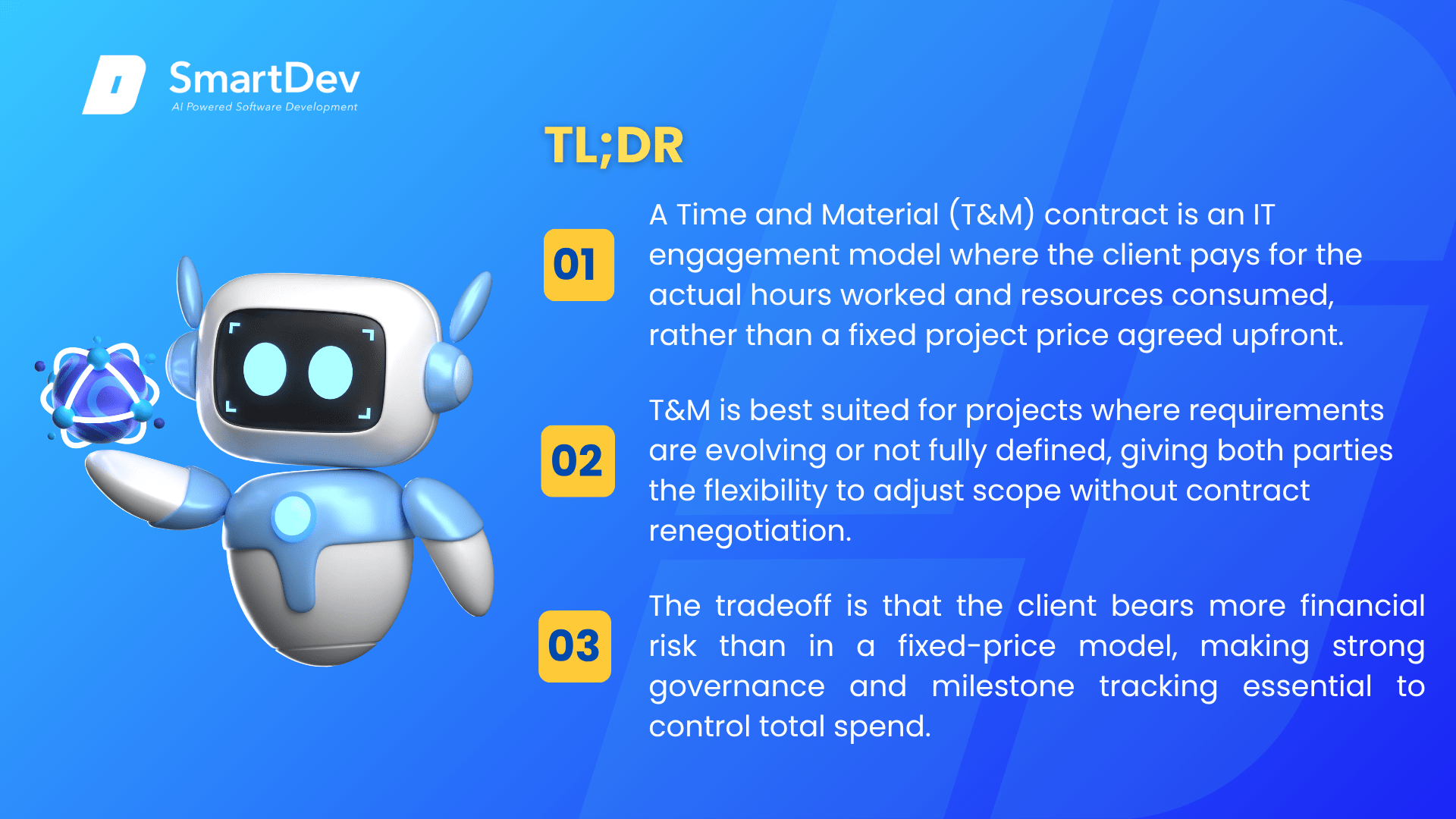
- A Time and Material (T&M) contract is an IT engagement model where the client pays for the actual hours worked and resources consumed, rather than a fixed project price agreed upfront.
- T&M is best suited for projects where requirements are evolving or not fully defined, giving both parties the flexibility to adjust scope without contract renegotiation.
- The tradeoff is that the client bears more financial risk than in a fixed-price model, making strong governance and milestone tracking essential to control total spend.
Not every IT project starts with a fully defined scope. Digital transformation programs evolve as business understanding deepens. Product development projects pivot as market feedback arrives. Forcing an undefined project into a fixed-price contract creates a negotiation battleground every time scope changes. The Time and Material contract model solves this by making flexibility the default rather than the exception.
What is a Time and Material Contract?
A Time and Material (T&M) contract is an IT outsourcing agreement in which the client pays the vendor based on the actual time spent by the project team (billed at agreed hourly or daily rates) and materials or expenses consumed, with the total project cost determined by actual delivery effort rather than a fixed price agreed before work begins.
The contract defines the composition of the team, the billing rates for each role, any agreed rate escalation provisions, and the invoicing cadence. What it does not define is the final scope or the total project cost, because those depend on decisions made throughout delivery. The client retains the right to adjust priorities, add or remove features, and redirect effort as the project progresses.
T&M contracts are distinguished from fixed-price contracts, where the vendor commits to delivering a defined scope for an agreed sum, bearing the financial risk if delivery takes longer than estimated. In T&M, that risk profile is reversed: the vendor is paid for their time regardless of total scope, and the client bears the risk of scope growth.
Pourquoi c'est important pour les entreprises
Requirement uncertainty is the most common cause of fixed-price contract disputes. When the full scope cannot be reliably defined at the start of a project, a fixed-price contract creates contractual friction at every scope change. T&M removes this friction by making adaptability the operating model.
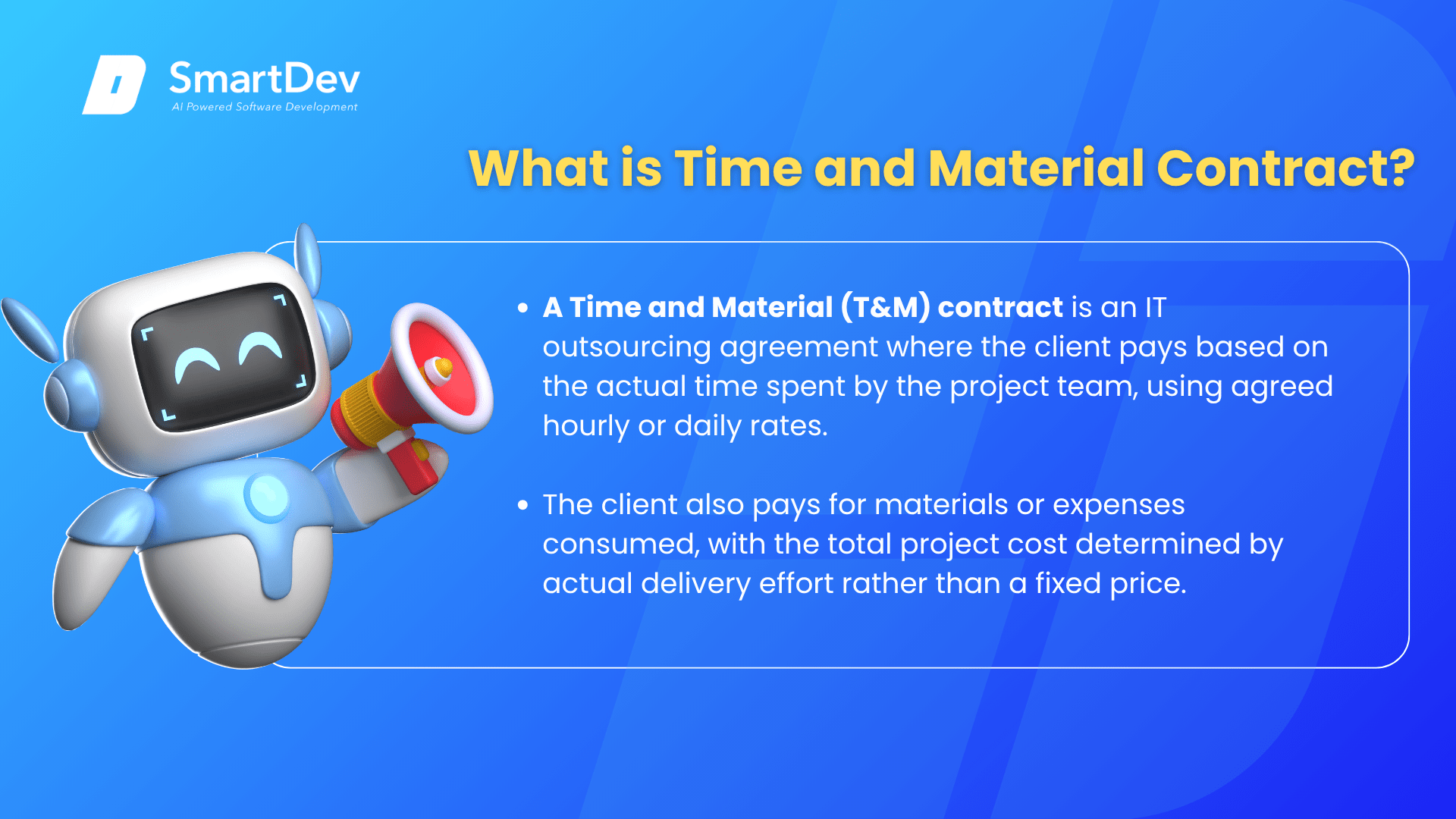
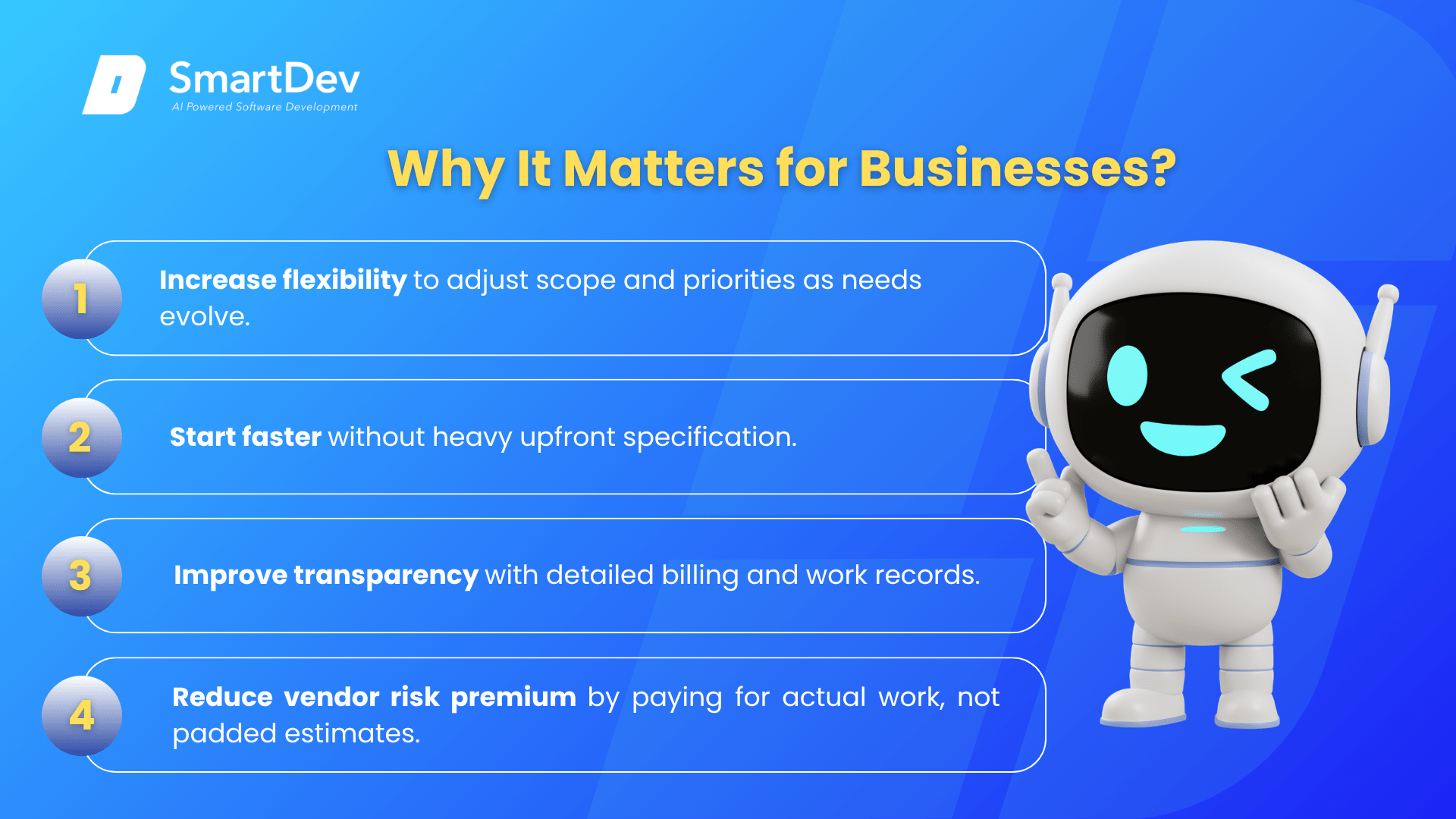
- Increase flexibility to adjust scope, priorities, and direction as the project evolves without triggering costly change-order negotiations with the vendor.
- Accelerate project starts by eliminating the extensive upfront specification process required to underwrite a fixed-price commitment, allowing development to begin while requirements are still being refined.
- Improve transparency through detailed billing records that show exactly how many hours each team member worked and on what, giving the client full visibility into where spend is going.
- Reduce vendor risk premium: fixed-price vendors build contingency into their quotes to cover scope uncertainty. T&M eliminates this buffer, meaning you pay for actual work rather than for the vendor’s insurance against scope risk.
For example, a startup building its first software platform selected a T&M engagement with its development partner because its product requirements were still being shaped by early user research. Over six months, the team pivoted the core workflow twice based on beta user feedback. Under a fixed-price contract, both pivots would have required change orders, renegotiation, and likely project delays. Under T&M, the team simply redirected their sprint priorities, and the product launched aligned to what users actually needed.
How Does a Time and Material Contract Work?
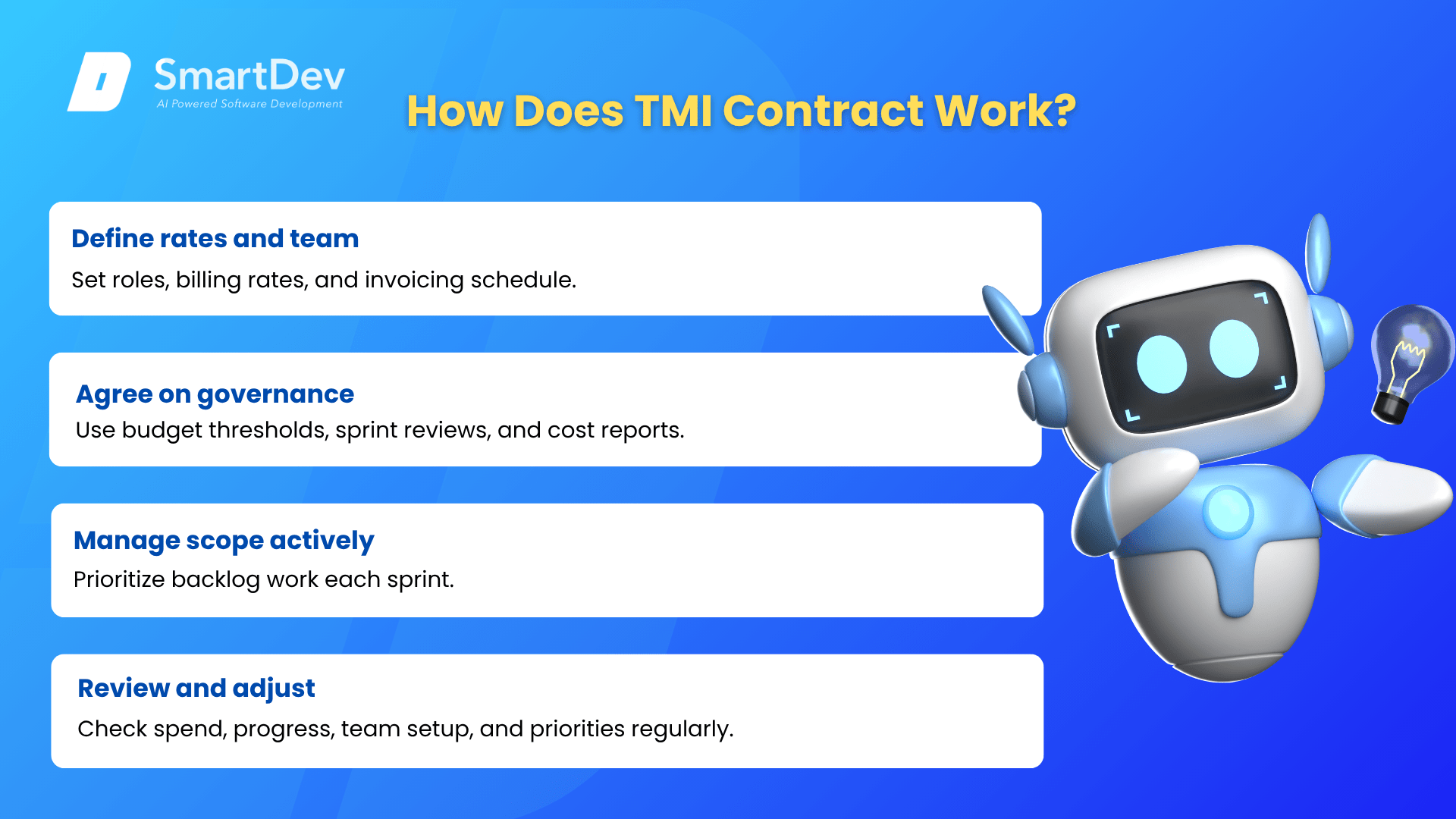
- Define Rates and Team Composition: The contract specifies the roles included in the team (e.g., two senior developers, one QA engineer, one project manager), the billing rate for each role, and the invoicing schedule (typically weekly or bi-weekly).
- Agree on Governance Mechanisms: Because T&M costs are variable, strong governance is essential. Establish budget thresholds that trigger client approval before additional spend, regular sprint reviews that track velocity and cost, and monthly budget-to-actual reports.
- Manage Scope Actively: The client’s product owner or project manager must actively manage the backlog and prioritize work each sprint. Without active client-side engagement, T&M projects accumulate scope and cost without direction.
- Review and Adjust: At defined intervals (typically monthly), review spend against progress, assess whether the team composition is still optimal, and adjust priorities or team size accordingly.
The result is a development partnership that adapts to reality rather than being constrained by a scope agreed before development revealed what the project actually required.
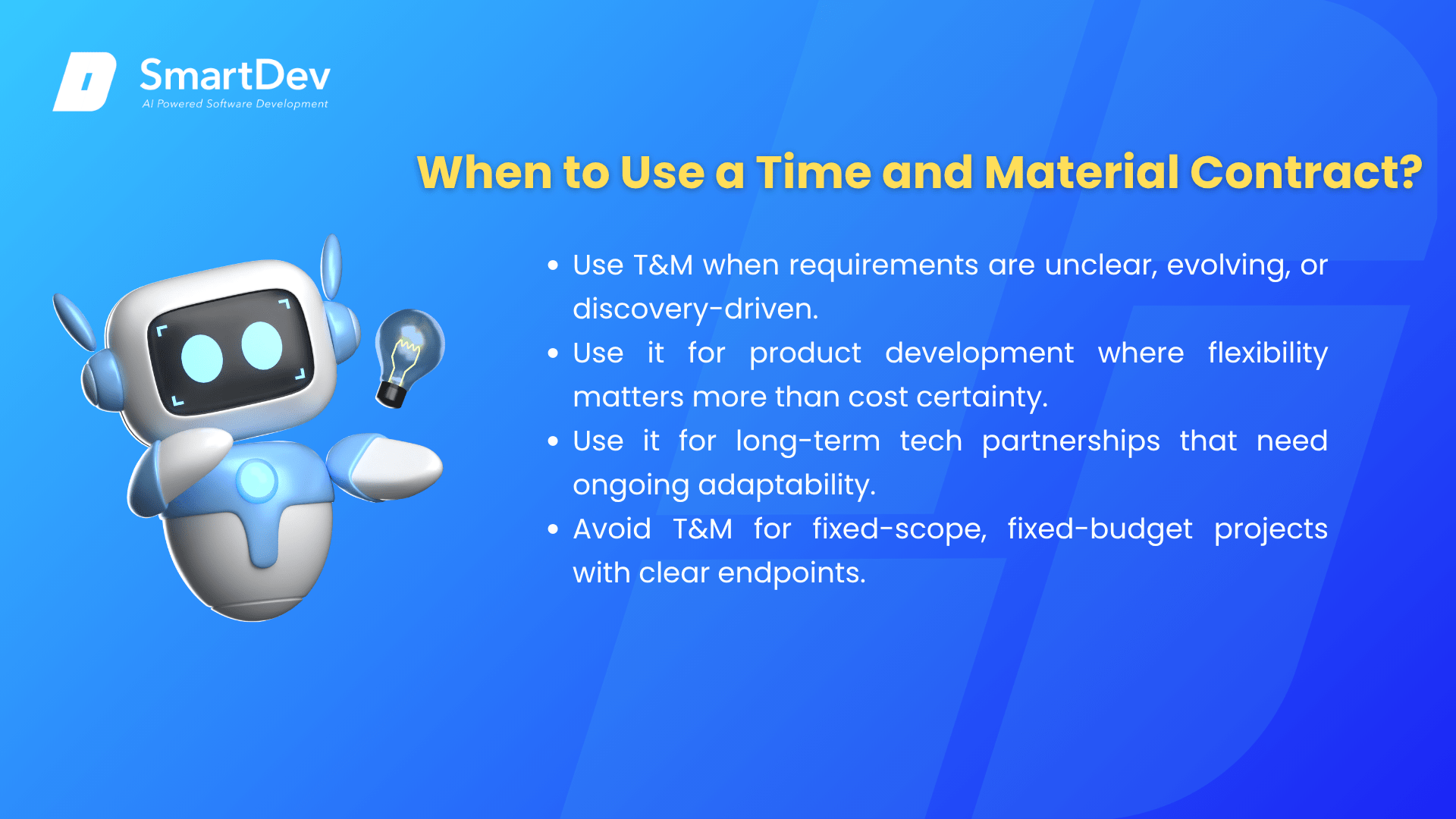
When to Use a Time and Material Contract?
- Use T&M when project requirements are unclear, likely to evolve, or dependent on early delivery learnings such as user research, technology proofs of concept, or regulatory developments.
- Use T&M for product development where business direction may shift in response to market feedback, and scope flexibility is more valuable than cost certainty.
- Use T&M for long-term technology partnerships where ongoing collaboration and adaptability are more important than the predictability of a defined scope and fixed price.
- Avoid T&M for projects with a fixed, non-negotiable scope and budget, such as regulatory compliance implementations or system migrations with a defined endpoint, where a fixed-price model allocates risk more appropriately.
Autres termes associés
Engineering Productivity: Measures how effectively a software team converts time, skills, and tools into valuable outcomes that advance business goals.
Solution Pitch: A tailored presentation that frames a vendor’s offering as the specific answer to a client’s defined business problem.
Sprint Planning: The agile ceremony that makes T&M engagements manageable by establishing a clear plan for each sprint’s work, giving the client visibility and control over where T&M hours are being directed each cycle.