
TL; DR:
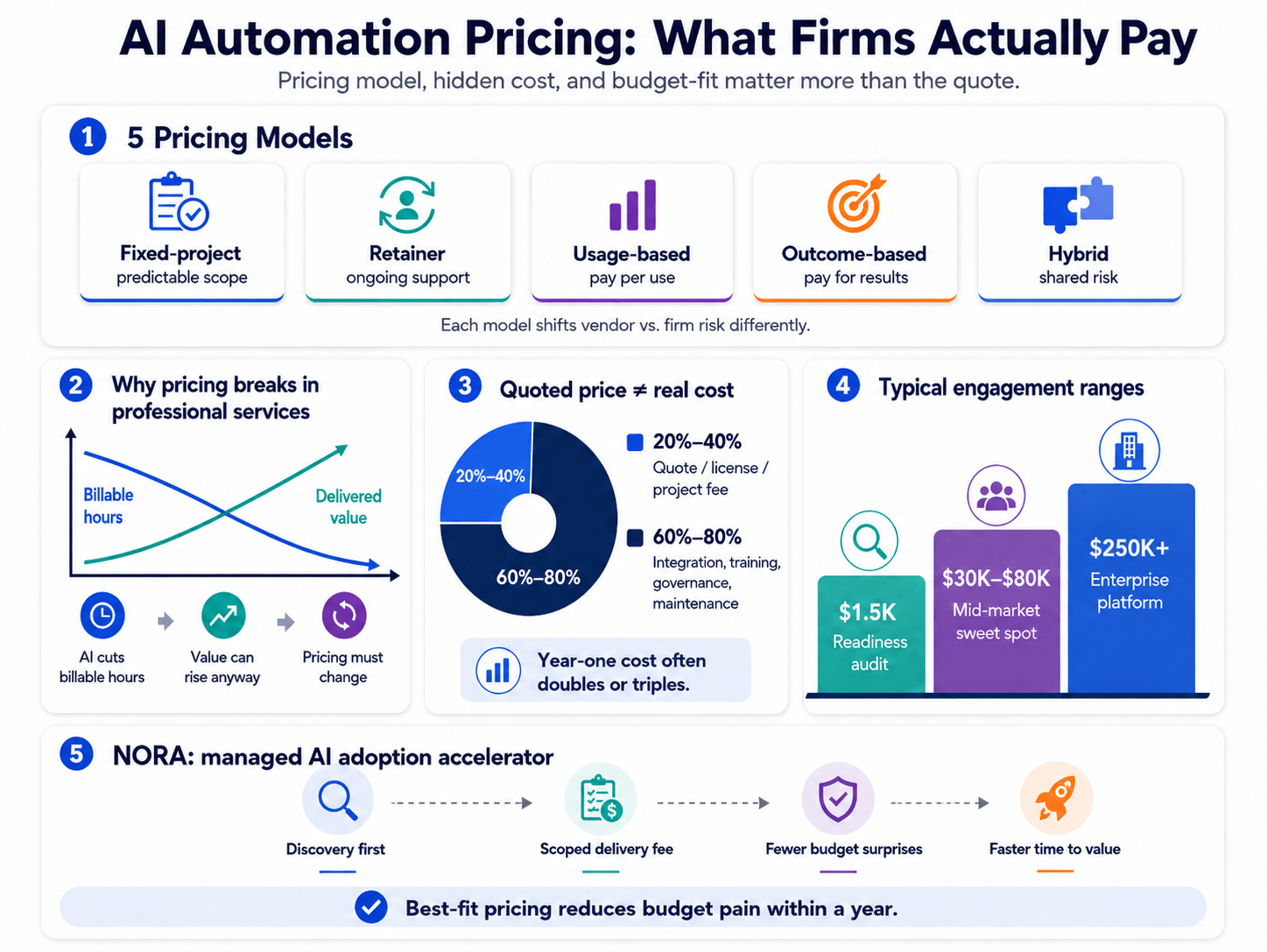
- AI automation pricing splits into five models: fixed-project, retainer, usage-based, outcome-based, and hybrid. Each shifts financial risk differently between the firm and the vendor, and the wrong match creates budget pain within a year.
- Professional services firms face a structural pricing problem. AI compresses billable hours, which shrinks revenue under the traditional hourly model even when delivered value increases, so pricing has to change alongside the technology.
- The quoted price rarely equals the real cost. License or project fees cover roughly 20% to 40% of total spend; integration, training, governance, and maintenance absorb the rest, often doubling or tripling year-one budgets.
- Typical engagement ranges run from $1,500 for a readiness audit to over $250,000 for an enterprise-wide platform with custom models and compliance controls, with most mid-market firms landing between $30,000 and $80,000.
- A managed AI adoption accelerator, like SmartDev’s NORA, replaces open-ended build hours with a structured discovery phase and a scoped delivery fee, reducing budget surprises and shortening time to value.
Introduction
Every professional services leader eventually asks: how much should AI automation actually cost? The answer is rarely straightforward. A law firm might receive one contract-review quote priced per hour, another per document, and a third as a flat annual license with an undefined scope. An audit director may hear promises of faster workpaper review without clarity on whether ongoing monitoring comes included. For consulting firms, the challenge is often building a business case that partners can approve when every vendor calculates costs differently.
This spread is more than a pricing inconvenience; it can delay investment decisions and cost firms an entire budget cycle. AI automation pricing is still evolving, while professional services firms face another challenge: the technology promising greater efficiency can also disrupt the billable-hour model many firms still depend on. This tension appears across SmartDev’s broader look at AI use cases in professional services.
According to the Thomson Reuters Institute’s 2026 AI in Professional Services Report, generative AI use among firms has nearly doubled year over year, with four in ten firms now using it actively and more than 80% of those users engaging weekly. Adoption is accelerating faster than the pricing frameworks needed to support it.
This guide explains the five pricing models, realistic cost ranges, hidden expenses, and practical ways to evaluate vendor proposals. It also explores how a managed adoption accelerator can replace fragmented project quotes with a structured, discovery-first engagement. For further reading, explore SmartDev’s AI automation guides.
1. The Five Pricing Models Behind AI Automation
Every AI automation quote traces back to one of five underlying pricing structures, even when the vendor’s marketing language obscures which one you are actually being asked to sign. Understanding each model helps you read a proposal correctly, spot where financial risk sits, and negotiate from a position of knowledge rather than guesswork. The five models below are not mutually exclusive in practice; most mature vendor relationships blend two or three of them across the life of an engagement, starting with one structure during the build phase and shifting to another once the automation is stable and running in production.
1.1 Fixed-project pricing
A vendor scopes a defined workflow, quotes one number, and delivers that scope within an agreed timeline. This model suits one-time builds where requirements are genuinely clear from day one, such as automating a single, well-documented intake process. In practice, this is exactly why finance teams favor it for budget approval: a $25,000 fixed-price quote for one workflow is a number a CFO can put in front of a partnership without hedging, unlike an open-ended hourly estimate that could land anywhere in a wide range once the real work starts. SmartDev structures most first engagements this way, following the same logic outlined in its glossary entry on fixed-price contracts: a defined scope, one number, and a delivery date set before work begins.
The trade-off falls on the vendor, who absorbs scope-creep risk if the real-world workflow turns out messier than the discovery documents suggested. That risk often produces defensively written contracts full of change-order clauses, so read the fine print on what counts as “in scope” before you sign and ask for a written example of what a typical change order looks like in practice.
1.2 Retainer and subscription pricing
The firm pays one recurring monthly fee that covers monitoring, optimization, and incremental improvements after go-live. Three things matter most here: it converts unpredictable maintenance into a fixed, forecastable line item; it keeps the vendor accountable for the automation’s health, not just its initial delivery; and it removes the ad hoc invoice every time something needs tuning. According to Monetizebot’s 2026 analysis of automation agency pricing, a monthly retainer has become the most sustainable model once a firm has a repeatable delivery system in place, since it keeps the vendor’s incentive aligned with long-term performance rather than the next new project.
1.3 Usage-based pricing
Cost scales directly with volume: per document processed, per API call made, or per active seat provisioned. Usage pricing feels fair and appropriately low friction at low volume, which is exactly why so many vendors default to it during a pilot phase. The risk appears later, once adoption succeeds, and volume climbs faster than anyone modeled at signing. One case documented by Korix’s 2026 AI pricing analysis showed a support-automation bill jump from $300 in a trial month to $14,000 twelve months later, driven by a 40x increase in conversation volume after a feature launch, with no cost cap or usage alert built into the original contract. Any firm considering usage-based pricing should insist on tiered rates and hard spending alerts before rolling out, not after the first surprising invoice arrives.
1.4 Outcome-based and value-based pricing
The firm pays only when the AI delivers a defined, measurable result: a resolved support ticket, a completed regulatory filing, or a validated invoice line item. This model ties cost directly to delivered value rather than to effort expended, which is precisely why it resonates so strongly with finance leaders who have grown skeptical of paying for hours regardless of outcome. It is also, by most accounts, the hardest model to operationalize well. Both sides need to agree on a precise, disputable definition of “success” before work begins, and someone needs to measure that outcome reliably and handle disagreements when the AI partially succeeds, which happens more often in professional services than in simpler transactional industries.
1.5 Hybrid pricing
Hybrid pricing combines a predictable base fee with a variable usage- or performance-based component. A base subscription covers platform access, support, and baseline monitoring; the variable layer then rewards or penalizes actual delivered results. This structure balances predictability for the buyer, who always knows the floor of their monthly spend, with meaningful upside for the vendor when the automation performs well. According to Lago’s 2026 review of AI pricing models, companies using a hybrid structure of a subscription floor plus usage saw 21% higher median growth than companies using either pure subscription or pure usage pricing alone, which helps explain why hybrid adoption has climbed so quickly across the AI services market.
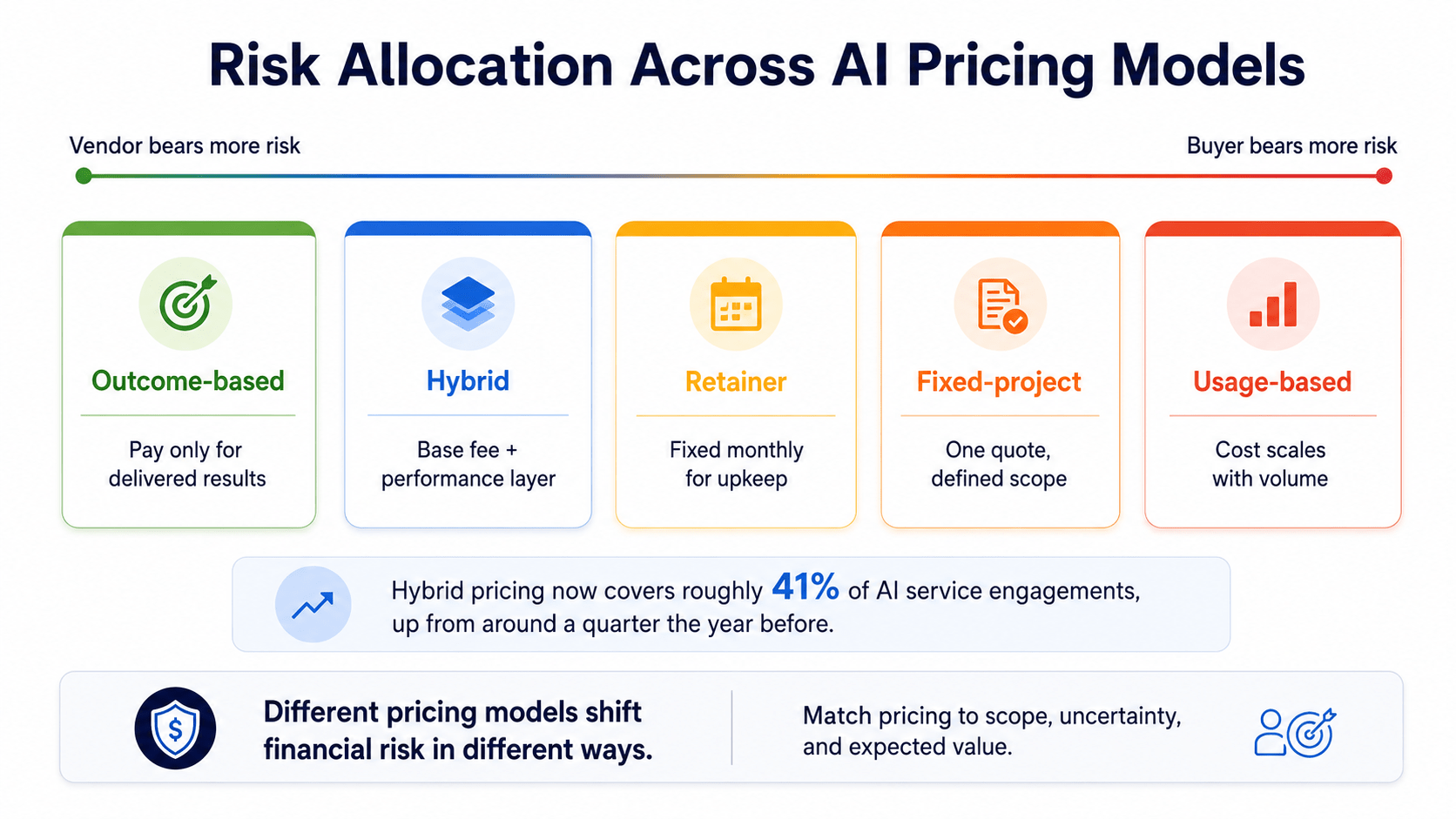
The framework compares five AI automation pricing models by how they distribute financial risk between vendors and buyers.
- Outcome-based: The vendor carries the most risk, as clients pay primarily for delivered results.
- Hybrid: Combines a base fee with performance-based pricing, sharing risk between both parties.
- Retainer: Charges a fixed monthly fee for ongoing maintenance and support, providing predictable costs.
- Fixed project: Sets one price for a defined scope, offering budget certainty but less flexibility.
- Usage-based: The buyer carries more risk because costs increase directly with usage or transaction volume.
The choice of pricing model therefore determines not only how much you pay, but who absorbs the financial risk when scope, usage, or performance changes.
Takeaway: No single pricing model works for every engagement. Fixed-project pricing fits defined builds, while retainers suit stable workflows and hybrid or outcome-based models to suit measurable value. Choose based on transaction volume and scope of clarity, not vendor convenience, and expect the right model to evolve as the engagement moves from pilot to production.
2. Why Professional Services Firms Face a Unique Pricing Problem
Professional services carry a pricing tension that manufacturing, retail, or logistics rarely face in the same way: the industry’s core revenue model runs billed time, and AI’s entire value proposition is compressing that time down toward zero. This is not a marginal efficiency story that a firm can absorb quietly. It strikes directly at how partners, consultants, and advisors have measured and captured their own value for well over a century, and it forces uncomfortable questions about what a firm is selling once the hours behind the work shrink dramatically.
2.1 The billable hour math breaks down
When AI turns a four-hour document review into a twenty-minute task, the invoice for that task shrinks by roughly 90%, even though the client received an outcome that was equally thorough, and often more consistent, than the manual version. Firms that keep billing purely by the hour effectively give away their AI investment as an unplanned client discount rather than capturing it as margin. Over time, this dynamic punishes the firms that adopt AI fastest and rewards the ones that adopt slowly, which is precisely backward from how a healthy market should allocate rewards for innovation.
2.2 Clients are already asking why
Clients increasingly notice the mismatch between premium hourly rates and visibly AI-assisted delivery. Thomson Reuters research on legal service economics found that one in four buyers report never experiencing a firm that delivered clear value despite premium hourly pricing, and that dissatisfaction is only growing sharper as clients run their own internal AI tools and can see firsthand how much faster comparable work can move. That gap creates a real opening for firms willing to price differently and communicate that difference clearly, rather than quietly folding AI efficiency into the same old rate card.
2.3 The shift toward alternative fee arrangements is already underway
Thomson Reuters’ broader professional services research reports that one-third of firms surveyed now bill an increasing share of work through methods other than hourly rates, and roughly a quarter of in-house buyers have expanded work with outside firms specifically because those firms offered flexible fee structures. The same research notes that 26% of firms have started offering higher-value advisory services over the past twelve months, using AI to shift from a pure transaction model toward a strategic-partner relationship that clients are willing to pay for differently, and often more generously, than commoditized hourly work.
2.4 Early movers are converting efficiency into margin
Firms that pair AI rollout with fixed-fee or value-based work capture the resulting speed gains as profit instead of losing them to shrinking invoices. Large legal-market movers publicly credit this pairing with improved margins on engagements where AI would otherwise have quietly cut billable revenue, and consulting firms exploring SmartDev’s AI consulting services report the same underlying pattern: the pricing conversation, not the technology deployment itself, is usually the harder and more consequential change to get right.
2.5 Standing still carries its own cost
Firms that delay the pricing conversation do not avoid the disruption; they simply let faster-moving competitors capture the value first and set client expectations for everyone else in the market. A firm still billing the hour for AI-assisted work is, in effect, subsidizing the client’s efficiency gain for free, quarter after quarter, while a rival down the street quietly restructures its fee model and keeps the upside. According to the broader analysis in The Thinking Company’s 2026 guide to AI in professional services, firms that delay this pricing transition are, in effect, subsidizing competitors who have already made the shift, since 56% of firms report AI adoption but only 24% have reached actual production deployment with pricing changes to match.
Takeaway: AI does not just change how professional services firms deliver work; it forces a rethink of how they charge it. Firms that pair automation with value-based or fixed-fee pricing keep the efficiency gains as margin. Firms that keep billing the hour give those gains away, and every quarter of delay widens the gap with competitors who have already made the switch.
3. What Actually Drives the Final Price Tag
A vendor’s headline quote almost never equals the true cost of running AI automation over its first year in production. Several layers of spend stack on top of the number written in the proposal, and most of them only become visible once the project is well underway, which is exactly why so many finance teams describe AI budgets as a moving target rather than a fixed line item.
3.1 Discovery and scoping
Before any build begins, a structured discovery phase should map current workflows, data sources, and every integration point the automation will eventually need to touch. Skipping this step is the single biggest predictor of budget overruns later, since undiscovered complexity always surfaces eventually, usually mid-project, once the vendor’s engineers are already deep into the build and every change costs more than it would have during planning. SmartDev structures every engagement around this principle, starting with a dedicated discovery phase such as the 3-Week AI Discovery Program before any implementation pricing gets finalized.
3.2 Implementation and integration
Connecting AI automation to legacy case-management systems, document repositories, or ERP platforms routinely costs more than the AI component itself, and this is consistently the line item that surprises finance teams the most. Research from Glean’s total cost of ownership analysis puts legacy-integration costs at 25% to 35% above initial estimates, and notes that license or project fees typically cover only 20% to 40% of the real total spend across a project’s lifecycle. Separate research from Xenoss on enterprise AI total cost of ownership puts the integration complexity premium even higher, at two to three times the original implementation estimate. Once legacy systems and custom data pipelines enter the picture.
3.3 Training, change management, and adoption
Staff need onboarding, clear documentation, and often a redesigned day-to-day workflow before an automation actually sticks and delivers the efficiency the business case promised. Budgeting nothing for change management is one of the most common reasons expensive automations sit largely unused six months after a technically successful go-live, because the people who were supposed to use the new workflow never fully adopted it. Firms exploring a larger rollout can pair this stage with SmartDev’s UI/UX design services to keep adoption friction low from the first day the tool reaches end users.
3.4 Ongoing maintenance and governance
Maintenance, monitoring, and periodic compliance audits typically consume 15% to 30% of the original build cost every year after launch, according to multiple independent cost breakdowns, including analysis from Dan Cumberland Labs’ 2026 AI consulting pricing guide, which pegs annual maintenance at 15% to 25% of implementation cost plus additional tooling subscriptions. Regulated professional services add governance overhead on top of that baseline: audit trails, explainability documentation, and periodic model review all carry real, recurring cost that rarely appears in a first-draft proposal.
3.5 The hidden-cost multiplier
Put together, these layers routinely push first-year to spend two or three times the initial quote, and sometimes considerably further. Independent research on AI project costs found that 85% of organizations misestimate AI project spend by more than 10%, and a meaningful share misses their forecast by over half. The same research notes that an MVP-level implementation typically ranges from $50,000 to $100,000, while production-grade systems commonly run three to five times that figure once every hidden layer is included in the final accounting.
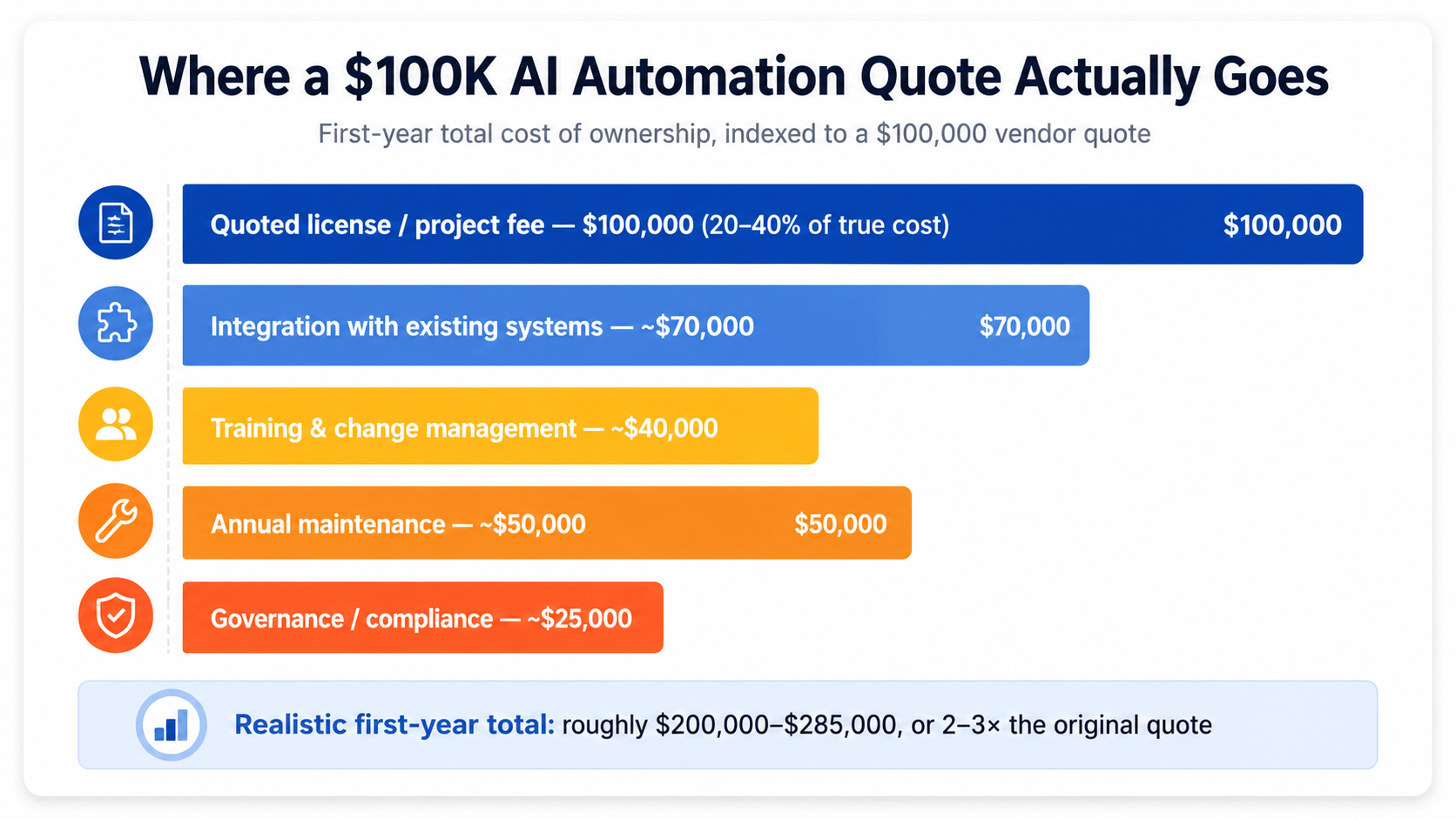
The breakdown shows why a $100,000 AI automation quote rarely represents the full first-year investment.
- Quoted license/project fee – $100K: The upfront vendor price, but potentially only 20–40% of the total cost.
- Integration – ~$70K: Connecting the solution with existing systems, workflows, and data infrastructure.
- Maintenance – ~$50K: Ongoing technical support, updates, monitoring, and model maintenance.
- Training & Change Management – ~$40K: Preparing employees to adopt the new workflow and embedding it into daily operations.
- Governance & compliance – ~$25K: Covering testing, documentation, oversight, security, and regulatory requirements.
As a result, the realistic first-year total can reach roughly $200K–$285K, or two to three times the original vendor quote.
Takeaway: Treat any vendor’s headline number as a starting point, not a budget. Ask specifically about integration complexity, training investment, and year-one maintenance before you compare two proposals side by side, and push every vendor to put a number, however rough, on each of these hidden layers in writing.
4. Typical Price Ranges by Engagement Type
Cost scales predictably with scope once your account for integration depth and governance requirements, which matters far more to the final number than how sophisticated the underlying AI model happens to be. The ranges below reflect current market data drawn from AI automation agencies and consulting firms serving professional services clients across legal, financial, and advisory work, cross-referenced against SmartDev’s own delivery experience across similar engagements.
4.1 AI readiness audit or discovery engagement
According to Digital Applied’s 2026 AI agency pricing strategies guide, a scoped audit of current workflows, data quality, and automation opportunities typically runs $1,500 to $5,000. The guide frames this tier as an entry-level trust step: it lets a firm see a realistic opportunity map before committing to a much larger build, rather than buying full implementation on faith. Several vendors, including SmartDev’s 3-Week AI Discovery Program, structure their engagement around this same principle: map the opportunity and the real cost first, then decide whether a larger build is worth funding.
4.2 Single-process automation
One workflow with AI decision-making and basic system integration generally costs $10,000 to $30,000, based on the tiered breakdown published by Digital Applied. This tier suits a firm automating one specific, well-bounded task, such as intake triage, a single document type, or one compliance checkpoint, where the scope stays narrow enough that fixed-project pricing works cleanly without much negotiation.
4.3 Multi-process automation
Connected workflows spanning several tools, with a monitoring dashboard layered on top, typically run $30,000 to $80,000. This is the most common tier for mid-sized professional services firms modernizing an entire function such as compliance screening, client onboarding, or engagement-to-deliverable workflows, and it closely mirrors the scope SmartDev covers through projects like connecting intake, validation, drafting, and approval into one governed workflow.
4.4 Enterprise automation platform
Organization-wide automation with custom models, governance controls, and compliance requirements usually start at $80,000 and can exceed $250,000. Highly regulated, highly customized deployments occasionally surpass $1 million, particularly when a firm needs custom model development on top of workflow automation, a scope that aligns with SmartDev’s dedicated Machine Learning Development Services and MLOps Services for firms operating their own models in production.
4.5 Ongoing retainer
Once live, a monitoring and optimization retainer commonly runs a smaller monthly fee layered on top of the build cost, covering monitoring, tuning, and incremental feature requests without a new contract each time a small adjustment is needed. This structure keeps the relationship with the vendor active and accountable well past the initial go-live date, which matters in regulated industries where drift in model behavior needs continuous, not periodic, attention.
| Engagement type | Typical price range | Best fit |
| Discovery / readiness audit | $1,500 – $5,000 | Firms scoping their first automation |
| Single-process automation | $10,000 – $30,000 | One workflow, defined scope |
| Multi-process automation | $30,000 – $80,000 | Full function modernization |
| Enterprise platform | $80,000 – $250,000+ | Org-wide, regulated environments |
Takeaway: AI automation costs depend more on integration depth and governance requirements than AI sophistication alone. A focused, well-scoped workflow usually delivers better cost and time-to-value than a poorly scoped enterprise platform.
5. How to Evaluate a Vendor’s Pricing Proposal
A low headline number means very little without scope clarity sitting right behind it, and the checks below should become a standard part of every AI vendor conversation your firm runs from this point forward, regardless of how small or exploratory the initial engagement feels.
5.1 Demand a defined scope, not a vague deliverable
Every proposal should name the specific workflow, data sources, and integration points included, along with an explicit list of what falls outside scope. A vague scope almost guarantees expensive change orders once the real complexity of your data and systems surfaces partway through the build, and vendors who resist writing this level of detail into a contract are usually signaling that their own estimate is softer than the headline number suggests.
5.2 Ask how “success” gets measured
If the pricing model includes any outcome-based component, insist on a precise, disputable definition of success before work begins, ideally with a worked example both sides agree represents a genuine success case. Ambiguous success criteria create billing disputes later, often at exactly the moment your team least wants to be negotiating instead of using the automation you already paid to build.
5.3 Request a total cost of ownership estimate, not just the build price
Ask the vendor to project integration, training, and first-year maintenance costs alongside the build quote, using the framework outlined in Section 3 as a starting checklist. Any vendor unwilling or unable to estimate these numbers is effectively asking you to discover them the hard way, mid-project, when your leverage to renegotiate has already largely disappeared.
5.4 Check contract flexibility as your volume changes
Usage-based and per-seat pricing can spike unpredictably as adoption grows, sometimes far faster than anyone modeled during the sales process. Confirm whether the contract includes usage caps, tiered volume discounts, or an explicit option to renegotiate once real usage patterns become clear after a few months in production, rather than locking into a rate structure designed around pilot-scale assumptions.
5.5 Watch for these red flags
Be cautious of fixed-price quotes with no scope of clause attached, unusually low bids with no clear explanation of margin, and any vendor that cannot describe its own audit trail or governance process for a regulated environment in specific, concrete terms. If a vendor cannot answer basic questions about how it logs decisions for compliance purposes, that gap will eventually become your firm’s problem, not theirs, once a regulator or a client asks the same question.
Takeaway: The cheapest quote rarely delivers the best value. Compare vendors by total cost of ownership, scope of clarity, and governance maturity, not just the headline price. A vendor that openly discusses hidden costs is also more likely to be a trustworthy partner.
6. NORA: SmartDev’s AI Adoption Accelerator
Much of the pricing uncertainty described in the sections above comes from buying AI automation as a series of disconnected, open-ended engagements, each priced and negotiated separately with its own scope, its own risk, and its own hidden costs. SmartDev built NORA, its AI Adoption Accelerator, specifically to close that gap for professional services firms and other mid-market businesses that want predictable pricing without sacrificing the flexibility to expand as their needs grow.
6.1 What is NORA?
NORA is a fully managed service, not a one-off software license sitting on a shelf after installation. SmartDev designs, builds, and continuously operates the AI workflow automation on the client’s behalf, rather than handing over a tool and stepping away once the initial go-live milestone is hit. This managed structure changes the pricing conversation fundamentally, because the vendor’s incentives stay aligned with the client’s outcomes for the life of the relationship, not just for the duration of a single build contract.
6.2 A four-layer capability stack, not a single tool
NORA’s capability stack shows how AI automation can scale progressively with a firm’s readiness, rather than requiring businesses to adopt the most advanced capabilities from day one. Firms start at the layer their current readiness supports and expand upward as confidence and internal capability grow, which keeps pricing tied to actual, demonstrated capability rather than to a flat license fee that assumes every client needs the same depth of automation on day one.
This structure closely mirrors the readiness framework covered in SmartDev’s AI readiness assessment for professional services, and it plays out in practice across SmartDev’s wider coverage of the sector, including its guides to AI use cases in professional services, AI document drafting for professional services, and AI use cases in law, each of which maps to a different layer of the same underlying stack.
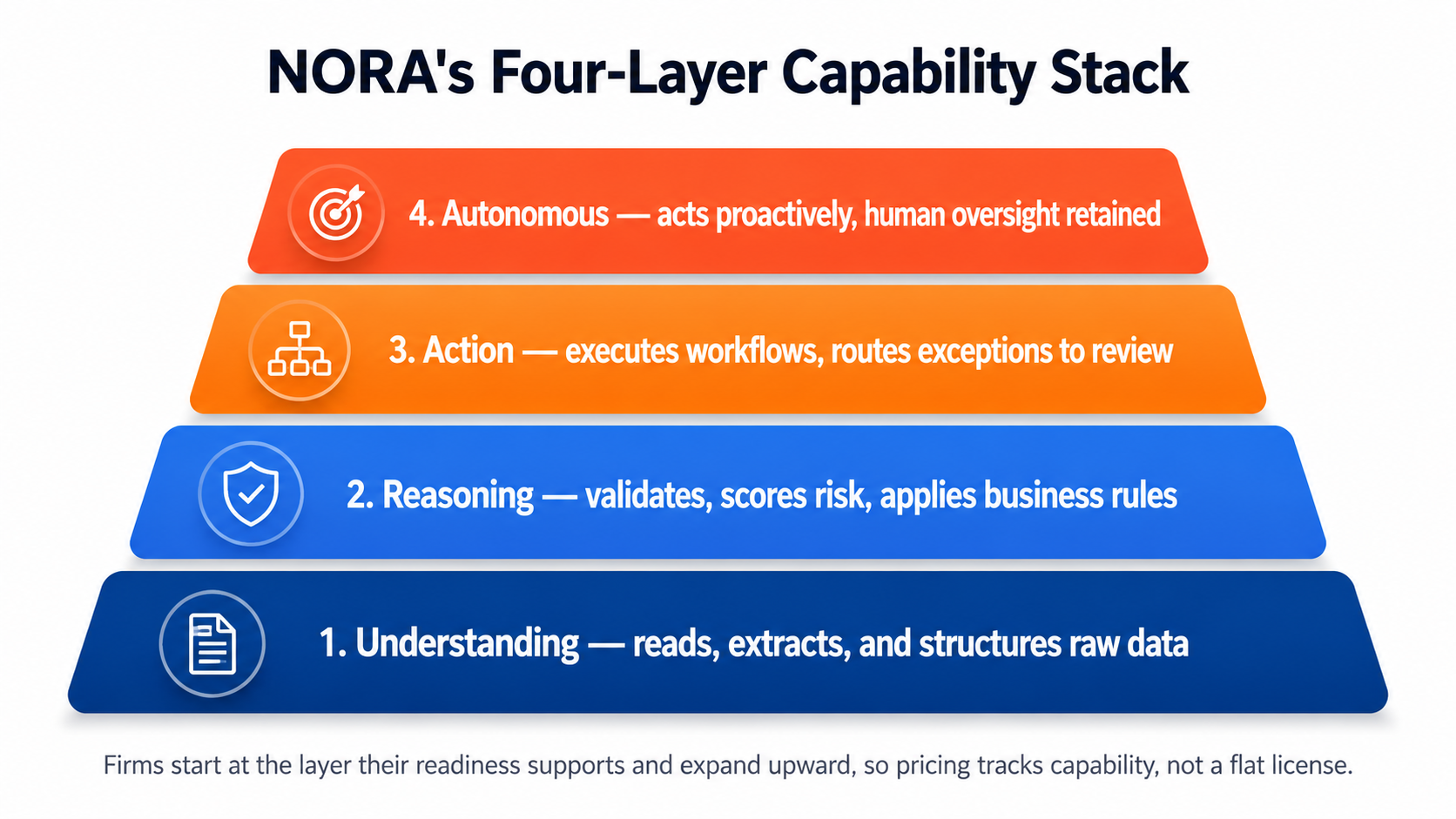
NORA’s Four-Layer Capability Stack
NORA’s capability stack shows how AI automation can scale progressively with a firm’s readiness, rather than requiring businesses to adopt the most advanced capabilities from day one.
- Understanding: NORA starts by reading, extracting, and structuring raw information from documents and other data sources. This creates a foundation for reliable downstream automation.
- Reasoning: The system then validates information, applies business rules, and scores risk. This layer turns structured data into actionable insights while keeping deterministic rules within defined boundaries.
- Action: NORA moves beyond analysis to execute workflows, such as routing cases or triggering next steps. When a case falls outside defined thresholds, the system routes it to a human reviewer.
- Autonomous: At the highest level, NORA can act proactively based on established rules and workflows. Human oversight remains in place, ensuring people retain control over high-impact or uncertain decisions.
This layered approach means firms can start with the capability their current data, workflow, and governance maturity can support, then expand as readiness improves. Pricing can therefore scale with the level of capability deployed rather than forcing every customer into a flat, one-size-fits-all license.
6.3 A discovery-first engagement model
Every NORA engagement opens with a structured discovery phase, often as short as one week. That maps existing processes, data sources, and integration points before a single dollar goes toward implementation. From that foundation, a working automation typically ships within six to eight weeks, following the same underlying logic explored in SmartDev’s 3-Week AI Discovery Program and its broader 10-Week AI Product Factory for firms building custom AI products rather than configuring an existing workflow template.
6.4 Governance and audit trail built into the price
NORA logs every AI decision automatically: the assessment made, the confidence score attached to it, the escalation routing applied, and the human review that followed, all captured in one structured audit trail rather than scattered across email threads and personal notes. Regulators today expect firms to show not just that a decision was made, but why it was made and who reviewed it, a standard SmartDev’s own writing on AI compliance audit trails and making every AI-assisted decision regulatorily defensible covers in more depth.
Because compliance-grade audit logging ships as a default feature rather than a paid add-on negotiated separately, professional services firms avoid exactly the governance-cost surprise described earlier in Section 3.4, since that cost is already built into the base engagement rather than discovered later, often at the worst possible time, mid-audit.
6.5 Real efficiency numbers from live deployments
In regulated environments, clients running NORA report roughly 60% faster processing, 40% less manual review time, and a 70% reduction in checking errors compared with fully manual workflows, figures drawn from SmartDev’s own delivery work in insurance underwriting automation. Because SmartDev structures pricing around the discovery-then-build model rather than open-ended hours, these efficiency gains translate directly into predictable client value instead of vanishing into unbilled hours the way they might under a traditional hourly consulting arrangement. Firms exploring this model can also review SmartDev’s dedicated AI Consulting Services and Data Analytics Services pages to see how a readiness score maps to a specific, scoped engagement before any commercial conversation begins.
Takeaway: NORA shifts pricing from “how many hours will this take?” to “which capability layer does your firm need today?” Discovery comes first; governance is built by default, and pricing scales with the capabilities a firm uses rather than a one-size-fits-all license.
7. A Simple Framework for Budgeting Your Next AI Automation Project
In regulated environments, clients running NORA report roughly 60% faster processing, 40% less manual review time, and a 70% reduction in checking errors compared with fully manual workflows, figures drawn from SmartDev’s own delivery work in insurance underwriting automation. Because SmartDev structures pricing around the discovery-then-build model rather than open-ended hours, these efficiency gains translate directly into predictable client value instead of vanishing into unbilled hours the way they might under a traditional hourly consulting arrangement. Firms exploring this model can also review SmartDev’s dedicated AI Consulting Services and Data Analytics Services pages to see how a readiness score maps to a specific, scoped engagement before any commercial conversation begins.
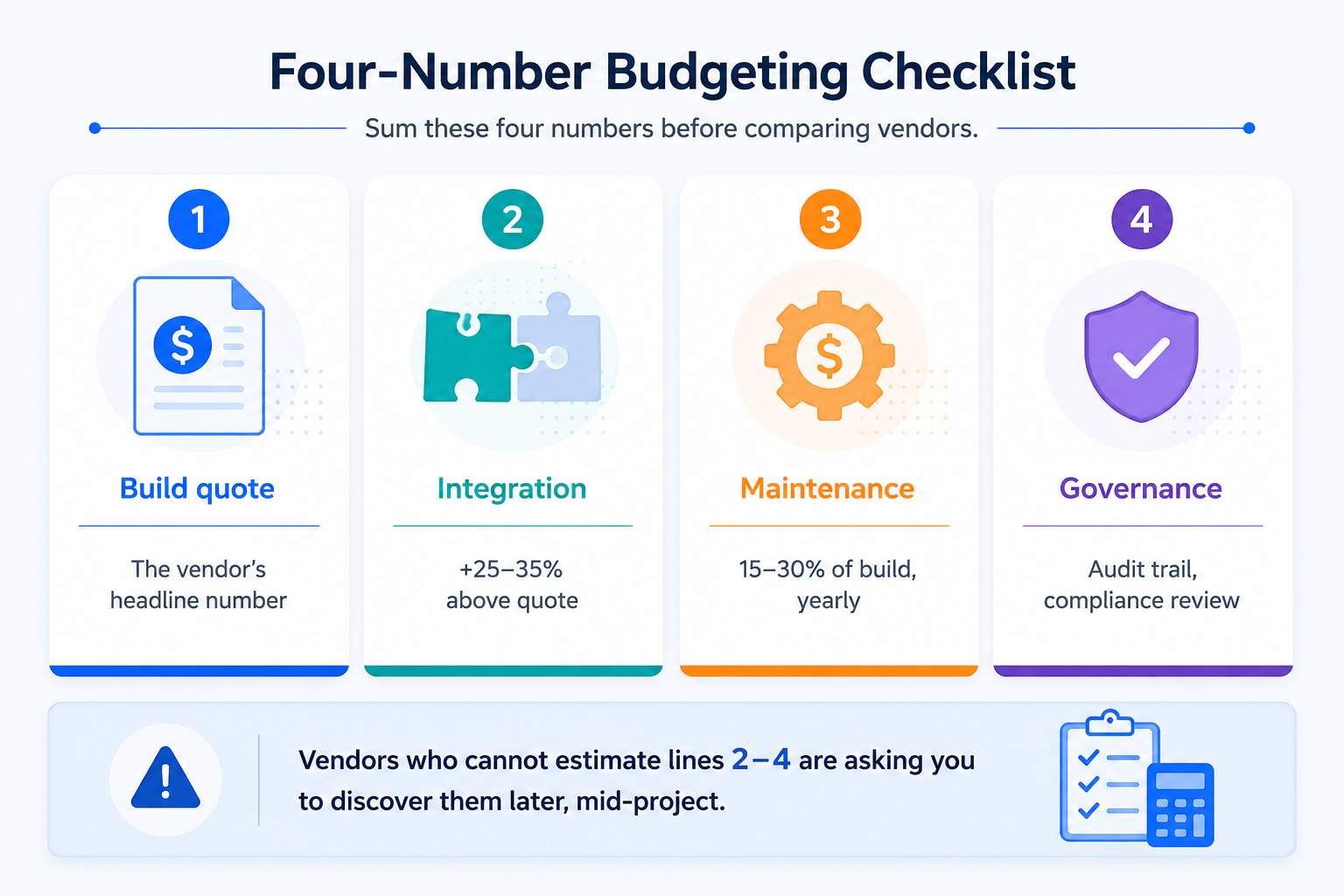
This approach also protects against vendor lock-in disguised as a low upfront price. A vendor offering a cheaper build but unable to explain integration or maintenance costs is not necessarily cheaper; it may simply be leaving future costs unpriced. Those costs often surface later, when switching vendors becomes harder, and your negotiating position weakens. By applying the same checklist to every proposal, firms can identify hidden costs earlier, negotiate more effectively, and avoid unexpected expenses after implementation. For a deeper look at how these costs translate into payback, SmartDev’s AI Automation ROI Calculator for Compliance Teams walks through the full calculation step by step.
Frequently Asked Questions
What does AI automation typically cost for a professional services firm?
A single-workflow automation usually runs $10,000 to $30,000. A multi-process builds spans from $30,000 to $80,000. Enterprise-wide platforms with governance and custom models often exceed $80,000 and can run past $250,000, occasionally into seven figures for heavily regulated deployments.
Is outcome-based pricing better than a fixed project fee?
Outcome-based pricing aligns cost with delivered value and suits firms with predictable, measurable transactions. Fixed-fee pricing suits one-time builds with a defined scope. Most firms land on a hybrid: a base fee plus a performance component, which is now the fastest-growing structure in the market.
Why is the total cost of ownership higher than the vendor’s quoted price?
License or project fees usually cover only 20% to 40% of the real spend. Integration, training, governance, and ongoing maintenance add the rest, often pushing first-year costs two to three times above the initial quote.
How does AI change the billable hour model in professional services?
AI compresses tasks that once took hours into minutes, which shrinks hourly invoices even as delivered value stays constant. Firms are shifting toward value-based and fixed-fee arrangements, so efficiency gains stay with the firm instead of disappearing from the bill.
What is a managed AI adoption accelerator and how is it priced?
A managed AI adoption accelerator, such as SmartDev’s NORA, bundles discovery, build, and ongoing operation into one service instead of a one-off project. Pricing typically combines a structured discovery phase with a scoped implementation fee, so firms pay for a working outcome rather than open-ended hours.
Conclusion
AI automation pricing for professional services has no single correct answer, but it does require a consistent evaluation process. Start by matching the pricing model to your transaction volume and scope of clarity, using the five-model framework as a guide. Then, budget for total cost of ownership, not just the headline quote, and apply the four-number checklist to every proposal. Before accepting a vendor’s price, compare it with the relevant engagement range and treat reluctance to disclose hidden costs as a warning sign.
Finally, consider whether a managed adoption accelerator, with discovery and governance built in from the start, offers less risk than disconnected project quotes. Firms that approach pricing strategically can turn AI efficiency into lasting margin, while those that overlook it may gradually give away those gains.
Ready to price your next AI automation project with confidence?
SmartDev’s team can walk through your current workflows, map a realistic total cost of ownership, and show how NORA’s discovery-first model removes budget surprises before they happen. Contact us to assess your AI automation opportunity and build a pricing model around your actual needs.