
TL; DR:
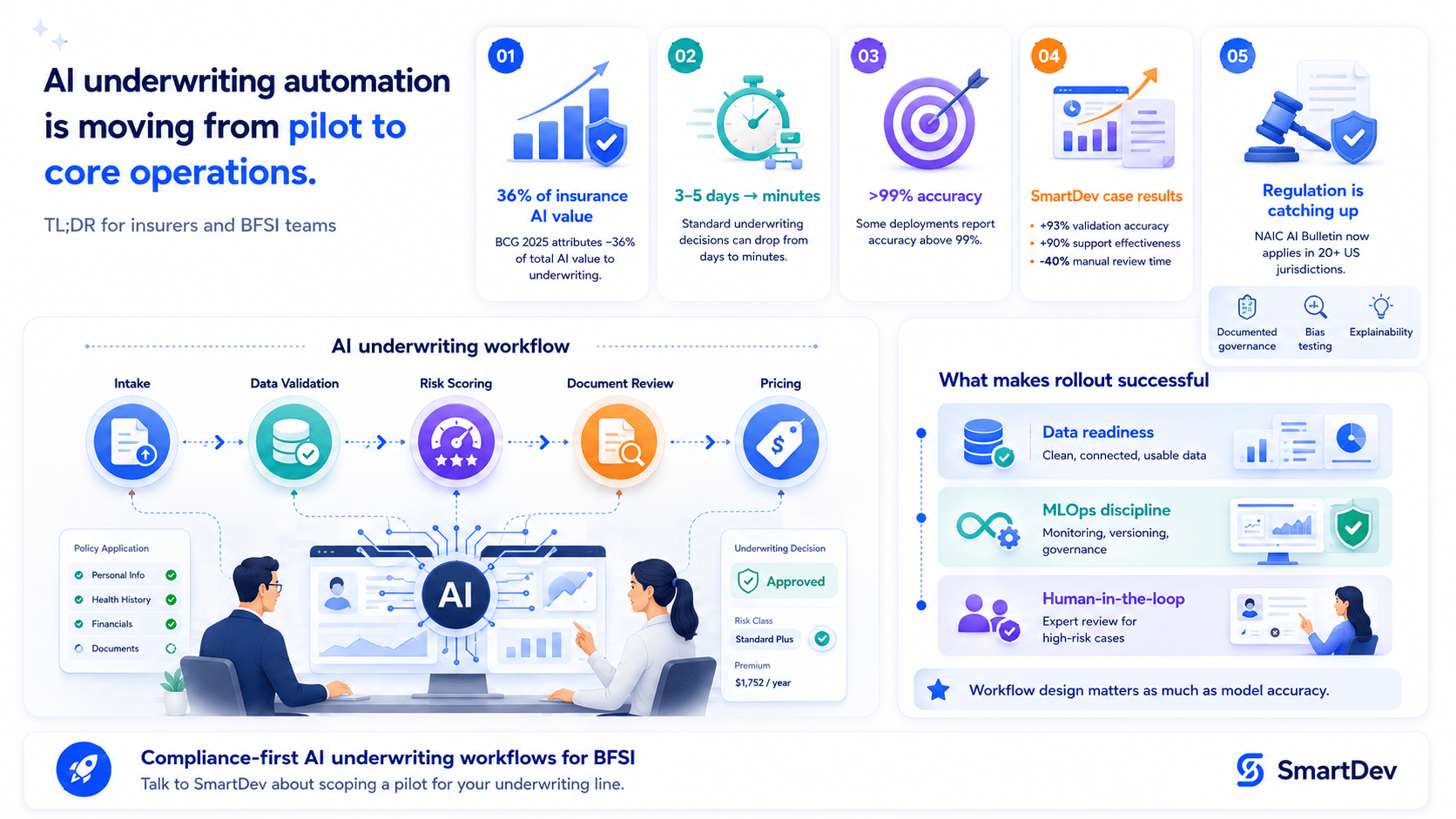
- AI workflow automation now touches every stage of underwriting – intake, data validation, risk scoring, document review, and pricing – and BCG’s 2025 analysis attributes roughly 36% of total AI value in insurance to the underwriting function alone.
- Speed and accuracy gains are large and measurable. Independent reporting cites underwriting decisions dropping from three-to-five days to minutes for standard policies, alongside accuracy rates above 99% in some deployments.
- SmartDev’s own insurance KYC automation work delivered +93% document validation accuracy, +90% support effectiveness, and a 40% cut in manual review time for a Singapore-based financial advisory client.
- Regulation is catching up fast. The NAIC Model Bulletin on AI Systems, adopted in December 2023, now applies in more than 20 US jurisdictions and requires documented governance, bias testing, and explainability.
- A successful rollout depends on workflow design, not just model accuracy. Data readiness, MLOps discipline, and human-in-the-loop review determine whether automation actually reduces risk instead of hiding it.
- SmartDev builds compliance-first AI underwriting workflows for BFSI clients. Talk to our team about scoping a pilot for your underwriting line.
Introduction
Underwriting has always been the financial engine room of an insurance business. It decides who gets covered, at what price, and under what conditions. For decades, that decision-making leaned on spreadsheets, PDFs, and the tacit judgment of experienced underwriters. That model is now under real strain. Application volumes keep rising; customer expectations have shifted toward instant quotes, and regulators expect documented, explainable decisions rather than institutional memory.
AI workflow automation offers a practical answer to this strain. Instead of replacing underwriters, it removes the repetitive, error-prone steps – data entry, document checks, rule lookups – so people can focus on complex risk judgment. Insurers who deploy this well are not just cutting cost; they are compressing underwriting cycles from days to minutes while improving consistency across every case a team handles.
This guide walks through what AI-powered underwriting automation involves, where it delivers the most value, what regulators now expect, and how to plan an implementation that survives an audit. Along the way, we reference SmartDev’s own delivery experience, including a live insurance KYC document validation project built for a Singapore-based financial advisory firm.
What Is AI Powered Underwriting Automation?
AI-powered underwriting automation combines machine learning models, natural language processing, and rules engines into a single workflow that ingests an application, checks it against policy and regulatory rules, scores the risk, and routes the case to the right outcome – approval, referral, or decline. It differs from older robotic process automation (RPA) because it interprets unstructured content, not just structured form fields.
From Manual Rules to Intelligent Workflows
Traditional underwriting systems rely on static rule trees: if income falls below X, refer to a human; if a medical code appears, request additional records. These rules work for simple cases but break down quickly with messy real-world data, such as scanned PDFs, handwritten forms, or inconsistent third-party feeds. AI models read that same messy data, extract the relevant fields, and normalize it before any rule ever fires, which cuts the referral rate for cases that a rule-only system would have kicked out unnecessarily.
Core Components of an AI Underwriting Stack
A production-grade stack usually combines four layers: a document intelligence layer that extracts and classifies data from applications and supporting files; a data enrichment layer that pulls in third-party sources such as credit bureaus, telematics, or property records; a risk-scoring layer built on machine learning or generative models; and an orchestration layer that manages case routing, audit logging, and human review. SmartDev’s AI & Machine Learning practice and generative AI development services both feed directly into this kind of stack, particularly the document intelligence and risk-scoring layers.
Structured vs. Unstructured Data in Underwriting
Underwriting data arrives in two very different shapes. Structured data – dates, dollar amounts, coded fields – slots neatly into a database and has always been easy to automate. Unstructured data, including scanned applications, medical notes, and adjuster comments, historically required a person to read and interpret it. Modern document intelligence models close that gap by converting unstructured content into structured fields the rest of the workflow can act on, which is often the single biggest unlock in an automation project.
Rules Engines vs. Machine Learning Models
Rules of engines and machine learning models solve different problems, and most production workflows need both. A rules engine enforces hard constraints, such as regulatory eligibility limits or product-specific exclusions, and it behaves the same way every time. A machine learning model, by contrast, learns patterns from historical data and produces a probabilistic risk score that improves as more claim outcomes feed back into it. Pairing the two keeps the workflow both compliant and adaptive.
Where Human Judgment Still Fits
Even a mature AI underwriting stack routes a meaningful share of cases to a human reviewer, and that is by design rather than a limitation. Ambiguous risk profiles, unusually large policies, and cases involving conflicting data sources still benefit from a person weighing context the model cannot fully capture. The goal is not to remove underwriters from the loop; it is to reserve their time for the cases where judgment genuinely matters.
Takeaway: AI underwriting automation is not a single model. Instead, it combines extraction, enrichment, scoring, and routing into one coordinated workflow. Organizations should validate each stage independently before trusting premium decisions.
Why Insurers Are Automating Underwriting Now
Three forces are pushing underwriting automation from a nice-to-have into a competitive requirement: cost pressure, customer expectations, and data volume. Each reinforces the other, and none of them is easing off in 2026.
Market and Competitive Pressure
Coverage from Vantage Point’s 2026 insurtech trends analysis describes underwriting timelines collapsing from roughly three days to three minutes at leading digital-first carriers, with straight-through processing rates climbing from the 10–15% range toward 70–90% in mature deployments. Carriers that still run manual-first underwriting cannot match that quote speed, and slower quoting directly costs them bound policies to faster competitors.
The Cost of Manual Underwriting
Manual review does not scale evenly with volume. A spike in applications during renewal season or after a market event forces insurers to either hire temporary staff or accept longer queues, and both options introduce inconsistency into risk decisions. Reporting from CIO Dive notes that carriers running agentic AI in claims and underwriting workflows have reported productivity gains between 30% and 40%, with the difference driven less by the underlying model and more by disciplined, governance-first workflow design.
Customer Expectations for Instant Quotes
Policyholders now compare insurance buying to e-commerce checkout, expecting a quote within minutes rather than days. Digital-first insurers have set that expectation by issuing real-time decisions for straightforward policies, and slower incumbents feel the gap directly in quote-to-bind conversion. Underwriting automation is often the only realistic path to matching that speed without sacrificing risk discipline.
Data Volume and Third-Party Feeds
Underwriters today pull from a growing list of data sources – credit bureaus, telematics devices, property records, and public databases – and manually reconciling all of them for every application simply does not scale. Automated enrichment pipelines query these sources in parallel and merge the results before a risk score ever runs, which removes a step that used to take hours per case.
Talent and Staffing Constraints
Experienced underwriters take years to train, and many carriers report growing difficulty hiring and retaining that expertise as senior staff retire. Automating the repetitive parts of the job makes the role more attractive to newer hires and reduces how much institutional knowledge walks out the door with any single departure.
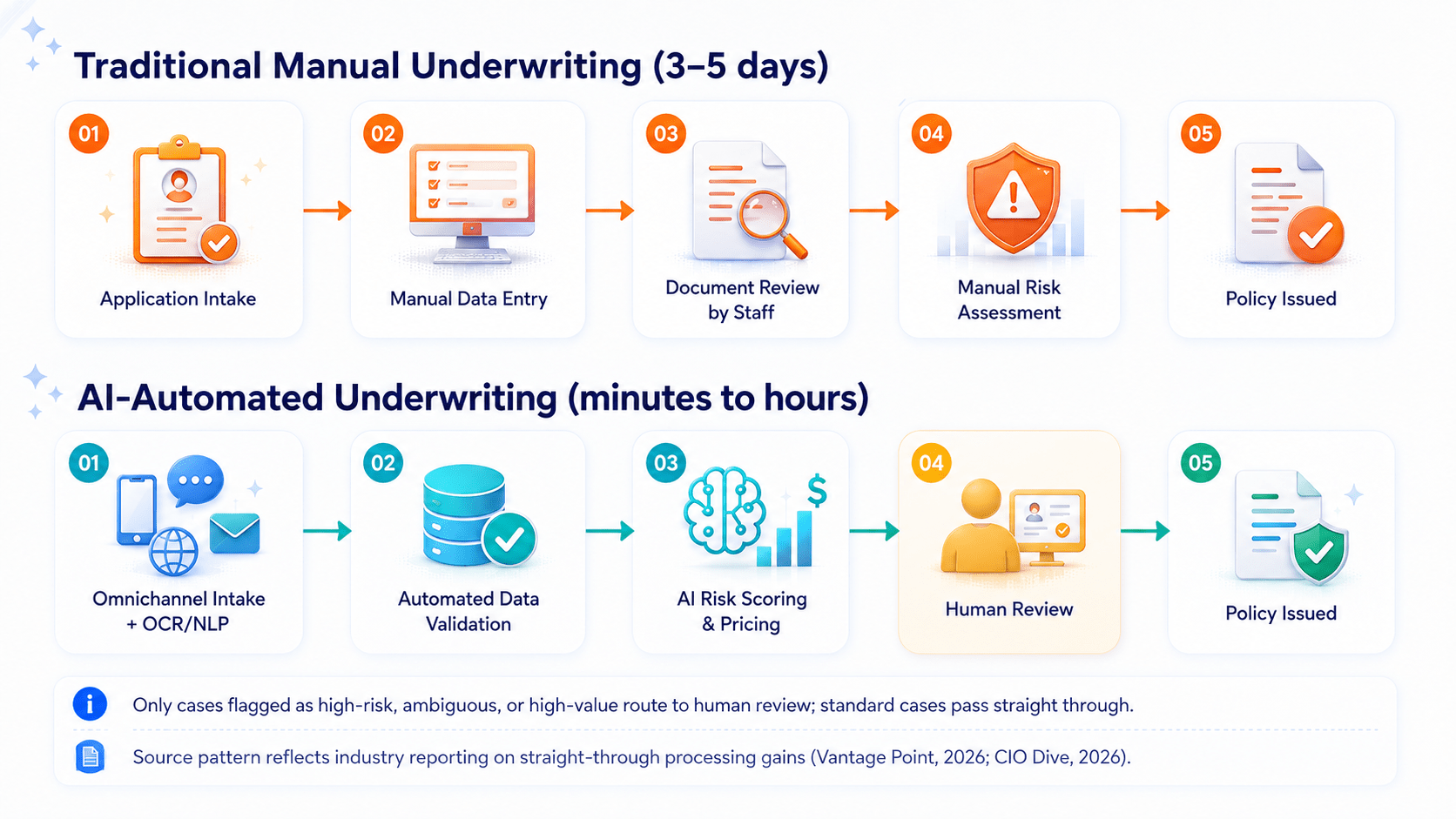
AI underwriting automation replaces sequential manual processing with a structured decision workflow. Instead of reviewing every application manually, insurers use AI to extract information, validate data, score risk, and route only complex cases for human review. Standard applications move through straight-through processing, while high-risk, ambiguous, or high-value cases receive additional human oversight. This hybrid workflow reduces underwriting time from days to minutes or hours, improves operational efficiency, and preserves governance for decisions with greater financial or regulatory impact.
Takeaway: The competitive advantage no longer comes from simply adopting AI. Most insurers already use it. Instead, success depends on redesigning the underwriting workflow, so only genuinely complex cases require human review.
Core Use Cases Across the Underwriting Lifecycle
AI automation touches nearly every step of the underwriting lifecycle. Below are the four use cases with the clearest, best-documented return on investment.
Application Intake and Data Validation
Automated intake systems accept applications from web forms, agent portals, email, and scanned documents, then normalize that data into a single structured record. This step alone removes a large share of downstream referral volume, because most “incomplete application” delays trace back to inconsistent formats rather than genuinely missing information.
Risk Scoring and Pricing
Machine learning models combine applicant data, third-party enrichment, and historical loss data to generate a risk score and a suggested price. Unlike static actuarial tables, these models update as new claims data arrives, which keeps pricing closer to real-world loss experience. SmartDev’s machine learning development services and data analytics services support this layer directly, from feature engineering through model deployment.
Document and KYC Verification
Insurance applications, especially for life and health lines, generate a heavy stack of supporting documents: identity proofs, medical records, and financial statements. Large language model-based validation systems can check these documents against product-specific compliance rules far faster than manual review, while keeping an audit trail of exactly which rule flagged which field. This is precisely the workflow SmartDev built for a Singapore-based financial advisory firm, detailed in the insurance document validation case study.
Fraud Signal Detection
Automated systems flag anomalies such as mismatched applicant details, unusual claim patterns, or duplicate submissions across channels, in real time rather than after the fact. Related patterns already appear in SmartDev’s coverage of AI workflow automation versus legacy intelligent document processing, since fraud detection depends heavily on how well the underlying document pipeline extracts and cross-references data.
Renewal and Portfolio Monitoring
Automation does not stop policy issuance. AI models can continuously monitor an existing portfolio for emerging risk signals, such as a policyholder changing claims history or new exposure data, and flag policies for underwriter review before renewal rather than reactively at the renewal date. This shifts underwriting from a point-in-time decision to an ongoing risk-management process.
Takeaway: The greatest automation gains come from intake and document verification, not risk scoring alone. Most underwriting delays occur before any risk model runs.
Real-World Impact: What the Data Shows
Industry data and SmartDev’s own delivery work both point to the same conclusion: AI underwriting automation produces measurable gains in speed, accuracy, and consistency, provided the workflow is designed around the right checkpoints.
Speed Gains
A 2025 technical analysis reported by BizTech Magazine found that AI cut average underwriting decision time from three-to-five days down to roughly 12.4 minutes for standard policies, while complex policies saw processing time fall by about 31%. Separate market research from market.us notes that by 2025, 91% of surveyed insurance companies had already adopted some form of AI technology in their operations.
Accuracy Gains
The same BizTech analysis cited a 99.3% accuracy rate in AI-assisted risk assessment for standard policies, with complex-policy accuracy improving by roughly 43% over manual baselines. These figures line up with what SmartDev observed in production: automation does not just move faster; it also catches errors that manual review consistently misses under time pressure.
Consistency Across Case Volume
Manual underwriting quality tends to drift as reviewer fatigue, workload spikes, and individual judgment differences creep in over a busy quarter. AI-driven scoring applies the same criteria to every case regardless of volume or time of day, which narrows the gap between how a policy gets treated on a quiet Tuesday versus during a renewal-season surge.
Cost-to-Serve Reduction
Faster processing and fewer errors compound into a lower cost per policy underwritten. Insurers spend less on rework, escalations, and temporary staffing during peak periods, and that saved capacity can go toward more complex risk analysis or product innovation instead of routine data checking.
SmartDev Case Study: Insurance KYC Document Validation
SmartDev partnered with a Singapore-based financial advisory firm, part of a larger global investment group, to replace a manual, experience-dependent insurance KYC review process. Senior administrators previously carried most of the compliance knowledge in their heads, which made scaling and training new staff slow and risky. After deploying an LLM-based document validation system integrated with product-specific compliance rules, the client achieved a 93% improvement in document validation accuracy, a 90% improvement in support effectiveness without escalation, and a 40% reduction in manual review time. Full details are available in the insurance document accuracy case study.
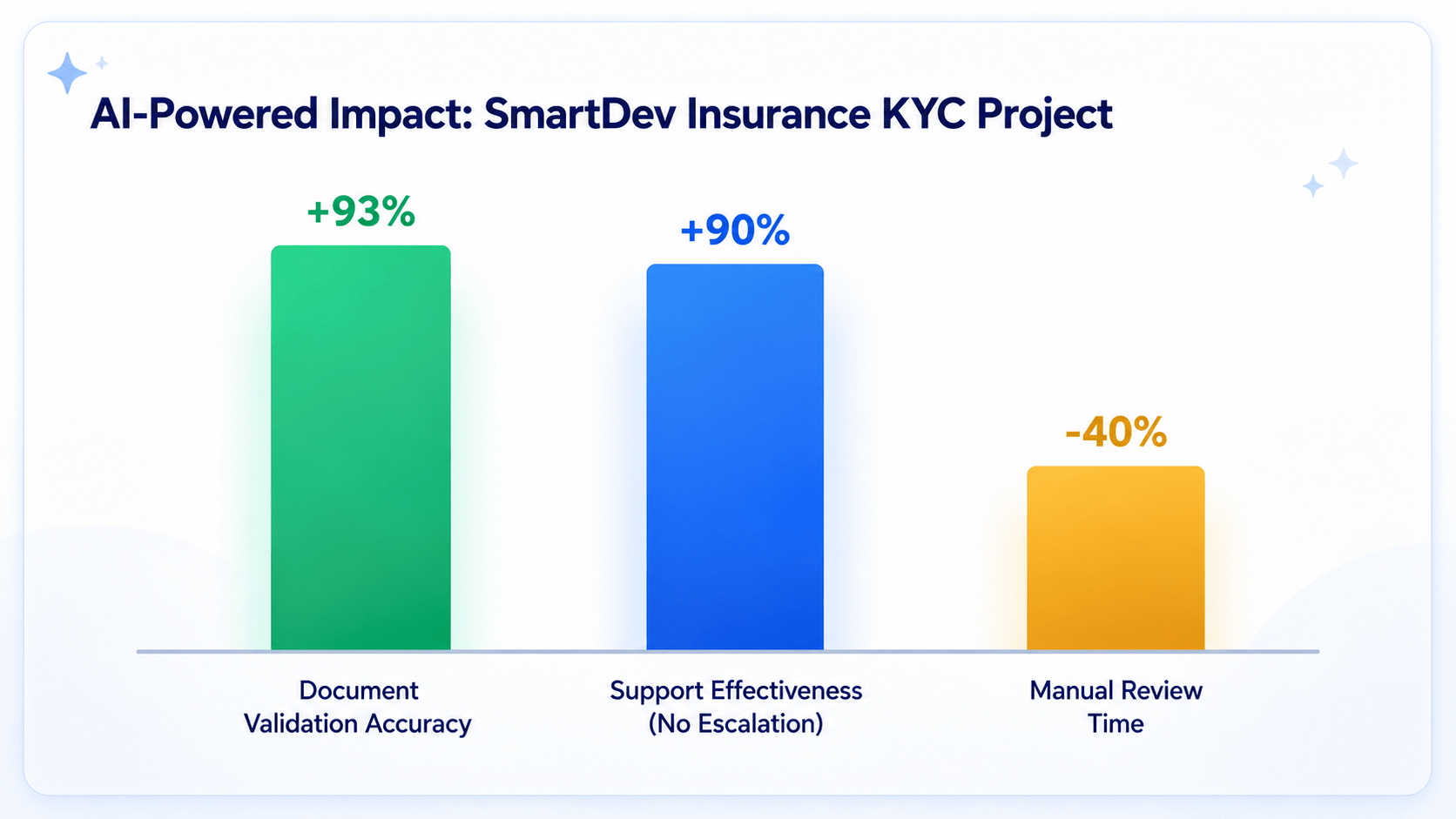
The results demonstrate how AI improves insurance KYC beyond simple automation. By combining LLM-based document validation with structured workflows, SmartDev increased document validation accuracy by 93%, improved support effectiveness by 90%, and reduced manual review time by 40%. Together, these outcomes show that AI can improve accuracy, reduce operational effort, and enable faster customer onboarding while preserving human oversight for exceptions.
Takeaway: Speed alone does not create lasting value. Organizations achieve the greatest impact when faster processing also reduces downstream errors.
NORA: SmartDev’s AI Workflow Automation for Risk & Compliance
The patterns described so far – document intelligence, risk scoring, human-in-the-loop review – are not theoretical. SmartDev has produced this exact workflow as NORA, its AI Adoption Accelerator, giving insurers and lenders a fully managed way to run AI-assisted underwriting without building the pipeline from scratch.
What NORA Does
NORA is a fully managed service that automates risk assessments, compliance checks, and credit scoring workflows across banking, lending, and insurance. Clients running it report roughly 60% faster risk processing, 40% less manual review time, 95% more assessment consistency, and a 70% reduction in human checking errors compared with fully manual workflows. Rather than replacing compliance and underwriting teams, NORA absorbs the repetitive review work, so analysts can concentrate on exceptions and high-value judgment calls.
The NORA Assessment Pipeline
NORA runs a six-step pipeline that mirrors the AI underwriting workflow covered earlier in this guide. The process begins with document intake, accepting financial statements, KYC files, and supporting records in PDF or DOCX format. Next, Docling-powered OCR extracts structured text with layout awareness, including tables in scanned documents. An LLM, such as GPT-4o or Claude 3.5 Sonnet through OpenRouter, then generates a structured risk narrative and risk score.
Next, a deterministic rule engine validates required fields and thresholds against product-specific business logic. Low-confidence or flagged cases automatically route to a human review queue because regulators require human oversight at critical decision points. Finally, NORA generates a timestamped, audit-ready report that captures the complete data lineage for every underwriting decision.
Manual Underwriting vs. NORA: A Direct Comparison
| Without NORA (Manual) | With NORA (AI-Assisted) |
| Manual borrower or applicant profile review | AI-assisted risk assessment embedded in the workflow |
| Experience-driven judgment, no standardized logic | Standardized compliance and risk scoring framework |
| 60–90 minutes per individual case / 7–10 days for business cases | 2–3 minutes per individual case / 15–30 minutes for business cases |
| 2–4 people involved per application | 1 person for final review or refinement |
| Difficult to scale during peak volume periods | Faster processing with no added headcount |
| Slow onboarding of new underwriting or credit staff | Reduced training dependency via AI guidance |
| Ongoing third-party data or bureau fees on every case | Significantly reduced external data and bureau costs |
Tech Stack and Delivery Timeline
NORA runs on a defined, production-ready technology stack rather than a custom build for every client. Its AI layer uses GPT-4o and Claude 3.5 Sonnet through OpenRouter with LangGraph orchestration. The data-processing layer combines Docling OCR, deterministic rule logic, and a Qdrant vector database. FastAPI, AWS S3, Docker, and CI/CD pipelines power the backend, while pre-built connectors integrate with Microsoft 365, Outlook, Teams, Excel, and existing CRM or onboarding APIs.
SmartDev typically deploys NORA within six to ten weeks. The implementation progresses through workflow analysis, rule and integration configuration, testing with real business cases, and production rollout. After go-live, SmartDev continues monitoring and optimizing the system to ensure reliable performance and regulatory compliance.
Who NORA Is Built For
NORA serves three primary customer groups. These include mid-market and enterprise lenders processing 500 or more applications each month, insurance and financial advisory organizations with strict compliance requirements, and microfinance institutions constrained by bureau costs and limited analyst capacity. Each group uses NORA to improve decision consistency without scaling headcounts.
For insurers, NORA applies the same AI pipeline to underwriting intake, KYC verification, and policy risk scoring. This approach helps automate routine assessments while maintaining the audit trails and human oversight required for regulated insurance operations.
Takeaway: NORA transforms the AI underwriting workflow into a production-ready platform. Insurers can deploy document intelligence, risk scoring, and audit trails without building the entire stack from scratch.
Regulatory and Governance Considerations
Underwriting automation operates in one of the most heavily regulated corners of financial services. Any implementation plan must treat governance as a design requirement, not an afterthought bolted before launching.
The NAIC Model AI Bulletin
The NAIC Model Bulletin on the Use of Artificial Intelligence Systems by Insurers, adopted in December 2023, now applies in more than 20 US jurisdictions. It requires insurers to maintain a written AI Systems Program covering governance, risk management, model validation, and vendor oversight across the full insurance lifecycle, including underwriting and pricing. Analysis from Kennedys Law highlights that insurers must also notify consumers when AI systems influence a decision that affects them.
Explainability and Bias Testing
Regulators increasingly expect insurers to explain how a specific input led to a specific underwriting outcome; not just show that the model performs well on average. This typically means building trace logs that connect an output back through the model’s features, thresholds, and decision path, alongside documented bias testing for proxy discrimination against protected classes.
Human-in-the-Loop Review
High-stakes decisions – coverage of denials, unusually large policies, ambiguous risk profiles – still benefit from a human checkpoint before finalization. This is not a regulatory nicety; industry commentary in Risk & Insurance and analysis from Fenwick both describe 2025 as the year agentic AI moved from pilot to production in underwriting and claims, precisely because insurers-built governance and human oversight into the workflow from day one. SmartDev’s work on AI-native compliance for RegTech firms and AI-powered regulatory change monitoring covers this governance layer in more depth.
State-Level Divergence
Because the NAIC bulletin only takes effect once a state insurance department formally adopts it, requirements still vary by jurisdiction. Colorado, for instance, layers on its own mandate for annual algorithm bias testing submitted directly to the state’s Division of Insurance. Carriers operating across multiple states need a governance framework flexible enough to satisfy the strictest jurisdiction they write about business in, rather than a single lowest-common-denominator policy.
Third-Party Vendor Accountability
Insurers remain fully accountable for AI systems even when a third-party vendor built the underlying model. Regulators expect documented vendor oversight, including validation of evidence and bias-testing results, before an insurer relies on an external tool for underwriting decisions. This makes vendor selection a compliance decision as much as a technical one, and it is one reason SmartDev builds transparent, auditable models rather than opaque black-box systems.
Takeaway: Compliance-ready automation starts with governance. Organizations should build model validation, bias testing, and audit trails into the system from day one.
Building an AI Underwriting Workflow: Implementation Roadmap
A workflow for this consequential deserves a staged rollout rather than a single big-bang launch. The following four phases reflect how SmartDev structures underwriting automation engagements for BFSI clients.
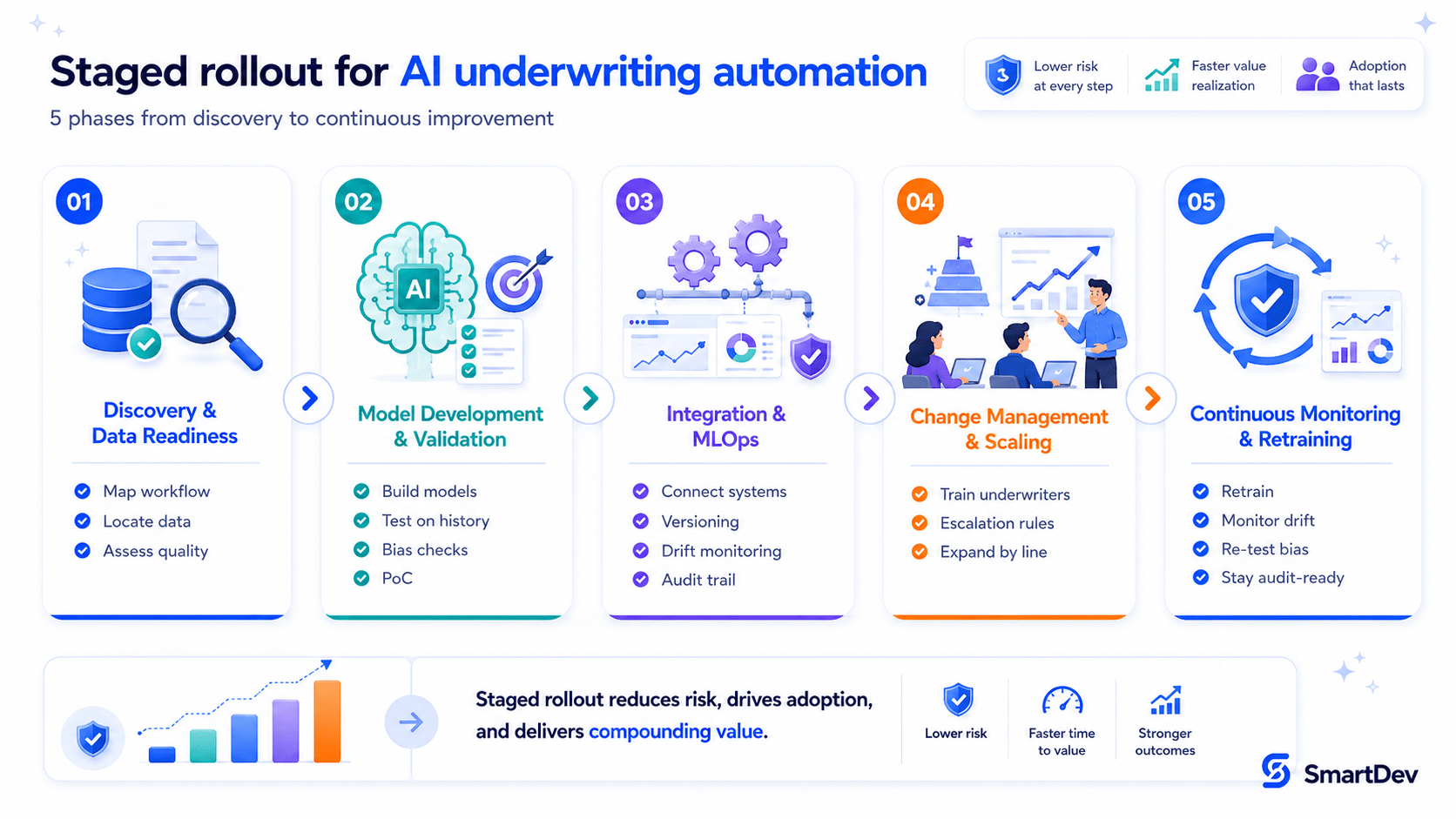
Phase 1: Discovery and Data Readiness
Every automation project starts by mapping the current underwriting process from end to end, identifying where data lives, and assessing its quality. This phase typically surfaces as the biggest source of delay: fragmented data spread across legacy systems, PDFs, and spreadsheets rather than the AI model itself. SmartDev runs this stage through structured programs such as the 3 Weeks AI Discovery Program and AI consulting services.
Phase 2: Model Development and Validation
With clean, representative data in hand, teams build and validate risk-scoring and document-extraction models, testing them against historical decisions and known bias risks before any production traffic touches them. A proof-of-concept phase, similar to SmartDev’s AI Proof of Concept offering, keeps this stage low-risk and measurable.
Phase 3: Integration and MLOps
Models need to plug into existing policy administration and underwriting systems without breaking downstream reporting or compliance with workflows. This is where MLOps services matter most – versioning models, monitoring drift, and keeping deployment auditable as regulations evolve. SmartDev’s broader AI development services cover this integration layer end to end.
Phase 4: Change Management and Scaling
This phase trains underwriters to work alongside the new system, defines escalation rules for edge cases, and expands automation coverage line by line rather than all at once. This staged expansion matches the pattern SmartDev used successfully in its insurance KYC automation project, which launched a feature-rich MVP within four months despite cross-time-zone collaboration.
Phase 5: Continuous Monitoring and Retraining
Launch is only the beginning of the AI lifecycle. Over time, risk patterns change as claims data accumulate. Therefore, organizations should schedule model retraining, drift monitoring, and regular bias re-testing. These practices help maintain both accuracy and regulatory compliance. Furthermore, building this feedback loop into the workflow from the start keeps the system audit ready. It also prevents model performance from quietly degrading after go-live.
Takeaway: Treat AI implementation as a phased transformation, not a one-time deployment. Many underwriting projects fail because teams skip data readiness and build models too early.
Choosing the Right AI Development Partner
Underwriting automation touches compliance, customer trust, and revenue at the same time, so the choice of delivery partner matters as much as the choice of model.
What to Look For
Look for a partner with proven BFSI delivery experience, not just general AI expertise. Request evidence of regulatory-aware design and measurable outcomes from previous projects. In addition, ask for a clear plan for post-deployment model monitoring. Finally, ensure that the partner can explain its approach to bias testing and audit logging. Otherwise, the partner is unlikely to support underwriting workloads effectively.
Evaluating Technical Depth
Ask prospective partners to explain their approach to document intelligence, model validation, and MLOps in concrete terms. They should avoid relying on marketing language alone. In addition, experienced teams should explain the trade-offs between rules engines and machine learning models. They should also describe how they test bias and monitor models after deployment. This demonstrates long-term operational expertise rather than a deployment-only engagement.
Assessing Delivery Track Record
Request references and measurable outcomes from comparable BFSI projects. Focus on metrics such as accuracy improvements, cycle-time reduction, and time to MVP. In addition, ask for examples from insurance or fintech deployments. Partners who share specific results demonstrate proven delivery experience. By contrast, vague success stories provide little evidence of performance in regulated environments.
Post-Launch Support and Ownership
Underwriting models need ongoing care long after go-live, including retraining, compliance updates, and incident response if a model starts drifting. Confirm upfront who owns monitoring, how quickly issues get escalated, and whether the partner offers continued support such as Maintenance and Support services, rather than handing off the system and moving on to the next client.
How SmartDev Helps Build AI-Powered Underwriting Workflows
SmartDev has delivered AI-powered underwriting and KYC automation for BFSI clients, including the Singapore-based insurance document validation project referenced throughout this guide, and productized that experience into NORA, covered in detail in Section 5 above.
Our teams combine AI & Machine Learning engineering with deep BFSI/Fintech industry knowledge, ISO 27001 and SOC 2 Type 2-backed security practices, and a delivery model built around measurable outcomes rather than open-ended experimentation. Explore more of our work in the case studies library or browse the SmartDev blog for related reading on AI adoption in regulated industries.
Takeaway: The right implementation partner delivers compliance and measurable business outcomes together. That combination determines whether automation withstands regulatory scrutiny.
Frequently Asked Questions
What is AI underwriting automation?
AI underwriting automation combines machine learning, natural language processing, and rules engines. Together, these technologies automate application intake, data validation, risk scoring, and document review. Meanwhile, complex cases route to human underwriters for final decisions.
How much faster is AI-driven underwriting compared to manual review?
Industry reporting highlights significant underwriting efficiency gains. Standard policy decisions can fall from three to five days to about 12.4 minutes. Meanwhile, complex policy processing times can decrease by approximately 31%. These findings come from a 2025 technical analysis covered by BizTech Magazine.
Is AI underwriting automation regulated?
Yes. The NAIC Model Bulletin on AI Systems was adopted in December 2023. It now applies in more than 20 U.S. jurisdictions. Accordingly, insurers should maintain a documented AI governance program. That program should cover model validation, bias testing, and consumer notification.
Does AI underwriting automation replace underwriters?
No. Most insurers keep humans in the loop for high-stakes or ambiguous decisions. Instead, AI automates routine data validation and risk scoring. This approach allows underwriters to focus on complex cases requiring professional judgment.
How long does an underwriting automation project take to launch?
A typical pilot-to-production timeline spans four to six months, covering discovery, model development, integration, and staged rollout. For example, SmartDev delivered its insurance KYC automation MVP within four months, demonstrating how a structured implementation approach can accelerate deployment.
What is NORA and how does it apply to insurance underwriting?
NORA is SmartDev’s AI Adoption Accelerator, a fully managed service for automating risk assessment, compliance checks, and credit scoring workflows. As a result, underwriting and lending teams can reduce assessment time from 60–90 minutes to just 2–3 minutes. Furthermore, SmartDev typically brings clients live within 6 to 10 weeks, accelerating AI adoption without compromising governance or regulatory readiness.
Conclusion
AI workflow automation has moved from an experimental idea to a standard expectation in underwriting. As a result, insurers that redesign their intake, validation, and risk-scoring workflows around AI can quote faster, reduce error rates, and free underwriters to focus on genuinely complex decisions. For example, SmartDev’s insurance KYC project achieved a 93% improvement in validation accuracy, a 90% increase in support effectiveness, and a 40% reduction in manual review time within a four-month MVP timeline.
However, these benefits depend on strong governance from the beginning. The NAIC Model AI Bulletin and related state regulations now expect documented validation, bias testing, and explainability. Therefore, underwriting workflows must satisfy both regulatory examiners and business users. Ultimately, insurers that treat compliance as a design requirement, rather than an afterthought, build automation that withstands regulatory scrutiny.
Finally, organizations exploring underwriting automation should begin with a data-readiness assessment and a focused pilot instead of a full-portfolio rollout. This phased approach reduces implementation risk while generating measurable evidence before scaling. Contact SmartDev to discuss how a compliance-first AI workflow can strengthen your underwriting operations.