TL;DR
Introduction
Most mid-market companies do not have a document-processing problem. They have an execution problem. Every invoice, contract, customer form, or compliance document may be extracted successfully, yet employees still spend hours validating information, requesting approvals, updating ERP systems, resolving exceptions, and coordinating across teams.
While Intelligent Document Processing (IDP) has dramatically improved document digitization, it was never designed to automate everything that happens after extraction. As organizations grow, these downstream activities—not OCR or data capture—become the real operational bottleneck.

After documents are processed, employees still need to validate information, request approvals, update ERP systems, notify stakeholders, investigate exceptions, and maintain audit records. These manual activities often consume far more time than document extraction itself.
As organizations seek greater efficiency without significantly expanding headcount, many are shifting from legacy IDP solutions toward AI workflow automation. Rather than automating a single step of the process, AI workflow automation connects and orchestrates entire business operations—from document ingestion to decision-making and execution.
What Is Legacy Intelligent Document Processing (IDP)?
Intelligent Document Processing (IDP) combines Optical Character Recognition (OCR), machine learning, and document classification technologies to extract structured information from unstructured documents. Modern IDP platforms typically perform several core functions:
- Capture documents from scanners, email, or cloud storage
- Classify document types automatically
- Extract structured data using OCR and AI
- Validate extracted information
- Export data into downstream business systems
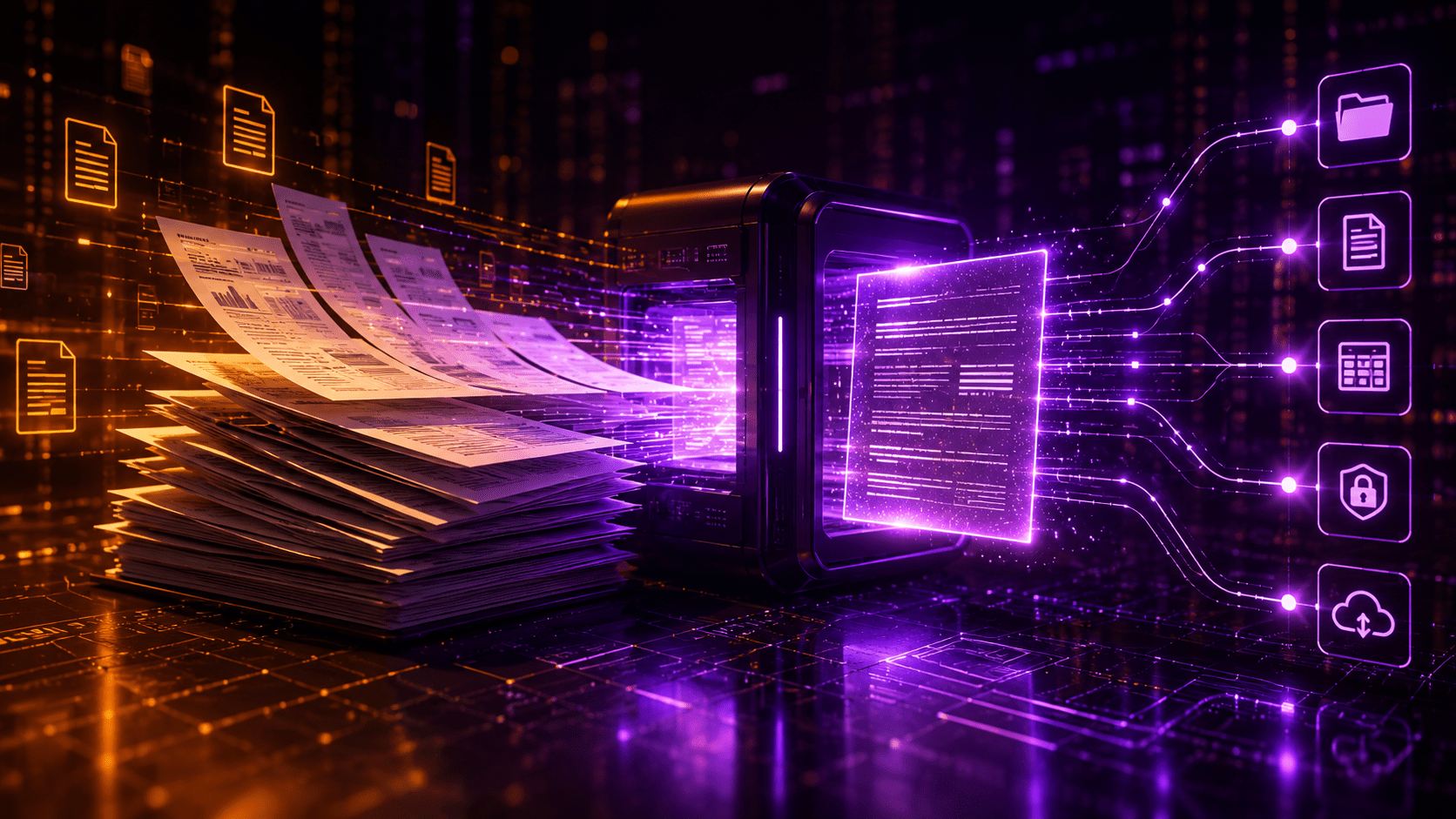
Compared to manual data entry, IDP significantly reduces processing time while improving consistency and accuracy. However, despite its name, IDP primarily focuses on document understanding, not business process execution. Once information has been extracted, most organizations still rely on employees to perform the remaining operational work manually.
Where IDP Needs Additional Automation?
As organizations grow, operational complexity increases much faster than document volume alone. New business units, additional approval layers, evolving compliance requirements, and an expanding technology stack all contribute to more intricate workflows. While legacy IDP solutions remain effective at extracting data from documents, they were never designed to coordinate the growing number of decisions, exceptions, and cross-functional processes that follow. This is where many legacy IDP implementations begin to show their limitations.
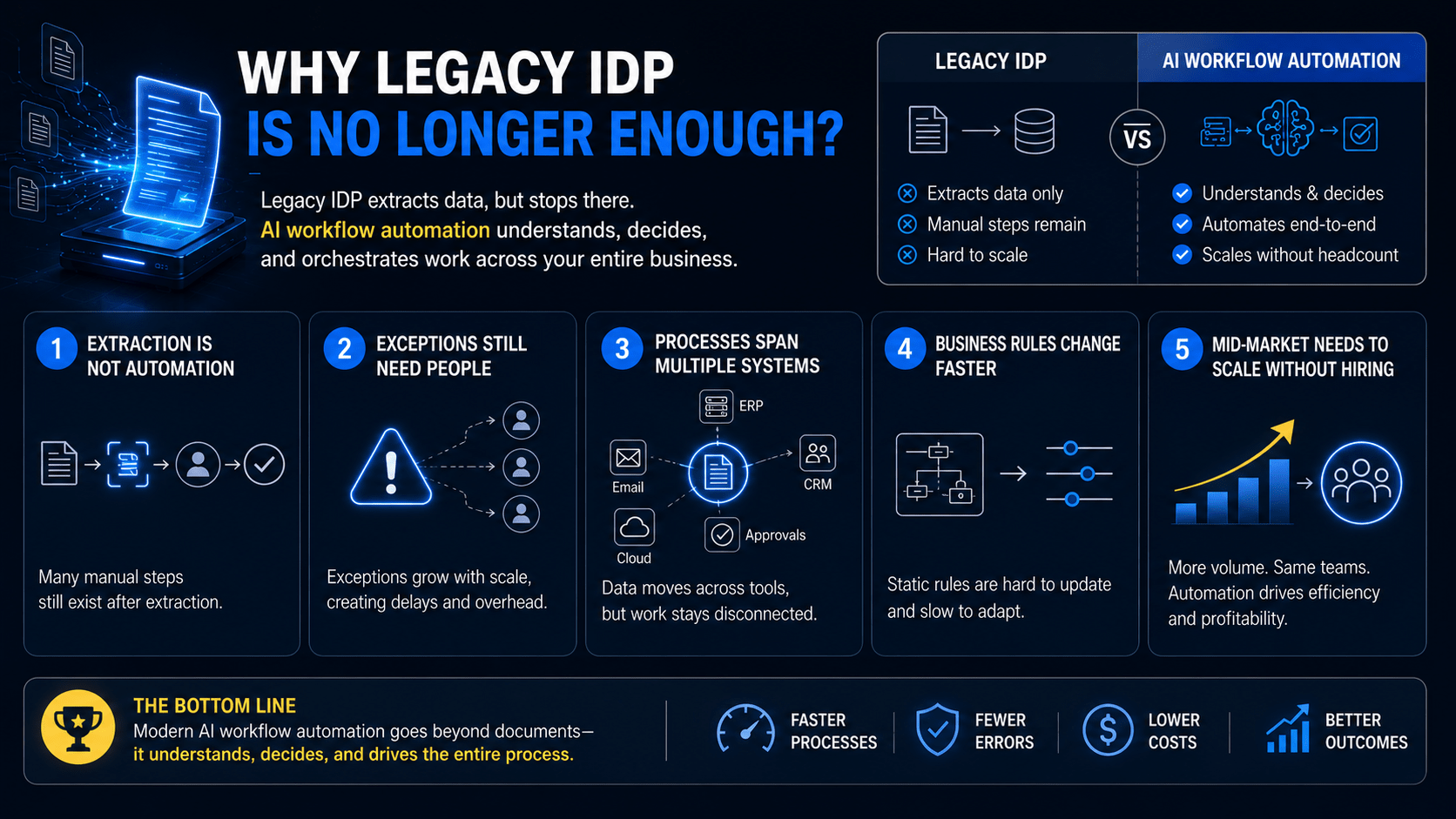
1. Documents Are Extracted – but Work Still Happens Manually
Many companies assume document extraction equals process automation. In reality, document extraction is only the beginning. Consider a typical invoice workflow: Invoice arrives via email -> IDP extracts invoice information -> Finance reviews extracted fields -> Procurement verifies purchase order -> Manager approves payment -> ERP system is updated -> Supplier is notified.
While IDP automates the second step, every subsequent activity often requires manual intervention. Employees continue switching between multiple systems, sending emails, validating information, and coordinating approvals. As transaction volumes increase, these manual tasks quickly become operational bottlenecks. The result is an organization where documents move faster, but work does not.
2. Exception Handling Still Depends on People
No AI model achieves perfect accuracy. Invoices may contain missing purchase order numbers, contracts may include non-standard clauses, or shipping documents may arrive in unfamiliar formats. Legacy IDP platforms typically flag these exceptions for human review. As businesses scale, exception queues grow larger, increasing administrative workload and slowing business operations.
The challenge is no longer extracting data—it is determining what should happen next. Employees spend valuable time investigating discrepancies, deciding who should resolve them, and manually routing documents to the appropriate stakeholders.
3. Business Processes Span Multiple Systems
Modern organizations rarely operate within a single application. A single document-driven process may involve ERP platforms, CRM systems, finance tools, email, cloud storage, approval workflows, and collaboration platforms such as Microsoft Teams or Slack. However, traditional IDP solutions often stop after extracting data and exporting it into one destination.
From there, employees still need to manually move information across systems, check whether records match, trigger approvals, update internal tools, and notify the right stakeholders. This creates fragmented workflows where documents may be digitized, but the actual business process remains disconnected. Without orchestration across these business applications, organizations struggle to achieve true operational efficiency.
4. Business Rules Change Faster Than Legacy Automation
Business environments are becoming increasingly dynamic. As approval thresholds change, compliance requirements evolve. Customer onboarding processes are updated. Procurement policies are revised. Traditional IDP implementations often rely on predefined rules and static workflows that require IT support whenever business logic changes.
For growing mid-market organizations with lean technical teams, maintaining these workflows becomes increasingly expensive and time-consuming. Modern AI workflow automation platforms are designed to adapt much more quickly by combining AI reasoning with configurable workflow logic.
5. Mid-Market Companies Need to Scale Without Hiring
Perhaps the biggest driver behind AI workflow automation adoption is economics. Mid-market organizations often experience rapid business growth but cannot continuously expand operational teams. Finance departments process more invoices. Compliance teams review more documents. Customer service teams manage increasing case volumes. Operations teams coordinate larger supply chains.
Hiring additional administrative staff for every increase in workload is rarely sustainable. Instead, organizations are investing in automation that allows existing teams to handle significantly higher transaction volumes while maintaining service quality. This can help teams reduce costs while boost profitability simultaneously.
AI Workflow Automation: Moving Beyond Document Processing
AI workflow automation represents the next evolution of enterprise automation because it addresses the full operational process, not just the document itself. While legacy IDP focuses on extracting information from invoices, contracts, forms, or compliance records, AI workflow automation goes further by understanding what that information means and what action should happen next.
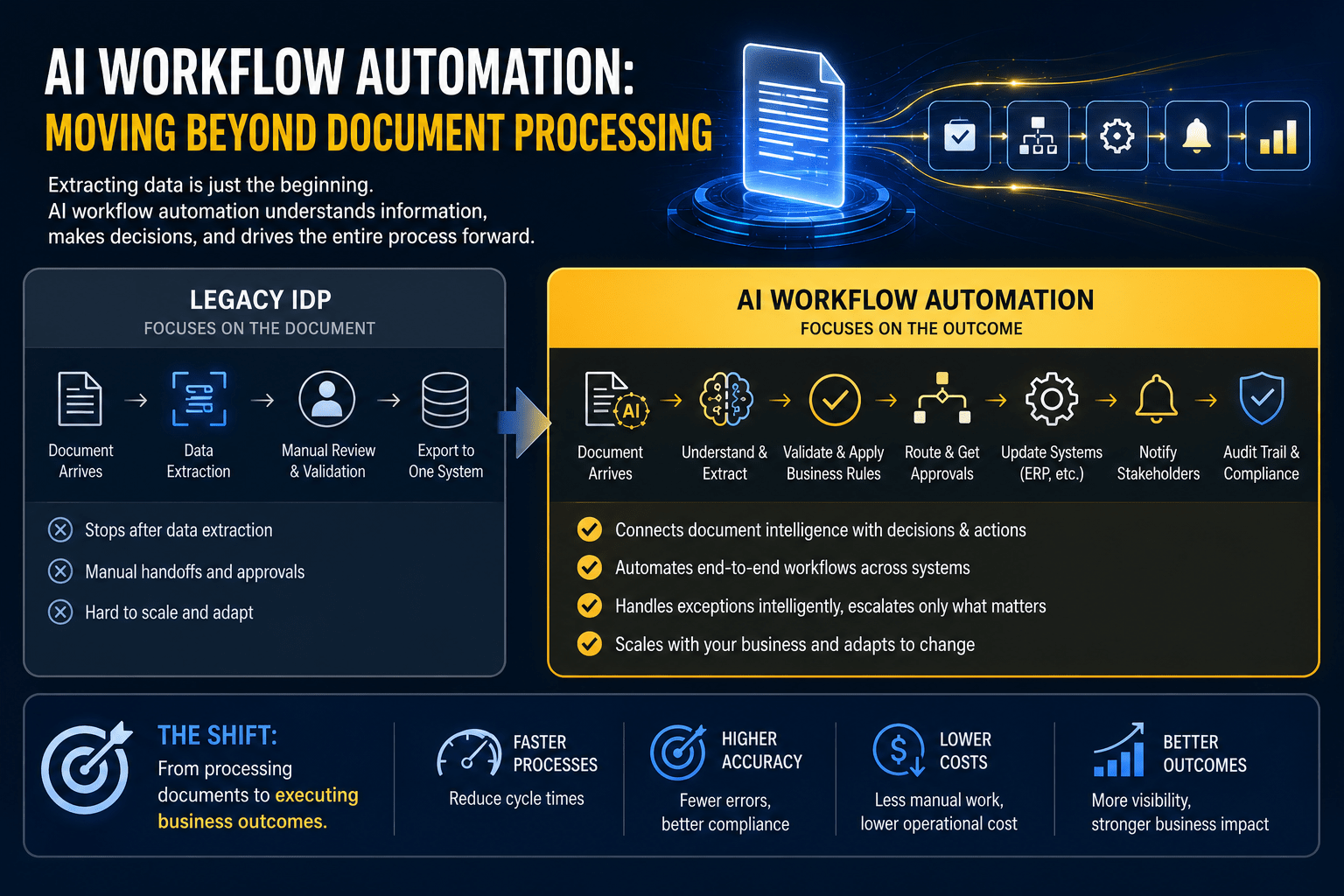
For example, when an invoice enters the system, the goal is not simply to extract the supplier name, invoice number, amount, and due date. The real business goal is to verify whether the invoice matches the purchase order, determine whether approval is required, route it to the correct finance or procurement owner, update the ERP system, notify stakeholders, and maintain a reliable audit trail. These are the steps that usually create operational delays, not the extraction stage alone.
This is where AI workflow automation creates a major shift. It connects document intelligence with decision-making, business rules, system updates, approval routing, and exception handling. Instead of leaving employees to manually interpret extracted data and coordinate the next steps, the automation layer can validate information, detect inconsistencies, trigger workflows, and escalate only the cases that require human judgment.
In other words, AI workflow automation transforms isolated document processing into intelligent operational execution. The shift is no longer about digitizing paper files; it is about building connected, AI-enabled business processes that can operate faster, more accurately, and with far less manual coordination.
Legacy IDP vs. AI Workflow Automation
Legacy IDP and AI workflow automation are often discussed together, but they solve different levels of business problems. Legacy IDP is mainly designed to capture, classify, and extract information from documents. Its core value lies in reducing manual data entry and helping organizations convert unstructured documents into structured digital data. This makes it useful for processing invoices, contracts, forms, claims, shipping records, and compliance documents more efficiently.
However, legacy IDP usually stops at the point where data has been extracted and exported. It does not fully manage the operational decisions, approvals, escalations, and system updates that need to happen afterward. As a result, employees still need to review extracted information, interpret exceptions, coordinate with other departments, and manually move work forward across business systems.
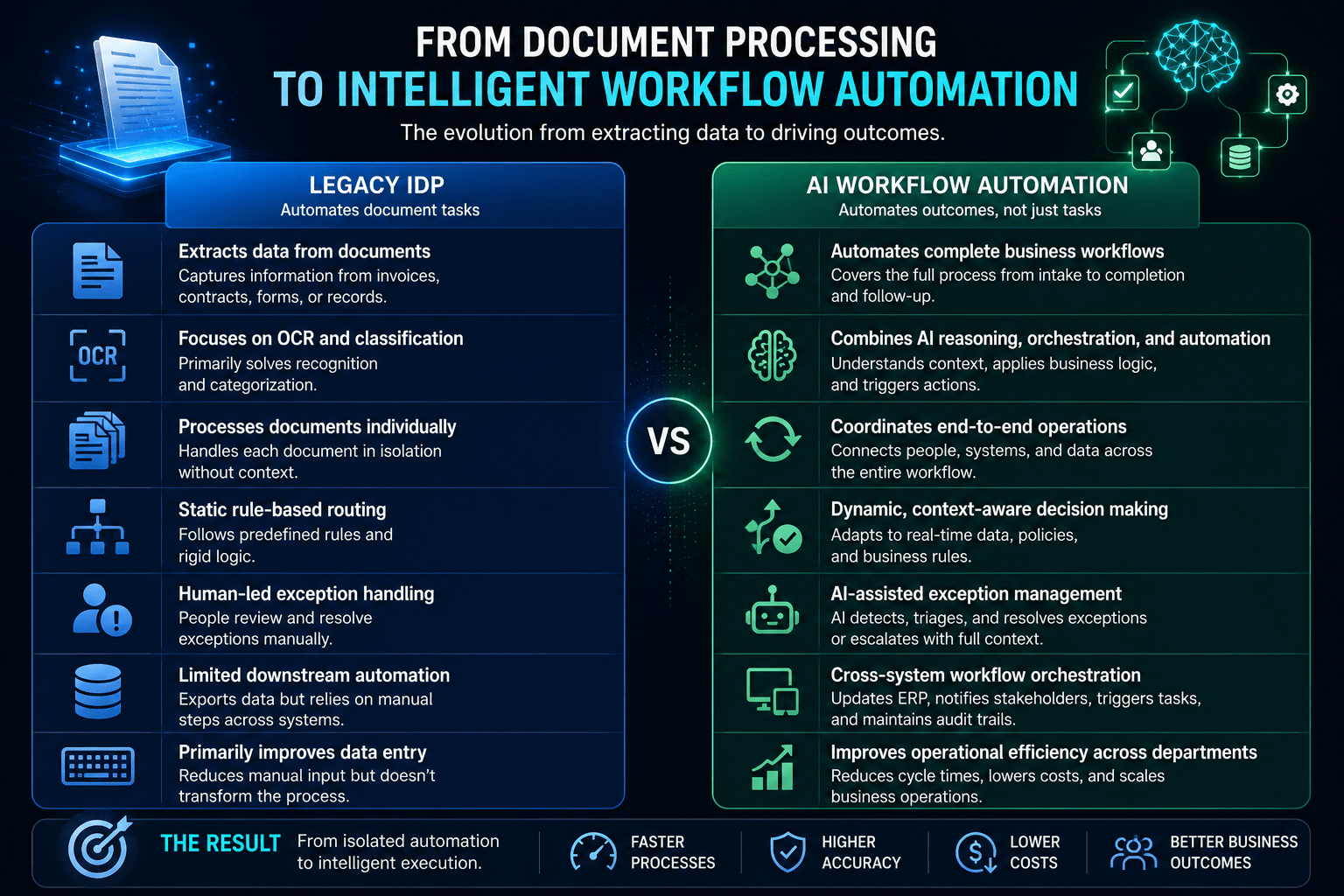
AI workflow automation takes a broader approach. Instead of focusing only on the document, it focuses on the full process surrounding that document. It can understand the context of extracted information, apply business rules, determine the next action, route work to the right team, trigger approvals, update enterprise systems, and maintain a complete audit trail. This allows organizations to automate not just data capture, but also execution.
The key difference is scope. Legacy IDP improves document processing, while AI workflow automation improves operational performance. IDP helps organizations read documents faster; AI workflow automation helps organizations act on those documents faster. For mid-market teams dealing with growing transaction volumes, lean operations, and fragmented systems, this shift is critical. The real competitive advantage no longer comes from extracting information alone, but from turning that information into timely, accurate, and governed business action.
How NORA Extends Traditional IDP into Intelligent Workflow Automation
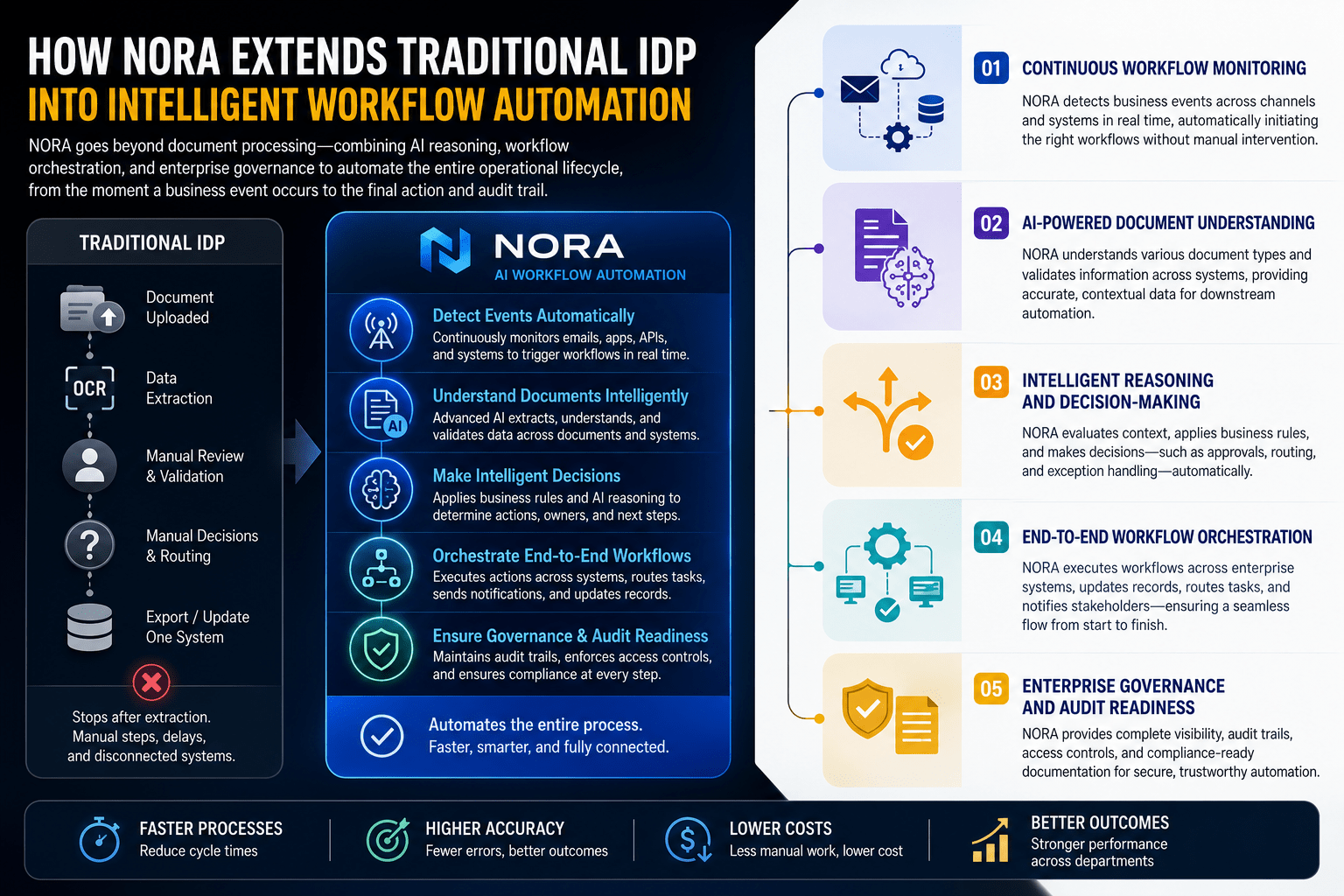
While traditional IDP platforms excel at extracting document data, NORA extends those capabilities by orchestrating everything that happens next. Rather than functioning as another document processing tool, NORA combines AI reasoning, workflow orchestration, and enterprise governance into a unified automation framework that helps organizations automate not only document handling but also the operational decisions and actions that follow.
1. Continuous Workflow Monitoring
Business processes rarely begin when a document is uploaded—they begin when a business event occurs. An invoice arrives in an inbox, a customer submits a form, a contract is signed, or a shipment is confirmed. NORA continuously monitors these events across emails, cloud storage, enterprise applications, APIs, and other connected business systems.
Instead of waiting for employees to manually initiate processing, it automatically detects new events and launches the appropriate workflows in real time. This proactive approach eliminates unnecessary delays, shortens processing cycles, and ensures that operational activities begin as soon as new information becomes available.
2. AI-Powered Document Understanding
Beyond traditional OCR, NORA leverages advanced document intelligence to understand a wide variety of business documents, including invoices, contracts, compliance records, shipping documents, customer forms, and many others. NORA can integrate information across systems and validate data based on company’s rules.
Rather than simply extracting fields from individual documents, NORA analyzes contextual relationships between documents and business data to generate a more complete understanding of each transaction. This enables more accurate data extraction, reduces manual validation, and creates a stronger foundation for downstream automation.
3. Intelligent Reasoning and Decision-Making
The most significant difference between AI workflow automation and traditional IDP lies in the ability to make operational decisions. Instead of relying on employees to interpret extracted information and determine the next step, NORA evaluates business context automatically using configurable business rules and AI reasoning.
It can determine whether additional approvals are required, identify the appropriate department or process owner, detect inconsistencies between documents and enterprise records, assess potential compliance risks, and trigger further validation when necessary. By automating these decisions, organizations reduce administrative overhead while enabling faster, more consistent business operations.
4. End-to-End Workflow Orchestration
Once a decision has been made, NORA orchestrates the execution of the entire workflow across enterprise systems. Based on predefined business logic, it can update ERP platforms, route tasks to finance, operations, or compliance teams, generate notifications, create support tickets, initiate approval workflows, and synchronize information across multiple business applications.
Instead of relying on disconnected emails, spreadsheets, and manual coordination between departments, organizations gain a unified workflow that moves information seamlessly from one stage of the process to the next. This can help organizations significantly save time while also enhances productivity across systems.
5. Enterprise Governance and Audit Readiness
Automation must remain transparent, secure, and compliant, particularly for organizations operating in regulated industries. NORA is designed with governance at its core, maintaining a complete audit trail of every automated action, approval, and workflow decision.
It supports role-based access controls, human-in-the-loop approvals, compliance-ready documentation, and enterprise-grade security standards, allowing organizations to automate confidently without sacrificing oversight. By combining intelligent automation with robust governance, NORA helps businesses improve operational efficiency while remaining audit-ready and aligned with internal policies and regulatory requirements.
Conclusion
Intelligent Document Processing transformed how organizations capture and extract information from business documents. However, document extraction alone no longer solves today’s operational challenges. The real opportunity lies in automating the decisions, approvals, exceptions, and workflows that occur after documents enter the business.
With NORA, SmartDev helps businesses combine AI-powered document understanding, workflow orchestration, intelligent reasoning, and enterprise governance into a single automation platform. Rather than simply processing documents faster, NORA enables organizations to streamline entire business processes, reduce operational friction, and scale efficiently as they grow.
If your organization is looking to move beyond legacy IDP and unlock the full potential of AI-powered workflow automation, SmartDev can help you build the intelligent operations needed for long-term growth.