

TL;DR
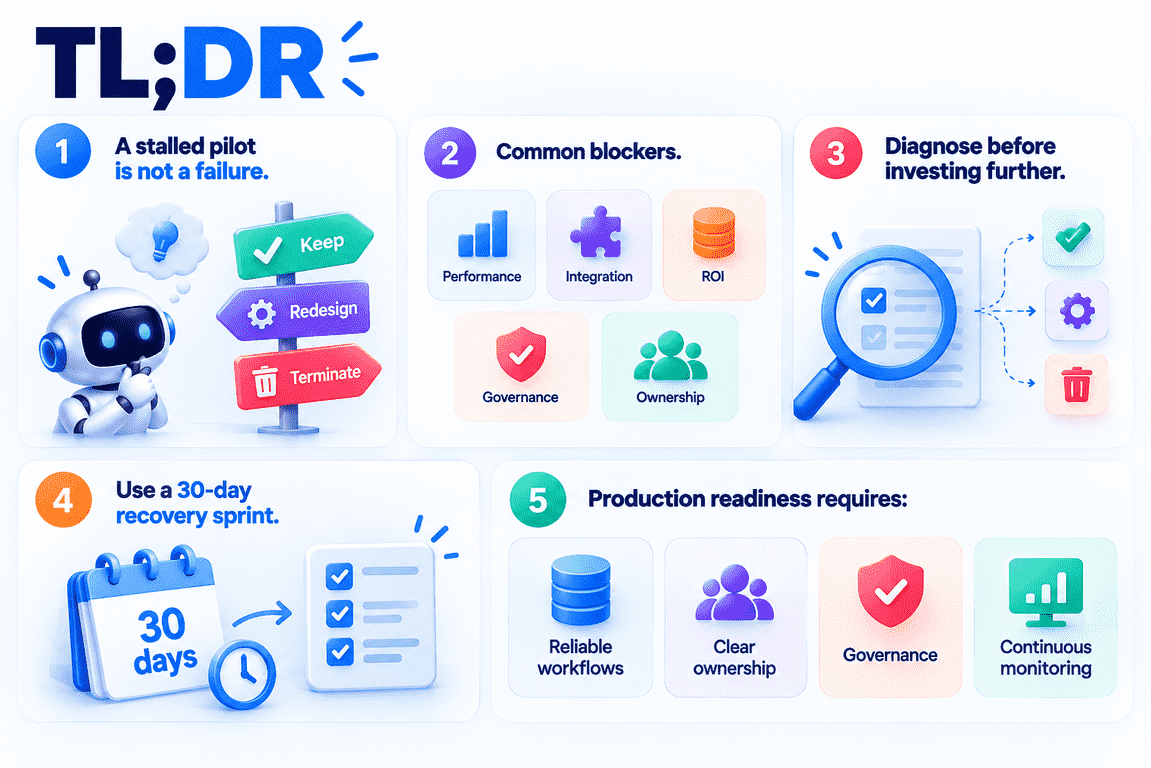
- A stalled AI pilot is not necessarily a failure. Some are worth keeping, others need a rebuild, and some should be killed.
- Common blockers include unreliable production performance, integration gaps, weak ROI, governance issues, and unclear ownership.
- Diagnose the root causes before investing further. The right decision depends on business value, technical feasibility, and remaining risks.
- Use a 30-day recovery sprint to validate options and make an evidence-based Keep/Rebuild/Kill decision.
- Production success requires connected workflows, clear ownership, continuous monitoring, and measurable business outcomes.
Introduction: Is Your AI Pilot Stalled or Just Not Ready?
According to McKinsey’s 2025 State of AI report, 88% of organizations use AI, but only about one-third have begun scaling it. Gartner reported in January 2026 that at least 50% of GenAI projects had been abandoned after proof of concept by late 2025.
The demo worked, but months later, the pilot remains stuck. Integrations stall, costs rise, and the path to production remains unclear.
The question isn’t whether the AI works, but whether it’s worth further investment. Should you keep, rebuild, or kill it?
This guide helps diagnose the blockers and make that decision within 30 days. The goal is a viable path to production or a justified decision to stop.
Five Ways an AI Pilot Gets Stuck
AI pilots stall for different reasons. Identifying the pattern helps teams avoid spending resources on fixes that cannot solve the underlying problem.
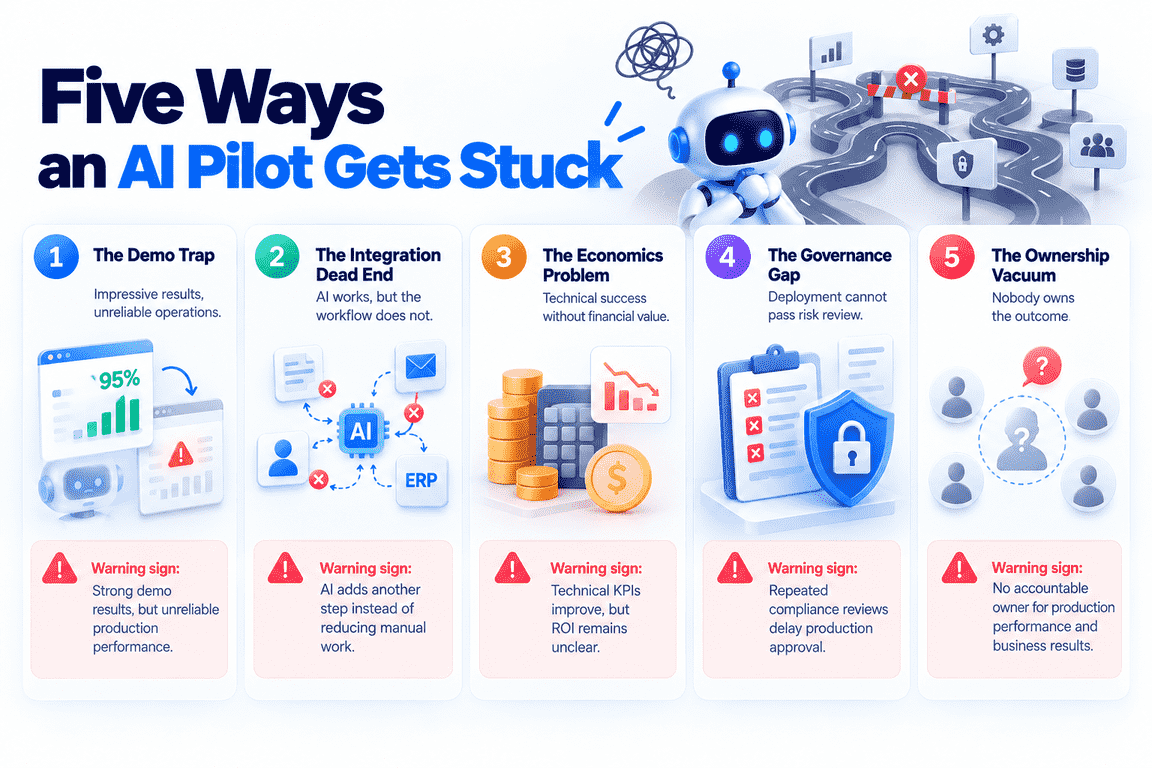
The Demo Trap: Impressive Results, Unreliable Operations
The pilot performs well in testing but struggles with real-world data. Say a pilot hits 95% extraction accuracy during testing. That figure means little when unfamiliar formats increase manual reviews during production.
Effective AI workflow validation must reflect actual operating conditions, not just controlled demonstrations.
The Integration Dead End: AI Works, but the Workflow Does Not
The AI delivers accurate outputs, but employees still transfer data manually, chase approvals, and update ERP records. Poorly designed handoffs between AI and enterprise systems prevent end-to-end automation. Instead of removing work, the pilot introduces another step.
The Economics Problem: Technical Success Without Financial Value
Infrastructure, integration, maintenance, and human oversight can outweigh expected savings. Even a hypothetical 40% reduction in processing time means little when operating costs erase those gains. Technical improvements only justify investment when they translate into sustainable business value.
The Governance Gap: Deployment Cannot Pass Risk Review
The pilot works but fails security or compliance reviews. Missing audit trails, access controls, and human oversight can block deployment, especially in regulated industries. These safeguards must be embedded into AI compliance workflows rather than added after development.
The Ownership Vacuum: Nobody Owns the Outcome
Technical teams deliver the pilot, but no one owns the business outcome or ongoing operations. Without clear accountability, critical decisions remain unresolved and deployment delays accumulate. A pilot cannot progress indefinitely without someone responsible for making the investment and operational decisions.
Diagnose What Is Actually Broken
Recognizing the symptoms is only the first step. Before investing further, teams need evidence of what’s actually causing the stall. The diagnostic matrix connects common symptoms with potential root causes and the evidence needed to investigate them.
Diagnostic Matrix: From Symptoms to Root Causes
| Visible symptom | Potential root cause | Evidence to examine |
| High demo accuracy, poor real-world results | Unrepresentative testing data | Production samples, error rates, exceptions |
| AI outputs require manual re-entry | Incomplete workflow integration | Process maps, API gaps, manual handling time |
| Expected ROI never materializes | Underestimated operating costs | Cost per transaction, labor savings, infrastructure costs |
| Security or compliance approval stalls | Missing production controls | Risk assessments, access policies, audit logs |
| Repeated delays and conflicting priorities | Unclear accountability | Assigned owners, decision records, escalation history |
Table 1. Diagnostic matrix for identifying the root causes of stalled AI pilots.
A proper diagnosis should assess five areas: business value, data and integration, technical scalability, workflow fit, and governance. For each critical blocker, identify its business impact, supporting evidence, and estimated cost of resolution.
These findings provide the basis for deciding whether to keep, rebuild, or kill the pilot.
Keep, Rebuild, or Kill? The Decision Framework
Continued development should never be the default response to a stalled AI pilot. The decision must reflect remaining business value, technical feasibility, operational risks, and future investment.
KEEP: When the Pilot Is Worth Fixing
Keeping a pilot makes sense when its business case remains strong and the underlying design is suitable. Problems such as limited integration gaps, performance weaknesses, or missing controls can be resolved without major redevelopment.
Keep the pilot when:
- Business value has been demonstrated with measurable results.
- Technical and operational gaps are clearly identified and manageable.
- Remaining investment is justified by expected returns.
- Accountable owners can support the path to production.
Keeping the pilot should not mean extending experimentation indefinitely. Define remediation targets, deadlines, and measurable acceptance criteria before committing further resources.
REBUILD: When the Use Case Is Right but the Solution Is Wrong
A rebuild makes sense when the business problem is worth solving, but the current design cannot support production. Disconnected systems, unsuitable architecture, or manual workflows may prevent the solution from scaling.
Adding more features or patching individual components may only preserve these limitations. Effective workflow modernization focuses on removing structural bottlenecks rather than layering AI onto inefficient processes.
Rebuilding does not always mean starting from scratch. Teams should preserve validated components and redesign only what prevents sustainable operations.
Rebuild the solution when:
- The underlying use case has proven business value.
- Architecture or workflow limitations prevent reliable production deployment.
- Incremental fixes would increase complexity without resolving core problems.
- A redesigned approach offers better long-term operational and financial outcomes.
Before committing to redevelopment, validate the most critical design assumptions. A smaller proof of the revised workflow can prevent another expensive pilot cycle.
KILL: When Continuing No Longer Makes Business Sense
Terminating a pilot can be the most financially responsible decision. Some initiatives lack sufficient business value, while others face unacceptable risks or prohibitively expensive deployment requirements.
Past spending should not justify further investment. The decision must depend on future costs, risks, and expected returns.
Kill the pilot when:
- Expected benefits cannot justify additional investment.
- Critical technical or governance risks remain unacceptable.
- Required data or integrations are unavailable at a reasonable cost.
- A simpler alternative can deliver comparable value more efficiently.
Termination should still be controlled. Document lessons learned, preserve reusable assets, and close outstanding operational or data obligations.
The objective is to stop an unsuitable investment without losing valuable organizational knowledge.
The Keep/Rebuild/Kill Decision Matrix
| Evaluation dimension | KEEP | REBUILD | KILL |
| Business value | Validated | Validated | Unproven or insufficient |
| Technical foundation | Mostly suitable | Fundamentally unsuitable | No viable approach |
| Integration feasibility | Manageable gaps | Requires redesign | Economically impractical |
| Risk and governance | Controllable | Addressable through redesign | Unacceptable residual risk |
| Remaining investment | Limited, justified | Significant, justified | Unjustified |
| Recommended action | Targeted remediation | Redesign and revalidate | Controlled termination |
Table 2. Decision framework for evaluating stalled AI pilots.
The matrix supports decision-making rather than replacing professional judgment. Strong business value cannot justify unacceptable risks, while technical weaknesses do not automatically make a pilot unviable.
The right decision protects future value, not past investment.
A 30-Day Action Plan for Stalled AI Pilots
A stalled pilot does not necessarily need another lengthy development cycle. A focused 30-day sprint can diagnose blockers, validate recovery options, and establish the next investment decision.
The objective is not guaranteed production deployment within 30 days. It is to replace uncertainty with evidence and establish a justified path forward.
Actual deployment timelines depend on technical complexity, integration, governance, and organizational readiness. These factors are examined in the pilot-to-production timeline guide.
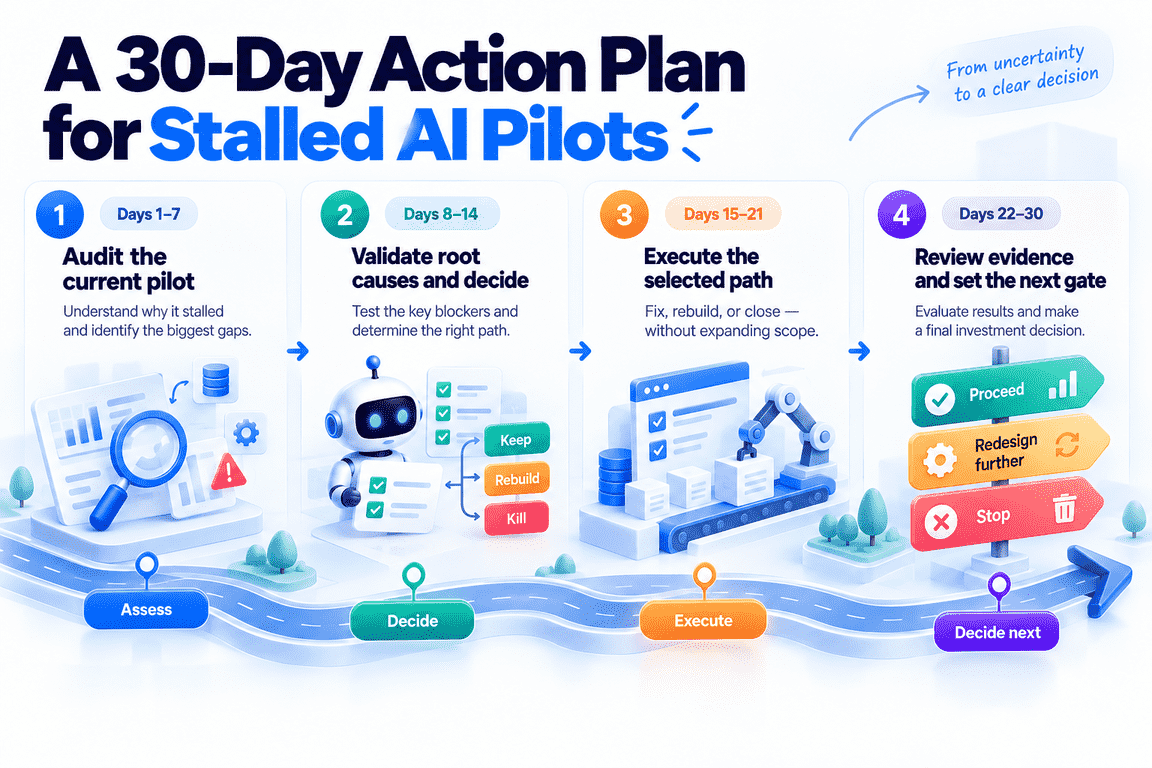
Days 1–7: Audit the Current Pilot
The first week focuses on understanding why the pilot stalled, not fixing it yet. Compare actual performance against original business goals, using real-world data instead of demo results. Identify the biggest gaps in reliability, integration, costs, and ownership.
Priority actions:
- Establish baseline business and operational KPIs.
- Review model performance using representative production-like data.
- Map integrations, manual handoffs, and exception pathways.
- Calculate actual spending and projected operating costs.
- Document critical risks and unresolved ownership questions.
Expected output: A documented assessment of current performance, business value, critical blockers, and evidence gaps.
Days 8–14: Validate Root Causes and Decide
Focus on validating the biggest blockers before committing more resources. Test whether these issues can be resolved within acceptable costs and risks. Use the findings to make an initial Keep/Rebuild/Kill decision.
Priority actions:
- Test critical technical and operational assumptions.
- Estimate the cost and feasibility of each recovery option.
- Compare expected benefits against future operating costs.
- Confirm risk requirements and accountable owners.
- Define measurable success criteria for the selected path.
Expected output: An evidence-based Keep/Rebuild/Kill decision with clear investment requirements and success criteria.
Days 15–21: Execute the Selected Path
Put the selected decision into action without expanding the scope. Focus on demonstrating whether the chosen approach can deliver the expected results.
Priority actions:
- KEEP: Fix critical blockers, such as data quality, integration, or monitoring gaps.
- REBUILD: Test essential workflow or architecture changes before committing to full redevelopment.
- KILL: Close unnecessary services, preserve reusable assets, and document lessons learned.
Expected output: Measurable progress toward recovery or a controlled closure of the pilot.
Days 22–30: Review Evidence and Set the Next Gate
Evaluate results against agreed success criteria, including business value, reliability, costs, and remaining risks. Decide whether the evidence supports the original decision or requires a change.
Final decision:
- KEEP: Approve the next productionization milestone when remediation meets its acceptance criteria.
- REBUILD: Authorize a bounded redesign phase when revised foundations demonstrate potential value.
- KILL: Stop further investment when results fail to justify continuation.
Expected output: A confirmed investment decision with defined next steps, accountable owners, and a clear governance checkpoint.
From Recovery to Production: Preventing the Next Stall
Fixing a stalled pilot does not guarantee production readiness. The real test is whether AI can operate reliably, securely, and cost-effectively within existing business workflows.
What Makes a Recovered AI Pilot Production-Ready?
Production readiness goes beyond model accuracy. Organizations should evaluate four essential areas:
- Integration and Reliability: Stable performance under real workloads, with secure system connections and exception handling.
- Governance and Human Oversight: Clear access controls, audit trails, risk management, and escalation procedures.
- Monitoring and Ownership: Continuous evaluation of system performance, with accountable owners for incidents and business outcomes.
- Business Performance and ROI: Measurable operational improvements that justify ongoing costs and investment.
Even strong technical monitoring cannot guarantee correct business outcomes. AI observability must be supported by evaluation and accountability, especially for high-risk workflows.
Real-World Example: Turning Manual Invoice Processing Into a Production Workflow
The difference between a working AI component and a production-ready workflow becomes clear in actual operations.
A logistics company processing approximately 200 invoices daily faced repetitive data entry, reconciliation delays, and supplier disputes. Its finance team spent around four hours each day manually processing invoices.
SmartDev implemented an AI-enabled document-processing workflow through a six-week engagement. The solution extracted invoice data, validated records against purchase orders, and connected approved information with the ERP system. Unmatched records entered a human review queue, keeping exceptions under operational control.
| Metric | Result |
| Daily invoice volume | 200+ invoices |
| Implementation timeline | 6 weeks |
| Daily processing time | Reduced from 4 hours to under 20 minutes |
| Manual-entry errors | Zero reported in the first 90 days |
The improvement came from connecting extraction, validation, ERP integration, and human exception handling into one operational process. This case illustrates why production value depends on the complete workflow, not model performance alone.
How SmartDev Helps Move AI Pilots Toward Production
SmartDev’s NORA AI Adoption Accelerator helps organizations assess viable AI pilots and move them toward reliable production operations.
For organizations with an existing pilot, the approach follows five stages:
- Production Readiness Assessment: Identify critical deployment gaps.
- Productionization Design: Redesign workflows and architecture for production.
- Production Deployment: Integrate and deploy with appropriate controls.
- Operate & Optimize: Monitor performance, costs, and exceptions.
- Scale: Expand automation based on proven business value.
Sustainable operations also depend on clear ownership of production responsibilities and continued evaluation after deployment.
Conclusion: Rescue the Value, Not Necessarily the Pilot
A stalled AI pilot doesn’t always need saving. Keep it when the business case remains strong, rebuild when the foundation is flawed, or kill it when further investment cannot be justified.
A 30-day assessment helps make that decision based on evidence, not sunk costs. The goal is to move viable AI initiatives into production, not rescue every pilot.
The most important outcome is clarity about what deserves further investment.
For teams navigating that decision, SmartDev’s approach to AI production readiness offers a practical perspective on assessment, redesign, and operational ownership.
Frequently Asked Questions
- How do you know when an AI pilot is stalled?
Common signs include repeated delays, unresolved integrations, rising costs, and no clear path to production.
- How long should an AI pilot run before deciding whether to continue?
There is no fixed timeline. Set measurable milestones and reassess when progress stalls or key assumptions fail.
- When should you rebuild an AI pilot instead of fixing it?
Rebuild when the use case remains valuable, but architecture or workflow limitations make incremental fixes ineffective.
- What are the signs that an AI pilot should be killed?
Consider termination when expected returns cannot justify further costs, technical barriers, or operational risks.
- Can a stalled AI pilot be recovered in 30 days?
A 30-day sprint can identify root causes, validate solutions, and support an investment decision. Full production recovery may take longer.
- What is the difference between a successful AI pilot and a production-ready AI solution?
A successful pilot proves feasibility. A production-ready solution delivers reliable, secure, and measurable results within real business workflows.