Introduction
Most companies exploring workflow automation already know they have a problem worth solving. The real question is not whether automation could help. It is whether the timing, the process, and the solution fit where the business stands today.
Choosing the wrong approach at the wrong stage is one of the most expensive mistakes in enterprise AI. Teams deploy a tool before they clean the data, automate a process that was already broken, or buy a product that demands more internal expertise than they have. According to BCG research, 70% of digital and AI transformations fall short of their objectives. The technology rarely causes this. Poor sequencing does.
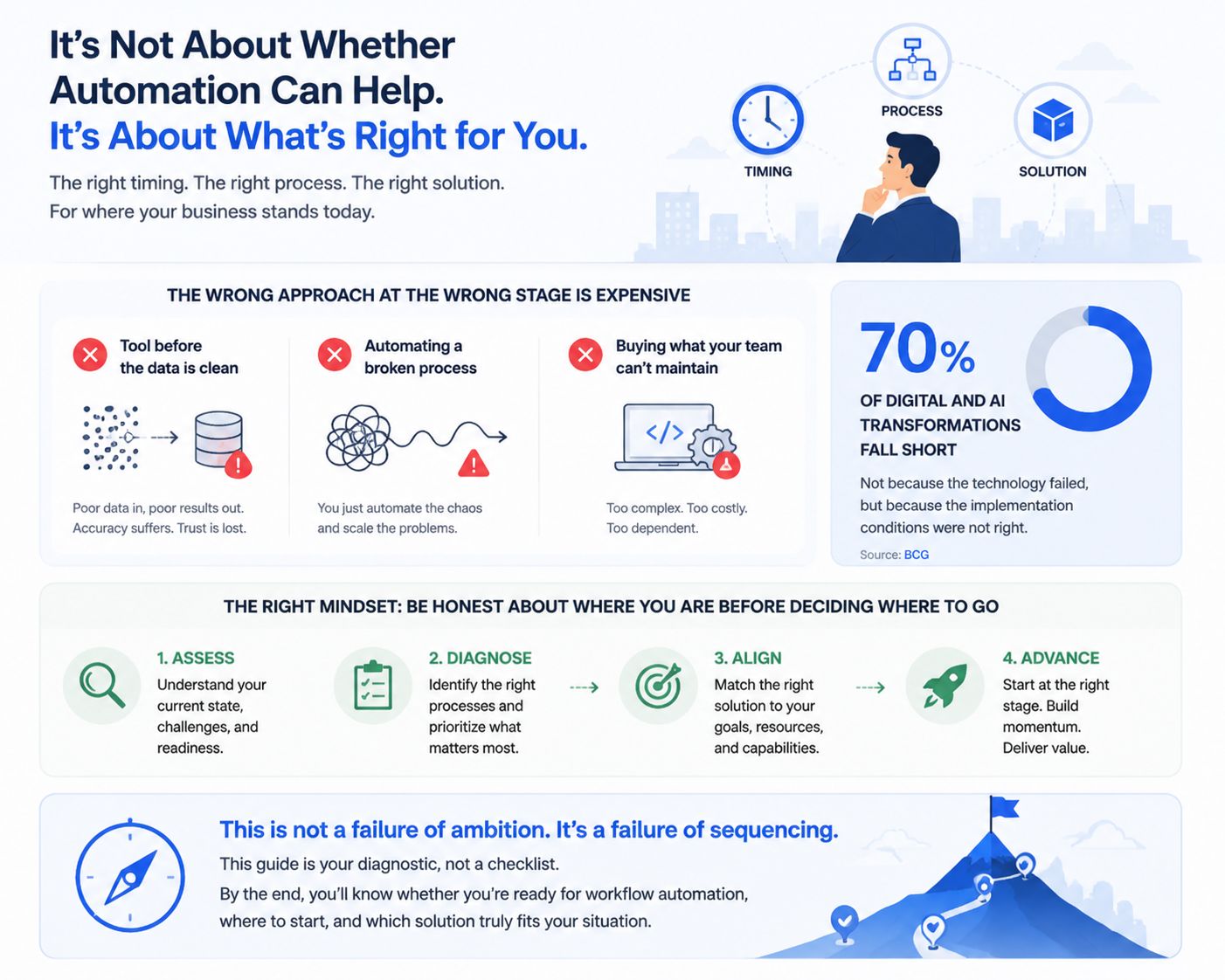
Organizations that succeed with workflow automation tend to share one trait: they assess their readiness honestly before they commit. This guide helps you do exactly that. Work through each section as a diagnostic, not a checklist. By the end, you will know whether your business is ready, where to start, and which solution fits your situation.
Do You Have a Process Worth Automating?
Not every inefficiency makes a good workflow automation candidate. AI-powered automation delivers the highest return on processes that are high-volume, repetitive, and rule-based. In other words, the process should follow the same steps hundreds or thousands of times per week. The challenge is identifying which of your current processes genuinely meet that threshold.
1. Does Your Team Perform the Same Task More Than 50 Times Per Week?
This is a practical minimum threshold for workflow automation ROI. Below 50 repetitions per week, the efficiency gain rarely justifies the implementation cost. Above it, however, even a modest improvement compounds quickly into real savings.
For example, consider a logistics company that processes 200 invoices per day. Automating data extraction and ERP entry alone can reclaim 3 to 4 full working hours every day. At that scale, a 10-minute reduction per invoice recovers the equivalent of a full-time employee’s productive output every week. As a result, the numbers change the conversation entirely.
2. Is the Process Rule-Based, or Does It Require Human Judgment?
Workflow automation performs best when rules are consistent and predictable. Extracting vendor names, invoice amounts, and delivery dates follows clear rules. Deciding whether to approve an unusual credit application for a new counterparty, however, does not. These are fundamentally different types of work, and confusing them is one of the most common reasons automation underdelivers.
Processes at this boundary work best with a human-in-the-loop design. In practice, AI handles extraction, routing, and validation, while humans handle exceptions, edge cases, and final approvals. NORA builds every workflow around this model, automating what is predictable and escalating what requires judgment.
3. Is This Process Creating Measurable Pain Right Now?
The strongest automation candidates are not theoretical inefficiencies. Instead, they are bottlenecks that operations managers, finance leads, and department heads already know about. These show up as backlogs, recurring errors, delayed reporting, or teams spending most of their time on data entry rather than decision-making.
If your team works overtime to clear invoice queues, if compliance reviews delay client onboarding, or if customer queries go unanswered because staff are buried in manual triage, these are the starting points worth automating first.
Is Your Data Ready for Workflow Automation?
Data quality is one of the most underestimated barriers to successful workflow automation. AI systems can only work with what they receive. As a result, inconsistent, incomplete, or hard-to-extract data slows implementation and reduces accuracy.
This does not mean you need perfect data before you start. Modern AI workflow automation systems handle messy inputs. For instance, NORA’s document intake layer reads PDFs, scanned documents, email attachments, faxed images, and legacy file formats. However, understanding what you are working with upfront lets you scope the implementation accurately and prevents surprises mid-project.
1. Can You Identify Where Your Data Currently Lives?
Workflow automation needs a clear map of where source documents originate. Invoices might arrive via email, fax, and a supplier portal at the same time. That is manageable, but you need to account for all three channels from day one. Miss a data source during discovery, and it surfaces later as a gap that requires rework after go-live.
This is why SmartDev starts every implementation with a one-week discovery phase. The team maps the data landscape before any configuration begins. In short, this is not overhead. It determines whether the solution fits the real environment.
2. Are Your Data Formats Consistent Enough to Extract From Reliably?
Different suppliers use different invoice templates, field positions, and terminology. For example, one vendor lists the delivery date in the header, while another puts it in the footer. Similarly, one writes “PO Number” where another writes “Purchase Order Ref.”
A capable AI workflow automation system handles this variability through intelligent extraction models that learn to recognize the same field across different layouts. However, wider variation requires more training examples upfront. Therefore, reviewing a representative sample of documents before implementation begins is essential.
3. Do You Have a Sample of Real Historical Documents?
Any serious workflow automation implementation should start with a review of actual documents from your operation, not hypothetical examples. Without this, accuracy estimates and delivery timelines tend to be optimistic in ways that create problems later. Specifically, a sample of 50 to 100 real invoices, compliance documents, or incoming emails is usually enough to surface the variation the system will need to handle.
Does Your Organization Have the Capacity to Support Workflow Automation?
Even the best-built workflow automation solution fails when no one inside the business takes ownership of it. You do not need a dedicated AI engineering team. In fact, one of the core advantages of a managed service model like NORA is that SmartDev carries the ongoing technical responsibility, not the client. However, you do need a clear internal point of contact, a well-defined workflow, and genuine organizational buy-in before implementation begins.
1. Is There a Clear Process Owner?
Implementations succeed when one specific person owns the workflow, typically an operations manager, finance lead, or department head. That person needs to understand the current process in detail and have the authority to make decisions about edge cases during the build.
Without this, requirements drift as different stakeholders introduce conflicting expectations mid-project. As a result, the final output fits no one’s actual working environment well. The process owner does not need to be technical. They simply need to know the workflow deeply enough to describe it accurately.
2. Has the Current Process Been Documented, Even Informally?
You do not need a formal process map. However, you do need to describe the process concretely. Where does it start? What triggers it? What happens at each step? Who approves what, and how long does each stage take?
This information allows SmartDev to build automation that fits your actual operation, not a simplified version of it. If the process has never been written down, the discovery phase is the right time to document it. Furthermore, SmartDev’s team facilitates this as part of the initial engagement.
3. Is Leadership Aligned on the Objective?
Workflow automation touches operations, finance, compliance, and often HR. When leadership actively supports the project, implementations move faster, user adoption rises, and time-to-value shortens considerably. On the other hand, when automation is treated as a technical side project with no executive sponsorship, it tends to stall regardless of the technology.
Leadership alignment does not mean everyone needs deep involvement. Instead, it means there is a shared understanding of the goal and visible support from someone who can resolve cross-departmental friction when it arises.
Which Workflow Automation Solution Is Right for You?
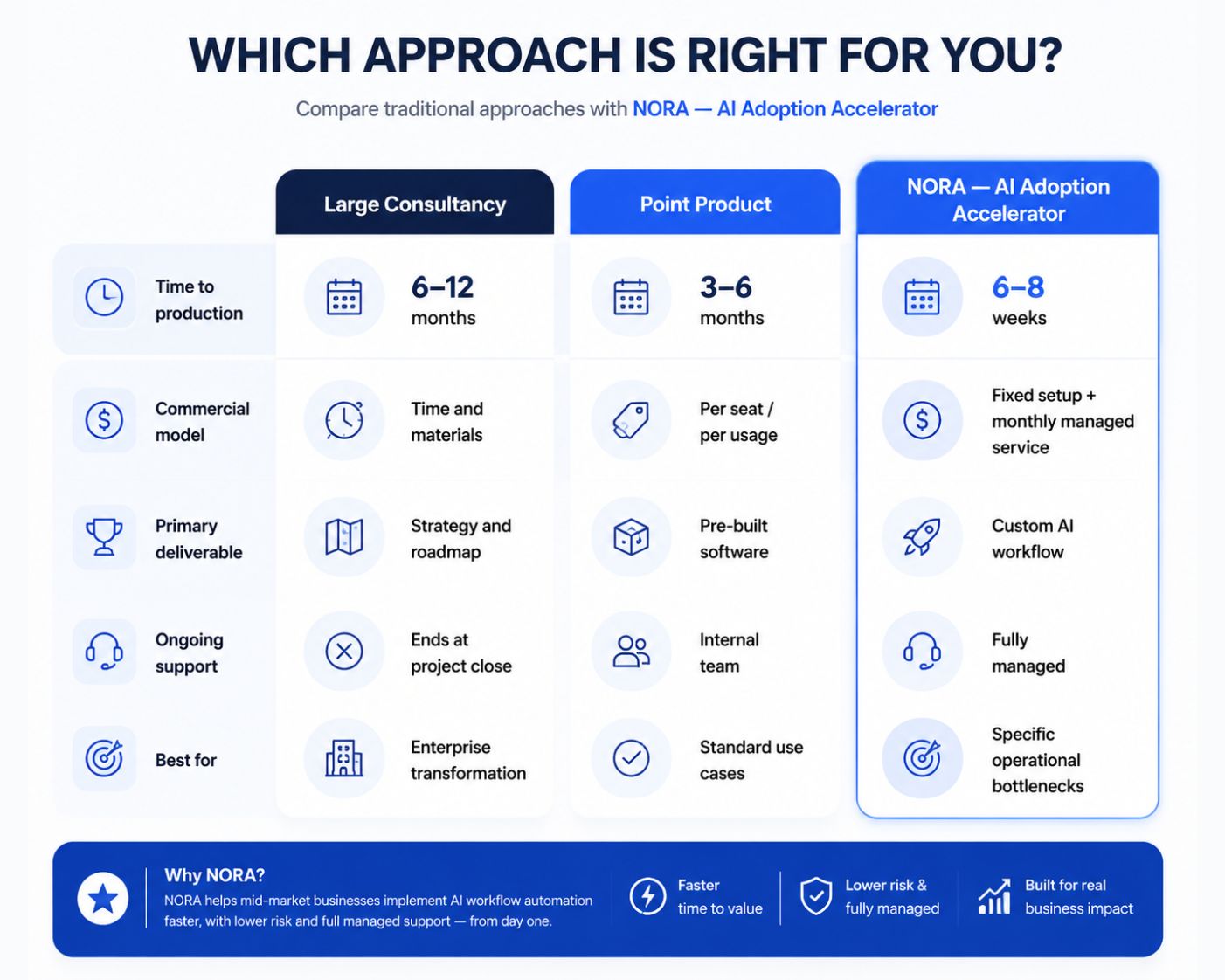
Many businesses choose a solution category that does not match their actual needs. Three main options exist in the market, and they serve fundamentally different use cases at different price points and delivery timelines. Understanding which category fits your situation before engaging any vendor saves significant time and budget.
1. Large Consultancies (Deloitte, Accenture, McKinsey)
Large consultancies suit multi-year enterprise transformation programs with budgets above $500,000. They deliver strategic roadmaps and change management support across multiple business units. However, if you need a specific operational bottleneck solved in eight weeks at a predictable cost, this is the wrong choice. Engagement models run on time-and-materials, meaning costs are hard to cap, and the primary output is strategic guidance, not working software.
2. Off-the-Shelf Point Products (UiPath, ServiceNow, C3.ai)
Point products offer pre-built workflow automation for standardized use cases. They work well when your process closely matches the product’s design. In logistics and financial compliance, however, it often does not. As a result, organizations end up adapting their workflow to the product’s constraints rather than the other way around. Licensing costs scale faster than business value, and ongoing maintenance falls entirely to the internal team.
3. AI Adoption Accelerators (NORA by SmartDev)
An AI adoption accelerator suits mid-market businesses with a specific, high-volume operational problem. Unlike consultancies, it delivers working software, not a roadmap. Unlike point products, SmartDev builds the automation for your specific workflow. Moreover, the commercial model runs on a fixed setup fee plus a monthly managed service, so costs stay predictable and the technical responsibility stays with SmartDev.
NORA combines pre-built AI components, a structured delivery methodology, and a fully managed service layer. As a result, most organizations get a working automation in 6 to 8 weeks.
Where Does Workflow Automation Deliver the Most Value?
Workflow automation does not deliver equal value across all industries. The strongest ROI consistently appears in environments where document volume is high, processing rules are consistent, and manual effort runs deep in daily operations. Specifically, NORA deploys across three of these environments.
1. Logistics and Supply Chain
Logistics operations generate a constant flow of documents. Purchase orders, freight invoices, delivery confirmations, customs declarations, and proof of delivery documents all arrive through different channels, in different formats, and on different timelines. Every shipment adds to the stack.
For example, a mid-sized logistics company handling 200 freight invoices per day can have a team of three or four people spending most of their working hours on data entry, reconciliation, and error correction. This happens before a single invoice reaches the finance system. When margins run in percentage points, that overhead matters significantly.
NORA’s document intake capability addresses this directly. The system reads incoming invoices from email, fax, and supplier portals simultaneously, extracts PO numbers, freight amounts, delivery dates, and vendor details regardless of template format, and validates extracted data against existing purchase orders before pushing verified records into the ERP. Anything that cannot match automatically goes to a human review queue, so the operations team stays in control of exceptions without taking on extra workload for standard cases.
In practice, logistics businesses using NORA reduce invoice processing time by up to 80% and reach full ROI within 6 to 9 months. Furthermore, the system improves over time. As new supplier formats appear, NORA retrains its extraction models automatically, so accuracy compounds rather than degrades.
2. Financial Compliance and BFSI
In financial services, compliance screening consumes enormous resource. Teams screen incoming transactions, customer onboarding documents, and counterparty records against sanctions lists, politically exposed persons databases, internal risk policies, and regulatory requirements. The volume is significant, the margin for error is effectively zero, and a missed flag can trigger regulatory censure or serious reputational damage.
Moreover, manual screening at scale is inherently inconsistent. Human reviewers work at different speeds, apply judgment differently, and experience fatigue. As a result, false positive rates in manual processes tend to be high, meaning reviewers spend significant time on records that carry no genuine risk.
NORA’s compliance screening capability solves both problems. The system screens documents against the relevant reference lists automatically, applies consistent rule sets regardless of volume or time of day, and flags genuine matches for human review. In addition, it filters out false positives that would otherwise consume reviewer capacity, and SmartDev maintains a full audit trail for regulatory reporting purposes. Therefore, compliance teams can focus on genuine risk cases rather than routine document processing.
3. Professional Services
Professional services firms handle a high volume of incoming communications, client document requests, internal approvals, and time-sensitive follow-ups every day. The administrative overhead of managing this volume, before any billable work begins, is one of the most persistent drains on professional capacity in the industry.
For instance, a consulting firm receiving 500 emails per day to a shared inbox may have staff spending two to three hours daily on triage, routing, and initial response drafting. At typical billing rates, that overhead carries a significant opportunity cost. Furthermore, it rarely appears explicitly on any management report, which is exactly why it persists.
NORA’s email triage capability reads each incoming message, extracts the relevant action items, identifies the right owner based on subject matter and client context, and then drafts a response for human review before sending. This does not remove professional judgment from client-facing decisions. Instead, it removes the administrative layer that delays those decisions and consumes time that belongs on higher-value work.
How NORA Works in Practice: Workflow Automation in a Real Logistics Operation
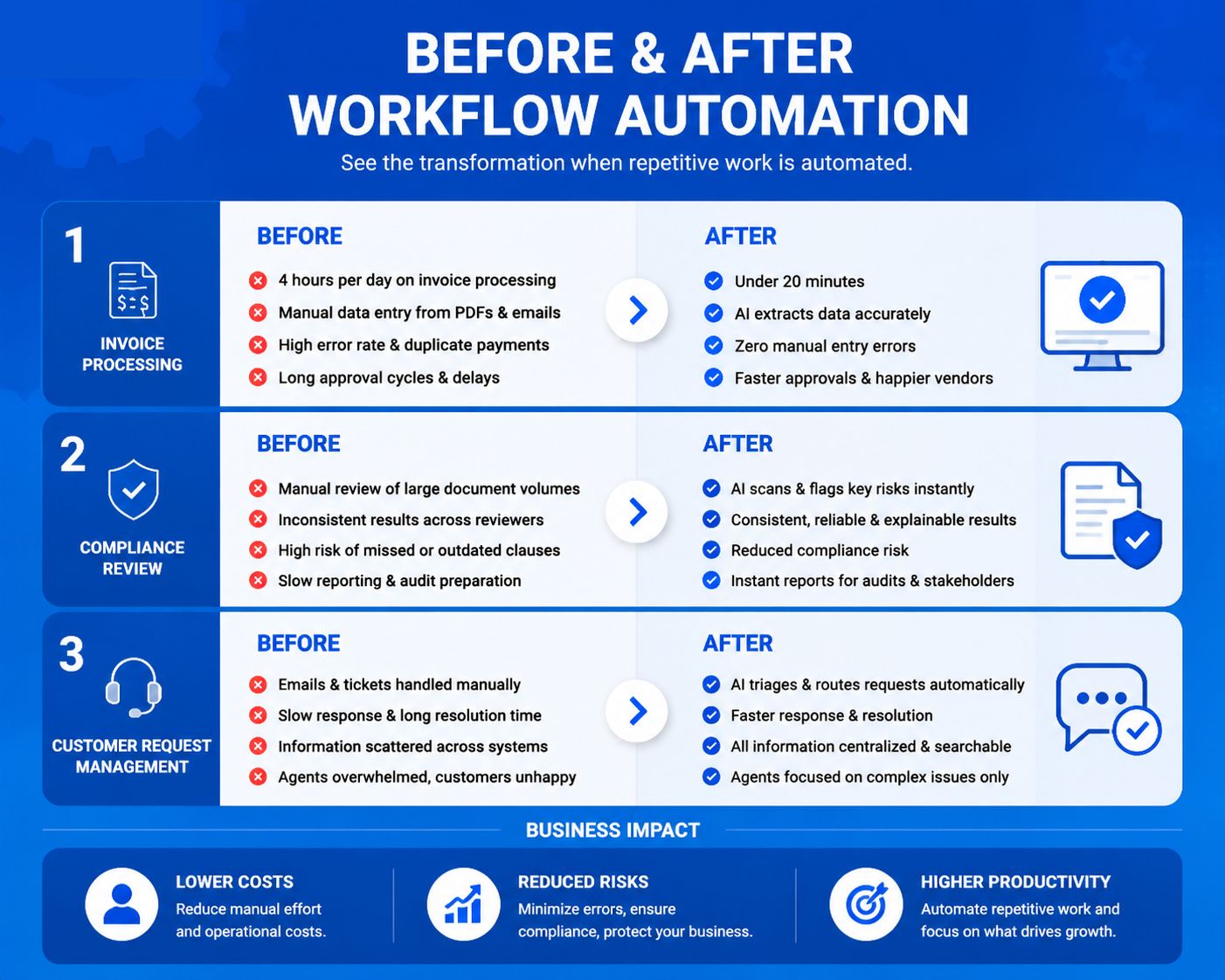
A logistics company receiving 200 invoices per day via email and fax engaged SmartDev to solve a specific problem. Three members of the finance team spent the majority of their working day on manual data entry, reconciliation, and error correction. Invoice processing took an average of four hours per day, and manual entry errors generated supplier disputes every week.
SmartDev ran a one-week discovery phase to map the current workflow, identify the required data fields, and understand the ERP integration requirements. Over the following five weeks, the team configured NORA’s document intake capability to extract purchase order numbers, invoice amounts, dates, and vendor details automatically, regardless of supplier template format. Each extracted record was validated against existing purchase orders before entering the ERP. Records that did not match went to a human review queue, so the operations team retained control of exceptions without taking on extra workload for standard cases.
The results were immediate. Invoice processing time dropped from four hours per day to under twenty minutes, and the team recorded zero manual entry errors in the first ninety days after go-live. SmartDev continues to monitor system accuracy, retrain extraction models as new supplier formats appear, and deliver monthly performance reports. As a result, the system compounds in value over time, which is what separates a managed AI service from an AI project that gets handed over and left to degrade.
Are You Ready to Start or Still in Exploration Mode?
The final question is about timing and intent. Workflow automation works best for businesses that have identified a specific problem and are ready to move toward a working solution. It does not suit organizations still exploring what AI could theoretically do for them in broad terms.
If you are in exploration mode, running internal working groups, attending industry events, or building a business case for leadership, that is a legitimate and necessary stage. In that case, the right next step is a structured AI discovery program that helps identify and prioritize the highest-impact automation opportunities before you commit to implementation. Moving directly to production without this foundation is one of the most reliable ways to solve the wrong problem.
However, if you have a defined problem, a clear process owner, and leadership support, the conditions for a successful workflow automation project are in place. At that point, the question is not whether to automate. It is who to trust to build it, maintain it, and ensure it keeps delivering value as your business evolves.
Where to Start With Workflow Automation
SmartDev’s discovery process takes one week. The team maps the current workflow in detail, identifies data sources and formats, scopes integration requirements, and produces a fixed-price workflow automation proposal with a clear delivery timeline. There is no commitment beyond the discovery phase, and the output gives you everything you need to make an informed decision.
To find out whether NORA fits your operational challenge, contact the SmartDev team or explore how other logistics, financial compliance, and professional services businesses have used it to move from problem to production in weeks.