
TL, DR:
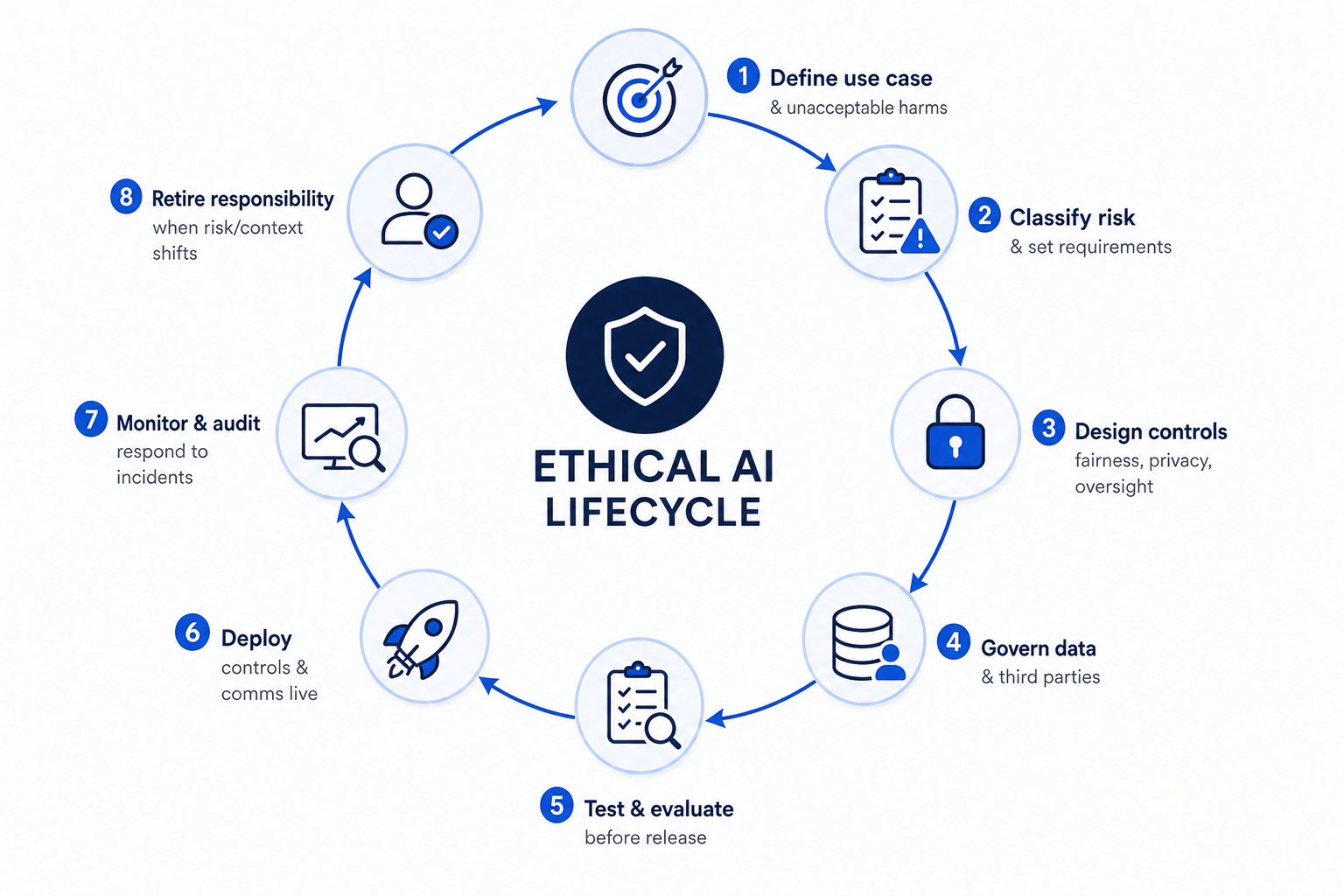
- Ethical AI is a lifecycle discipline, not a checklist. Controls belong at every stage, from use-case definition through retirement, not only at launch.
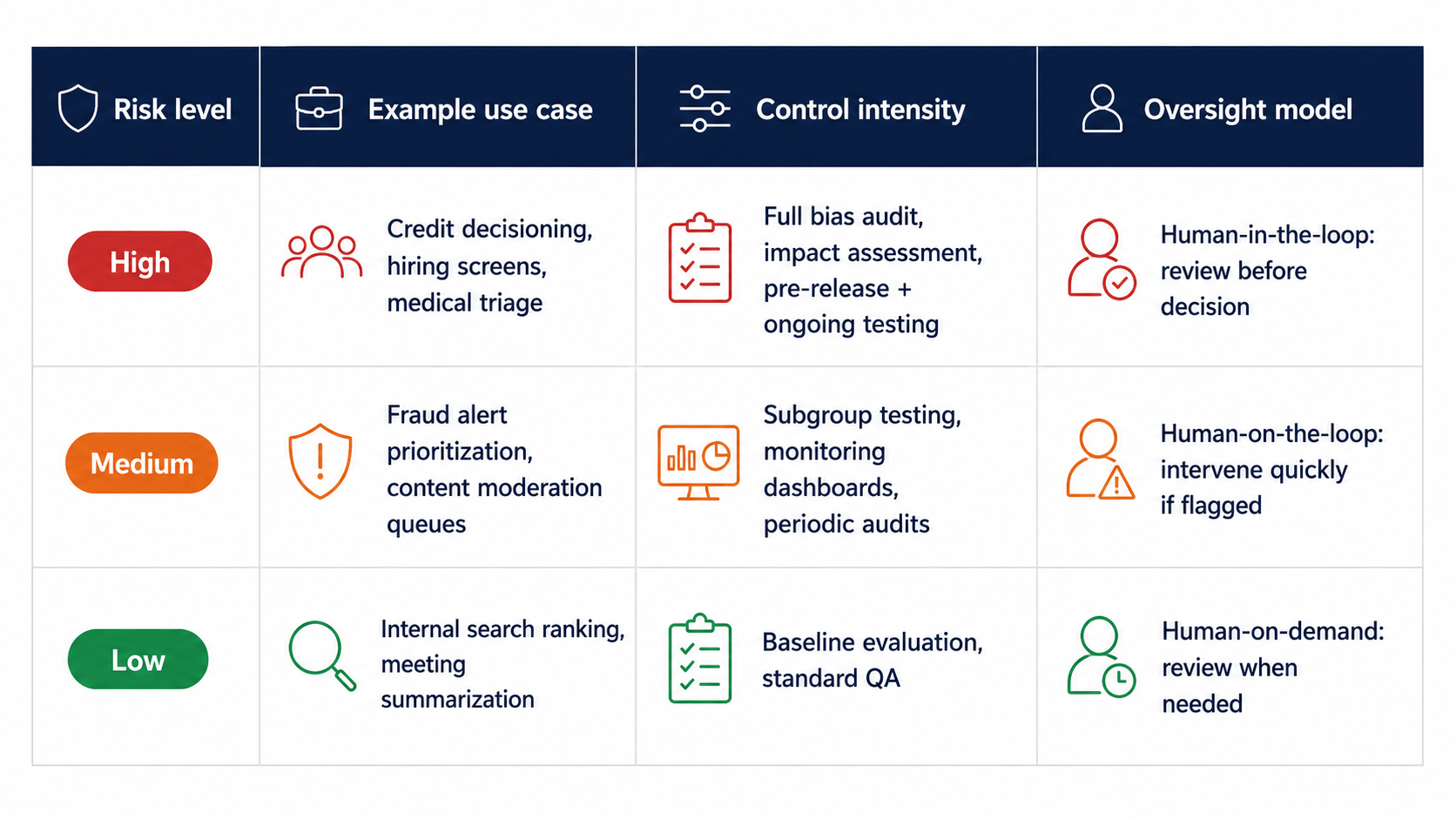
- Risk should set control intensity. A credit-scoring model and an internal meeting summarizer do not need the same level of oversight, documentation, or testing.
- Human oversight must include real authority to intervene. A human who can only watch a system run is not providing oversight; they need the power to pause, override, or escalate.
- Evidence beats intention. Regulators, auditors, and customers respond to documented risk assessments, test results, and audit trails, not stated values.
- Generative AI adds a distinct risk category. Confabulation, information-integrity threats, and harmful outputs need their own controls beyond standard bias testing.
- Governance frameworks inform practice; they do not replace legal advice. NIST AI RMF and the EU AI Act give structure, but obligations vary by jurisdiction, sector, and use case.
- Monitoring never really stops. Data drifts, regulations change, and models degrade quietly, so post-deployment monitoring is as important as pre-launch testing.
Introduction
AI now approves loans, screens job candidates, detects fraud, and generates content at a scale no human team could match. However, that scale also amplifies risk. An unmanaged AI system does not simply make a single incorrect decision, it can repeat the same error across thousands of cases before anyone detects it. As a result, issues such as bias, opacity, and unclear accountability become more significant as AI adoption grows.
To address these challenges, ethical AI development treats governance as a lifecycle discipline rather than a one-time policy exercise. Principles such as fairness, transparency, and accountability only create value when they are translated into clear ownership, operational controls, and auditable evidence. This guide explores that transition from high-level principles to practical implementation.
Specifically, you will learn what ethical AI development means, the core principles that underpin it, the key risks organizations should address, including those unique to generative AI, how governance frameworks such as the NIST AI Risk Management Framework and the EU AI Act establish accountability, and an eight-step framework for building ethical AI throughout the system lifecycle.
1. What Is Ethical AI Development?
Ethical AI: a practical definition
Ethical AI development is the practice of building and operating AI systems so that their impact on people and society remains fair, transparent, accountable, and safe throughout the entire lifecycle. Rather than being a feature added before deployment, it is an ongoing discipline that shapes how AI systems are designed, tested, deployed, monitored, and continuously improved.
Importantly, ethical AI extends beyond model accuracy alone. A highly accurate model can still produce unfair outcomes if it is trained on historically biased data or if its decisions cannot be explained or challenged. Instead, ethical AI evaluates whether a system’s overall impact remains trustworthy, responsible, and aligned with ethical and regulatory expectations.
Ethical AI vs. responsible AI vs. fair AI
These three terms overlap heavily in practice, and no single body enforces a universal taxonomy across industry and government. That said, most organizations use them with slightly different emphasis:
| Term | Primary focus | Typical usage |
|---|---|---|
| Fair AI | Eliminating discriminatory outcomes across protected groups | Narrow, technical – bias testing, disparate-impact analysis |
| Responsible AI | Organizational commitments and governance processes | Corporate policy language, internal governance programs |
| Ethical AI | Human and societal effects across the full system lifecycle | Broadest framing; includes fairness, transparency, oversight, and safety together |
| Trustworthy AI | Whether a system merits reliance by users and regulators | Standards and government usage, e.g. NIST’s trustworthy AI characteristics |
Treat these as overlapping lenses on the same problem rather than a strict hierarchy. What matters more than the label is whether your organization has assigned ownership and built working controls for each concern the terms point to.
Why ethical AI matters for organizations, users, and society
The impact of unmanaged AI risk extends across organizations, individuals, and society. For organizations, it can result in reputational damage, regulatory penalties, and costly remediation after deployment. For individuals, it may lead to unexplained decisions, intrusive surveillance, or outcomes that cannot be meaningfully challenged. At a broader societal level, unchecked AI systems can reinforce and amplify existing inequalities at a scale far beyond individual human decision-making.
These are not hypothetical concerns. Our related guide on AI ethics concerns for business leaders walks through how bias, privacy gaps, and misinformation translate into direct business risk, not just abstract harm.
When ethical AI risk is highest
Risk is shaped by three key factors: the stakes of the decision, the sensitivity of the data involved, and the extent to which affected individuals can contest the outcome. As these factors increase, so does the need for stronger governance and oversight. For example, AI systems used for credit decisions, medical assessments, or hiring require significantly more rigorous controls than low-impact applications such as design or productivity recommendations.
- High-impact decisions: outcomes that affect employment, credit, healthcare, housing, or legal status.
- Sensitive or protected data: health records, biometric data, financial history, or data about children.
- Limited contestability: situations where the affected person cannot easily question, appeal, or understand the decision.
When any two of these three converge, treat the system as high-risk by default and apply proportionately stronger controls discussed further in Section 6.
Takeaway: Ethical AI development is the practice of managing an AI system’s human impact across its whole lifecycle. Risk climbs fastest where decisions are high-stakes, data is sensitive, and people have little power to contest the outcome.
2. The Principles of Trustworthy and Ethical AI
Principles only earn their keep once they connect to a specific control and a specific piece of evidence. The table below maps each principle to the question it answers and what an organization can actually produce to demonstrate it.
Fairness and harmful-bias management
Fairness means ensuring that an AI system does not systematically disadvantage individuals based on protected characteristics such as race, gender, or age. However, bias can emerge through historically skewed training data, proxy variables that correlate with protected attributes, or evaluation processes that overlook subgroup performance. For a deeper discussion, our AI model training guide explores representative data sourcing and structured bias evaluation in greater detail.
Transparency, explainability, and meaningful disclosure
Transparency ensures that people know when an AI system is involved in decisions that affect them. Beyond transparency, explainability enables users and stakeholders to understand, in clear terms, why a particular decision was made. Because more complex models often trade explainability for predictive performance, organizations should align model complexity with the level of risk, avoiding opaque “black-box” systems in high-stakes decisions where meaningful human review or contestability is limited.
Accountability and traceable decision-making
Accountability begins with assigning clear ownership to every AI system and establishing a documented chain of responsibility for its outputs. In practice, this includes maintaining model documentation, decision logs, and clearly defining who approves deployment and who remains responsible after launch. Without these governance mechanisms, incidents may be identified, but no one is formally accountable for responding to them.
Privacy, data governance, and security
AI systems rely on large volumes of data, often including personal or sensitive information. To mitigate associated privacy risks, organizations should embed privacy-by-design principles such as data minimization, access controls, encryption, and clearly defined retention policies. Together, these safeguards help prevent sensitive information from being exposed through either security breaches or unintended model outputs.
Human oversight, contestability, and user autonomy
Meaningful human oversight ensures that a person can review, override, or halt an AI-driven decision before real-world harm occurs, rather than simply observing outcomes after the fact. Similarly, contestability gives affected individuals a clear mechanism to challenge decisions and request human review. As discussed in Section 6, the level of oversight should be proportionate to the risk associated with each AI use case.
Reliability, safety, robustness, and sustainability
A reliable AI system performs consistently across the full range of real-world inputs it is likely to encounter, including edge cases and adversarial scenarios. Accordingly, safety and robustness testing should take place before deployment and continue throughout the system’s lifecycle, as outlined in our AI model testing guide. In addition, sustainability has become an increasingly important consideration, requiring organizations to balance the computational and energy demands of large models against the business value they deliver.
| Principle | Risk it addresses | Practical control | Evidence artifact |
|---|---|---|---|
| Fairness | Discriminatory outcomes | Subgroup performance testing before release | Bias audit report |
| Transparency | Undisclosed automated decisions | User-facing disclosure of AI involvement | Disclosure copy, UX review |
| Accountability | No one owns the outcome | Named system owner and sign-off gate | Model card, ownership register |
| Privacy | Data misuse or leakage | Data minimization and access controls | Data protection impact assessment |
| Human oversight | Unchecked automated harm | Escalation path with override authority | Oversight protocol, escalation log |
| Reliability & safety | Unpredictable failure in production | Pre-release and ongoing performance testing | Evaluation report, monitoring dashboard |
Takeaway: Each principle needs a named control and a retrievable artifact. A principle without evidence is a slogan; a principle with evidence is a governance program.
3. Ethical AI Risks: What Can Go Wrong?
Model behavior risks and governance risks are distinct challenges that require different mitigation strategies. For example, biased model outputs are typically addressed through improvements to data quality, model design, and training processes. By contrast, deploying an otherwise accurate model without appropriate human oversight in high-stakes scenarios is a governance failure, not a technical one.
Bias and discriminatory outcomes
AI systems trained on historical data can reproduce or even amplify existing patterns of discrimination. Consequently, these risks are particularly evident in high-impact domains such as hiring, lending, and criminal justice, where biased decisions can directly affect people’s opportunities, financial well-being, and fundamental rights.
Privacy violations, surveillance, and data misuse
AI-powered surveillance technologies, particularly facial recognition, can enable large-scale tracking without meaningful consent while producing higher error rates for certain demographic groups. As discussed in Section 7, documented real-world cases illustrate how these failures can lead to significant ethical and societal consequences.
Misinformation, deepfakes, and information integrity
Generative AI has significantly lowered the cost of producing convincing synthetic content at scale, from fabricated news articles to AI-generated videos. As a result, the challenge extends beyond individual instances of misinformation, contributing to a broader erosion of public trust in digital content and online information.
Generative AI risks: confabulation, harmful outputs, and misuse
Generative AI introduces risks that differ from those of predictive models. According to the NIST Generative AI Profile, a companion resource to the AI RMF, these risks include confabulation, confidently stated but false content, alongside harmful bias, data privacy exposure, and threats to information integrity. Treat confabulation as a calibration problem, not a simple accuracy bug: measure how often the system is confidently wrong, not just how often it is wrong.
Security, adversarial misuse, and model abuse
AI systems face threats standard software does not: adversarial inputs designed to fool a classifier, prompt injection attacks against generative systems, and attempts to extract training data. Security testing needs to account for these AI-specific attack surfaces alongside conventional application security.
Workforce, autonomy, and human-rights impacts
Automation inevitably changes how work is performed. Therefore, the ethical challenge is not whether jobs will evolve, but how organizations manage that transition through transparent communication, workforce reskilling, and augmentation-first strategies that support employees rather than abruptly replacing them.
High-stakes AI: healthcare, finance, hiring, justice, and public services
These sectors share a common feature: decisions carry irreversible consequences for real people, and the affected person often has limited power to contest an automated outcome. Controls should scale accordingly, a theme we return to in Section 6.
| Risk category | Affected stakeholders | Typical harm | Likely control |
|---|---|---|---|
| Algorithmic bias | Job applicants, borrowers, defendants | Discriminatory decisions | Subgroup testing, fairness audits |
| Privacy & surveillance | General public, employees | Unconsented tracking, misidentification | Data minimization, human review of matches |
| Misinformation & deepfakes | General public, institutions | Erosion of information trust | Provenance disclosure, detection tooling |
| Confabulation (GenAI) | End users relying on outputs | Acting on false information | Output validation, human review for high-stakes use |
| Security & adversarial misuse | Organization, end users | Manipulated outputs, data extraction | Adversarial testing, access controls |
| Workforce impact | Employees in automated roles | Displacement without support | Change management, retraining programs |
Our business-oriented guide to AI ethics concerns goes deeper into how these risks connect to brand trust and legal exposure across industries.
Takeaway: Separate model-behavior risks (bias, confabulation) from deployment risks (missing oversight, weak security). GenAI carries its own risk category and needs its own controls, not just a bias audit borrowed from predictive models.
4. Ethical AI Governance: Frameworks, Regulations, and Accountability
The information in this section is general guidance, not legal advice. Regulatory obligations vary by jurisdiction, sector, and use case, so confirm specific requirements with qualified counsel.
A risk-based approach to AI governance
The dominant pattern across major AI governance frameworks is a risk-based approach, where the level of documentation, testing, and oversight increases in proportion to a system’s potential impact. Rather than applying a uniform standard across all AI applications, organizations tailor governance requirements to the specific risks associated with each use case.
NIST AI Risk Management Framework: a practical reference point
The NIST AI Risk Management Framework (AI RMF) provides voluntary guidance organized around four core functions: Govern, Map, Measure, and Manage. Together, these functions establish governance structures, contextualize AI use cases, evaluate trustworthiness characteristics such as fairness and robustness, and translate assessment results into risk mitigation actions. More recently, NIST introduced a Generative AI Profile to address emerging risks, including confabulation and information integrity, that extend beyond the scope of traditional predictive AI systems.
The EU AI Act: risk categories and organizational responsibilities
The EU AI Act sorts AI systems into four tiers, as summarized in the official EU AI Act overview: unacceptable risk (prohibited outright, such as social scoring), high risk (strict obligations including conformity assessment and human oversight — categories like credit scoring, employment, and law enforcement typically qualify), limited risk (transparency obligations, such as disclosing that a user is talking to a chatbot), and minimal risk (largely unregulated). Applicability and enforcement timelines depend on the organization’s role, sector, and jurisdiction, so this section should not be read as a compliance checklist.
Global and sector-specific standards: ISO, IEEE, UNESCO, and local obligations
Beyond NIST and the EU AI Act, other international standards and guidance further strengthen ethical AI governance. For example, ISO/IEC and IEEE publish technical standards focused on AI trustworthiness and responsible development, while UNESCO’s global recommendation provides a values-based framework that has influenced national AI policies worldwide. In addition, sector-specific regulators in industries such as healthcare, finance, and employment often introduce more detailed requirements that complement these broader frameworks.
Defining accountability across leadership, product, data, engineering, legal, risk, and operations
Effective governance begins with clearly assigning ownership across every function. At the strategic level, leadership sets the organization’s risk appetite, while product teams define use-case boundaries. Meanwhile, data teams document data provenance, engineering implements technical controls, legal interprets regulatory obligations, risk teams assess potential impacts, and operations continuously monitor live systems. Without this clear accountability, governance programs often struggle to operate effectively, as ambiguity over ownership can undermine even well-designed policies.
What governance evidence organizations should maintain
- Use-case inventory and risk classification
- Impact and risk assessments
- Data documentation and provenance records
- Evaluation, testing, and monitoring evidence
- Incident, escalation, and remediation records
Organizations that need to demonstrate compliance-relevant evidence at scale, particularly in regulated industries such as BFSI and fintech, often turn to workflow automation to keep this evidence current rather than reconstructing it manually after the fact. SmartDev’s NORA AI Adoption Accelerator builds audit-ready logging directly into risk and compliance workflows, so evidence generation is a byproduct of normal operation rather than a separate scramble.
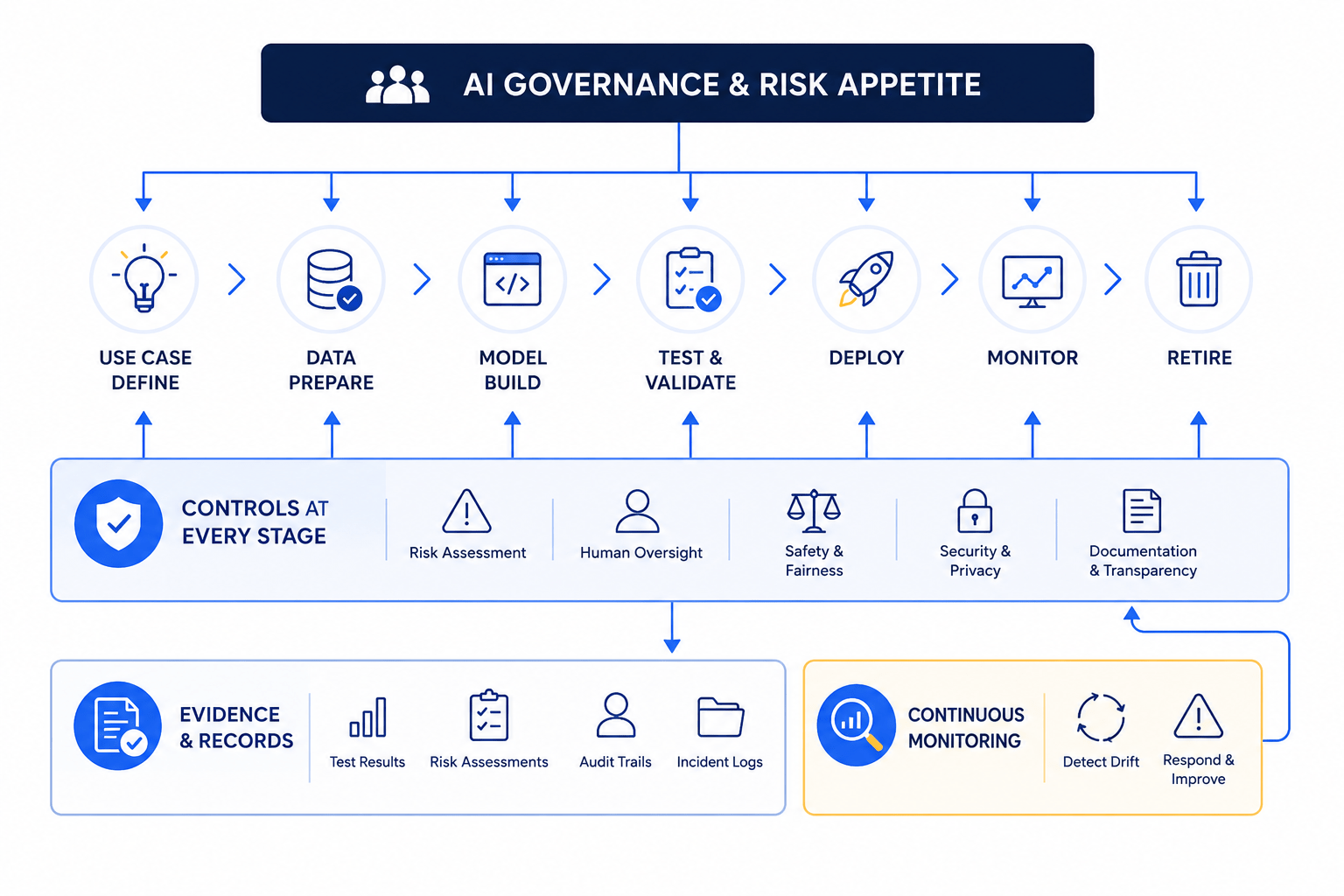 Effective AI governance requires both clear accountability and continuous evidence generation across the AI lifecycle.