

TL;DR:
- Public value, not cost alone, is the test. A use case succeeds when it improves service quality, access, or accountability, cost reduction is one input, not the whole answer.
- Risk rises with impact, not with the technology itself. A chatbot that answers hours-of-operation questions carries far less risk than a model that flags a household for fraud investigation.
- Governance has to exist before the pilot, not after it. Data quality, bias testing, and a named human reviewer are prerequisites, not add-ons for later.
- Start with low-risk, high-volume internal work. Document processing and knowledge search build capability and trust before an agency touches citizen-facing decisions.
- Every high-impact use case needs an escalation path. Residents affected by an automated decision need a way to reach a human who can review and reverse it.
- Measurement has to start before deployment. Without a baseline, an agency cannot prove a system improved anything once it reaches production scale.
- Case studies cut both ways. Estonia’s citizen-facing assistant and the UK’s fraud-detection bias findings both belong in the same conversation about what governed adoption requires.
Introduction
Public agencies do not adopt artificial intelligence because the technology is new. They adopt it because backlogs are growing, staff capacity is limited, and residents expect the same responsiveness they get from private services. That pressure is real, but it does not change the standard a public body must meet. A government decision affects rights, benefits, and trust in ways a retail recommendation never will, so the bar for evidence, oversight, and accountability sits higher from the start.
This guide treats AI adoption as a decision problem, not a technology rollout. It explains where AI creates public value and where it creates risk, how to select a first use case, what governance has to be in place before a pilot begins, and how to measure whether a deployment actually served the public. Every claim below is tied to a named source, the OECD’s 2025 review of 200 government AI use cases, U.S. Government Accountability Office (GAO) audits, and documented deployments, so a reader can verify each figure before citing it internally.

1. Why AI Matters in Public Services Today
AI matters in public services because it can shorten the distance between a resident’s request and a government response, while also introducing new ways for that response to go wrong. Both halves of that sentence are true at once, and a leader who only hears the first half will under-govern a deployment.
Public value: better services, better operations, and better decisions
Public value is broader than cost savings. It includes service quality, equitable access, timeliness, operational resilience, and the accountability of the decisions an agency makes on a resident’s behalf. A use case that cuts processing time but degrades accuracy for one group of applicants has not created public value, it has shifted a cost onto the people least able to absorb it.
The OECD’s 2025 review synthesised 200 real-world AI use cases across 11 core government functions and found that adoption concentrates heavily in public-facing service delivery, justice administration, and civic participation, while policy evaluation and internal workforce functions lag well behind. That pattern reflects where the largest number of residents interact with government, not necessarily where the risk-adjusted value is highest.
Where public-sector AI creates value, and where it creates risk
Value concentrates where AI removes a bottleneck without removing a safeguard: sorting documents faster, surfacing the right policy passage, or flagging a case for a human to look at sooner. Risk concentrates where an automated output substitutes for a judgment a person is legally or ethically entitled to have made about them individually.
The same underlying technology can sit on either side of that line depending on how an agency deploys it. A natural-language model that drafts a benefits-decision letter for a caseworker to edit supports a person. The same model auto-approving or auto-denying that claim without review makes the decision. The distinction is not about the model’s capability, it is about who holds the authority to act on the output.
The difference between AI assistance, automation, and high-impact decisions
Four categories help an agency locate any proposed use case on a shared risk scale. Assistance supports a staff member who retains full control, such as drafting a summary. Automation completes a routine, reversible task without individual review, such as routing a form to the correct queue. Decision support ranks or scores options for a human who makes the final call, such as prioritising inspection sites. A high-impact automated decision changes a person’s rights, benefits, or legal status with no meaningful human review before the action takes effect.
Most defensible public-sector deployments today sit in the first two categories. Decision support and high-impact automation both need the governance foundation covered in Section 2 before an agency should consider them.
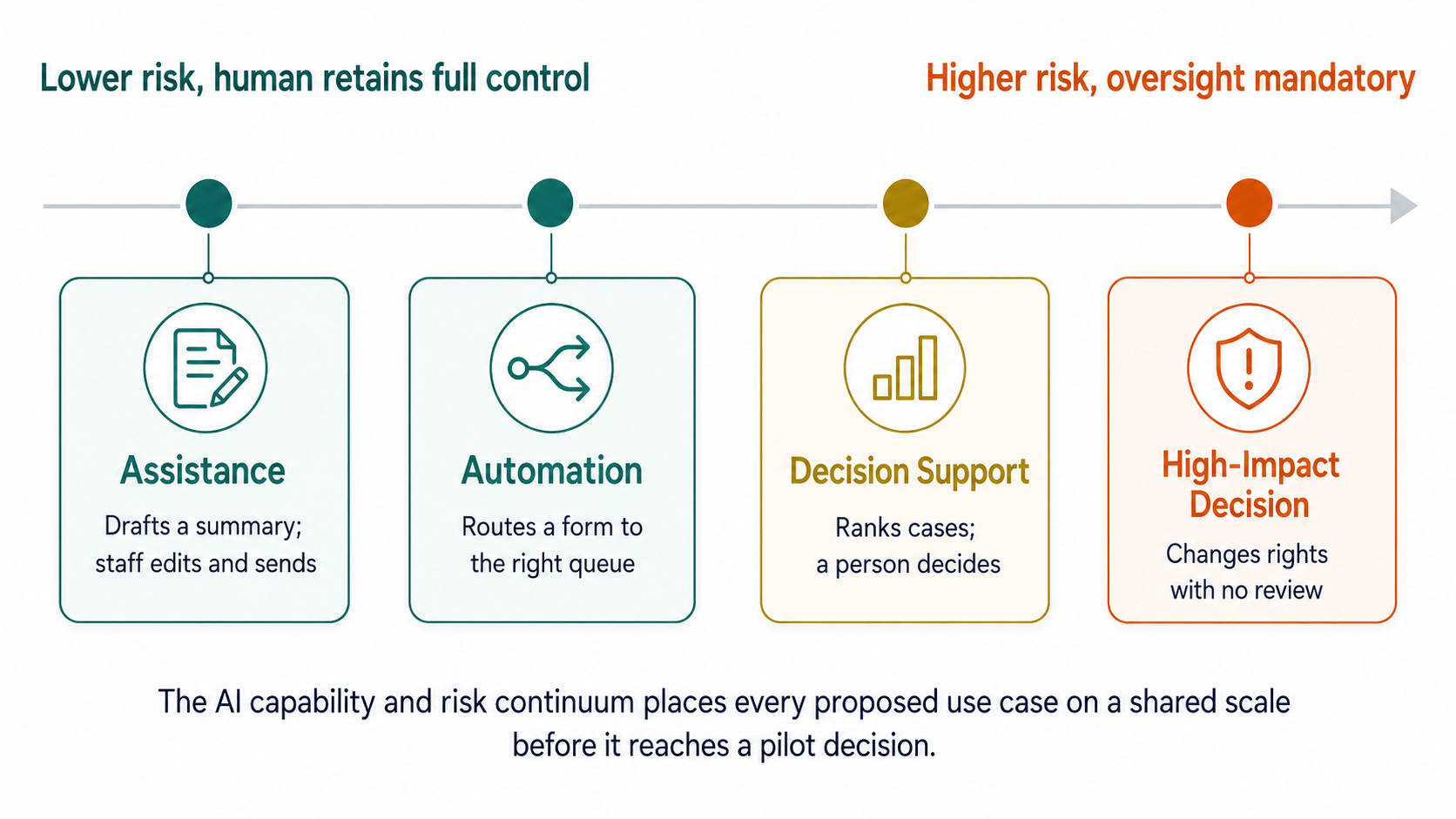
One-Page Governance Checklist: AI Capability & Risk
Use the risk stage to determine the level of oversight required before approving any AI use case.
| Risk stage | What to check | Governance requirement |
|---|---|---|
| 1. Assistance | AI drafts or summarizes, but staff edits before use. | Human reviews all outputs before they are used or shared |
| 2. Automation | AI routes or processes information without making substantive decisions. | Define clear rules and exception handling |
| 3. Decision Support | AI ranks, recommends, or prioritizes cases for a human decision. | Document inputs, reasoning, confidence, and human override |
| 4. High-Impact Decision | AI directly affects rights, access, benefits, or other significant outcomes. | Require mandatory human oversight Conduct impact/risk assessment Maintain full audit trail |
Before any pilot, confirm:
- The AI use case and risk stage are clearly documented
- A named human owner is accountable for the final outcome
- Data sources and model outputs can be traced and verified
- Escalation thresholds are defined in advance
- Human review is built into the workflow where required
- Decisions and interventions are logged for audit
- Performance, errors, and risks will be monitored after deployment
Core principle: As AI moves from assisting people toward making or influencing high-impact decisions, governance and human oversight must increase accordingly.
Takeaway: AI creates public value when it removes a bottleneck without removing a safeguard. Classify every use case as assistance, automation, decision support, or a high-impact decision before scoping it, because that classification sets the governance workload in Section 2.
2. The Public-Sector AI Foundation: Data, Governance, and Trust
Data quality, security, fairness, transparency, and human oversight are not separate workstreams. They interlock, and a weakness in one undermines the others – a well-governed model trained on incomplete data will still produce inequitable outcomes.
Data quality, interoperability, privacy, and security
An AI system can only be as reliable as the records it draws on. Public-sector data frequently sits in legacy systems that were never designed to share information, which forces agencies to either invest in interoperability or accept that a model will work from an incomplete picture of each case. Security and privacy controls, encryption, access logging, and a documented lawful basis for processing personal data, need to be in place before, not after, a system reaches production, because retrofitting them into a live citizen-facing service is far harder than designing them in from the outset.
Fairness, transparency, explainability, and accountability
Fairness testing checks whether a system’s outputs differ across protected characteristics such as age, disability, or nationality in ways that cannot be justified by the underlying policy. Transparency means a resident can find out that an AI system was involved in a decision about them. Explainability means a caseworker can describe, in plain terms, why the system produced a particular output. Accountability ties all three together: someone inside the agency has to own the outcome, even when a model generated the recommendation.
Human oversight and escalation for decisions affecting citizens
Every use case that touches eligibility, benefits, or legal status needs a named reviewer with real authority to overrule the system, not just a formality attached to the workflow. Escalation only works when the reviewer has enough time and context to catch an error — a caseworker asked to sign off on hundreds of automated recommendations per day cannot meaningfully exercise that authority. SmartDev’s AI Model Testing Guide covers how to validate a model’s behaviour before it reaches that reviewer’s desk.
Workforce capability and change management
Staff need training that goes beyond “how to use the tool” to include when to trust an output and when to escalate it. Agencies that skip this step tend to see one of two failure modes: automation bias, where staff rubber-stamp AI outputs without real scrutiny, or blanket distrust, where staff quietly work around a system that could have helped them.
Trustworthy-AI readiness gate
Before any use case moves from pilot planning to a live test, an agency should be able to answer yes to each of the following. A “not yet” on any gate is a reason to close it before proceeding, not a reason to proceed anyway.
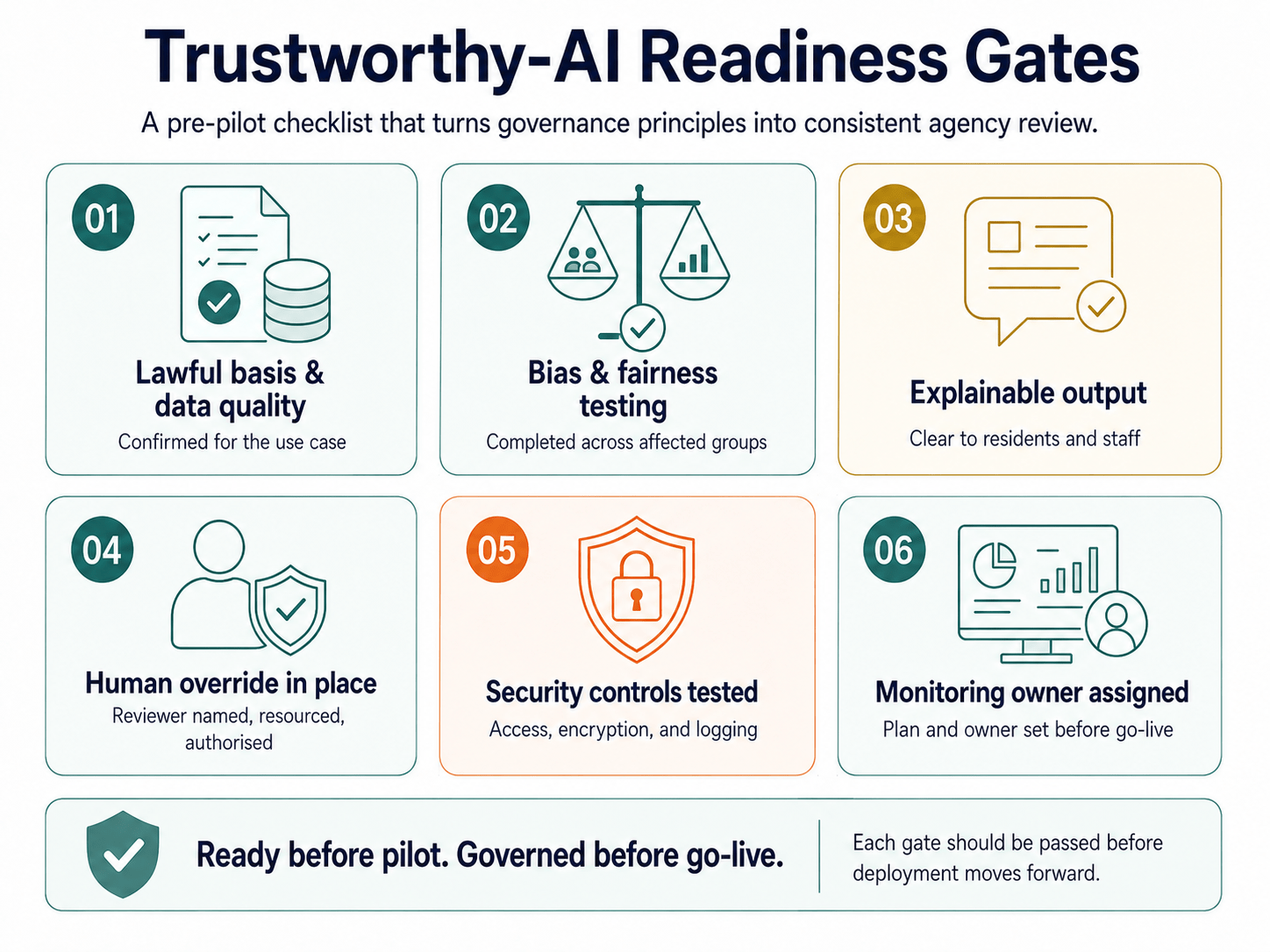
Takeaway: Treat the readiness gate as a hard prerequisite, not a parallel workstream. A use case that cannot pass all six gates is not ready for a pilot, regardless of how promising the underlying model looks in a demo.
3. How to Select the Right AI Use Case
Prioritisation should happen before an agency evaluates a single vendor or tool. Choosing the technology first tends to produce solutions in search of a problem, which is one of the most common reasons public-sector AI pilots stall.
A use-case selection matrix: public value, feasibility, risk, and readiness
Score each candidate use case against four criteria: the public value it could create, the feasibility of the data and systems required, the risk tier it falls into, and the agency’s current readiness against the gates in Section 2. A use case that scores high on value but low on readiness is not disqualified, it becomes a target for a future pilot once the foundation is in place.
| Criterion | Guiding question | Low score signal | High score signal |
|---|---|---|---|
| Public value | Does this improve service quality, access, or accountability? | Value is speculative or internal-only | Directly reduces resident wait time or error rate |
| Feasibility | Is the required data available, accurate, and interoperable? | Data is fragmented across legacy systems | Data is centralised and already validated |
| Risk tier | Where does this sit on the assistance-to-high-impact continuum? | Touches eligibility with no review | Internal, reversible, human-reviewed |
| Readiness | Can the agency pass all six trustworthy-AI gates today? | Multiple gates unresolved | All gates confirmed or scheduled |
Low-risk starting points versus high-impact applications
Low-risk starting points share three traits: they are internal, reversible, and already reviewed by a human before anything reaches a resident. Document intelligence, internal knowledge search, and meeting or case-note summarisation fit this profile. High-impact applications, eligibility determinations, fraud flags that trigger benefit suspension, predictive risk scores in justice settings, require the full governance foundation before a pilot, and even then need continuous monitoring once live.
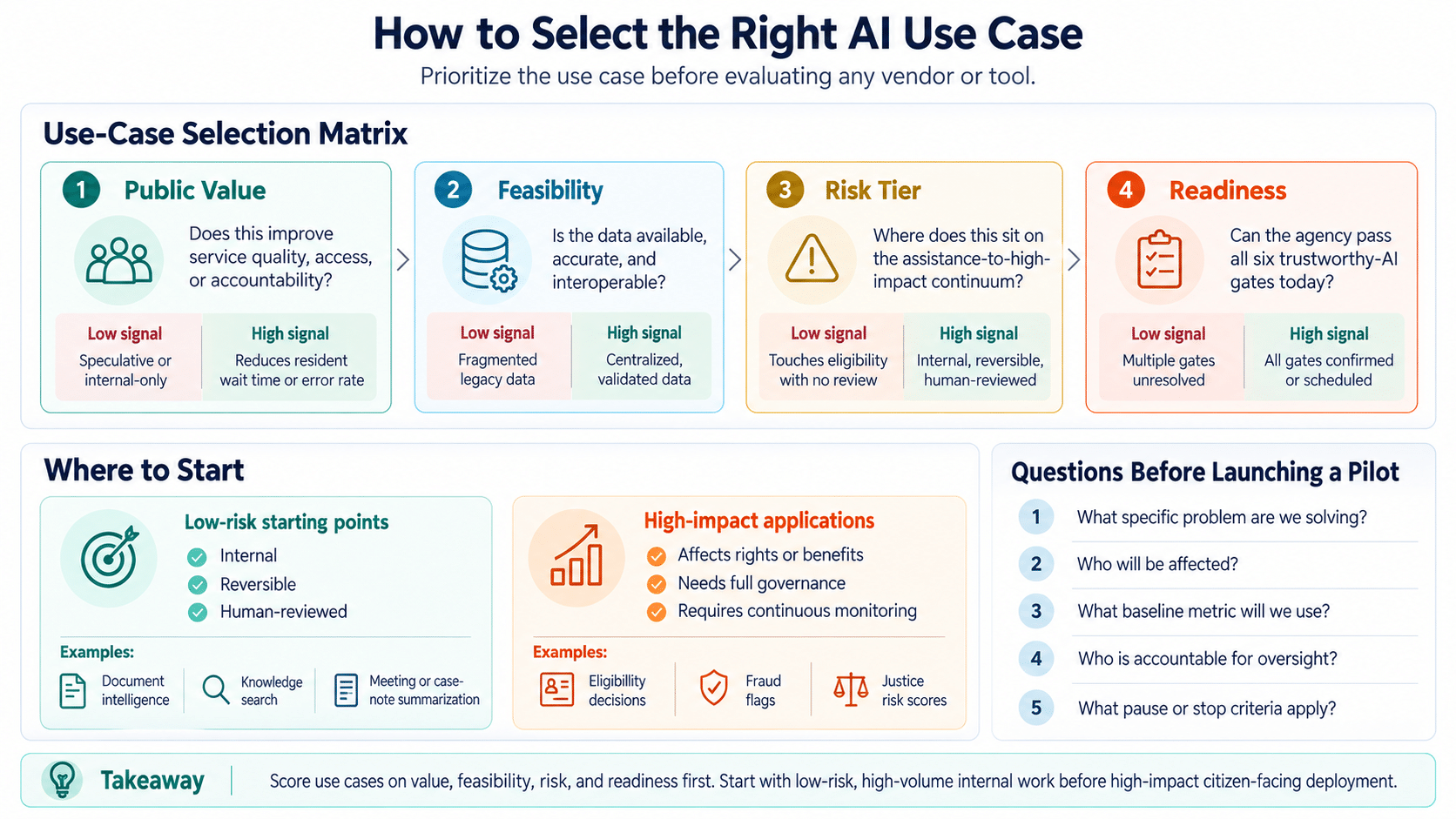
Questions to answer before launching a pilot
Before committing budget to a pilot, an agency should be able to name: the specific problem the use case solves, the population it will affect, the baseline metric it will be measured against, the reviewer accountable for oversight, and the criteria that would trigger pausing or stopping the pilot. A pilot without a stop condition tends to continue by default, regardless of the evidence it produces.
Takeaway: Score candidate use cases on value, feasibility, risk, and readiness before selecting a vendor. Start with low-risk, high-volume internal work to build institutional capability before attempting a high-impact citizen-facing deployment.
4. AI Use Cases in Public-Service Delivery
Service-delivery applications sit closest to residents, so the benefit is visible quickly, and so is the harm from a poorly governed rollout. This section separates support to staff from decisions that are fully automated, because the two carry very different risk profiles even when the underlying use case looks similar.
Citizen engagement and service navigation
Citizen-facing AI works best when it helps someone find the right service faster, not when it replaces the judgment behind an eligibility decision.
Virtual assistants and multilingual support
Conversational assistants can answer routine questions, office hours, required documents, application status, in multiple languages, reducing the number of calls that need a human agent for information a resident could otherwise self-serve. Estonia’s Bürokratt initiative, developed under the national Information System Authority, gives residents a single conversational entry point across government websites; the system is explicitly designed to provide informational and advisory support rather than binding decisions, with caseworkers validating any outcome that matters.
Guided forms, case updates, and service access
AI can pre-fill forms from data the government already holds, flag missing fields before submission, and give residents plain-language status updates on an open case. Each of these reduces friction without shifting a decision away from the person who is legally accountable for it.
Public health and social-service operations
In public health and social services, AI most often supports resource allocation and early identification rather than individual clinical or eligibility decisions.
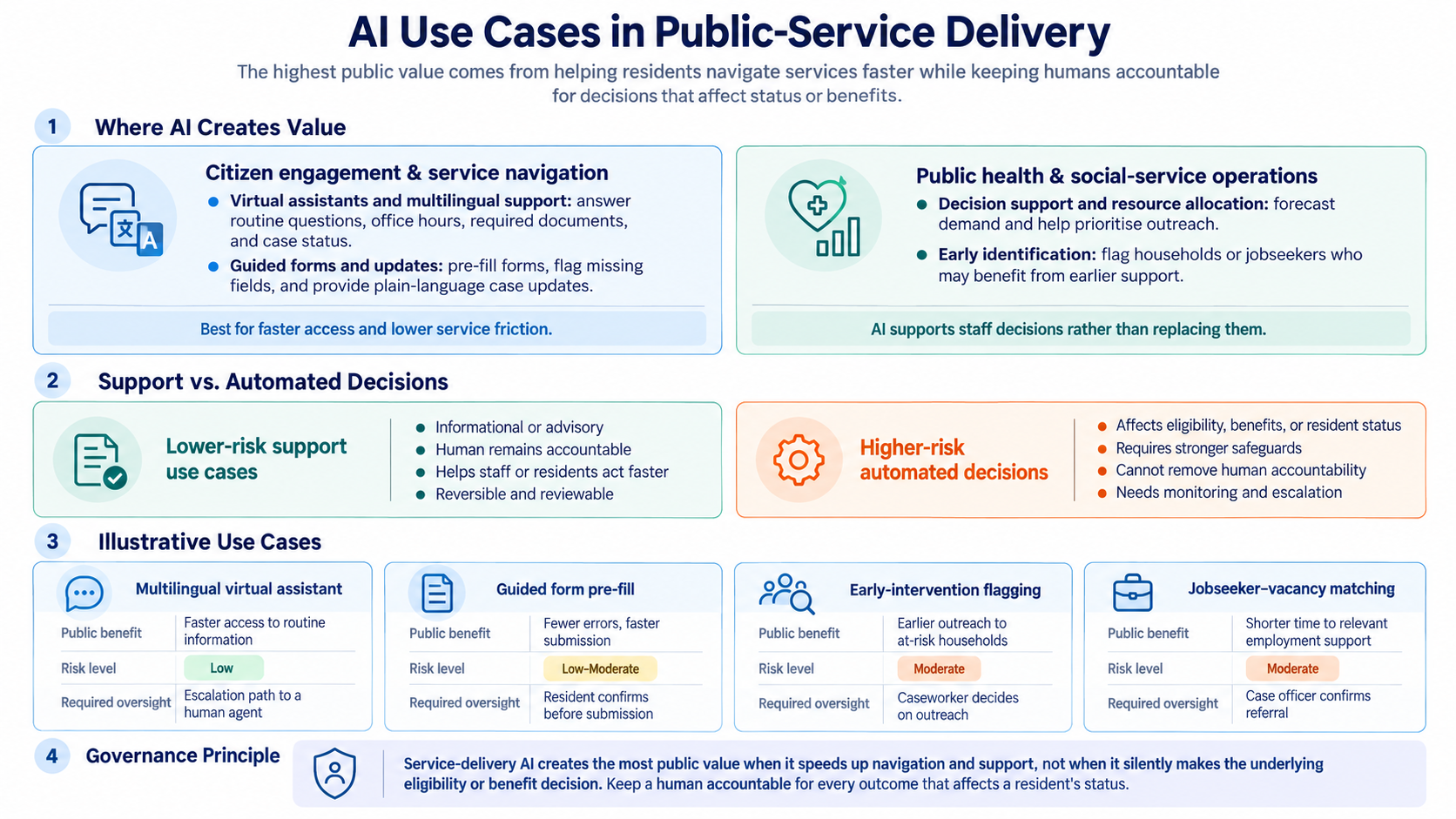
Decision support, resource allocation, and safeguards
Models that help forecast demand for services, or flag a household that may benefit from proactive outreach, function as decision support: a caseworker still decides whether and how to act. Safeguards matter most here because the populations served by social programmes are often the least able to challenge an error, so the human-review requirement from Section 2 carries extra weight.
Public employment services use AI to match jobseekers to openings and to identify people at risk of long-term unemployment so caseworkers can intervene earlier — an application Estonia’s public employment programme has documented, with case officers retaining the referral decision. Used this way, AI shortens the time between a person losing work and receiving relevant support, without automating the underlying employment decision itself.
| Use case | Public benefit | Data required | Risk level | Required oversight |
|---|---|---|---|---|
| Multilingual virtual assistant | Faster, wider access to routine information | Service FAQs, hours, eligibility summaries | Low | Escalation path to a human agent |
| Guided form pre-fill | Fewer errors, faster submission | Existing government records | Low–Moderate | Resident confirms before submission |
| Early-intervention flagging (social services) | Earlier outreach to at-risk households | Case history, service usage patterns | Moderate | Caseworker decides on outreach |
| Jobseeker–vacancy matching | Shorter time to relevant employment support | Skills profile, vacancy data | Moderate | Case officer confirms referral |
Takeaway: Service-delivery AI creates the most public value when it speeds up navigation and support, not when it silently makes the underlying eligibility or benefit decision. Keep a human accountable for every outcome that affects a resident’s status.
5. AI Use Cases for Government Operations
Internal operations are usually the safest place to start, because the people affected are government staff who can review the output before it reaches a resident.
Document intelligence and workflow automation
Document automation reduces the manual keying, sorting, and cross-checking that consumes a large share of administrative capacity in permitting, licensing, and case processing. Natural-language processing tools extract key fields from unstructured documents and route them for review, which speeds up the process without removing the human check on the outcome. SmartDev’s guide to AI automation for document and data processing covers how to scope this kind of project for high manual-keying volume. Automation should give staff time back for complex judgment calls, not signal that review is no longer needed.
Knowledge management and staff copilots
Staff-facing copilots surface the right policy passage, precedent, or internal guidance during a live case, reducing time spent searching fragmented internal systems. Because a staff member reviews the output before acting, this is one of the lowest-risk applications available and a strong second pilot after document automation.
Infrastructure, mobility, environment, and resilience
AI supports infrastructure operations by analysing sensor data to flag maintenance needs before a failure occurs, and by helping plan mobility and environmental monitoring programmes. The OECD notes that predictive-analytics applications like these fall under a broader category of government AI aimed at productivity and responsiveness, distinct from citizen-facing services.
Procurement, finance, and internal resource planning
AI can support procurement teams by summarizing vendor proposals against requirements and flagging inconsistencies for review, and can support finance teams with anomaly detection in internal spending. These applications stay internal to the agency, which keeps the risk tier low as long as a procurement or finance officer retains the final decision.
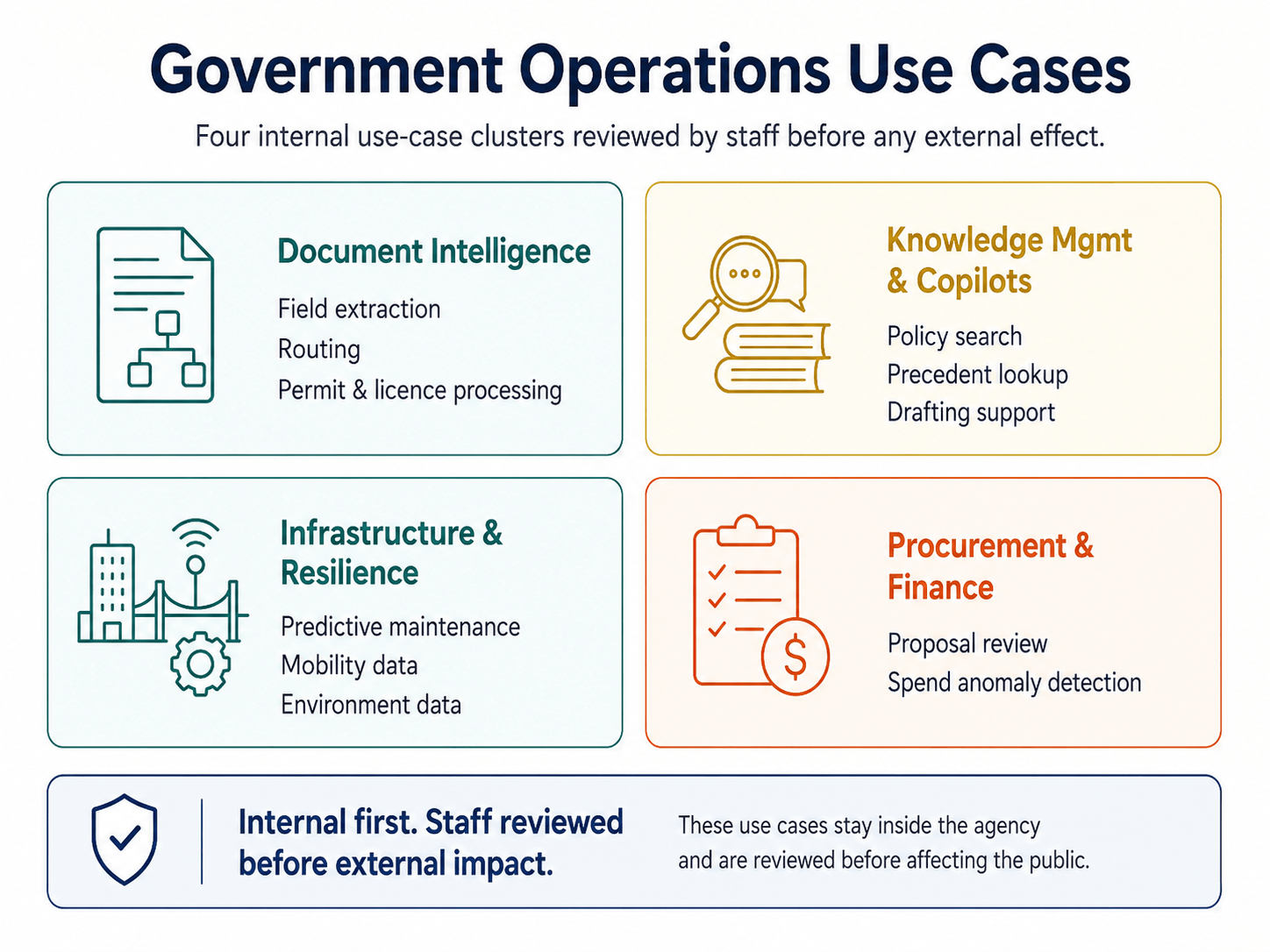
The diagram groups internal government AI use cases into four main operational categories, all designed to support staff while keeping final decisions under human control.
- Document Intelligence – Handles field extraction, document routing, and permit or licence processing to reduce repetitive administrative work.
- Knowledge Management & Copilots – Supports policy search, precedent lookup, and drafting, helping staff access and synthesize information faster.
- Infrastructure & Resilience – Uses AI for predictive maintenance, mobility analysis, and environmental data to improve planning and operations.
- Procurement & Finance – Assists with proposal review and spend anomaly detection, helping teams identify risks and prioritize further investigation.
The key principle is that these applications support internal operations rather than directly determining outcomes for residents.
Takeaway: Internal operations use cases carry manageable risk because staff review the output before it affects a resident. Use them to build data pipelines, workforce trust, and measurement discipline before attempting citizen-facing automation.
6. AI Use Cases for Oversight, Integrity, and Risk Management
Fraud detection, compliance, and public-safety applications can support detection and prioritization, but they operate on data that reflects historical enforcement patterns, so they need the strictest governance of any category in this guide.
Fraud detection, compliance, and anomaly detection
Machine learning models can scan large volumes of claims, transactions, or filings to flag statistical outliers for human investigation, which is faster than manual sampling. The critical design choice is what happens after a flag: a system that only opens an investigation queue for a trained reviewer behaves very differently from one that automatically suspends a payment. SmartDev’s work on AI workflow automation for risk and compliance illustrates the same underlying pattern used in regulated financial services, a rule engine paired with human review before any high-stakes action, that public-sector fraud teams can apply to their own workflows.
Public safety and justice: benefits, limits, and governance requirements
In public safety and justice, AI can support resource allocation and case triage, but predictive tools trained on historical enforcement data risk reproducing the same patterns of over-policing that produced that data in the first place. Any deployment in this space needs documented bias testing against the communities it affects, a transparent appeal process, and a reviewer with the authority to override the system before an action is taken against an individual.
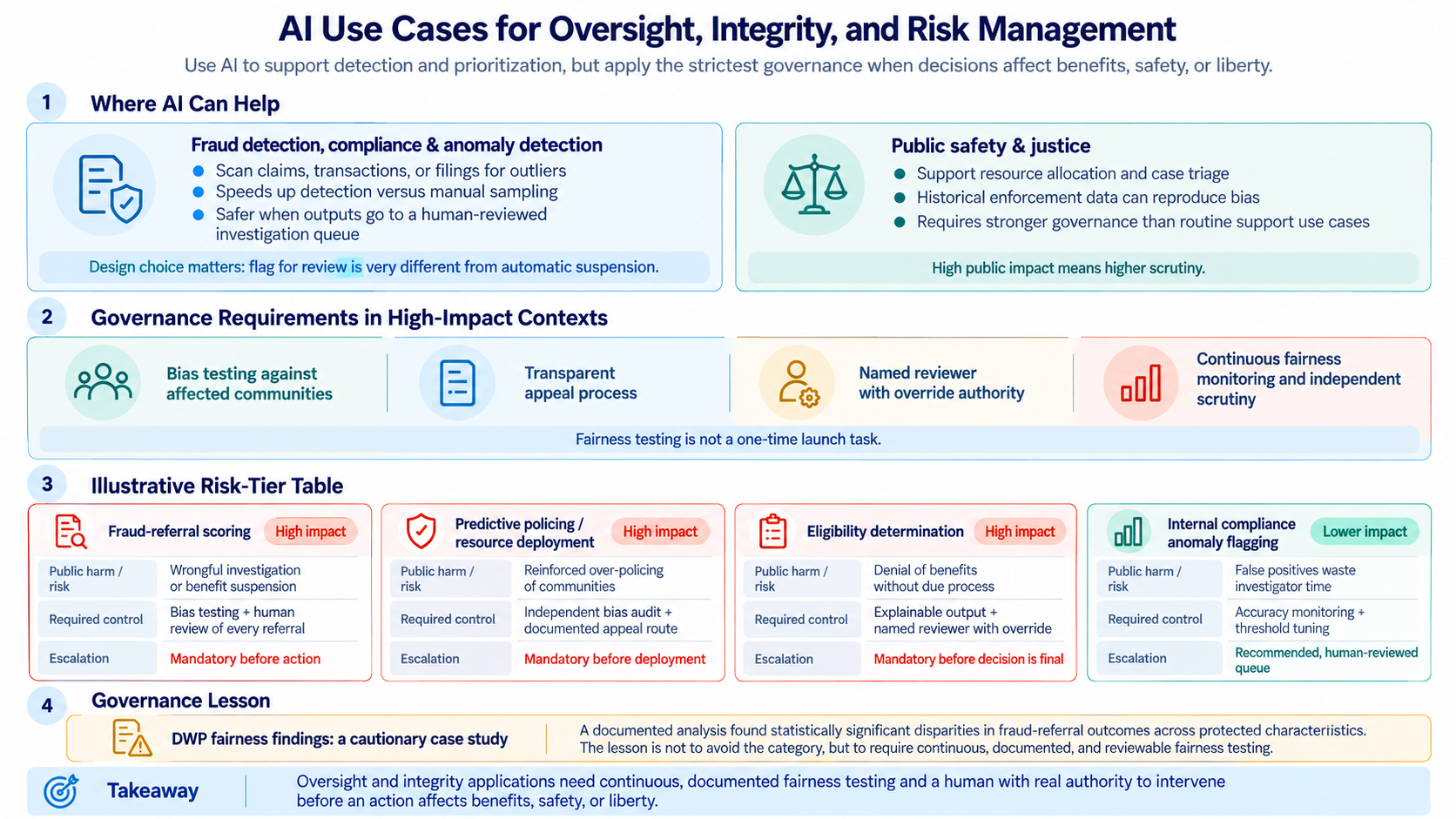
Responsible use in high-impact and rights-sensitive contexts
The UK Department for Work and Pensions offers a documented, cautionary example of what happens without that governance in place. A fairness analysis released under freedom-of-information rules found a statistically significant referral and outcome disparity across protected characteristics including age, disability, and nationality in the department’s machine-learning fraud-referral system. The department maintained that safeguards were in place and found no immediate evidence of unfair treatment, but independent reviewers and advocacy groups continued to press for greater transparency into how the disparities arose and whether they were adequately mitigated. The lesson is not that fraud-detection AI is inherently unsafe, it is that fairness testing has to be continuous, documented, and open to independent scrutiny, not a one-time check before launch.
| Application | Potential harm | Required control | Escalation requirement |
|---|---|---|---|
| Fraud-referral scoring | Wrongful investigation, benefit suspension | Bias testing by protected characteristic; human review of every referral | Mandatory before action |
| Predictive policing or resource deployment | Reinforced over-policing of specific communities | Independent bias audit; documented appeal route | Mandatory before deployment |
| Eligibility determination | Denial of benefits without due process | Explainable output; named reviewer with override authority | Mandatory before decision is final |
| Internal compliance anomaly flagging | Wasted investigator time on false positives | Model accuracy monitoring; threshold tuning | Recommended, human-reviewed queue |
Takeaway: Oversight and integrity applications need continuous, documented fairness testing and a human with real authority to intervene before an action affects someone’s benefits or liberty. Treat the DWP finding as a governance case study, not a reason to avoid the category.
7. Real-World Public-Sector AI Examples: What to Learn From Them
Case examples are only useful when they show the full picture: the problem, the deployment context, the oversight approach, the measured outcome, and the limitation. A single success metric without that context tells a reader very little about whether the same approach would work in their agency.
Evidence-backed case snapshots by government function
Estonia – citizen service navigation. Problem: residents faced a fragmented set of government websites and contact points. Deployment: Bürokratt, an interoperable network of AI chatbots run by Estonia’s Information System Authority, gives residents one conversational channel across agencies. Oversight: the system is advisory, with caseworkers validating any outcome that matters, and it authenticates users through Estonia’s national digital-identity infrastructure. Outcome: documented as a single, united channel for accessing public services since its first official version launched in 2022. Limitation: the programme itself acknowledges that moving from pilot to sustained production required dedicated long-term budget and governance, not just a working model. Transferability: high for agencies with fragmented citizen-facing channels and existing digital-identity infrastructure.
United Kingdom – fraud-referral risk scoring. Problem: high claim volume made manual fraud review unsustainable. Deployment: the Department for Work and Pensions used a machine-learning model to flag universal-credit claims for investigation. Oversight: flagged cases route to a human investigator rather than triggering an automatic suspension. Outcome: an internal fairness analysis found statistically significant referral disparities across several protected characteristics. Limitation: the disparities raised open questions about transparency and independent oversight that remained unresolved at the time of reporting. Transferability: this case transfers as a governance lesson — continuous bias testing and independent scrutiny are not optional for any agency running similar risk-scoring work.
United States federal government – inventory-driven oversight. Problem: agencies were adopting generative AI faster than existing oversight mechanisms could track. Deployment: the U.S. GAO reviewed AI-use-case inventories that 11 selected federal agencies are required to submit under federal AI policy. Outcome: reported AI use cases nearly doubled from 571 in 2023 to 1,110 in 2024, and generative AI use cases grew roughly ninefold over the same period. Limitation: GAO’s review focused on inventory completeness and management practice, not on the accuracy or fairness of any individual use case. Transferability: the inventory approach itself, a public, annually updated register of every AI system in use — is a governance practice any agency can adopt regardless of jurisdiction.
What successful deployments have in common
Across these examples, the deployments that held up shared three features: a defined advisory or reversible role rather than a fully automated high-impact decision, a named party accountable for the outcome, and a mechanism, an audit, an inventory, or a fairness analysis, that made the system’s performance visible to someone outside the team that built it.
Common failure modes and caution signals
The clearest caution signal is a system operating on rights-affecting decisions without a published fairness assessment, as the DWP case illustrates. A second failure mode is treating a pilot’s technical success as sufficient evidence to scale, without the budget and governance structure Estonia’s programme identified as the harder, longer-term requirement. A third is an inventory or register that exists on paper but is not kept current, which GAO’s review found agencies still working to fully close out.
Takeaway: Judge a case study by its oversight design and its limitations, not by its headline outcome alone. The strongest deployments pair a reversible or advisory role with independent, ongoing scrutiny of how the system performs.
8. From Pilot to Scale: A Governed Implementation Roadmap
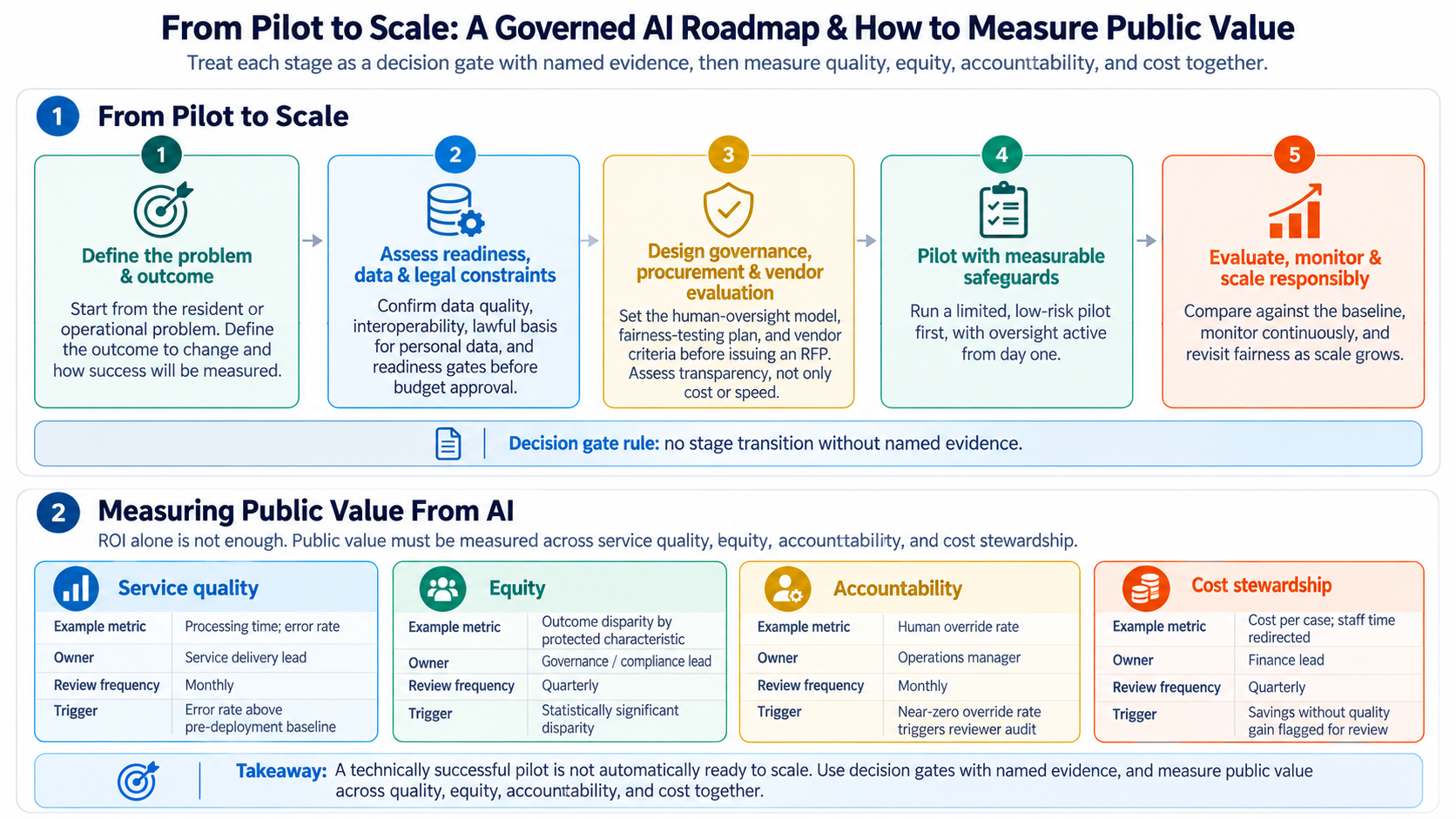
A pilot that works technically is not the same as a system ready to scale. Each stage below needs a decision gate and named evidence before an agency moves to the next one.
Step 1: Define the public problem and desired outcome
Start from the resident or operational problem, not from the technology. Write down the specific outcome the project should change and how the agency will know it changed.
Step 2: Assess readiness, data, and legal constraints
Confirm data quality and interoperability, identify the lawful basis for processing any personal data, and check the use case against the readiness gates from Section 2 before committing budget.
Step 3: Design governance, procurement, and vendor evaluation
Set out the human-oversight model, the fairness-testing plan, and the vendor-evaluation criteria before issuing a request for proposals. Vendors should be assessed on transparency about how their system works and how it handles data, not only on cost or speed. SmartDev’s AI proof-of-concept guide covers how to structure this stage-gated evaluation before a full build begins.
Step 4: Pilot with measurable safeguards
Run the pilot in a limited, low-risk area first, with the human-oversight model from Step 3 fully active from day one. A pilot that skips oversight “to move faster” produces evidence that cannot be trusted when the agency scales it.
Step 5: Evaluate, monitor, and scale responsibly
Evaluate the pilot against the baseline set in Step 1, monitor performance continuously after scaling rather than treating evaluation as a one-time event, and revisit the fairness assessment as the population served grows. SmartDev’s guide to AI model training and AI model testing guide cover the technical practices that support this ongoing monitoring stage.
Takeaway: Treat each stage transition as a decision gate that requires named evidence, not a calendar milestone. A pilot that skips governance to hit a deadline produces results the agency cannot trust once it scales.
9. Measuring Public Value From AI
Return on investment alone cannot establish public value, because it ignores service quality, equity, and accountability — the dimensions residents actually experience.
Service quality, speed, accessibility, and user experience
Track processing time, error rate, and resident satisfaction alongside each other, not in isolation. A faster process that generates more errors or complaints has not improved service quality, even if the average handling time looks better on a dashboard.
Operational efficiency and cost stewardship
Cost metrics matter, but they should sit next to a quality metric so a leader can see whether savings came from genuine efficiency or from reduced service quality. Track staff time redirected to higher-value work, not just hours removed from a process.
Accuracy, equity, accountability, and risk metrics
Accuracy needs to be broken down by the population segments a use case affects, not reported only as a single aggregate figure, because an aggregate can hide a large disparity for one group. Accountability metrics track how often the human-review step actually overturns an AI recommendation – a rate near zero can signal either a highly accurate system or a reviewer who is rubber-stamping outputs, and an agency needs to know which.
Establishing baselines and reporting outcomes
A baseline captured before deployment is the only way to prove a system changed anything. Report outcomes on a fixed schedule to a named owner, using the same metrics defined at the start of the pilot in Section 8, so that pre- and post-deployment figures are genuinely comparable.
| Dimension | Example metric | Baseline owner | Review frequency | Decision threshold |
|---|---|---|---|---|
| Service quality | Processing time; error rate | Service delivery lead | Monthly | Error rate above pre-deployment baseline triggers review |
| Equity | Outcome disparity by protected characteristic | Governance/compliance lead | Quarterly | Statistically significant disparity triggers pause |
| Accountability | Human override rate | Operations manager | Monthly | Override rate near zero triggers reviewer audit |
| Cost stewardship | Cost per case; staff time redirected | Finance lead | Quarterly | Savings without quality gain flagged for review |
Agencies budgeting a first project against this scorecard should size expectations realistically; SmartDev’s AI development cost guide and guide to evaluating AI performance both cover how to plan a budget and a metrics framework side by side rather than treating cost and quality as separate conversations.
Takeaway: Measure public value across quality, equity, accountability, and cost together. A single ROI figure without a baseline and an equity breakdown cannot tell an agency whether an AI system genuinely served the public.
10. What’s Next for AI in the Public Sector
Future readiness depends on governance maturity and workforce preparation, not on adopting the newest model first.
Generative AI, agentic workflows, and government operating models
Generative AI use inside government is growing quickly: GAO found generative AI use cases across 11 selected U.S. federal agencies grew roughly ninefold from 2023 to 2024, alongside a near-doubling of AI use cases overall. That pace outstrips many agencies’ existing oversight capacity, which is why GAO’s recommendation focused on strengthening inventory and management practice alongside adoption. Agentic AI – systems that take multi-step action rather than only generating text – raises the stakes further, because an agent that can act across systems needs the same human-oversight design discussed in Section 2, applied at every step it takes rather than only at the final output. Readers exploring this shift can review SmartDev’s guide to building AI agents and generative AI development services for the underlying technical patterns.
Building long-term institutional readiness
Institutional readiness rests on four capabilities: durable funding that survives the transition from pilot to production, a current and public inventory of every AI system in use, a workforce trained to question outputs rather than defer to them, and interoperable data infrastructure that reduces the cost of the next use case. Agencies that build these capabilities now will adopt each new wave of AI technology faster and more safely than agencies that wait and then rush.
Takeaway: Prepare institutional capability, not just technology roadmaps. Governance maturity, a current AI inventory, and a trained workforce determine whether an agency can adopt generative AI and agentic workflows safely as they mature.
FAQ: AI in the Public Sector
What are the lowest-risk AI use cases for public-sector organisations?
The lowest-risk starting points are internal, staff-facing applications that support rather than replace a decision, such as the document intelligence and knowledge-management use cases in Section 5. A human reviews every output before it reaches a resident, so an error slows a process rather than changing someone’s benefits or rights.
How can public agencies reduce AI bias and protect citizen data?
Agencies reduce bias by testing models against protected characteristics before and after deployment, as described in Section 2, and by keeping a defined human reviewer for any output affecting eligibility or rights. Data protection depends on minimising collected data, encrypting it, and setting clear access and retention rules before go-live, consistent with the readiness gates covered above.
What should a government agency measure before scaling an AI pilot?
An agency needs a documented baseline for service quality, accuracy, and cost, a fairness assessment across affected populations, and a named monitoring owner, all covered in Section 9. Scaling without these baselines makes it impossible to prove the system is working as intended at full volume.
When should human review be mandatory?
Human review is mandatory whenever an AI output can change a person’s benefits, legal status, or access to an essential service, as set out in the risk-tier table in Section 6. Low-impact, reversible, internal tasks can run with lighter oversight, but every high-impact decision needs a named reviewer with real authority to overrule the system.
Conclusion
Public-sector AI succeeds when an agency treats it as a decision problem before a technology problem. Start with the public value a use case could create, place it honestly on the risk continuum from Section 1, and confirm the governance foundation from Section 2 before a pilot begins.
Select use cases deliberately using the criteria in Section 3, build institutional capability through low-risk internal work before touching high-impact citizen-facing decisions, and pilot only with the safeguards and decision gates set out in the governed implementation roadmap. Measure the result against a real baseline, across quality, equity, accountability, and cost together, not against a single efficiency number.
None of this requires waiting for perfect certainty. It requires sequencing the work so that trust, evidence, and capability build in the right order, and so that the residents affected by a government decision can always find a person accountable for it.
Next Steps: Assessing a Public-Sector AI Opportunity
If your agency has identified a candidate use case, the next step is validating it against the readiness gates and selection criteria in this guide before committing to a build. That validation can take the form of a structured proof of concept, a readiness assessment, or a scoped pilot design, depending on where the use case currently sits.
SmartDev works with public-sector and regulated organisations to scope AI opportunities responsibly, from an initial proof of concept through AI consulting and full-scale AI development services. If you would like to talk through a specific use case, tell us more about it.