
TL;DR
- Define a specific business question: Use an AI PoC to test whether AI can solve one clearly scoped problem before committing significant budget or resources.
- Choose the right development stage: Use a PoC for feasibility, a prototype for solution design, a pilot for real-world validation, and production for sustained delivery.
- Build the business case first: Establish the target workflow, current baseline, expected improvement, accountable owner, constraints, and final decision criteria before selecting a model.
- Confirm organizational readiness: Verify that suitable data, technical access, stakeholder support, security controls, and governance requirements are available before development begins.
- Follow a stage-gated process: Frame the hypothesis, define success criteria, prepare data, select the approach, test the minimum solution, evaluate evidence, and make a decision.
- Measure success across three dimensions: Assess business value, model quality, and operational viability rather than relying on technical accuracy alone.
- Manage risks with clear controls: Track warning signs, owners, controls, and impacts for scope, data, cost, governance, security, and production-readiness risks.
- Scale only when evidence supports it: Move from PoC to pilot or production only when the solution remains valuable, reliable, governable, and operationally sustainable.
Introduction
Many businesses start AI experiments without clearly defining the business decision they aim to support. As a result, they often produce technical demos that look promising but fail to prove real value, feasibility, or scalability. This gap is common. PwC reports that while 43% of companies see revenue gains or cost savings from AI, 42% remain stuck without clear results – showing how easily AI efforts can stall without proper validation.
An AI Proof of Concept (PoC) addresses this issue. It is a focused exercise to test whether AI can solve a specific problem under realistic conditions. A strong PoC defines a clear use case, sets measurable success criteria, and provides evidence for a go-or-no-go decision.
This guide explains what an AI PoC is, when a business needs one, how it differs from an exploratory demo, and how to structure it so the outcome supports a confident decision to advance, refine, or stop the initiative.
What an AI Proof of Concept Is – and When to Use One
An AI Proof of Concept (POC) is most useful when a business needs reliable evidence before committing significant time, budget, and resources to an AI initiative. Instead of immediately developing a production-ready system, a PoC allows the organization to test its most important assumptions within a controlled and clearly defined scope.
AI PoC Definition and Core Purpose
An AI Proof of Concept (PoC) is a small-scale, focused experiment or prototyping designed to demonstrate the feasibility of an AI solution in solving a specific business problem. It typically involves creating a model or system that addresses a particular issue within a defined scope, allowing businesses to evaluate the effectiveness and potential of AI technologies before committing to full-scale deployment. The goal is to prove that AI can deliver tangible results, such as increased efficiency, reduced costs, or improved decision-making.
A PoC serves as an early indicator of the AI solution’s practicality, and it often includes testing key parameters, data models, and performance metrics. Once the PoC is complete, the results can guide decisions regarding the future scale-up or modification of the AI system.
The Business Problems an AI PoC Should Validate
An AI PoC should answer a specific business question rather than simply demonstrate that an AI model can work. Before starting, the organization should define the assumptions it needs to test and the evidence decision-makers require before approving further investment.
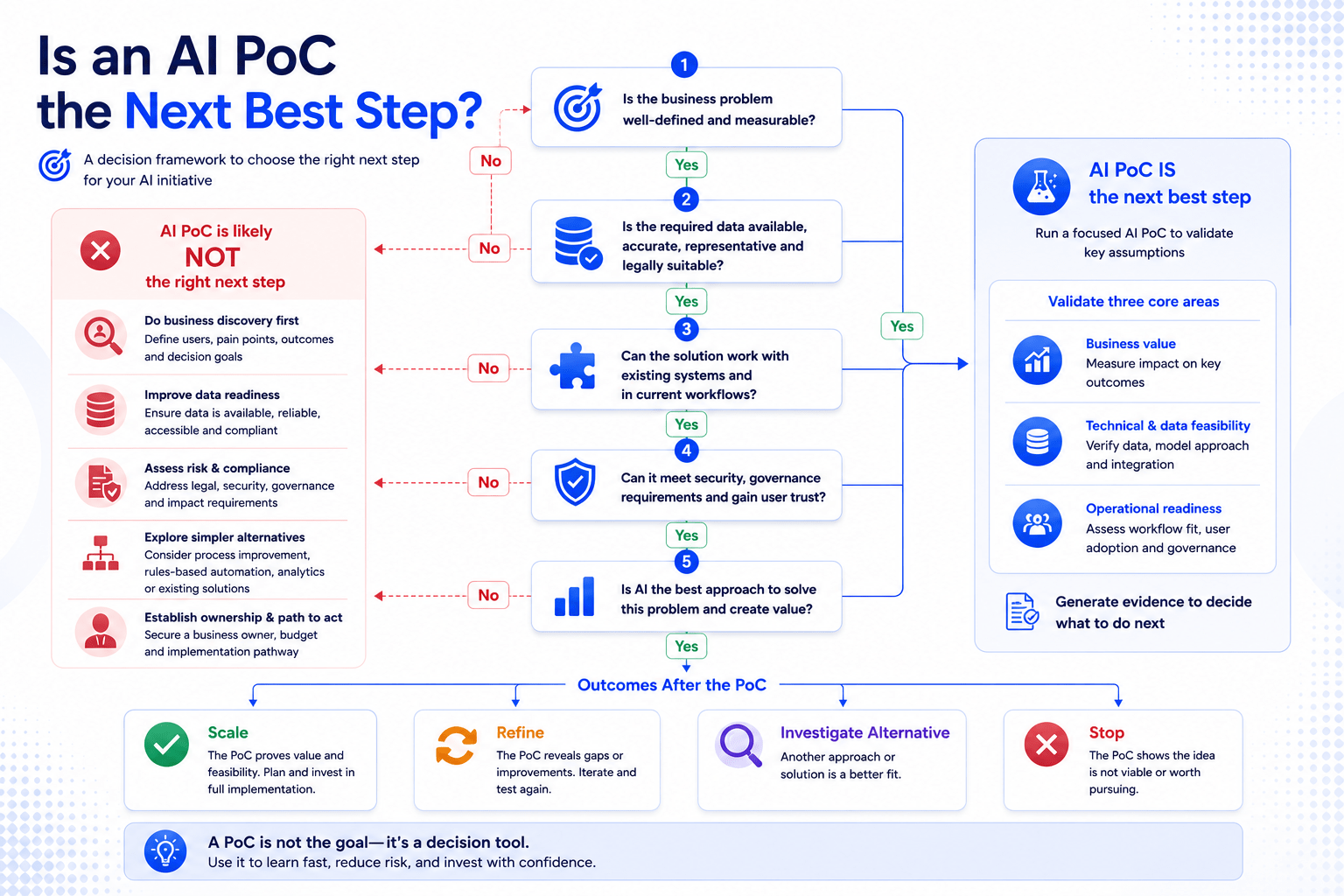
A well-structured PoC should validate three core areas:
- Business value: Can the solution improve a measurable outcome, such as processing time, operating cost, forecast accuracy, detection rates, or decision quality?
- Technical and data feasibility: Is the required data available, accurate, representative, and legally suitable, and can the proposed solution work with existing systems?
- Operational readiness: Can the solution fit into current workflows, meet security and governance requirements, and gain the trust of its intended users?
These areas must be assessed together. A model may perform well technically but still fail to deliver business value if it relies on poor-quality data, cannot integrate with existing platforms, or requires employees to adopt an impractical workflow.
The PoC should also determine whether AI is genuinely the right solution. In some cases, workflow redesign, rules-based automation, conventional analytics, or an existing software product may solve the problem more efficiently. The purpose of the PoC is not to prove that AI can be used, but to establish whether it should be used.
The final result should provide enough evidence to decide whether to scale the solution, refine the approach, investigate an alternative, or stop the initiative.
When an AI PoC Is the Wrong Next Step
An AI PoC is not automatically the right starting point for every AI initiative. When the business problem is still vague, launching a PoC often creates activity without generating useful evidence. The organization should first define the target user, the current pain point, the desired outcome, and the decision the experiment is intended to support.
A PoC may also be premature in several situations:
- The organization has no measurable definition of success.
- The required data is unavailable, unreliable, or restricted from the proposed use.
- A proven commercial solution already meets the requirement.
- The problem can be solved more simply through conventional software or process improvement.
- There is no business owner, budget, or implementation pathway to act on a positive result.
For example, goals such as “improve customer experience” or “increase efficiency with AI” are too broad to support meaningful evaluation. The business should translate them into measurable targets, such as reducing response time, lowering manual review effort, or improving the accuracy of a specific decision.
Data readiness is equally important. If essential information is incomplete, inconsistent, inaccessible, or poorly governed, the organization should address those limitations before testing a model. Otherwise, the PoC may reveal little more than problems the business already has with its data.
High-risk use cases may also require legal review, security assessment, governance controls, or impact analysis before experimentation begins. In these cases, the appropriate next step may be business discovery, data preparation, workflow redesign, vendor evaluation, or AI governance planning rather than a PoC.
A PoC should begin only when its findings can lead to a clear and actionable decision.
Common Misconceptions About AI PoCs
While an AI PoC is an important step in AI adoption, misunderstanding its role can create unrealistic expectations.
A successful AI PoC does not guarantee production success. A model may perform well in a controlled test but struggle with scale, integration, real users, or changing conditions.
AI PoCs are also not limited to highly technical organizations. Clear business objectives, relevant data, suitable expertise, and stakeholder involvement matter more than having a large in-house data science team.
PoCs are rarely one-time experiments. Initial results often reveal data gaps, risks, or improvements that require further testing.
Finally, completing a PoC does not mean the solution is ready to deploy. Production still requires work on scalability, security, compliance, monitoring, integration, and user adoption.
Understanding these limitations helps businesses treat the PoC as a structured decision-making tool rather than an automatic gateway to full-scale AI implementation.
AI PoC vs. Prototype vs. Pilot vs. Production
AI Proofs of Concept, prototypes, pilots, and production systems represent different stages of AI development. Although the terms are often used interchangeably, each stage answers a different business question and requires a different level of investment, technical maturity, and organizational involvement.
A PoC asks whether the idea is feasible. A prototype explores how the solution should work. A pilot testing whether it can operate effectively in a real business environment. Production turns the validated solution into a reliable, scalable, and continuously managed service.
Confusing these stages can lead to unrealistic expectations. A business may evaluate a PoC as though it were a finished product or move a promising prototype into live operations before addressing security, governance, integration, and performance risks. Understanding the purpose of each stage helps organizations invest gradually and require stronger evidence as the initiative advances.
The Role and Expected Outcome of Each Stage
AI Proof of Concept: Validate Feasibility
An AI PoC is a focused experiment designed to test the most uncertain assumptions behind an AI use case. It typically uses a limited dataset, simplified workflow, and controlled environment to determine whether the proposed approach can produce a meaningful result.
The purpose is not to create a polished application. It is to answer questions such as:
- Can the available data support the use case?
- Can the model achieve an acceptable level of performance?
- Does AI provide an advantage over simpler alternatives?
- Is the potential business value strong enough to justify further investment?
The expected outcome is a go, revise, or stop decision. A successful PoC confirms that the idea is worth developing further, but it does not prove that the solution is ready for users or production.
AI Prototype: Validate the Solution Experience
Once technical feasibility has been established, a prototype demonstrates how the AI solution could function in practice. It may include a user interface, basic integrations, workflow logic, and a more complete model than the one used during the PoC.
The prototype stage shifts the focus from “Can this work?” to “How should this work for the user?” Business stakeholders and intended users can interact with the solution, assess whether it fits their needs, and identify usability or workflow issues before significant engineering effort is committed.
The expected outcome is a clearer solution design. Feedback from the prototype helps refine features, user journeys, model outputs, human-review requirements, and integration needs. However, prototypes often rely on temporary infrastructure, limited security controls, or manually supported processes, so they should not be mistaken for deployable systems.
AI Pilot: Validate Real-World Performance
An AI pilot introduces the solution into a limited but real operating environment. It may be deployed within one department, location, customer segment, or business process and used with live or representative production data.
At this stage, the organization evaluates more than model accuracy. It tests whether the solution performs consistently under real workloads, integrates with business systems, supports users effectively, and delivers measurable operational value.
A pilot should also reveal how the solution affects roles, decision-making, compliance responsibilities, and existing workflows. For example, a model may generate accurate recommendations but still fail if users do not trust the output or if reviewing each result creates more work than the system saves.
The expected outcome is evidence that the solution can operate safely and effectively within defined business conditions. The pilot should provide a clear basis for deciding whether to expand, modify, or discontinue the initiative.
AI Production: Deliver and Sustain Business Value
Production is the stage at which the AI solution becomes part of normal business operations. It must support expected user volumes, integrate with core systems, meet security and compliance requirements, and maintain reliable performance over time.
A production AI system requires more than a validated model. It also needs scalable infrastructure, access controls, monitoring, incident management, model versioning, auditability, fallback procedures, and clear ownership. Teams must monitor changes in data and model performance because an AI solution that works at launch may become less reliable as business conditions evolve.
The expected outcome is sustained and measurable business value. Unlike earlier stages, production is not a one-time milestone. It is an ongoing operating model that requires maintenance, governance, performance reviews, and continuous improvement.
Scope, Timeline, Stakeholders, and Evidence Required
The level of rigor should increase at every stage. Early experiments can remain narrow and flexible, while pilots and production systems require stronger operational, technical, and governance controls.
| Stage | Typical Scope | Indicative Timeline | Core Stakeholders | Evidence Required |
|---|---|---|---|---|
| PoC | One narrow use case, limited data, controlled environment | Several weeks to a few months | Business owner, AI or data specialists, domain expert | Data suitability, baseline model performance, technical feasibility, early business-value estimate |
| Prototype | Core workflows, basic interface, selected integrations | Several weeks to several months | Product owner, designers, developers, end-user representatives, AI team | User feedback, workflow fit, functional requirements, usability findings, refined technical design |
| Pilot | Limited live deployment within a defined team, market, or process | Several months, depending on risk and complexity | Operations, IT, security, compliance, end users, business sponsor, support teams | Live performance, adoption, process impact, integration stability, risk findings, measurable business outcomes |
| Production | Full approved scope across intended users and operations | Ongoing implementation and operation | Executive sponsor, product and engineering teams, IT operations, security, compliance, legal, business owners | Reliability, scalability, security assurance, compliance approval, monitoring controls, ROI, ownership and support model |
These timelines are directional rather than fixed. A document-classification PoC may take only a few weeks, while a regulated credit-risk use case may require months of validation before it can move beyond a controlled experiment.
The evidence required should also reflect the decision being made. A PoC may only need to demonstrate that the model performs better than an agreed baseline. A pilot must show that the system creates value under real conditions without introducing unacceptable operational or regulatory risks. Production approval requires stronger evidence that the organization can run, monitor, secure, and maintain the solution at scale.
Stakeholder involvement should expand in the same way. Technical teams may lead the PoC, but business owners must define the problem and success criteria. During prototyping, users and product teams become more important. Pilots require operational, security, legal, and compliance participation. By production, ownership must extend beyond the project team to the departments responsible for ongoing performance and risk.
How to Choose the Right Stage for Your Initiative
The right starting point depends on what the organization already knows and what it still needs to validate.
Start with a PoC when the main uncertainty is technical or data-related. This is appropriate when the business problem is clear, but there is not yet enough evidence that AI can solve it with the available data and technology.
Move to a prototype when feasibility has been demonstrated but the workflow, interface, or user experience remains unclear. This stage is useful when stakeholders need to see and interact with the proposed solution before agreeing on requirements.
Choose a pilot when the solution is technically credible and usable but has not yet been tested under real operating conditions. A pilot is appropriate when the remaining questions concern adoption, integration, reliability, process impact, risk, or measurable business value.
Proceed to production only when the organization has sufficient evidence that the solution is valuable, usable, operationally viable, and governable. There should also be a named owner, approved budget, support model, monitoring approach, and clear process for responding when performance declines or risks emerge.
Not every initiative must pass through all four stages in the same way. A business adopting a mature third-party AI product may begin with a pilot rather than building a custom PoC. Conversely, a high-risk or technically novel use case may require several rounds of validation before live testing is appropriate.
The key is to match the stage to the uncertainty. If the question is about feasibility, run a PoC. If it is about design, build a prototype. If it is about real-world performance, conduct a pilot. If those questions have already been answered with sufficient evidence, focus on building a production-ready operating model.
Build the Business Case Before Building the Model
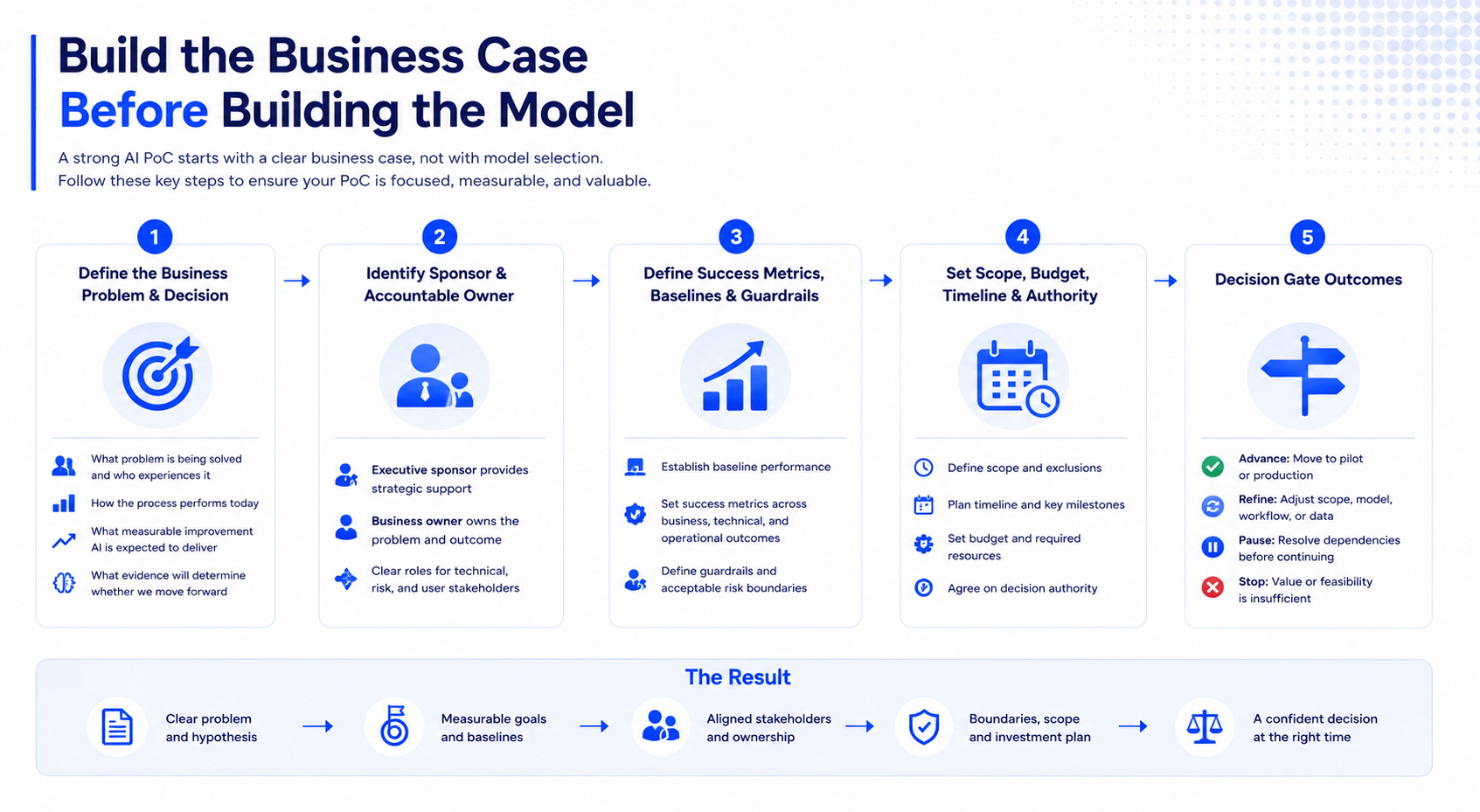
An AI PoC should not begin with model selection. It should begin with a clearly defined business problem, a measurable baseline, and a decision that needs to improve.
Without this foundation, teams often build technically impressive demos that do not solve a meaningful operational issue. A viable AI PoC must connect the proposed technology to a specific workflow, user group, business outcome, and investment decision.
Before development starts, the organization should be able to explain:
- What problem is being solved and who experiences it
- How the process performs today
- What measurable improvement AI is expected to deliver
- Who owns the outcome
- What constraints the solution must respect
- What evidence will determine whether the initiative advances
These elements form the AI PoC business case. They help the organization compare the opportunity with other priorities and prevent technical experimentation from moving ahead without a clear path to value.
Define the Business Problem and Decision to Improve
The strongest AI PoC use cases begin with a specific workflow or decision, not a broad ambition such as “use AI to improve efficiency.”
The problem should describe an observable gap between current and desired performance. For example, “customer service is inefficient” is too vague. “Agents spend an average of 12 minutes searching across five systems before responding to billing queries” provides a measurable starting point.
The organization should then define the decision or action that AI is expected to improve. This could involve classifying incoming requests, identifying unusual transactions, forecasting demand, extracting information from documents, or recommending the next best action.
A clear problem statement should identify the user, workflow, current limitation, business impact, and expected improvement. It should also explain why AI may be more suitable than conventional automation, analytics, process redesign, or an existing software product.
A practical use-case hypothesis might follow this structure:
If AI is applied to a defined workflow using available data, it should improve a measurable business outcome without exceeding agreed cost, risk, or performance limits.
For example, a company may hypothesize that AI-assisted document review can reduce average processing time from 30 minutes to 10 minutes while maintaining at least the current level of accuracy.
This hypothesis gives the PoC a clear purpose. It also creates a direct link between model performance and business value.
Identify the Executive Sponsor and Accountable Owner
Every AI PoC needs both executive support and operational ownership.
The executive sponsor provides strategic backing, removes organizational barriers, and helps secure funding or cross-functional participation. However, sponsorship alone is not enough. The initiative also needs an accountable business owner who is responsible for the outcome, not only the delivery of the experiment.
The business owner should understand the workflow, control the relevant process or budget, and have authority to act on the result. This person should help define the problem, approve success criteria, coordinate user participation, and make or recommend the final go-or-no-go decision.
Technical teams may build and evaluate the model, but they should not own the business case by default. A data science team can determine whether a model achieves a target accuracy level. It cannot independently decide whether that level of performance is sufficient for the business to change its process.
Ownership should therefore be explicit:
- Executive sponsor: Provides direction, funding support, and organizational alignment
- Business owner: Owns the problem, expected benefit, and final recommendation
- Technical lead: Owns feasibility, architecture, and model evaluation
- Risk and control stakeholders: Define legal, security, compliance, and governance requirements
- Users or domain experts: Validate workflow fit and the practical value of the output
Clear ownership prevents the PoC from becoming an isolated innovation project with no route into business operations.
Define Success Metrics, Baselines, and Guardrails
Success criteria must be defined before the PoC begins. Otherwise, teams may select favorable metrics after seeing the results or declare success based only on technical performance.
The first step is to establish a baseline. This describes how the current workflow performs without the proposed AI solution. Depending on the use case, the baseline may include processing time, labor cost, error rate, forecast accuracy, conversion rate, incident volume, customer response time, or the percentage of cases requiring manual review.
The PoC should then define a target improvement against that baseline. Metrics should cover three dimensions:
- Business outcomes: Cost reduction, time saved, revenue impact, risk reduction, or service improvement
- Technical performance: Accuracy, precision, recall, latency, reliability, or output quality
- User and operational outcomes: Adoption, usability, override rate, workload impact, or satisfaction
For example, a fraud-detection PoC should not be judged only by model accuracy. It may also need to reduce false positives, maintain review capacity, meet response-time requirements, and avoid creating unacceptable customer friction.
Guardrails define the conditions the solution must not violate while pursuing those outcomes. These may include privacy restrictions, security requirements, fairness thresholds, explainability standards, maximum error rates, human-review requirements, or limits on operational disruption.
A successful PoC therefore needs both a performance target and an acceptable risk boundary. Improving speed is not a valid outcome if accuracy falls below a safe level. Increasing automation is not valuable if employees must spend more time correcting unreliable outputs.
Set Scope, Budget, Timeline, and Decision Authority
A PoC should be narrow enough to produce evidence quickly but realistic enough to support a meaningful decision.
The scope should define the target workflow, user group, data sources, model capabilities, integrations, and exclusions. It should also state what the PoC is not expected to deliver. For example, a PoC may test classification accuracy using historical data without building a production interface or connecting to live systems.
Budget and timeline should reflect the uncertainty being tested. The organization should avoid spending heavily on infrastructure, interface design, or production engineering before feasibility has been established. At the same time, an unrealistically small budget may produce a weak test that cannot answer the business question.
The PoC plan should specify:
- The resources and data required
- The expected duration and key milestones
- The maximum approved spend
- The assumptions being tested
- The evidence required at the final decision gate
Decision authority must also be agreed in advance. The team should know who can approve the next stage, request further validation, change the scope, or stop the initiative.
The final decision should not be limited to “success” or “failure.” A useful decision gate may produce four outcomes:
- Advance: The evidence supports prototype, pilot, or production investment.
- Refine: The concept is promising, but the model, workflow, data, or scope requires adjustment.
- Pause: The opportunity may be viable, but dependencies such as data readiness or governance must be resolved first.
- Stop: The expected value is insufficient or the risk, cost, or technical limitations are unacceptable.
Defining these outcomes before development protects the organization from continuing an initiative simply because time and money have already been spent.
A strong AI PoC business case should fit on one page. It should summarize the problem, target users, current baseline, use-case hypothesis, expected benefit, constraints, accountable owner, required investment, and final decision gate. If these elements cannot be defined clearly, the initiative is not ready for model development.
AI PoC Readiness: Data, Technology, People, and Risk
Before funding an AI Proof of Concept, organizations should confirm that the minimum conditions for credible testing are in place. A promising use case can still fail if the data is inaccessible, integrations are unrealistic, key stakeholders are missing, or governance requirements are unclear.
AI PoC readiness depends on four connected areas: suitable data, technical feasibility, responsible governance, and committed stakeholders. Critical blockers should be identified before significant development begins.
Assess Data Availability, Quality, Access, and Privacy
The key question is not whether data exists, but whether the right data is available for the use case.
The team should confirm that the data is sufficiently complete, accurate, current, and representative. Missing records, inconsistent formats, outdated labels, and data bias can undermine the reliability of PoC results.
Data Access must also be resolved early. The organization should identify where the data is stored, who owns it, how it will be retrieved, and who can approve its use.
Legal and privacy requirements must be assessed before testing. This includes personal or regulated information, consent, anonymization, retention, residency, and data privacy obligations. If these conditions are not met, data readiness should come before model development.
Evaluate Technical Feasibility and Integration Constraints
An AI PoC should test whether the solution can work within the organization’s technical environment, not only whether the model produces useful outputs.
The team should assess how data enters the system, where the model runs, how outputs reach users, and which platforms must be connected. API availability, legacy systems, access controls, cloud restrictions, latency, and data-transfer requirements may all affect feasibility.
The setup does not need to be production-ready, but it should be realistic enough to reveal important system integration challenges. Testing through manual file uploads may validate model quality, but it may not prove that the solution can support an automated workflow.
Technical feasibility should also cover third-party platforms, hosting, licensing, data handling, usage limits, and expected costs.
Establish Governance, Security, Compliance, and Responsible-AI Controls
AI Governance should begin before the PoC. Even a limited experiment can create privacy, security, compliance, or reputational risk.
Controls should reflect the impact of the use case. A low-risk internal assistant may require lighter oversight than a system used in lending, recruitment, healthcare, or fraud detection.
The organization should define ownership, access rights, approval points, security requirements, regulatory compliance, and where human oversight is required. It should also determine how inaccurate, biased, or unsafe outputs will be detected and handled.
Responsible AI requirements should be part of the success criteria. Depending on the use case, these may include error thresholds, explainability, source attribution, bias testing, confidence indicators, and limits on automated decisions.
A PoC should not be judged on model performance alone. It must also operate within acceptable model risk, security, legal, and ethical boundaries.
Plan Stakeholder Involvement and Change Readiness
AI PoCs require business, technical, operational, and risk stakeholders. The core group typically includes the business owner, technical lead, domain experts, users, data owners, and relevant legal, security, or compliance representatives.
Their responsibilities should be clear from the start, including who approves access, validates outputs, provides feedback, and makes the final decision.
Operational ownership should remain with the business team responsible for the workflow. Technical teams can validate feasibility, but the business owner must determine whether the solution is useful and worth further investment.
Change readiness also matters when the solution affects roles, workload, or decision-making. Users should understand the purpose of the PoC, its limitations, and how their feedback will shape the outcome.
Before proceeding, the organization should confirm that no critical readiness blocker remains unresolved. The goal is not perfect readiness, but enough readiness to ensure the PoC produces credible and decision-ready evidence.
The AI PoC Framework: A Stage-Gated Process
An AI Proof of Concept should move through clear stages, with each stage answering a specific question and producing evidence for the next decision. This prevents teams from expanding scope too early or treating technical performance as proof of business value.
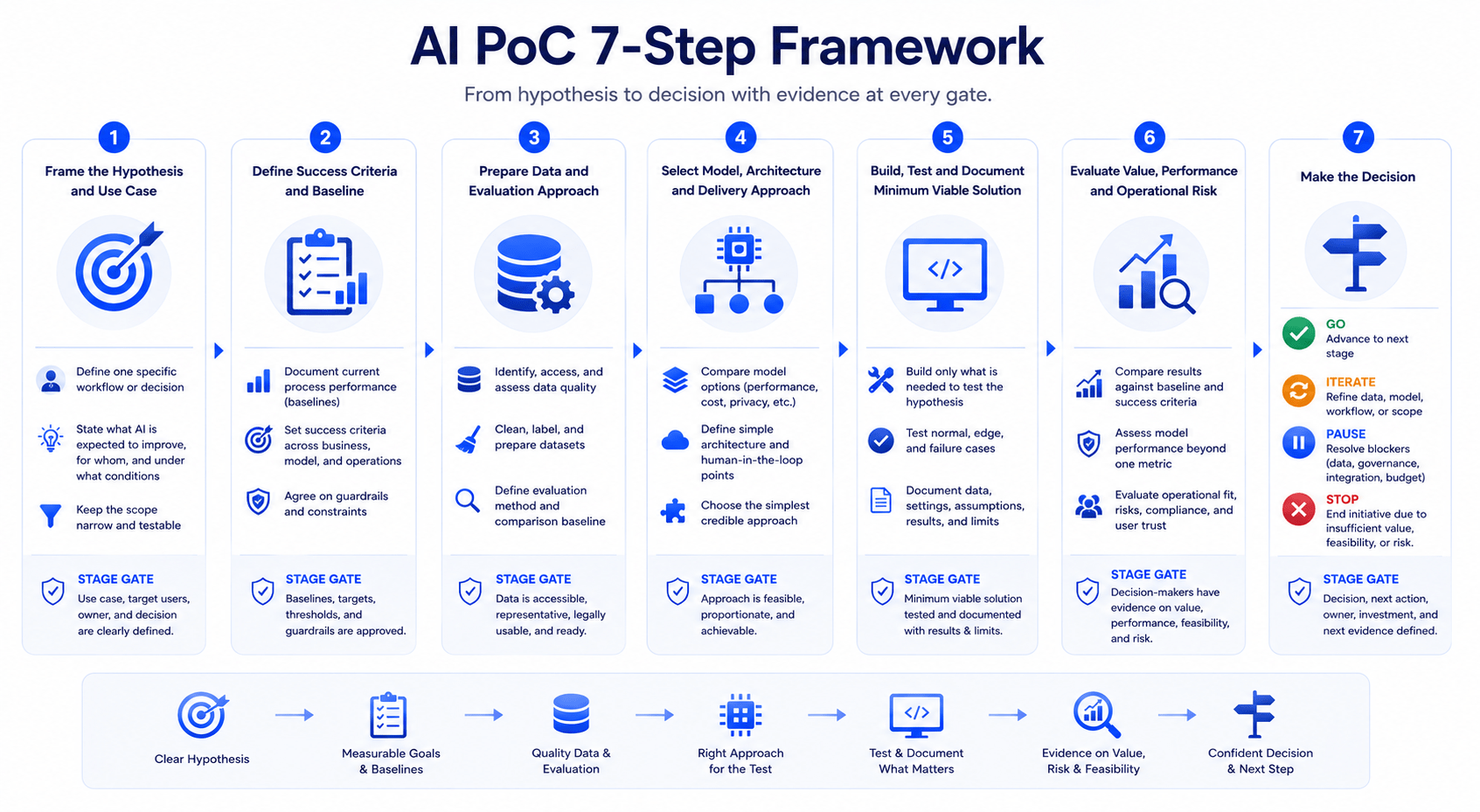
Step 1: Frame the Hypothesis and Target Use Case
Start with one clearly defined workflow, decision, or user problem. The hypothesis should explain what AI is expected to improve, for whom, and under what conditions.
For example:
AI-assisted invoice extraction will reduce processing time while maintaining current accuracy levels.
The scope should remain narrow enough to test quickly and produce a clear result.
Stage Gate: The use case, target users, business owner, and decision to support are clearly defined.
Step 2: Define Measurable Success Criteria and Baseline Performance
The team must document how the current process performs before testing AI. Relevant baselines may include processing time, error rate, cost per transaction, manual effort, response time, or forecast accuracy.
Success criteria should combine business value, model performance, and operational constraints. Guardrails should also be agreed in advance so that improvements in speed or automation do not come at the expense of accuracy, privacy, fairness, or security.
Stage gate: Baselines, target outcomes, performance thresholds, and guardrails are approved.
Step 3: Prepare Data and Choose an Evaluation Approach
The team should identify the required data, secure access, assess quality, and prepare it for testing. This may involve cleaning records, standardizing formats, creating labels, removing sensitive information, and separating training and evaluation datasets.
The evaluation method should also be defined before testing begins. Results may be compared with the current process, expert judgment, historical outcomes, or an existing rules-based solution.
Stage gate: The data is accessible, representative, legally usable, and supported by a clear evaluation method.
Step 4: Select the Model, Architecture, and Delivery Approach
Model selection should follow the business requirements rather than drive them. The team should compare options based on performance, cost, latency, privacy, explainability, integration needs, and vendor dependency.
The AI Architecture should define how data enters the solution, where processing occurs, how outputs reach users, and where human review is required. The goal is not to design the final production system, but to choose the simplest credible approach for testing the main assumptions.
Stage gate: The selected approach is feasible, proportionate, and achievable within scope and budget.
Step 5: Build, Test, and Document the Minimum Viable Solution
The PoC should include only the components needed to test the hypothesis. Additional features, polished interfaces, and production-grade infrastructure should be avoided unless they are essential to the evaluation.
Testing should cover normal cases, edge cases, and known failure conditions. The team should document datasets, model settings, prompts, assumptions, changes, results, and limitations so the findings can be reviewed and reproduced.
Stage gate: The minimum viable solution has been tested and its performance and limitations are documented.
Step 6: Evaluate Business Value, Model Performance, and Operational Risk
Evaluation should return to the original hypothesis and compare the results with the baseline and success criteria.
Business value may include time saved, lower costs, increased capacity, better decisions, or reduced risk. Any early AI ROI estimate should also consider integration, infrastructure, licensing, oversight, maintenance, and change-management costs.
Model performance should be reviewed beyond a single metric. The team should examine consistency, latency, false results, failure patterns, and performance across different cases. Operational assessment should cover workflow fit, user trust, human review, security, compliance, integration, and support needs.
A technically strong model should not advance if the business value is weak or the operating risks are impractical.
Stage gate: Decision-makers have sufficient evidence on value, performance, feasibility, and risk.
Step 7: Make the Go, Iterate, Pause, or Stop Decision
The final result should lead to one of four decisions:
- Go: Advance to the next delivery stage.
- Iterate: Refine the data, model, workflow, or scope.
- Pause: Resolve blockers such as access, governance, integration, or budget.
- Stop: End the initiative because value, feasibility, or risk is unacceptable.
The decision should state the next action, accountable owner, approved investment, and evidence required at the next gate.
Required PoC Deliverables and Evidence Pack
A completed PoC should leave decision-makers with a concise record of what was tested and what was learned. At minimum, the evidence pack should include the business hypothesis, scope, baseline, success criteria, data sources, technical approach, test results, business-value estimate, risk findings, limitations, and final recommendation.
Without this evidence, the PoC remains a demonstration rather than a reliable business decision.
Measure AI PoC Success
An AI PoC should be evaluated across three dimensions: business value, model quality, and operational viability. Strong technical performance alone is not enough if the solution does not improve a real outcome or cannot be scaled practically.
Business-Value Metrics: Cost, Revenue, Speed, Quality, and Risk
Business metrics should compare PoC results with the baseline defined before development.
- Cost: Reduction in labor, processing, support, or error-correction costs.
- Revenue: Improvement in sales, conversion, retention, or revenue-generating capacity.
- Speed: Reduction in response, processing, or decision time.
- Quality: Improvement in accuracy, consistency, service quality, or customer experience.
- Risk: Reduction in errors, fraud, downtime, compliance exposure, or missed incidents.
The selected metrics should reflect the original business problem rather than generic AI benefits.
Model-Quality Metrics: Accuracy, Reliability, Robustness, and Error Patterns
Model Performance should be assessed using metrics suited to the use case.
- Accuracy: How often the model produces the correct result.
- Reliability: Whether performance remains consistent across repeated tests.
- Robustness: How well the model handles unusual, incomplete, or changing inputs.
- Latency: How quickly the model produces a usable output.
- Error patterns: Where errors occur, how serious they are, and which cases are most affected.
For classification use cases, precision and recall may also be important. Average scores should not hide critical false positives, false negatives, or weaker performance across specific data groups.
Operational Metrics: Usability, Adoption, Integration, and Maintainability
Operational metrics show whether the solution can work under real business conditions.
- Usability: How easily users can understand and act on the output.
- Adoption: How often intended users choose to use the solution.
- Workflow impact: Whether it reduces effort or creates additional steps.
- Integration stability: Whether data and outputs move reliably between systems.
- Maintainability: How easily models, prompts, rules, and integrations can be updated.
Human-review effort, override rates, training needs, and support requirements should also be considered. A technically strong solution may still be unsuitable for scaling if users do not trust it or if maintaining it requires excessive effort.
ROI and Total-Cost Considerations Before Scaling
An early AI ROI estimate should compare expected financial benefits with the full cost of moving beyond the PoC. Benefits may include lower operating costs, increased capacity, higher revenue, faster decisions, and reduced risk.
Total cost should include development, data preparation, licensing, infrastructure, integration, security, governance, monitoring, human oversight, maintenance, user training, and vendor or internal support.
A basic calculation is:
ROI = (Expected financial benefit − Total cost) ÷ Total cost
The organization should also consider recurring costs, usage growth, payback period, and the financial impact of model errors. A positive PoC result does not justify scaling unless the expected value remains attractive after production and operating costs are included.
Choose How to Deliver the AI PoC
The delivery model affects how quickly an AI Proof of Concept can be built, how much control the organization retains, and how easily the solution can progress beyond experimentation. The right choice depends on internal expertise, data sensitivity, integration complexity, budget, and long-term ownership.
Organizations can build the PoC internally, work with an external provider, or combine both through a hybrid model. The best option is the one that can produce credible evidence while preserving the organization’s ability to understand, govern, and advance the solution.
Build In-House, Use a Vendor, or Use a Hybrid Model
In-house AI development provides greater control over data, architecture, intellectual property, and development priorities. It is most suitable when the organization already has experienced AI engineers, data specialists, product owners, and security support.
However, internal delivery requires more than model development. The organization must also be able to prepare data, evaluate results, manage risks, integrate systems, and maintain the solution after the PoC.
Using an external AI Vendor or AI implementation partner can accelerate delivery when internal expertise is limited or the use case requires specialized capabilities. An experienced provider may bring reusable components, industry knowledge, proven methods, and technical specialists.
The main trade-off is reduced control and possible vendor dependency. Ownership of data, code, documentation, models, and intellectual property should therefore be defined clearly.
A hybrid delivery model often provides the strongest balance. Internal teams retain ownership of the business problem, data, governance, and final decisions, while external specialists support model development, architecture, integration, or evaluation.
The delivery decision should consider internal capability, required speed, data sensitivity, solution complexity, and long-term ownership.
How to Assess Vendors, Platforms, and Implementation Partners
AI vendor selection should begin with the business and technical requirements defined earlier in the PoC process. Organizations should not choose a provider based only on an impressive demo, a well-known platform, or broad claims of AI expertise.
A suitable partner should demonstrate experience with the target workflow, industry, data type, and integration environment. Relevant experience in areas such as document processing, computer vision, forecasting, fraud detection, or enterprise search is often more valuable than general AI capability.
The assessment should cover:
- Delivery capability: Ability to frame the use case, prepare data, build the solution, evaluate results, and document limitations.
- Technical fit: Compatibility with existing systems, cloud environments, security controls, and data architecture.
- AI Governance: Support for privacy, access control, auditability, bias testing, and human oversight.
- Commercial model: Transparency around licensing, infrastructure, support, usage, and scaling costs.
- Ownership and portability: Clear rights over data, code, prompts, models, documentation, and intellectual property.
The provider should also explain how it manages model failure, changing data, maintenance, and platform lock-in. A partner focused only on model accuracy may not be prepared to support the solution beyond the PoC.
A small paid discovery phase or tightly scoped PoC can provide stronger evidence of vendor fit than a lengthy procurement process based mainly on presentations. Contracts should define confidentiality, data usage, security responsibilities, documentation, handover, and exit conditions.
Where No-Code, Cloud, and Open-Source Tools Fit
No-Code AI Platforms, cloud AI platforms, and open-source AI tools can reduce development time, but each option creates different trade-offs.
No-code and low-code AI tools are useful for rapidly testing straightforward use cases, particularly when the goal is to validate user demand, workflow fit, or whether the available data contains a useful signal. Their limitations may include reduced control over model behavior, privacy, integration, and customization.
Cloud AI services provide managed infrastructure, pre-built models, development tools, and scalable computing resources. They are suitable when the organization needs to move quickly or already uses a major cloud environment. Key considerations include usage costs, data residency, service limits, and vendor dependency.
Open-source AI models and libraries offer greater flexibility, customization, and deployment control. They may support private hosting and reduce licensing dependency, but the organization remains responsible for infrastructure, security, updates, testing, documentation, and support.
These approaches can also be combined. A team may use cloud infrastructure, an open-source model, and a low-code interface to test the workflow. The right AI technology stack should be based on what the PoC needs to prove rather than on a preference for a specific platform.
The delivery stack should remain as simple as possible while still producing relevant evidence. Tools that accelerate the PoC are valuable, but they should not hide future constraints related to cost, security, integration, scalability, or ownership.
Common AI PoC Risks – and How to Manage Them
An AI Proof of Concept is designed to reduce uncertainty, but it can still fail if the problem is poorly framed, the data is unreliable, ownership is unclear, or technical results are mistaken for production readiness.
The goal is not to remove every risk before starting. It is to identify the risks that could invalidate the PoC, assign clear owners, and define practical controls before significant time and budget are committed.
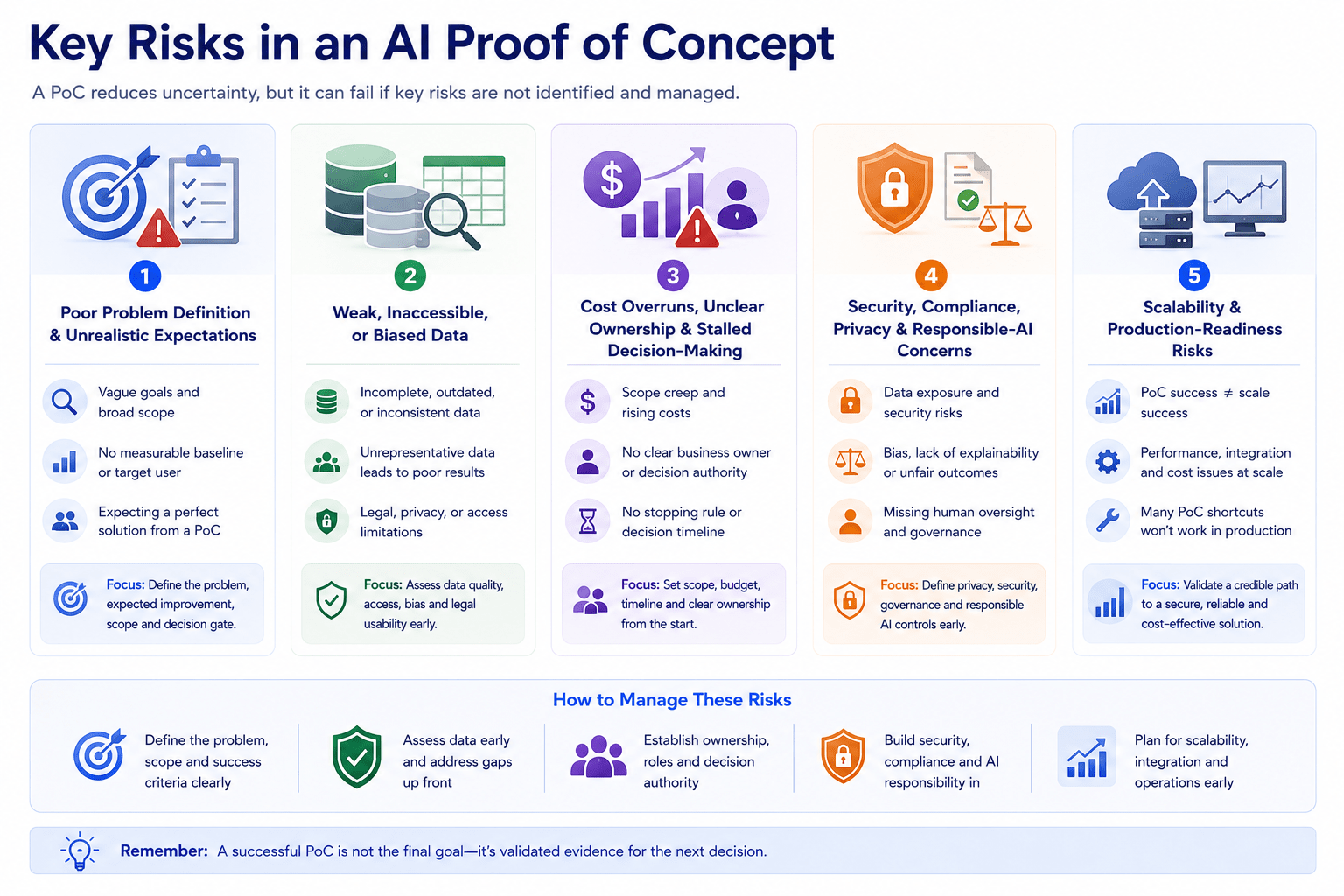
Poor Problem Definition and Unrealistic Expectations
Many AI PoCs begin with an ambition such as “improve efficiency” rather than a specific workflow or decision. Without a narrow problem, measurable baseline, and defined target user, the team may produce an impressive demo that does not solve a meaningful business need.
Expectations must also reflect the limits of an early-stage experiment. A PoC is intended to validate feasibility and value, not deliver a complete or flawless solution.
To manage this risk, define the business problem, expected improvement, scope, constraints, and decision gate before model selection. Success should be measured against agreed evidence rather than stakeholder enthusiasm.
Weak, Inaccessible, or Biased Data
Poor data is one of the most common causes of unreliable PoC results. Data may be incomplete, outdated, inconsistent, stored across disconnected systems, or unavailable within the project timeline.
Historical data may also reflect past process errors or data bias. A model trained on unrepresentative data can appear accurate overall while performing poorly for important users, scenarios, or edge cases.
The team should assess data quality, access rights, ownership, representativeness, and legal usability before development. Cleaning, relabelling, anonymization, additional data collection, or synthetic data may be required, but these methods should not conceal gaps that would remain in production.
Cost Overruns, Unclear Ownership, and Stalled Decision-Making
AI PoCs can become expensive when the scope expands, integrations are added too early, or teams continue experimenting without a clear stopping rule. Costs may also rise through data preparation, cloud usage, specialist support, licensing, or repeated model testing.
Unclear ownership creates a related problem. Technical teams may complete the work, but no business owner is prepared to approve the next investment, change the workflow, or stop the initiative.
This risk can be reduced by setting a fixed scope, budget ceiling, timeline, and evidence requirements from the start. The project should have an accountable business owner, an executive sponsor, and a named person with authority to make the go, iterate, pause, or stop decision.
Security, Compliance, Privacy, and Responsible-AI Concerns
Even a limited PoC can expose sensitive information or influence important decisions. Risks may include unauthorized data access, insecure third-party tools, privacy violations, biased outputs, limited explainability, or inappropriate automation.
The required controls should reflect the impact of the use case. Systems used in lending, recruitment, healthcare, fraud detection, or employee decisions typically require stronger oversight than low-risk internal productivity tools.
The PoC should define data privacy, access controls, retention rules, security requirements, audit logs, and where human oversight is mandatory. Responsible AI testing should also cover bias, harmful outputs, explainability, confidence levels, and the consequences of incorrect decisions.
Security, legal, and compliance stakeholders should be involved early enough to shape the design rather than reviewing it only after the model has been built.
Scalability and Production-Readiness Risks
A successful PoC does not prove that the solution can operate reliably at scale. Controlled tests often use limited data, manual processes, simplified integrations, and temporary infrastructure.
Problems may appear when the solution faces higher volumes, concurrent users, changing data, stricter latency requirements, or live enterprise systems. Costs can also increase sharply as model usage, storage, monitoring, and human-review requirements grow.
Before advancing, the team should assess whether the proposed AI architecture can support expected demand, security controls, system integration, monitoring, maintenance, and failure recovery. It should also identify which PoC shortcuts must be replaced before a pilot or production release.
The objective is not to build a production-grade system during the PoC. It is to confirm that there is a credible path from experimental success to a secure, maintainable, and economically viable solution.
AI PoC Examples and Lessons by Industry
The value of an AI Proof of Concept depends less on the industry than on how clearly the problem, data, success metrics, and next decision are defined. The following examples show how organizations can use a PoC to test a narrow use case before committing to wider deployment.
Healthcare and Life Sciences
A healthcare provider may test AI-powered medical imaging to support the early detection of abnormalities in X-rays, MRIs, or other clinical images.
- Problem: Clinicians spend significant time reviewing images, while subtle indicators may be difficult to detect consistently.
- Data: Historical medical images with verified diagnoses, clinical labels, and relevant patient information.
- Success metric: Detection accuracy, false-negative rate, review time, and agreement with qualified clinicians.
- Learning: Strong model accuracy alone is insufficient. The PoC must also test data representativeness, explainability, clinician trust, privacy, and how the output fits into clinical workflows.
- Next decision: Proceed to a controlled pilot if the model improves review efficiency without increasing clinical risk. Otherwise, refine the dataset, model, or intended use.
Financial Services
A financial institution may use an AI PoC to test fraud detection, credit-risk assessment, customer-service automation, or personalized banking recommendations.
- Problem: Existing rules may miss complex fraud patterns or generate too many false alerts, increasing manual-review effort.
- Data: Transaction histories, customer behaviour, confirmed fraud cases, account activity, and review outcomes.
- Success metric: Fraud-detection rate, false-positive rate, investigation time, financial loss prevented, and customer impact.
- Learning: A model may identify more suspicious activity but still create limited value if it overwhelms review teams or cannot explain high-impact decisions. AI governance, auditability, and human approval are critical.
- Next decision: Advance if the solution improves detection while remaining operationally manageable and compliant. Otherwise, adjust thresholds, data sources, or the human-review process.
Retail and Customer Experience
Retailers can use AI PoCs to test demand forecasting, product recommendations, inventory optimization, or AI-assisted customer support.
- Problem: Inaccurate demand forecasts can lead to stockouts, overstock, lost sales, and unnecessary storage costs.
- Data: Historical sales, inventory levels, promotions, seasonality, pricing, customer behaviour, and external demand signals.
- Success metric: Forecast accuracy, stockout rate, excess inventory, inventory turnover, and sales availability.
- Learning: The PoC should account for seasonal changes, promotions, new products, and unusual demand patterns. A model that performs well on average may still fail during commercially important periods.
- Next decision: Pilot the solution within a limited product category or location if it improves forecast quality and inventory outcomes. Expand only after performance remains stable under changing conditions.
Manufacturing, Logistics, and Predictive Maintenance
Manufacturing and logistics organizations may test predictive maintenance, route optimization, quality inspection, or demand and capacity forecasting.
- Problem: Unplanned equipment failure or inefficient logistics can increase downtime, maintenance costs, delivery delays, and operational disruption.
- Data: Sensor readings, maintenance histories, machine logs, failure records, route information, delivery times, and operating conditions.
- Success metric: Downtime avoided, failure-prediction accuracy, maintenance cost, delivery time, asset utilization, and false-alarm rate.
- Learning: Reliable outcomes depend on consistent sensor data and sufficient examples of failure conditions. Excessive false alarms can reduce trust and create unnecessary maintenance work.
- Next decision: Move to a limited operational pilot if the model predicts failures or disruptions early enough to support action. Pause if data gaps or integration limitations make the results unreliable.
Marketing, Legal, and Knowledge-Work Automation
Knowledge-intensive teams can use AI PoCs for content generation, customer segmentation, document review, contract analysis, compliance screening, enterprise search, and document automation
- Problem: Employees spend substantial time searching for information, reviewing documents, extracting key clauses, or repeating similar drafting tasks.
- Data: Contracts, policies, marketing content, customer records, internal knowledge bases, emails, and previously approved outputs.
- Success metric: Time saved, extraction accuracy, response quality, review effort, user adoption, and the rate of unsupported or incorrect outputs.
- Learning: Generative AI can accelerate knowledge work, but its outputs still require clear source grounding, access controls, review procedures, and limits on automated decisions. A faster process is not valuable if users must extensively correct the results.
- Next decision: Advance to a pilot when the solution consistently reduces manual effort while maintaining acceptable accuracy and oversight. Refine or narrow the use case when output quality varies too widely.
Across industries, the most valuable PoC outcome is not always a successful model. A PoC may reveal that the data is insufficient, the workflow is unsuitable, or a simpler solution would create more value. These findings still support a sound decision and prevent larger investments in an unviable approach.
From Successful PoC to Pilot and Production
A successful AI Proof of Concept confirms that an idea deserves further investment, but it does not prove that the solution is ready for wider deployment. Moving forward requires evidence that the system can handle real users, live data, operational dependencies, and higher volumes without creating unacceptable cost or risk.
A pilot should validate the solution within a limited production environment. Full deployment goes further, requiring scalable infrastructure, clear ownership, reliable monitoring, and an operating model that can sustain value over time.
Confirm Scale-Readiness Before Expanding
Before expanding the PoC, the organization should confirm that results remain consistent across representative cases, users, and expected workloads. It should also identify which temporary PoC shortcuts must be replaced.
Manual data transfers, simplified integrations, temporary infrastructure, and informal review processes may be acceptable during experimentation but unsuitable for live operations. Scale-readiness requires a credible plan for AI system integration, security, support, governance, user training, and long-term ownership.
The decision to proceed should reflect the full cost and complexity of scaling, not only the model’s technical performance.
Plan Integration, Monitoring, Human Oversight, and Continuous Improvement
Moving from PoC to production requires the solution to fit into an existing business workflow. The organization should define how data enters the system, how outputs reach users, which applications must be connected, and what happens when the model or an integration fails.
A production plan should include AI model monitoring for output quality, latency, data changes, error patterns, and usage costs. Clear thresholds should determine when the system continues automatically, requests human oversight, falls back to another process, or is suspended.
Named teams should own technical support, model updates, user feedback, security, compliance, and business performance. Changes to models, prompts, data, or decision rules should follow a controlled review process rather than informal experimentation.
Current Considerations for Generative AI and Edge AI PoCs
For generative AI PoCs, evaluation should cover factual accuracy, output consistency, unsupported responses, prompt injection, sensitive-data exposure, and user overreliance. Systems connected to enterprise data or external tools also require strict permissions, action limits, and human approval for high-impact tasks.
For edge AI, testing should take place on the intended hardware and under realistic operating conditions. Teams should assess latency, power and memory limits, connectivity interruptions, device security, local data processing, remote updates, and monitoring across distributed locations. Edge deployment can improve speed and privacy, but it also introduces additional device-management responsibilities.
AI PoC Checklist
This AI PoC checklist helps teams confirm that the initiative is properly framed, evaluated, and documented. It should support decision-making rather than become a box-ticking exercise.
Before the PoC Starts
- Define the business problem, target workflow, accountable owner, baseline, and measurable success criteria.
- Confirm that relevant data is accessible, suitable, representative, and legally usable.
- Set the scope, timeline, budget ceiling, delivery model, and decision authority.
- Identify technical, privacy, security, compliance, and responsible AI requirements.
The PoC should not begin until the team can explain what is being tested, why it matters, and what evidence will determine the next step.
During Build and Evaluation
- Build only the minimum solution required to test the hypothesis.
- Evaluate representative cases, edge cases, failure conditions, and high-risk scenarios.
- Measure business value, model quality, usability, integration, and operational effort against the original baseline.
- Document data sources, model choices, prompts, assumptions, changes, results, and limitations.
Structured feedback should also be collected from users, domain experts, and risk stakeholders. Success criteria should not be changed after results become available simply to make the PoC appear stronger.
Before Approving a Pilot or Production Rollout
- Confirm that the PoC met its approved business, technical, and risk thresholds.
- Review the total cost of integration, infrastructure, licensing, oversight, maintenance, and support.
- Define production ownership, monitoring, human review, fallback, escalation, and incident-response procedures.
- Record the final go, iterate, pause, or stop decision and the evidence supporting it.
A pilot or production rollout should proceed only when there is a credible path to sustainable value, not merely because the PoC produced an impressive demonstration.
Frequently Asked Questions
How Long Should an AI PoC Take?
A well-scoped AI PoC commonly takes four to twelve weeks. The timeline depends on data readiness, integration complexity, evaluation requirements, and the risk level of the use case.
A PoC that continues for many months without producing a decision may be too broad. The purpose is to test the most important assumptions quickly, not to build a production-ready system.
What Makes an AI PoC Successful?
A successful AI PoC produces enough credible evidence to support a clear business decision. It should test a specific hypothesis, use appropriate data, meet predefined performance thresholds, and demonstrate a measurable benefit.
Success does not always mean advancing. Discovering that a use case is too expensive, risky, or technically unsuitable is also a valuable outcome because it prevents further investment in the wrong solution.
How Much Does an AI PoC Cost?
The cost of an AI PoC depends on the use case, data-preparation effort, model requirements, integrations, security controls, delivery model, and specialist expertise involved.
The budget should cover more than model development. Data preparation, infrastructure, evaluation, governance, documentation, vendor fees, and stakeholder involvement should also be included.
What Data Is Needed for an AI PoC?
An AI PoC needs data that is relevant to the business problem and representative of the conditions the system will encounter. The required volume and format depend on whether the use case involves forecasting, classification, document processing, computer vision, or generative AI.
The data must also be accurate enough for evaluation, accessible within the project timeline, and legally suitable for the intended use. A smaller high-quality dataset is often more useful than a large but unreliable one.
Should a Company Build an AI PoC Internally or Hire a Vendor?
Building internally provides greater control and works best when the organization already has the required AI, data, product, integration, and governance capabilities. Hiring an AI development company or implementation partner can accelerate delivery when internal expertise is limited.
A hybrid model is often the strongest option. The organization retains ownership of the business problem, data, governance, and final decision, while external specialists support technical delivery, architecture, evaluation, or integration.
Conclusion: Make the PoC a Business Decision, Not a Technology Demo
An AI Proof of Concept should reduce uncertainty around a specific business decision. It should combine a clear use case, suitable data, measurable success criteria, responsible controls, and operationally relevant evidence.
The outcome may be to advance, iterate, narrow the scope, pause, or stop. Each is valuable when it supports a better investment decision.
Next Steps: Plan Your AI PoC
Start with one defined workflow or decision, then establish the baseline, expected outcome, data requirements, accountable owner, and success criteria.
Explore SmartDev’s AI consulting services, AI-powered software development, AI case studies, and AI strategy resources to assess feasibility and plan the right delivery approach.