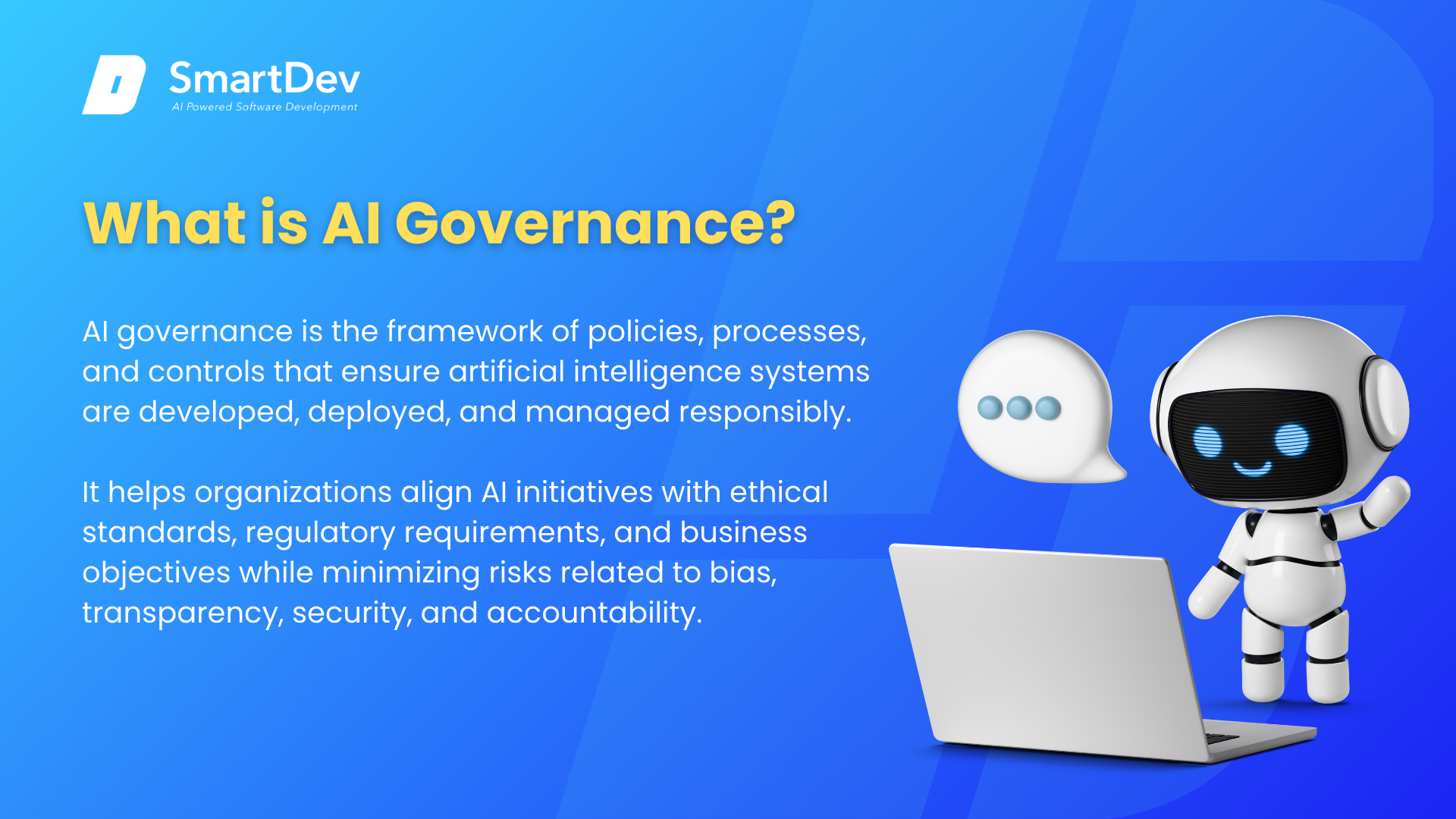
AI governance is the framework of policies, processes, and controls that ensure artificial intelligence systems are developed, deployed, and managed responsibly. It helps organizations align AI initiatives with ethical standards, regulatory requirements, and business objectives while minimizing risks related to bias, transparency, security, and accountability.
AI governance applies across the entire AI lifecycle, including data collection, model training, validation, deployment, and ongoing monitoring. It ensures that AI outputs remain reliable, explainable, and compliant with internal policies as well as external regulations. As AI adoption accelerates across industries, governance becomes essential to maintain trust, consistency, and long-term sustainability.
Why AI Governance Matters for Businesses?
AI governance enables organizations to scale AI safely while maintaining trust, compliance, and operational reliability. Without structured oversight, AI systems may produce biased decisions, create compliance risks, or damage brand reputation.
 Key benefits include:
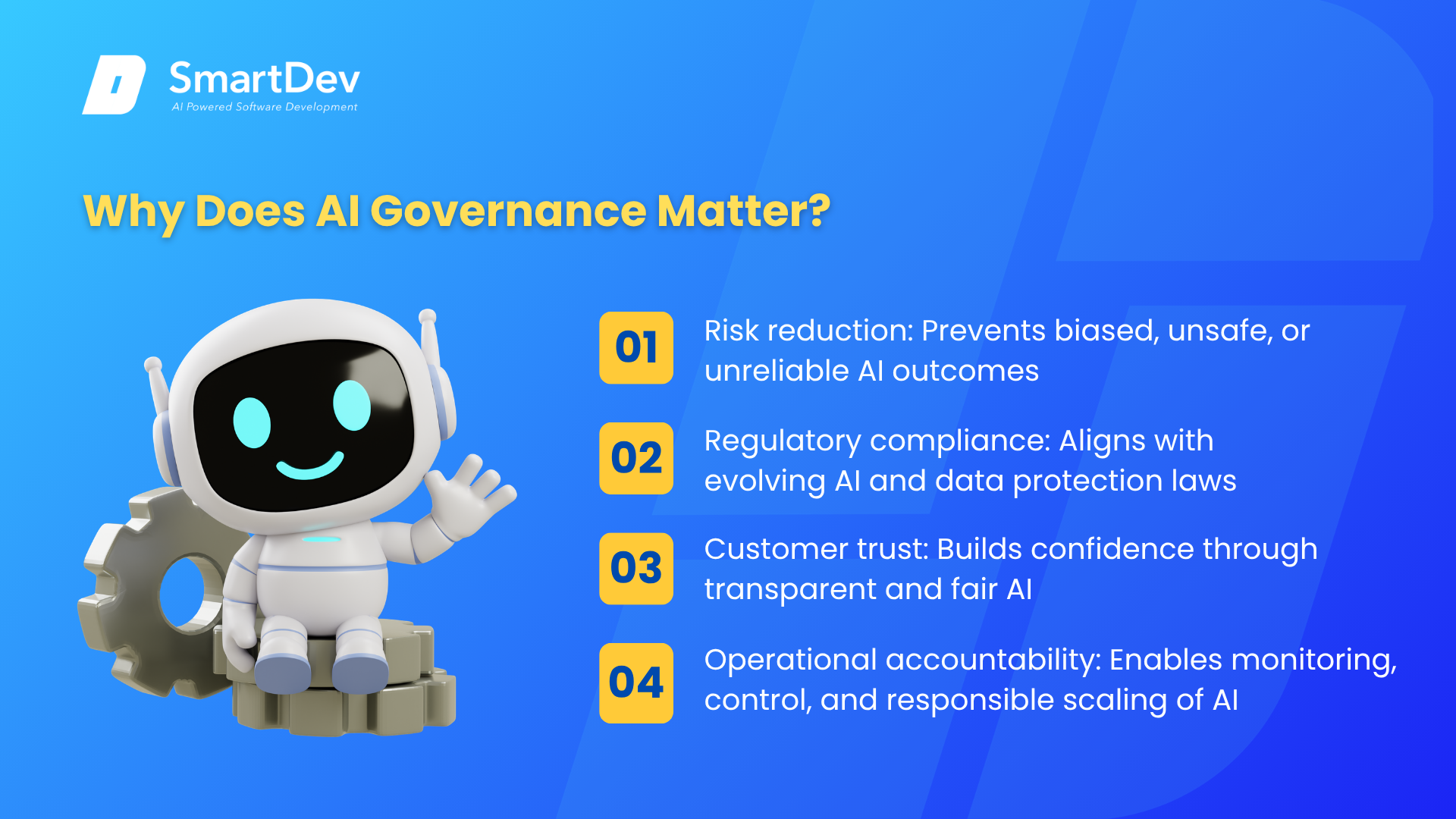
- Risk reduction: Prevents biased, unsafe, or unreliable AI outcomes
- Regulatory compliance: Aligns with evolving AI and data protection laws
- Customer trust: Builds confidence through transparent and fair AI
- Operational accountability: Enables monitoring, control, and responsible scaling of AI
Strong governance helps organizations balance innovation with risk management, ensuring AI delivers measurable value without creating unintended consequences.
When is AI Governance needed?
AI governance becomes critical when organizations deploy AI systems that influence decisions, automate processes, or interact with customers. It is especially important in regulated industries such as finance, healthcare, insurance, and public services, where transparency and accountability are required.
Governance is also needed when companies adopt generative AI, machine learning models, or workflow automation tools at scale. As AI begins to impact hiring decisions, fraud detection, credit scoring, medical diagnostics, or customer interactions, structured oversight ensures outcomes remain fair, auditable, and aligned with business goals.
Additionally, organizations implementing enterprise-wide AI platforms require consistent governance standards to avoid fragmented or uncontrolled AI experimentation across departments.
How does AI Governance work?
AI governance combines organizational policies, technical controls, and monitoring mechanisms to manage AI risks throughout the system lifecycle. The process typically begins with defining governance principles, including ethical guidelines, compliance requirements, and acceptable risk thresholds.
Organizations implement validation procedures such as bias testing, explainability techniques, and data quality checks to ensure AI models produce reliable results. Monitoring systems continuously track model performance, identifying drift, anomalies, or unintended outcomes that could impact business operations.
Governance frameworks often include human oversight, documentation standards, audit trails, and approval workflows to maintain transparency and accountability. Many enterprises also establish cross-functional governance teams responsible for defining policies, managing risks, and ensuring compliance across AI initiatives.
その他の関連用語
- Responsible AI: Ensures AI systems operate ethically, fairly, and transparently, minimizing bias and unintended harm. Responsible AI principles often guide governance frameworks and decision policies.
- AI Security & Compliance: Focuses on protecting AI systems and ensuring they meet regulatory requirements related to privacy, safety, and data protection.
- データガバナンス: Defines policies and standards for managing data quality, privacy, and accessibility, forming the foundation for trustworthy AI systems.


160 ロビンソンロード、14-04 シンガポールビジネスフェデレーションセンター、シンガポール (068914)

Rue de la Gare 11、1260 ニヨン、スイス

151 Wardour Street、ロンドン、イギリス、W1F 8WB

6th floor, News Agency Building, 81 Quang Trung Street, Hai Chau Ward, Danang
19 Duy Tan Street, Cau Giay Ward, Hanoi

ドバイ国際金融センター、ドバイ、UAE

The Wildlife Tower Plot 31, Kanjokya Street, Kampala Uganda

Plateau, 66 Bld De La République, Immeuble Seydou Nourou Tall, 1er Étage, BP 11417, Dakar, Senegal

12 Chilekwa Mwamba Road, Longacres, Lusaka, Zambia