TL;DR
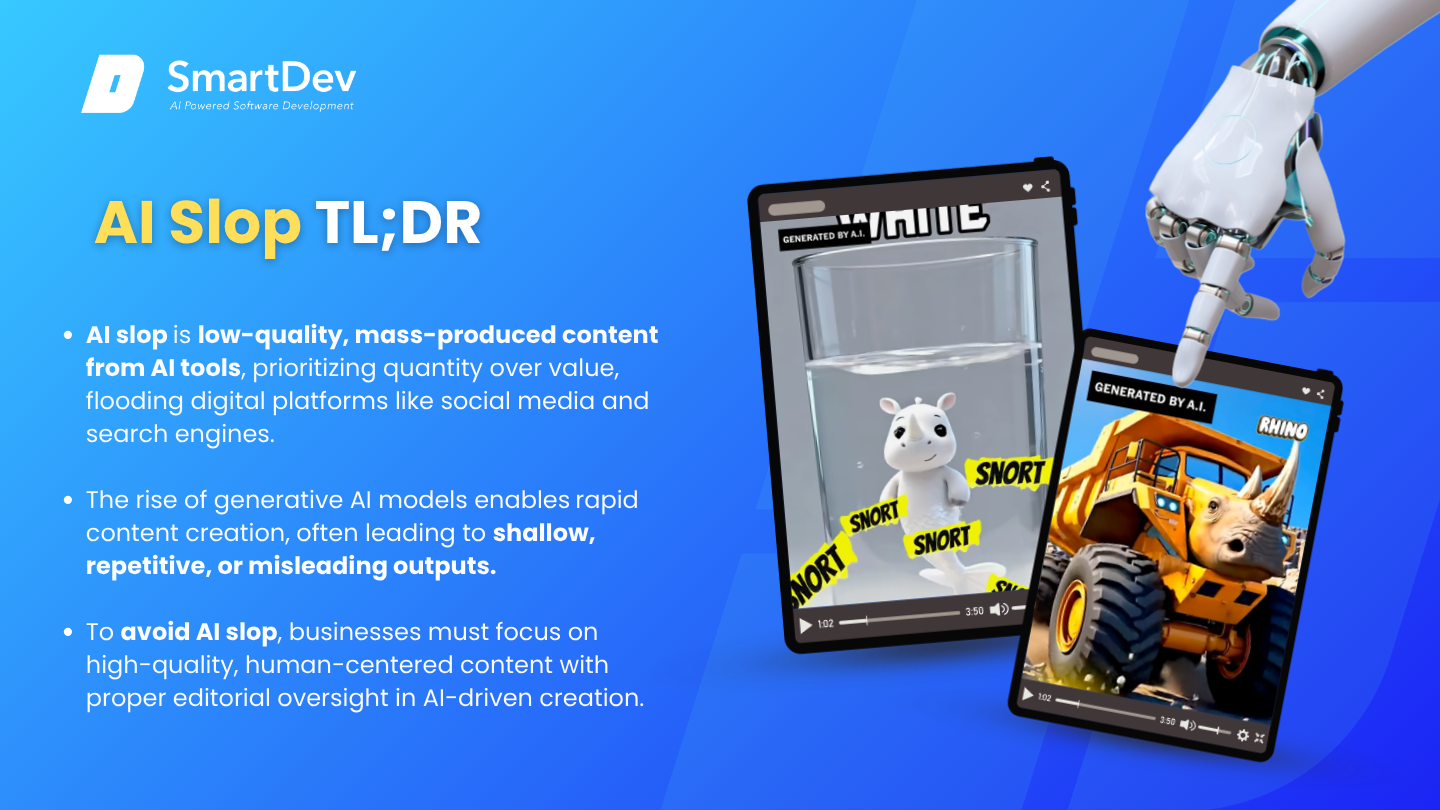
- AI slop refers to low-quality, mass-produced content generated by AI tools, often prioritizing quantity over value.
- It floods digital platforms like social media and search engines, often resulting in shallow, repetitive, or misleading content.
- The rise of AI slop is tied to the growing use of generative AI models, which allow rapid content creation with minimal human input.
- This trend negatively impacts content quality, reduces trust in AI-generated media, and can spread misinformation.
- To avoid contributing to AI slop, businesses should focus on high-quality, human-centered content and ensure proper editorial oversight in AI-driven creation.
What Is AI Slop?
AI slop refers to low-quality content churned out by AI systems designed to maximize engagement, clicks, or revenue without regard for real value. This includes generic articles, repetitive videos, shallow social media posts, and more. Often, AI-generated slop is produced without meaningful oversight or creative input, sacrificing quality for quantity. The goal of AI slop is to generate high volumes of content for the sake of ranking, clicking, and engaging, not for genuinely solving problems or informing audiences.
Why Does AI Slop Matter?
AI slop is more than just an online nuisance. It affects businesses, consumers, and the digital ecosystem in several critical ways:
1. Degrades Content Quality
2. Reduces Trust in AI
3. Spreads Misinformation
Who Produces AI Slop?
While AI slop isn’t created by any single entity, it’s typically produced by:
- Content Farms & Clickbait Sites: These platforms leverage AI tools to generate high volumes of content aimed at maximizing ad revenue, often without concern for the quality or integrity of the information.
- Social Media Creators & Influencers: Many social media influencers use AI-driven tools to generate posts that align with trending topics or keywords, but sometimes, this leads to repetitive, shallow, or misleading content.
- Political or Commercial Bad Actors: Some entities use AI tools to create and distribute low-quality, manipulative media to sway public opinion or sell products.
Where Does AI Slop Appears?
AI slop is pervasive in spaces where content is consumed in large volumes:
- Social Media Feeds
Platforms like Facebook, TikTok, and YouTube are often flooded with AI-generated posts that prioritize engagement over meaningful interaction.
- Search Engine Results
Search engines may pull up AI-generated content that’s optimized for ranking rather than relevance or depth, muddying search results with low-value information. - Automated Content Streams
News outlets and blogs use AI to produce articles, often in a bid to rank for keywords without focusing on research or thoughtful writing.
When Does AI Slop Become あ Thing?
The term “AI slop” gained traction in the early 2020s, as generative AI technologies like GPT-3 and various deep learning models became mainstream. These tools allowed businesses to automate content creation at scale, leading to a flood of subpar outputs designed to keep up with the demand for content. By 2024, public discourse around AI slop had become significant, with debates on its impact on information integrity and digital spaces.
How Does AI Slop Get Made?
AI slop is typically created through automated content-generation pipelines. Here’s how it works:
1. AI Models Generate Content
AI models like GPT, Jasper, or copywriting tools generate content based on data inputs (e.g., trending keywords, topics, or audience demands) with minimal human oversight.
2. Optimization for Engagement
Content is optimized for metrics like clicks, shares, and views rather than depth, accuracy, or real-world application.
3. Fast, Low-Cost Production
With AI tools, businesses can generate large volumes of content in minimal time. While this may be cost-effective, it often results in repetitive, shallow, or irrelevant material.
Why Should Businesses Care About AI Slop?
Businesses need to pay attention to AI slop because it has several far-reaching consequences:
1. Dilutes Brand Integrity
If a business leverages AI for content generation without adequate oversight, it may end up producing generic, low-value content that damages its brand reputation.
2. Challenges to SEO and Content Visibility
While AI slop can sometimes game algorithms, it can also be penalized by search engines that prioritize high-quality, authoritative content.
3. Customer Trust Issues
When AI slop is widely disseminated, consumers start questioning the legitimacy and reliability of AI-driven content. This could slow the broader adoption of AI solutions in marketing and other industries.
How Can Businesses Respond に AI Slop?
To avoid contributing to AI slop and ensure that their content remains valuable and trustworthy, businesses should:
1. Focus on High-Quality, Human-Centered Content
Instead of churning out content for the sake of volume, businesses should use AI tools to enhance human creativity, ensuring content that resonates with their audience and provides real value.
2. Educate Audiences About AI-Generated Content
By transparently acknowledging AI’s role in content creation, businesses can build trust and manage expectations regardingthe quality and authenticity of AI-powered materials.
3. Implement Content Review Controls
While AI tools can speed up content production, businesses must implement strong editorial processes to filter out AI slop and ensure all content aligns with brand values and standards.
その他の関連用語
1. AI Prototyping
The process of quickly building and testing rough versions of AI-powered tools or systems to assess their viability and functionality before full-scale development.
2. 生成AI
A subset of AI that focuses on creating new content, such as text, images, or music, through machine learning models that learn patterns from existing data.
3. AI統合
The process of embedding AI capabilities into existing systems, workflows, or applications to enhance performance, automation, or decision-making.