- Connects AI models with business systems to automate workflows and improve decision-making
- Enables practical AI adoption by embedding intelligence into existing processes
- Supports scalable digital transformation without replacing core infrastructure
What is AI Integration?
 AI integration is the process of embedding artificial intelligence capabilities into existing business systems, applications, and workflows to enhance automation, decision-making, and operational efficiency. Instead of functioning as standalone tools, AI models become part of enterprise technology environments such as ERP platforms, CRM systems, customer portals, internal dashboards, or software products.
AI integration connects machine learning models, generative AI, or intelligent agents with real business data and processes. It allows organizations to automate repetitive tasks, generate insights, personalize user experiences, and improve productivity without replacing existing infrastructure.
Modern organizations increasingly treat AI integration as part of digital transformation strategies. It enables companies to move from experimentation to production-ready AI systems that support long-term scalability and measurable business outcomes.
なぜ企業にとって重要なのか
AI integration allows businesses to unlock the value of artificial intelligence within existing technology ecosystems. Instead of building entirely new systems, organizations can enhance current workflows with intelligent capabilities that improve speed, accuracy, and decision quality.
 Business impact includes:
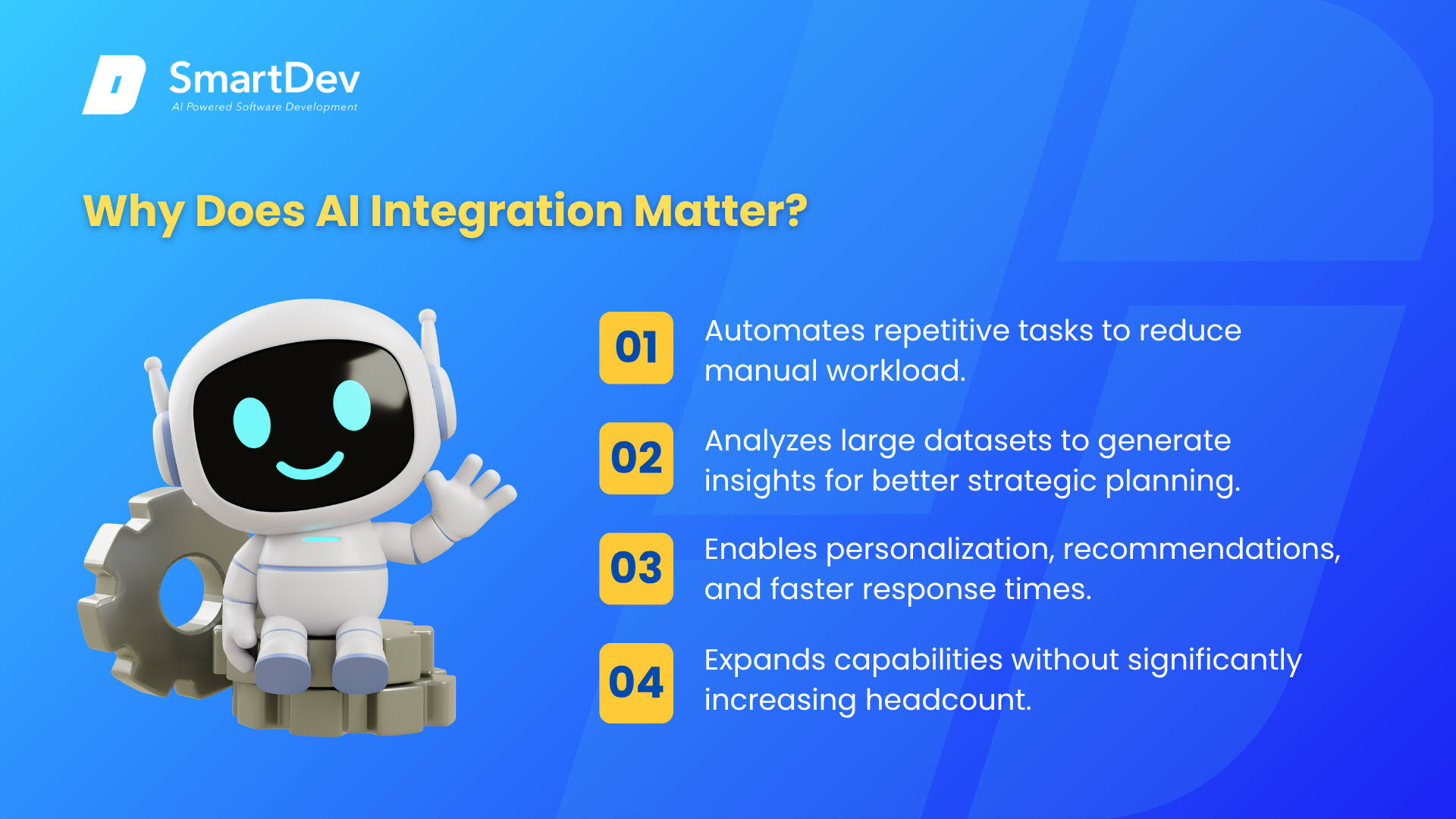
- Operational efficiency: AI automates repetitive tasks such as document processing, customer support responses, and data classification, reducing manual workload.
- Improved decision-making: AI models analyze large datasets to generate insights that support strategic planning and operational optimization.
- Enhanced customer experience: Integrated AI enables personalization, recommendation engines, and faster response times across digital channels.
- Scalable innovation: AI integration allows organizations to expand capabilities without significantly increasing headcount.
- Competitive advantage: Companies that embed AI into core workflows can respond faster to market changes and evolving customer expectations.
Without proper integration, AI initiatives often remain isolated proofs of concept that fail to generate measurable business value. Integration ensures that AI solutions become part of everyday operations and deliver continuous impact.
How does AI Integration work?
AI integration connects artificial intelligence models with existing business systems through structured data pipelines, APIs, and orchestration layers. The process usually begins by identifying practical use cases where AI can improve efficiency, reduce manual work, or support better decision-making. By focusing on real operational needs, organizations ensure that AI delivers measurable business value rather than remaining an isolated experiment.
To enable this connection, companies prepare and structure their data so that AI models can interact smoothly with current infrastructure. Integration layers allow AI systems to access both structured and unstructured data from sources such as databases, cloud platforms, and enterprise applications. This ensures that AI can operate within real workflows, using relevant business data to generate useful outputs.
Once deployed, AI models process inputs and produce results such as predictions, classifications, or recommendations that feed directly into operational systems. Monitoring tools track model performance and reliability over time, while feedback loops allow continuous improvement as data patterns evolve. Well-designed AI integration creates seamless interaction between AI components and enterprise environments without disrupting existing processes.
Where is AI Integration used?
AI integration is applied across multiple business functions and industries. In customer service environments, AI chat assistants and automated email systems improve response speed and reduce manual workload. In finance and operations, AI models support fraud detection, forecasting, and document classification.
Product teams integrate AI features such as recommendation engines, predictive analytics, and intelligent search into digital platforms. Marketing teams use AI integration to automate segmentation, content generation, and campaign optimization.
AI integration is also widely used in internal enterprise workflows, including HR automation, IT support ticket handling, and knowledge retrieval systems.
Organizations adopting AI-powered software development increasingly integrate AI tools directly into development workflows to improve coding efficiency, testing accuracy, and documentation generation.
その他の関連用語
- AI Strategy: A structured plan that defines how organizations prioritize, implement, and scale artificial intelligence initiatives. AI integration plays a key role in executing AI strategy by embedding models into real business workflows.
- 機械学習: A subset of AI that enables systems to learn patterns from data and make predictions or decisions without explicit programming. Machine learning models are commonly used as the core intelligence layer in AI integration projects.
- AI Model Deployment & Monitoring: The process of releasing trained AI models into production environments and continuously tracking their performance. Effective monitoring ensures that integrated AI systems maintain accuracy, reliability, and stability over time.