TL;DR:
- Code translation is the process of converting source code from one programming language to another while preserving its original logic and functionality.
- AI-powered code translation reduces modernization time by 40 to 50% and cuts implementation costs by up to 30% compared to manual rewrites.
- It is critical for businesses modernizing legacy systems, reducing technical debt, or migrating to new technology platforms.
Code translation is the process of converting an existing software codebase from one programming language to another, while maintaining the same functionality and business logic. For businesses running software built on aging technologies, code translation is often the first step toward modernization and long-term cost reduction. This article explains what code translation is, why it matters, how it works, and what it costs to undertake.
What is Code Translation?
Code translation is the automated or semi-automated process of transforming source code written in one programming language into equivalent source code in a different programming language, without changing the program’s underlying logic or output.
A company running critical software in COBOL, Visual Basic 6, or older Java may need to translate that code to modern languages like Python, Java 17, or Go to keep systems maintainable and scalable. Code translation handles that conversion systematically.
Modern code translation typically falls into two categories:
- Automated translation: AI models analyze the original code and generate equivalent code in the target language, with minimal human intervention.
- Human-assisted translation: A development team uses AI tools to accelerate the process but reviews and validates the output at each step.
The scope of translation can range from individual modules or functions to full-scale application rewrites across millions of lines of code.
なぜ企業にとって重要なのか
Legacy software is expensive to maintain and increasingly risky to operate. Organizations with aging codebases typically spend 75 to 85% of their IT budget maintaining existing systems, leaving little room for innovation.
Code translation addresses this by enabling businesses to move their most critical systems to modern, supported programming languages without starting from scratch.
Key business benefits include:
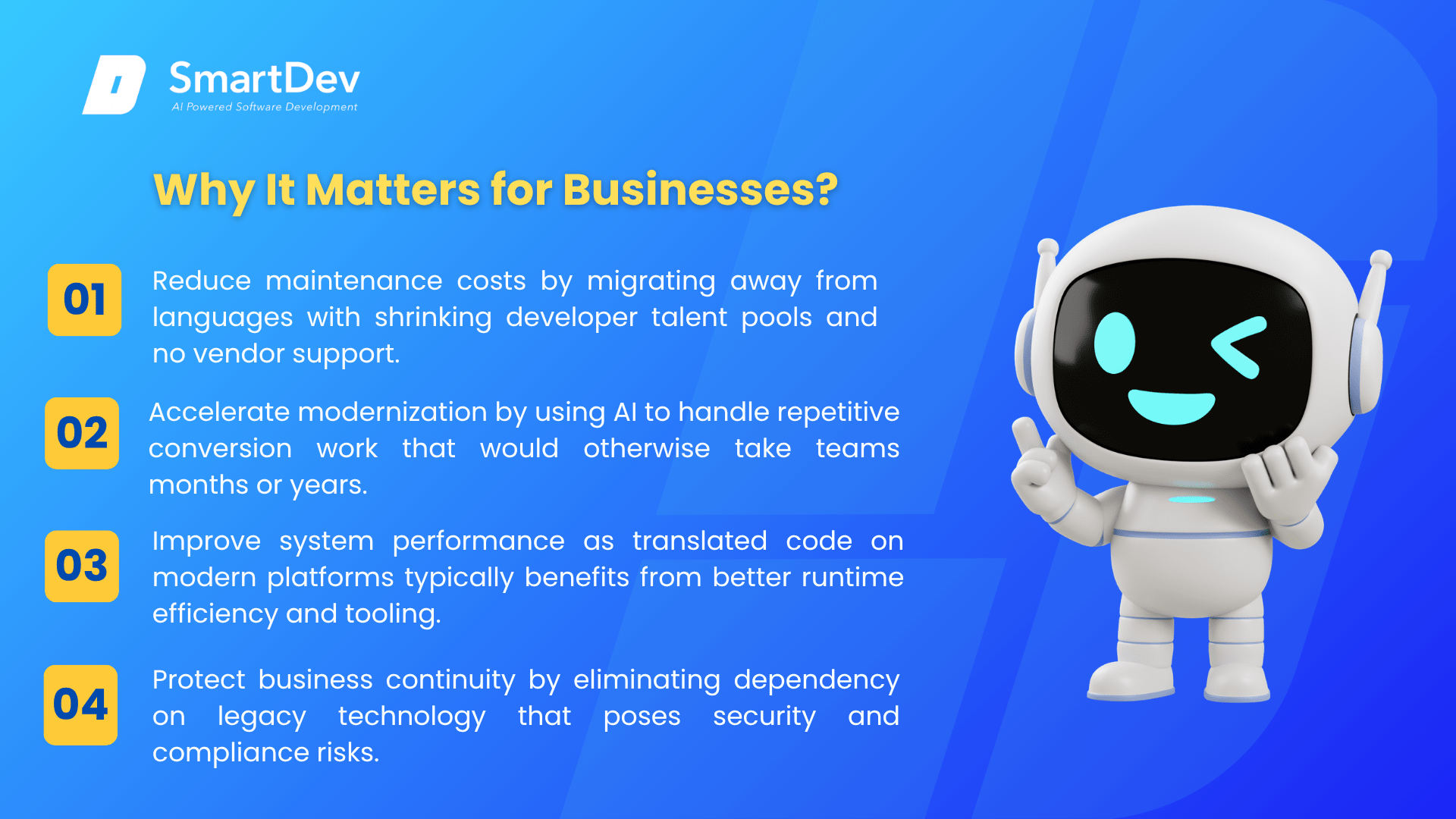
- Reduce maintenance costs by migrating away from languages with shrinking developer talent pools and no vendor support.
- Accelerate modernization by using AI to handle repetitive conversion work that would otherwise take teams months or years.
- Improve system performance as translated code on modern platforms typically benefits from better runtime efficiency and tooling.
- Protect business continuity by eliminating dependency on legacy technology that poses security and compliance risks.
For example, a financial services firm that engaged an IT outsourcing partner to translate its COBOL-based core processing system to Java completed the project in five months instead of the originally estimated 18, achieving a 30% reduction in implementation costs.
How Does It Work?
AI-assisted code translation follows a structured process:
- Codebase audit: The existing codebase is analyzed to map its structure, dependencies, data flows, and business logic. This produces a translation blueprint.
- Language mapping: The AI tool builds a translation model that maps constructs, functions, and patterns from the source language to equivalent constructs in the target language.
- Automated conversion: The AI generates translated code in the target language, handling syntax differences, library substitutions, and structural transformations automatically.
- Validation and testing: The translated code is tested against the original system’s outputs to confirm functional equivalence. Any gaps are flagged for human review.
- Cleanup and optimization: Developers refine the translated code to meet the conventions and performance standards of the target language.
The result is a modernized codebase that behaves identically to the original but is written in a language your current and future development teams can maintain, scale, and extend.
How Much Does It Cost?
Code translation costs depend on codebase size, language complexity, and the level of human oversight required.
- Small projects (under 100,000 lines of code): $30,000 to $150,000, typically completed in 4 to 12 weeks.
- Mid-size projects (100,000 to 500,000 lines): $150,000 to $600,000, spanning 3 to 9 months.
- Large enterprise projects (over 500,000 lines): $600,000 and above, often exceeding one year.
Three key cost factors include the complexity of business logic embedded in the original code, the number of external integrations and dependencies that must be preserved, and whether the target language requires significant architectural changes.
Compared to a full rewrite from scratch, AI-assisted code translation typically costs 25 to 40% less, because the AI handles the structural conversion and developers focus only on validation and optimization.
その他の関連用語
Code Migration: The process of moving software from one platform, environment, or language to another; code translation is often the first technical step within a broader code migration project.
Technical Debt: The accumulated cost of shortcuts and outdated design choices in a codebase; code translation is one of the primary ways organizations reduce technical debt systematically.
AI-assisted Engineering: The practice of using artificial intelligence tools to support software developers throughout the entire development process, from writing code and reviewing logic to generating tests, identifying bugs, and preparing releases.