TL;DR:
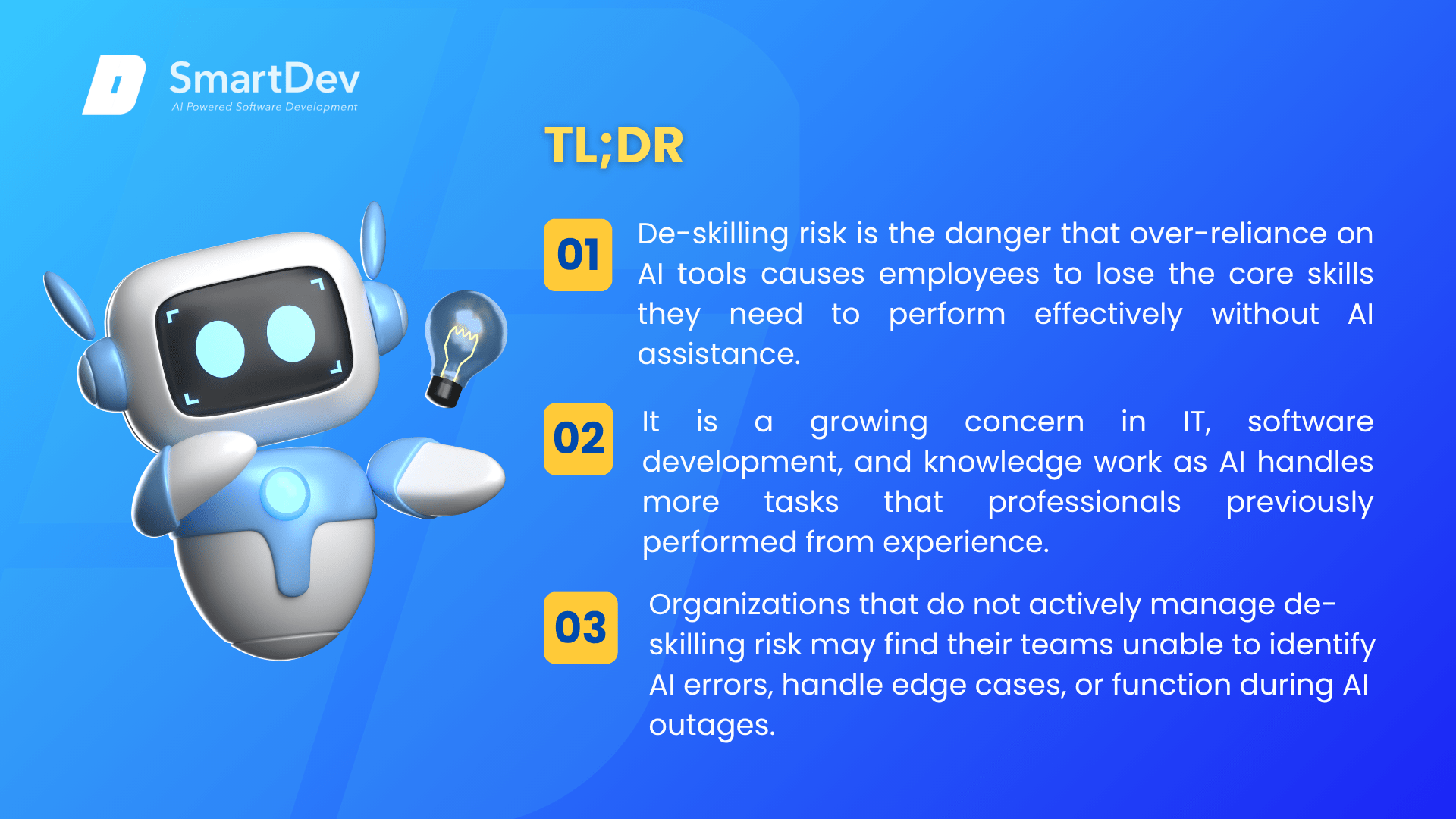
- De-skilling risk is the danger that over-reliance on AI tools causes employees to lose the core skills they need to perform effectively without AI assistance.
- It is a growing concern in IT, software development, and knowledge work as AI handles more tasks that professionals previously performed from experience.
- Organizations that do not actively manage de-skilling risk may find their teams unable to identify AI errors, handle edge cases, or function during AI outages.
As AI tools take over more routine cognitive and technical tasks, a quiet but serious risk is building inside many organizations. De-skilling risk is the gradual erosion of human expertise that occurs when professionals repeatedly delegate tasks to AI tools rather than performing them through their own knowledge and judgment. For business leaders investing in AI adoption, understanding and managing this risk is as important as capturing the productivity benefits AI delivers.
What is De-skilling Risk?
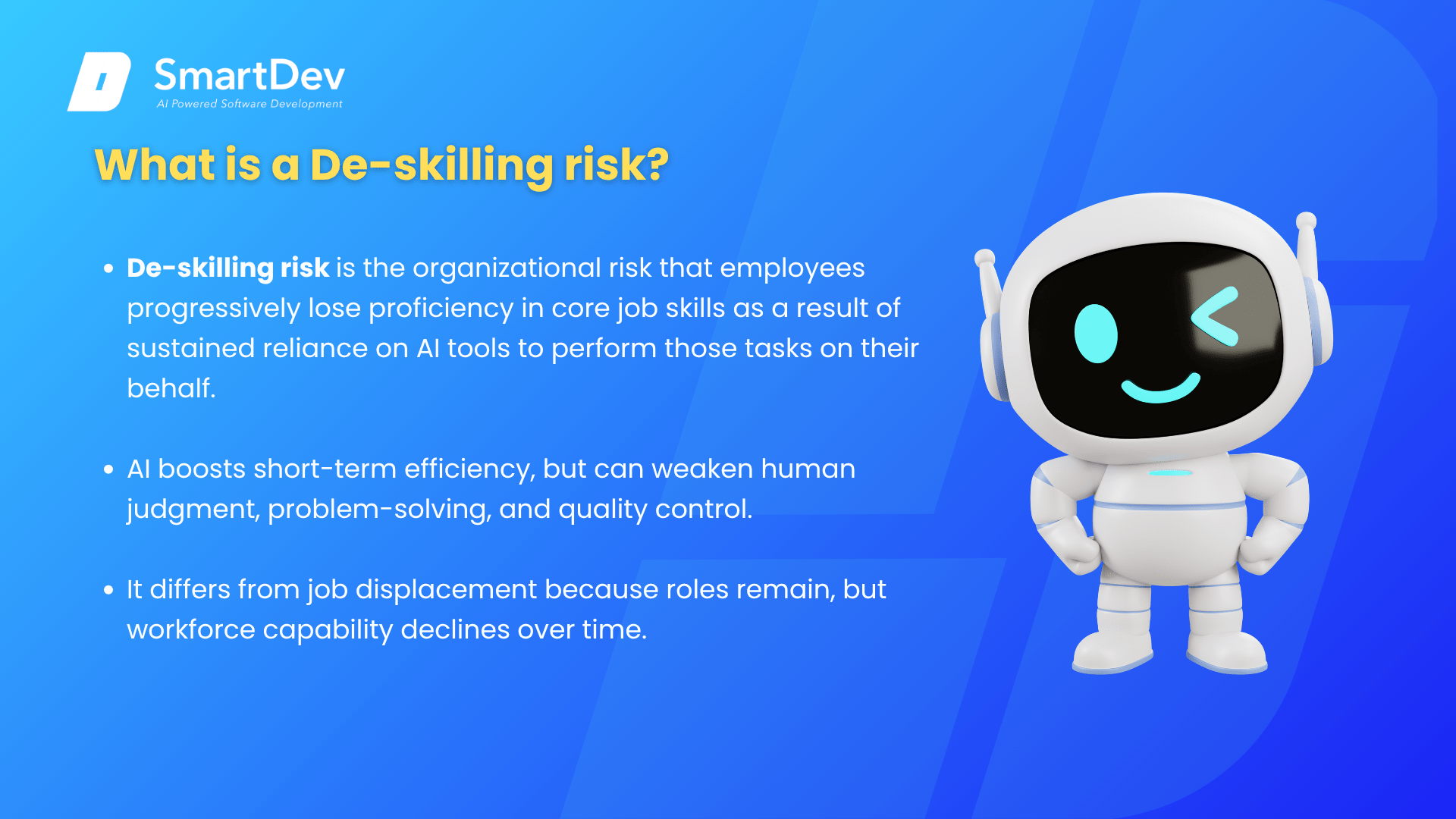
De-skilling risk is the organizational risk that employees progressively lose proficiency in core job skills as a result of sustained reliance on AI tools to perform those tasks on their behalf.
The mechanism is straightforward. When a developer uses an AI coding assistant to write functions they previously coded by hand, they practice that skill less. When a financial analyst uses AI to generate the first draft of every report, their ability to structure and interpret raw data independently atrophies. When a support agent relies on AI-suggested responses for every customer interaction, their own problem-solving capability weakens. The AI may deliver short-term efficiency gains while simultaneously reducing the human capability depth that the organization depends on for quality control, exception handling, and continuity.
De-skilling risk differs from job displacement. Displacement refers to roles being eliminated. De-skilling refers to the remaining workforce becoming less capable within their roles over time, even when headcount stays the same. A team of ten developers who collectively lose deep coding proficiency after two years of heavy AI dependence may cost the organization far more in quality incidents and vendor lock-in than the productivity gains they captured initially.
なぜ企業にとって重要なのか
The business impact of de-skilling compounds over time. Early effects are invisible because AI tools are covering the gap. Later effects surface as quality problems, inability to course-correct AI errors, and catastrophic exposure during AI outages or vendor changes.
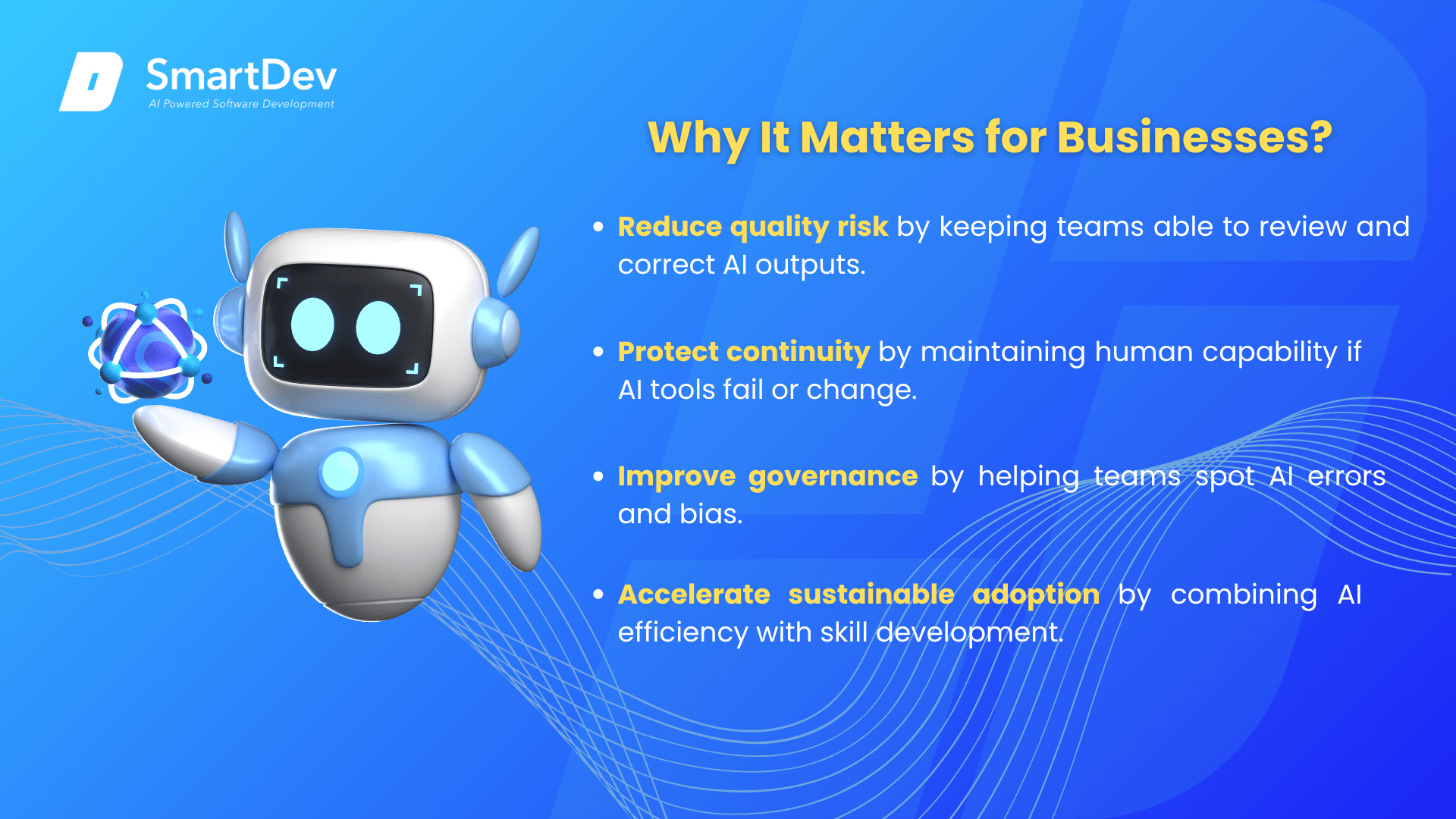
- Reduce quality risk by ensuring your team retains the expertise needed to evaluate, correct, and override AI outputs when they are wrong or inappropriate.
- Protect operational continuity by maintaining human capability that can function independently if AI tools become unavailable, change provider terms, or fail unexpectedly.
- Improve AI governance by developing team members who understand the work deeply enough to catch the errors and biases that AI tools introduce.
- Accelerate sustainable AI adoption by pairing efficiency gains with structured skill development that keeps the workforce adaptable across future technology changes.
For example, a software outsourcing firm introduced AI coding assistants across its development teams. Within eighteen months, senior developers reported that junior team members struggled to debug code they had not written themselves and could not explain why AI-generated solutions worked. The firm introduced mandatory code-without-AI exercises and structured code review rotations to rebuild baseline competency, adding modest overhead but significantly reducing production incidents tied to unreviewed AI suggestions.
Who Is Affected by De-skilling Risk?
De-skilling risk is most acute in roles where AI tools are capable enough to handle the full spectrum of routine tasks, leaving professionals with limited opportunities to practice foundational skills organically.
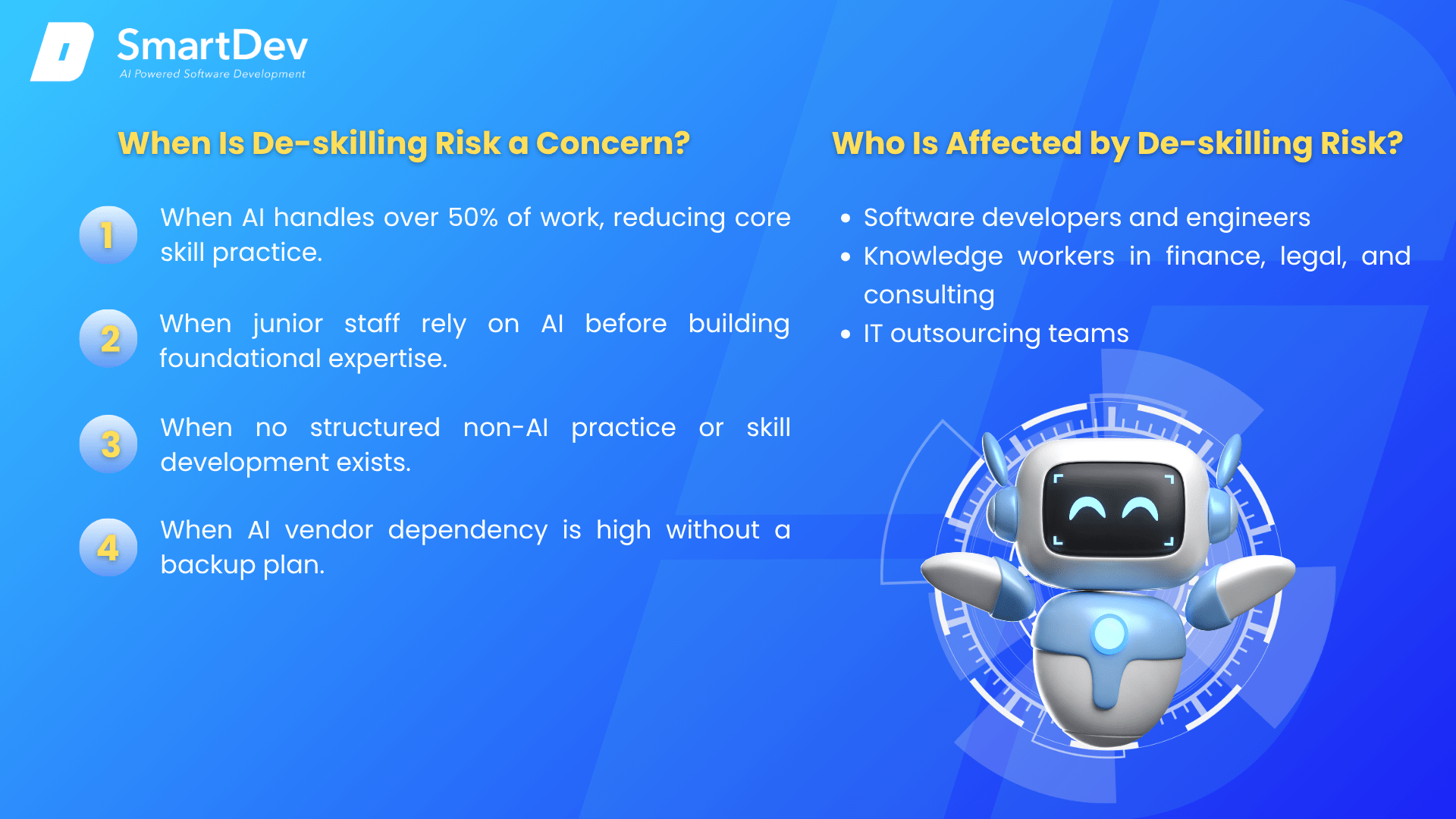
Software developers and engineers face significant de-skilling risk as AI coding assistants take over code writing, debugging, and documentation tasks that previously required active skill application. Junior developers are particularly exposed because they are still building the foundational knowledge that makes expert AI oversight possible.
Knowledge workers in finance, legal, and consulting risk losing analytical depth as AI tools generate first drafts, summaries, and data interpretations that would previously have required careful human reasoning and pattern recognition.
IT outsourcing teams managing client systems face de-skilling risk when AI automation handles the majority of monitoring, triage, and configuration tasks, reducing the hands-on experience that builds true operational expertise over time.
The organizational roles most concerned with managing de-skilling risk include Chief People Officers designing workforce development programs, Chief Technology Officers setting AI adoption policies, and IT Directors responsible for team competency frameworks in outsourced technology environments.
When Is De-skilling Risk a Concern?
De-skilling risk becomes a genuine organizational concern in specific circumstances:
- When AI tools handle more than 50% of a professional’s previously manual output, leaving insufficient opportunity to practice core skills independently.
- When junior or early-career staff members rely heavily on AI assistance before they have developed foundational expertise that would allow them to evaluate AI outputs critically.
- When no structured skill development or non-AI practice is built into team workflows, meaning skill erosion goes undetected until it causes a measurable problem.
- When AI vendor dependency is high and the organization has no documented plan for maintaining operations if AI tool access is interrupted or pricing changes materially.
De-skilling risk is not a reason to slow AI adoption. It is a signal that AI adoption must be paired with intentional workforce development to remain sustainable over the long term.
その他の関連用語
- Multi-File Editing: Is one of the most impactful advances in AI-assisted software development for enterprise teams.
- 責任あるAI: refers to the development, deployment, and use of artificial intelligence systems in a way that is ethical, transparent, fair, and aligned with societal values.
- AI Governance: The policies and oversight frameworks organizations use to manage AI adoption responsibly, including the workforce development commitments needed to prevent de-skilling from undermining the long-term value of AI investments.