TL;DR:
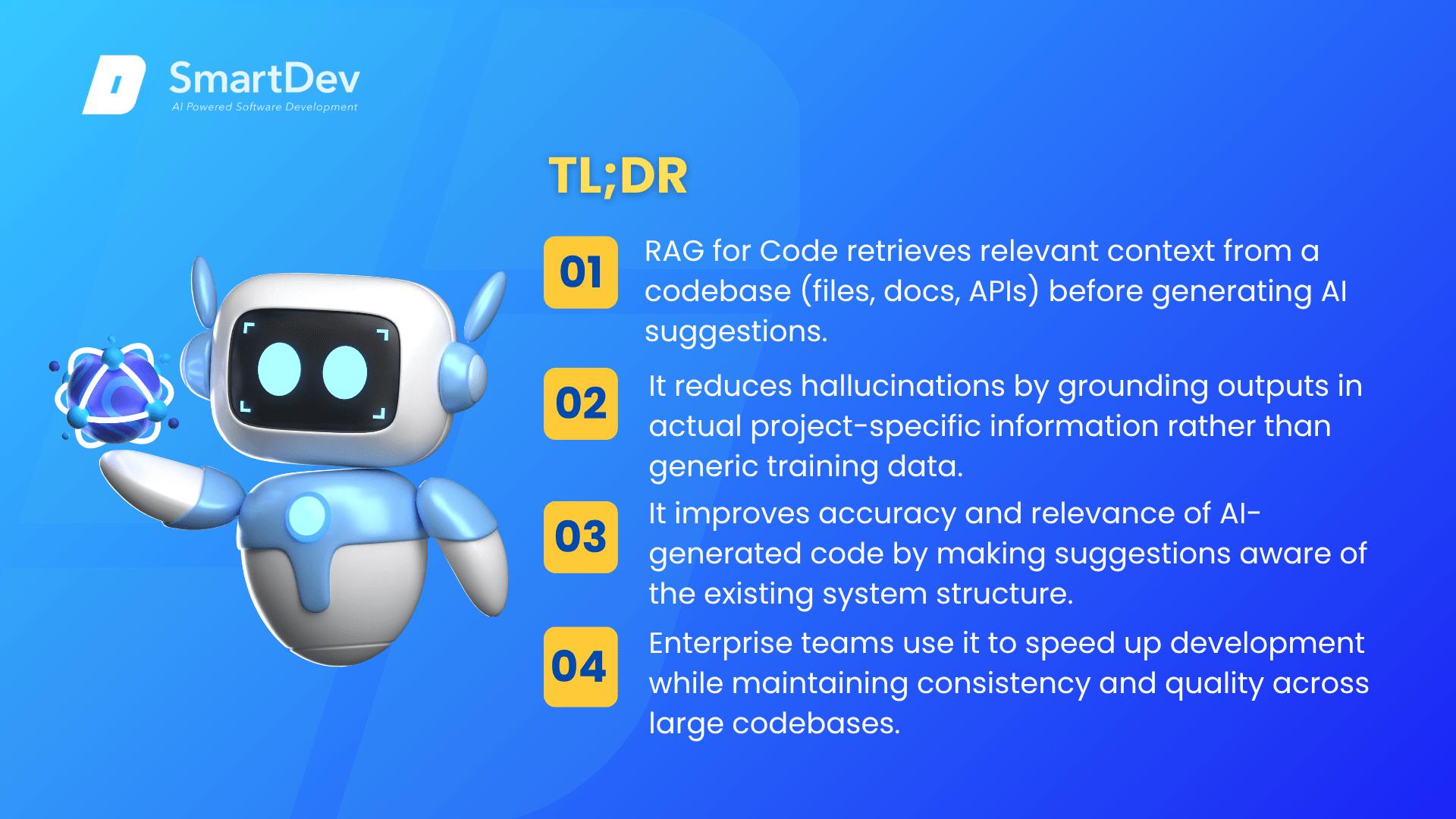
- RAG for Code is a technique that retrieves relevant code context before an AI generates a suggestion, producing more accurate and codebase-aware results.
- It dramatically reduces hallucinated code by grounding AI outputs in your actual project files, documentation, and APIs.
- Enterprise software teams use RAG for Code to accelerate development while maintaining quality and consistency across large codebases.
AI code assistants that generate suggestions without understanding your specific project often produce technically correct but contextually wrong outputs. RAG for Code solves this problem by retrieving the right context from your codebase before generating anything. The result is AI assistance that understands your system, not just syntax.
What Is RAG (for Code)?
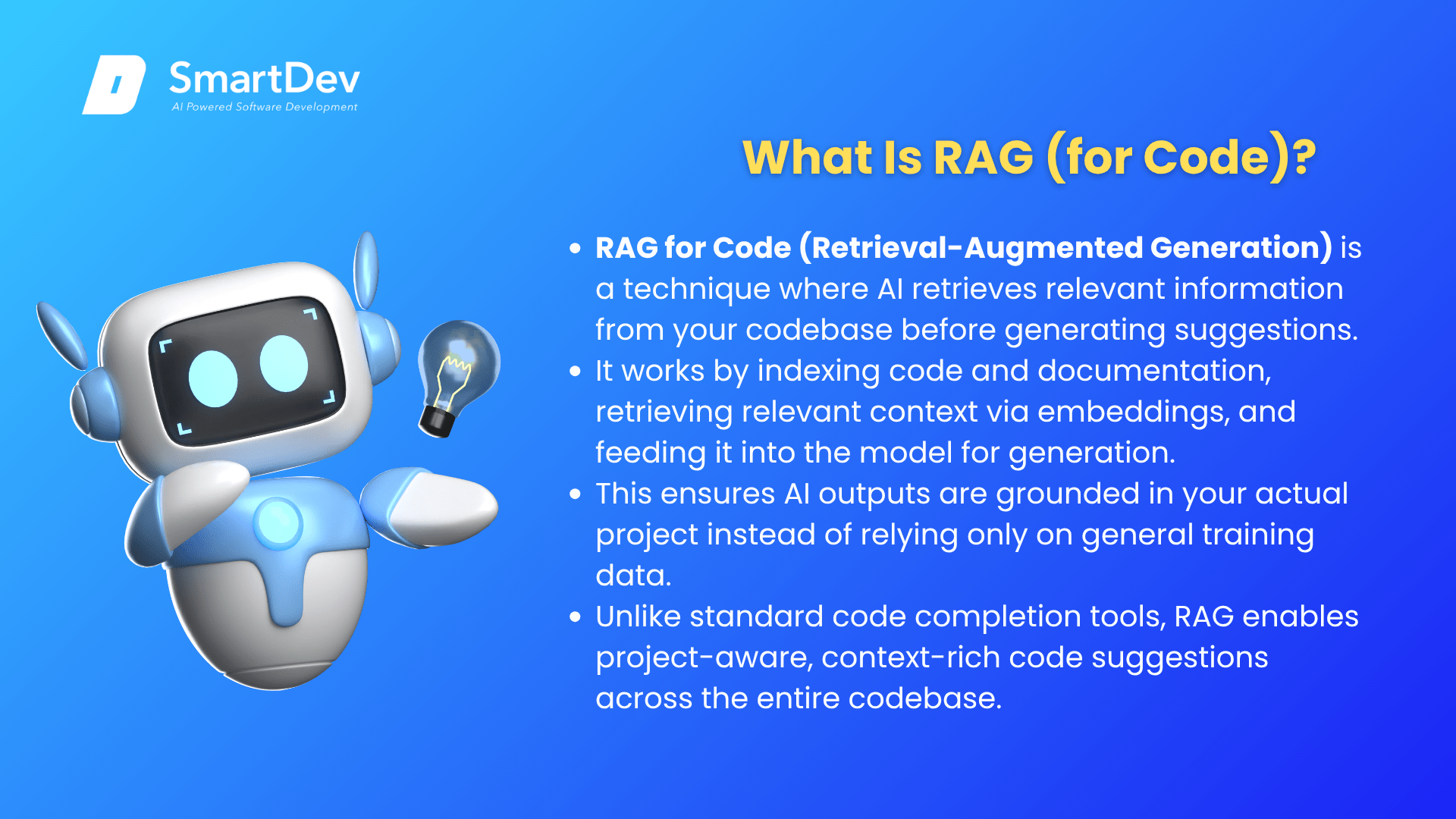
RAG stands for Retrieval-Augmented Generation. Applied to code, it is a technique where an AI model searches your codebase, documentation, or API references to retrieve relevant context before generating a code suggestion or answer. Instead of relying only on general training data, the model uses real, up-to-date information from your project.
The process works in three steps. First, your codebase is indexed into a vector database, where files, functions, and documentation are stored as numerical embeddings that capture meaning. Second, when a developer asks a question or requests a code suggestion, the system retrieves the most relevant pieces of your actual code. Third, this retrieved context is combined with the request and sent to the AI model, which generates a response grounded in your specific codebase.
This is fundamentally different from standard code completion tools that operate with no memory of your project beyond the file currently open.
なぜ企業にとって重要なのか
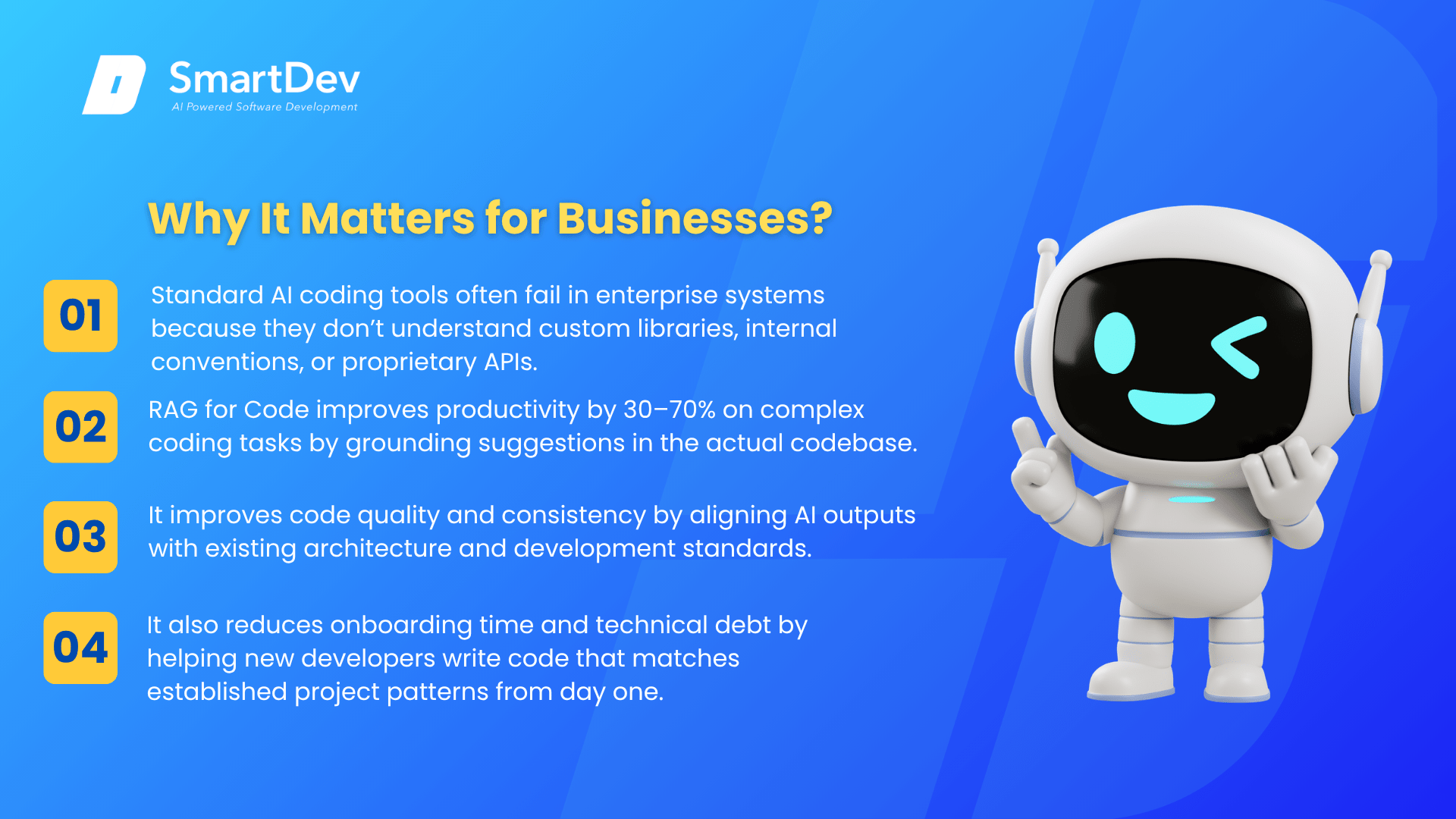
Standard AI coding tools generate suggestions based on general patterns learned from public code repositories. When your project has custom libraries, internal naming conventions, or proprietary APIs, those tools produce suggestions that require significant manual correction. This creates more work, not less.
RAG for Code changes the economics of AI-assisted development. Enterprise teams report productivity gains of 30 to 70 percent on knowledge-heavy coding tasks when RAG is implemented effectively. More importantly, code quality improves because suggestions align with existing architecture and standards.
For organizations running large, multi-year software systems, consistency matters enormously. Developers who are new to a codebase can produce contributions that follow established patterns from day one when they are supported by a RAG-powered tool that understands the project’s history and structure. This reduces onboarding time, code review friction, and the risk of introducing inconsistencies that compound into technical debt.
How Does It Work in Practice?
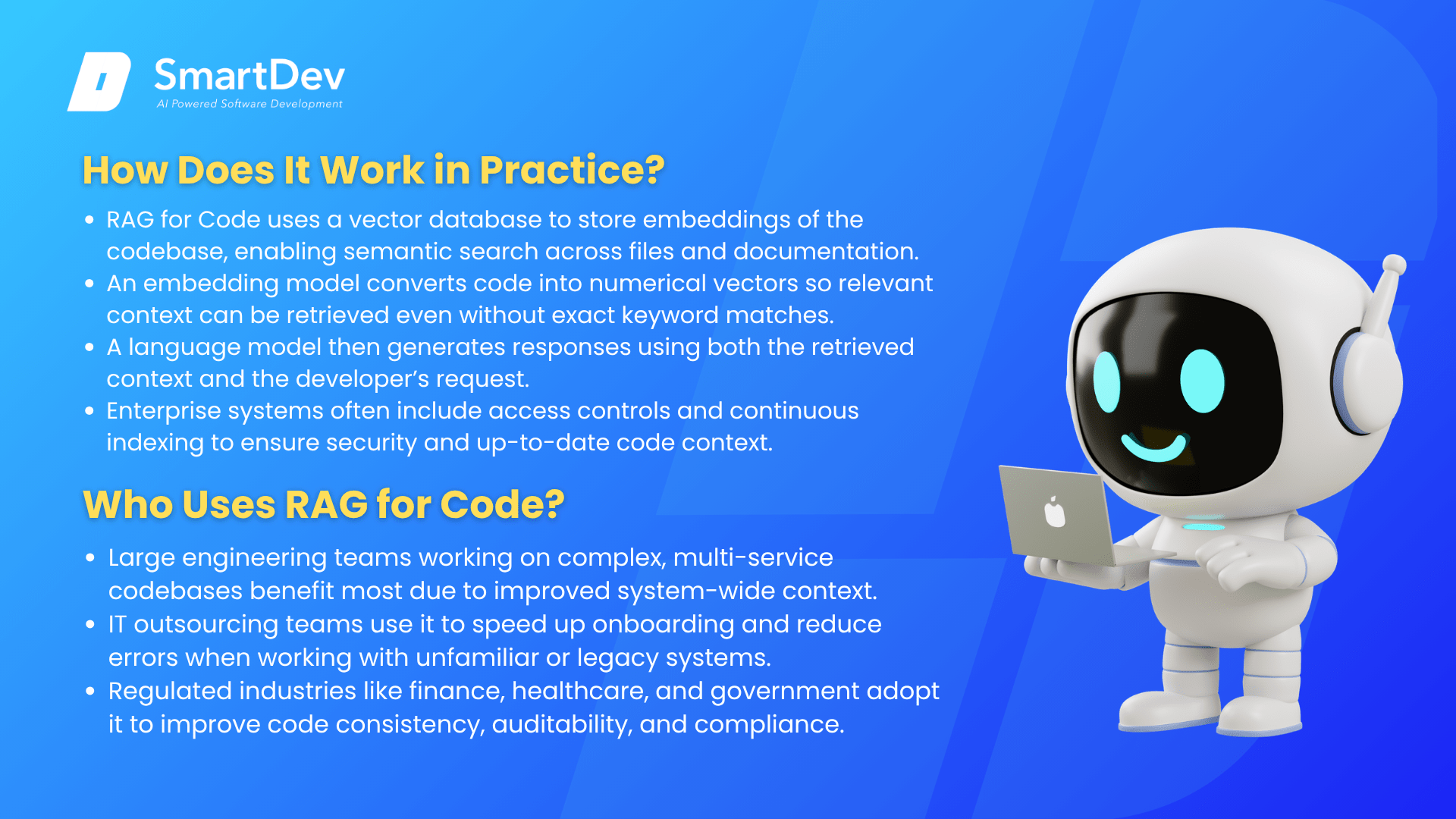
Setting up RAG for Code in an enterprise environment involves three core components. First, a vector database, such as Pinecone, Weaviate, or Qdrant, stores embeddings of your codebase. Second, an embedding model converts code into numerical representations that capture semantic meaning, allowing the system to find relevant code even when the exact words do not match. Third, a language model generates the final response using the retrieved context alongside the developer’s request.
Enterprise deployments often combine RAG for Code with role-based access controls, ensuring that developers only retrieve code they are authorized to view. This is particularly important for large organizations where codebases contain sensitive business logic, security configurations, or proprietary algorithms.
Maintenance of a RAG system requires keeping the code index current. Modern implementations use continuous indexing pipelines that update the vector database as code is committed, so suggestions always reflect the latest state of the project.
Who Uses RAG for Code?
Large software engineering teams working on mature, complex codebases benefit most from RAG for Code. Organizations with hundreds of thousands of lines of code across dozens of services, where no single developer understands the entire system, gain the most value because the retrieval system effectively extends each developer’s context window to encompass the whole project.
IT outsourcing providers use RAG for Code to accelerate onboarding of client projects. When an outsourced development team takes over a large legacy system, RAG enables them to ask questions about the codebase and receive answers grounded in actual project files rather than general AI guesses. This shortens the transition period and reduces errors during handover.
Financial services firms, healthcare technology companies, and government contractors that maintain strict code quality and audit requirements also adopt RAG for Code because it produces explainable suggestions tied to specific source files, supporting compliance and code review processes.
その他の関連用語
- AIの導入: The process by which an organization moves from experimenting with AI to embedding it meaningfully in day-to-day operations. On-premise AI removes the compliance and data sovereignty barriers that often stall AI Adoption in regulated industries, giving organizations a deployment model that satisfies legal requirements while still capturing the operational benefits of AI at scale.
- AI Transformation: The organization-wide shift in how a business operates when AI becomes embedded in its core processes and decision-making. For enterprises in regulated sectors, on-premise AI is often the only viable path to full AI Transformation. Without a self-hosted deployment option, compliance barriers prevent these organizations from embedding AI into the sensitive workflows where it would deliver the most value.
- Agentic Engineering: refers to the design and implementation of AI systems that act as autonomous agents capable of pursuing goals with limited human intervention. These agents can reason, make decisions, execute actions, and continuously improve based on feedback and changing conditions.
- AI Context Window is the maximum amount of text an AI model can process and reference at one time. RAG for code directly addresses context window limitations — instead of cramming an entire codebase into a single prompt, RAG retrieves only the most relevant code snippets and feeds them within the model’s active context window, making large-scale codebase queries practical.
- AI Grounding is the practice of connecting AI outputs to verified, real-world data sources to improve accuracy and reduce hallucinations. RAG for code is one of the most effective grounding techniques available to development teams — by anchoring code generation and search responses to actual repository content, it ensures AI suggestions reflect the team’s real codebase rather than generic training data.