TL;DR:
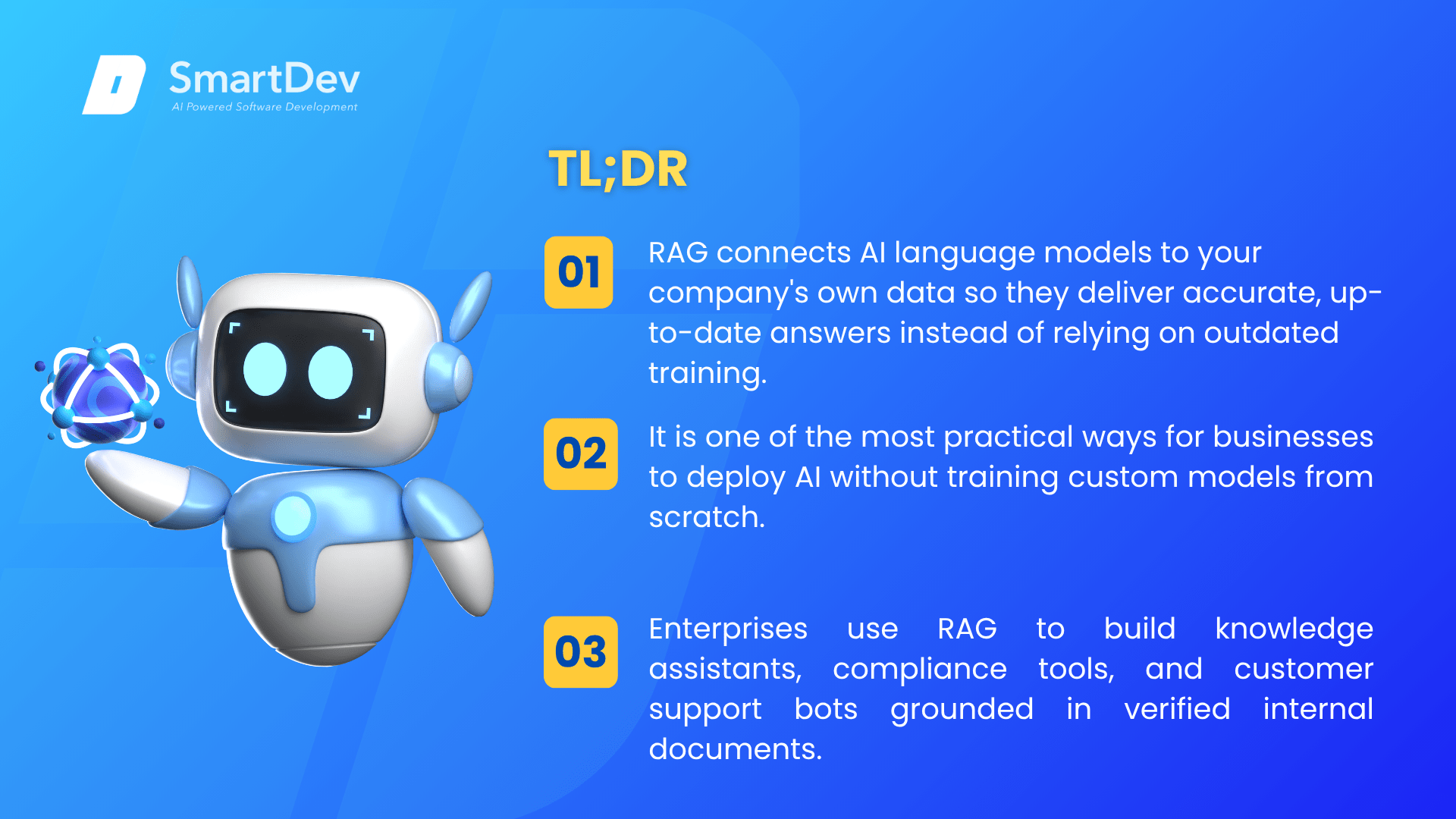
- RAG connects AI language models to your company’s own data so they deliver accurate, up-to-date answers instead of relying on outdated training.
- It is one of the most practical ways for businesses to deploy AI without training custom models from scratch.
- Enterprises use RAG to build knowledge assistants, compliance tools, and customer support bots grounded in verified internal documents.
Retrieval Augmented Generation, or RAG, is one of the most impactful AI techniques available to enterprises today. Rather than relying on general training data, RAG-powered systems pull directly from your documents, policies, and databases to deliver answers grounded in your actual business context. If your organization is evaluating AI assistants, compliance tools, or internal knowledge systems, understanding RAG is essential for making the right technology decision.
What is Retrieval Augmented Generation (RAG)?
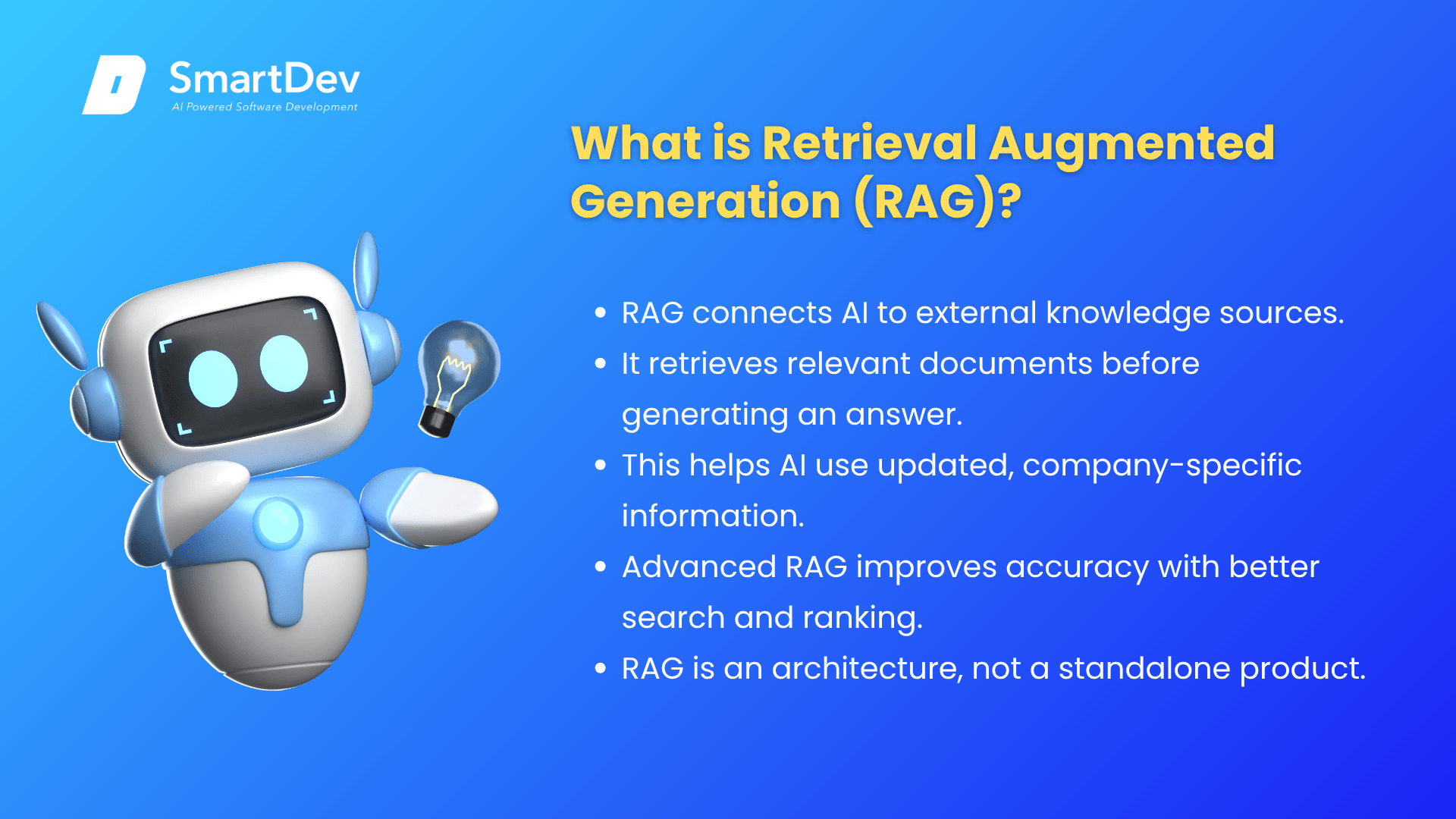
Retrieval Augmented Generation is an AI technique that enhances a language model by connecting it to an external knowledge base, allowing the system to retrieve relevant documents before generating a response.
Standard AI models are trained on large datasets up to a fixed cutoff date. They have no knowledge of your company’s latest pricing updates, internal procedures, or proprietary research. RAG closes this gap by adding a retrieval step before the model generates any answer. When a user poses a question, the system searches your indexed content, identifies the most relevant passages, and passes them to the language model as added context. The model then produces a response grounded in your actual documents rather than approximating from general knowledge alone.
RAG systems fall into two broad categories. Basic RAG performs straightforward document retrieval followed by direct generation. Advanced RAG adds re-ranking, query rewriting, and hybrid search that blends keyword matching with semantic understanding. For enterprise environments handling legal, financial, or compliance-sensitive content, advanced RAG provides the precision that business-critical use cases demand.
It is worth noting that RAG is not a standalone product you purchase. It is an architecture pattern that your technology team or outsourcing partner builds on top of an existing language model and your document infrastructure.
なぜ企業にとって重要なのか
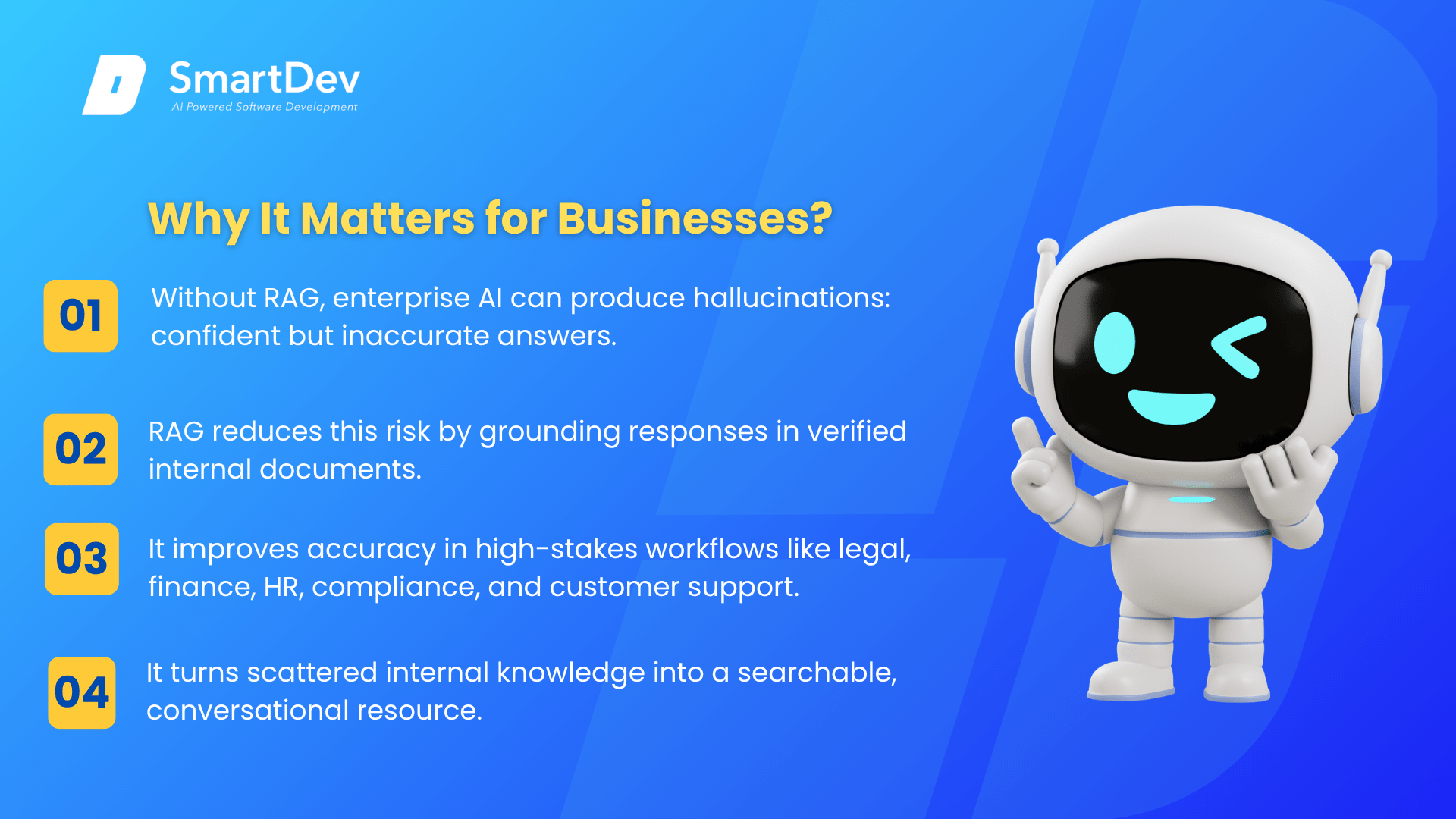
Without RAG, AI tools deployed in an enterprise setting frequently produce inaccurate answers, a failure mode known as hallucination. In a regulated industry, a confident but incorrect answer can create compliance risk, erode customer trust, or expose the organization to legal liability. RAG tackles this problem at its root.
- Reduce hallucinations by grounding every AI response in verified, retrievable source documents your team controls.
- Increase response accuracy across high-stakes workflows in legal review, financial reporting, HR policy, and customer support.
- Improve knowledge access by turning disconnected internal documents into a searchable, conversational resource available to every employee.
- Accelerate time to insight for analysts and consultants who currently spend hours searching through shared drives and outdated wikis.
For example, a mid-sized professional services firm deployed a RAG-powered assistant over its compliance knowledge base. Consultants could ask plain-language questions about regulatory requirements and receive precise, citation-backed answers in seconds. The firm reduced the average time spent finding internal guidance from 45 minutes per query to under two minutes, measurably improving both productivity and compliance accuracy.
How Does Retrieval Augmented Generation Work?
- User submits a query. An employee or customer types a question into an AI-powered interface, such as an internal search portal or a customer support chatbot.
- The retriever searches your knowledge base. The system scans indexed documents including PDFs, internal wikis, CRM records, and policy files to identify the most semantically relevant passages using a technique called vector search.
- Retrieved context is bundled with the query. The relevant text passages are appended to the original question and passed together to the language model.
- The model generates a grounded answer. Drawing on both the retrieved content and its training, the model synthesizes a response directly referencing your verified documents.
- Results are returned with source citations. The final answer links back to the originating documents, making every response auditable and trustworthy for business use.
The result is an AI assistant that behaves like a well-briefed analyst. It has read everything in your document library and can reference its sources on demand, making it far more reliable than a standard chatbot for enterprise applications.
Who Uses Retrieval Augmented Generation?
RAG adoption is highest in industries where accuracy, auditability, and data privacy are non-negotiable business requirements.
Financial services firms use RAG to power investment research tools and regulatory compliance assistants that draw from proprietary data without exposing sensitive information to external AI training pipelines.
Healthcare organizations deploy RAG to give clinical staff fast access to treatment protocols, formulary guidelines, and patient record summaries from a single interface, reducing the time clinicians spend searching across disconnected systems.
Legal and professional services companies use RAG to build contract review tools and precedent search systems that reference their internal case libraries and approved document repositories, bringing consistency and speed to document-intensive work.
The roles driving RAG adoption include Chief Technology Officers evaluating AI infrastructure choices, IT Directors managing knowledge management platforms, and Chief Information Officers seeking measurable ROI from existing document repositories without the cost and complexity of training a custom AI model from scratch.
その他の関連用語
- Vector Database: A specialized database that stores and searches text as numerical representations, enabling the fast semantic retrieval that makes RAG systems effective at enterprise scale.
- AI Hallucination: The tendency of language models to produce plausible but factually incorrect answers, the core problem that RAG directly addresses by anchoring responses in verified source documents.
- AI embedding: A technique that converts text, images, or other data into numerical vectors