
TL;DR:
- Synthetic data is artificially generated information that mirrors real-world data without containing any actual personal or sensitive records.
- Enterprises use it to train AI models, run software tests, and share data with third parties while staying fully compliant with privacy regulations.
- It reduces the cost and legal risk of working with real customer data and accelerates AI development timelines significantly.
Synthetic data has become a strategic asset for enterprises building AI-powered products and services. As data privacy laws tighten globally and the demand for large, diverse training datasets grows, organizations are turning to synthetic data to bridge the gap between what they need and what they can legally use. This guide explains what synthetic data is, why it matters, and when your business should consider it.
What is Synthetic Data?
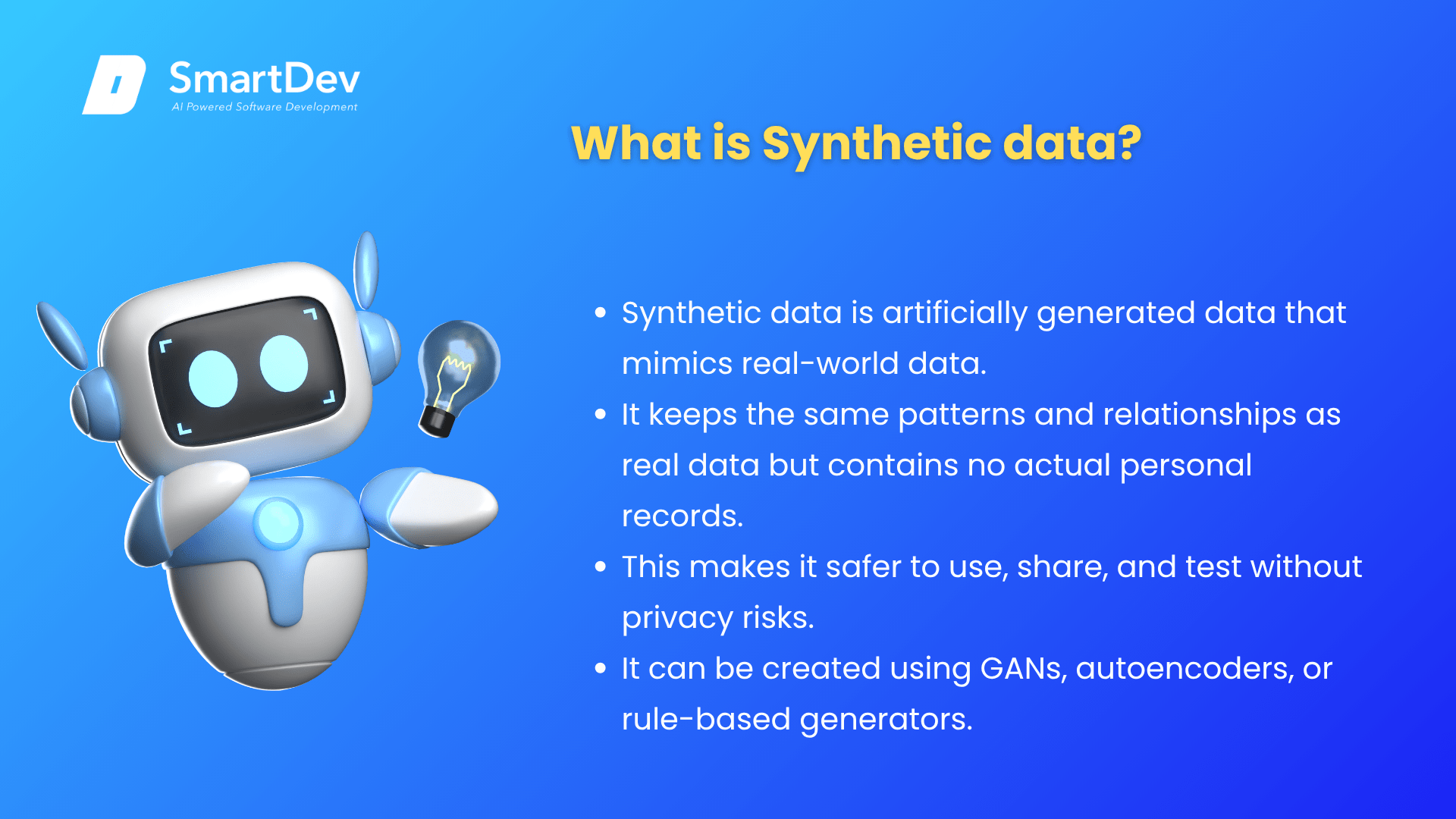
Synthetic data is artificially generated information that is statistically representative of real-world data but does not contain any actual records belonging to real individuals or systems.
Unlike real data collected from customers, transactions, or operations, synthetic data is produced by algorithms trained to replicate the statistical patterns, distributions, and relationships found in genuine datasets. The output looks and behaves like real data for analytical and modeling purposes but contains no actual personal information. This makes it safe to share, store, and use across teams without the legal and ethical complications tied to personal data.
Synthetic data is generated using several techniques. Generative Adversarial Networks, or GANs, pit two AI models against each other to produce highly realistic outputs. Variational Autoencoders learn compressed representations of data to generate new samples. Rule-based generators create structured records following defined business logic, useful for software testing environments. Each approach serves different use cases depending on the required fidelity and volume.
なぜ企業にとって重要なのか
Privacy regulations such as GDPR in Europe, HIPAA in the United States, and equivalents across Asia-Pacific have made it significantly more expensive and legally complex to use real customer data in AI development and testing. Violations carry substantial fines, and the reputational damage of a data breach during a development cycle can be severe.
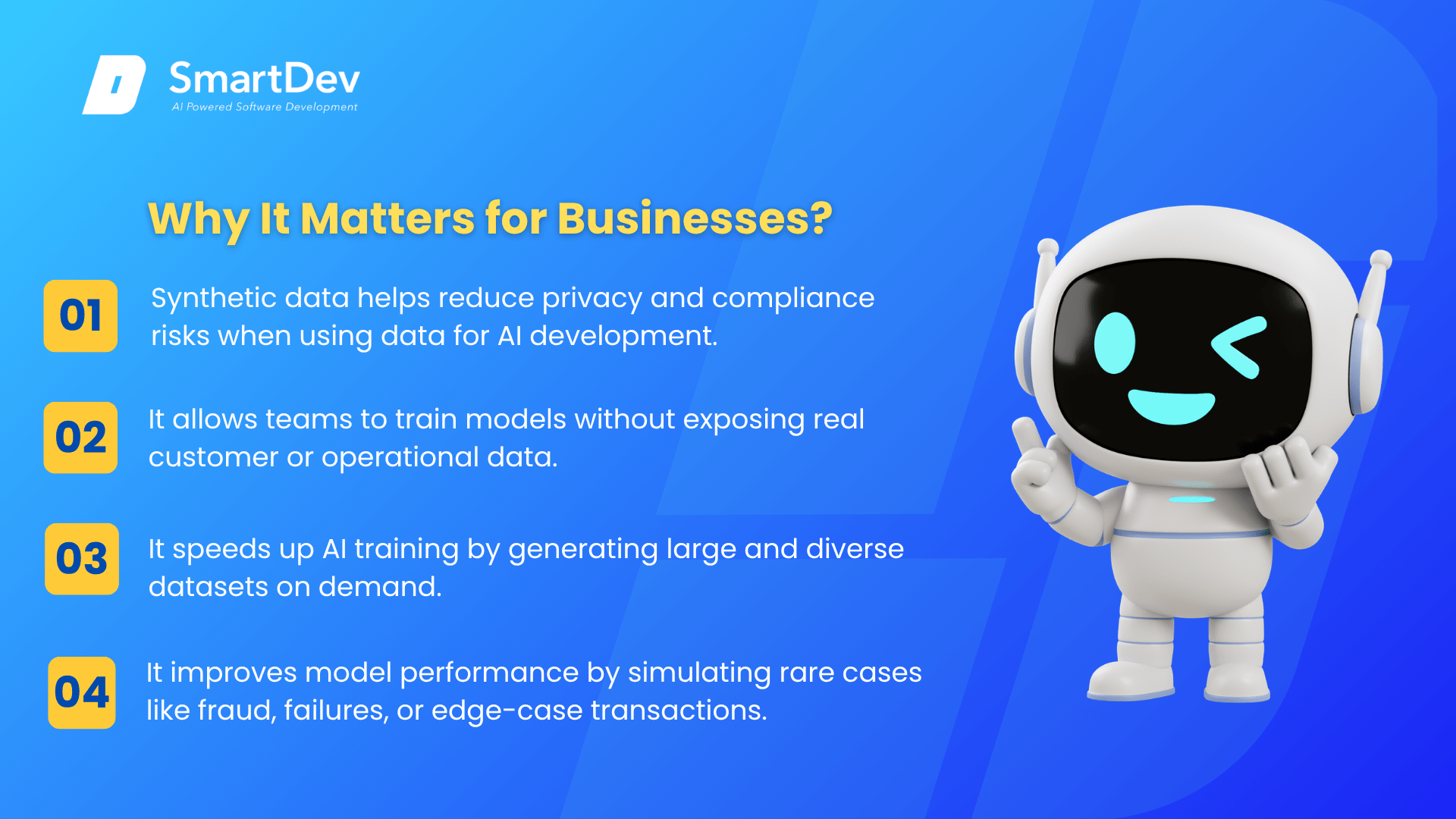
- Reduce compliance risk by replacing sensitive real data with synthetic equivalents that carry no personal data obligations under privacy law.
- Accelerate AI model training by generating large, diverse datasets on demand rather than waiting months to accumulate enough real-world examples.
- Improve model robustness by creating synthetic examples of rare events such as fraud scenarios, equipment failures, or edge-case transactions that rarely appear in historical data.
- Protect competitive advantage by enabling collaboration with vendors and outsourcing partners without exposing proprietary operational data.
For example, a major insurance company needed to train a fraud detection model but could not share policyholder records with its AI development partner due to regulatory constraints. By generating a synthetic dataset that replicated the statistical patterns of real claims, the team trained a model that performed within two percentage points of one trained on genuine data, achieving the goal in a fraction of the time with zero compliance exposure.
How Does Synthetic Data Work?
- Analyze the real dataset. The generation system studies the structure, distributions, relationships, and statistical properties of your actual data, without storing or transmitting raw records externally.
- Train a generative model. A GAN, autoencoder, or rule-based system learns to replicate these patterns mathematically.
- Generate synthetic records. The trained system produces new data rows that reflect the same statistical reality as the original but contain no real personal or proprietary values.
- Validate the output. Quality checks compare the synthetic dataset against the original across key dimensions to confirm it is statistically representative and free of any real data leakage.
- Deploy in place of real data. The synthetic dataset is used for AI model training, software testing, or third-party sharing, delivering the same analytical value without the associated risk.
The result is a data pipeline that is faster to operate, safer to share, and easier to scale than one relying entirely on real-world records.
When to Use Synthetic Data?
Synthetic data is the right choice in several specific scenarios:
- Your AI model requires training data for rare events, such as cyberattacks, equipment failures, or financial fraud, that are underrepresented in historical records.
- Your team needs to share data with an external vendor, outsourcing partner, or research institution but cannot share personal or regulated information under applicable privacy law.
- Your development and testing environments require realistic data but must remain isolated from production systems that hold real customer records.
- You are entering a new market and need synthetic population data to prototype an AI product before real data becomes available.
Synthetic data is not always the best fit. If your use case requires absolute fidelity to individual-level records, such as a specific audit trail or a unique transaction history, synthetic data may introduce inaccuracies. It also requires investment in generation tooling and validation, which may not be justified for small, low-risk datasets. When your existing data is large, diverse, and fully compliant to use, real data remains the stronger option.
その他の関連用語
- AI Embedding is the process of converting text or other data into numerical vectors that capture semantic meaning, so AI systems can compare, search, and retrieve information by similarity instead of exact keywords, forming the foundation of semantic search and RAG workflows.
- AI embedding: A technique that converts text, images, or other data into numerical vectors
- AI Governance: A structured set of policies, roles, and processes that an organization uses to approve, monitor, and retire AI systems. AI guardrails are the technical enforcement layer within an AI governance framework, translating its policies into concrete operational controls that act on inputs and outputs in real time.