
TL;DR:
- A system prompt is a set of behind-the-scenes instructions that tells an AI model how to behave before any user interaction begins.
- Businesses use system prompts to customize AI tools for their brand voice, enforce compliance rules, and restrict the model to relevant topics.
- Getting the system prompt right is the single most effective way to make a general-purpose AI model work reliably for a specific business function.
A system prompt is the invisible foundation of any enterprise AI deployment. It is the set of instructions that shapes how an AI model behaves, what it will and will not do, and how it communicates with your team or customers. For business leaders adopting AI tools, understanding the system prompt is as important as understanding the software itself. It is where governance, brand consistency, and compliance controls are actually enforced.
What is a System Prompt?
A system prompt is a block of instructions provided to an AI model before a conversation begins, defining its role, rules, tone, and operational boundaries for every interaction that follows.
When you use a general-purpose AI model such as a large language model, the model arrives with broad capabilities and no knowledge of your specific context. The system prompt fixes this by telling the model what it is, who it serves, and how it should respond. It might specify that the model is a customer support agent for a software company, that it must always respond in formal English, that it should never discuss competitor products, and that all financial figures must be flagged for human review before sharing.
Unlike user prompts, which are the questions and requests typed by the person in a conversation, the system prompt is set by the business deploying the AI. Users often cannot see it, and it persists across every interaction. This makes it the primary control mechanism for enterprise AI governance. A well-designed system prompt reduces unpredictable AI behavior and ensures the model consistently represents your organization the way you intend.
なぜ企業にとって重要なのか
Deploying a general-purpose AI model without a system prompt is like hiring a contractor and giving them no brief. The results will be unpredictable, off-brand, and potentially harmful to your reputation or compliance standing.
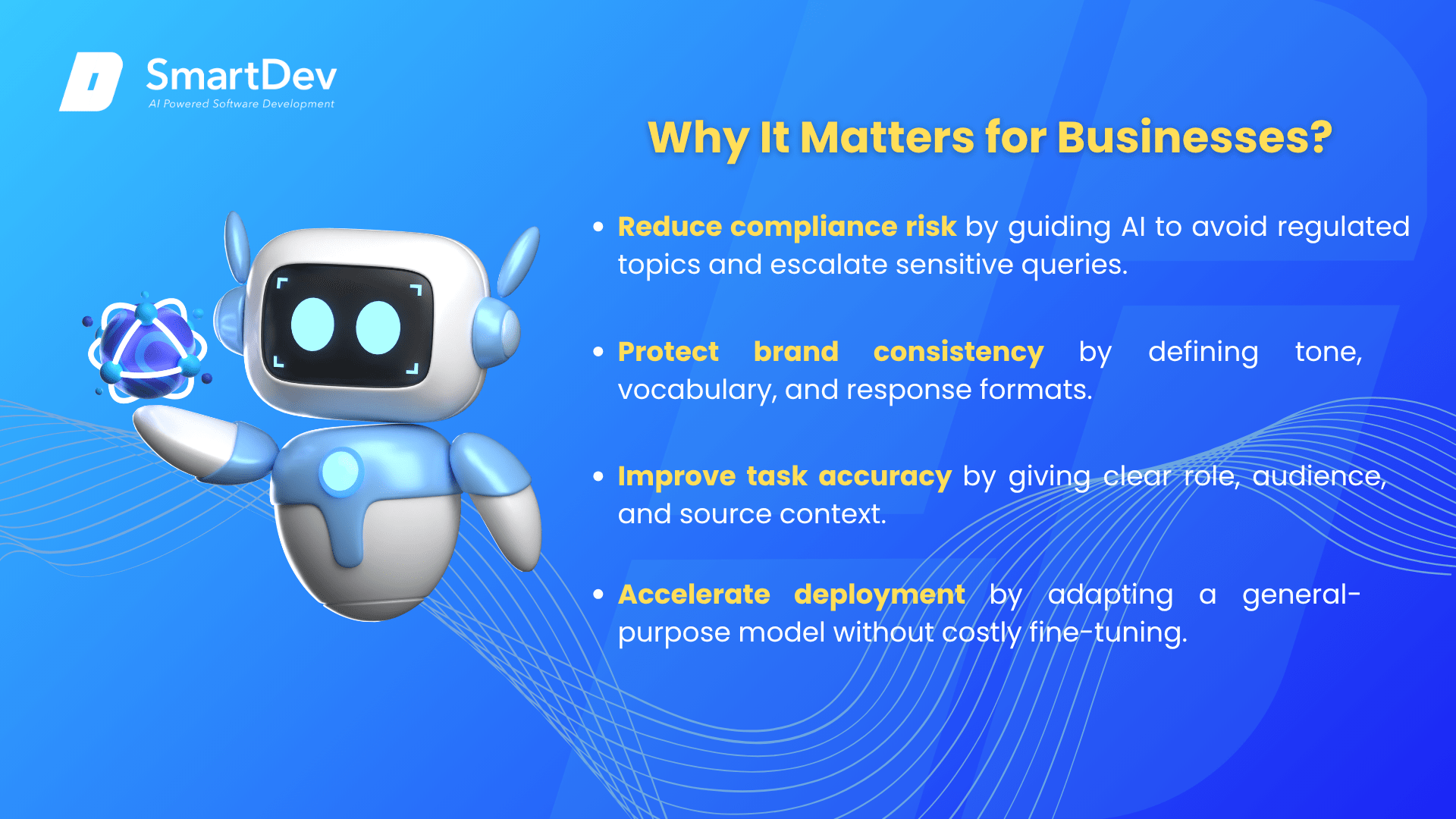
- Reduce compliance risk by instructing the AI model to avoid regulated topics, escalate sensitive queries, and always recommend consulting a qualified professional.
- Protect brand consistency by specifying tone, vocabulary, and response formats that align with your company’s communication standards.
- Improve task accuracy by giving the model clear context about its role, the audience it serves, and the specific information it should draw from.
- Accelerate deployment by customizing a general-purpose model for your specific use case without the cost and time of fine-tuning or building a proprietary model.
For example, a financial services firm deployed an AI assistant for its retail banking customers. Without a system prompt, early testing showed the model providing general investment advice outside its scope. After implementing a detailed system prompt that restricted topics, required escalation language for financial queries, and enforced a specific tone, the assistant performed within regulatory boundaries consistently across thousands of interactions per day.
How Does a System Prompt Work?
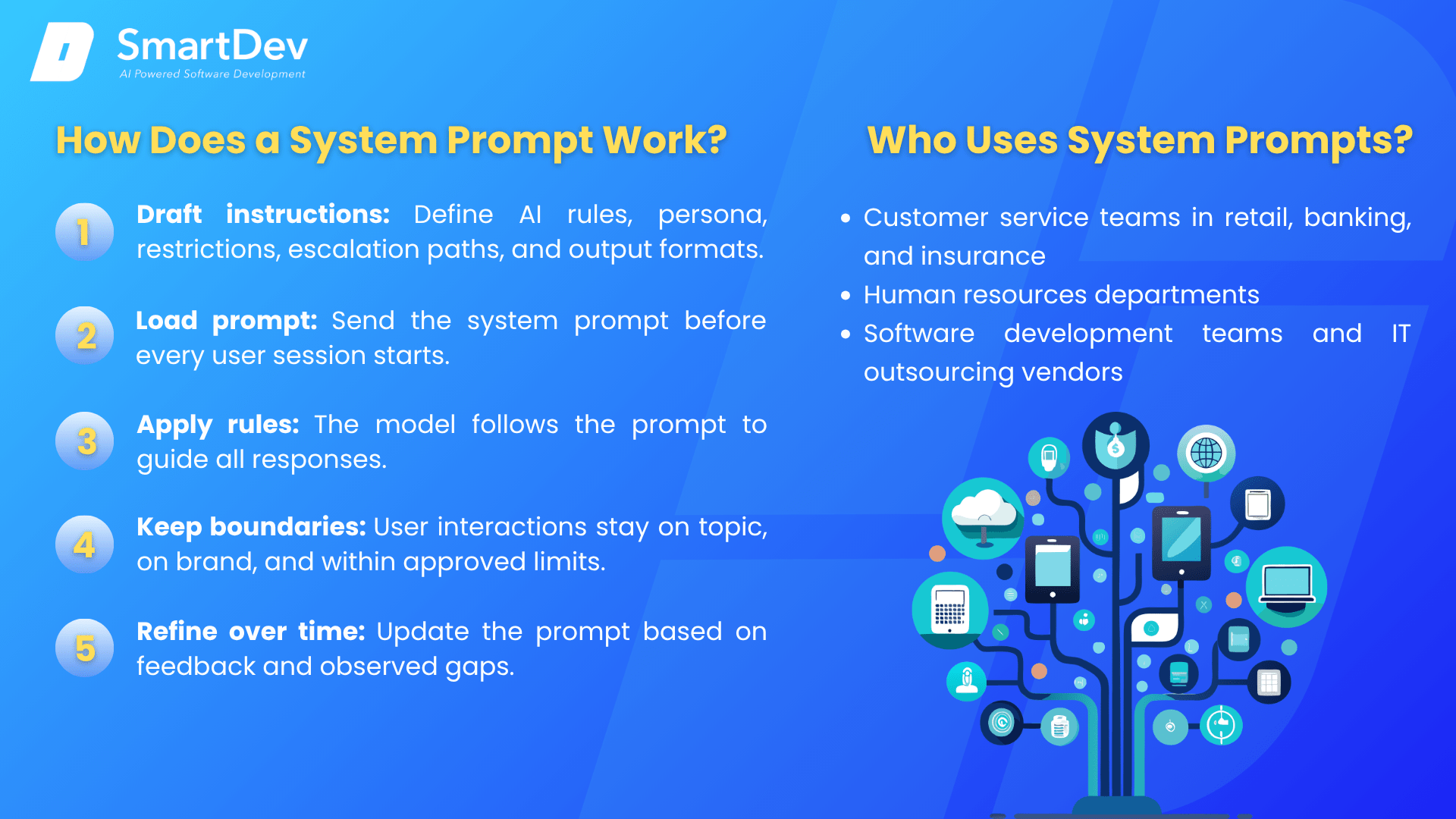
- The business drafts the instructions. Your team writes a set of rules, persona definitions, and behavioral guidelines for the AI. This includes role definition, topic restrictions, escalation rules, and output format requirements.
- The system prompt is loaded before every session. Each time a user opens the AI tool, the system prompt is automatically sent to the model as the first piece of context, before any user message arrives.
- The model reads and applies the instructions. The AI model processes the system prompt and calibrates all subsequent responses according to the rules it contains.
- User interactions proceed within the defined boundaries. Every question asked by the user is answered through the filter of the system prompt, keeping the model on topic, on brand, and within approved boundaries.
- The system prompt is refined over time. Based on observed behavior and business feedback, the prompt is updated iteratively to close gaps and improve consistency.
Think of a system prompt as the standing operating procedures for your AI. They do not change with every conversation, but they govern how every conversation unfolds.
Who Uses System Prompts?
System prompts are used by any organization deploying AI models for internal or customer-facing purposes.
Customer service teams in retail, banking, and insurance use system prompts to configure AI chatbots that handle inquiries consistently, stay within approved topics, and escalate complex cases to human agents at the right moment.
Human resources departments use system prompts to build AI assistants for employee queries about benefits, policies, and onboarding procedures, ensuring responses reflect current company policy rather than generic information.
Software development teams and IT outsourcing vendors use system prompts to configure AI coding assistants that follow specific coding standards, security guidelines, and architecture rules relevant to a client’s technology stack.
Decision-makers who care most about system prompts include Chief Information Officers governing AI deployment policies, Legal and Compliance Officers ensuring AI outputs meet regulatory requirements, and IT Directors responsible for integrating AI tools into existing workflows safely and consistently.
その他の関連用語
Prompt Engineering: The practice of designing and refining prompts, including system prompts, to improve the accuracy, reliability, and usefulness of AI model outputs in specific business contexts.
AI Grounding is the practice of connecting an AI model’s responses to verified, real-world data sources so its outputs stay accurate, traceable, and less prone to hallucinations. When you design a system prompt, grounding techniques ensure those high-level instructions are backed by authoritative knowledge (docs, databases, policies), so the model doesn’t just follow the “rules” of the prompt but also stays anchored in your organization’s actual facts and constraints.
AI Prototyping: the process of rapidly creating, testing, and refining prototypes using AI technologies to explore potential ways to solve specific problems.
AI Governance: The policies, processes, and controls an organization puts in place to ensure AI systems behave safely, ethically, and in compliance with legal requirements, of which the system prompt is one practical implementation tool.