
TL;DR
- Upselling is the practice of encouraging an existing client to purchase a higher-tier service, expanded scope, or premium add-on that delivers more value than their current engagement.
- In IT services and outsourcing, upselling to existing clients is significantly more cost-efficient than acquiring new ones, with conversion rates 5 to 7 times higher than new business efforts.
- Effective upselling is needs-based, not pressure-based. It works when the expanded offering genuinely solves a problem or accelerates an outcome the client already cares about.
Acquiring a new IT services client costs significantly more than growing an existing one. Yet many IT organizations invest the majority of their sales effort in new business while underinvesting in the commercial relationships they already have. Upselling changes this equation by treating the existing client relationship as the primary growth channel, offering relevant expansions of service that deepen the partnership while delivering additional value.
What is Upselling?
Upselling is a sales and account management practice in which a service provider encourages an existing client to expand their current engagement by purchasing a higher-tier service level, an extended scope, or a premium feature or add-on that provides measurably more value than the client’s current arrangement.
In IT outsourcing and technology services, upselling typically takes one of several forms. A staff augmentation client is offered dedicated team management alongside their engineers. A managed services client is offered a security monitoring add-on when a new compliance requirement emerges. A software development client is offered QA automation services after manual testing becomes a delivery bottleneck. In each case, the upsell addresses a genuine business need that the existing relationship has revealed.
Upselling is distinct from cross-selling, which introduces a different product or service category to an existing client. Upselling moves the client up the value stack within their existing service relationship, while cross-selling introduces an adjacent service. Both are components of a mature account growth strategy in IT services.
なぜ企業にとって重要なのか
For IT services companies, upselling is the most capital-efficient path to revenue growth. The cost of selling to an existing client is a fraction of the cost of acquiring a new one, because trust is already established, the client’s needs are already understood, and the relationship has already proven its value.
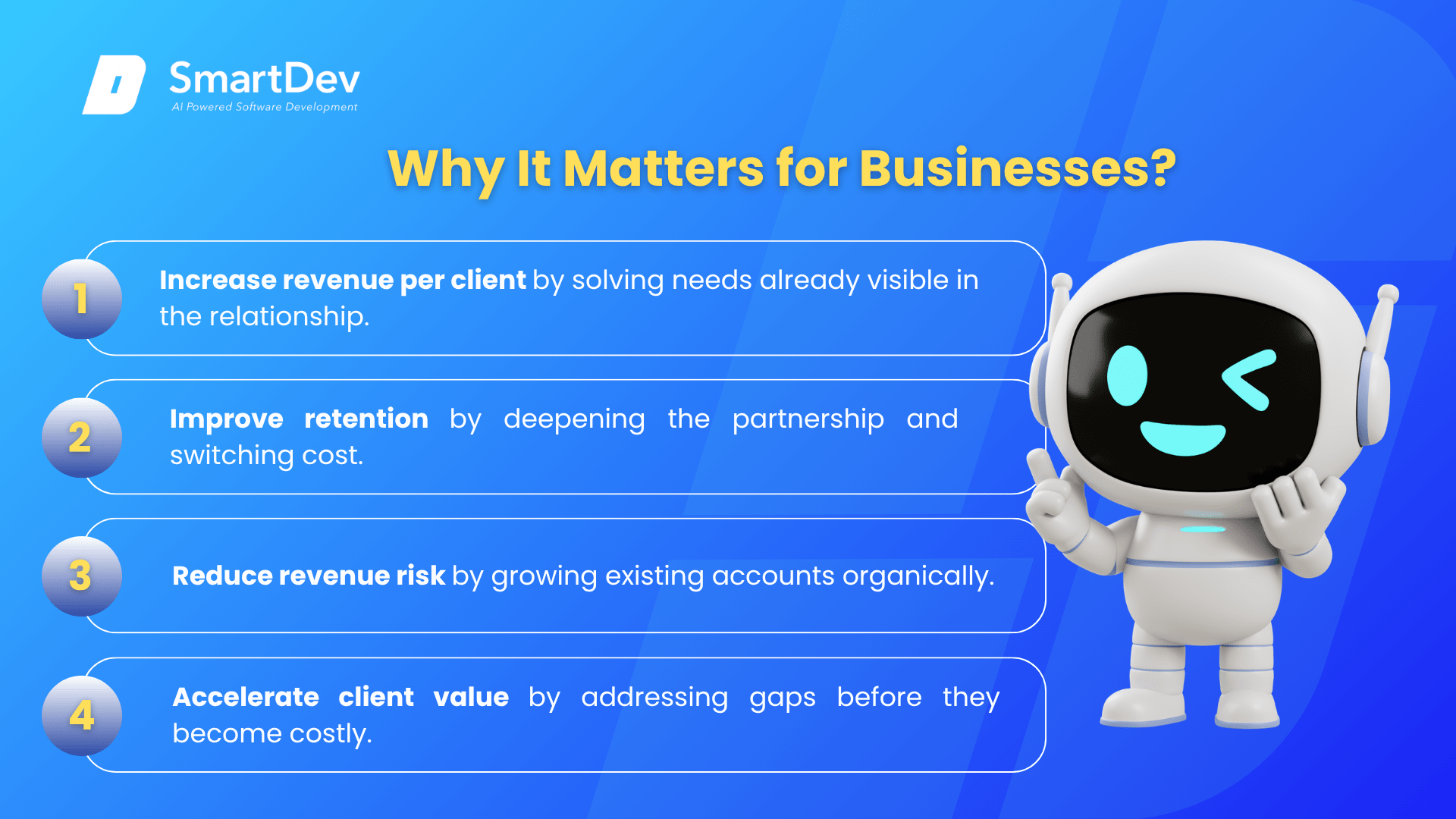
- Increase revenue per client by identifying and proposing expansions that solve problems the existing relationship has revealed, without the sales cost of new client acquisition.
- Improve client retention by deepening the partnership and increasing the switching cost for the client, who now relies on more of your services to run effectively.
- Reduce revenue concentration risk by growing accounts organically rather than depending on a constant flow of new project wins to hit revenue targets.
- Accelerate time to value for clients by proactively identifying gaps in their current setup and proposing solutions before those gaps become costly problems.
For example, an IT outsourcing company that had placed a team of six engineers with a fintech client noticed recurring delays in the client’s release cycle caused by manual QA bottlenecks. The account manager proposed adding a dedicated QA automation engineer to the team. The client accepted within two weeks, release frequency increased from monthly to bi-weekly, and the account value grew by 18% without any additional sales effort beyond the relationship already in place.
How Does Upselling Work?
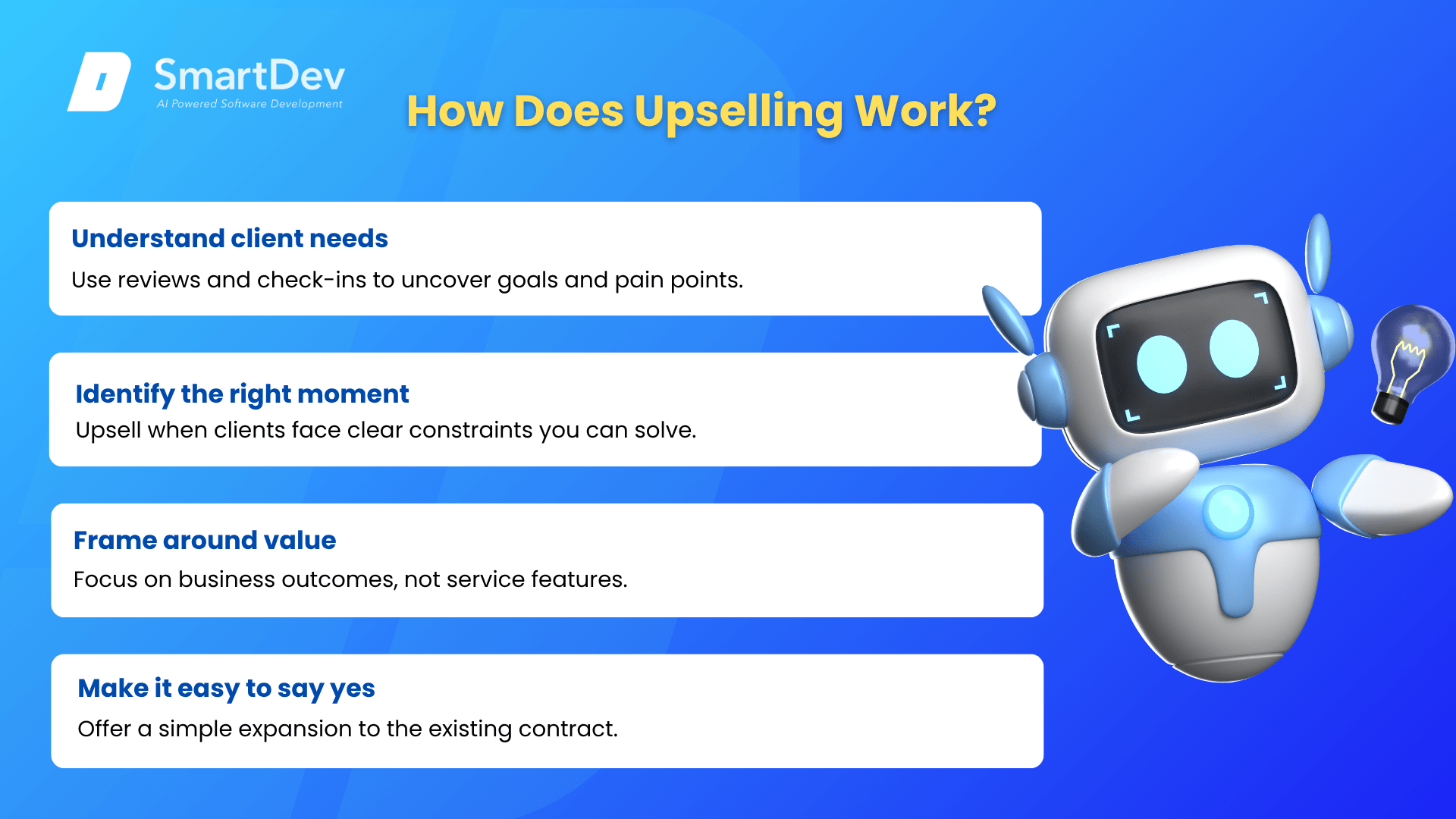
- Understand Client Goals and Pain Points: Effective upselling starts with listening. Regular account reviews, delivery check-ins, and stakeholder conversations surface the problems the client is wrestling with and the outcomes they are trying to achieve. These conversations are the source material for relevant upsell proposals.
- Identify the Right Moment: Upsell opportunities arise when a client hits a visible constraint (quality issues, capacity limits, compliance requirements, performance problems) that a service expansion can address. Timing matters: a proposal that solves a problem the client is actively feeling is far more likely to convert than one introduced when there is no immediate context.
- Frame Around Value, Not Features: Present the upsell in terms of the business outcome it enables, not the features it includes. “This will allow you to release every two weeks instead of monthly” is more compelling than “this includes QA automation and CI/CD pipeline support.”
- Make It Easy to Say Yes: Reduce friction by proposing a clear, simple expansion to the existing contract rather than requiring a full new procurement cycle. The easier the operational path to a “yes,” the higher the conversion rate.
The result is a client portfolio that grows in value over time as relationships deepen and service scope expands to match growing client needs, rather than a business that must continuously win new logos to offset churn and stagnant account values.
Who Uses Upselling in IT Services?
Account managers and client success teams at IT outsourcing companies, managed service providers, and SaaS vendors use upselling as a core revenue growth strategy. From the client side, procurement and IT leadership should expect upsell proposals from established vendors as a normal part of a healthy service relationship. A vendor who never proposes expansions to their service may not be paying enough attention to your evolving needs. Conversely, a vendor whose upsells consistently align with real business problems rather than their own revenue targets is demonstrating a client-centric relationship model that is worth maintaining.
その他の関連用語
Strategic Technology Partnership: A deep, long-term collaboration between a business and a technology provider aligned around shared goals and outcomes.
Milestone-Based Contract: A formal agreement between a client and a service provider where compensation is released only when specific, measurable project milestones are completed and accepted.
Service Level Agreement (SLA): The contractual framework that governs expanded upsell engagements, ensuring that the performance standards and obligations of the new service scope are clearly defined alongside the existing arrangement.