
Your operations team didn’t join logistics to copy-paste tracking numbers or chase emails for ETA updates. This roadmap shows you exactly what to automate, in what order, and how fast you can realistically get there.
TL;DR:
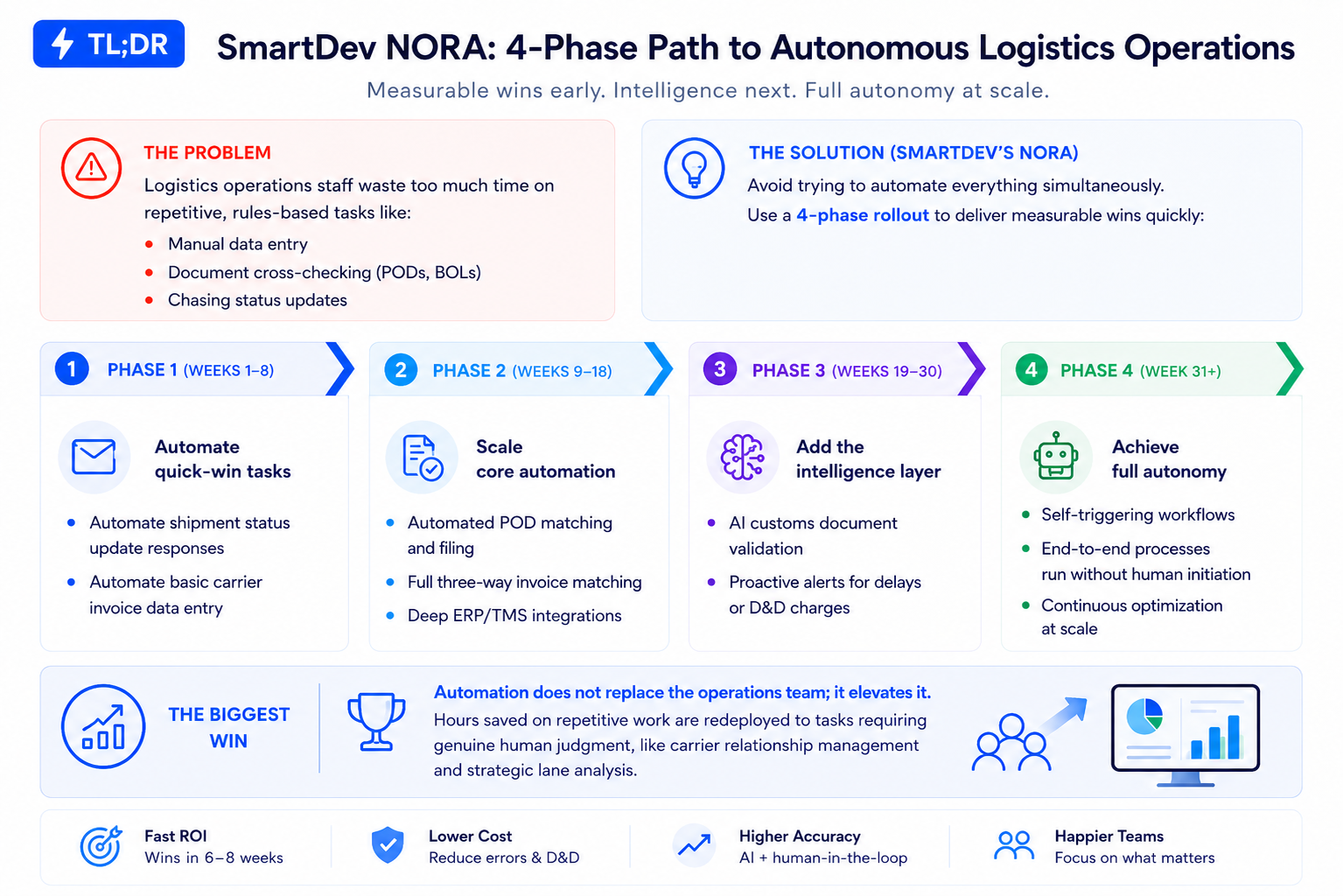
The Problem: Logistics operations staff waste too much time on repetitive, rules-based tasks like manual data entry, document cross-checking (PODs, BOLs), and chasing status updates.
The Solution (SmartDev’s NORA): Avoid trying to automate everything simultaneously. Instead, use a 4-phase rollout to deliver measurable wins quickly:
- Phase 1 (Weeks 1–8): Automate shipment status update responses and basic carrier invoice data entry.
- Phase 2 (Weeks 9–18): Upgrade to automated POD matching and filing, full three-way invoice matching, and deep ERP/TMS integrations.
- Phase 3 (Weeks 19–30): Deploy the intelligence layer for AI customs document validation and proactive alerts for delays or Detention & Demurrage (D&D) charges.
- Phase 4 (Week 31+): Achieve full autonomous operations with self-triggering workflows that run without human initiation.
The Biggest Win: Automation does not replace the operations team; it elevates it. Hours saved on repetitive work are redeployed to tasks requiring genuine human judgment, like carrier relationship management and strategic lane analysis.
Introduction
Across freight, 3PL, shipping, and supply chain operations, the same operational pattern repeats consistently across daily workflows. Specifically, skilled operations staff spend most working hours on predictable, rules-based administrative and document-processing responsibilities. These tasks include manual data entry, status update chasing, document cross-checking, and operational exception flagging across shipment workflows daily. By definition, these responsibilities do not require human judgment or strategic operational decision-making expertise.
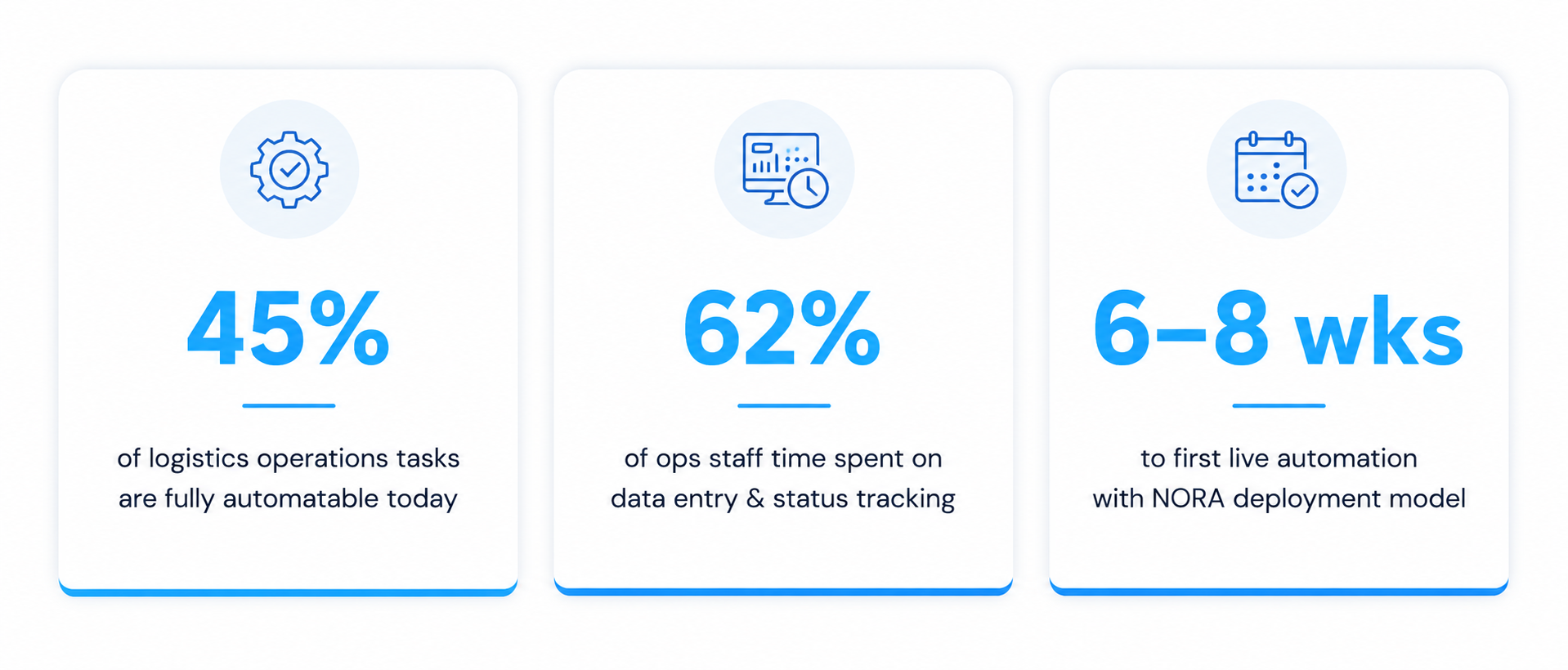
The business case for automating these tasks is not theoretical. It is measurable, proven, and increasingly urgent as logistics labor markets tighten and margin pressure intensifies. According to McKinsey’s Global Institute, up to 45% of logistics operations tasks can be fully automated with currently available technology. The gap is not technological, it is implementation.
This post is an implementation roadmap. It identifies which repetitive tasks to target first, how to sequence the automation rollout, what technology decisions matter most, and where SmartDev’s NORA AI Adoption Accelerator compresses a 12-month program into a 6–10 week deployment cycle.
The Anatomy of Repetitive Work in Logistics Operations
Why logistics operations are uniquely automation-ready
Unlike creative, advisory, or relationship-driven work, most logistics operations tasks are highly suitable for AI automation. Specifically, these tasks share three characteristics that make automation operationally effective and scalable. First, they are high-frequency and performed dozens or hundreds of times daily across logistics workflows. Second, they are rules-based, meaning correct actions follow logic rather than human judgment consistently. Finally, they are document-centric and involve extracting, reading, or comparing structured and semi-structured operational data.
Combine these three characteristics with the industry’s chronic labor shortage and the compressed margins of the post-pandemic freight market, and automation is no longer a competitive advantage, it is an operational necessity. SmartDev’s AI & Machine Learning solutions are purpose-designed for exactly this task profile.
The five task categories consuming the most operations hours
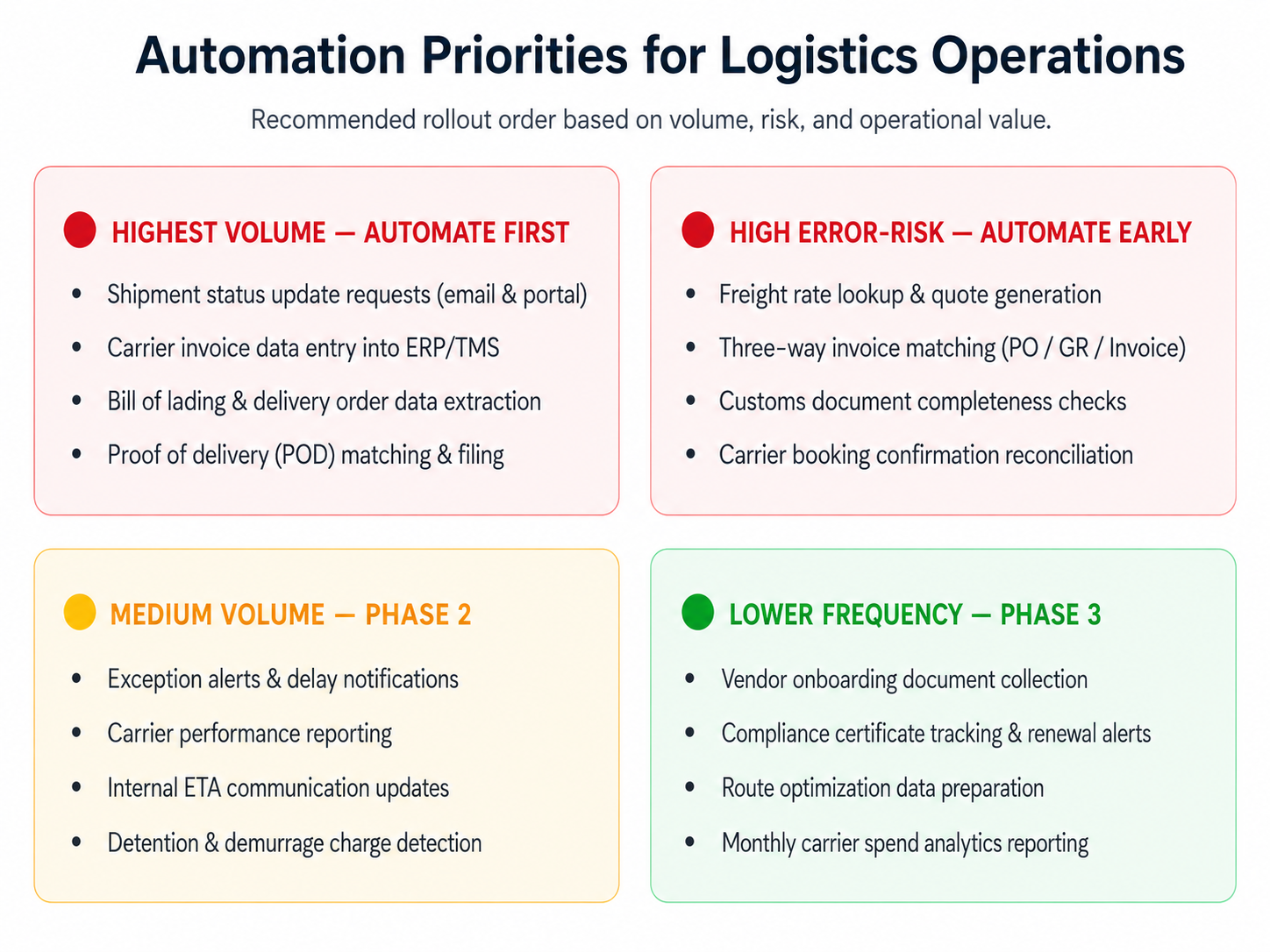
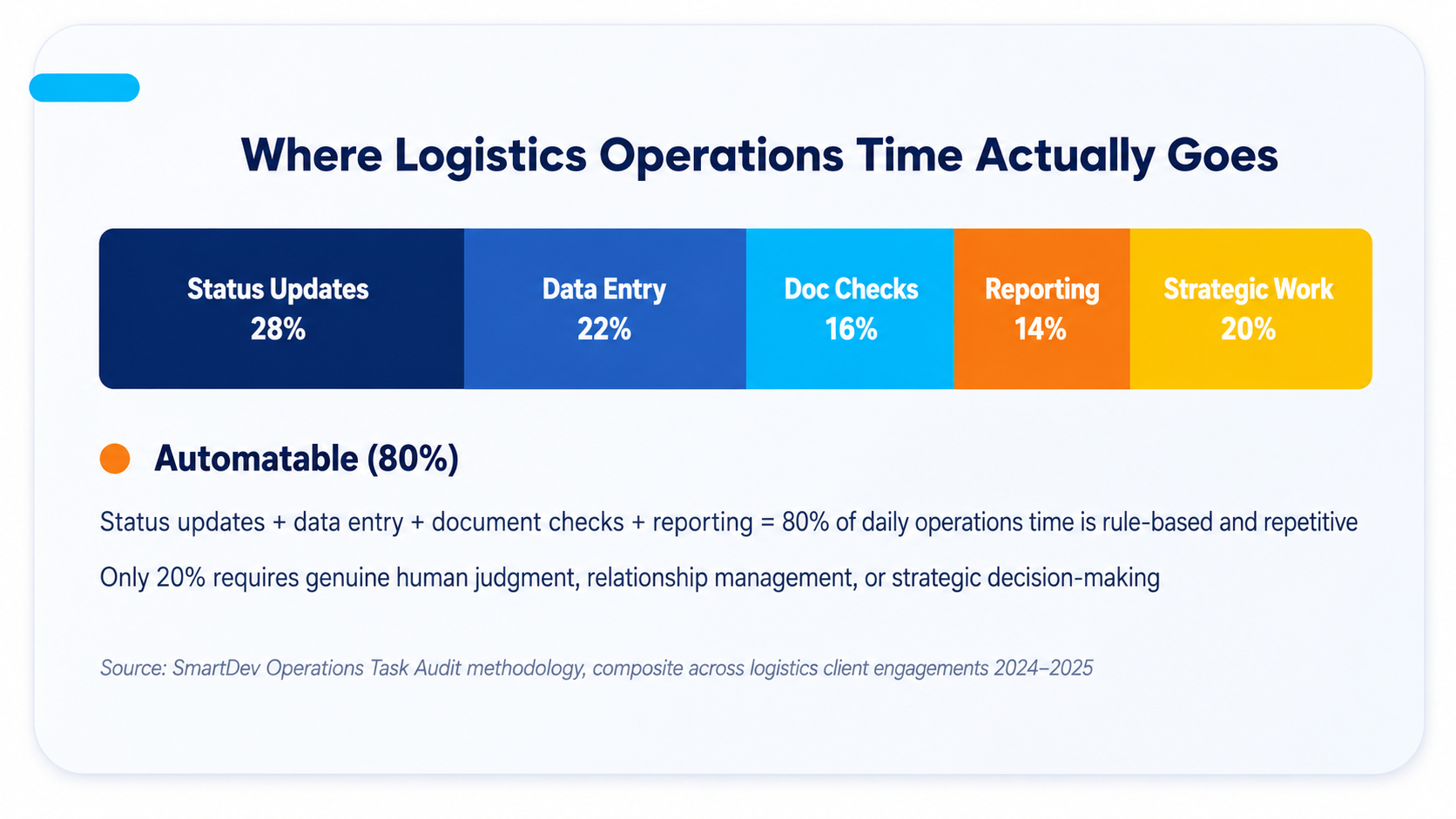
Through SmartDev’s logistics client engagements and operational audits, we consistently identify five categories that account for the largest share of automatable labor time in logistics operations:
Quantifying the time cost before you start
Before any automation program, SmartDev conducts a structured Operations Task Audit, mapping each task category, its daily frequency, average handling time, and error rate. For most mid-sized logistics operations (50–500 staff), this audit reveals that between 30% and 55% of total operations labor cost is tied to tasks on the automatable list above.
Example from a SmartDev client: A freight forwarding company with 120 operations staff discovered that status update management alone consumed 2.3 FTE per day, approximately $180,000 per year in labor costs. Automation delivered an 87% reduction in that task within 8 weeks of go-live.
The Automation Priority Framework: What to Tackle First
The three-axis prioritisation model
Not all automatable tasks deserve equal urgency. SmartDev uses a three-axis model to sequence automation programs: Volume × Error Risk × Integration Complexity. Tasks that score high on volume and error risk but low on integration complexity deliver the fastest and most visible ROI, and build organisational confidence for the next phase.
Axis 1, Volume: tasks performed more than 20 times per day per staff member
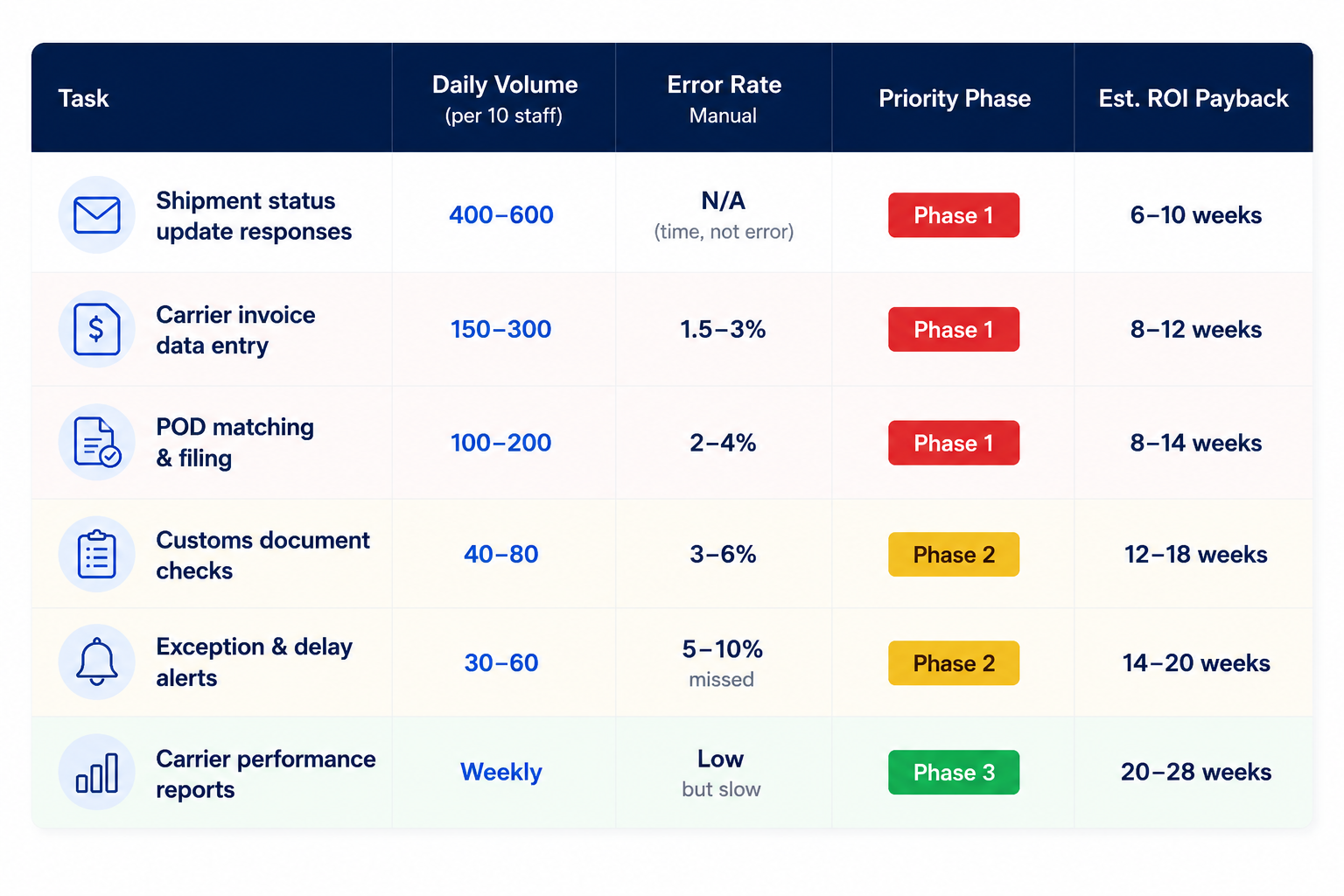
High-volume tasks generate the largest labor savings. Shipment status requests, carrier ETA updates, and invoice data entry typically top this list. A single operations team of 10 staff may handle 400–600 status update interactions per day, a task that automation reduces to near-zero human involvement.
Axis 2, Error Risk: tasks where mistakes carry financial or compliance consequences
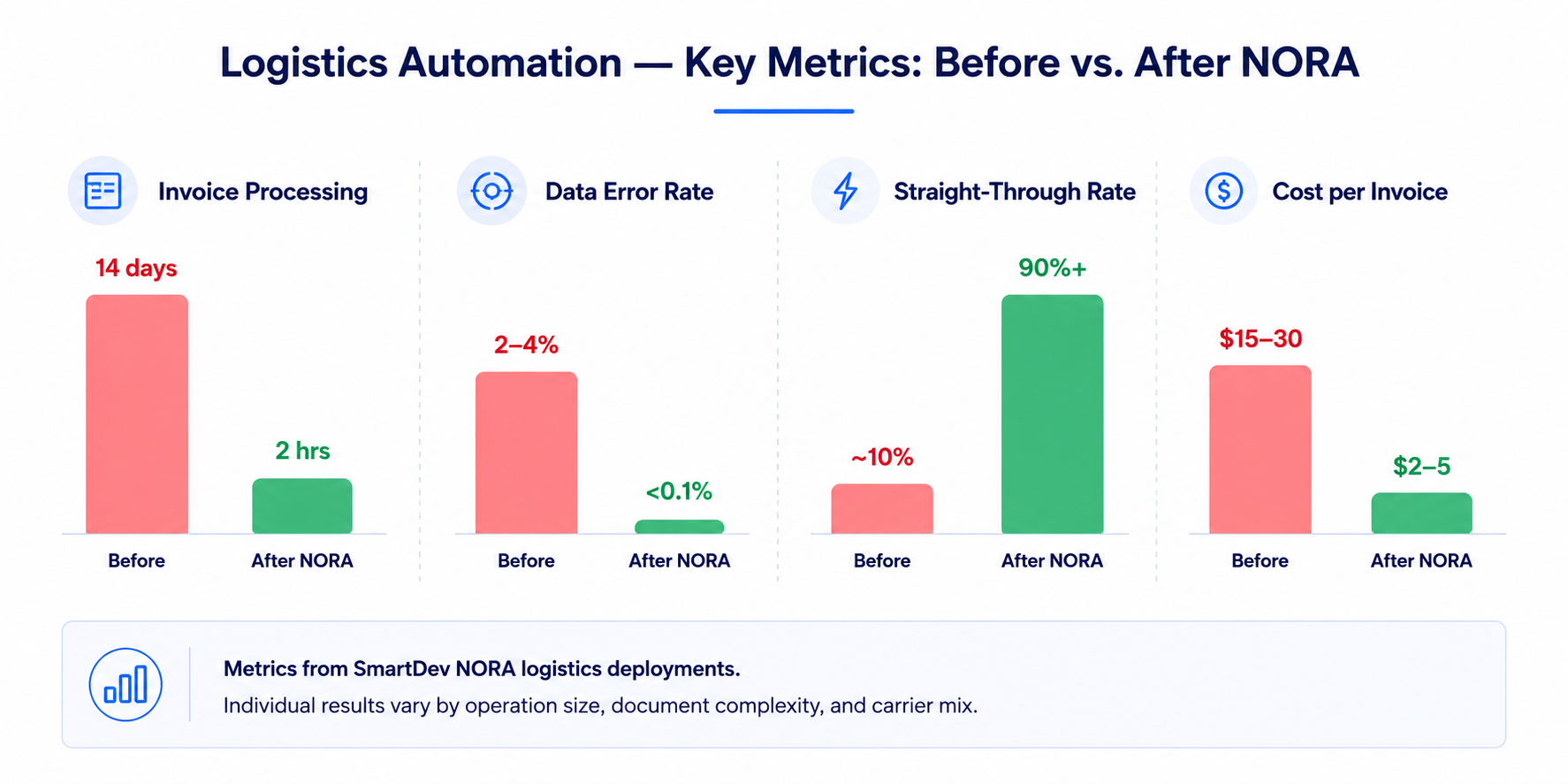
Invoice matching errors, customs document gaps, and incorrect duty classifications can trigger fines, payment disputes, or shipment holds. Automating these tasks with validation logic reduces error rates from the industry average of 1–4% to under 0.1%. SmartDev’s AI Development Services build exactly this kind of validation layer.
Axis 3, Integration Complexity: tasks requiring minimal new system connections
Early-phase automations should target tasks that can be connected to existing systems via standard APIs, TMS, ERP, email, without requiring new platform procurement. This keeps implementation timelines tight and avoids the 6-month procurement cycles that kill momentum.
The prioritised automation shortlist
Based on this framework, SmartDev recommends the following sequencing for most logistics operations environments:
Task 1 – Shipment Status Update Responses
Shipment status updates are one of the most repetitive workflows in logistics operations. Staff often spend 4–6 minutes per request switching between TMS portals, carrier websites, and email threads just to provide a simple tracking update. During peak periods, response delays, copy-paste errors, and missed escalations become unavoidable.
NORA automates the entire process. AI extracts shipment references from inbound requests, pulls real-time tracking data from TMS or carrier APIs, and sends a formatted response in under 60 seconds. Instead of manually handling 50–80 repetitive queries per day, teams can focus only on complex exceptions, reducing workload while improving response speed and accuracy.
Task 2 – Carrier Invoice Data Entry & Three-Way Matching
Manual carrier invoice processing is one of the biggest hidden cost drains in logistics finance. Teams spend 8–15 minutes per invoice retyping data, checking PO records, and validating charges line by line, while duplicate invoices, billing errors, and month-end backlogs quietly pile up.
NORA eliminates the manual workload with AI-powered invoice extraction and automated three-way matching. The system validates carrier charges against contracted rates, flags duplicates instantly, and matches invoices with PO and GR records in real time. Up to 90% of invoices flow straight into the ERP without human intervention, while finance teams only review true exceptions, already summarized and ready for action.
Task 3 – Proof of Delivery (POD) Matching & Filing
Proof of Delivery processing becomes a hidden operational bottleneck as shipment volumes grow. Teams spend hours downloading PODs from carrier portals, manually matching shipment references, and filing documents one by one, while missing PODs, unread damage notes, and delayed claims quietly create financial risk.
NORA automates the entire POD workflow. AI retrieves PODs from portals and email attachments, extracts shipment and delivery data, matches documents directly to TMS records, and files everything automatically. Damage notations, short deliveries, and signature mismatches are flagged instantly, helping logistics teams respond faster, protect claims windows, and accelerate customer billing.
Task 4 – Customs Document Completeness Checks
Customs document review is one of the highest-risk manual processes in logistics. Teams spend 10–20 minutes per shipment checking invoices, packing lists, certificates, and bills of lading line by line, while a single missing HS code or mismatched value can trigger costly customs holds, demurrage fees, and shipment delays.
Most logistics teams still discover shipment delays the same way customers do, after the complaint arrives. Staff spend hours manually refreshing TMS dashboards and scanning shipment lists, yet critical exceptions still slip through during busy periods, weekends, or overnight operations.
NORA turns exception management from reactive to proactive. The system monitors live shipment milestones 24/7, detects delays automatically, and triggers instant alerts when shipments fall outside expected timelines. From vessels stuck at anchor to trucks missing origin scans, NORA prepares escalation paths and drafts customer notifications before the customer even asks for an update.
The Implementation Roadmap: Four Phases to Full Automation
Why phasing matters more than speed
The most common mistake in logistics automation programs is attempting to automate everything simultaneously. This approach overwhelms operations teams, creates integration bottlenecks, and produces systems that partially work everywhere but fully work nowhere. A phased approach delivers measurable wins every 6–10 weeks, builds internal confidence, and allows continuous improvement before scope expands.
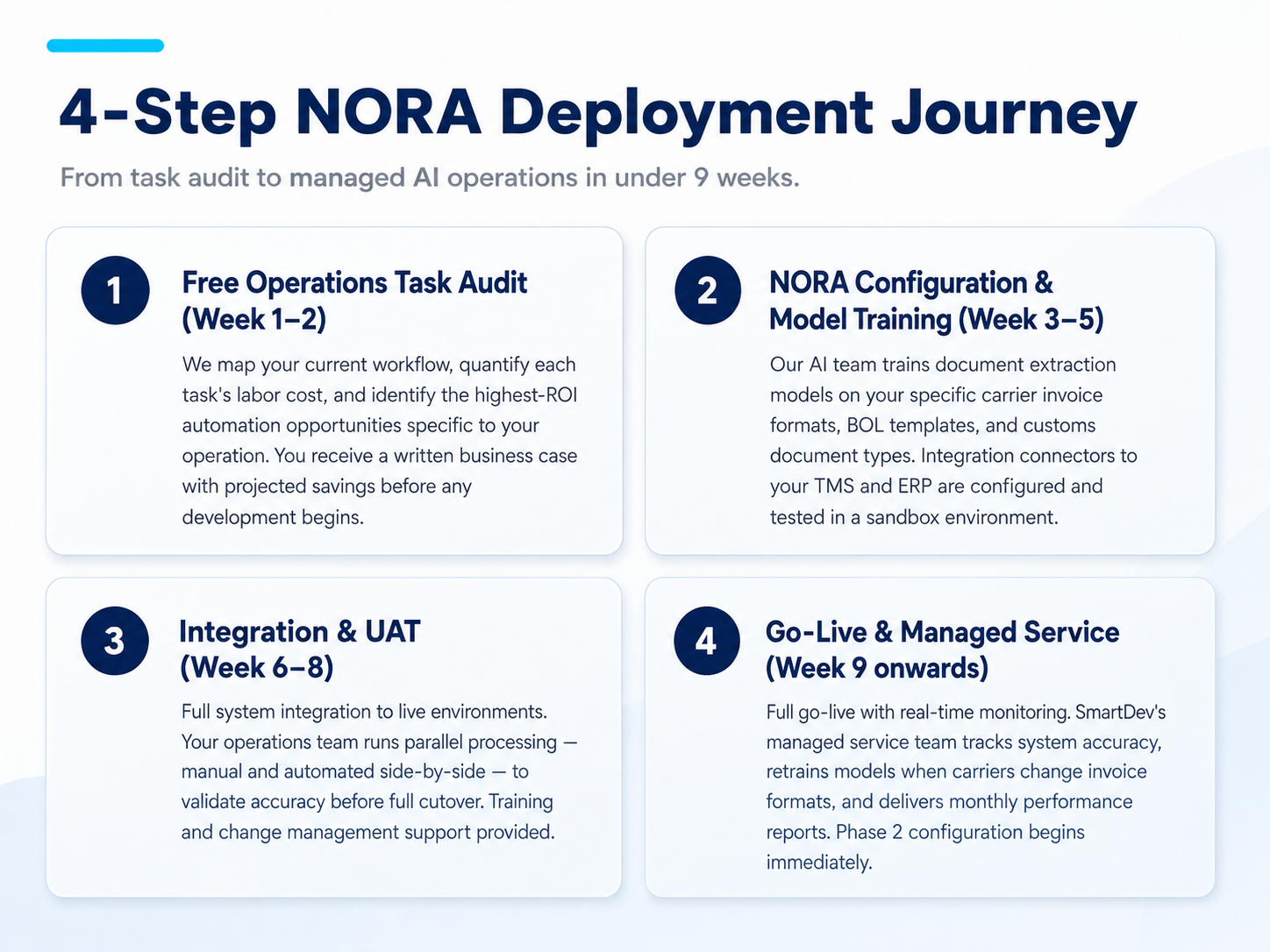
SmartDev’s NORA framework is specifically designed for phased deployment, modular by design, so Phase 1 can go live in 6 weeks while Phase 2 configuration begins in parallel.
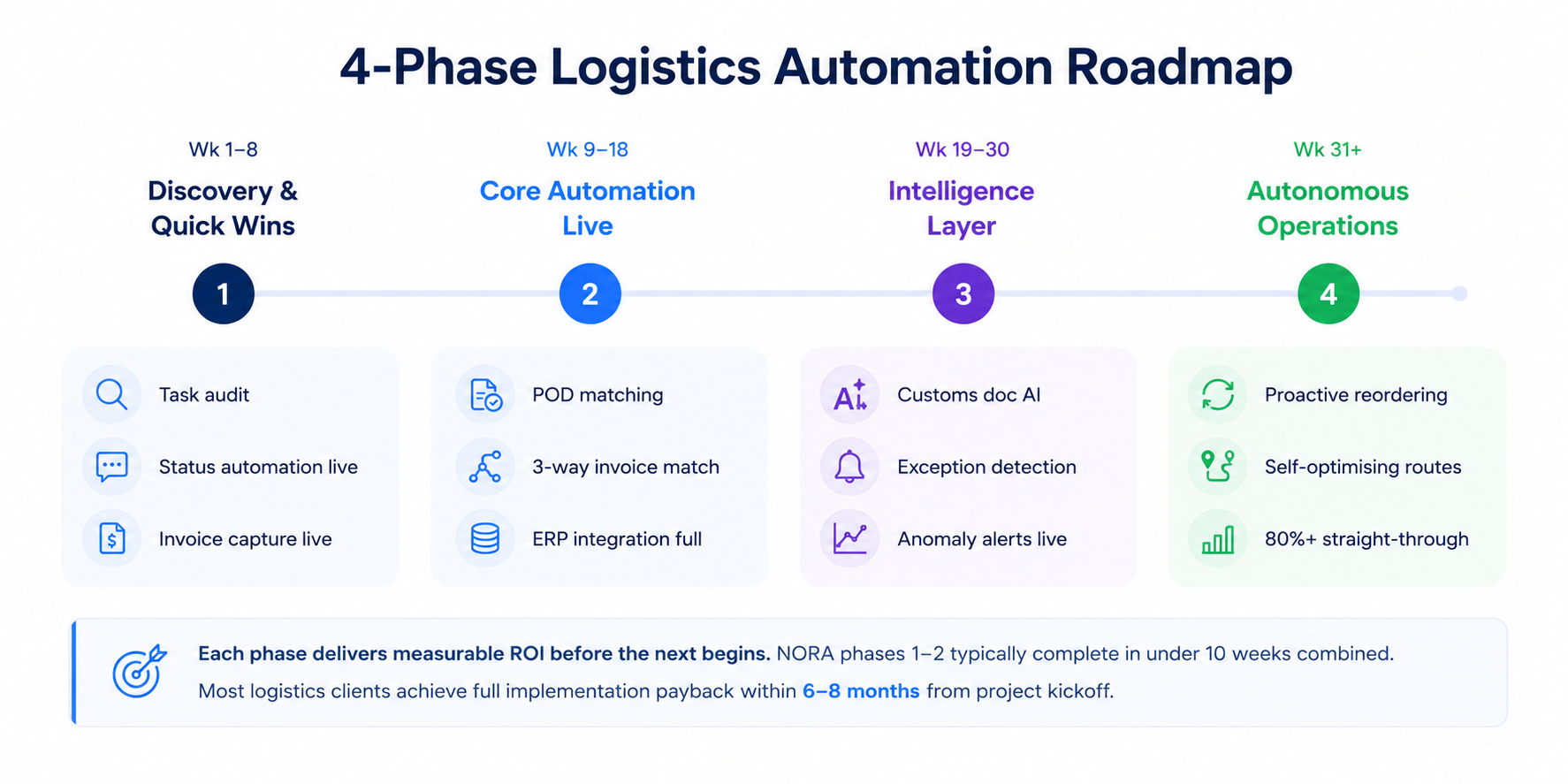
Phase 1: Discovery and quick wins (Weeks 1–8)
Week 1–2: Operations Task Audit
SmartDev’s team maps every operations workflow, counts task frequency, measures handling time, and identifies integration touchpoints. The output is a prioritised automation backlog with dollar-value estimates for each task category. No assumptions, every figure is specific to your environment.
Week 3–5: Status update automation deployment
The highest-volume task, shipment status responses, goes live first. An AI layer reads inbound status requests from email and customer portals, queries the TMS or carrier API for real-time data, and sends formatted responses automatically. No human intervention for standard queries; exceptions escalate to a human queue.
Week 6–8: Invoice capture and basic validation live
AI-powered OCR extracts key fields from carrier invoices, vendor, amount, invoice number, line items, and populates the ERP directly. A basic validation layer checks for obvious errors: duplicate invoice numbers, amounts outside tolerance, missing mandatory fields. By Week 8, the team is already recovering hours per day.
Phase 2: Core automation at scale (Weeks 9–18)
POD matching and filing automation
Proof-of-delivery management is one of the most labour-intensive and risk-laden tasks in logistics operations, yet it is almost entirely automatable. AI reads POD documents from carrier portals and email attachments, extracts key fields (shipment reference, delivery date, consignee name, signature presence), matches them to the corresponding shipment record in the TMS, and files them in the correct location automatically. What previously took 3–5 minutes per document per staff member is reduced to seconds, with zero manual portal logins required.
Exception flagging: damaged goods, short delivery, signature mismatch
The real value of POD automation lies not only in speed but also in exceptional operational intelligence across logistics workflows. For example, when a POD contains damage notations, including handwritten driver remarks, the AI flags issues immediately for review.
Additionally, shipment records are automatically attached and routed directly to claims teams for faster operational resolution and escalation handling. Similarly, short-delivery quantities trigger discrepancy reports automatically against original booking records without requiring manual verification from operations teams.
Furthermore, missing or illegible signatures are detected before filing, preventing documentation gaps from surfacing weeks later during customer claims. These exception scenarios align directly with SmartDev’s broader guide to AI use cases in supply chain management, where document intelligence and automated exception handling protect revenue and customer relationships simultaneously.
Cargo claims window protection
In many trade lanes, the window to file a cargo claim against a carrier is 3–7 days from delivery. Manual POD review processes, especially during peak periods when backlogs of 3–5 days are common, routinely cause companies to miss these windows entirely, turning preventable losses into written-off costs. Automated POD processing eliminates this risk: every exception is surfaced within minutes of document receipt, not days. For logistics operations handling high-value or fragile cargo, this single capability frequently justifies the entire Phase 2 automation investment on its own.
Audit trail and compliance documentation
Beyond the operational benefits, automated POD matching creates a complete, timestamped audit trail for every shipment, a requirement for ISO compliance, customer audits, and dispute resolution. The system logs when each POD was received, when it was matched, what exceptions were flagged, and who actioned them. Manual filing systems, shared drives, email folders, physical archives, cannot produce this level of traceability without significant manual effort. Automated systems generate it as a by-product of normal operation.
Full three-way invoice matching
The Phase 1 invoice capture is upgraded to full three-way matching: the system compares extracted invoice data against the purchase order and goods receipt record simultaneously. Rules-based logic handles standard approvals automatically; only genuine exceptions reach a human reviewer. This is where SmartDev’s AI-powered invoice processing delivers its most significant financial impact, typically a 40–60% reduction in manual invoice review time and near-elimination of duplicate payments.
ERP and TMS deep integration
Phase 2 establishes the full bidirectional data connections between the automation layer and core operating systems. SmartDev’s Application Engineering team specialises in these integrations, connecting to SAP, Oracle, Microsoft Dynamics, and the major TMS platforms without disrupting live operations.
Phase 3: Intelligence layer: exceptions, anomalies, and predictions (Weeks 19–30)
Customs document AI validation
AI reviews import and export documentation for completeness, consistency, and compliance against the applicable regulatory requirements for each origin-destination pair. Missing HS codes, incorrectly declared values, or absent certificates of origin are flagged before the shipment reaches customs, not after a hold has been issued. SmartDev’s AI & Machine Learning solutions include training on jurisdiction-specific customs rule sets.
Exception detection and predictive delay alerts
Rather than waiting for delays to surface through carrier updates, the system monitors live shipment data against expected operational milestones continuously. Additionally, the system detects early warning signals, including anchored vessels, geofence deviations, and cancelled carrier bookings, before disruptions escalate further. This allows proactive customer notifications and internal escalations to trigger automatically before shipment issues become operationally critical. Meanwhile, operations teams shift from reactive firefighting toward proactive logistics management and exception prevention.
Detention and demurrage charge detection
D&D charges are among the most preventable costs in logistics, yet they regularly slip through manual oversight, quietly consuming freight budgets without triggering the scrutiny that a single large carrier invoice would. According to Windward’s industry expert report on D&D management, misunderstandings, hidden charges, and manual tracking processes turn these fees into what practitioners describe as an “operational nightmare”, one that consumes significant portions of freight budgets precisely because the charges accumulate incrementally and invisibly until an invoice arrives weeks later.
Why D&D is uniquely hard to manage manually
The core problem is timing asymmetry. Specifically, free time thresholds vary across carriers, ports, container types, and trade lanes significantly. Additionally, those thresholds begin counting from operational events teams rarely monitor consistently in real time manually. Consequently, by the time D&D invoices arrive, intervention opportunities have often disappeared for days or weeks already. As Windward’s expert panel explains, the charges are predictable in theory but invisible in practice when teams rely on manual dwell-time monitoring. As a result, logistics teams repeatedly pay avoidable charges and dispute invoices afterward instead of preventing those costs proactively.
What the Phase 3 intelligence layer does differently
Rather than discovering D&D charges on invoices after the fact, the Phase 3 automation layer flips the model entirely. The system ingests live container event data, vessel discharge timestamps, terminal gate events, carrier free-time rules by trade lane, and compares actual dwell time against the free-time threshold for each container in real time. When a container is tracking to breach its free-time window, the system alerts the operations team 24–48 hours before charges accrue, with enough lead time to arrange an early pickup, request a free-time extension, or escalate to the relevant party before the clock runs out.
From invoice disputes to charge prevention
The financial impact of this shift is significant. Specifically, Windward’s research shows logistics teams spend substantial time disputing D&D invoice charges after carrier billing occurs. However, those disputes often achieve limited success while consuming staff time that reduces the recovered financial value significantly. Consequently, automation does not simply reduce unnecessary charges. Instead, it prevents those charges from accruing and eliminates the dispute workflow entirely. For operations managing more than 50 containers monthly across congested trade lanes, this capability alone frequently justifies full Phase 3 investment ROI.
Phase 4: Autonomous operations (Week 31 onwards)
Self-triggering workflows without human initiation
Phase 4 moves beyond task-level automation toward process-level autonomy across logistics and supply chain workflows. Consequently, the system monitors conditions and triggers workflows proactively without requiring manual operational involvement. For example, customs document gaps are detected automatically, and supplier requests are generated immediately without human initiation. Similarly, carrier invoices arrive and process completely without employees logging into operational systems manually. Additionally, missed shipment milestones trigger revised ETAs and customer apology notifications automatically without human involvement at any stage.
Continuous model improvement
Every exception your team resolves in Phases 1–3 feeds back into the AI models, improving extraction accuracy, validation rules, and anomaly detection precision. The system compounds in capability over time, a fundamental advantage over static rules-based tools that degrade as your carrier mix, document formats, and business rules evolve.
Before vs. After: What Changes for Your Operations Team
The day-in-the-life transformation
The most tangible measure of a successful automation program is what your operations team’s day looks like 6 months after go-live. The contrast is significant:
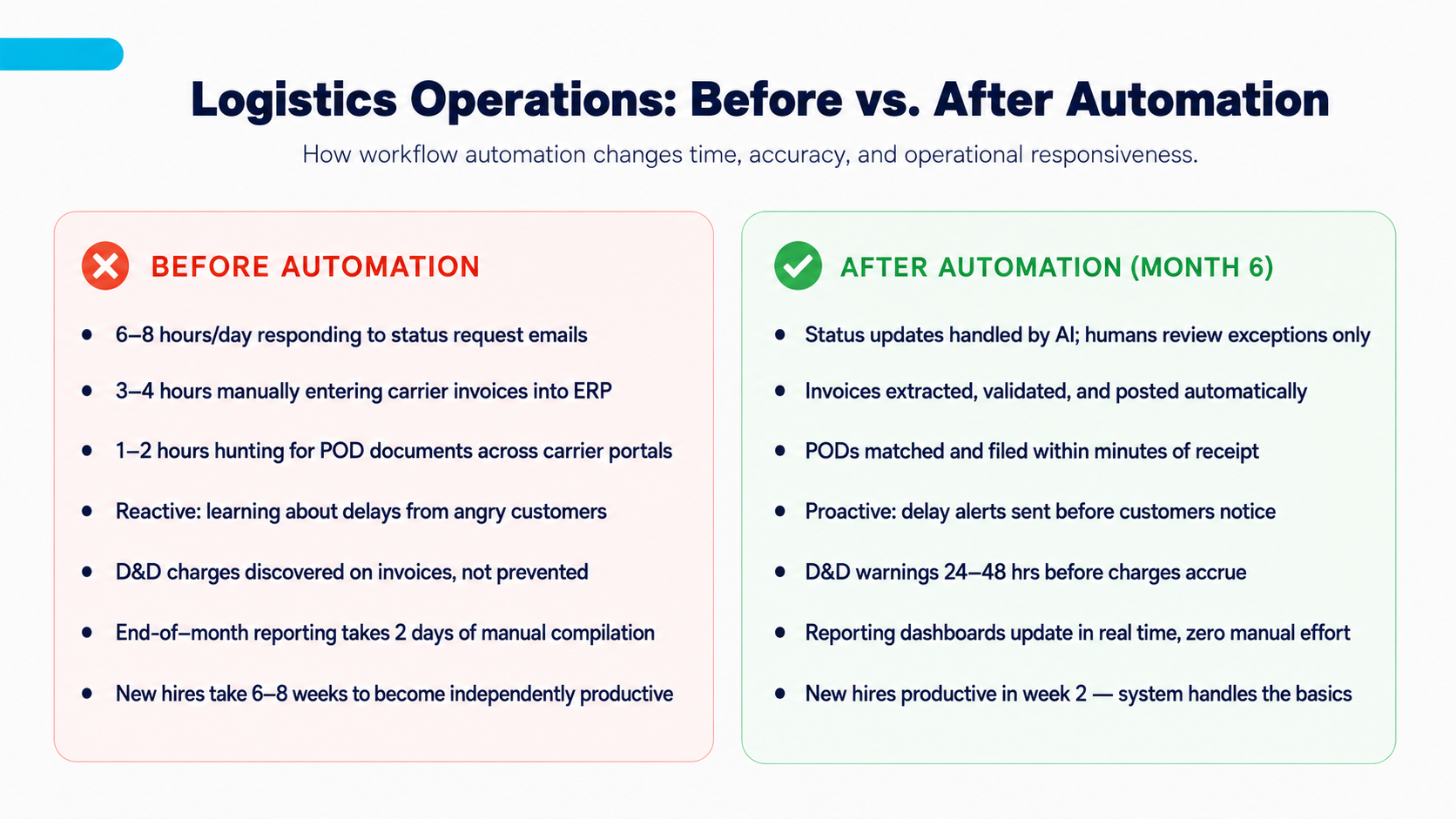
Where your team’s time goes instead
Automation does not eliminate operations teams. Instead, it elevates them toward work requiring genuine human judgment and operational expertise. Consequently, hours recovered from repetitive tasks shift toward carrier relationship management, exception negotiation, strategic lane analysis, and escalation handling. Additionally, Gartner’s supply chain research found companies automating operational tasks report 35–45% higher staff engagement because skilled employees finally perform skilled work.
This four-phase roadmap is exactly how NORA is structured. SmartDev’s AI Adoption Accelerator compresses Phase 1 and Phase 2 into a single 6–10 week deployment cycle, so your team can live with core automation in under two months, not eighteen.
Read: What is an AI Adoption Accelerator? →
Technology Decisions That Determine Automation Speed
AI document processing: OCR is not enough
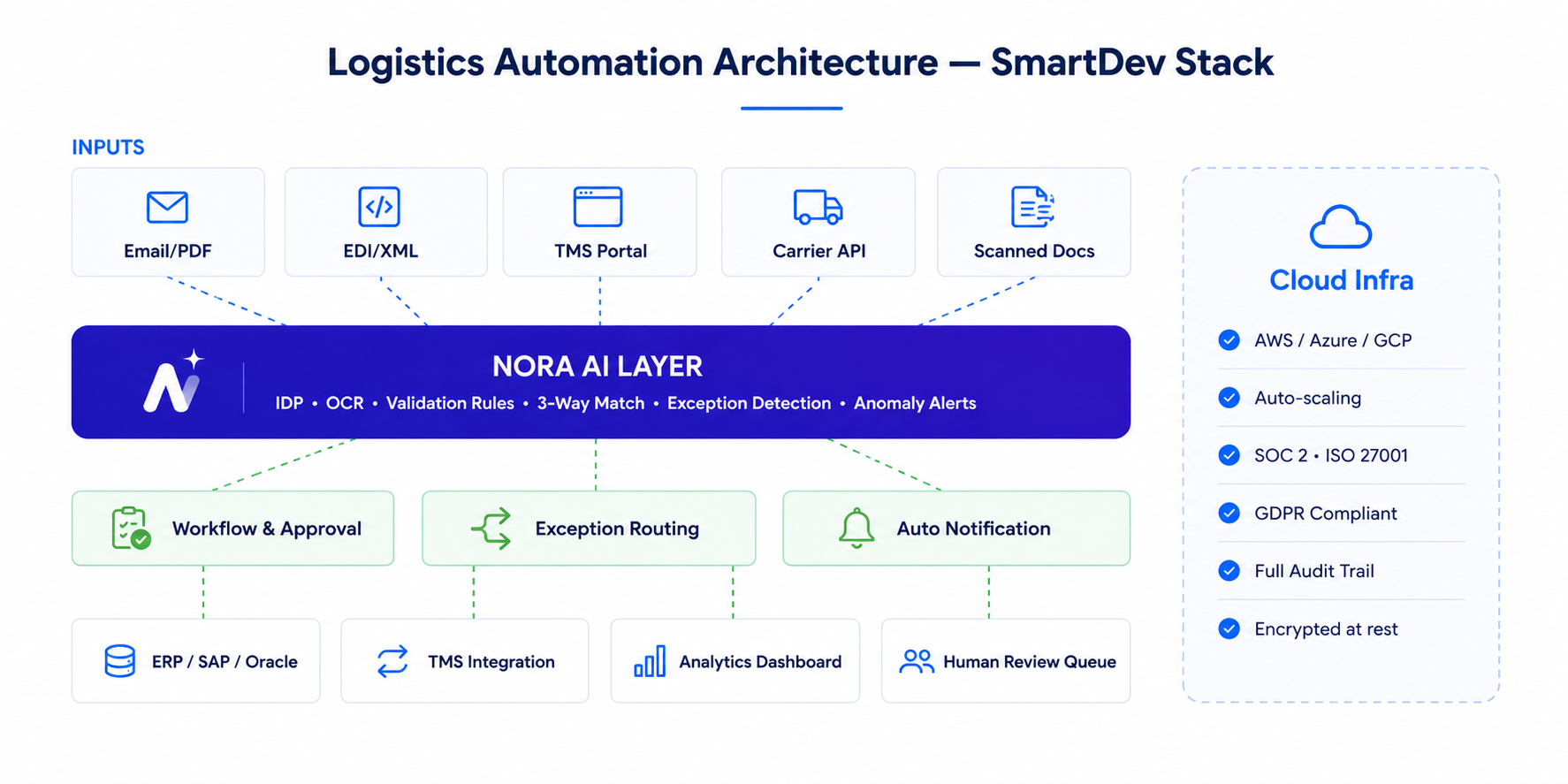
Legacy OCR tools extract text, they cannot understand it. A carrier invoice that changes its layout, adds a new surcharge line, or uses a different date format breaks a template-based OCR system immediately. Modern Intelligent Document Processing (IDP) uses machine learning to understand document structure semantically, it recognises that “BRUT WT” and “Gross Weight” mean the same thing across different carrier invoice formats.
SmartDev’s AI Development Services build IDP pipelines trained on your specific document types and carrier mix. We work with leading document AI platforms including Google Document AI and Microsoft Azure Document Intelligence, choosing the right engine for each client’s document complexity and volume.
Integration architecture: API-first is non-negotiable
Automation that cannot talk to your existing systems is automation that creates more work, not less. Every SmartDev logistics automation engagement starts with a technical integration audit: what APIs does your TMS expose? What version is your ERP? Do your carrier portals support EDI or API connectivity, or are you still on email/portal?
The answers determine the integration approach, and SmartDev’s Application Engineering team has built connectors for SAP, Oracle, Microsoft Dynamics 365, MercuryGate, BluJay, Oracle TMS, and the major carrier APIs. Where APIs don’t exist, we build intelligent web scraping or RPA layers as a transitional bridge, a pragmatic approach that keeps timelines tight rather than waiting for a perfect integration environment.
Cloud infrastructure and scalability
Logistics operations are seasonal. A system sized for average volume will fail in peak season. SmartDev’s Cloud Solutions team designs all automation infrastructure to scale elastically, so a 400% Q4 volume spike doesn’t require any infrastructure intervention. Containerized deployment on AWS, Azure, or GCP with auto-scaling groups is standard practice for all SmartDev logistics deployments.
Security, compliance, and audit trail requirements
Logistics automation handles sensitive commercial data: carrier contracts, customer shipment details, invoice amounts, and customs declarations. Every SmartDev automation deployment is built to enterprise security standards: data encrypted at rest and in transit, role-based access controls, full audit logging, and compliance with GDPR, SOC 2 Type 2, and regional data protection requirements. SmartDev holds ISO 27001 and SOC 2 Type 2 certifications, non-negotiable for regulated industries.
Common Implementation Pitfalls, and How to Avoid Them
The statistics on automation failure are sobering. S&P Global Market Intelligence’s 2025 survey of over 1,000 enterprises found that 42% of companies abandoned most of their AI initiatives, up from just 17% the year prior. The average organisation scrapped 46% of AI proof-of-concepts before they ever reached production. These failures are not primarily technical. They are organisational, process-level, and vendor-selection mistakes that are entirely preventable, if you know what to look for.
Trying to automate broken processes
Automation amplifies whatever process it automates, including its flaws. If your invoice approval process requires three email forwards and a phone call to clarify who should approve what, automating it will produce faster confusion, not resolution. As MeltingSpot’s analysis of digital transformation failures puts it plainly: “Pouring modern technology over bad processes is a recipe for failure. Tech can’t fix what you don’t understand, it will only amplify the status quo.” The same pattern appears in logistics specifically: Mavim’s research on enterprise transformation cites “automating a chaotic manual process without standardising it” as one of the most consistent root causes of failed deployments.
The pre-automation checklist
Phase 1 of every SmartDev engagement includes process review before a single line of automation code is written successfully. Specifically, SmartDev confirms whether tasks are performed consistently or whether individual team members follow different operational variations instead.
Additionally, SmartDev evaluates whether decision rules are clear enough to document logically and automate reliably across operational workflows consistently. Furthermore, the review examines whether input documents arrive in manageable formats and whether operational exceptions can be routed clearly.
If the answer to any requirement is “it depends,” process standardization must happen before automation implementation begins. Otherwise, organizations risk engineering operational scale into existing problems instead of building scalable solutions that eliminate inefficiencies.
Under-investing in change management
The technical implementation is often the easier half of a logistics automation project. The harder half is ensuring your operations team understands what is changing, why, and what it means for their roles. According to Gartner’s Future of Supply Chain Survey cited by Supply Chain Management Review, 76% of logistics transformations never fully succeed, failing to meet budget, timeline, or KPI targets, and the leading cause is not technology failure but people resistance. Teams that fear automation resist it subtly: low adoption rates, workarounds, exception over-classification, and deliberate reliance on the parallel manual process long after go-live.
Why logistics teams resist, and what actually works
Research from Prosci’s change management studies in logistics shows that projects with excellent change management achieve significantly higher implementation success rates. Specifically, those projects are seven times more likely to achieve successful organisational change than poorly managed transformation initiatives.
Importantly, the critical factor is not training volume. Instead, success depends on communication timing and organisational framing before implementation begins. Teams briefed before go-live adopt systems faster and classify significantly fewer operational exceptions incorrectly during implementation periods.
Similarly, Harvard Business Review research cited by Perfect Planner found structured change management programs increase project success rates by 30%. Consequently, SmartDev includes explicit change management as a core project deliverable rather than an optional additional implementation service.
This includes pre-go-live team briefings, transparent communication regarding role evolution, measured parallel-run validation periods, and internal adoption champions. As a result, organisations achieve genuine operational adoption instead of passive employee resistance toward automation initiatives.
Choosing a generic vendor over a logistics-specific one
Generic AP automation or workflow tools do not understand freight invoices, bills of lading, or customs entries out of the box. Specifically, they lack accessorial charge logic, carrier tariff awareness, and multi-modal document understanding required across logistics operations consistently.
Consequently, the integration work required to make generic platforms understand logistics-specific documentation often exceeds initial implementation expectations significantly. In many cases, those customisation costs require more time and money than purpose-built logistics solutions would have demanded initially.
Furthermore, this pattern is confirmed by Georgia Tech’s Supply Chain and Logistics Institute, which highlights recurring implementation failures consistently. Specifically, the institute notes that automation investments in logistics “fail for people and domain reasons, not engineering reasons.” Therefore, vendors with deep logistics expertise close both operational and implementation gaps simultaneously.
What to demand from any automation vendor before signing
Ask specifically: How many logistics-specific invoice and document automation projects have you delivered successfully across real operational environments previously? Additionally, can you show a live demo using freight invoices from our carrier mix instead of sanitised sample documents?
Furthermore, ask how the model handles accessorial charge codes, multi-currency invoices, and handwritten POD notations during processing workflows. Also, clarify the retraining process when carriers change invoice layouts or modify document structures across operational systems regularly.
Vendors unable to answer these questions with operational specificity are typically selling general-purpose tooling instead of logistics-focused automation solutions. Consequently, your organization will likely absorb additional costs customising those platforms into functional logistics systems independently.
SmartDev’s AI & Machine Learning practice includes pre-trained models for logistics document types, freight invoices, BOLs, PODs, DOs, and customs entries, built across multiple client engagements and continuously improved through managed service retraining. The logistics domain expertise is built in, not bolted on.
NORA, SmartDev’s AI Adoption Accelerator for Logistics Operations
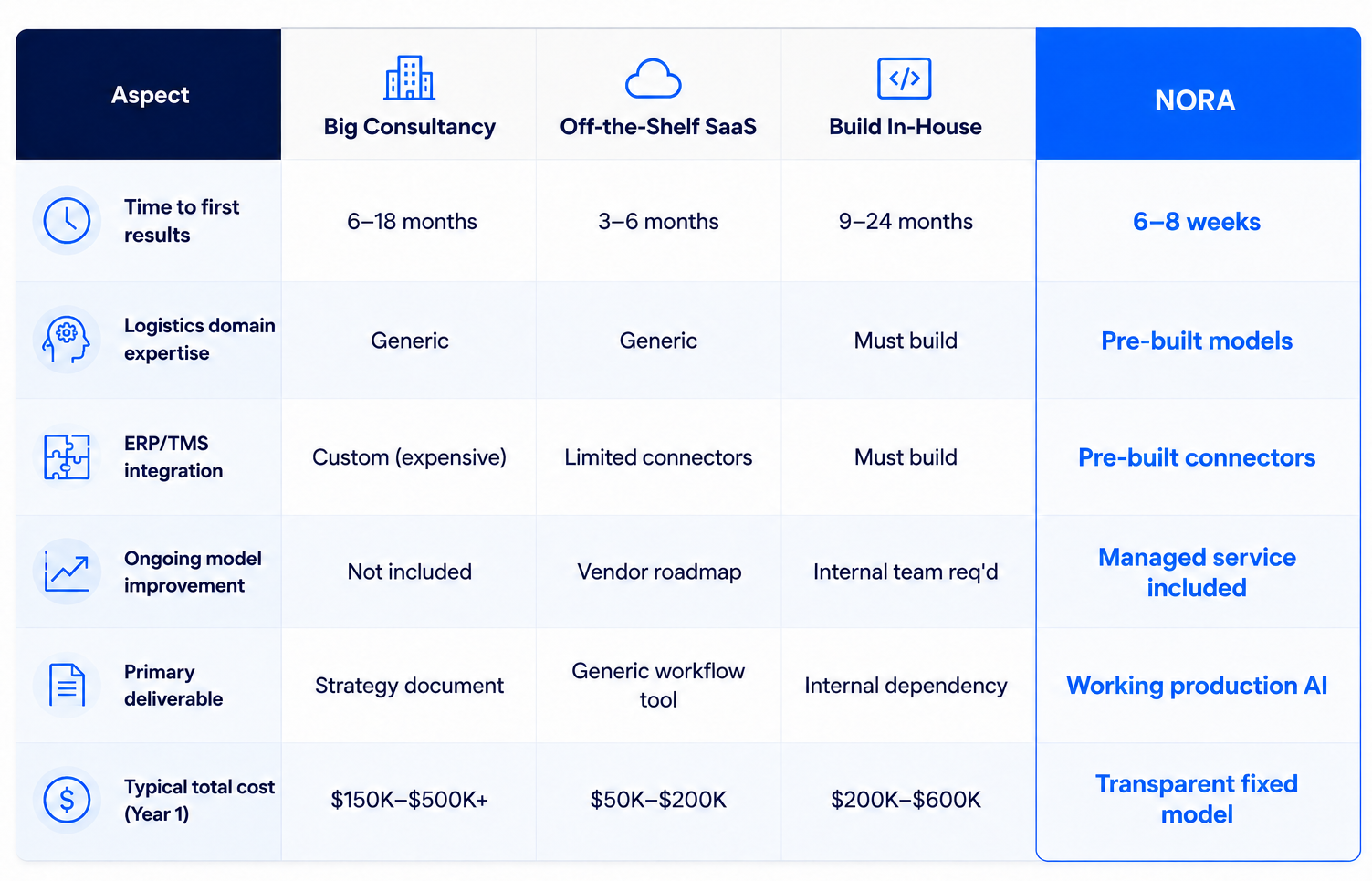
NORA, SmartDev’s AI Adoption Accelerator, enables companies to execute every roadmap element faster, with lower risk, and at a significantly lower total implementation cost. SmartDev combines pre-built AI components, proven delivery methodologies, and managed services to keep systems effective as business requirements evolve.
How NORA’s four layers apply to logistics operations
NORA is organised into four capability layers that map directly onto the four roadmap phases outlined previously within this article. First, the Foundation layer handles document ingestion and data extraction across freight invoices, BOLs, PODs, and customs entries.
Next, the Intelligence layer applies validation rules, three-way matching, and anomaly detection across operational logistics and financial workflows consistently. Furthermore, the Execution layer triggers operational actions, including ERP posting, notification delivery, and exception routing across connected business systems.
Finally, the Autonomous layer monitors operational conditions continuously and acts proactively without requiring direct human initiation or intervention manually. Most logistics clients begin with Layers 1 and 2 and achieve measurable ROI within eight weeks after implementation kickoff.
As operational confidence increases, Layers 3 and 4 expand implementation scope gradually. Consequently, each additional layer becomes cheaper and faster than the first because the underlying infrastructure already exists. Read the full breakdown in SmartDev’s article: What is an AI Adoption Accelerator?
NORA vs. alternatives: a direct comparison
Measuring Success: The KPIs That Matter
Operational efficiency metrics
The primary KPIs for a logistics automation program measure reclaimed operational time and eliminate processing errors across repetitive workflows. Specifically, organizations should track average invoice processing time, with a target reduction exceeding 70% after automation deployment.
Additionally, teams should monitor straight-through processing rates, targeting more than 85% of invoices requiring zero human touchpoints consistently. Furthermore, exception rates should remain below 15% of transactions flagged for manual review during operational processing workflows.
Finally, status response time should decrease significantly, targeting automated responses within two minutes instead of four-to-eight-hour manual delays.
Financial performance metrics
Operational savings compound into financial outcomes. Track: cost per invoice processed (target: reduce from $12–30 to $2–5), duplicate payment rate (target: near-zero), late payment penalty costs (target: 90%+ reduction), and early payment discount capture rate (target: 85%+ of available discounts captured). SmartDev’s Data Analytics Services build the dashboards that surface these metrics automatically.
Team performance and satisfaction metrics
Track the human side too: operations team overtime hours (target: significant reduction within 90 days), new hire time-to-productivity (target: halved), and staff engagement scores. Companies that automate repetitive tasks consistently report higher staff retention, skilled people stay where they do skilled work.
SmartDev’s Solution: Your Logistics Automation Partner
What SmartDev brings that others don’t
SmartDev has delivered AI-powered automation across logistics, BFSI, and enterprise operations since 2019. Our team combines logistics domain expertise, understanding freight billing, customs compliance, carrier operations, with deep AI engineering capability. We don’t hand you a strategy and disappear. We build, integrate, go live, and stay.
With ISO 27001 certification, multiple Sao Khue Awards in 2024 and 2025, recognised among Vietnam’s Top 10 Tech Companies 2025, and an 80% client return rate speak to what we actually deliver, working software, not presentations.
The SmartDev logistics engagement model
Ready to start? Three ways to engage SmartDev
Whether you want to understand your automation opportunity, see NORA in action, or move straight to implementation, SmartDev has an entry point for your situation:
- Free Operations Task Audit, 2-week structured discovery; we map your workflows and quantify the savings before you commit to anything. Book your audit
- NORA Proof of Concept, SmartDev’s AI Proof of Concept program lets you validate the technology on a single workflow (e.g., invoice capture) within 3 weeks, at minimal cost and zero long-term commitment.
- Full NORA Deployment, End-to-end engagement from audit through go-live and ongoing managed service. Most clients live within 8 weeks. Talk to our team
Frequently Asked Questions
How long does a logistics operations automation program realistically take?
With SmartDev’s NORA framework, Phase 1 automation, including status updates and invoice capture, is typically live within 6–8 weeks of project kickoff. Furthermore, full four-phase implementation, covering invoice matching, customs document AI, exception detection, and autonomous workflows, typically completes within 7–9 months.
In contrast, traditional enterprise implementations usually require 12–24 months for equivalent operational scope. Therefore, NORA’s pre-built components compress implementation timelines significantly while accelerating measurable operational outcomes.
Will automation replace our operations team?
No, and this is an important distinction to communicate to your team. Automation eliminates repetitive, rules-based tasks so that operations staff can focus on the judgment-dependent, relationship-driven, and strategically valuable work that genuinely requires human expertise. SmartDev’s logistics clients consistently report that their operations teams are more engaged and more productive after automation, because they are finally doing meaningful work.
What if our systems are outdated or poorly integrated?
This is one of the most common concerns, and it is rarely a blocker. SmartDev’s Application Engineering team has connected NORA to legacy ERP systems, TMS platforms with limited API support, and carrier environments where EDI is not available. Where modern APIs don’t exist, we build RPA or intelligent web scraping bridges as transitional solutions, keeping timelines tight while the longer-term modernisation roadmap develops in parallel.
How does SmartDev handle our data security requirements?
SmartDev holds ISO 27001 and Clutch certifications. All automation deployments use end-to-end encryption, role-based access controls, and full audit logging. Data residency requirements (GDPR, regional data protection laws) are addressed at the architecture design stage, not retrofitted after deployment. Your commercial and customer data never transits unsecured or unvetted infrastructure.
Conclusion
The Operational Reality Behind Logistics Inefficiency
Logistics operations teams are among the most time-pressured workforces in any industry. The painful irony is that the majority of what consumes their day, status update emails, invoice data entry, document cross-checking, POD filing, is not skilled work. Instead, it is high-volume, rules-based processing that current AI technology handles faster, more accurately, and more consistently than any human team. Therefore, keeping people in those roles is not caution. It is a waste.
As SmartDev’s guide to AI use cases in logistics makes clear, the technology to replace every one of these tasks exists today. However, the gap is not technological. Instead, it is implementation.
From Automation Theory to Operational Execution
Importantly, the four-phase roadmap in this article is not theoretical. It maps directly to how SmartDev delivers automation for supply chain operators, freight forwarders, and 3PLs, starting with the highest-volume, highest-error-risk tasks in Phase 1, and compounding outward to fully autonomous operations in Phase 4. Moreover, the same AI principles that drive value in transportation management and warehouse operations apply directly to the back-office workflows that logistics operations teams handle manually every day.
Furthermore, each phase delivers measurable ROI before the next begins. No 18-month big-bang deployments. No “go live and hope.” Instead, the approach remains structured, phased, and proven.
Why Implementation Matters More Than AI Hype
Additionally, the technology decisions matter, Intelligent Document Processing over legacy OCR, API-first integration via SmartDev’s Application Engineering team, cloud-native scalability, and continuous model retraining. For finance-heavy operations, the same AI layer that automates freight invoice processing extends naturally to trade finance automation and end-to-end financial operations. Likewise, for operations leaders thinking about broader AI in operations beyond logistics specifically, the pattern is consistent: high-frequency, rules-based tasks yield the fastest and most measurable ROI when automated first.
However, the implementation model matters just as much as the technology. That is precisely why SmartDev built NORA: to compress the 12–18 month timeline that has historically made enterprise AI feel inaccessible, down to a 6–8 week cycle that delivers working automation in production, not a pilot, not a proof of concept, but a live system recovering hours every day. Whether your starting point is distribution centre operations, cross-border freight invoicing, or a broader AI strategy for your organisation, SmartDev’s approach is the same: start with the highest-value task, prove the ROI, then expand.
The Competitive Window Is Already Closing
Meanwhile, your competitors are moving on this. McKinsey’s 2024 Global AI Adoption report found that 44% of supply chain leaders are already piloting or deploying AI, with a projected ROI of 20–30% within two years, and the global AI in logistics market is forecast to grow from $2.9 billion to $15.3 billion by 2030.
Furthermore, the freight market rewards operational efficiency with better carrier relationships, tighter margins, and the capacity to take on volume that manual teams cannot handle. Therefore, the question is not whether to automate. Instead, it is how many more months of unnecessary labour cost, compounding errors, and team burnout you can afford before you do.
The Next Step for Logistics Leaders
Finally, contact us to explore how NORA can map your highest-cost repetitive tasks, quantify the savings opportunity specific to your operation, and deliver a working automation system in production within 6–8 weeks, with no long-term commitment required to get started.