

TL;DR
- IoT connects physical devices to networks and software so businesses can turn real-world conditions into data-driven decisions or automated actions.
- The main benefits cluster around visibility, efficiency, asset management, customer experience, cost control, and new revenue models – but none of these are automatic.
- The main risks cluster around cybersecurity, data privacy, integration complexity, total lifecycle cost, reliability, vendor lock-in, and workforce/ethical impact.
- Value and risk scale together: more connected devices mean more potential insight, and more attack surface and maintenance burden at the same time.
- IoT is more likely to pay off when the business problem is specific and measurable, data governance is already reasonably mature, and there’s a clear owner for security and outcomes.
- A focused pilot – testing one assumption with defined success criteria – is a lower-risk way to validate an IoT investment than a full rollout.
- Total cost of ownership, not upfront hardware cost, is what determines whether an IoT initiative is actually worth it.
- No single answer fits every business – the right call depends on your specific use case, readiness, and risk tolerance, not on IoT’s reputation as a category.
Introduction
Every connected device a business adds is also a new thing it has to manage. A temperature sensor on a production line, a GPS tracker on a delivery van, a badge reader in an office – each one can generate genuinely useful data, and each one is also a piece of infrastructure that needs security, integration, and upkeep.
That tension hasn’t slowed adoption. MarketsandMarkets projects the global IoT market will grow from roughly $547 billion in 2025 to $865 billion by 2030, a 9.6% annual growth rate – driven largely by organizations embedding sensors across operations and pairing them with AI-driven analytics to turn raw telemetry into real-time action, rather than connectivity for its own sake. The same research also flags what’s holding some of that growth back: rising cybersecurity and data-privacy concerns, and persistent interoperability and integration challenges, sit right alongside the growth drivers as the two most cited restraints on adoption.
That’s the real decision businesses face with IoT: not “should we adopt IoT” as a blanket yes-or-no, but whether a specific use case creates enough measurable value to justify the investment, the integration work, and the ongoing security and governance responsibility it brings with it.
This guide takes a balanced look at both sides – the genuine operational benefits IoT can deliver, and the security, cost, and complexity risks that come with it – and then walks through a practical way to evaluate whether a particular IoT initiative is worth pursuing for your business.
What Is IoT in a Business Context?
The Internet of Things (IoT) refers to networks of physical devices – sensors, machines, vehicles, wearables, appliances – that collect data and connect to the internet or to each other, so that data can be transmitted, analyzed, and acted on. In a business context, IoT is less a single technology and more an operating layer: a way of turning conditions in the physical world (a machine’s temperature, a shelf’s stock level, a truck’s location) into data that people or systems can respond to.
How IoT connects devices, data, and business processes
A typical IoT system runs through four stages: a device or sensor captures a signal, connectivity transmits that signal to a platform, the platform processes and analyzes the data, and the result triggers an alert, an insight, or an automated action. Where a given deployment sits on that chain matters – some systems stop at monitoring (a dashboard a person checks), others trigger automated alerts, and a smaller number close the loop with fully automated action. Conflating these three is a common source of unrealistic expectations: a sensor that flags an anomaly is not the same thing as a system that resolves it.
Common business applications of IoT
IoT shows up across a wide range of business functions, generally in one of four clusters:
- Operations and asset monitoring – tracking machine condition, utilization, and location to support maintenance and asset management decisions.
- Supply chain, inventory, and logistics – monitoring stock levels, shipment location, and cold-chain conditions to reduce stockouts and losses.
- Customer and workplace experiences – connected products and environments that reveal usage patterns to improve service, personalization, or workplace safety.
- Energy, facilities, and environmental monitoring – tracking energy use, occupancy, and environmental conditions to support facilities decisions and sustainability goals.
SmartDev’s guide to overcoming IoT development challenges and our piece on how AI and IoT integration is transforming operations go deeper into how these clusters translate into real deployments.
The Main Advantages of IoT for Businesses
The benefits below are achievable, but adding connected devices alone does not guarantee them. Results depend on the use case, data quality, and integration with real operational workflows. Today, IoT also rarely delivers meaningful value by itself. Its strongest benefits come when sensors feed data into AI and analytics systems. These systems convert raw signals into decisions and actions, rather than simply providing connectivity.
Enhanced operational efficiency
Continuous data collection can reveal bottlenecks, identify emerging issues, and support automation that reduces manual monitoring. The efficiency gain comes from turning real-time information into action faster than manual processes can. Increasingly, AI-driven workflow automation processes sensor data automatically instead of requiring someone to watch a dashboard. This distinction matters because a dashboard only supports monitoring. Combining IoT sensors with automation is what actually removes manual effort from the workflow.
Better visibility and data-informed decisions
IoT provides real-time or near-real-time visibility into asset status, environmental conditions, and usage patterns. Without connected devices, collecting this information would often require repeated manual checks. However, visibility is not the same as insight. Sensor data improves decisions only when it is accurate, integrated, and interpreted by someone authorized to act. As data volumes grow, businesses also need a dedicated data analytics layer. Manual review simply cannot scale beyond a relatively small number of connected devices.
Asset, inventory, and maintenance management
Connected sensors support three related but different use cases. Tracking identifies an asset’s location, while condition monitoring shows its current state. Predictive maintenance estimates when equipment is likely to fail. However, accurate predictions require sufficient historical data and mature analytical capabilities. Sensors alone cannot produce reliable maintenance forecasts. SmartDev’s work on AI-driven predictive maintenance in manufacturing and our warehouse management use cases explains these practical data requirements.
Improved customer experiences and service delivery
Connected products can reveal usage signals that help businesses improve availability, responsiveness, and personalization. However, these benefits depend on transparent and responsible data practices. Using data to improve services differs significantly from tracking people without clear consent. Unclear or intrusive practices can quickly undermine the customer trust these improvements are intended to strengthen.
Cost control and resource efficiency
IoT can reduce waste, energy consumption, downtime, and manual labor in specific and measurable ways. However, businesses must compare those savings with the full cost of implementation. Hardware, connectivity, integration, security, and ongoing maintenance all create recurring expenses. Therefore, the key question is whether operational savings exceed the system’s total lifecycle cost. This calculation should also include the MLOps discipline required to keep AI-driven processing reliable over time.
Business innovation and new revenue opportunities
Connected product data can support subscription services, usage-based pricing, and proactive support offerings. These models may create opportunities that were previously difficult or impossible to deliver. However, new revenue is potential rather than a guaranteed outcome. Businesses still need a clear customer value proposition, not merely access to more data. SmartDev’s guide to no-code AI platforms explores how smaller teams can prototype these ideas without building custom infrastructure.
Safety, sustainability, and environmental benefits
Sensors can monitor energy use, equipment conditions, and environmental factors continuously. This visibility can support earlier safety interventions and more efficient use of resources. However, these benefits should be measured through specific indicators and operational outcomes. They should not be treated as automatic results of installing connected sensors.
The Main Disadvantages and Risks of IoT
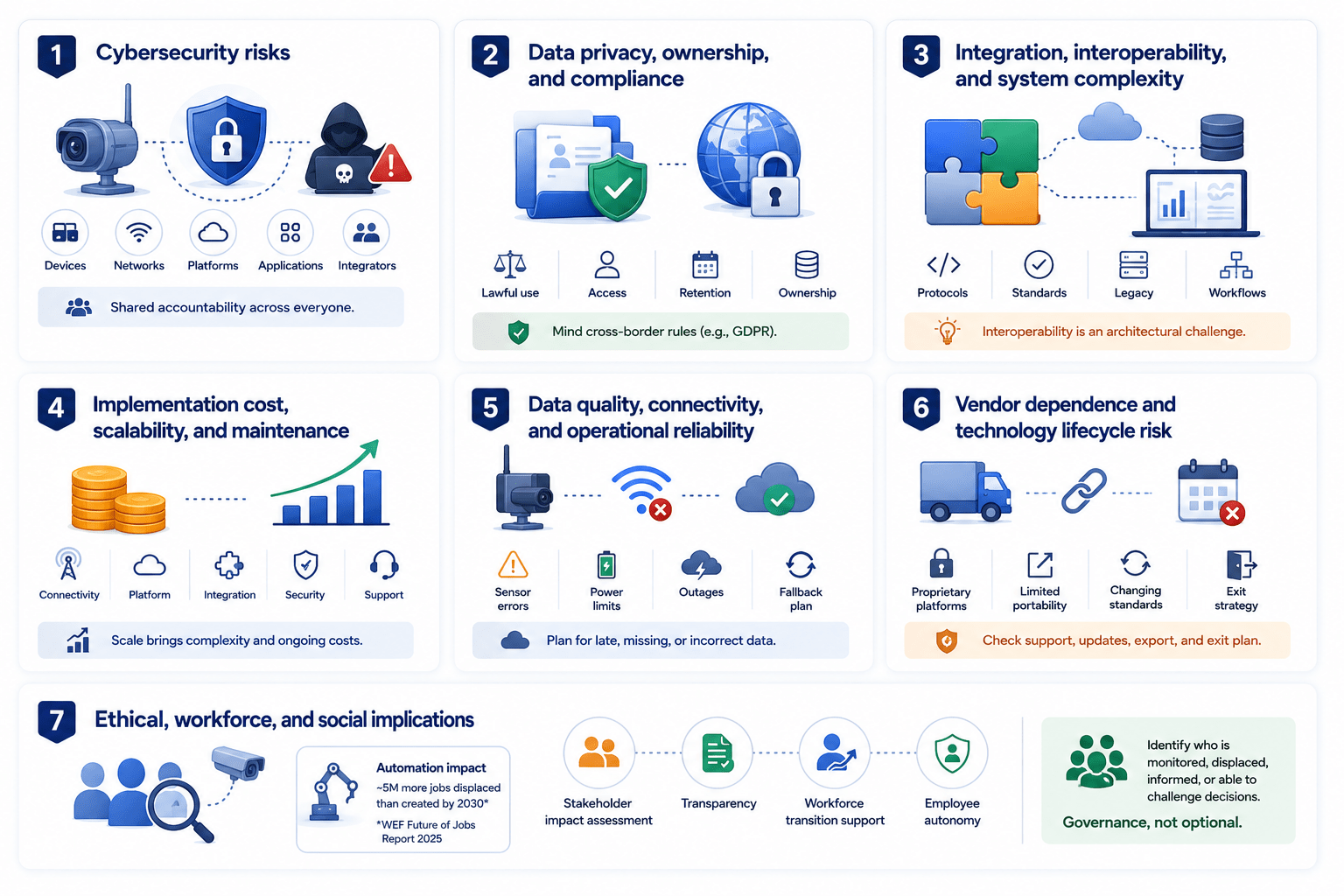
These risks are significant, but they remain manageable with realistic assessment and careful planning. The goal is not to discourage IoT adoption. It is also important to separate inherent connected-system risks from problems caused by poor implementation. The second group is largely avoidable.
Cybersecurity risks
Every connected device can become a potential entry point for attackers, with common risks including weak default security, outdated firmware, poor identity management, and exposed network interfaces. For this reason, security should often be designed into firmware rather than added after deployment, as explained in SmartDev’s embedded software solutions work, which shows how device-level security can be implemented effectively.
IoT security spans devices, networks, platforms, applications, and system integrators, meaning no single party can secure the entire environment alone. A shared accountability model is therefore required across all organizations involved in the system, and NIST’s Cybersecurity for IoT program provides useful baseline guidance for secure device capabilities. In addition, SmartDev’s AI use cases in security explains how AI-driven monitoring can detect unusual behavior across expanding device fleets.
Data privacy, ownership, and compliance concerns
IoT devices may continuously collect personal, behavioral, location, or operational information, so businesses need clear policies covering lawful use, access, retention, and data ownership. These policies must also address cross-border processing when information moves between jurisdictions, and for deployments involving EU residents, the GDPR’s official text remains the main reference.
The regulation defines obligations involving lawful processing, data minimization, access rights, and deletion requests, although privacy requirements still differ across jurisdictions and industries. Therefore, general guidance should not replace legal review of a specific deployment.
Integration, interoperability, and system complexity
Devices from different manufacturers often use incompatible protocols, standards, and data formats, while legacy systems may also struggle to communicate with modern IoT platforms. Interoperability is therefore an architectural and planning challenge rather than a simple device-selection decision, as dependencies extend across devices, connectivity, platforms, data, applications, and workflows.
Unclear ownership at any stage can create friction across the entire system, and SmartDev’s custom solution architecture services explains how these dependencies are mapped before development. The IoT market also lacks a single universally adopted technical standard, as vendors continue promoting competing protocols, platforms, and data formats.
As a result, interoperability planning must be reviewed whenever a business introduces a significantly different device category, since it cannot be solved once and ignored.
Implementation cost, scalability, and ongoing maintenance
IoT costs extend far beyond purchasing connected devices, as expenses include connectivity, platform licenses, integration, security, data management, support, and hardware replacement. A small pilot also has a very different cost structure from a large deployment, since managing 50 sensors does not simply cost 50 times more.
Scaling introduces additional complexity involving monitoring, updates, support processes, infrastructure, and device lifecycle management, making long-term planning essential.
Data quality, connectivity, and operational reliability
Sensor errors, limited power, and connectivity outages can reduce IoT data quality, so the system must handle information that arrives late, incomplete, or incorrect. Every deployment therefore needs an operational fallback plan, not only reliable sensors, and power dependency deserves particular attention.
Many deployments require continuous power for both devices and connectivity equipment, and any interruption may create a monitoring gap when visibility matters most. Not every IoT architecture requires permanent connectivity, but connected systems still need clear procedures for network or power failures.
SmartDev’s hybrid cloud solutions covers one common approach for building platform-level redundancy and maintaining operational continuity.
Vendor dependence and technology lifecycle risk
Proprietary platforms, discontinued devices, changing standards, and limited data portability can create significant long-term risks, as these issues may restrict future flexibility and increase switching costs. Before choosing a vendor, businesses should examine support periods, update frequency, data export options, and exit procedures to understand what happens when the relationship ends.
Ethical, workforce, and social implications
Continuous sensing and monitoring raise concerns about surveillance, transparency, and employee autonomy, and these concerns increase as monitoring becomes more detailed and persistent. Workforce displacement is another important issue, as the World Economic Forum’s Future of Jobs Report 2025 projects significant displacement from robotics and automation.
It estimates that these technologies could displace around five million more jobs than they create by 2030, making responsible workforce planning essential. When IoT automation replaces manual work, businesses must consider affected employees, not only improved processes, so retraining and role-transition support should be part of implementation planning.
A stakeholder-impact assessment should occur before deployment, where businesses identify who is monitored, displaced, informed, or able to challenge decisions. This assessment is a reasonable governance requirement, not an optional addition.
IoT Benefits and Risks at a Glance
Business benefit-versus-risk comparison matrix
| Potential benefit | Representative use case | Key dependency | Principal risk | Validation question |
|---|---|---|---|---|
| Operational efficiency | Real-time process monitoring | Accurate, integrated data | Automation errors compound quickly | Can this alert actually trigger a faster decision than today? |
| Predictive maintenance | Equipment condition monitoring | Sufficient historical + sensor data | False positives/negatives in predictions | Is there enough data history to validate prediction accuracy? |
| Better customer experience | Usage-based personalization | Transparent data practices | Privacy/trust erosion | Do customers know what’s being collected and why? |
| Cost/resource efficiency | Energy or waste monitoring | Total lifecycle cost accounting | Savings don’t offset operating cost | Does the measured savings exceed full TCO? |
| New revenue models | Usage-based service offerings | Clear value proposition | Data without a viable business model | Would a customer actually pay for this specific insight? |
When expected business value is likely to outweigh risk
Value is more plausible when the business problem is specific and measurable, the required data is feasible to collect reliably, governance ownership is clear, and there’s operational capacity to act on what the system reveals.
When an IoT initiative requires further assessment first
It’s worth pausing when the problem being solved is still vague, data governance responsibility is unclear, no one owns security for the deployment, integration dependencies haven’t been mapped, or there’s no way to measure whether the initiative actually worked.
How to Evaluate Whether IoT Is Right for Your Business
Define the business problem before selecting technology
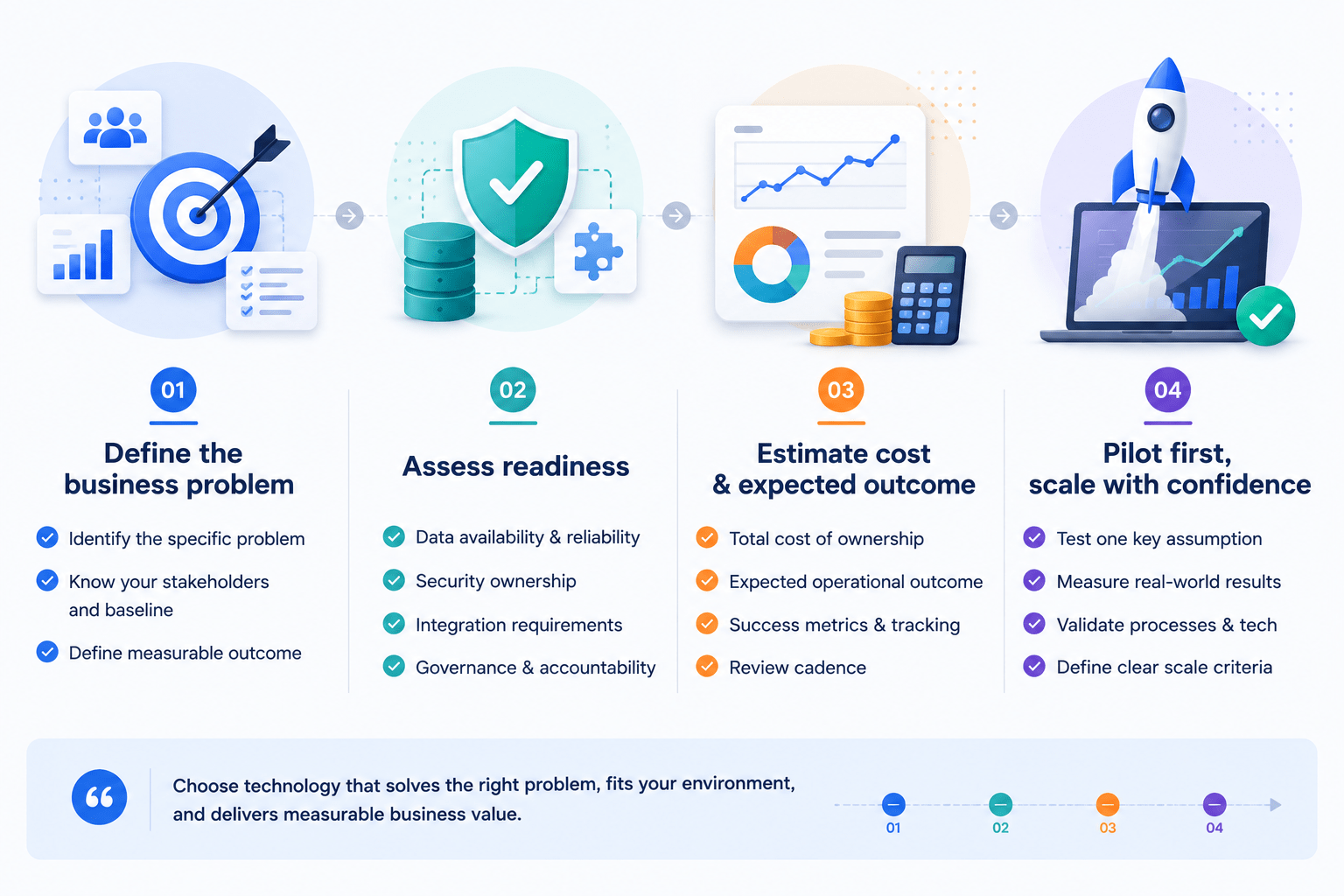
Start by identifying the specific process problem, affected stakeholders, current baseline, decision owner, and measurable outcome. A statement such as “we should use IoT for maintenance” is still too broad. A clearer problem is: “Each unplanned equipment failure causes four hours of lost production.”
Assess data, security, integration, and governance readiness
Before committing, confirm that the required data exists, remains reliable, and can support the intended use case. Teams should also define who owns security, which systems require integration, and who remains accountable after deployment. Most readiness gaps can be addressed, but they must be identified before development begins rather than during implementation.
Estimate total cost, expected outcomes, and measurable success criteria
Build a simple framework linking the baseline condition, planned intervention, success metric, tracking owner, and review frequency. The assessment should compare full lifecycle costs with the expected operational outcome, not only the hardware purchase price.
Start with a focused pilot and plan for scale
A strong pilot tests one assumption, measures a defined result, and validates both technology and operating processes. It should also establish clear criteria showing when the solution is ready to scale. Unlike a generic proof of concept, the pilot should operate under real business conditions rather than inside a laboratory.
Practical IoT Use Cases and Their Trade-Offs
Each of these follows the same structure: what the business is trying to achieve, what data gets used, the outcome sought, the key trade-off, and the question worth asking before committing.
Manufacturing and predictive maintenance
Sensors monitor equipment condition to flag developing issues before failure. Value depends on integrating alerts into an actual maintenance workflow – a sensor that flags a problem no one acts on creates no value.
Evaluation question: is there a clear process for who responds to an alert, and how fast?
Retail, inventory, and connected customer experiences
IoT can track inventory status, store conditions, and customer-facing service assets. SmartDev’s retail AI overview covers how this connects to personalization specifically.
Evaluation question: does this data actually change a stocking or staffing decision, or just get logged?
Logistics and fleet or asset tracking
Location and condition data support real-time visibility into shipments and vehicles. The value only materializes when tracking data is tied to an exception-handling workflow – someone needs to be notified and empowered to act when something goes off-plan.
Evaluation question: what happens differently today because you now know where something is?
Smart buildings, energy, and facilities management
Occupancy, equipment, and environmental sensors support facilities decisions and energy efficiency, as covered in SmartDev’s look at AI in the energy sector.
Evaluation question: is there a documented, comparable baseline to measure any claimed energy reduction against?
Healthcare and connected monitoring
Connected monitoring can support care operations and asset visibility, but sensitive patient data, device reliability, and compliance requirements make this a genuinely high-stakes category – not just another example on a list.
Evaluation question: has this been reviewed against the specific clinical, safety, and compliance standards that apply, not just general IoT best practice?
Frequently Asked Questions About IoT Advantages and Disadvantages
- What are the main advantages of IoT for businesses?
Better operational visibility, faster decisions from real-time data, improved asset and maintenance management, stronger customer experiences, and potential new revenue models – though realizing any of these depends on the specific use case and how well the data is integrated into a workflow.
- What are the biggest disadvantages of IoT?
Expanded cybersecurity exposure, data privacy and compliance obligations, integration and interoperability complexity, full lifecycle cost, reliability dependencies, and vendor lock-in risk. The severity of each depends heavily on implementation maturity, not on IoT as a category.
- What security risks should a business consider before adopting IoT?
Device identity and authentication, software update processes, network segmentation, ongoing monitoring, vendor security practices, and incident response readiness are the core areas to assess – this isn’t an exhaustive list, and a formal security assessment is worth doing for anything beyond a small pilot.
- How can a company reduce IoT implementation risks?
Define the use case precisely, assess readiness honestly, build security in from the start rather than bolting it on, run a focused pilot before scaling, vet vendors on long-term support terms, and measure results against a defined baseline. This reduces risk — it doesn’t eliminate it.
- Is IoT worth the investment for small and mid-sized businesses?
It depends on whether there’s a defined problem, a measurable expected benefit, a manageable lifecycle cost, and enough readiness to execute – not on company size alone. A smaller, well-scoped pilot is often a more realistic entry point than a large deployment regardless of company size.
Conclusion: Making a Balanced IoT Decision
IoT’s value doesn’t come from the technology itself – it comes from applying it, with discipline, to a specific business problem that can actually be measured. The benefits covered here (efficiency, visibility, asset management, customer experience, cost control, innovation) are real and achievable, but every one of them depends on data quality, integration, and governance being handled well, not on simply adding connected devices.
The risks (security, privacy, complexity, cost, reliability, vendor dependence, ethical implications) are equally real, but they’re largely manageable through the same discipline: defining the problem clearly, assessing readiness honestly, and building in security and governance from the start rather than as an afterthought.
The businesses that get the most out of IoT are the ones that evaluate benefits and risks together, validate assumptions through a focused pilot before committing to scale, and hold the initiative accountable to a measurable outcome – not the ones that adopt IoT because the technology itself seemed inevitable.
Next Steps: Explore IoT Strategy and Implementation Support
Key takeaways
| Theme | Takeaway |
|---|---|
| Value | IoT benefits – efficiency, visibility, asset management, customer experience, cost control, innovation – are real, but none are automatic; they depend on data quality, integration, and governance |
| Risk | Security, privacy, complexity, cost, reliability, vendor lock-in, and workforce impact are material risks, not just theoretical ones – and largely manageable with the right planning |
| Growth context | The IoT market is projected to grow from ~$547B (2025) to ~$865B (2030) at 9.6% CAGR, with cybersecurity and interoperability cited as the leading restraints on adoption |
| Decision | The right question isn’t “should we adopt IoT” – it’s whether a specific use case has measurable value that justifies its integration, security, and governance cost |
| Readiness | Value is more likely when the business problem is specific, data is feasible to collect, and there’s a clear owner for security and outcomes |
| Validation | A focused pilot – testing one assumption with defined success criteria – is a lower-risk way to prove an IoT investment than a full rollout |
| Cost | Total lifecycle cost, not upfront hardware cost, is what actually determines whether an initiative pays off |
If you’re weighing a specific IoT initiative and want help validating it before committing resources:
- Scoping your first IoT project? SmartDev’s guide to overcoming IoT development challenges covers common pitfalls and how to plan around them.
- Combining IoT with AI-driven analytics? See our overview of AI and IoT integration for how predictive maintenance and smart automation typically get built.
- Concerned about security readiness? Our AI use cases in security resource covers how AI-driven monitoring is applied to connected-device environments specifically.
- Need a broader strategy conversation first? SmartDev’s AI consulting services can help translate a business problem into a concrete evaluation and pilot plan.