
TL;DR
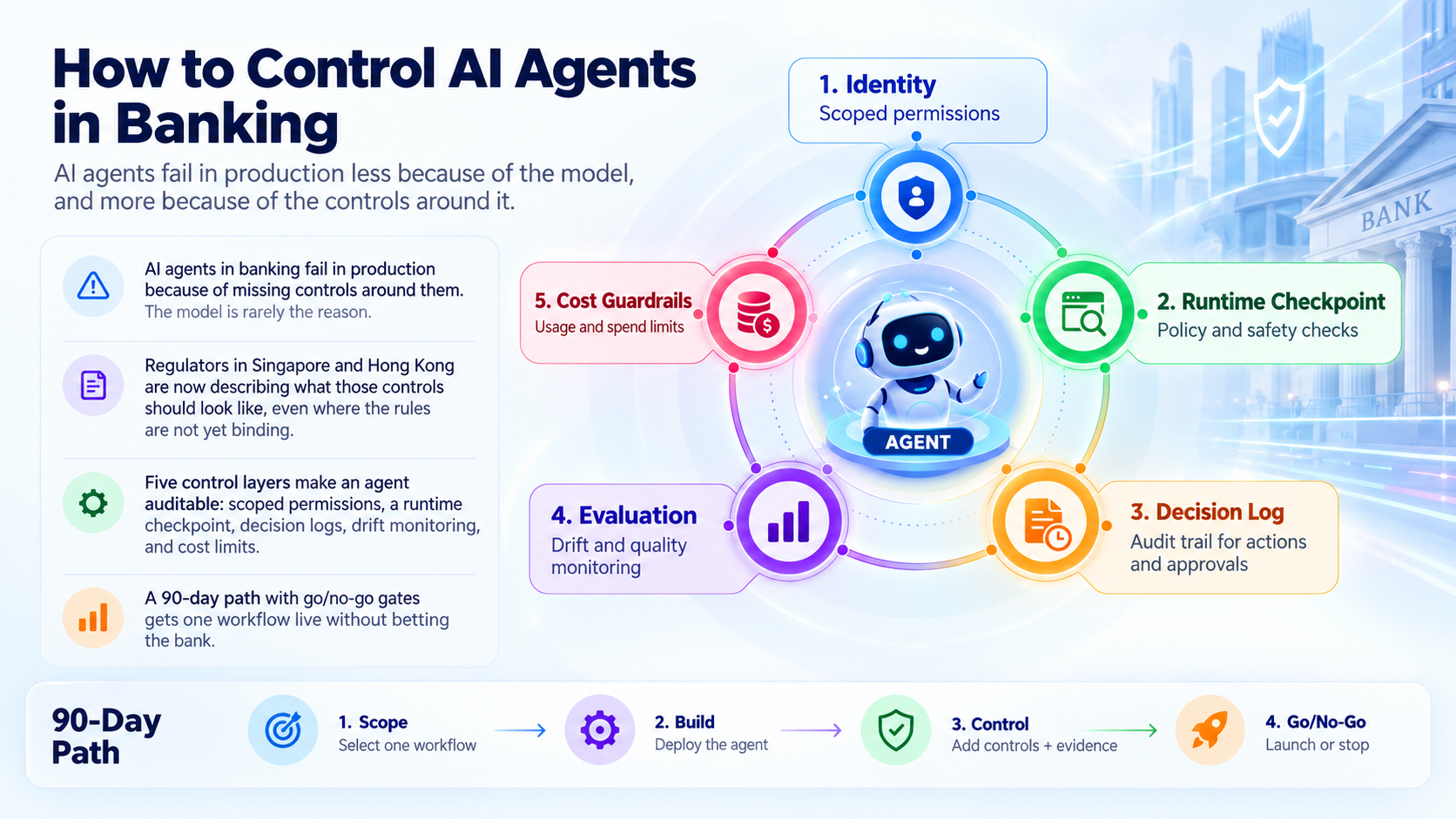
- AI agents in banking fail in production because of missing controls around them. The model is rarely the reason.
- Regulators in Singapore and Hong Kong are now describing what those controls should look like, even where the rules aren’t binding yet.
- Five control layers make an agent auditable: scoped permissions, a runtime checkpoint, decision logs, drift monitoring and cost limits.
- A 90-day path with go/no-go gates gets one workflow live without betting the bank.
Your agent pilot worked. It read the documents, called the right APIs and produced a sensible answer in the demo. Then it went to the risk committee, and someone asked a simple question: “If it does the wrong thing, how would we know, and who signs for it?”
That question stops more AI agents in banking than any model limitation. This guide is for the CTO who has to answer it. It covers what APAC regulators now expect, the control architecture that lets an agent act inside a bank, and a 90-day path from pilot to a governed production workflow.
1. Why Banking Agents Stall Between Demo and Production
A chatbot that gives a wrong answer creates a complaint. An agent that takes a wrong action creates an incident. That shift, from wrong answer to wrong action, is why banks treat agents differently from every earlier wave of AI.
Interest is clearly there. A KPMG survey reported by PYMNTS in July 2026 found that 51% of US banks are piloting AI agents. Piloting is the easy part. The pilot runs on a clean data extract, with a friendly reviewer and no real permissions. Production means legacy core systems, real customer data and a second line of defense that wants evidence.
Most stalled pilots are missing the same things:
- No defined authority. Nobody wrote down what the agent may do without a human.
- No record of reasoning. Logs show what the agent output, not which data and rule led there.
- No owner after go-live. The vendor built it, IT hosts it, and operations uses it. When it drifts, nobody is accountable.
None of these are model problems. They are architecture and operating-model problems, and they can be designed for from day one.
2. What APAC Regulators Actually Expect From AI Agents
APAC regulators are moving faster on agentic AI than most. The detail matters, though, because much of what’s been published is guidance rather than law. Knowing which is which keeps your team from under-building or over-building.
Singapore. MAS consulted on proposed Guidelines on AI Risk Management in late 2025, covering board oversight, AI inventories, materiality assessment and human oversight across the AI life cycle. In March 2026, the MAS-led MindForge consortium published an AI risk management handbook with specific practices for agents: least-privilege design, agent tracking, logging and traceability, limited rollouts, and human approval for high-risk actions.
In July 2026, MAS published the Safeguards for Agentic Finance at Runtime (SAFR) white paper. SAFR describes a governance checkpoint between every agent decision and its execution. It covers what an agent is authorized to do, how each proposed action is assessed before it runs, and what records are kept. MAS states that SAFR is not regulatory guidance or a supervisory expectation. It is, however, the clearest public blueprint any regulator has offered for governing agents.
Hong Kong. In August 2026, HKMA and three other financial regulators selected 36 use cases from 30 financial institutions for the GenA.I. Sandbox++. It focuses on systems that perform tasks with a degree of autonomy, such as onboarding, payments and claims, including AI agent identity and accountability. Participation does not mean approval for commercial use.
| Status | What it means for your build | |
|---|---|---|
| MAS AI Risk Management Guidelines | Proposed; consultation closed | Plan for board oversight, AI inventory and materiality ratings per use case |
| MindForge handbook | Industry practice guide | Least privilege, logging and human approval for high-risk agent actions |
| MAS SAFR | Non-binding white paper | A reference design for runtime authorization and records |
| HKMA GenA.I. Sandbox++ | Supervised trials | A signal of where HK supervisors will focus, including agent identity |
For a bank operating in several APAC markets, the practical choice is to build to the most detailed standard once. Retrofitting controls per market costs more than designing them in.
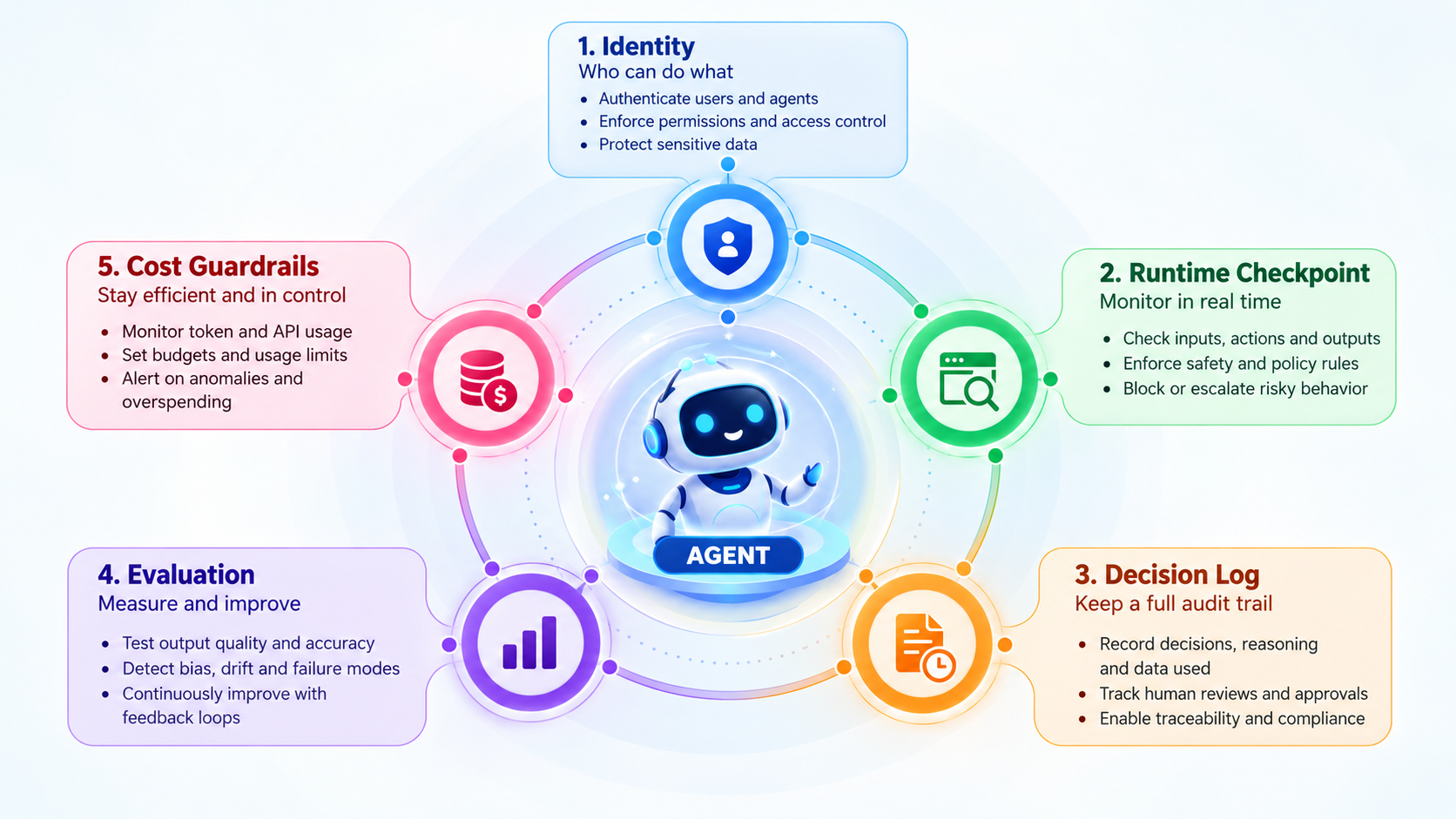
3. The Production Architecture: Five Control Layers Around the Agent
A production agent is a small part of a larger system. Most of the engineering effort sits in the layers around it. We think about five of them.
3.1 Scoped Identity and Permissions
Give each agent its own identity, separate from the service accounts your applications already use. Then grant it the narrowest access that the workflow needs. A KYC review agent may need to read onboarding documents and write a recommendation to a case. It does not need write access to the core ledger.
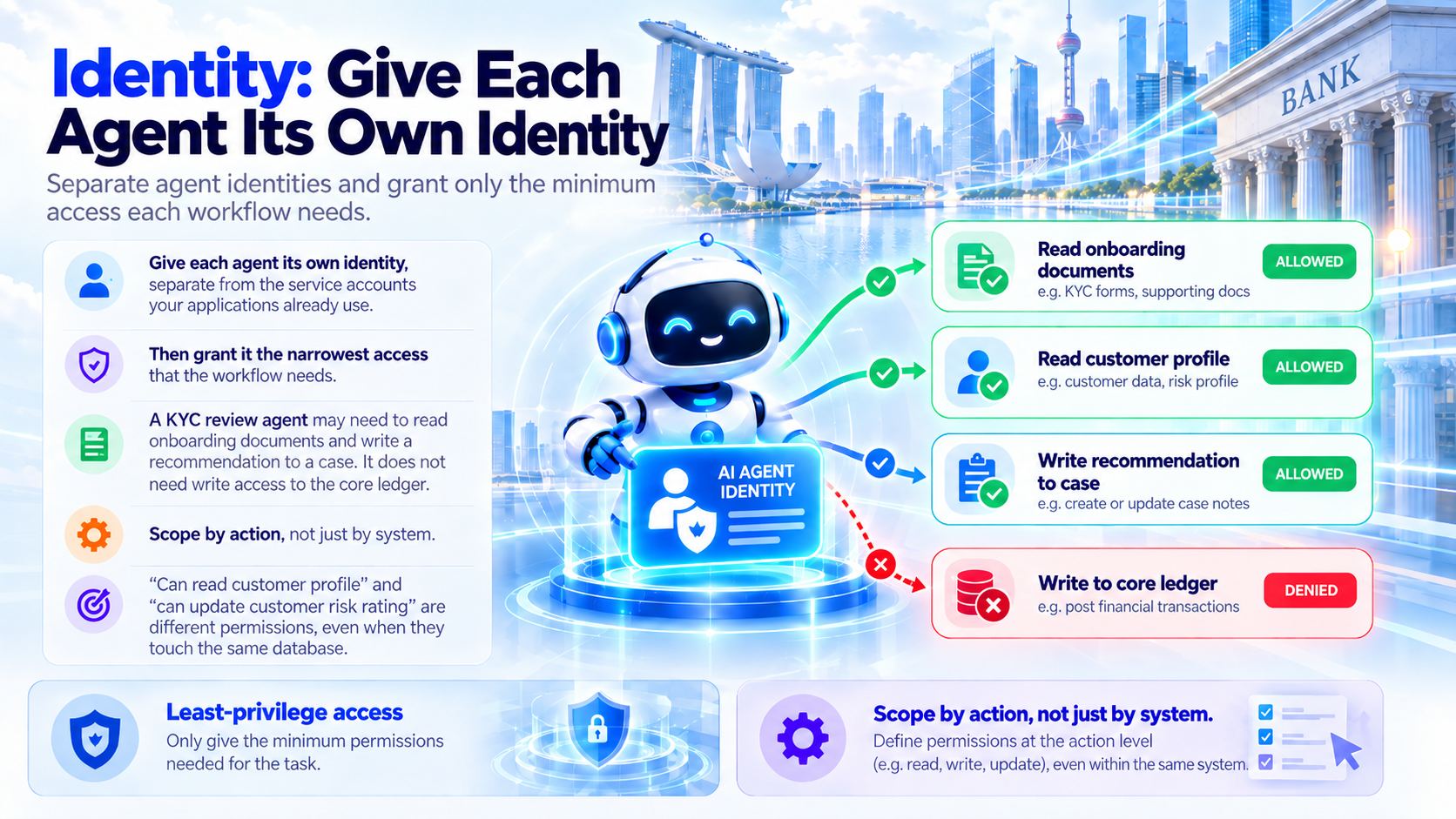
Scope by action, not just by system. “Can read customer profile” and “can update customer risk rating” are different permissions, even when they touch the same database.
3.2 A Runtime Checkpoint Before Every Action
This is the core idea behind SAFR, and it’s the layer most pilots skip. Before an agent executes anything consequential, the proposed action passes through a checkpoint that asks three questions. Is this action on the agent’s approved list? Does it fall within the limits, such as amount, customer segment or risk rating? Does it need a human?
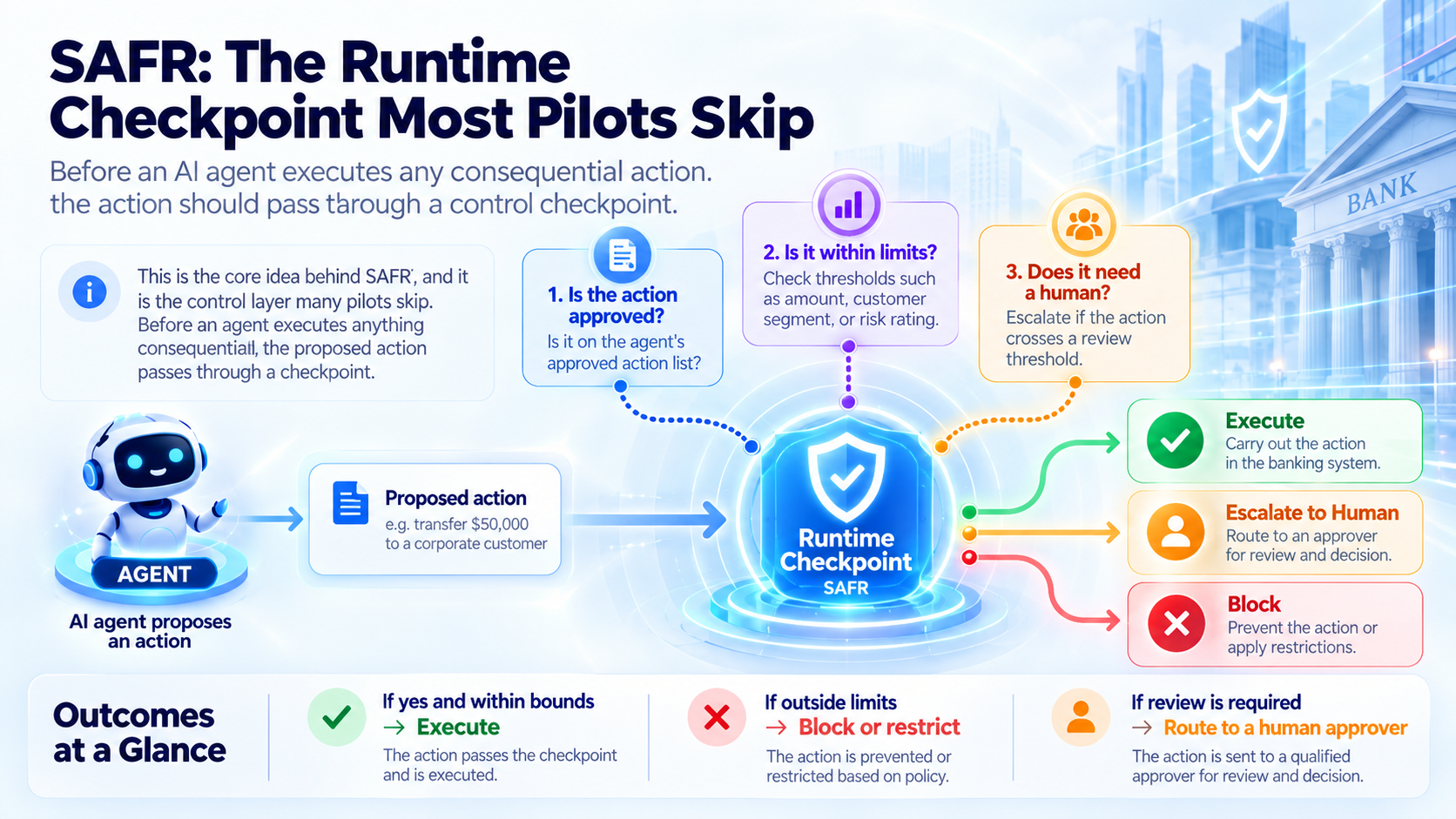
The checkpoint should be deterministic code or rules, not another LLM call. The agent proposes, and the checkpoint decides whether the action runs, waits for approval or is rejected.
3.3 Decision Logs That Answer “Why”
When an auditor asks why a customer was flagged, “the model decided” is not an answer. For every consequential step, log the inputs, the documents or records retrieved, the rule or policy applied, the output, the confidence score and what the human did next.
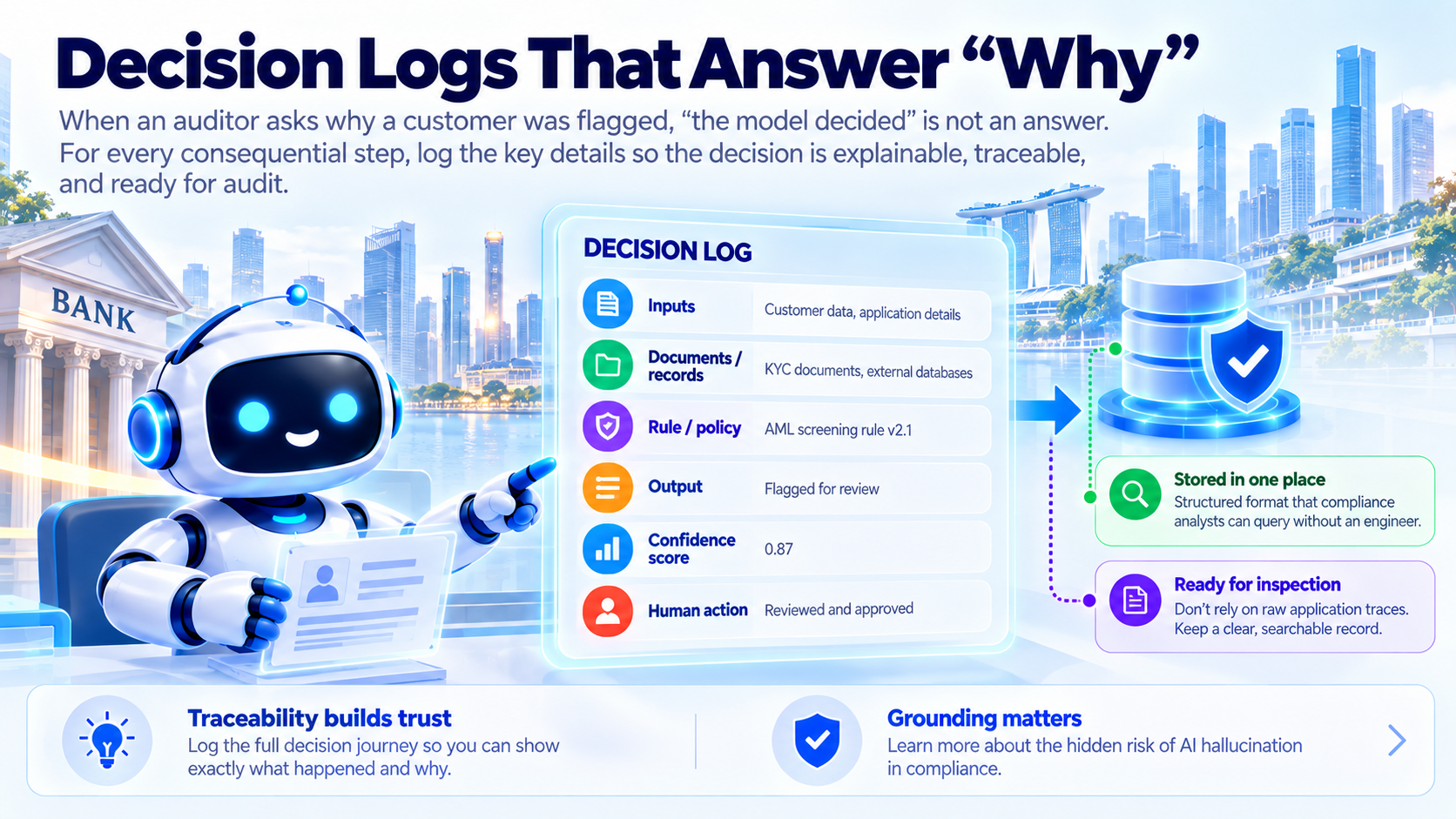
Store this in one place, in a structured format that a compliance analyst can query without an engineer. If the log only exists as raw application traces, it won’t hold up in an inspection. Our guide on the hidden risk of AI hallucination in compliance covers why grounding and traceability matter so much here.
3.4 Evaluation and Drift Monitoring
An evaluation pipeline is a set of automated checks that tells you whether the agent is still right after launch. Build it from real, labeled cases taken from the workflow, including the awkward edge cases your operations team remembers.
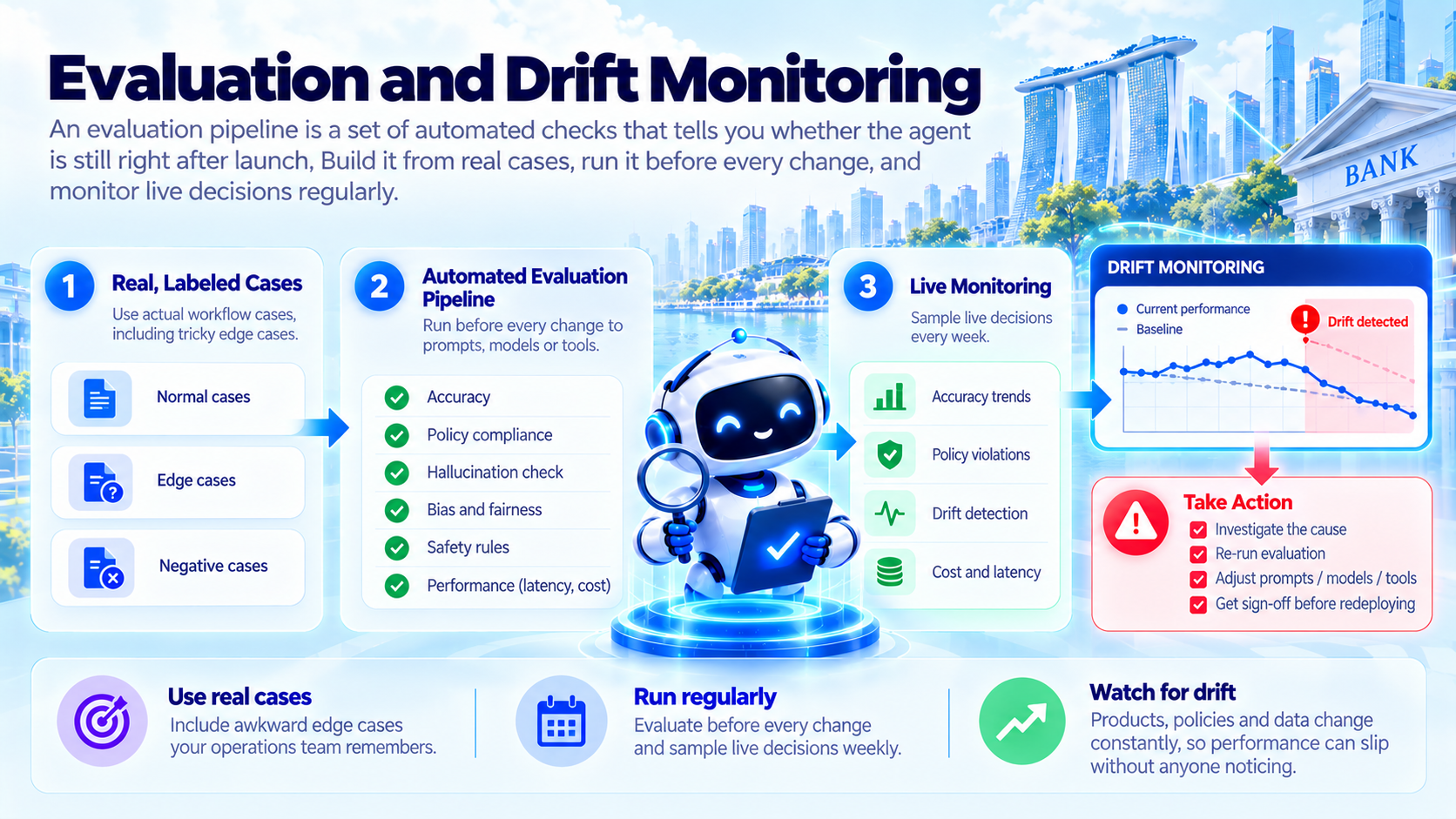
Run it before every change to prompts, models or tools, and sample live decisions every week. Products, policies and data change constantly in a bank, so an agent that was accurate at launch can slip without anyone noticing.
3.5 Cost and Rate Guardrails
Agents call models and tools in loops, so costs can spike quietly. Set limits per task on steps, tool calls and tokens. Cap how often an agent can hit any core system API, especially legacy systems with batch windows or fragile interfaces.
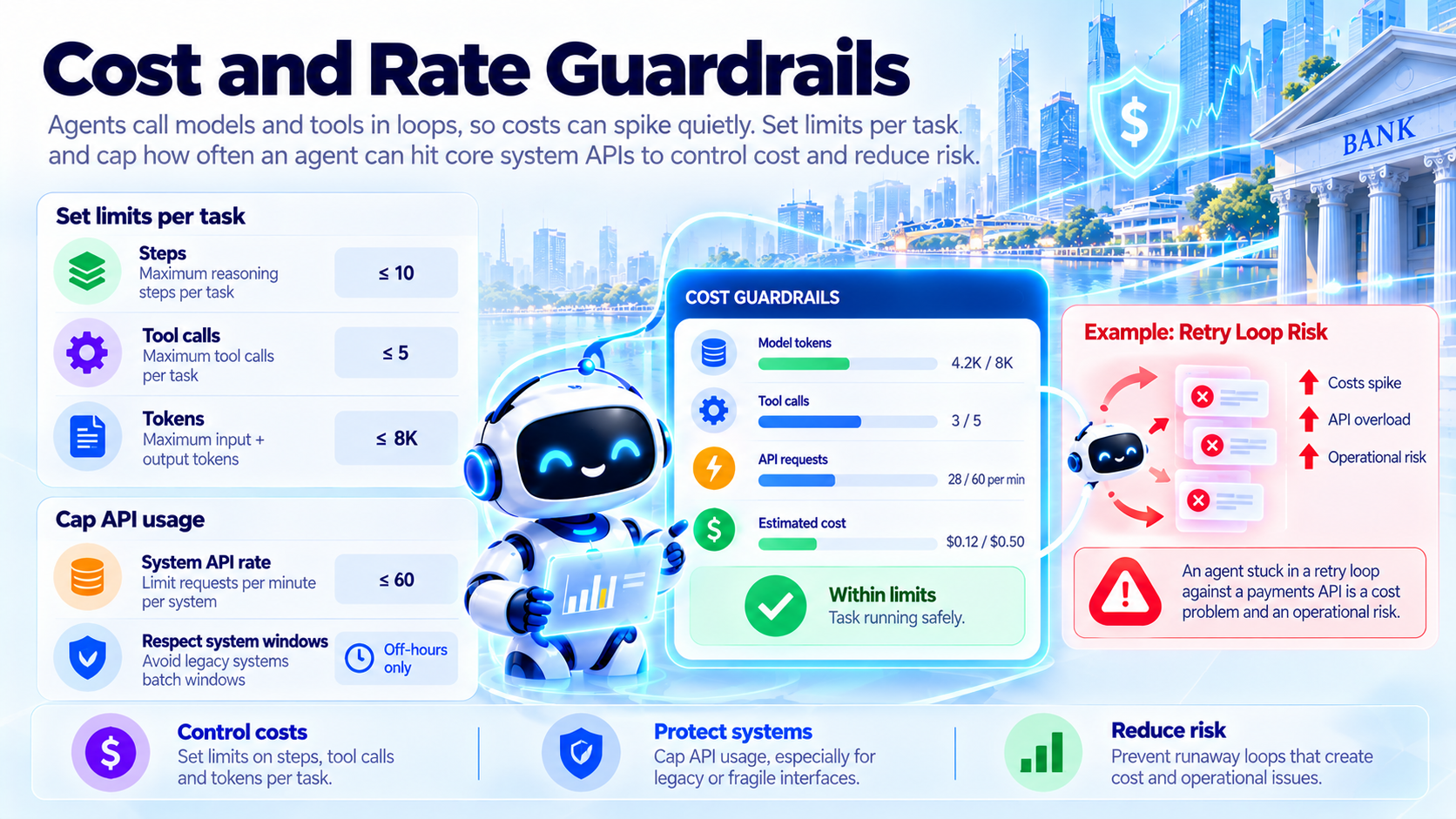
These limits also serve as a safety control. An agent stuck in a retry loop against a payments API is a cost problem and an operational risk.
4. A 90-Day Path From Pilot to Production
The timeline below is the pattern we recommend for one bounded workflow. It isn’t a regulatory requirement. Each phase ends with a go/no-go gate, and the gate is where risk and compliance get a real say. For more on realistic timelines, see how long pilot to production really takes.
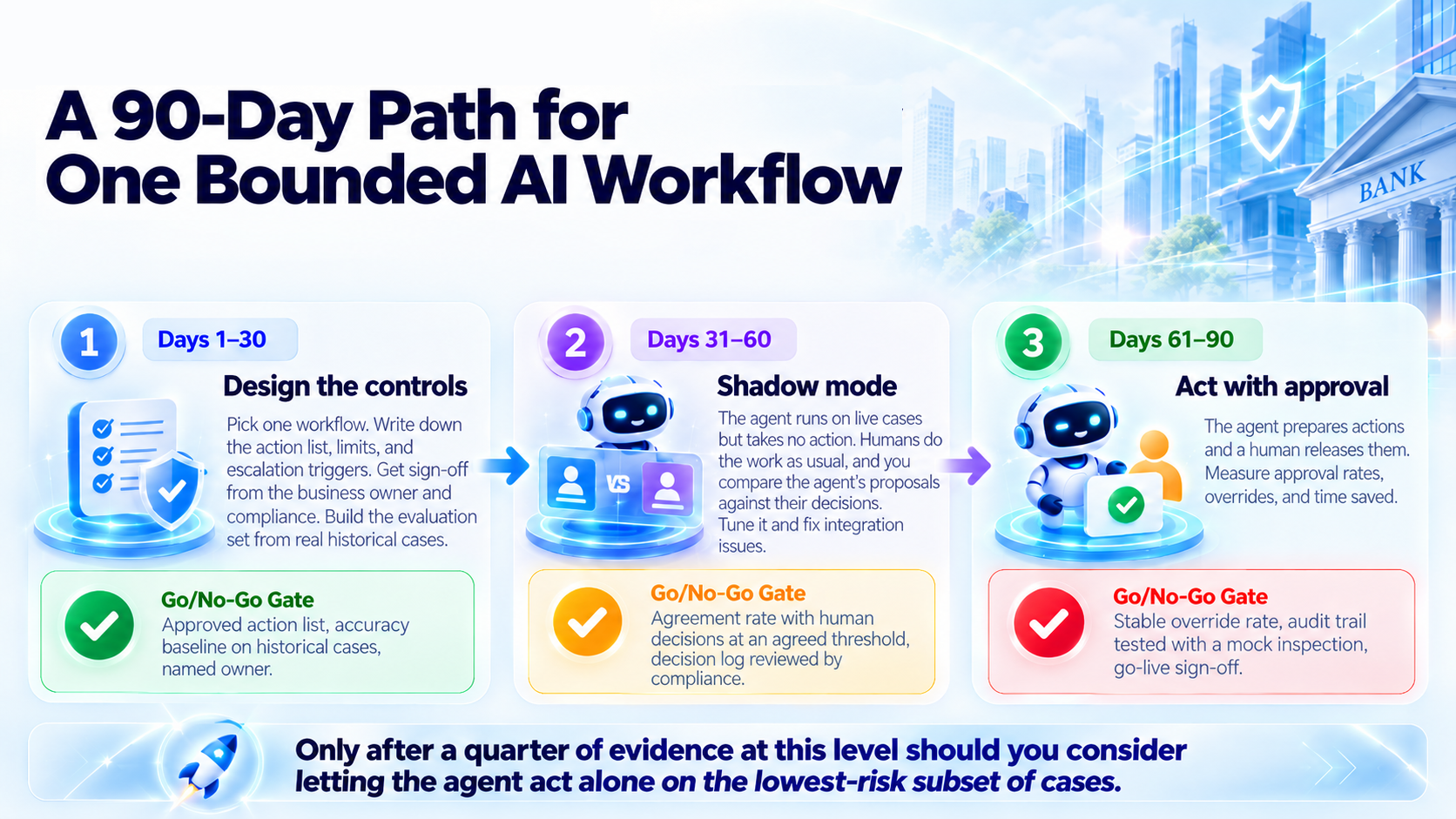
Days 1–30: Design the controls. Pick one workflow. Write down the action list, limits and escalation triggers, and get sign-off from the business owner and compliance. Build the evaluation set from real historical cases.
Gate: approved action list, accuracy baseline on historical cases, named owner.
Days 31–60: Shadow mode. The agent runs on live cases but takes no action. Humans do the work as usual, and you compare the agent’s proposals against their decisions. Tune it and fix integration issues.
Gate: agreement rate with human decisions at an agreed threshold, decision log reviewed by compliance.
Days 61–90: Act with approval. The agent prepares actions and a human releases them. Measure approval rates, overrides and time saved.
Gate: stable override rate, audit trail tested with a mock inspection, go-live sign-off.
Only after a quarter of evidence at this level should you consider letting the agent act alone on the lowest-risk subset of cases.
5. Which Workflows to Put Into Production First
Two questions filter most candidates: are the rules clear enough to check the agent against, and can a mistake be caught before it reaches a customer or a regulator?
| Errors easy to catch | Errors hard to reverse | |
|---|---|---|
| Clear rules | Start here: KYC document review, screening alert triage, reconciliation breaks | Agent prepares, human decides: payment instruction checks |
| Judgment-heavy | Agent assists: policy Q&A for operations staff, case summaries | Wait: credit decisions, customer-facing financial advice |
The top-left box is where most banks should put their first production agent. Our map of AI use cases in banking covers the wider landscape once the first one is running.
6. How SmartDev Builds Governed Agent Workflows
We build agent workflows for regulated financial firms, and the pattern stays the same: a bounded workflow, a human at the decision point, and a record of every step.
For a financial advisory firm in Singapore, KYC checks depended on senior administrators, so results were inconsistent. We built an LLM-powered review pipeline that parses KYC documents, validates them against product-specific compliance rules and flags missing or high-risk details for human review. The firm saw 60% faster KYC verification, 75% less manual document handling and 40% fewer review inconsistencies. Read the KYC review case study.
For a Dutch financial services startup, every AI response passes automated guardrail validation before it reaches a user, with a timestamped recommendation trail. Risk assessment became 50% faster, with 70% less manual compliance documentation. See how the governed AI platform works. Working with a Swiss payments fintech, we built a multi-agent support layer that unified inquiries from several channels. It resolves routine requests and routes complex ones to people with the context already prepared. Explore the multi-agent support case.
For compliance teams that want this approach without building it in-house, NORA designs, runs and maintains governed compliance workflows, with the decision log built in.
7. Frequently Asked Questions
What Are AI Agents in Banking?
AI agents in banking are software systems that use large language models to plan and complete multi-step tasks across bank systems. They read documents, query data, apply rules and propose or take actions. Unlike chatbots, they act. Unlike RPA, they handle inputs that don’t follow a fixed script, which is why they need runtime controls.
Does MAS Regulate Agentic AI?
MAS has consulted on Guidelines on AI Risk Management that cover AI use across financial institutions. In July 2026 it also published SAFR, a white paper on runtime safeguards for AI agents. SAFR is explicitly not regulatory guidance, but it is the most detailed public reference for how agent actions should be authorized, assessed and recorded.
What Is SAFR in Banking?
SAFR stands for Safeguards for Agentic Finance at Runtime, a July 2026 MAS white paper. It places a governance checkpoint between every agent decision and its execution. The checkpoint defines what the agent may do, assesses each proposed action before it runs and keeps records for accountability. MAS says it is non-binding.
How Long Does It Take to Put an AI Agent Into Production at a Bank?
For one bounded workflow, about 90 days is realistic if the controls are designed up front: 30 days to define authority and evaluation, 30 days in shadow mode and 30 days acting with human approval. Integration with legacy core systems is usually what stretches the timeline.
Which Banking Workflows Are Safest for AI Agents?
Start with workflows that have clear rules and errors you can catch before they reach a customer, such as KYC document review, screening alert triage and reconciliation breaks. Keep credit decisions, payment initiation and customer-facing advice at an assist or recommend level until you have evidence from lower-risk workflows.
8. Conclusion: Build the Controls, Then Scale the Agents
AI agents in banking will reach core operations. The ones that get there first won’t have the smartest models. They’ll have controls a regulator can inspect. Pick one workflow, build the five layers around it, and give it 90 days of evidence before you widen its authority. If you have an agent pilot stuck at the risk review, talk to us about moving it into production. We’ll map the controls it needs against your own workflow.