
TL;DR
- AI won’t fix a broken workflow. It automates whatever inefficiency sits underneath.
- Fragmented data and disconnected systems are what stop AI from scaling and staying governable.
- You don’t need to rebuild the tech stack. Modernize the priority workflow your AI use case depends on.
- AI-ready workflows are connected, controlled, observable, and human-supervised.
- Next step: pick one high-value workflow and map its data, system, and control gaps.
Introduction
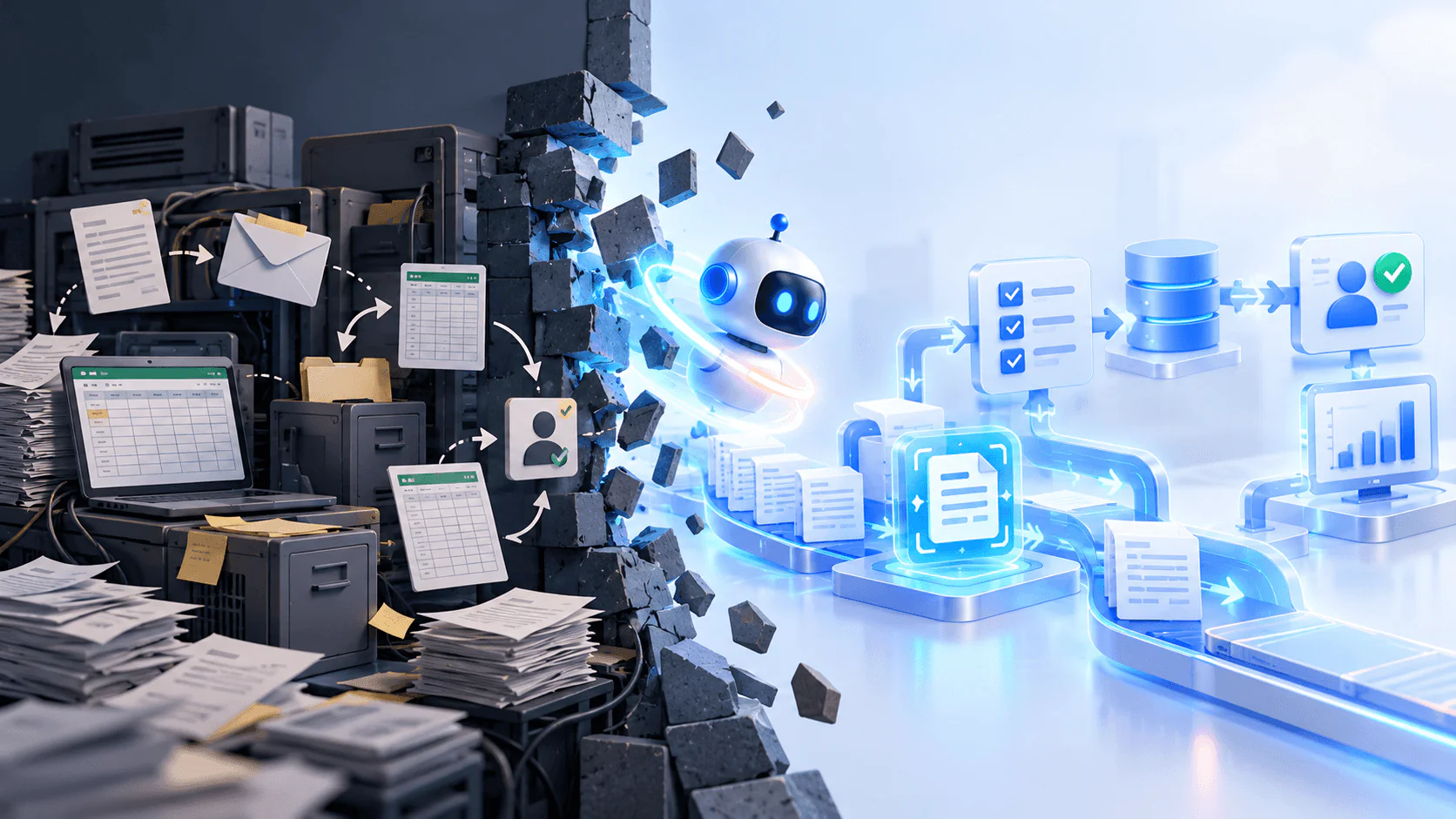
AI adoption is now an operating priority. But many organizations are introducing AI into workflows still built on spreadsheets, email approvals, manual handoffs, and disconnected systems.
That creates a fundamental problem: AI does not fix a broken workflow. It automates whatever inefficiency already sits underneath it. Fragmented data, unclear business rules, and weak system integration do not disappear when an AI model is added — they become constraints on how reliably AI can scale.
The adoption gap already reflects this. Microsoft’s 2025 Work Trend Index found that 46% of leaders said their organizations were already using agents to fully automate workstreams or business processes. Yet McKinsey found that nearly two-thirds of organizations had not begun scaling AI across the enterprise, while only 39% reported enterprise-level EBIT impact.
The issue, then, is not simply where to add AI. It is whether the workflow underneath it is ready to support AI at scale.
The Spreadsheet Is a Symptom of a Bigger Problem
Spreadsheets work well for analysis and flexible, lightweight tasks. The problem starts when they become the backbone of critical operations. In invoice processing, for example, data may sit across multiple spreadsheets, approvals happen by email, and employees still reconcile information with the ERP and enter transactions manually.
The spreadsheet itself is not the core problem. The deeper issue is the lack of a structured system: no consistent source of truth, fragmented business rules, limited system integration, and heavy reliance on individual judgment. As a result, changes are difficult to trace, and the workflow depends largely on experienced employees to keep it running.
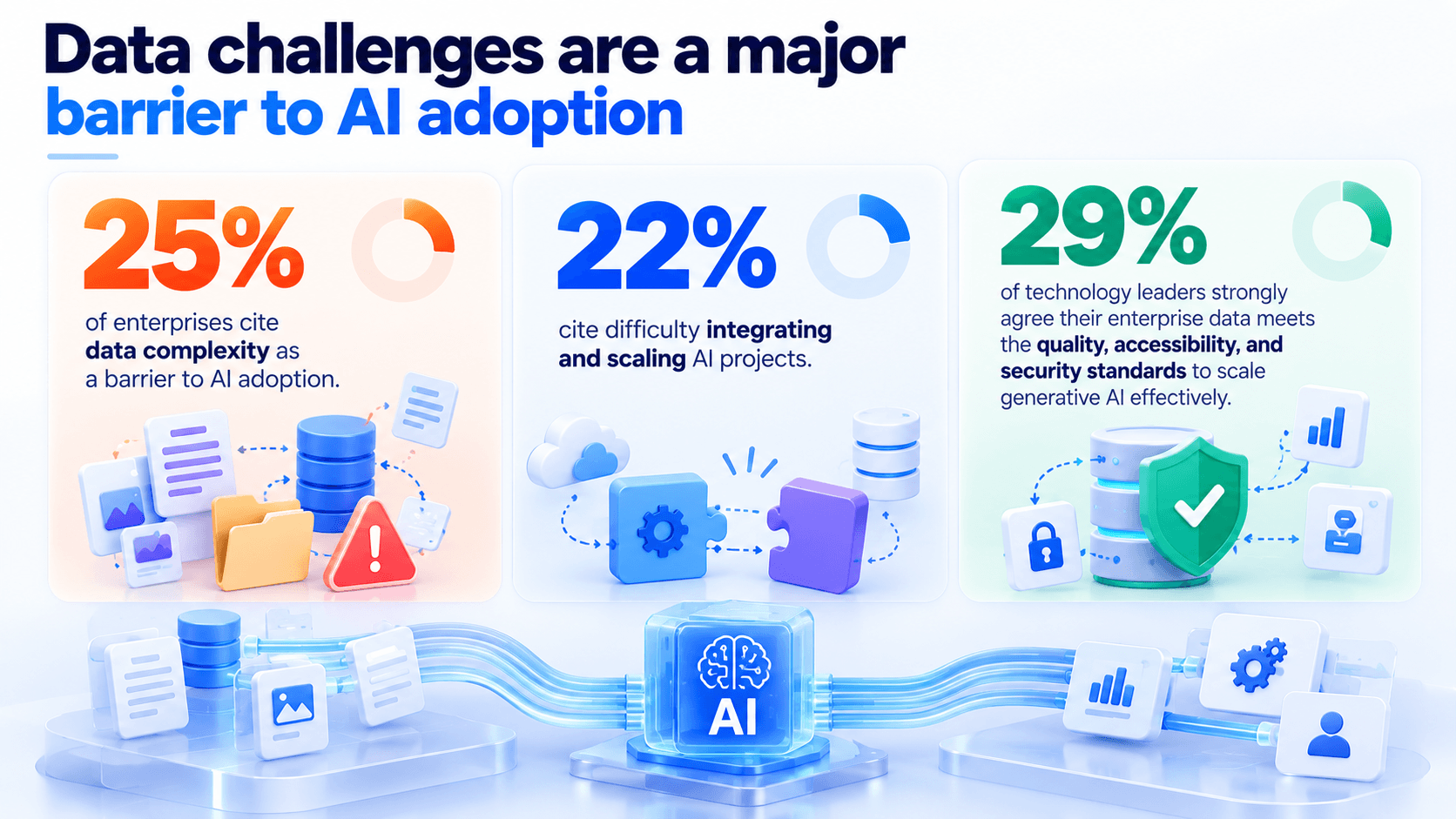
These conditions become much more serious once AI enters the workflow. IBM found that 25% of enterprises cited data complexity as a barrier to AI adoption, while 22% struggled with integration and scaling. More recent IBM research found that only 29% of technology leaders strongly agreed their enterprise data met the quality, accessibility, and security standards needed to scale generative AI.
The core issue is fragmented data and disconnected systems. AI needs a clear source of truth, consistent business rules, defined permissions, system connectivity, and traceable outcomes. Without that foundation, scaling AI becomes unreliable and governance becomes harder.
The spreadsheet is rarely the root problem. It is usually a sign that the workflow underneath is not yet connected, scalable, or governable enough for AI.
Why Fragmented Workflows Stop AI from Scaling
Adding AI to a fragmented workflow does not remove its weaknesses. It gives those weaknesses a new way to scale.
If data is duplicated, outdated, or defined differently across teams, AI inherits those inconsistencies. Deloitte found that data-related challenges caused 55% of organizations to avoid certain generative AI use cases, while 75% were increasing investment in data management, 48% were improving data quality, and 45% were updating data-governance frameworks.
Disconnected systems create a second problem. A process such as:
Spreadsheet → Employee → ERP
may simply become:
Spreadsheet → AI → Employee → ERP
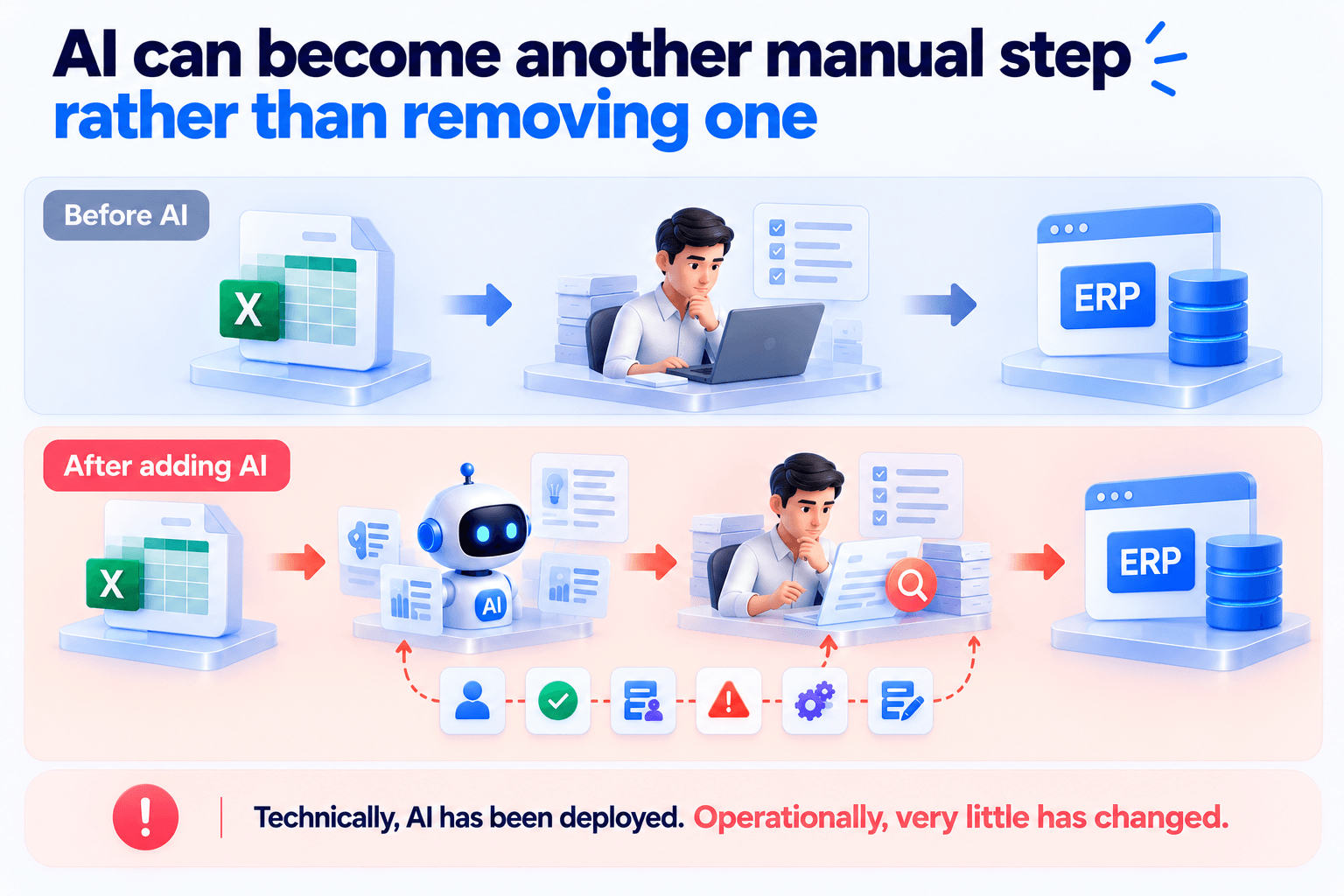
Technically, the organization has deployed AI. Operationally, very little has changed. An employee may still need to verify the result, move it into another system, initiate an approval, resolve exceptions manually, and document what happened elsewhere.
AI has automated one task, but the workflow itself remains manual. McKinsey found that workflow redesign had the strongest association with EBIT impact from generative AI, yet only 21% of organizations using generative AI had fundamentally redesigned at least some workflows.
At scale, these weaknesses also become governance problems. Organizations need to know which data serves as the authoritative source, what AI can change, when humans must intervene, and how they can trace decisions later.
The issue is not that organizations need more AI. They need connected, governed workflows that AI can operate across reliably.
Once an AI system moves beyond generating text and begins informing or executing business decisions, several questions become unavoidable:
- Which data did it use?
- Was that data current?
- Which system was authoritative?
- What was the model allowed to change?
- Why was an exception escalated?
- Who approved the final action?
- Can the organization reconstruct that decision six months later?
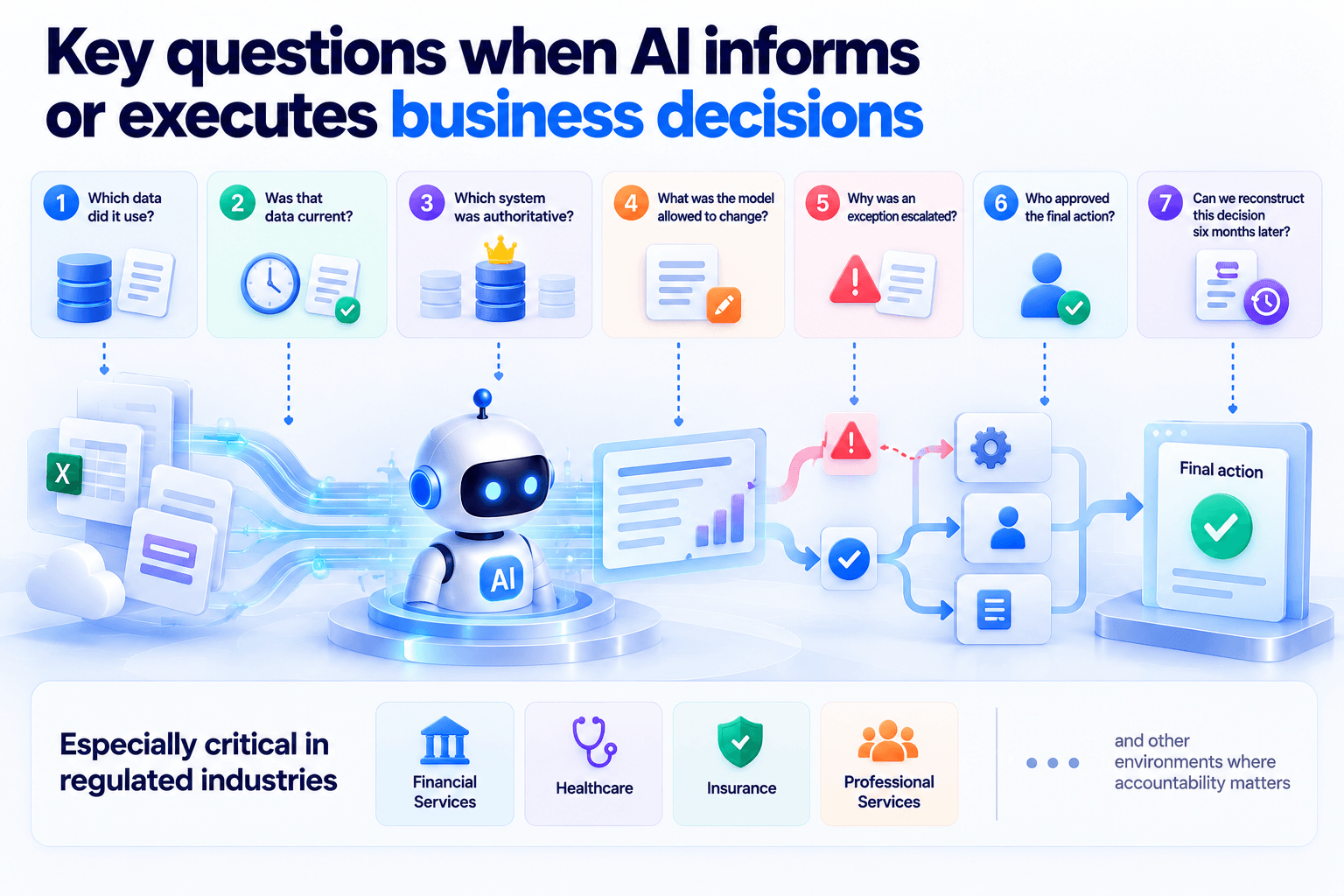
These questions are particularly important in financial services, healthcare, insurance, professional services, and other environments where accountability cannot disappear simply because part of a workflow has been automated.
Deloitte found that regulatory compliance concerns, difficulty managing AI risk, and the absence of governance models were among the leading barriers to successful generative AI deployment. If the existing workflow already lacks clear ownership, permissions, traceability, and system boundaries, adding AI introduces another decision-maker into an environment that was difficult to govern in the first place.
That is not modernization. It is additional complexity disguised as automation.
Modernize the Workflow, Not the Entire Tech Stack
The answer is not to modernize the entire technology estate before introducing AI. For most organizations, that would create unnecessary cost, delay, and complexity.
A more practical approach is to modernize the priority workflow the AI use case depends on.
Take invoice processing. The question is not “How do we modernize the entire finance stack?” but “What must change for this workflow to operate reliably with AI?” That may mean establishing trusted supplier and purchase-order data, connecting document intake to the ERP through APIs, turning spreadsheet logic into explicit business rules, defining approval thresholds, assigning exception owners, and logging key actions.
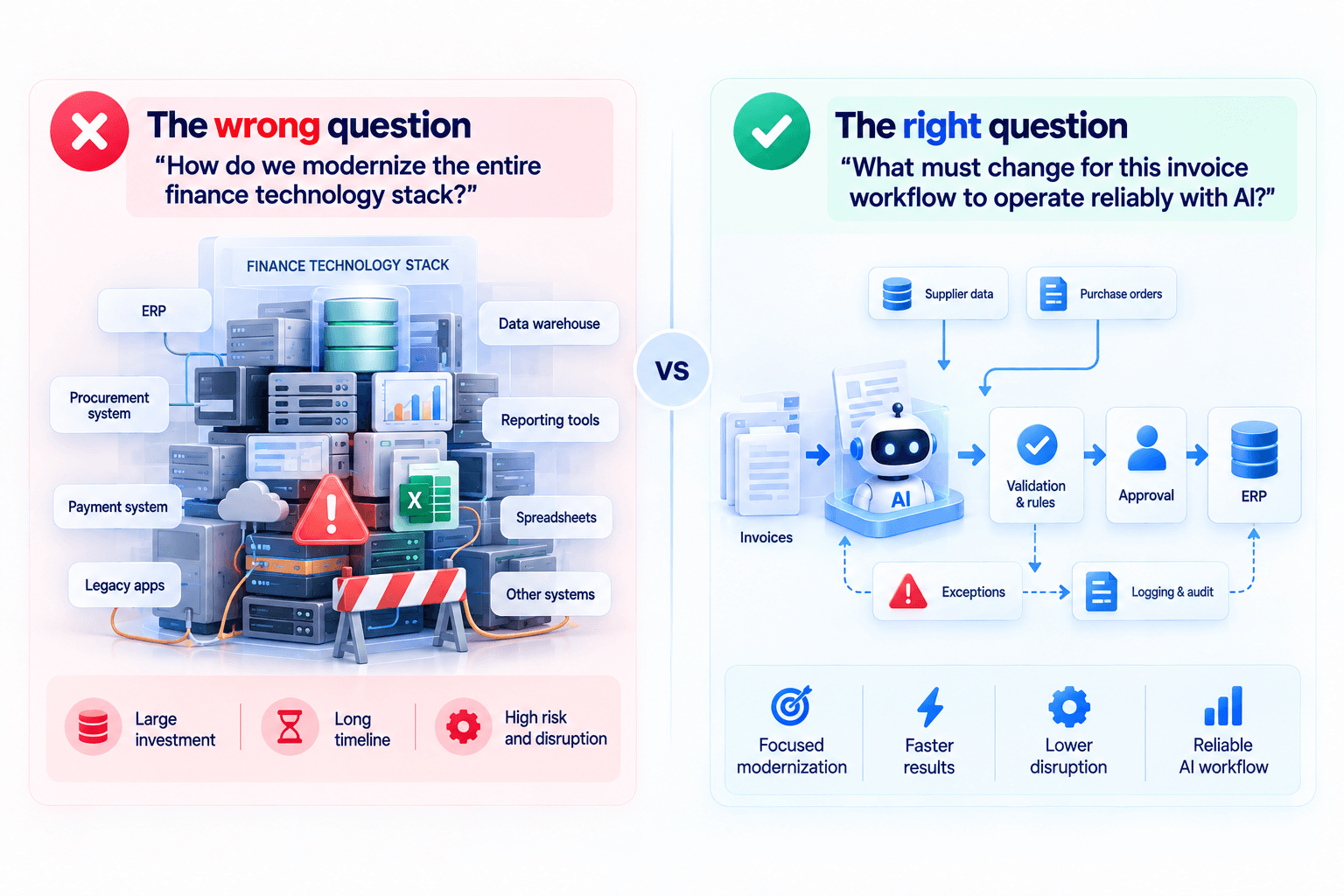
Some legacy systems can remain in place. What matters is removing the manual workarounds and disconnected handoffs that prevent AI from operating reliably across the workflow.
An AI-ready workflow typically needs a clear system of record, accessible and structured data, defined integrations, explicit business rules, and clear controls over what AI can read, recommend, change, or escalate. Roles and permissions and sufficient logging also make the workflow easier to govern when AI begins taking action.
This does not require a clean-sheet rebuild. Deloitte’s work on legacy modernization similarly emphasizes modernization around the capabilities and outcomes the business needs, rather than treating transformation only as a long sequence of system replacements.
The principle is simple: modernize the parts of the workflow that AI depends on.
Select the workflow → map its data and system dependencies → remove unnecessary handoffs → establish trusted data → connect systems → define controls → introduce AI.
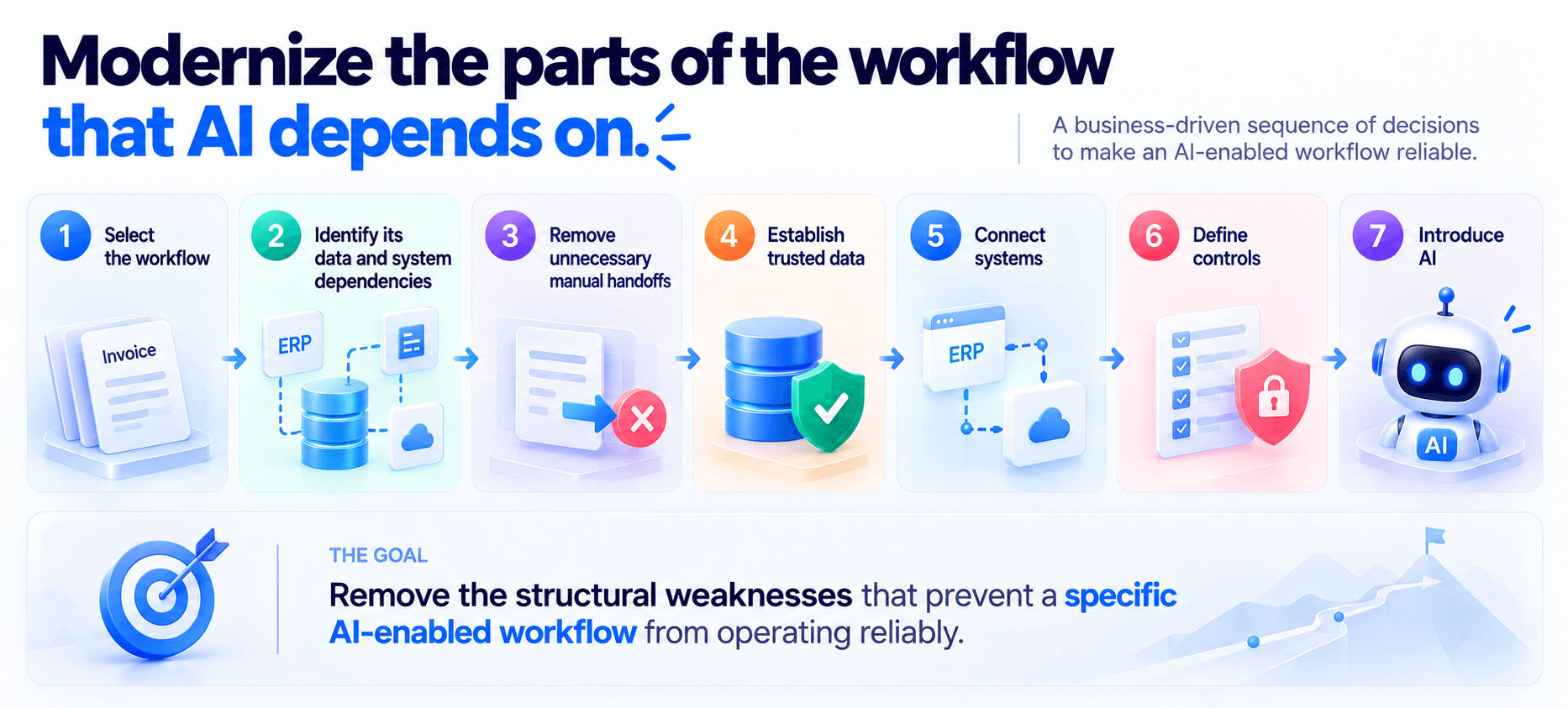
The goal is not a perfect technology estate. It is a workflow that AI can operate across reliably, at scale, and under clear control.
What an AI-Ready Workflow Actually Looks Like
The AI use case itself should guide modernization: what data it needs, which systems it must connect to, what actions it can take, and where human oversight remains necessary. In other words, the goal is not to modernize first and add AI later, but to design the workflow so AI can operate reliably within it.
Consider a typical legacy document-processing workflow:
Document or email → Spreadsheet → Manual validation → Email approval → Manual system entry
Simply adding AI may only change one step:
Document or email → AI extraction → Spreadsheet → Manual validation → Email approval → Manual system entry
The extraction is faster, but the workflow is still fragmented and dependent on manual handoffs.
An AI-ready workflow is designed differently:
Automated ingestion → Structured AI extraction → Business-rule validation → Connected enterprise systems → Human review for defined exceptions → Controlled execution → Monitoring and audit trail
The difference is not more technology. It is a workflow where data, systems, controls, humans, and AI each have a defined role.
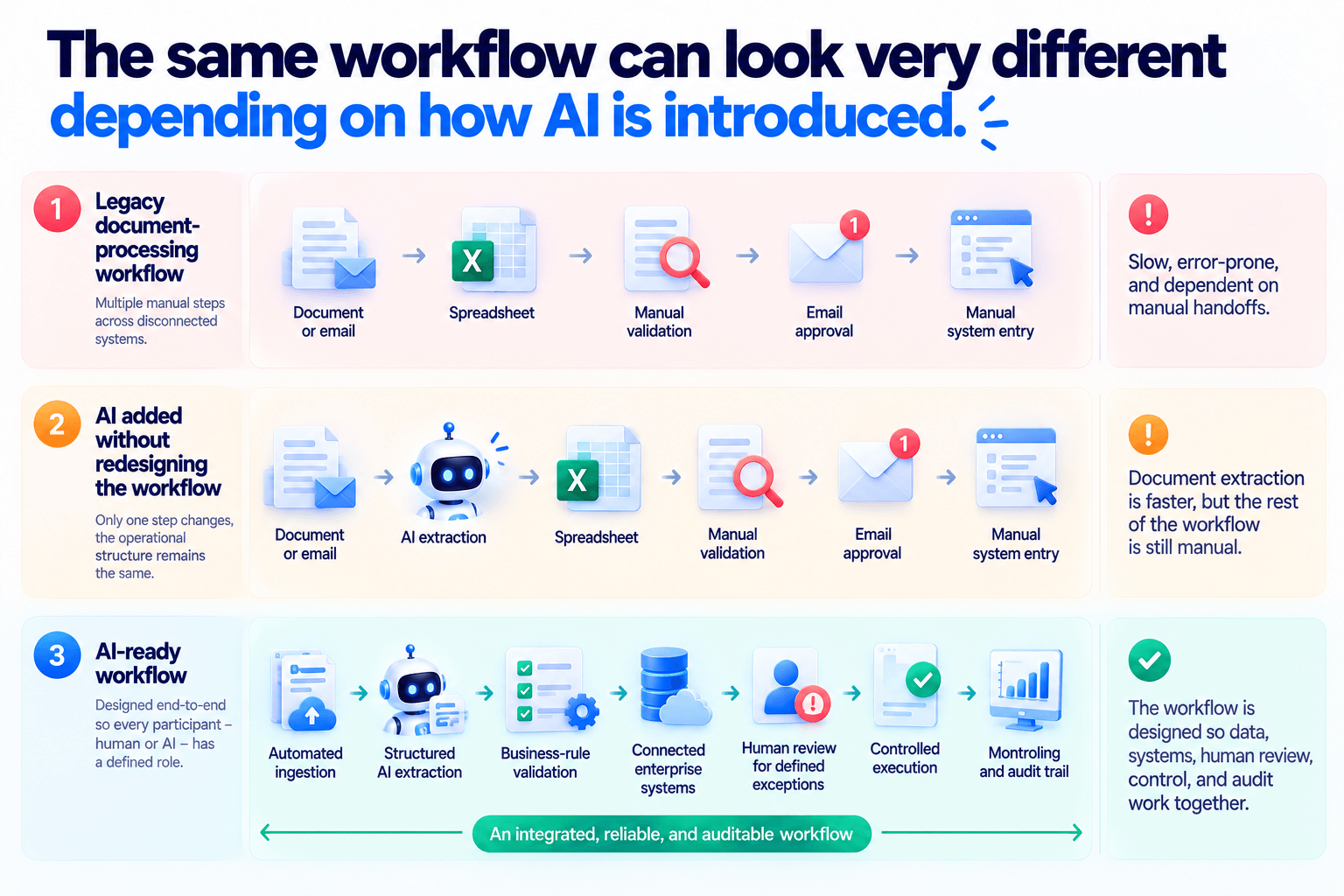
A strong AI-ready workflow is typically:
- Connected. AI can retrieve information from and interact with the systems required to complete the process rather than producing outputs that employees must manually move elsewhere.
- Context-aware. Models operate on relevant, structured, and trustworthy enterprise context instead of whichever document happens to be available.
- Controlled. Permissions, thresholds, business rules, and system boundaries determine what AI can and cannot do.
- Observable. Teams can monitor inputs, outputs, exceptions, performance, and failures rather than discovering problems only after an incorrect action reaches the business.
- Human-supervised where it matters. Routine cases can move automatically while uncertain, high-value, or high-risk decisions reach accountable employees with the relevant context attached.
This is why AI readiness is less about whether an organization has access to the latest model. It is about whether the environment around that model has been engineered for it to operate reliably.
How SmartDev Approaches AI-Ready Modernization
SmartDev starts with the workflow, not the AI tool. We first identify data sources, connected systems, manual handoffs, automation opportunities, and decisions that require human judgment.
From there, we focus modernization on what the workflow needs. This may involve data engineering, system integration, clearer business logic, application modernization, or stronger operational controls. SmartDev’s broader AI-native engineering approach embeds AI into the operating architecture rather than treating it as an isolated layer.
For organizations with a defined use case or an AI pilot that has not reached production, NORA AI Adoption Accelerator helps identify critical gaps. These include data, integration, security, evaluation, controls, and ownership. This assessment helps organizations address operational gaps before moving AI into production.
The objective is simple: retain what works, connect what is fragmented, and redesign only what prevents the workflow from operating reliably with AI.
Frequently Asked Questions
Do we need to replace all our legacy systems before adopting AI?
No. Modernize the priority workflow, not the entire technology estate. Focus on the data, integrations, rules, controls, and dependencies the AI use case actually requires.
Can AI still work with spreadsheets?
Yes. The problem is not the spreadsheet itself, but when critical workflows depend on spreadsheets as the source of truth, workflow engine, integration layer, and audit record at the same time.
What should we modernize first for AI?
Start with one high-value workflow. Map its data, systems, manual handoffs, business rules, permissions, and exception paths, then address the gaps that prevent reliable automation.
Should modernization come before AI adoption?
They should be designed together. The AI use case determines what needs to change, while modernization creates the environment that allows AI to operate reliably.
How do we know when a workflow is ready for AI?
When the organization can clearly answer: where does trusted data come from, how do systems connect, what can AI do, when must humans intervene, and how are actions monitored and audited?
Conclusion: Modernize the Work, Not Just the Interface
The pressure to move quickly on AI is real, but adding AI to a fragmented process does not make that process ready for scale.
The organizations that create lasting value will redesign how work happens so data, systems, people, controls, and AI operate as one connected process.
At SmartDev, we start with the process, not the AI tool. We identify what needs to be connected, clarified, or redesigned before AI is introduced where it can create real operational value.
If your AI initiative still depends on spreadsheets, manual handoffs, or disconnected systems, SmartDev can help identify where that redesign should start and move the workflow toward a production-ready AI implementation.