
TL; DR:
- Supply chain compliance has quietly become one of the most document-intensive, risk-exposed processes in enterprise operations.
- Manual review fails at scale: volume outpaces capacity, inconsistency accumulates, and audit trails are incomplete.
- Automation extracts supplier data, screens against regulatory databases, flags violations, and logs every decision – without manual input.
- NORA delivers working compliance automation in 6–8 weeks, fully managed, with ROI typically within 6-9 months.
Introduction
A supplier flagged three months after onboarding. A customs hold triggered by missing documentation. An auditor requesting screening records that no one can locate. These are not edge cases – they are the direct consequences of compliance processes built for lower volume, simpler regulation, and fewer supplier tiers than modern supply chains actually have.
Supply chain compliance has grown significantly more complex over the past decade. The regulatory environment now includes the EU Corporate Sustainability Due Diligence Directive (CSDDD), the UK Modern Slavery Act, US OFAC sanctions requirements, the EU Deforestation Regulation, and a growing number of country-specific import controls, labor standards, and environmental reporting obligations. The supplier base that organizations must screen against these requirements spans dozens of jurisdictions, hundreds of document types, and thousands of individual entities.
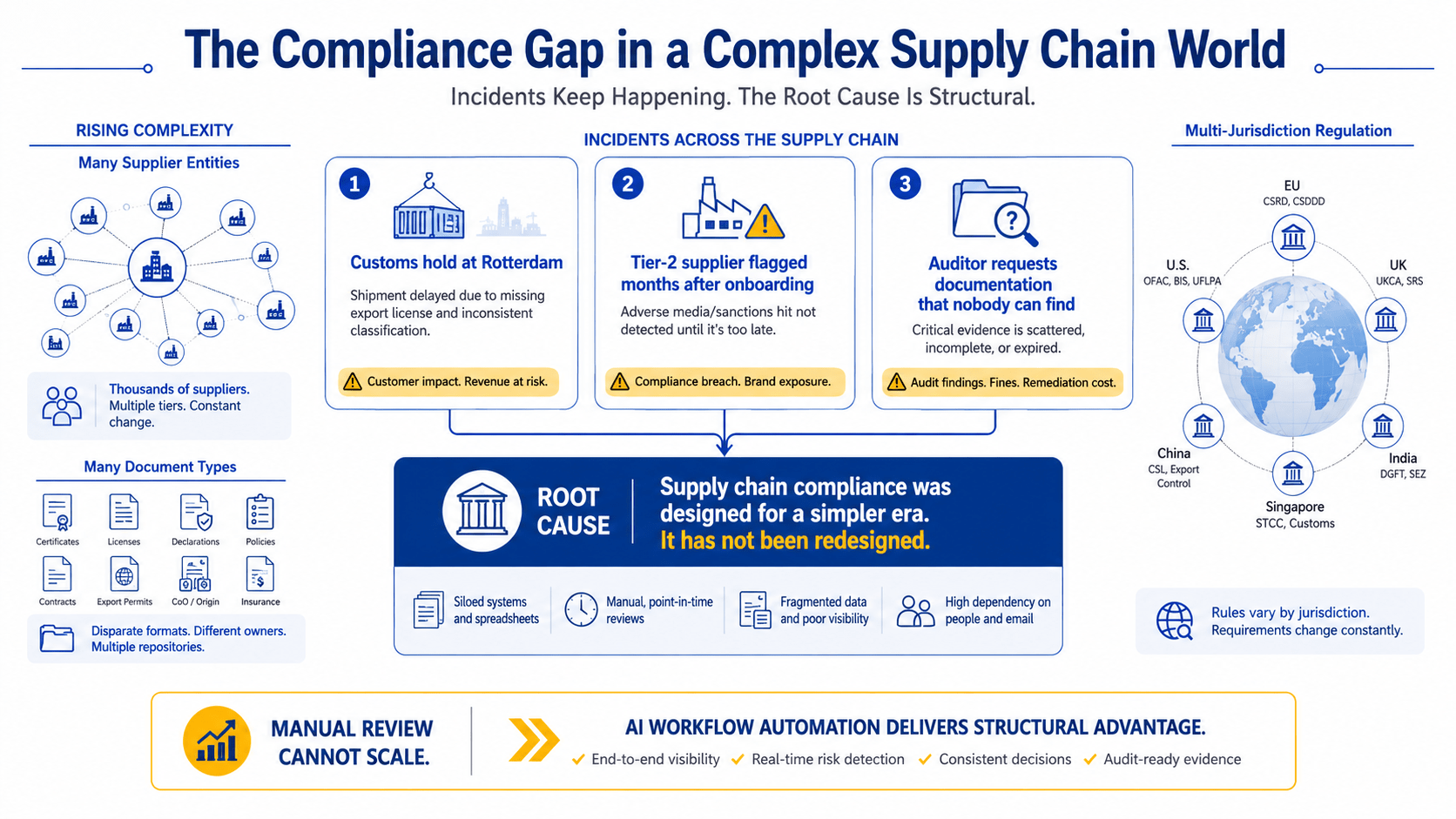
Manual review cannot scale to meet those requirements. The organizations that recognize this early and implement AI workflow automation across their compliance processes will build a structural advantage. The organizations that wait will continue absorbing the cost – in analyst hours, regulatory risk, and delayed onboarding – until the weight becomes impossible to ignore.
This guide covers what supply chain compliance automation actually does, the specific regulatory requirements now driving adoption, where manual workflows break down structurally, and how organizations can implement a working automation layer without a multi-year transformation project.
Why Manual Supply Chain Compliance Review Breaks Down
The Document Volume Problem
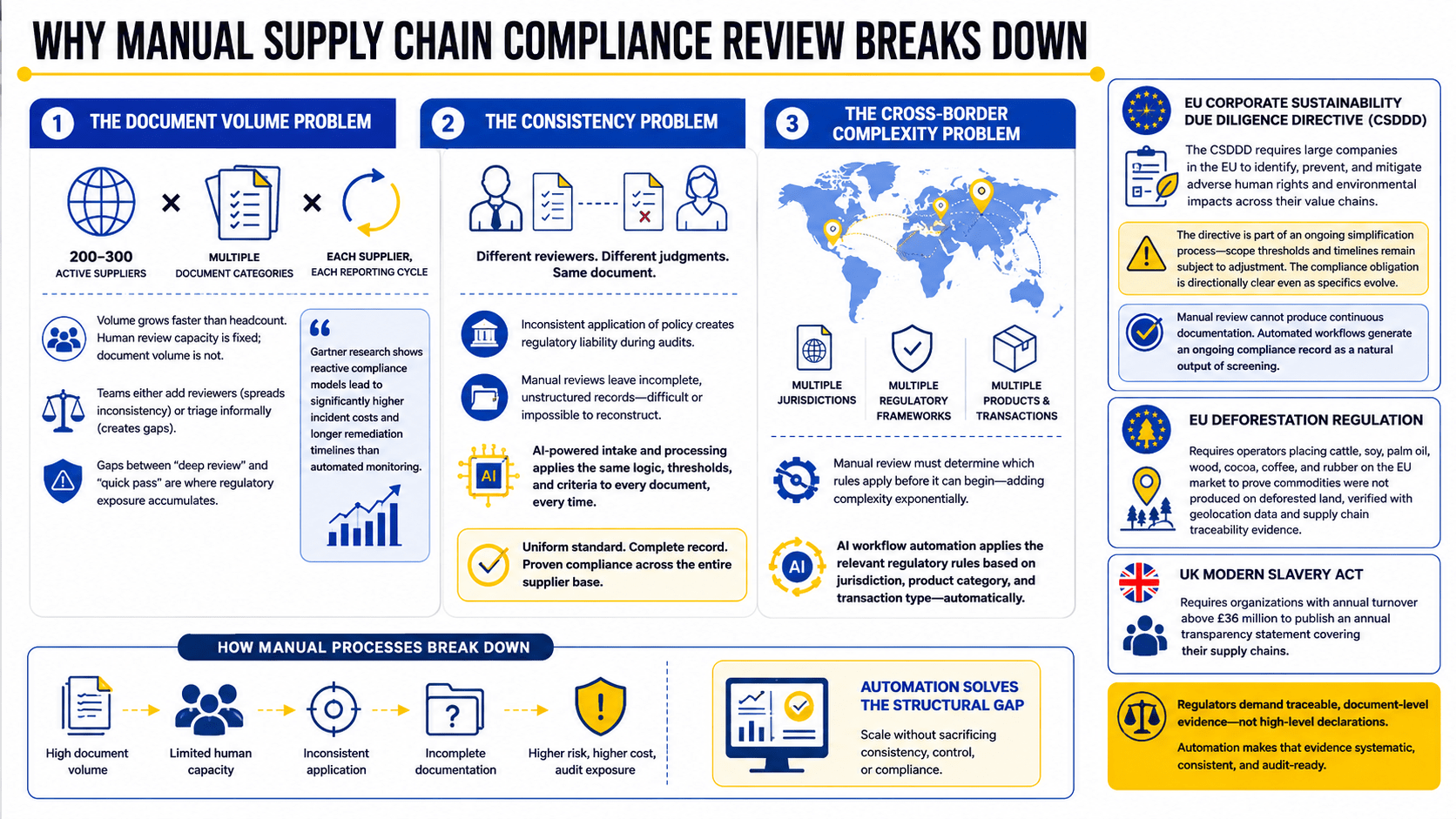
The most immediate failure of manual supply chain compliance is volume. A global manufacturer sourcing from 200 to 300 active suppliers does not receive 200 to 300 compliance documents annually. It receives that number per category – certificates of origin, supplier declarations, labor compliance attestations, environmental certifications, sanctions checks, quality audits, and customs documentation – multiplied by each supplier and each reporting cycle.
Compliance teams responsible for reviewing this volume face the same structural ceiling that financial services compliance teams encounter in high-throughput screening environments: human review capacity is fixed, but document volume is not. When volume grows faster than headcount, organizations respond in one of two ways. They add reviewers, which distributes the same inconsistency across more people. Or they triage informally, which means some documents receive close attention and others move through quickly. The gap between those two categories is where regulatory exposure accumulates.
According to Gartner’s research on supply chain risk, organizations with reactive compliance models – those that investigate supplier risks after they materialize rather than screening proactively – report significantly higher incident costs and longer remediation timelines than those with automated monitoring in place. The cost of a reactive model is not just operational. It is reputational and, in the case of sanctions violations, potentially criminal.
The Consistency Problem
Reviewer judgment varies by individual experience, by the complexity of the document under review, and by the point in the day at which the review occurs. Two experienced compliance analysts applying the same internal policy to the same supplier document may reach different conclusions on what constitutes a material risk. Neither is wrong. The process simply does not enforce a uniform standard across every case.
This inconsistency becomes a regulatory liability when an auditor asks a firm to demonstrate that its supplier screening was applied consistently across its full supplier base. The documentation that exists after a manual review is typically whatever the reviewer chose to record, in whatever format they preferred, filed in whatever system they happened to use. Reconstructing that record during an audit is time-consuming at best and impossible at worst.
AI-powered document intake and data processing addresses this consistency problem at the process level. The same logic, the same thresholds, and the same screening criteria are applied to every document, every time, regardless of who submitted it or when it arrived. The result is a compliance standard that is uniform across the entire supplier base, with a complete record to prove it.
The Cross-Border Complexity Problem
Supply chain compliance does not operate within a single regulatory jurisdiction. A global procurement team may be sourcing materials from Southeast Asia, components from Eastern Europe, and finished goods from Latin America, all subject to different import regulations, different labor standards, different environmental requirements, and potentially overlapping sanctions regimes.
Keeping track of which regulatory requirements apply to which suppliers – and ensuring that documentation reflects current requirements rather than outdated versions – is a full-time task in itself.
This cross-border complexity multiplies the manual review burden rather than adding to it linearly. A supplier that ships across multiple jurisdictions may require simultaneous verification against the EU Conflict Minerals Regulation, US Customs and Border Protection import controls, and the receiving country’s environmental certification requirements. A manual reviewer handling that case is not performing three discrete checks.
AI workflow automation in business processes handles multi-framework screening by design. A well-configured compliance automation layer applies the relevant regulatory rules to each document based on the supplier’s jurisdiction, product category, and transaction type – automatically, without requiring the reviewer to determine which rules apply before they can begin the review.
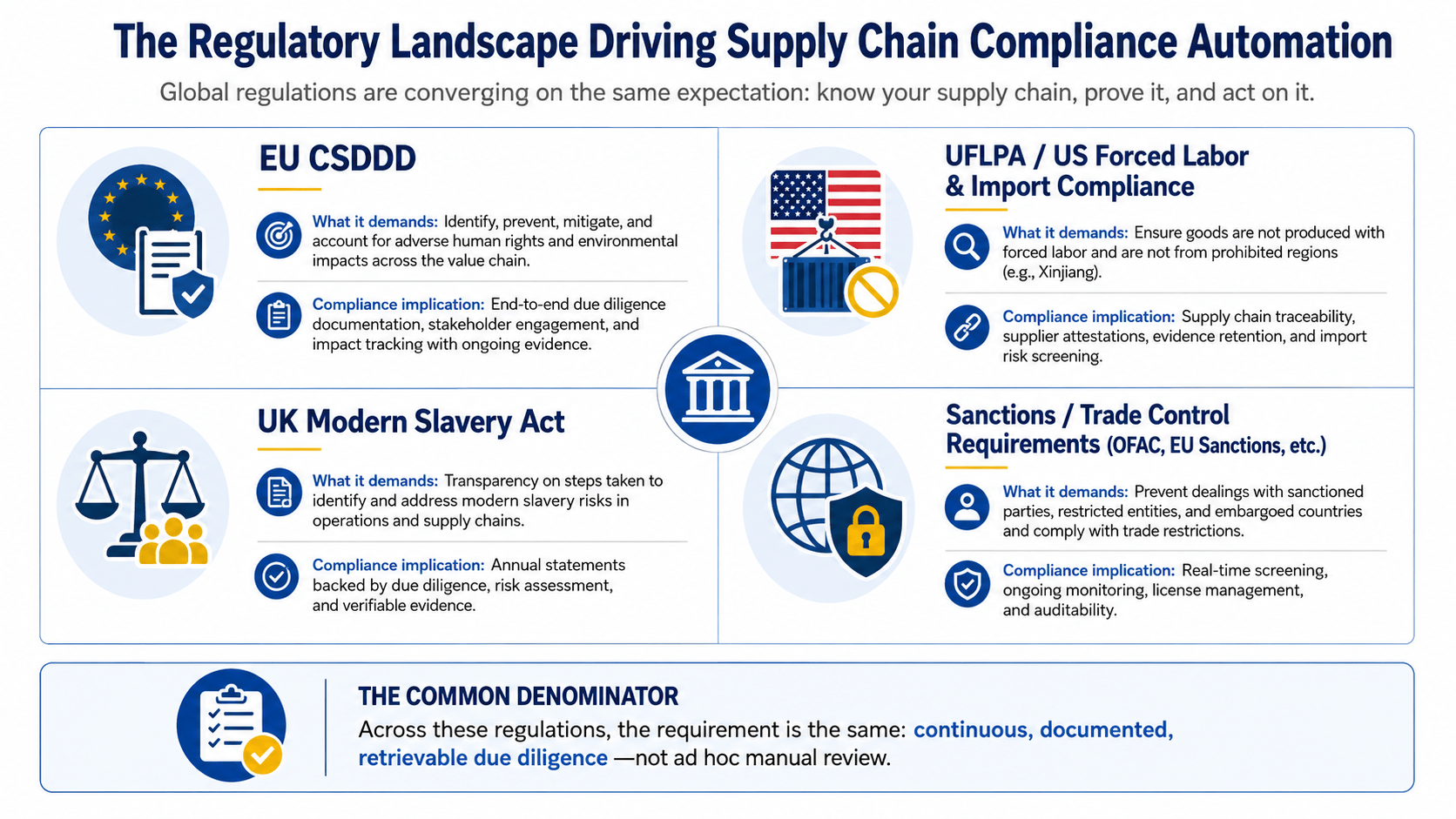
EU Corporate Sustainability Due Diligence Directive (CSDDD)
The CSDDD requires large companies operating in the EU to identify, prevent, and mitigate adverse human rights and environmental impacts across their value chains. Crucially, the European Commission has confirmed the directive is part of an ongoing simplification process – scope thresholds and timelines remain subject to adjustment. Organizations should not treat published thresholds as fixed; the compliance obligation is directionally clear even as the specifics evolve.
Manual review processes are structurally unable to produce the continuous documentation this directive requires. Automated workflows generate an ongoing compliance record as a natural output of the screening process, without additional burden on the compliance team.
EU Deforestation Regulation and UK Modern Slavery Act
The EU Deforestation Regulation requires operators placing cattle, soy, palm oil, wood, cocoa, coffee, and rubber on the EU market to demonstrate those commodities were not produced on deforested land, verified with geolocation data and supply chain traceability evidence.
The UK Modern Slavery Act requires organizations with annual turnover above £36 million to publish an annual transparency statement covering their supply chains. These two instruments illustrate a broader trend: regulators are no longer satisfied with high-level supplier declarations. They require traceable, document-level evidence. Automation makes that evidence systematic rather than ad hoc.
What Supply Chain Compliance Automation Actually Does
1. Automated Document Intake and Data Extraction
Supply chain compliance automation begins at the point where documents enter the organization. Whether a supplier submits a compliance certificate via email, uploads it to a supplier portal, or transmits it through an EDI integration, the automation layer receives it immediately. It reads the document – whether structured or unstructured, in PDF, Excel, Word, or image format – and extracts the relevant fields without manual input.
Those fields include supplier identifiers, issuing authority, certification date, expiry date, jurisdiction, product scope, and any declarations the document contains regarding labor practices, environmental standards, or material origins. Extraction happens in seconds, regardless of the document’s format or the language it was written in.
The extracted data is then available for downstream screening without anyone having touched the document manually. This capability is what turns a compliance review from a human reading exercise into a structured data process.
The practical consequence is significant. A compliance team that previously spent the first half of every review session reading and re-reading documents to find the relevant fields now receives those fields pre-extracted, pre-structured, and pre-labeled. The review itself shifts from information gathering to judgment — which is where experienced compliance professionals actually add value.
2. Automated Regulatory and Sanctions Screening
Once document fields have been extracted, the compliance automation layer screens them against the relevant databases simultaneously. Supplier names and entity identifiers are checked against OFAC sanctions lists, EU consolidated sanctions lists, and any industry-specific watchlists relevant to the organization’s sourcing geography.
Jurisdictions are checked against import restriction lists and high-risk country registers. Certification claims are checked against issuing authority records to verify authenticity and current validity.
This screening happens in parallel, not sequentially. The system does not finish one check before starting the next. All relevant databases are queried simultaneously, and the results are assembled into a structured screening summary that arrives with the document review.
A screening event that previously required 15 to 25 minutes of manual analyst time – reading the document, running the checks, recording the results – can complete in under two minutes with automated extraction and screening in place. At scale, across hundreds of suppliers and thousands of annual document submissions, that time reduction changes the economics of the compliance function entirely.
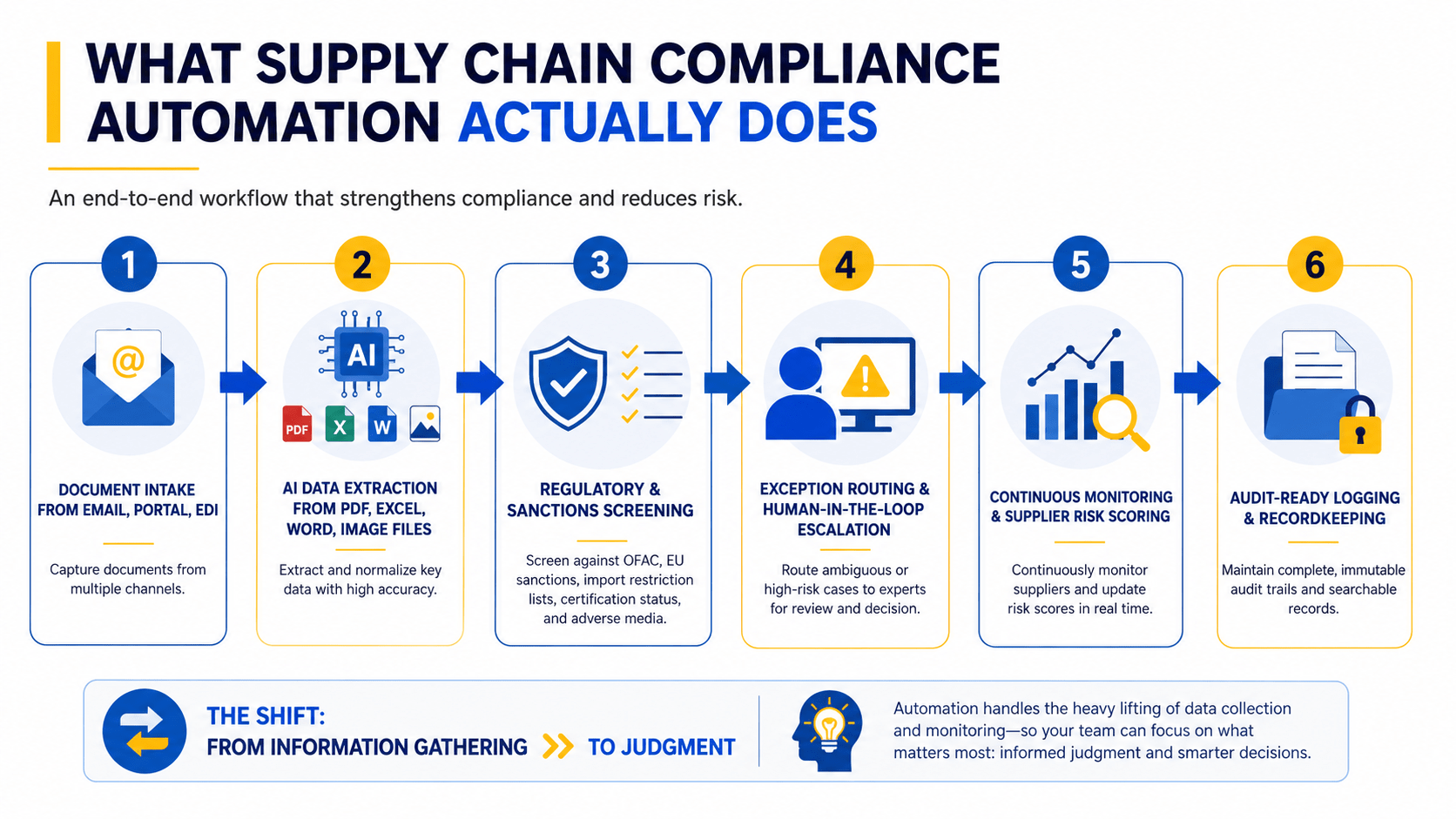
3. Exception Routing and Human-in-the-Loop Escalation
Compliance automation does not mean removing human judgment from the compliance process. It means routing human judgment to the cases where it is actually needed. Documents that clear all screening checks automatically move forward with a complete log of the checks performed. Documents that trigger potential matches or policy flags are routed to a human reviewer – with the relevant context pre-assembled.
That context includes the specific field that triggered the escalation, the database record it matched against, the confidence score the system assigned, and any differentiating information available. A reviewer opening an escalated case does not start from scratch. They start from a structured briefing that tells them exactly what the system found and why it flagged the case. Their job is to make the judgment call, not to gather the information that supports it.
The CSDDD and UFLPA both require that automated due diligence processes include documented human oversight for ambiguous or high-risk cases – the obligation is explicit, not implied. A compliance automation layer that routes exceptions to human reviewers with full context attached satisfies that requirement by design, and produces the accountability record that both frameworks require when regulators ask for evidence.
4. Continuous Monitoring and Supplier Risk Scoring
A supplier who passes onboarding screening in January may acquire a new beneficial owner, move operations to a sanctioned jurisdiction, or have their labor certification lapse by June. Manual review processes rarely catch these changes unless a new transaction triggers a fresh review. By the time the issue surfaces, the exposure may already be substantial.
Supply chain compliance automation addresses this through continuous monitoring. Rather than reviewing suppliers only when a new document arrives, an automated monitoring layer checks active suppliers against sanctions lists, adverse media sources, and regulatory registers on a scheduled basis.
When a change is detected – a new sanctions listing, a certification expiry, an adverse media hit – the system generates an alert automatically and routes it to the relevant reviewer with full context. This shift from event-driven to continuous compliance monitoring changes the risk profile of the compliance function in a way that headcount cannot replicate. A team of five compliance analysts working an eight-hour day cannot monitor 300 active suppliers continuously.
The Regulatory Landscape Driving Supply Chain Compliance Automation
EU Corporate Sustainability Due Diligence Directive
The EU Corporate Sustainability Due Diligence Directive imposes due diligence obligations on large companies operating in the EU, requiring them to identify, prevent, mitigate, and account for adverse human rights and environmental impacts in their own operations and in their value chains. For companies above the applicable thresholds, this is not a voluntary reporting requirement.
Manual compliance processes are not designed to meet this standard. The CSDDD requires organizations to demonstrate ongoing due diligence across their supply chains, document the steps taken to identify and address risks, and report on the effectiveness of those measures annually. That level of documentation and evidence cannot be produced reliably by a process that relies on individual reviewers to record their own decisions.
*The European Commission has confirmed CSDDD is subject to an active simplification review. Applicable thresholds and timelines may change – organizations should monitor the official CSDDD legislative tracker for the most current scope.
Automated compliance workflows produce the documentation CSDDD requires as a natural output of the screening process. Every supplier check, every risk assessment, and every escalation decision is logged automatically with a timestamp, a rationale, and a link to the source document. When the compliance officer needs to demonstrate due diligence to a regulator or auditor, the evidence exists already – structured, complete, and immediately retrievable.
US Import Compliance and Forced Labor Regulations
The Uyghur Forced Labor Prevention Act (UFLPA) creates a rebuttable presumption that goods produced wholly or in part in the Xinjiang Uyghur Autonomous Region, or by entities on the UFLPA Entity List, are made with forced labor and are therefore prohibited from import into the United States. The burden of proof falls on the importer to demonstrate that goods are not subject to the prohibition, which requires traceability documentation reaching back through the supply chain to the point of production.
This traceability requirement is incompatible with manual compliance review at scale. Importers with complex, multi-tier supply chains cannot manually verify the provenance documentation for every product category they import. Automated data extraction and screening applied to supplier documentation – certificates of origin, material declarations, production records – makes it possible to flag potential UFLPA exposure systematically before goods enter the import process rather than after a customs hold has already occurred.
Applying Supply Chain Compliance Automation Across Industries
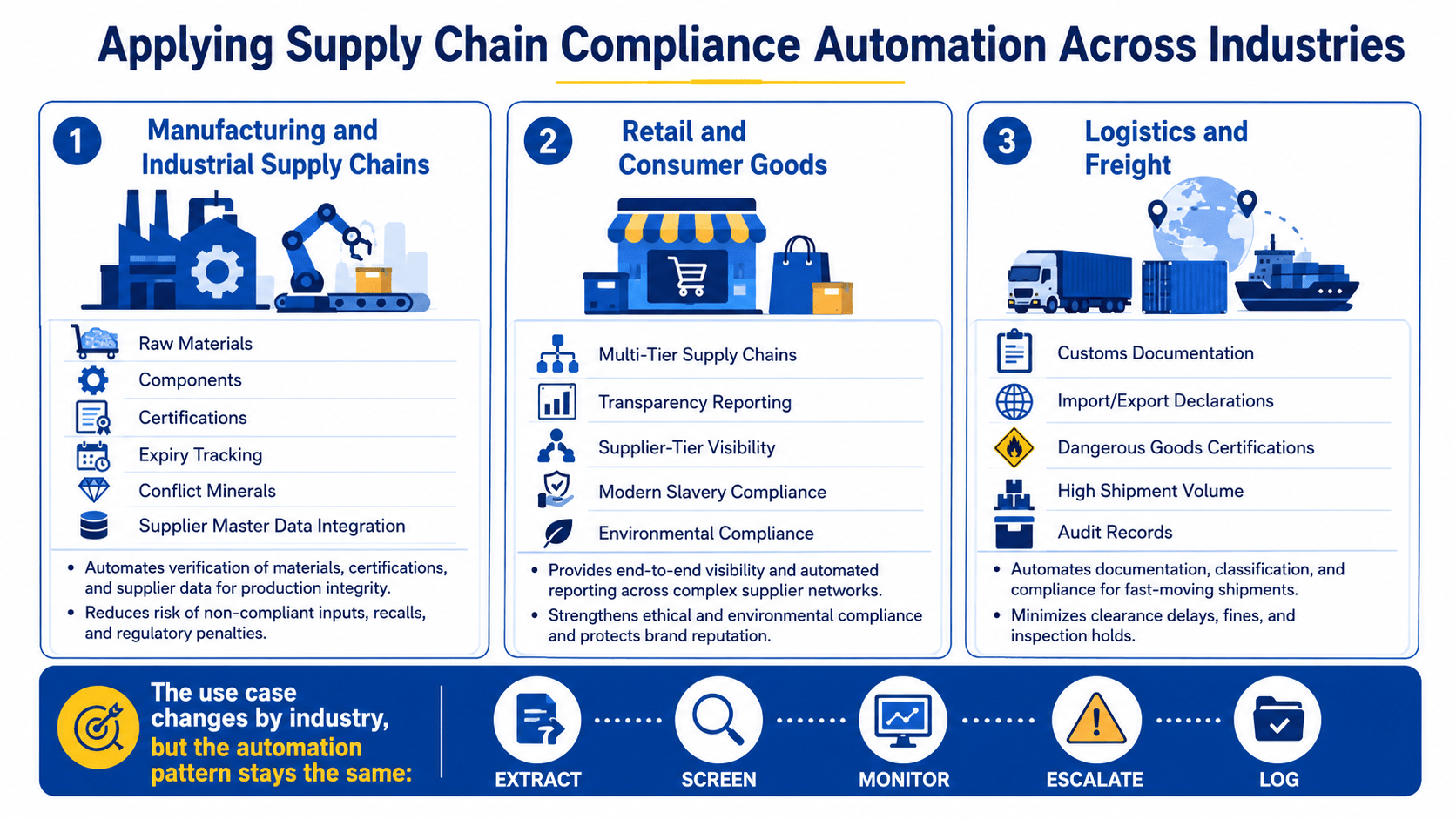
Supply chain compliance requirements vary by industry, but the automation logic is consistent: extract the right documents, screen against the relevant requirements, flag gaps, and log every action. The table below maps common document types and automation use cases by sector.
| Industry | Common compliance documents | Typical automation use cases |
|---|---|---|
| Manufacturing | Certificates of origin, conflict-mineral declarations, ISO certificates | Certificate validation, expiry monitoring, material-origin screening |
| Retail and consumer goods | Supplier declarations, modern-slavery evidence, environmental certifications | Multi-tier evidence collection, gap detection, supplier reporting |
| Logistics and freight | Customs declarations, dangerous-goods records, carrier documents | Shipment-level validation, exception routing, customs audit trails |
For a deeper look at how AI solutions apply to manufacturing operations and retail supply chains, SmartDev’s industry pages cover the full implementation context.
The Business Case for Supply Chain Compliance Automation
What Manual Review Actually Costs
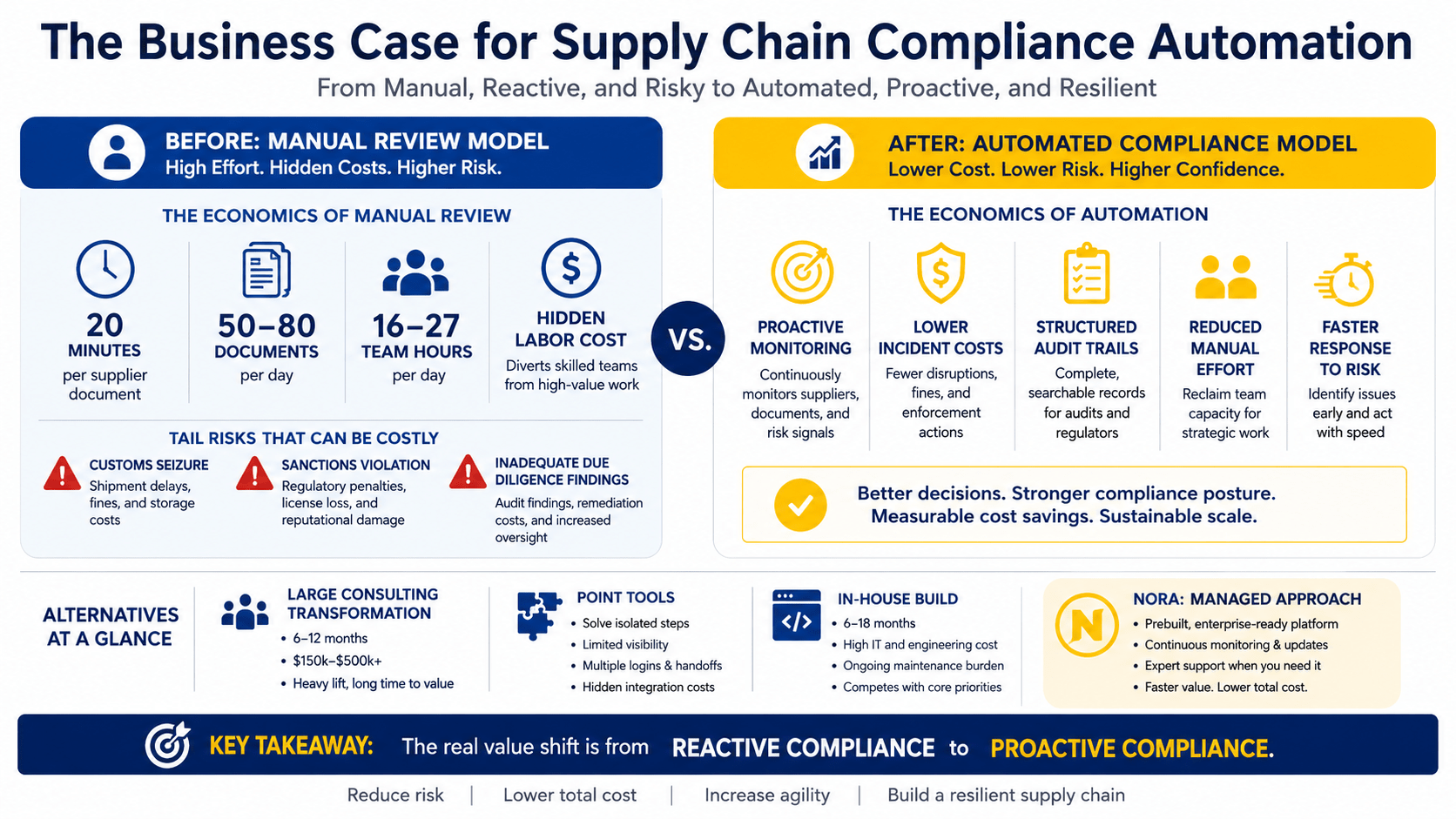
The cost of manual supply chain compliance review is consistently underestimated because it appears as staff time rather than a discrete line item. A compliance analyst spending 20 minutes per supplier document across a daily volume of 50 to 80 documents is committing 16 to 27 hours per day to manual review activity across the team. When that time is fully loaded – salary, benefits, management overhead, and the opportunity cost of work not done – the true operational cost of manual compliance review is substantially higher than most compliance budget analyses acknowledge.
Beyond direct labor costs, manual review carries a tail risk that is harder to quantify but far more significant in practice: the cost of a compliance failure. A customs seizure, a sanctions violation, or a regulatory finding related to inadequate due diligence documentation can generate penalties, remediation costs, and reputational damage that dwarf the annual cost of an automated compliance workflow. According to McKinsey’s analysis of supply chain risk, organizations that invest in proactive risk monitoring and compliance infrastructure consistently report lower total incident costs than those that manage compliance reactively.
The comparison with alternative approaches is also instructive. Large consulting engagements for enterprise compliance transformation – based on publicly reported engagement structures from firms including Deloitte, Accenture, and PwC – typically run 6 to 12 months before reaching a production workflow. Fee ranges vary significantly by scope, geography, and engagement model; organizations should request itemized proposals rather than relying on published benchmarks. Point products for specific compliance functions address individual workflow steps without integrating them end-to-end or generating a continuous audit trail.
From Reactive to Proactive Compliance
The structural shift that supply chain compliance automation makes possible is not simply faster manual review. It is a move from reactive compliance – catching problems after they occur — to proactive compliance — identifying risks before they materialize into operational or regulatory events.
Manual review processes are inherently reactive. They respond to documents that arrive, transactions that trigger a review, or audits that request evidence. They do not proactively monitor the supplier base for changes that introduce new risks between review cycles. An automated compliance layer that runs continuous monitoring against live sanctions databases, adverse media feeds, and regulatory change notifications closes this gap by design.
Compliance audit trail automation makes this shift operationally visible. When every compliance action – every document intake, every screening check, every escalation, every decision – is logged automatically in a structured, retrievable record, the compliance function’s work becomes transparent to regulators, to internal audit, and to senior leadership in a way that manual processes simply cannot support. The compliance officer who previously spent days reconstructing audit evidence from email archives now has a complete, structured record available on demand.
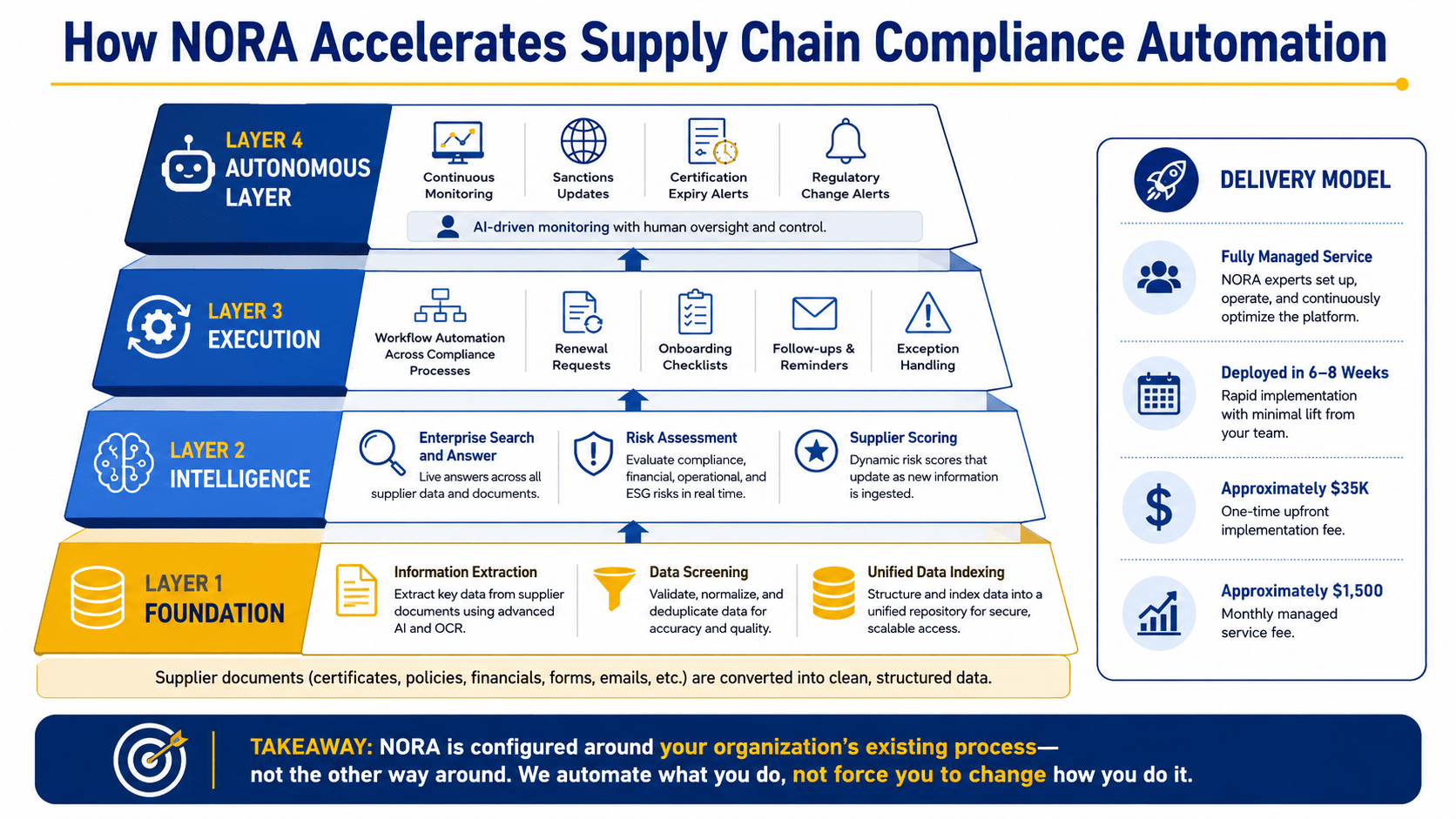
How NORA Accelerates Supply Chain Compliance Automation
Supply chain compliance is a process with specific, repeatable structure: documents arrive, data must be extracted, checks must be run, exceptions must be routed, and records must be kept. That structure is exactly what NORA is built to automate.
NORA is SmartDev’s AI Adoption Accelerator – not a fixed product that organizations must adapt to, but a framework of reusable AI components that are configured to the specific compliance requirements, document types, and regulatory context of each organization. The distinction matters. Most compliance automation solutions require organizations to restructure their processes around the tool’s architecture. NORA is built around the organization’s existing process, adding the automation layer where manual effort is currently consuming the most time and creating the most risk.
Foundation: Understanding Your Compliance Data
Every supply chain compliance automation project begins with the same challenge: the data exists in the wrong form. Supplier documents arrive in dozens of formats. Certification databases are maintained in disconnected systems. Risk flags live in email threads rather than structured records. Before compliance workflows can be automated, the underlying data must be made readable.
NORA’s Foundation Data Skills address this directly. The Information Extraction capability reads incoming supplier documents – PDFs, scanned images, structured spreadsheets, XML files from EDI systems – and pulls the relevant fields into a structured data format automatically. Data Screening applies categorical logic to classify suppliers, documents, and risk levels without manual labeling. Unified Data Indexing organizes the extracted compliance data across supplier records, certification categories, and regulatory frameworks so that every piece of compliance information is retrievable in seconds rather than buried in a shared drive.
This foundational layer is what makes the rest of the automation possible. Without clean, structured, indexed compliance data, there is nothing for the screening logic to work with. NORA builds that foundation as the first step, which is why organizations see results quickly rather than after a lengthy data preparation project.
Intelligence: Risk Assessment and Supplier Scoring
With structured data in place, NORA’s Intelligence Skills turn that data into the risk assessments and decisions that compliance teams actually need. The Enterprise Search and Answer capability allows compliance teams to query their supplier compliance data directly – asking questions like “which of our active suppliers have certifications expiring in the next 60 days” or “which tier-2 suppliers are sourcing from jurisdictions on our restricted list” – and receiving structured answers drawn from live supplier records rather than static reports.
The Risk Assessment capability applies configurable scoring logic to supplier profiles, combining certification status, jurisdiction risk, sanctions screening results, and adverse media signals into a single risk score that is recalculated automatically as new information arrives. Rather than reviewing each supplier case individually to form a risk opinion, compliance analysts see a current risk score for every supplier in the active base, with the factors driving that score transparently documented. This is what continuous compliance monitoring looks like in practice: not a manual review cycle, but a live risk picture that updates as the supplier landscape changes.
Execution: Workflow Automation Across Compliance Processes
Knowing there is a compliance risk and acting on it are two separate steps. NORA’s Execution Skills close that gap by automating the actions that follow a compliance finding. When a certification is identified as expiring, the system drafts and sends an automated renewal request to the supplier. When a new supplier is onboarded, the system generates a compliance checklist based on the supplier’s jurisdiction and product category and tracks submission against that checklist. When a document submission is incomplete, the system sends a structured follow-up without requiring a compliance analyst to draft it manually.
These execution capabilities reduce the manual coordination overhead that compliance teams spend a significant portion of their time on – the emails requesting missing documents, the tracking of outstanding submissions, the notifications to procurement teams when a supplier’s compliance status changes. Automating that coordination work frees compliance analysts to focus on the cases that require genuine judgment: the ambiguous risk assessments, the escalated exceptions, the supplier relationships where the compliance picture is complex enough to require experienced human analysis.
Autonomous Layer: Continuous Monitoring Without Constant Input
The most powerful capability NORA brings to supply chain compliance is its Autonomous Layer: AI that operates proactively with human oversight rather than waiting for a manual trigger. Trigger-based workflows run continuous checks against live data sources – sanctions lists, adverse media feeds, regulatory change notifications – and generate alerts automatically when a change affects an active supplier relationship.
This means the compliance team learns about a newly sanctioned supplier on the day the listing is published, not on the day a new transaction triggers a manual review. It means a certification that lapses on a Friday afternoon generates an alert on Friday afternoon rather than being discovered the following Monday when a shipment is already in transit. It means regulatory changes that affect sourcing requirements are flagged to the relevant procurement owners as soon as they are published, rather than surfacing as a compliance gap during an audit.
The practical result is a compliance function that is both more efficient and more effective than its manual equivalent: fewer surprises, faster responses, and a complete documented record of every monitoring action and alert generated. NORA delivers this full capability stack as a fully managed service, deployed in 6 to 8 weeks, without the volatility of open-ended consulting engagements or the internal burden of building and maintaining the infrastructure in-house.
Autonomous monitoring reduces response time significantly, but it does not eliminate the need for human governance. Automated alerts require defined escalation paths – without a clear owner for each alert type, high volumes of notifications can create the same triage problem they were meant to solve. Sanctions list updates and regulatory data feeds must be sourced from authoritative providers and refreshed on a defined schedule; stale data in an automated system creates false confidence rather than real coverage.
Organizations deploying autonomous compliance layers should maintain a documented rule log – a version-controlled record of the screening logic, thresholds, and data sources in use at any given time. When a regulator asks why a specific supplier was cleared on a specific date, the answer must include not just what the system found, but what logic it was running and against which data sources. NORA maintains this rule log as part of its managed service, ensuring that the governance layer exists by default rather than requiring the compliance team to build and maintain it separately.
Conclusion
Supply chain compliance has become too complex, too multi-jurisdictional, and too documentation-intensive for manual review to manage reliably at scale. The regulatory environment will continue to add requirements. Supplier networks will continue to grow in depth and geographic reach. The organizations that build automated compliance infrastructure now will absorb those additions without proportional increases in cost or risk. The organizations that do not will continue responding to problems after they happen, with the costs that reactive compliance consistently produces.
Compliance automation is not about replacing compliance professionals. It is about giving them the infrastructure to do their jobs at the scale and standard that modern supply chains require. When document extraction is automated, screening is consistent, monitoring is continuous, and every decision is logged automatically, compliance teams can direct their expertise toward the cases that actually need it — the genuinely ambiguous risk assessments, the complex supplier relationships, the regulatory judgments that experience and context make possible.
NORA brings that infrastructure to supply chain compliance as a fully managed service, with no internal technical overhead required and a working deployment in 6 to 8 weeks. If your compliance process is being outpaced by the volume and complexity of your supplier base, contact SmartDev to discuss what automation can deliver for your specific requirements.