
TL;DR:
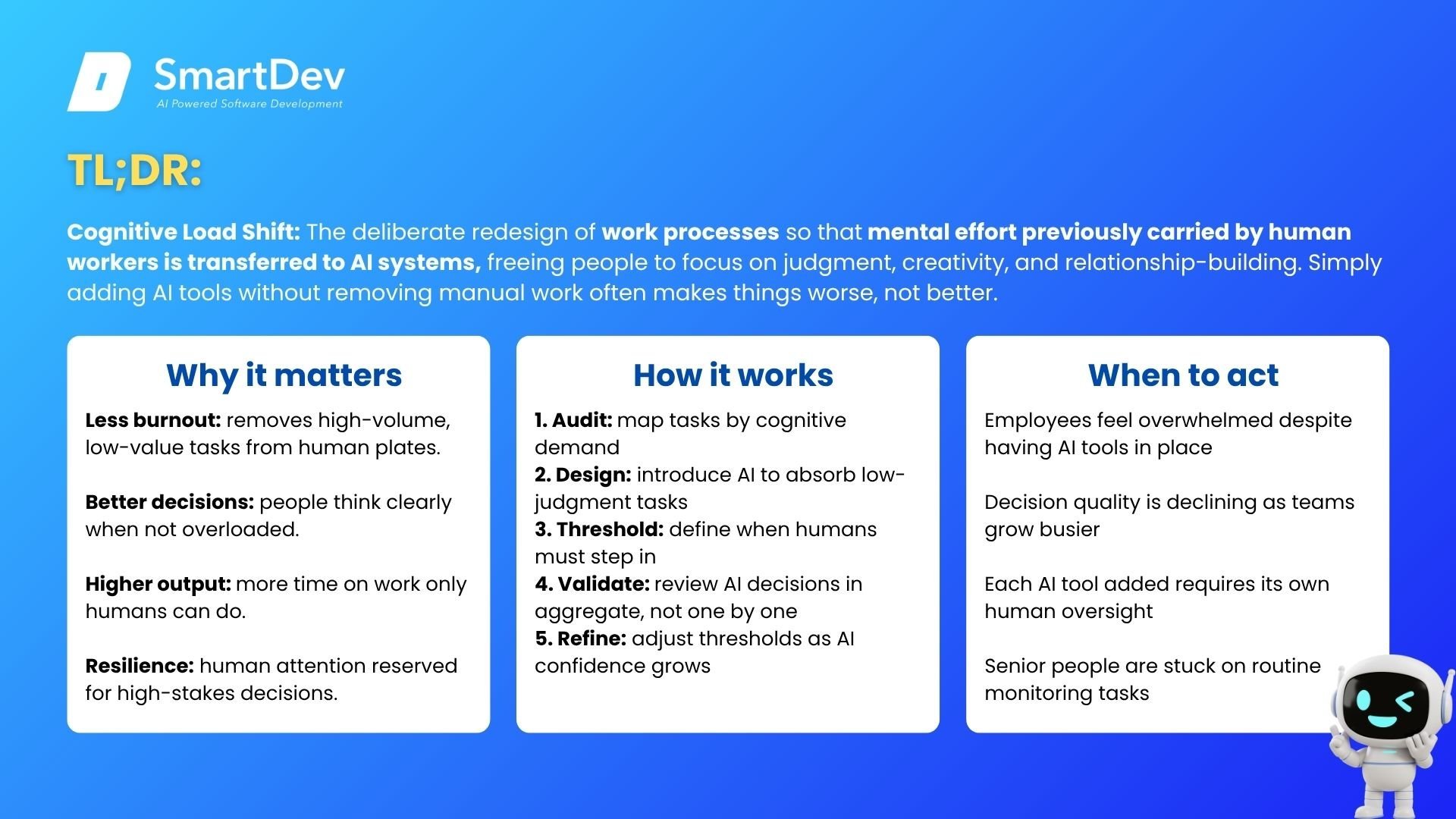
- Cognitive Load Shift is the intentional transfer of mental effort from human workers to AI systems, reducing fatigue and freeing people for higher-value thinking.
- Organizations using this approach report improved focus, better decision quality, and lower rates of employee burnout from information overload.
- Successfully implementing Cognitive Load Shift requires redesigning workflows, not just adding AI tools on top of existing processes.
Cognitive Load Shift is one of the most important ideas in enterprise AI strategy right now. As AI tools multiply across organizations, simply deploying more AI does not automatically reduce pressure on people. Done right, it does. Done wrong, it creates new kinds of fatigue. This article explains what Cognitive Load Shift is, why it matters, and how to implement it effectively.
What is Cognitive Load Shift?
Cognitive Load Shift is the deliberate redesign of work processes so that mental effort previously carried by human workers is transferred to AI systems, allowing people to direct their attention toward tasks that genuinely require judgment, creativity, and relationship-building.
The term draws on cognitive psychology’s concept of cognitive load, which refers to the total amount of mental effort being used in working memory at any given time. Every email filtered, every system alert reviewed, and every data report read consumes a portion of this finite mental capacity. When AI takes over the low-level monitoring and processing tasks, the human cognitive load drops, and the quality of the work people do on remaining tasks improves.
Cognitive Load Shift operates at two levels:
- Individual level: AI assistants handle scheduling, summarization, routine correspondence, and data lookup so individual employees can focus on strategic work.
- Organizational level: AI monitoring systems manage infrastructure alerts, compliance checks, and operational metrics, surfacing only the issues that genuinely require human decisions.
비즈니스에 중요한 이유
Without intentional Cognitive Load Shift, adding more AI tools to an already busy workplace often makes things worse. Employees end up managing AI systems on top of their existing workload, a phenomenon now widely described as AI cognitive overload or “AI brain fry.”
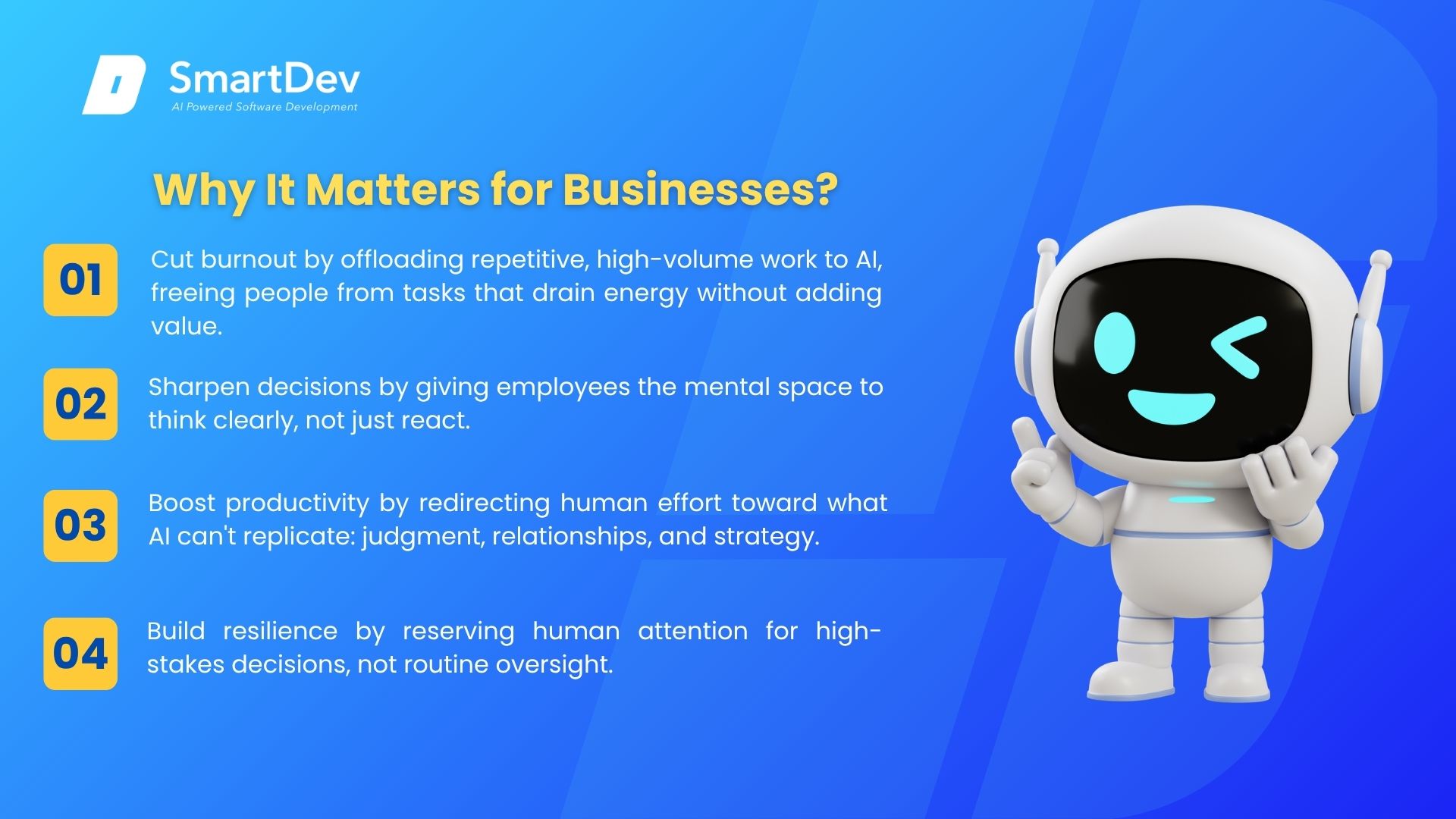
- Reduce employee burnout by removing low-value, high-volume tasks from human workflows and reassigning them to AI systems that handle the volume without fatigue.
- Improve decision quality by ensuring that when people do make decisions, they have the mental bandwidth to think clearly rather than operating under constant information overload.
- Increase productivity per person by allowing employees to spend more time on work that AI cannot do: nuanced judgment, client relationships, and creative strategy.
- Protect organizational resilience by designing workflows where human attention is reserved for high-stakes decisions rather than consumed by routine monitoring tasks.
For example, an IT operations team at a mid-sized enterprise reduced the number of daily system alerts requiring human review from 400 to just 15 by deploying an AI monitoring layer that handled correlation and triage automatically. Incident response times improved by 35%, and the team reported significantly lower stress levels within two months of the change taking effect.
How Does Cognitive Load Shift Work?
- Workflow audit: Map out the tasks your team currently performs and categorize them by cognitive demand. Identify which tasks are high-volume but low-judgment (prime candidates for AI delegation) versus those requiring nuanced human input.
- AI layer design: Introduce AI tools that absorb the low-judgment tasks. This might mean an AI that triages support tickets, summarizes meeting notes, or monitors system health without requiring human involvement for routine signals.
- Human threshold setting: Define clear escalation criteria. The AI handles everything below the threshold; humans only engage when a situation exceeds predefined complexity or risk levels.
- Output validation: Build a regular check-in cycle where humans review AI decisions in aggregate rather than individually, confirming the system performs correctly without recreating the original cognitive load.
- Iterative refinement: As AI systems learn from operational data, adjust the threshold to allow more routine work to be absorbed, freeing up additional human capacity as confidence in the system builds.
The result is a workforce that is less exhausted, more focused, and better positioned to handle the genuinely complex challenges that AI cannot solve on its own.
When Does Your Business Need Cognitive Load Shift?
The warning signs that your organization needs a Cognitive Load Shift strategy are often visible in day-to-day operations:
- Employees report feeling overwhelmed despite having AI tools in place, which signals that tools were added without removing equivalent manual work from their plates.
- Decision quality is declining as teams grow busier, indicating people are making choices under cognitive overload rather than with clear, focused thinking.
- You have deployed multiple AI tools but each one requires its own human oversight, multiplying rather than reducing the total workload your team carries.
- Senior people are spending significant time on routine monitoring tasks that should be handled automatically by properly configured AI systems.
Cognitive Load Shift is not the right approach when your core processes are still being defined. Automating unclear workflows produces automated confusion. Establish the workflow correctly first, then shift the cognitive work to AI.
기타 관련 용어
AI Agent: A software system that uses artificial intelligence to analyze data, make decisions, and perform tasks automatically to achieve a specific goal. AI Agents are the primary mechanism through which Cognitive Load Shift happens in practice. They absorb the high-volume, low-judgment tasks that previously consumed human mental capacity across teams.
Graduated Autonomy: A structured framework for expanding AI independence in stages, with each stage unlocked only after the system demonstrates reliable performance within defined guardrails. Graduated Autonomy governs how much cognitive load gets transferred to AI at any given point, ensuring the shift happens progressively rather than all at once in a way that creates new risks.
Agentic Flow: The sequence of steps an AI agent follows to complete a multi-step task from start to finish without continuous human instruction. Agentic Flow is what makes Cognitive Load Shift sustainable at scale. When an AI can handle an entire workflow end to end, the mental effort of managing each individual step no longer falls on the human team.






