
요약
- A pilot project is a small-scale trial of a new technology, process, or outsourcing arrangement used to validate feasibility and fit before a full commitment.
- It gives both client and vendor a low-risk opportunity to test working relationships, quality standards, and delivery timelines on a real piece of work.
- A well-structured pilot project reduces the risk of costly failures by surfacing problems early, when they are still inexpensive to correct.
Committing a large budget to a new technology vendor or software initiative without testing the relationship first is a significant business risk. A pilot project is the structured way to avoid that risk. By scoping a small, representative piece of work before signing a long-term contract, businesses get real evidence of whether a technology or partner will deliver on its promises.
What is a Pilot Project?
A pilot project is a small-scale, time-limited implementation of a new technology, process, or vendor partnership designed to test its feasibility, effectiveness, and organizational fit before committing to a full-scale rollout.
In IT outsourcing, a pilot project typically involves assigning a new vendor a defined piece of real work, whether a small feature, a module of a larger application, or a specific sprint, rather than a simulated or hypothetical task. This gives both sides genuine exposure to each other’s working styles, communication norms, technical standards, and delivery capabilities.
The term is distinct from a proof of concept (PoC), which tests whether a technology is technically viable in isolation. A pilot project tests whether the technology or vendor works within your specific business context, including your processes, constraints, and stakeholder environment.
비즈니스에 중요한 이유
Long-term outsourcing contracts, large software implementations, and technology adoption decisions carry inherent risk. A pilot project is the most cost-effective tool for validating that risk before it becomes expensive.
- 줄이다 financial exposure by testing a vendor or technology at limited scale before committing a full project budget.
- 개선하다 decision-making quality by replacing assumptions with real performance data from an actual engagement.
- 가속하다 vendor evaluation by running a structured trial instead of relying solely on proposals, references, and demos.
- 증가시키다 stakeholder alignment by demonstrating a working prototype or delivery sample before requesting approval for a larger investment.
For example, a manufacturing company evaluating two offshore development partners ran a two-week pilot project with each, assigning them identical small modules to build. The code quality, communication responsiveness, and delivery accuracy differed significantly between the two. The pilot saved the company from signing a 12-month contract with the underperforming vendor and gave them objective data to support their final selection decision.
When to Use a Pilot Project?
- Use a pilot project when evaluating a new outsourcing vendor to validate their quality, communication style, and delivery process before a long-term commitment.
- Use it when introducing a new technology platform across the organization, starting with one department or workflow before company-wide rollout.
- Use it when a project carries high uncertainty and the business needs to test core assumptions about feasibility or user adoption before full investment.
- Avoid pilot projects when the scope is too small to be representative of the real engagement, as a toy task will not reveal the vendor’s behavior under realistic conditions.
- Avoid using a pilot as a negotiating tactic to get free or discounted work from a vendor without genuine intent to evaluate and proceed.
How Does a Pilot Project Work?
- Define Scope and Success Criteria: Choose a representative piece of work that is small enough to complete quickly but large enough to reveal real capability. Define what success looks like in advance, including quality metrics, delivery timelines, and communication expectations.
- Set a Fixed Timeline: Establish a clear start and end date, typically two to six weeks. A fixed timeline creates urgency and prevents scope expansion from distorting the evaluation.
- Run the Pilot as a Real Project: Treat the pilot with the same rigor as a full project. Use your standard tools, processes, and review cycles so the vendor is evaluated in realistic conditions.
- Evaluate and Decide: At the end of the pilot, assess results against the success criteria. Document what worked, what did not, and whether the gaps are correctable before making a go or no-go decision on the full engagement.
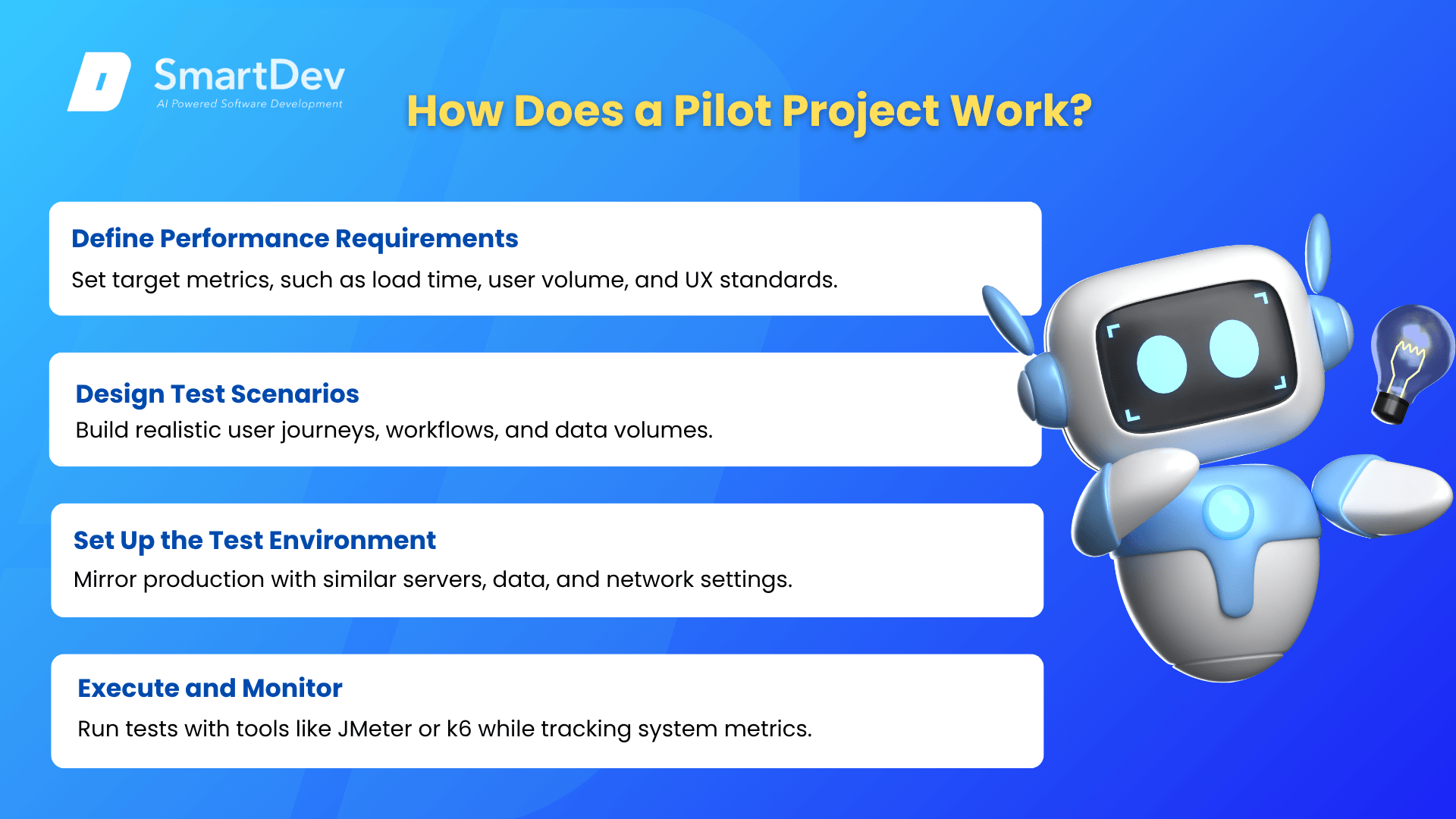
The result is a decision grounded in evidence rather than sales promises, which significantly improves the success rate of the full-scale initiative that follows.
기타 관련 용어
Milestone-Based Contract: A formal agreement between a client and a service provider where compensation is released only when specific, measurable project milestones are completed and accepted.
Skill Matrix: A structured grid that maps individual team members against a defined set of skills and competencies, with each intersection rated on a proficiency scale, giving managers a clear visual picture of the team’s overall capability and where gaps exist relative to project requirements.
Engineering Culture: The collective set of values, beliefs, practices, and behaviors that characterize how a software engineering team or organization approaches its work.