
요약
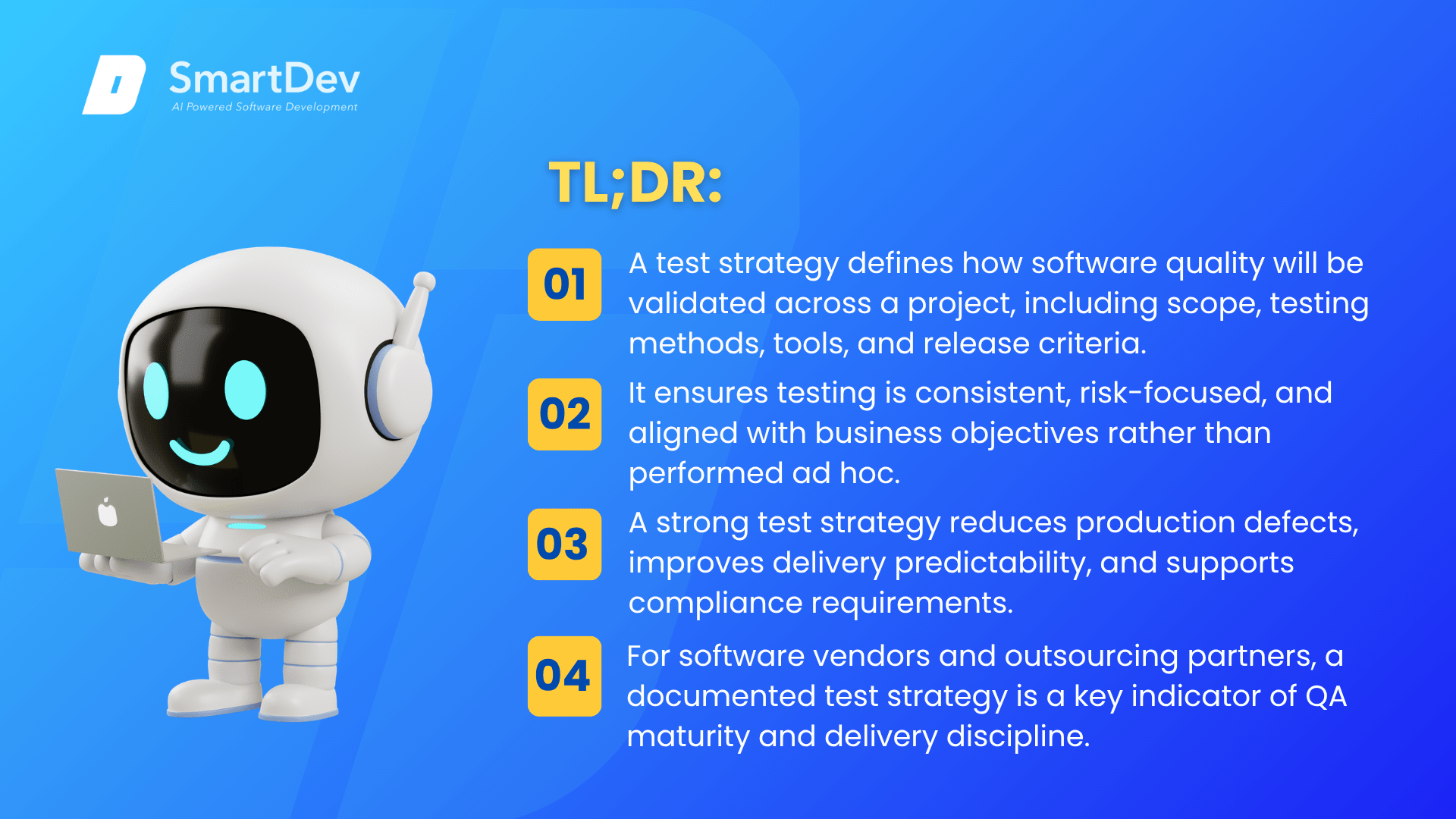
- A test strategy is a high-level document that defines how testing will be approached across a project or organization, including what will be tested, which testing types apply, and how quality will be measured.
- Without a defined test strategy, testing becomes inconsistent, coverage is unpredictable, and quality issues slip through in patterns that repeat across releases.
- For business leaders, a well-articulated test strategy from a software vendor or development team is a leading indicator of delivery maturity and quality discipline.
Two projects can spend the same budget on QA and produce very different results. The difference is usually not the individual testers’ skill. It is whether the testing is guided by a coherent strategy that defines what needs to be verified, how, and to what standard. A test strategy is the document that makes quality systematic rather than situational.
What is a Test Strategy?
A test strategy is a high-level planning document that defines the overall approach to testing for a project or organization, specifying which types of testing will be applied, what is in and out of scope, the tools and environments to be used, the entry and exit criteria for each test phase, and how quality metrics will be tracked and reported.
The test strategy operates above the level of individual test cases. While a test case defines how a specific scenario will be verified, the test strategy defines the framework within which all test cases are developed and executed. It answers the question “how are we approaching quality for this project?” rather than “what exactly will we test in this scenario?”
A test strategy typically covers: the testing types that apply (functional, integration, performance, security, regression, and user acceptance testing); the risk-based prioritization of what to test most thoroughly; tool and environment requirements; the roles and responsibilities of the QA team; entry criteria (what must be true before testing begins) and exit criteria (what must be true before testing is considered complete); and the defect management process.
비즈니스에 중요한 이유
Quality problems in software are rarely random. They tend to cluster in areas that were not systematically covered by testing, because the testing approach was not planned to reach them. A test strategy closes this gap by making coverage decisions explicit before testing begins, rather than discovering gaps after defects reach production.
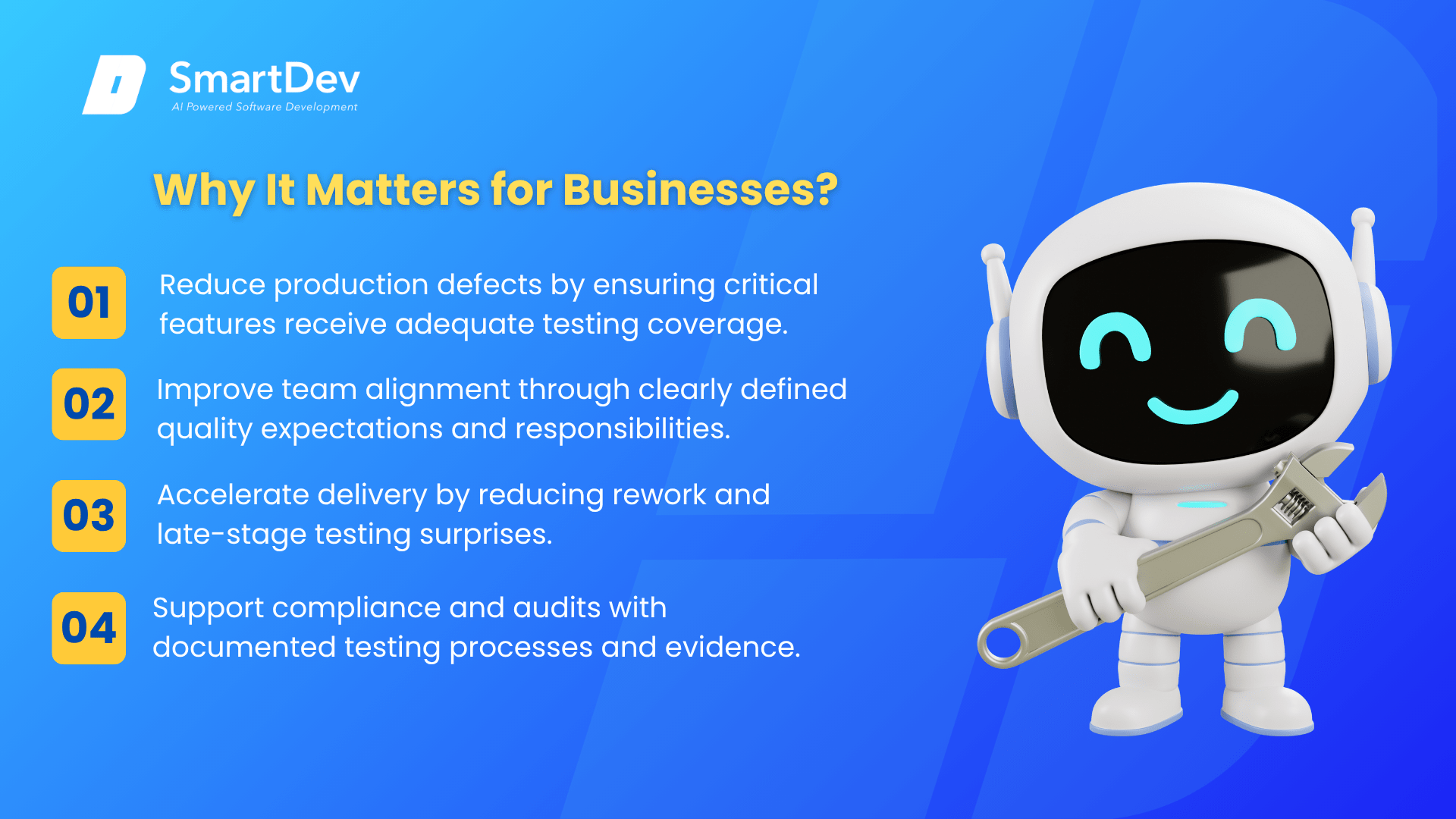
- 줄이다 production defects by establishing systematic coverage of critical business functions before release rather than discovering gaps reactively.
- 개선하다 team alignment by giving all stakeholders, including business owners, QA teams, and developers, a shared understanding of what quality standards apply and how they will be verified.
- 가속하다 testing cycles by defining clear entry and exit criteria that prevent testing from starting too early (wasting effort on unstable builds) or finishing too late (holding up release unnecessarily).
- Protect compliance and regulatory requirements by explicitly identifying which rules must be verified and mapping them to the testing activities that will provide that evidence.
For example, an enterprise software implementation team that developed a test strategy before beginning QA for a major ERP rollout identified that performance testing under peak load had not been included in the previous project’s approach. Adding a dedicated performance testing phase caught a critical database query bottleneck that would have caused the system to time out during the organization’s month-end close process. Fixing it pre-launch took two weeks. Addressing it post-launch would have caused a disrupted month-end close and an emergency remediation project.
How Does a Test Strategy Work?
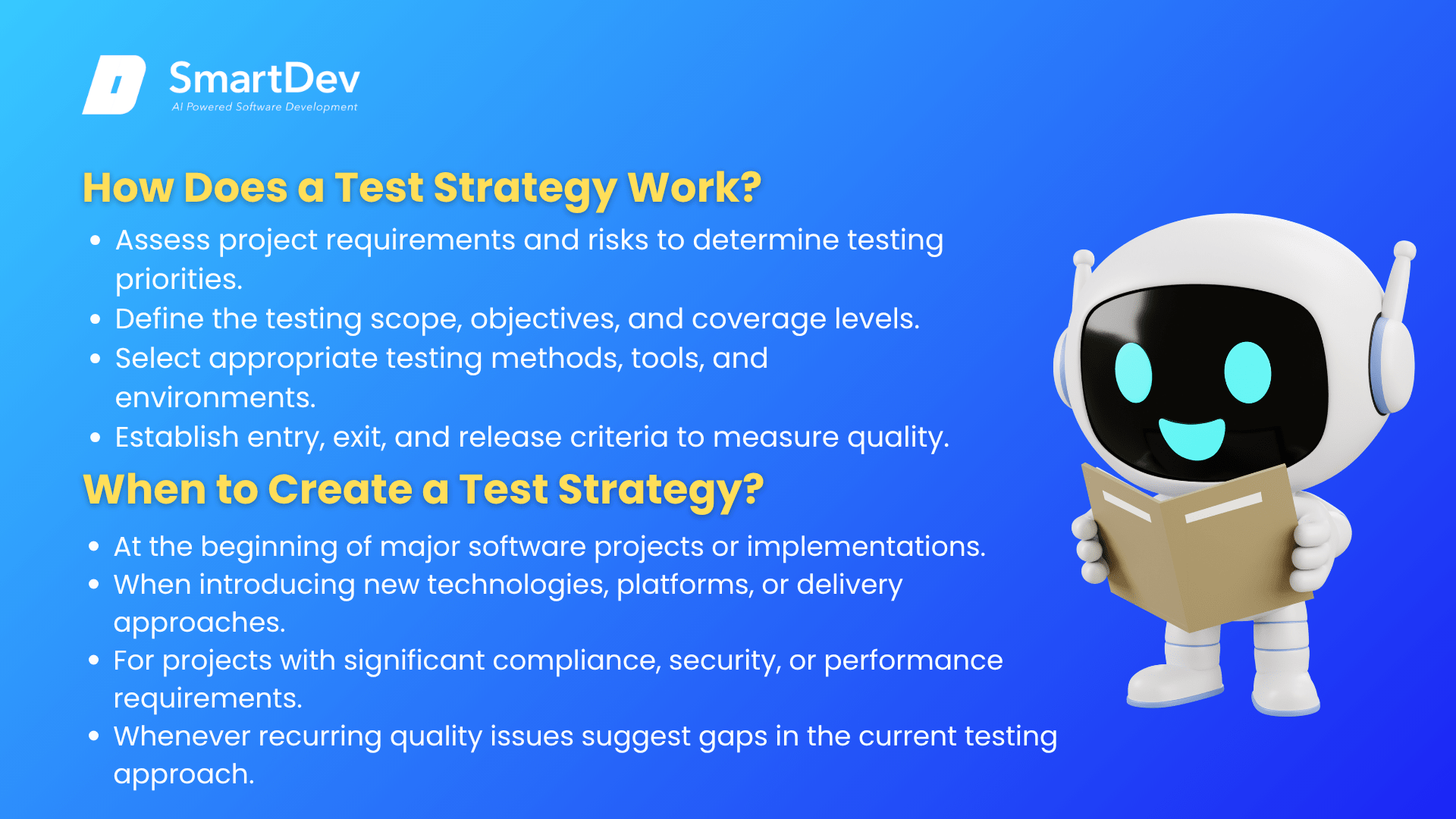
- Analyze the Project and Risks: Review the project scope, requirements, and known risks. Identify which areas of the system carry the highest business impact if they fail, and use this to prioritize testing depth. High-risk areas get thorough coverage; lower-risk areas may be tested more lightly.
- Define Testing Types and Scope: Determine which testing types apply to this project and what is explicitly in and out of scope. Document this clearly so the team has shared expectations about what QA will and will not cover.
- Select Tools and Define Environments: Specify which testing tools will be used (test management, automation frameworks, performance testing platforms) and what environments are required for each testing phase.
- Set Entry and Exit Criteria: Define the conditions that must be met before testing can start and the criteria that must be satisfied before testing is considered complete and the software is ready for the next phase or release.
The result is a testing program that is intentional, consistent, and aligned with the business risks that matter most, rather than a collection of tests assembled informally by whoever happens to be doing QA at the time.
When to Create a Test Strategy?
- Create a test strategy at the start of any significant project, ideally during the requirements or design phase, so testing activities can be planned alongside development rather than added as an afterthought.
- Create or update a test strategy when introducing new technology, adopting a new delivery methodology (such as moving from waterfall to agile), or when post-release defect rates suggest the current approach has systematic gaps.
- For ongoing agile delivery, maintain a living test strategy that is reviewed at least quarterly and updated as the product and team evolve.
- Avoid treating the test strategy as a one-time document filed and forgotten. A test strategy that is not referenced and maintained has no practical value.
기타 관련 용어
Test Case: The ground-level implementation of the test strategy, where individual scenarios are documented with specific inputs, steps, and expected outcomes that verify the system against defined requirements.
품질 보증: The broader discipline of systematic quality management within which the test strategy sits, providing the organizational framework and standards that the strategy translates into project-specific testing practice.
Software Development Lifecycle (SDLC): The structured delivery framework within which the test strategy is developed and executed as a defined phase, ensuring testing is integrated throughout delivery rather than bolted on at the end.