
TL;DR:
- AI code generation bias occurs when AI coding tools produce code that reflects unfair assumptions or systematic errors inherited from their training data.
- It can lead to software that discriminates against certain user groups, creates security vulnerabilities, or produces results that fail regulatory compliance checks.
- Business leaders who oversee AI-assisted development need governance practices in place to detect and correct bias before it reaches production systems.
As AI coding assistants become standard tools in software development teams, a new category of risk has emerged that business leaders cannot afford to overlook. Bias in code generation refers to the systematic errors and unfair patterns that AI tools can introduce into software, often invisibly and at scale. Understanding this risk is now a business governance issue, not just a technical one.
What is Bias in AI Code Generation?
Bias in code generation is the tendency of AI coding tools to produce software that reflects systematic errors, unfair assumptions, or discriminatory patterns inherited from the data those tools were trained on.
AI code generation tools such as GitHub Copilot, Amazon CodeWhisperer, and similar assistants learn from billions of lines of publicly available code. That training data reflects the biases, oversights, and assumptions of the developers who wrote it over decades. When the AI tool generates new code based on those patterns, it can reproduce the same biases. The problem is that the code looks correct and compiles without errors. The bias is in the logic, not the syntax, making it far harder to detect through standard code review processes.
Bias in code generation takes several distinct forms. Demographic bias produces code that treats certain groups differently, such as a form validation function that only accepts Western name formats. Security bias leads the model to suggest outdated or insecure coding patterns that were common in older training data. Representation bias causes AI tools to generate user interfaces that assume default characteristics, such as binary gender options or specific cultural date formats, that do not reflect a global user base.
Why It Matters for Businesses?
The business consequences of biased AI-generated code are no longer theoretical. Organizations that ship software with embedded bias face regulatory investigations, class-action litigation, and reputational damage that can take years to recover from. As regulators in the European Union, United States, and Asia-Pacific increase scrutiny of algorithmic decision-making, the legal exposure is growing.
- Reduce legal risk by establishing review processes that catch discriminatory logic in AI-generated code before it reaches users or regulators.
- Protect brand reputation by ensuring software products treat all users equitably regardless of background, geography, or demographic group.
- Improve product quality by identifying and removing assumptions baked into AI-generated code that reduce performance for underrepresented user segments.
- Accelerate compliance readiness by building bias detection into the development pipeline rather than addressing it reactively after deployment.
For example, a financial technology company used an AI coding assistant to build a credit application interface. Post-launch testing revealed that the input validation logic generated by the tool rejected address formats common in Southeast Asian markets, effectively blocking a significant portion of the intended user base. Fixing the issue after launch required emergency development sprints and a public statement. The cost significantly exceeded what a systematic bias review during development would have required.
How Does Bias Enter AI-Generated Code?
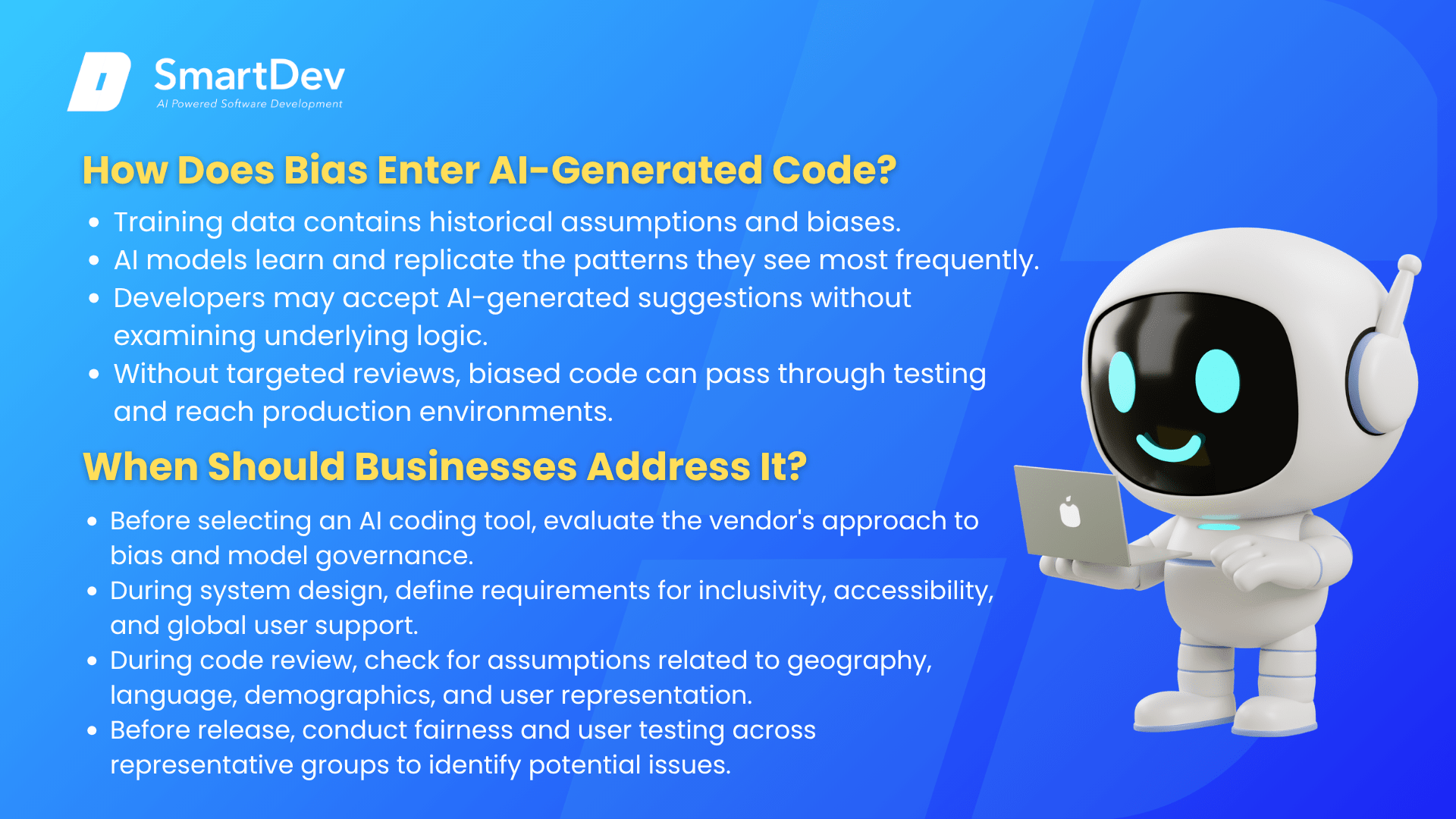
- Training data reflects historical patterns. The AI tool is trained on code written by developers whose own assumptions, tools, and user bases shaped their decisions. Those assumptions are encoded in the training data.
- The model learns to replicate common patterns. Because AI tools optimize for generating code similar to what they have seen most frequently, minority use cases and non-Western conventions are underrepresented in outputs.
- Code is generated and accepted without scrutiny. Developers using AI assistants often accept suggestions that compile correctly and appear functional, without examining the embedded logic for discriminatory patterns.
- Biased code is deployed to production. Without a specific review step targeting logic-level bias, the code moves through standard testing and reaches real users in its original form.
- Impact surfaces in user behavior or regulatory review. The bias becomes visible only when specific user groups report problems or when an audit examines the system for compliance with fairness requirements.
The result is that bias in AI-generated code is a systemic risk that grows with the scale of AI adoption, not a one-off error that can be corrected once and forgotten.
When to Address Bias in Code Generation?
Addressing bias at the right point in the development process is essential for both effectiveness and cost efficiency:
- Before adopting any AI coding tool, evaluate the provider’s published approach to bias in training data and their audit commitments.
- During design and architecture phases, define explicit requirements for inclusive logic, global user support, and equitable treatment across all user segments the product will serve.
- At code review, include specific checks for logic-level assumptions such as geographic defaults, demographic categories, and language encoding decisions made by AI-generated suggestions.
- Before major releases, run structured fairness testing across representative user groups that reflect your actual or intended market.
Bias review is not appropriate as a one-time exercise. It must be built into the ongoing development and quality assurance process, particularly for any team increasing its use of AI coding assistants over time.
Other Related Terms
- AI Readiness: An assessment of how prepared an organization is to adopt and scale AI across its operations, covering people, processes, data, and infrastructure. AI Readiness determines where on the adoption spectrum a business currently sits and what gaps need to be addressed before it can operate as a mature AI Adopter.
- AI Enterprise Roadmap: A structured plan that maps out how an organization will move from its current state to full AI integration across its operations. For an organization working toward becoming an AI Adopter, the Enterprise Roadmap is the practical blueprint that translates intent into sequenced, measurable steps.
- AI Governance: The policies, controls, and oversight processes organizations use to manage AI risk, of which bias detection and mitigation in code generation is one critical operational component.