TL;DR (Key Takeaways)
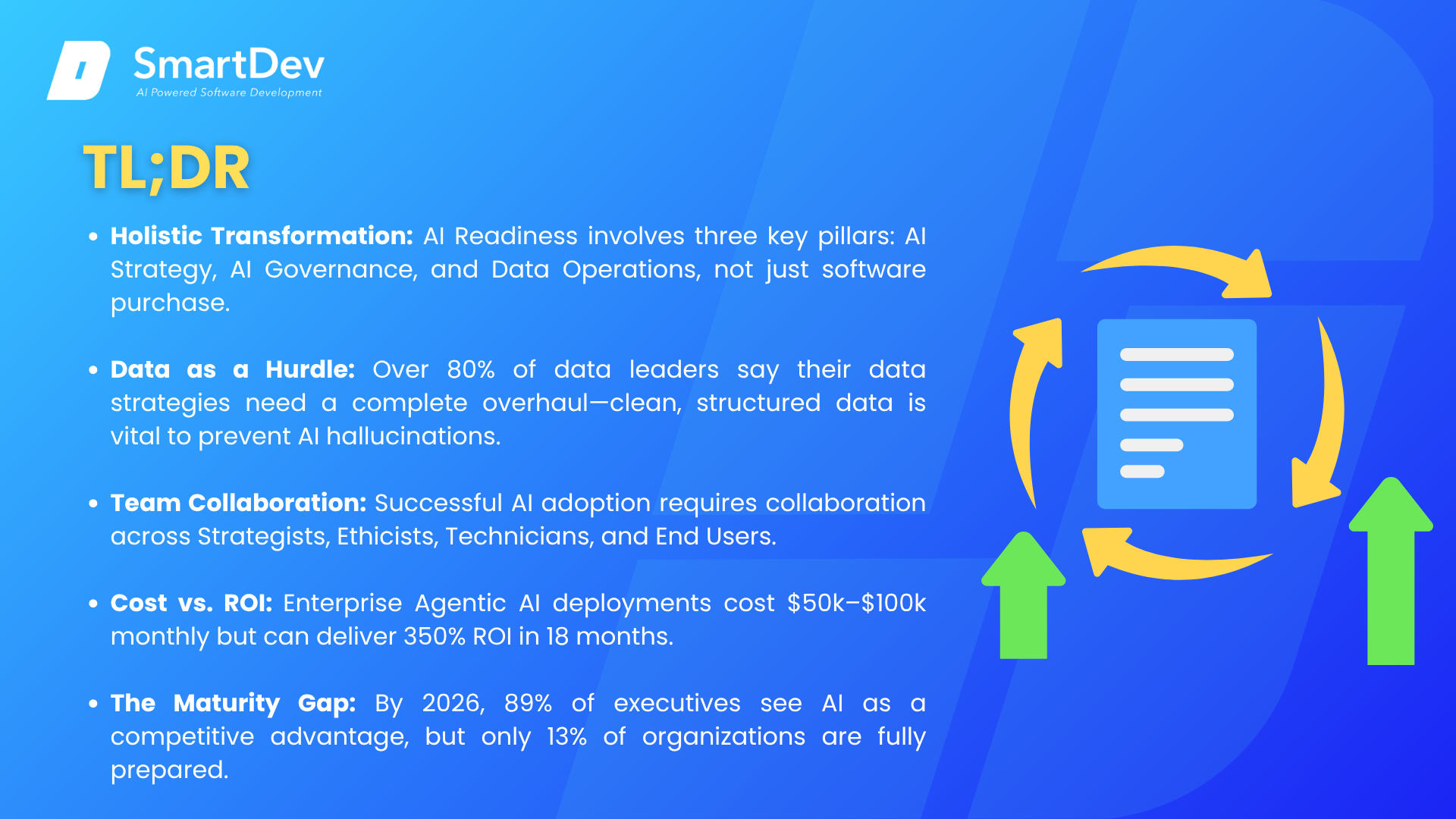
- Holistic Transformation: First and foremost, AI Readiness is not merely about buying software. Instead, it involves three core pillars: AI Strategy, AI Governance, and Data Operations.
- Data as the Biggest Hurdle: Shockingly, over 80% of data leaders admit their current data strategies need a complete overhaul. Therefore, clean and well-structured data is mandatory to prevent AI hallucinations.
- Team Sport Approach: Furthermore, successful AI adoption requires cross-functional collaboration. Specifically, this team includes Strategists, Ethicists, Technicians, and End Users.
- Cost vs. ROI: While Enterprise Agentic AI deployments cost between $50,000 and $100,000 monthly, they can remarkably deliver a 350% ROI within just 18 months.
- The Maturity Gap: Interestingly, as of 2026, 89% of executives view AI as a critical competitive advantage. However, only 13% of organizations globally are currently considered fully prepared “Pacesetters.”
What is AI Readiness?
AI Readiness measures an organization’s holistic ability to deploy, manage, and scale artificial intelligence to create real business value. Fundamentally, it transcends basic technological capacity. Rather, it represents structural maturity. Before applying generative or predictive algorithms, a company must absolutely build a solid foundation.
Often, businesses mistakenly equate AI Readiness with simply purchasing SaaS products. In reality, readiness depends heavily on data volume, organizational culture, and workforce mindset. According to industry frameworks, AI Readiness consists of six foundational pillars:
- Strategy: First, you need a blueprint aligning AI initiatives with specific business objectives.
- Infrastructure: Next, your technical systems and cloud platforms must seamlessly support high-speed data processing.
- Data: Undoubtedly, this is the most critical layer. High-quality data ensures accuracy and prevents biased AI models.
- Governance: Additionally, strong governance addresses ethical and legal complexities while strictly ensuring compliance.
- Culture: Moreover, an organization must foster an environment that actively embraces continuous innovation.
- Talent: Finally, companies need skilled personnel to maintain human oversight and fine-tune machine learning models.
The Maturity Spectrum
Globally, organizations fall into four distinct maturity stages based on their AI capabilities:
- Pacesetters (13%): These industry leaders possess advanced capabilities and a strong culture of innovation.
- Chasers (36%): Meanwhile, these companies actively implement AI to catch up with the leaders.
- Followers (48%): Consequently, this group adopts AI cautiously because they possess limited capabilities.
- Laggards (3%): Lastly, these organizations lack clear strategies and remain completely unprepared.
Why It Matters for Businesses?
Achieving high AI Readiness is crucial for maintaining a competitive edge and ensuring long-term business survival. Consequently, ignoring this framework can lead to severe financial and operational consequences.
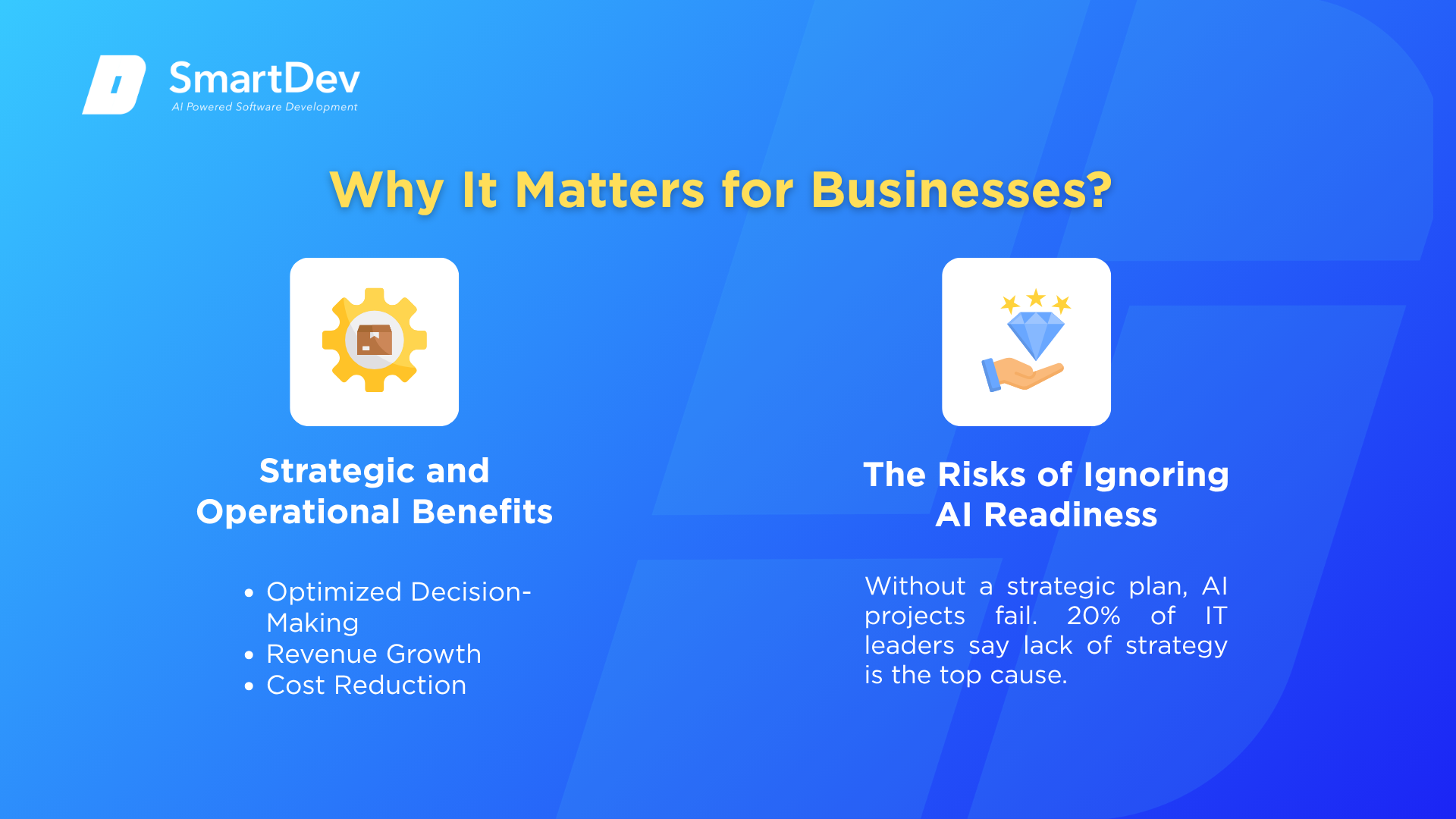
Strategic and Operational Benefits
When a company properly prepares its infrastructure, the AI ecosystem generates tangible value.
- Optimized Decision-Making: For example, AI quickly processes massive data volumes to deliver highly accurate, actionable insights.
- Revenue Growth: Furthermore, AI drives super-personalization. Subscription brands using AI for churn prediction successfully reduced cancellation rates from 25% down to 14%.
- Cost Reduction: Additionally, autonomous systems can accelerate business processes by 30% to 50%, particularly in heavy manufacturing environments.
The Risks of Ignoring AI Readiness
Conversely, rushing AI implementations without a strategic plan often leads to utter failure. In fact, 20% of IT leaders cite a lack of clear strategy as the primary reason for failed AI projects.
The greatest risk heavily involves data privacy and security. Handling massive datasets without strong security protocols exposes the company to severe data breaches and legal liabilities. Furthermore, lacking a data-ready foundation significantly increases long-term deployment costs. As a result, businesses get trapped in “pilot purgatory” without ever seeing a positive return on investment.
Who is Responsible for AI Readiness?
Many professionals falsely assume that AI Readiness is solely the IT department’s job. On the contrary, AI adoption operates as a cross-organizational “team sport.” To succeed, companies must distribute responsibilities among a “dream AI team” consisting of four main roles:
- The Strategists (The Coaches): This executive group includes the CIO, CTO, and business leaders. Ultimately, they anchor AI initiatives to real business pain points and track key performance indicators.
- The Ethicists: Meanwhile, the ethics committee ensures the AI system meets core requirements like transparency, privacy, and fairness.
- The Technicians: Subsequently, data scientists, engineers, and AI architects turn abstract concepts into reality. They build the models and design the logical data frameworks.
- The Playmakers (End Users): Finally, marketers, HR professionals, and supply chain managers use these advanced tools daily. Therefore, their feedback remains vital for continuous system improvement.
Moreover, leadership must actively manage workforce attitudes. A recent McKinsey survey categorizes employees into four groups: Bloomers (optimists), Gloomers (skeptics), Zoomers (fast adopters), and Doomers (critics). Thus, leaders must provide continuous upskilling to empower their diverse teams.
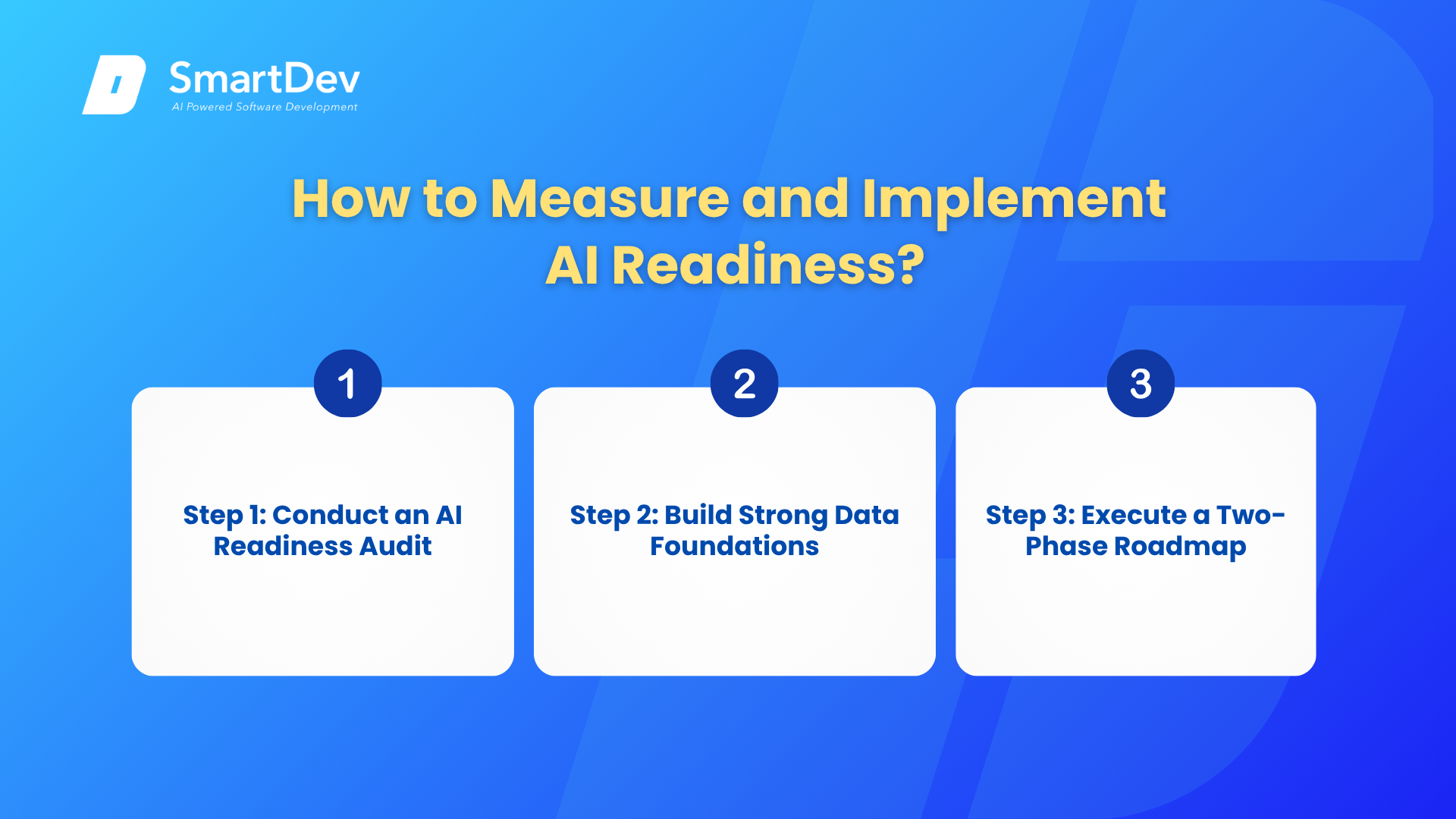
How to Measure and Implement AI Readiness?
Measuring AI Readiness requires a highly structured approach. Companies cannot skip the foundational audit phase if they truly want sustainable success.
Step 1: Conduct an AI Readiness Audit
Initially, organizations must use assessment tools to benchmark their current capabilities. This audit rigorously evaluates data management, technical infrastructure, and staff skills. For instance, the Microsoft AI Readiness Wizard categorizes businesses into exploring, planning, implementing, scaling, or realizing stages.
Step 2: Build Strong Data Foundations
Next, companies must proactively fix fragmented data silos. Clean, representative, and well-structured data is absolutely mandatory for success. By implementing robust data governance, businesses can confidently protect user privacy and easily detect algorithmic biases.
Step 3: Execute a Two-Phase Roadmap
Finally, organizations should execute a pragmatic deployment roadmap. They must start with a 30/60/90-day phase focused heavily on “quick wins” to build organizational trust. Afterward, they must integrate AI predictions directly into daily employee workflows to ensure long-term adoption.
How Much Does AI Readiness Cost?
The overall cost of AI Readiness varies significantly based on company size and project complexity. Generally, businesses should anticipate the following investment tiers:
- Assessment and Planning: A basic AI audit and strategic roadmap typically ranges from $5,000 to $25,000.
- Low-Complexity Solutions: Subsequently, simple automation projects using pre-trained models cost around $10,000 to $20,000.
- Moderate to Advanced Solutions: Meanwhile, custom models for risk management or computer vision cost between $50,000 and $150,000.
- Enterprise Agentic AI: Currently, the market is shifting rapidly toward usage-based pricing. Deploying fully autonomous AI agents generally costs between $50,000 and $100,000 per month.
The ROI Equation
Despite high upfront costs, mature AI systems deliver massive financial returns. Specifically, subscription-based AI agents can reduce task handle times by 70% and increase overall productivity by 3-4 times. Consequently, enterprises can save up to $400,000 monthly. This efficiency generates a staggering 350% ROI within just 18 months.
Other Related Terms
To fully grasp AI Readiness, business leaders must understand its surrounding technical ecosystem. Here are 10 essential related terms:
- Artificial Intelligence (AI): Technology that accurately simulates human comprehension, learning, and problem-solving.
- Machine Learning (ML): A specific subset of AI where algorithms learn from data to identify patterns and make predictions.
- Deep Learning (DL): An advanced ML technique using complex neural networks to process highly unstructured datasets.
- Responsible AI: The strict commitment to developing and using AI ethically, fairly, and transparently.
- Generative AI: AI systems capable of creating completely new, original content such as text, code, or images.
- Large Language Model (LLM): Massive deep learning models trained on vast text data to thoroughly understand and generate human language.
- Enterprise AI: The strategic integration of AI across an entire organizational framework to boost operational efficiency.
- Agentic AI (AI Worker): Highly skilled digital workers capable of making autonomous decisions and executing complex multi-step tasks.
- Explainability: Specialized techniques that make AI decisions and predictions clear and understandable to human users.
- AI Orchestration: The coordinated management of multiple AI systems and human workflows to optimize end-to-end business processes.