TL;DR
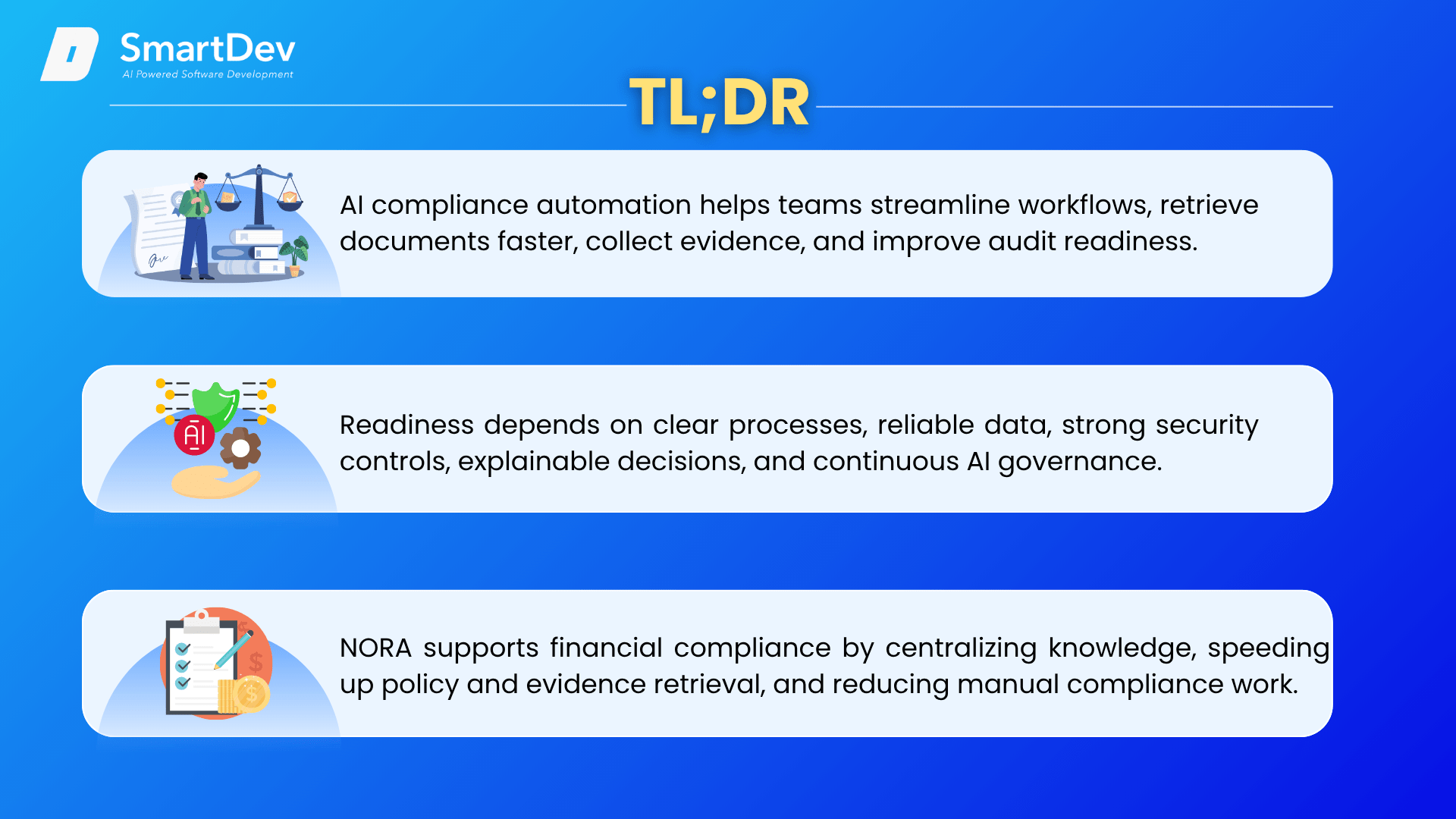
- AI compliance automation helps teams streamline workflows, retrieve documents faster, collect evidence, and improve audit readiness.
- Readiness depends on clear processes, reliable data, strong security controls, explainable decisions, and continuous AI governance.
- NORA supports financial compliance by centralizing knowledge, speeding up policy and evidence of retrieval, and reducing manual compliance work.
Introduction
Compliance operations are becoming more data-intensive, system-dependent, and difficult to manage at scale. As regulations expand across cybersecurity, data privacy, AI governance, and industry-specific standards, businesses must maintain accurate documentation, audit trails, and control evidence across multiple systems.
PwC’s Global Compliance Survey 2025 found that nearly 90% of organizations say compliance complexity affects their ability to manage technology systems and data effectively.
This is driving stronger interest in AI compliance automation and AI in compliance. By applying AI to compliance with workflows, organizations can accelerate document retrieval, streamline evidence collection, support audit preparation, and improve visibility across policies, controls, and regulatory obligations. As adoption of AI in compliance continues to grow, organizations are exploring new ways to improve efficiency while maintaining regulatory oversight.
However, effective implementation requires more than deploying an AI tool. Before training AI on compliance workflows, businesses must assess whether their processes, data architecture, security controls, and governance model are ready.
Concept of AI Compliance Automation
Definition of AI Compliance Automation
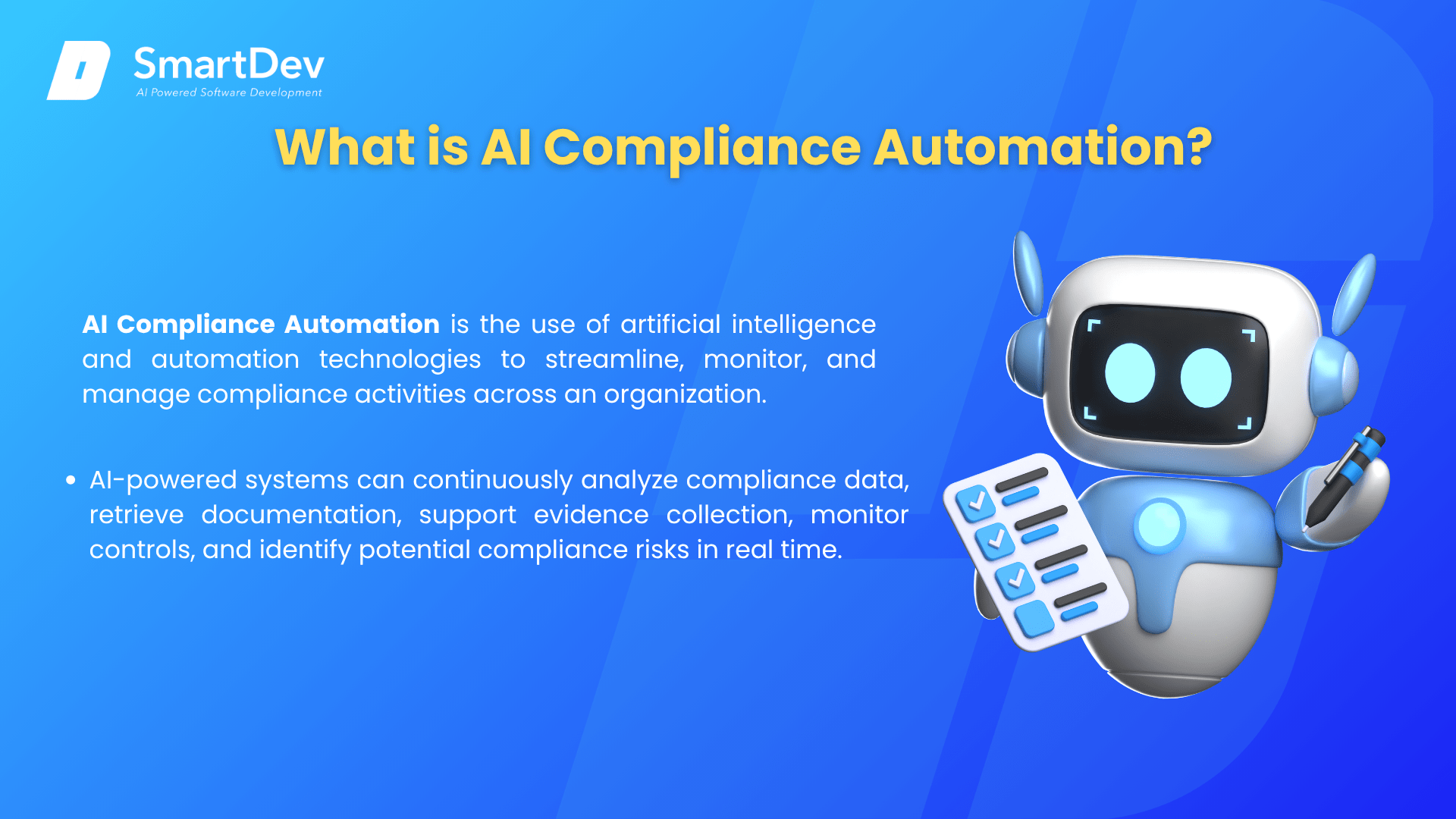
AI compliance automation is the use of artificial intelligence and automation technologies to streamline, monitor, and manage compliance activities across an organization. Instead of relying on manual reviews, spreadsheets, and repetitive administrative tasks, AI-powered systems can continuously analyze compliance data, retrieve documentation, support evidence collection, monitor controls, and identify potential compliance risks in real time.
At its core, AI compliance automation combines technologies such as machine learning, natural language processing (NLP), workflow automation, and intelligent search to help organizations maintain compliance more efficiently. These systems can process large volumes of policies, audit records, regulatory requirements, and operational data while providing faster access to information and greater visibility into compliance activities.
Unlike traditional compliance management systems, which is often reactive and audit-driven, AI-powered compliance solutions enable a more continuous and proactive approach. They help organizations reduce manual effort, improve accuracy, strengthen audit readiness, and scale compliance operations as regulatory requirements become increasingly complex.
4 Core Elements of AI Compliance
For an AI system to be considered compliant, it should address four core elements:
- Data privacy and security: Protects information used or processed by AI systems from unauthorized access, misuse, or breach. This includes consent management, secure data storage, access control, data governance, and transparency across the data lifecycle.
- Algorithmic transparency: Makes AI decision-making more understandable and explainable for users, regulators, and internal stakeholders. This requires clear documentation of model logic, data sources, assumptions, and design choices, especially for organizations building an AI governance framework.
- Bias detection and fairness: Helps identify and reduce unfair outcomes across different user groups. This involves regular model testing, statistical analysis, performance monitoring, and mitigation of biased outputs in line with responsible AI principles.
- Governance and accountability: Defines who owns, monitors, and validates AI systems. Strong governance includes audit trails, incident response plans, human oversight, and clear responsibility for AI-driven decisions, supporting broader AI risk management and regulatory compliance efforts.
Together, these four elements build a strong foundation for AI governance, regulatory compliance, responsible AI Adoption, and enterprise trust. They help organizations address privacy, transparency, fairness, and accountability from the start. They also reduce regulatory risk, improve audit readiness, and align AI decisions with business policies. As AI expands across operations, these principles support safer deployment and stronger stakeholder trust.
How AI compliance automation works
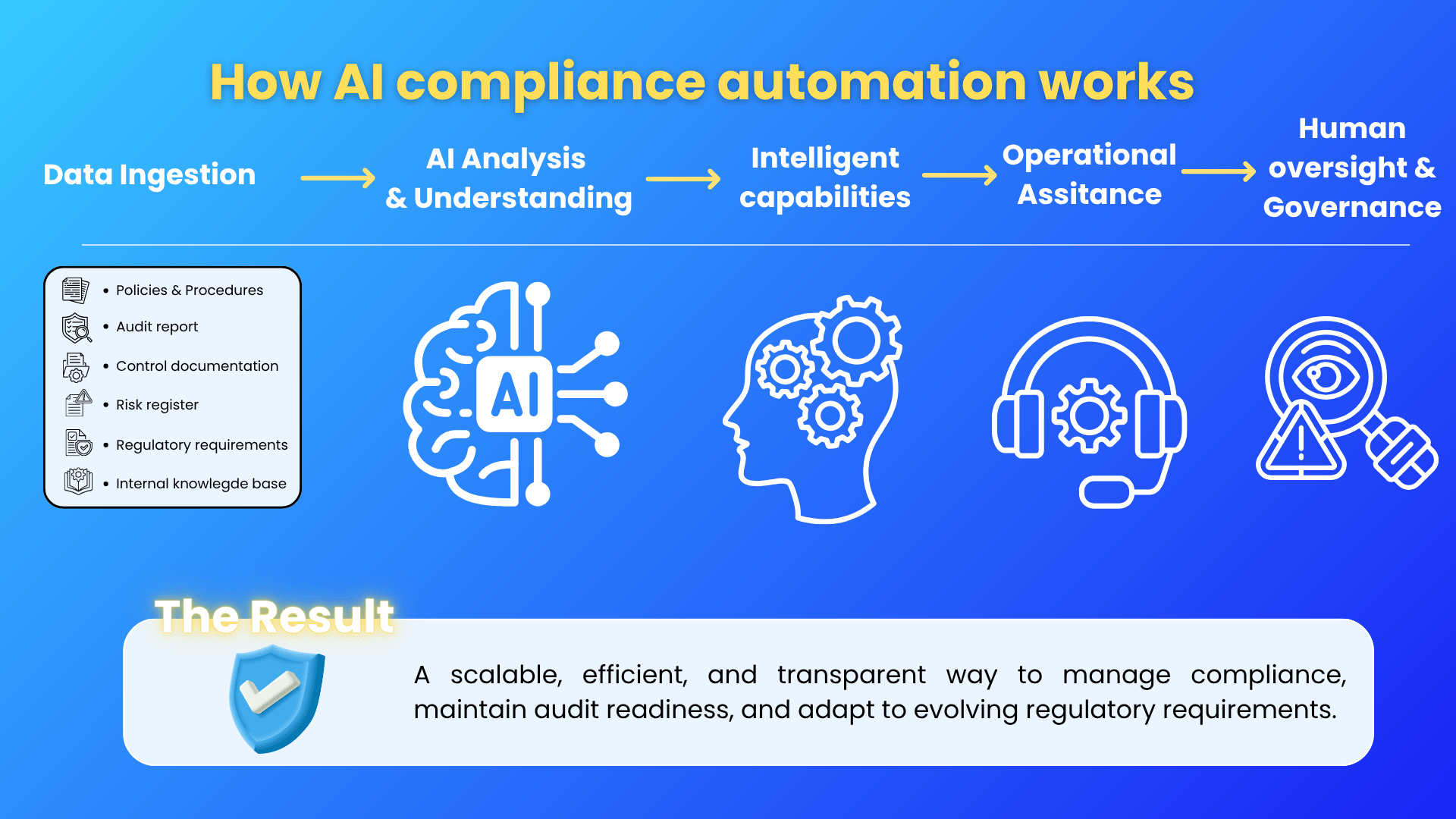
AI compliance automation applies artificial intelligence to support and streamline compliance workflows that traditionally require significant manual effort. Rather than replacing compliance teams, AI acts as an intelligent layer on top of existing compliance management systems, helping organizations process information faster, improve visibility, and maintain stronger regulatory oversight.
The process typically begins with data ingestion. AI systems connect to compliance-related sources such as policies, procedures, audit reports, control documentation, risk registers, regulatory requirements, and internal knowledge bases. By centralizing information from multiple repositories, organizations can create a more accessible and searchable compliance environment.
Once data is available, AI technologies such as natural language processing (NLP) and machine learning analyze and structure the information. This enables capabilities such as intelligent document search, policy retrieval, evidence collection support, regulatory mapping, and compliance-related question answering. Instead of manually searching through hundreds of documents, compliance teams can quickly locate relevant controls, procedures, and audit evidence.
AI can also assist with ongoing compliance operations. For example, organizations may use AI to identify missing documentation, monitor compliance activities, support audit preparation, classify sensitive information, and surface potential risks that require human review. These capabilities help reduce repetitive administrative work while improving consistency across compliance processes.
However, AI compliance automation is most effective when combined with strong governance practices. Human oversight remains essential for validating outputs, handling exceptions, and ensuring compliance decisions align with business policies and regulatory requirements. This is particularly important for organizations implementing broader AI governance frameworks, AI risk management programs, or standards such as ISO 42001.
As compliance requirements continue to evolve, AI-powered compliance solutions provide a scalable way to manage growing volumes of documentation, controls, and regulatory obligations while maintaining transparency, audit readiness, and operational efficiency.
6 readiness questions for training our workflow
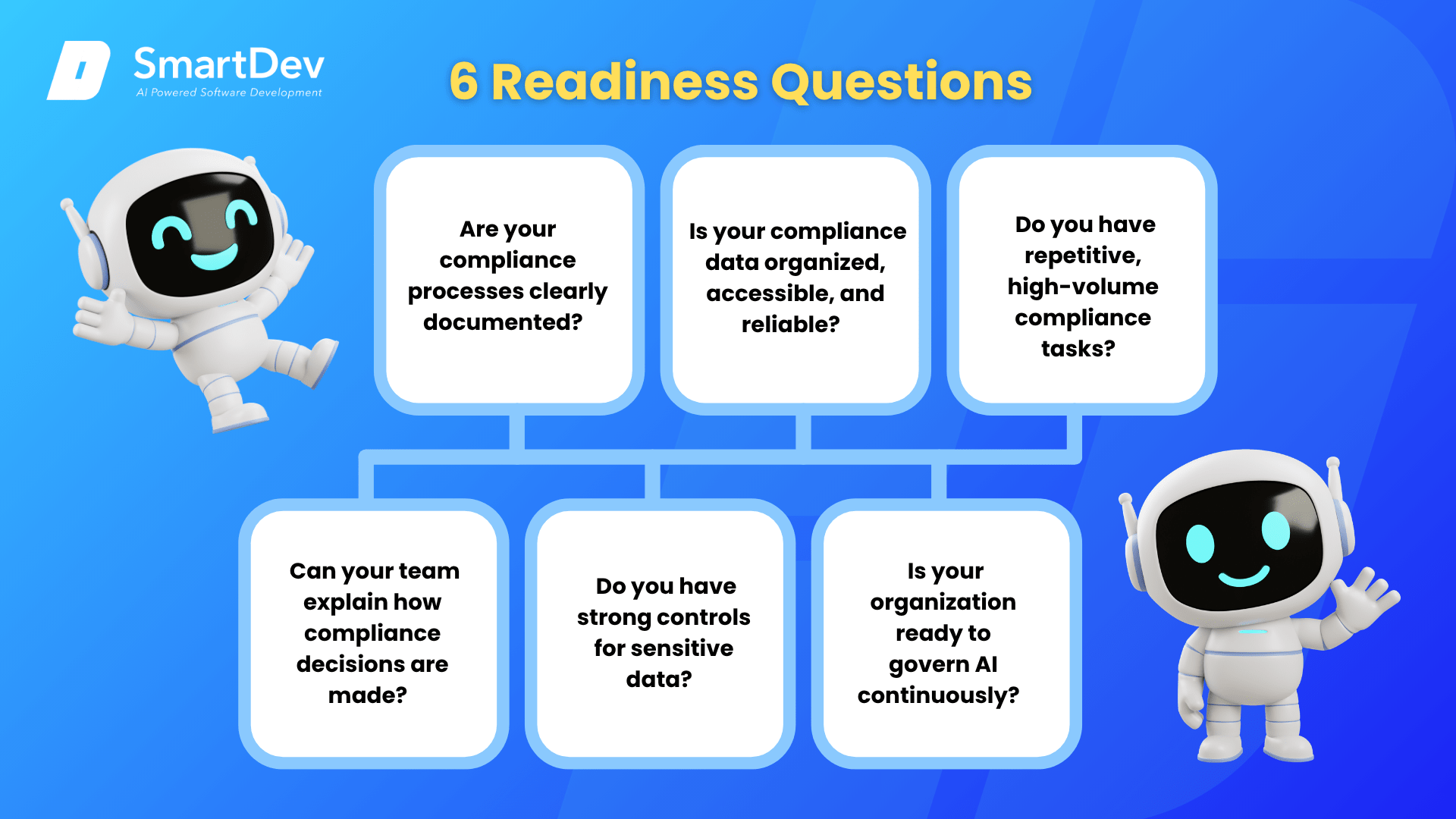
Before implementing AI compliance automation, businesses should assess whether their compliance environment is ready for governed AI adoption. AI delivers value only when workflows, data sources, security controls, and decisions are clearly managed. Without this foundation, automation may amplify gaps like inconsistent documentation, fragmented data, unclear ownership, or weak oversight. These six questions help teams evaluate readiness before training AI on internal compliance workflows.
1. Are your compliance processes clearly documented?
AI cannot automate what the organization has not clearly defined. If compliance activities depend heavily on individual knowledge, informal practices, or scattered instructions, AI may produce inconsistent or unreliable outputs.
This challenge is becoming increasingly important as organizations expand their use of AI. According to McKinsey, the rise of AI is compelling organizations to elevate their compliance capabilities and strengthen governance, accountability, and control mechanisms to build trusted AI systems. In practice, this requires clearly documented processes that AI systems can follow, monitor, and support consistently.
A ready organization should have documented workflows, defined approval steps, clear ownership, and standardized procedures. These elements create the foundation for AI-assisted compliance workflow automation, audit preparation, policy management, and process monitoring.
Beyond documentation, organizations should ensure that procedures are current and consistently followed across departments. For example, if different teams collect audit evidence or review policies using different methods, AI may struggle to identify the correct workflow or provide reliable recommendations.
Consider asking:
- Are compliance procedures documented in a central location?
- Are roles and responsibilities clearly assigned?
- Are approval and escalation paths defined?
- Are workflows reviewed and updated regularly?
The more structured and standardized your compliance operations are, the easier it becomes to train AI systems to support them accurately, consistently, and at scale.
2. Is your compliance data organized, accessible, and reliable?
AI compliance automation depends on the quality of the data it can access. Policies, controls, audit evidence, risk registers, regulatory documents, and internal procedures should be centralized, searchable, and regularly updated. If data is fragmented across emails, spreadsheets, shared drives, and disconnected tools, AI may struggle to retrieve accurate information. Strong data governance, document management, and enterprise search capabilities are essential before training AI on compliance workflows.
Organizations should also evaluate whether their compliance data is complete, accurate, and properly maintained. Outdated policies, duplicate records, or inconsistent naming conventions can reduce AI performance and increase the risk of incorrect outputs.
Questions to evaluate include:
- Can employees easily locate compliance documents when needed?
- Are policies version-controlled and regularly reviewed?
- Is compliance evidence stored in a consistent format?
- Are data ownership and maintenance responsibilities clearly defined?
AI systems perform best when they can access a trusted source of truth. Investing in data quality and governance before deployment often delivers better results than attempting to fix data issues after implementation.
3. Do you have repetitive, high-volume compliance tasks?
AI works best when applied to tasks that are frequent, structured, and time-consuming. Examples include document search, evidence collection, policy review, control mapping, compliance Q&A, and audit documentation support.
However, tasks requiring legal interpretation, risk judgment, or sensitive decision-making should remain under human supervision. The goal is not to remove compliance professionals, but to reduce manual workload and help them focus on higher-value analysis.
Organizations should identify areas where employees spend significant time on repetitive administrative work. These activities often provide the fastest return on investment because AI can automate or accelerate them without fundamentally changing compliance decision-making processes.
Potential use cases include:
- Responding to common compliance questions from employees
- Summarizing regulatory updates
- Mapping controls to compliance frameworks
- Collecting audit evidence from multiple systems
- Reviewing documents for policy alignment
- Generating draft reports and compliance summaries
If your compliance team spends hours each week performing repetitive tasks, AI may provide immediate efficiency gains while allowing specialists to focus on strategic risk management and regulatory analysis.
4. Can your team explain how compliance decisions are made?
Compliance automation must be auditable. If a team cannot explain how decisions are made, approved, or escalated, it becomes difficult to validate AI outputs or defend decisions during audits.
Organizations should define decision criteria, approval logic, documentation standards, and escalation rules. This supports algorithmic transparency, AI governance, and regulatory compliance requirements.
Before introducing AI, organizations should map key compliance decisions and identify the factors that influence them. This helps ensure that AI recommendations align with existing policies and can be reviewed by auditors, regulators, and internal stakeholders.
Important considerations include:
- What information is used to make compliance decisions?
- Who has authority to approve or reject actions?
- How are exceptions handled?
- What documentation is required to support decisions?
- How are decisions reviewed and monitored?
If compliance decisions are difficult to explain today, introducing AI may increase complexity rather than improve efficiency. Clear decision frameworks provide the transparency needed for responsible AI adoption.
5. Do you have strong controls for sensitive data?
Compliance workflows often involve confidential business data, customer information, financial records, and security documentation. According to PwC, compliance is becoming more data-driven, requiring stronger monitoring, oversight, and control over large volumes of information.
This is especially important when AI systems connect to internal knowledge bases, compliance platforms, or third-party tools. Without proper access controls, audit trails, data governance, and monitoring, AI compliance automation can create new privacy, security, and regulatory risks instead of reducing them.
Key questions include:
- Who can access compliance-related data?
- Are permissions based on roles and responsibilities?
- Is sensitive information encrypted at rest and in transit?
- Are user activities logged and monitored?
- Do AI vendors provide adequate security and privacy protections?
Businesses operating under regulations such as GDPR, HIPAA, PCI DSS, or industry-specific requirements should pay particular attention to how data is processed, stored, and shared within AI-enabled workflows.
6. Is your organization ready to govern AI continuously?
AI compliance automation is not a one-time deployment. Models, regulations, workflows, and business risks change over time. Organizations need clear ownership, human oversight, monitoring processes, incident response plans, and regular review cycles.
A mature approach to AI governance should combine AI risk management, responsible AI principles, and strong information security controls. While emerging standards such as ISO 42001 focus specifically on AI management systems, security foundations such as SmartDev’s ISO 27001 certification support the broader governance environment by reinforcing data protection, risk management, access control, and continuous oversight. This helps ensure that AI-enabled compliance solutions remain secure, accountable, and aligned with regulatory expectations as the business scales.
Effective AI governance also requires ongoing monitoring of system performance, output quality, security risks, and regulatory developments. Organizations should establish clear accountability for AI systems and define processes for reviewing and updating them over time.
Areas to assess include:
- Is there a designated owner for AI governance?
- Are AI outputs regularly reviewed for accuracy and bias?
- Are incidents documented and investigated?
- Are regulatory changes incorporated into AI workflows?
- Is there a process for retraining or updating AI systems when requirements change?
Organizations that treat AI as an ongoing governance of responsibility rather than a one-time technology project are more likely to achieve sustainable compliance outcomes. Continuous oversight helps ensure that AI remains aligned with business objectives, regulatory expectations, and evolving risk environments.
AI Readiness Scorecard: How Prepared Is Your Team?
To assess how ready your organization is to automate compliance, review the six readiness questions above and count how many times your organization can confidently answer “Yes.” Use the scorecard below to determine your current level of AI readiness.
- 0-2 Yes answers: Early Stage
Your organization may benefit from strengthening process documentation, data management, and governance foundations before implementing AI compliance automation.
- 3-4 Yes answers: Partially Ready
You have several key foundations in place but may still face challenges related to data quality, process consistency, or AI governance. Addressing these gaps can improve implementation success.
- 5-6 Yes answers: AI-Ready
Your organization has a strong foundation for AI compliance automation. With the right solution and governance framework, you are well-positioned to scale compliance operations and improve efficiency.
Remember that AI readiness is not a one-time milestone. As regulations, business requirements, and AI technologies evolve, organizations should regularly reassess their readiness to ensure sustainable and compliant AI adoption.
This scorecard is designed as a practical self-assessment tool based on the six readiness areas discussed above: process maturity, data readiness, task suitability, decision transparency, data security, and AI governance. While it is not a formal certification model, it helps organizations quickly identify whether they are prepared to move forward with AI compliance automation or whether they need to strengthen foundational capabilities first.
How Difference between “Before” and “After” NORA in Compliance Process of Finance
Financial institutions operate in one of the most heavily regulated environments, where compliance teams must continuously manage policies, controls, audit evidence, regulatory updates, and risk documentation. As regulatory obligations grow, traditional compliance processes often become fragmented, time-consuming, and difficult to scale.
NORA helps financial institutions streamline access to compliance knowledge and reduce the manual effort required to support regulatory and audit activities.
| Before NORA | After NORA |
| Compliance information is scattered across policies, procedures, audit reports, risk registers, and shared drives. | Compliance knowledge is centralized and accessible through a single AI-powered interface. |
| Employees spend significant time searching for regulations, internal policies, and control documentation. | Teams can retrieve relevant compliance information instantly using natural language queries. |
| Audit preparation requires manually collecting evidence from multiple systems and stakeholders. | Supporting documents and evidence can be located faster, improving audit readiness. |
| Compliance teams repeatedly answer policy and regulatory questions from business units. | Employees receive consistent answers based on approved compliance documentation. |
| Compliance professionals spend substantial time on administrative and document-related tasks. | More time can be dedicated to risk management, regulatory analysis, and governance activities. |
Rather than replacing compliance professionals, NORA acts as an AI-powered compliance assistant that helps financial institutions improve knowledge accessibility, accelerate information retrieval, and support more efficient compliance operations. This allows compliance teams to focus less on document hunting and more on managing risk, ensuring regulatory adherence, and strengthening governance across the organization.
Conclusion
AI compliance automation can help organizations improve efficiency, strengthen audit readiness, and manage growing regulatory requirements more effectively. However, successful adoption starts with readiness. Organizations must ensure they have documented processes, reliable data, strong security controls, and effective AI governance before training AI on compliance workflows.
By building these foundations first, businesses can unlock greater value from AI while maintaining regulatory oversight and trust. At SmartDev, solutions such as NORA help organizations transform compliance operations through faster access to compliance knowledge, streamlined audit support, and more intelligent compliance workflows.