

In a world where consumers expect instant relevance and seamless experiences, traditional retail strategies are no longer enough. Shoppers demand tailored product suggestions, faster discovery, and interactions that feel almost human – but at scale. That’s where AI recommendation and matching systems come in: intelligent, data-driven engines that analyze user behavior, historical interactions, and context to deliver highly personalized shopping journeys.
Recent statistics make one point clear: personalization isn’t optional – it’s a competitive necessity. AI-powered recommendation engines are now driving measurable revenue gains, lifting conversion rates, and reshaping how customers discover products online.
1. Why Personalization Has Become Critical in Retail & E- Commerce
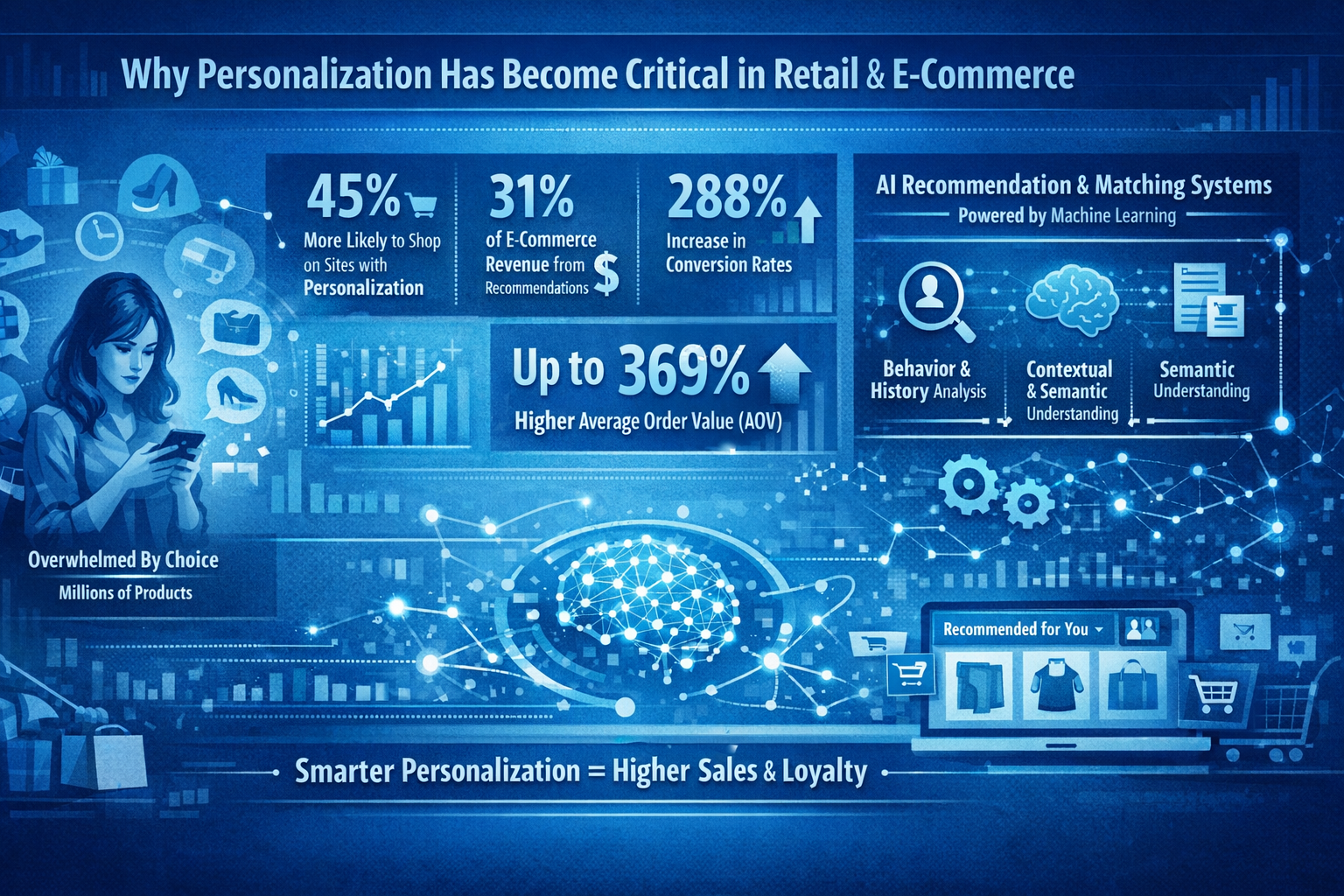
Consumers today are overwhelmed by choice. A typical marketplace may list thousands or even millions of products – far more than a shopper can reasonably explore manually. Without personalization, users struggle to find relevant items, and retailers lose potential sales and loyalty.
According to industry research:
- 45% of consumers are more likely to shop on an e-commerce site that offers personalization.
- Product recommendations account for up to 31% of e-commerce site revenues, with an average of 12% of sales directly attributed to product recommendation engines.
- Personalized recommendations can increase conversion rates by 288% and average order value (AOV) by up to 369% compared to non-personalized experiences.
These numbers reinforce how crucial intelligent systems have become. Customers not only expect personalization – they reward brands that provide it with higher engagement and loyalty.
Traditional rule-based systems are increasingly insufficient because they rely on static segments and predefined logic. In contrast, AI recommendation and matching systems continuously learn from user interactions and adapt in real time, producing far more relevant suggestions.
2. What Are AI Recommendation & Matching Systems in Retail?
At their core, AI recommendation and matching systems are intelligent engines powered by machine learning, semantic understanding, and contextual data analysis. Rather than responding solely to past purchases or basic categories, they delve deeper into user behavior, intent, and historical patterns.
This technology includes:
- Behavior and history-based matching that captures browsing, click, and purchase patterns.
- Contextual understanding through data indexing, making all catalog items searchable and comparable.
- Semantic representations (embeddings) that allow products and users to be compared on nuanced attributes.
- Continuous learning loops that refine logic based on outcomes (e.g., clicks and conversions).
By sculpting customer intent into actionable recommendations, AI systems transform generic e-commerce catalogs into hyper-relevant storefronts optimized for each shopper.
3. The Hidden Cost of Poor Product Discovery
Poor product discovery isn’t just a customer annoyance – it’s a real revenue leak.
High cart abandonment rates attest to this problem. Industry benchmarks show nearly 70% of online shopping carts are abandoned – often because shoppers can’t find what they want quickly enough.
Consider the implications:
- Weak recommendations lead to lower engagement, more drop-offs, and reduced revenue per visitor.
- Without AI, retailers compete primarily on price or promotions – strategies that erode margins and weaken brand value.
- In categories with thousands of SKUs, lack of relevance causes decision fatigue, directly discouraging purchases.
In contrast, when recommendations are intelligent and contextual, customers feel understood and supported in their decision-making – which boosts both conversion and loyalty.
4. How AI Recommendation Systems Drive Measurable Retail Growth
The most compelling evidence for adopting AI recommendation engines lies in their quantifiable outcomes.
4.1. Conversion Rate Improvements
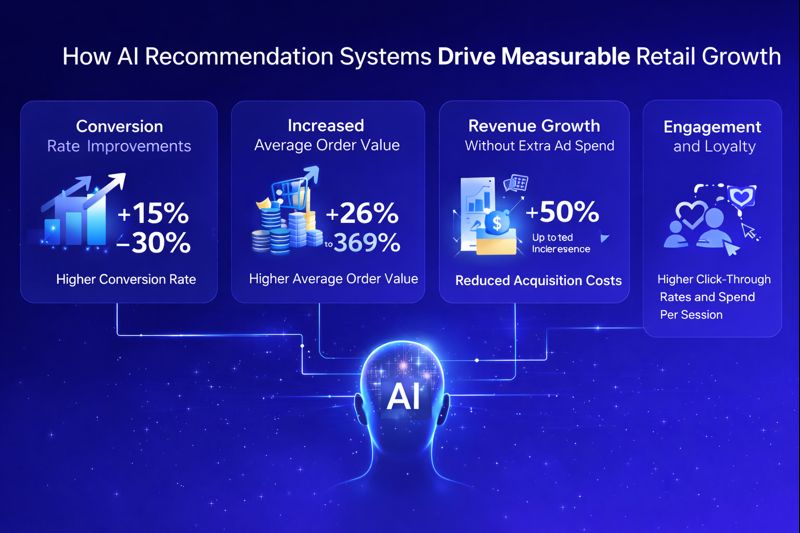
AI recommendations consistently lift conversion rates compared to traditional browsing experiences. According to McKinsey, effective AI recommendations can increase conversion rates by 15- 30%.
In more advanced implementations, companies using personalized engines see conversion rates increase by up to 288%, proving how relevance fuels purchase decisions.
4.2. Increased Average Order Value (AOV)
AI recommendations don’t just convert more customers – they encourage customers to buy more. Product recommendations are shown to:
- Increase AOV by up to 369% compared to generic suggestions.
- Deliver 26% higher AOV when shoppers engage with recommended items.
These gains come from intelligent upsell and cross-sell suggestions – for example, suggesting complementary gear to a shopper buying camping equipment or offering accessories alongside electronics.
4.3. Revenue Growth Without Extra Ad Spend
One of the most attractive aspects of AI recommendation systems is that they improve revenue metrics using existing data signals – without increasing marketing budgets. McKinsey research shows personalization can reduce acquisition costs by up to 50% while also increasing revenues by 5- 15%.
4.4. Engagement and Loyalty
Customers want relevance. When retailers deliver it, engagement deepens:
- Personalized recommendations show higher click-through rates than non- personalized suggestions.
- Shoppers who engage with recommendation widgets spend significantly more per session and are more likely to return.
Combined, these effects help increase customer lifetime value, reducing churn and driving long- term revenue.
5. Key Retail Use Cases Powered by AI Recommendations
AI recommendation and matching systems are versatile – they optimize multiple parts of the customer journey:
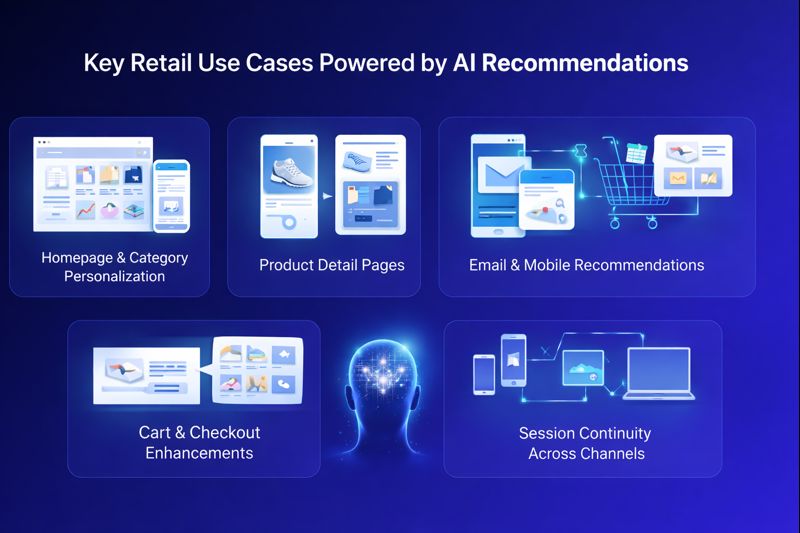
- Homepage & Category Personalization
AI dynamically reshapes what a shopper sees based on behavior, preferences, and context – ensuring the most relevant items are surfaced first.
- Product Detail Pages
Instead of showing generic “Customers also bought,” AI suggests items deeply tailored to each shopper’s intent, maximizing cross- sell effectiveness.
- Email & Mobile Recommendations
Personalized product suggestions in emails can lift open rates and conversions, making campaigns far more impactful.
- Cart & Checkout Enhancements
Suggesting complementary products during checkout increases AOV and reduces abandonment by making additional purchases easier.
- Session Continuity Across Channels
Modern shoppers switch devices. AI systems track intent across sessions, ensuring consistent personalization whether shopping on mobile, web, or app.
Because AI doesn’t merely segment users into broad groups, it delivers individual insights – turning every touchpoint into an opportunity to boost relevance and revenue.
6. Case Study. How Smartdev Built an AI Recommendation System for Asahi Beer
To understand how these systems perform in practice, let’s look at how Smartdev (via Verysell AI) developed a recommendation and matching engine for Asahi Beer – a leading Japanese food and beverage company.
Business Challenge
Asahi needed to deliver highly relevant suggestions across its digital platforms. Challenges included:
- Complex system integration with third-party authentication and secure access layers.
- Unstable UX that disrupted engagement.
- Limited personalization capabilities due to largely unannotated data.
- Tight security and compliance requirements.
AI- Powered Solution
Smartdev implemented a modular AI recommendation and matching engine that included:
- User- to- user and user- to- event matchmaking based on real behavior signals.
- Personalized drink recipe suggestions tailored to individual preferences.
- Semantic similarity search converting content and user interactions into embeddings for explainable matching.
- Secure integrations using JWT and row- level security.
Beyond matching logic, UX improvements and reliable notification systems (via SendGrid and Firebase) enhanced engagement and communication.
Outcomes
The implementation resulted in:
- A smoother, more intuitive user experience.
- Increased accuracy in recommendations, even with unannotated data.
- Smart matching logic for multiple recommendation types with clear reasoning.
- A scalable foundation for future personalization features.
This practical deployment showcases how AI systems can be integrated into existing platforms to deliver measurable improvements in engagement and decision support – the same outcomes driving revenue for retail brands worldwide.
7. Conclusion
In today’s digital marketplace, consumers expect personalization akin to a real, consultative shopping experience. AI recommendation and matching systems deliver exactly that – turning data into relevant insights instantaneously.
With conversion increases of up to 288%, AOV boosts exceeding 300%, and product recommendations contributing up to 31% of e- commerce revenue, the evidence is overwhelming: intelligent recommendations are one of the most effective ways for retailers to grow revenue and deepen customer loyalty.
Moreover, these systems don’t require more ad spend; they simply make existing data smarter – enhancing personalization, optimizing engagement, and driving profitable interactions.
For any retail or e-commerce brand looking to lead in a competitive environment, AI recommendation technology is not just an upgrade – it’s a strategic imperative.