

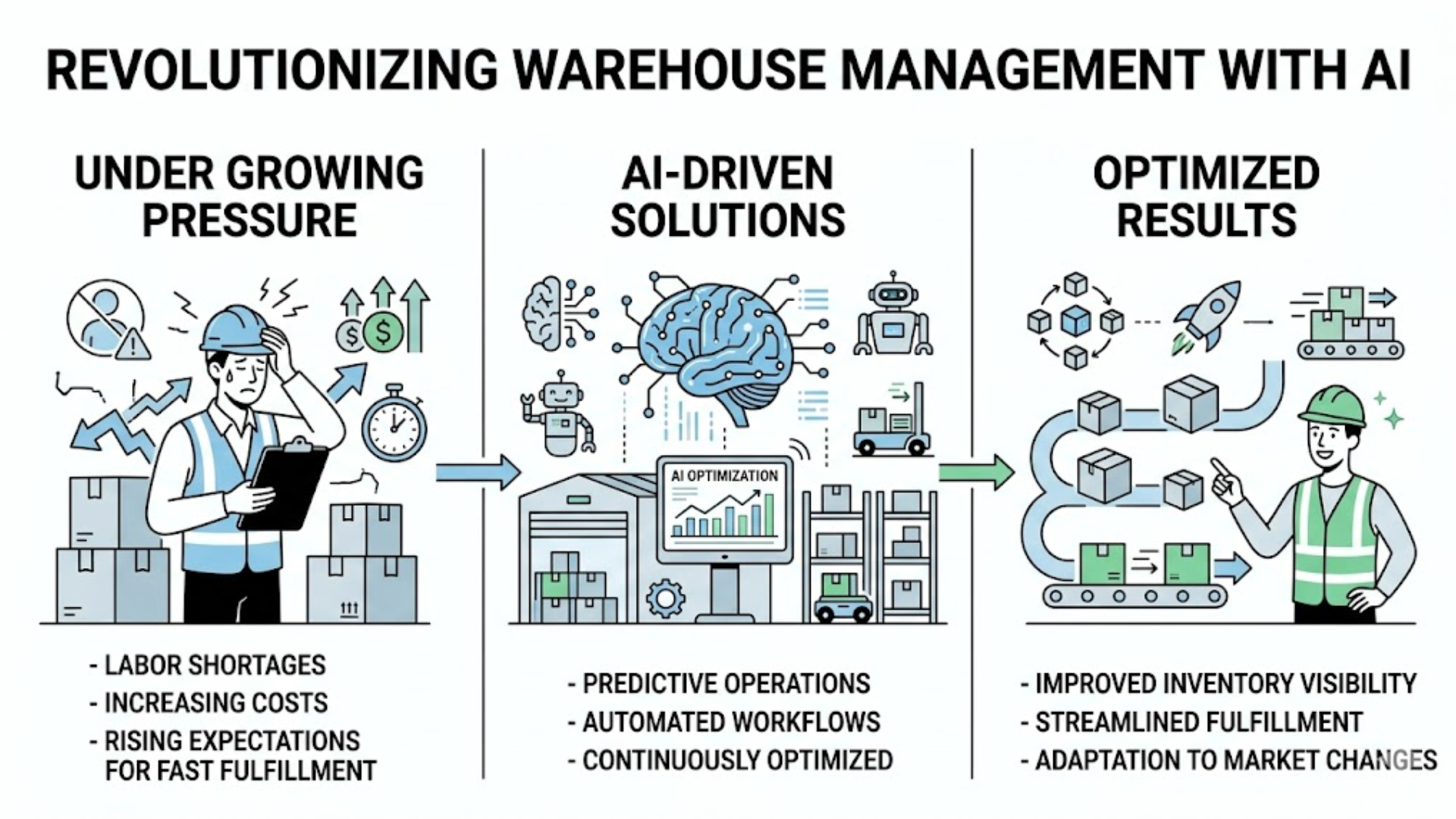
The modern supply chain is under growing pressure from labor shortages, increasing warehouse costs, and rising expectations for faster fulfillment. AI use cases in Warehouse Management are becoming essential for companies that need to improve operational speed, accuracy, and scalability. Traditional warehouse models can no longer keep up with dynamic demand and increasingly complex logistics networks.
Artificial intelligence enables warehouses to move beyond manual and reactive workflows toward predictive, automated, and continuously optimized operations. By leveraging AI-driven insights, businesses can improve inventory visibility, streamline fulfillment processes, and build more resilient supply chain ecosystems that adapt quickly to market changes.
What is AI and Why Does It Matter in Warehouse Management?
Definition of AI and Its Core Technologies
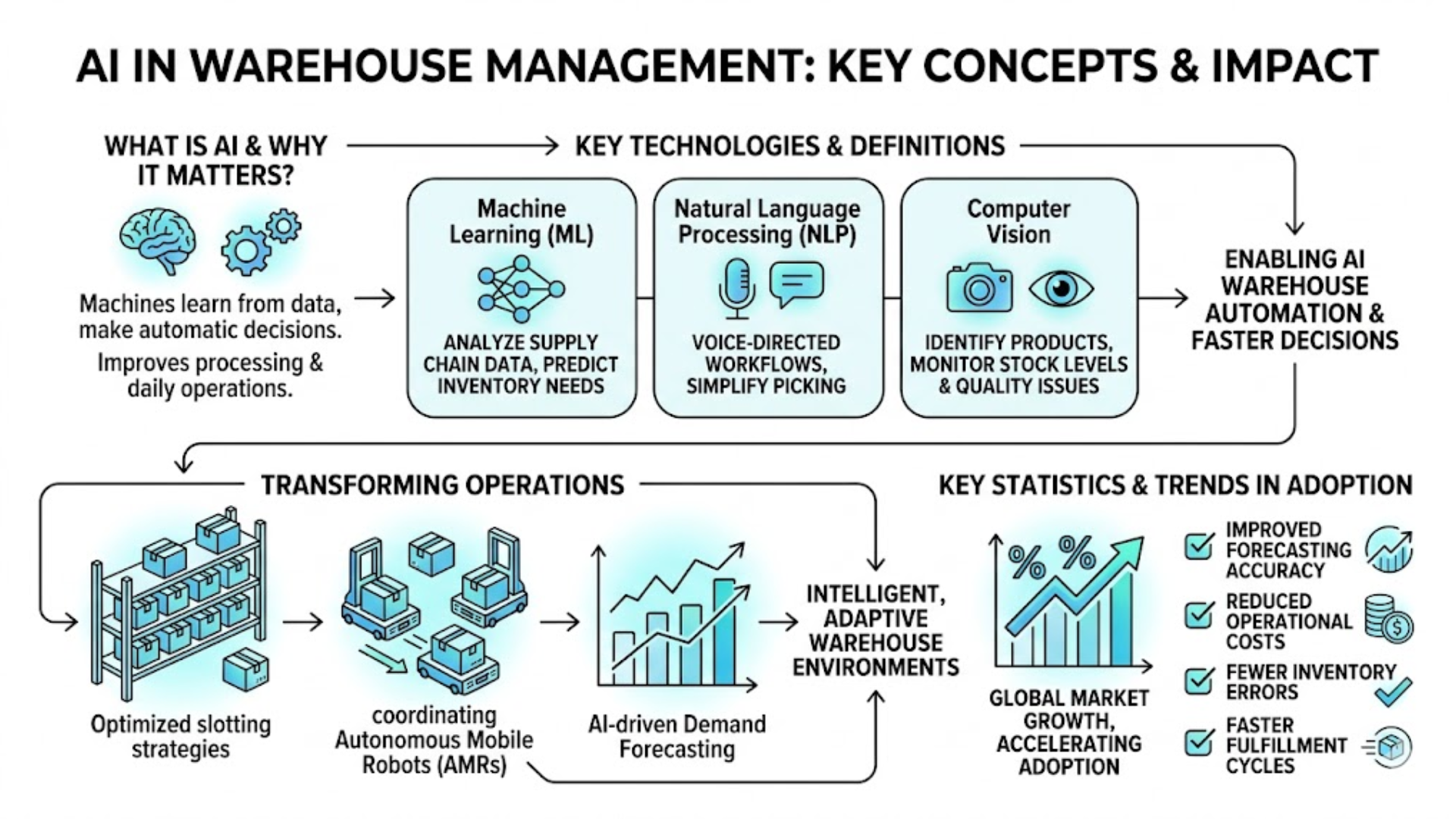
Artificial intelligence enables machines to learn from data, recognize patterns, and make decisions automatically. In logistics environments, AI improves how warehouses process information and execute daily operations. As a result, AI use cases in Warehouse Management help businesses increase efficiency, accuracy, and operational visibility.
Machine learning allows systems to analyze large volumes of supply chain data and predict inventory needs. Natural language processing enables voice-directed workflows that simplify picking and reduce manual input. Computer vision supports intelligent inventory management by identifying products, monitoring stock levels, and detecting quality issues through image recognition. Together, these technologies enable AI warehouse automation and support faster, more accurate decision-making.
The Growing Role of AI in Transforming Warehouse Management
AI plays an increasingly important role in smart warehouse optimization as supply chains become more complex. Warehouses must manage omnichannel fulfillment, fluctuating demand, and rising customer expectations for faster delivery. Traditional warehouse systems often lack the flexibility to respond quickly to these changes.
AI-powered systems continuously improve warehouse performance by optimizing slotting strategies, coordinating autonomous mobile robots, and enhancing AI-driven demand forecasting accuracy. These capabilities allow warehouses to operate as intelligent environments that adapt to real-time operational conditions. Companies implementing AI technologies often achieve higher productivity and better inventory visibility.
Key Statistics and Trends in AI Adoption in Warehouse Management
Adoption of artificial intelligence in logistics continues to accelerate as organizations invest in digital transformation. Industry reports estimate strong growth in the global market for AI-powered warehouse solutions over the next decade. Businesses increasingly prioritize technologies that improve operational resilience and reduce manual workload.
Many logistics providers report measurable benefits after implementing AI solutions, including improved forecasting accuracy and reduced operational costs. Companies using AI warehouse automation often experience fewer inventory errors and faster fulfillment cycles. As adoption increases, AI is becoming a foundational capability for modern warehouse management strategies.
Business Benefits of AI in Warehouse Management
Efficiency Improvements
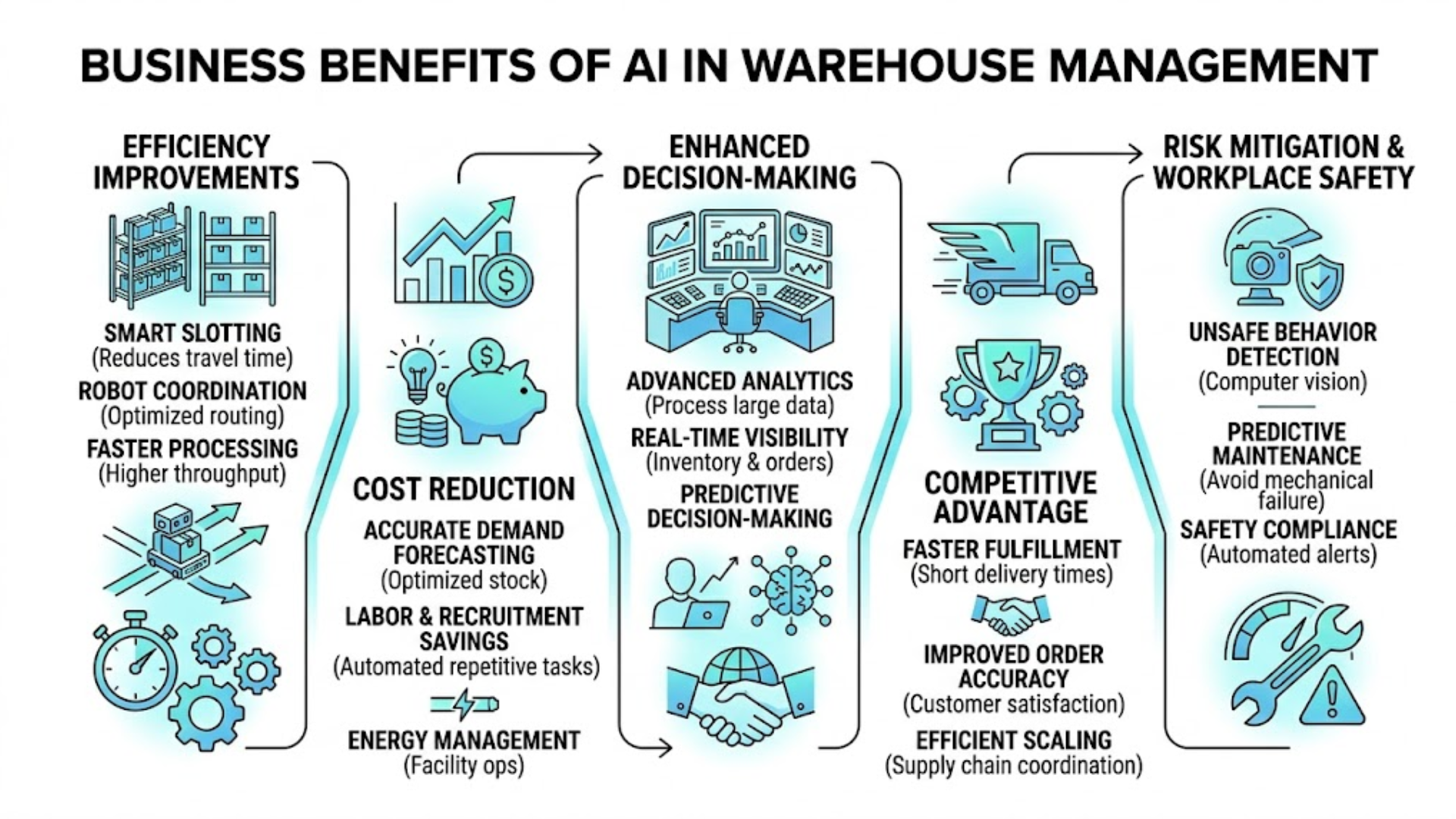
One of the most impactful AI use cases in Warehouse Management is improving operational efficiency. AI analyzes product demand, order patterns, and inventory movement to optimize storage locations automatically. This process, often called smart slotting, reduces travel time for picking and replenishment activities.
AI also improves workflow coordination by optimizing the movement of autonomous mobile robots. Intelligent routing systems dynamically adjust robot paths to avoid congestion and improve throughput. As a result, companies using AI warehouse automation often achieve faster order processing and higher productivity without expanding physical space.
Human workers also benefit from AI-supported decision-making. AI-powered picking guidance reduces manual searching and improves task accuracy. These improvements enable warehouses to handle higher order volumes while maintaining consistent performance levels.
Cost Reduction
Reducing operational costs is a major driver behind adopting AI-driven warehouse optimization. Machine learning models forecast demand accurately, helping companies maintain optimal inventory levels. Businesses can avoid excess stock while preventing costly stockouts that disrupt fulfillment operations.
AI also reduces labor dependency by automating repetitive processes such as sorting, counting, and quality inspection. This approach lowers recruitment costs and reduces reliance on temporary workers during peak seasons. Many companies implementing intelligent inventory management report lower holding costs and improved resource utilization.
Energy management is another area where AI creates savings. AI systems monitor warehouse conditions and optimize lighting, heating, and cooling usage based on occupancy and operational demand. These optimizations contribute to lower facility operating expenses over time.
Enhanced Decision-Making Capabilities
AI supports faster and more accurate decision-making across warehouse operations. Advanced analytics systems process large volumes of structured and unstructured supply chain data. These insights help managers identify inefficiencies, predict disruptions, and adjust operational strategies proactively.
AI-powered dashboards provide real-time visibility into inventory levels, order status, and warehouse performance metrics. This visibility enables managers to respond quickly to operational bottlenecks and improve fulfillment reliability. AI use cases in Warehouse Management increasingly focus on enabling predictive decision-making rather than reactive problem solving.
Organizations that leverage AI analytics gain stronger control over complex supply chain networks. Improved forecasting accuracy helps businesses maintain stable operations even during demand fluctuations.
Competitive Advantage
AI enables companies to deliver faster and more reliable fulfillment services. Intelligent warehouse systems improve order accuracy, reduce processing delays, and support shorter delivery times. These capabilities help organizations meet strict service level agreements and maintain customer satisfaction.
Companies implementing smart warehouse optimization often achieve higher operational transparency. Real-time data visibility allows businesses to track inventory movement and improve supply chain coordination. This transparency strengthens trust with partners and customers while improving long-term competitiveness.
By adopting AI warehouse automation, companies position themselves to scale operations efficiently without compromising service quality. Faster fulfillment and improved accuracy create meaningful differentiation in highly competitive logistics markets.
Proactive Risk Mitigation and Workplace Safety
AI improves workplace safety by identifying potential risks before accidents occur. Computer vision systems monitor warehouse environments and detect unsafe behaviors or restricted area violations. These systems help reduce incidents involving heavy equipment and automated machinery.
Predictive maintenance is another important application of AI in warehouse environments. Machine learning models analyze equipment performance data to detect early signs of mechanical failure. Early detection helps companies prevent costly downtime and avoid safety hazards.
AI-powered monitoring systems also support compliance with workplace safety standards. Automated alerts allow managers to respond quickly when unsafe conditions arise. These capabilities help create safer working environments while maintaining operational continuity.
Challenges Facing AI Adoption in Warehouse Management
Although AI use cases in Warehouse Management deliver significant value, implementation is not always straightforward. Many organizations face operational, technical, and cultural barriers when introducing AI into existing logistics environments. Understanding these challenges helps companies build realistic adoption strategies and maximize return on investment.
Data Privacy and Security Concerns
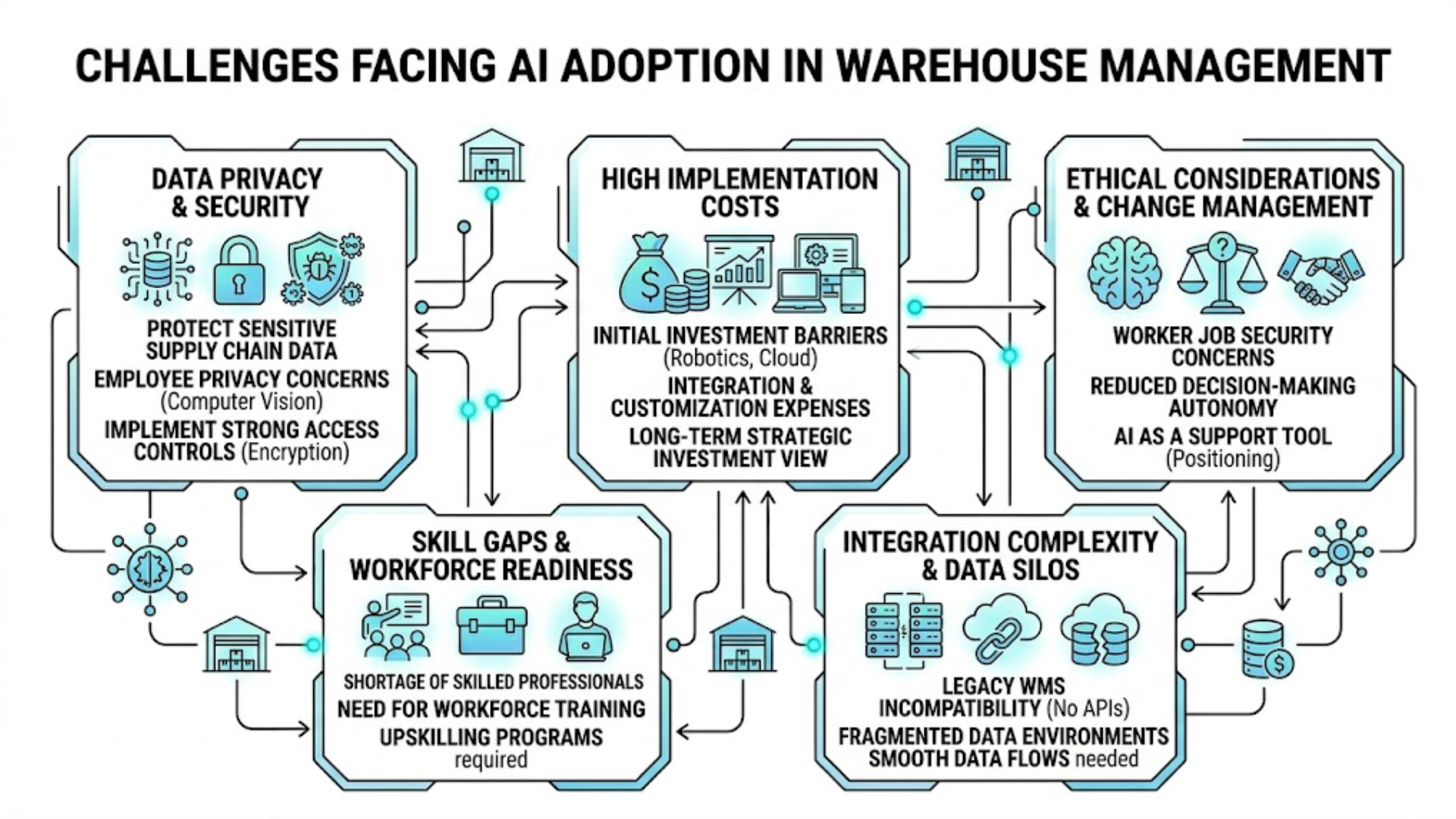
AI systems depend on large volumes of operational and behavioral data. As warehouses adopt IoT sensors, robotics, and connected platforms, cybersecurity risks increase. Companies must protect sensitive supply chain data from breaches, ransomware attacks, and unauthorized access.
Computer vision systems and connected devices also raise concerns about employee privacy. Organizations must implement strong access controls, encryption standards, and data governance policies. Secure infrastructure is essential for building trust and ensuring compliance with global data protection regulations.
Skill Gaps and Workforce Readiness
Successful adoption of AI warehouse automation requires both technical expertise and operational readiness. Many organizations face shortages of skilled professionals such as data engineers, AI specialists, and robotics experts. Without the right talent, implementation timelines may slow significantly.
Warehouse employees also need training to work effectively with AI-powered systems. Workers must learn how to interact with autonomous robots, voice-picking tools, and intelligent dashboards. Companies that invest in upskilling programs often achieve smoother adoption and higher productivity.
High Implementation Costs
Initial investment remains one of the most common barriers to adopting AI-driven warehouse optimization. Deploying AI often requires spending on sensors, robotics equipment, cloud infrastructure, and software platforms. Integration and customization costs can also increase total project budgets.
However, many organizations view AI as a long-term strategic investment. Over time, intelligent inventory management systems help reduce labor expenses, minimize inventory waste, and improve operational efficiency. Companies that define clear business objectives often achieve stronger financial outcomes from AI adoption.
Integration Complexity and Data Silos
Many warehouses rely on legacy warehouse management systems that were not designed for AI integration. Older platforms often lack flexible APIs, making data exchange difficult. As a result, companies may struggle with fragmented data environments and inconsistent system communication.
To unlock the full value of AI use cases in Warehouse Management, organizations must ensure data flows smoothly across supply chain platforms. Integration strategies may include middleware solutions, cloud-based data pipelines, or system modernization initiatives. Strong data architecture supports faster and more reliable AI deployment.
Ethical Considerations and Change Management
AI adoption can create uncertainty among employees concerned about job security. Workers may worry that automation will replace human roles or reduce decision-making autonomy. These concerns can slow adoption and reduce system effectiveness.
Successful organizations position AI as a tool that supports employees rather than replaces them. AI can reduce repetitive tasks, improve workplace safety, and enable staff to focus on higher-value activities. Clear communication, transparent policies, and structured change management programs help build trust and encourage collaboration between humans and intelligent systems.
Core AI Use Cases in Warehouse Management
Understanding AI use cases in Warehouse Management requires distinguishing core technologies from specific operational applications. Core AI capabilities form the foundation that enables automation, optimization, and intelligent decision-making across warehouse workflows. These technologies support a wide range of functions, from AI warehouse automation to intelligent inventory management and smart warehouse optimization.
Machine Learning for Predictive Optimization
Machine learning is one of the most important drivers behind modern AI-driven warehouse optimization. Algorithms analyze historical and real-time supply chain data to identify patterns in demand, inventory flow, and operational performance. These insights allow systems to continuously improve forecasting accuracy and optimize resource allocation.
Machine learning models support demand prediction, labor planning, and inventory replenishment decisions. Unlike rule-based systems, machine learning continuously improves as it processes new operational data. This capability enables warehouses to respond quickly to changes in customer demand and market conditions.
Computer Vision for Real-Time Warehouse Visibility
Computer vision enables machines to interpret visual data from cameras and sensors across warehouse environments. This technology supports automated product identification, barcode scanning, and quality inspection processes. As a result, AI use cases in Warehouse Management increasingly rely on computer vision to improve accuracy and reduce manual effort.
Computer vision also enhances intelligent inventory management by enabling real-time stock monitoring and automated counting. AI-powered visual systems detect damaged goods, misplaced items, and safety risks more efficiently than manual inspection. These capabilities improve operational transparency and reduce errors across fulfillment workflows.
Natural Language Processing for Voice-Enabled Operations
Natural language processing allows warehouse staff to interact with digital systems using voice or text commands. Voice-directed picking systems provide real-time instructions that guide workers through tasks more efficiently. This hands-free interaction improves productivity and reduces the need for manual data entry.
NLP-powered interfaces also support conversational queries within warehouse management platforms. Employees can quickly retrieve inventory data, order information, or workflow instructions without navigating complex dashboards. This accessibility supports faster decision-making and improves overall workflow efficiency.
Reinforcement Learning for Autonomous Robotics and Routing
Reinforcement learning supports intelligent decision-making in dynamic warehouse environments. AI models learn optimal behaviors through continuous interaction with real operational conditions. This technology enables autonomous mobile robots to navigate efficiently while avoiding obstacles and congestion.
Reinforcement learning improves robotic path planning and supports smart warehouse optimization by identifying the most efficient routes for material movement. AI-powered robotics systems adapt to changing warehouse layouts and fluctuating order volumes. These capabilities allow companies to scale operations while maintaining consistent performance and accuracy.
Let’s uncover whether deploying edge-based Small Language Models (SLMs) or centralized hyperscale AI delivers the best ROI for your enterprise.
SmartDev helps enterprises evaluate and deploy intelligent infrastructure solutions that dynamically scale workloads, automate server provisioning, and predict hardware failures without compromising system security or compliance.
Compare cost drivers, optimize your AI budget, and choose the strategy that maximizes ROI with SmartDev’s enterprise AI architecture and implementation expertise.
Talk to an AI Strategy ExpertSpecific Applications of AI in Warehouse Management
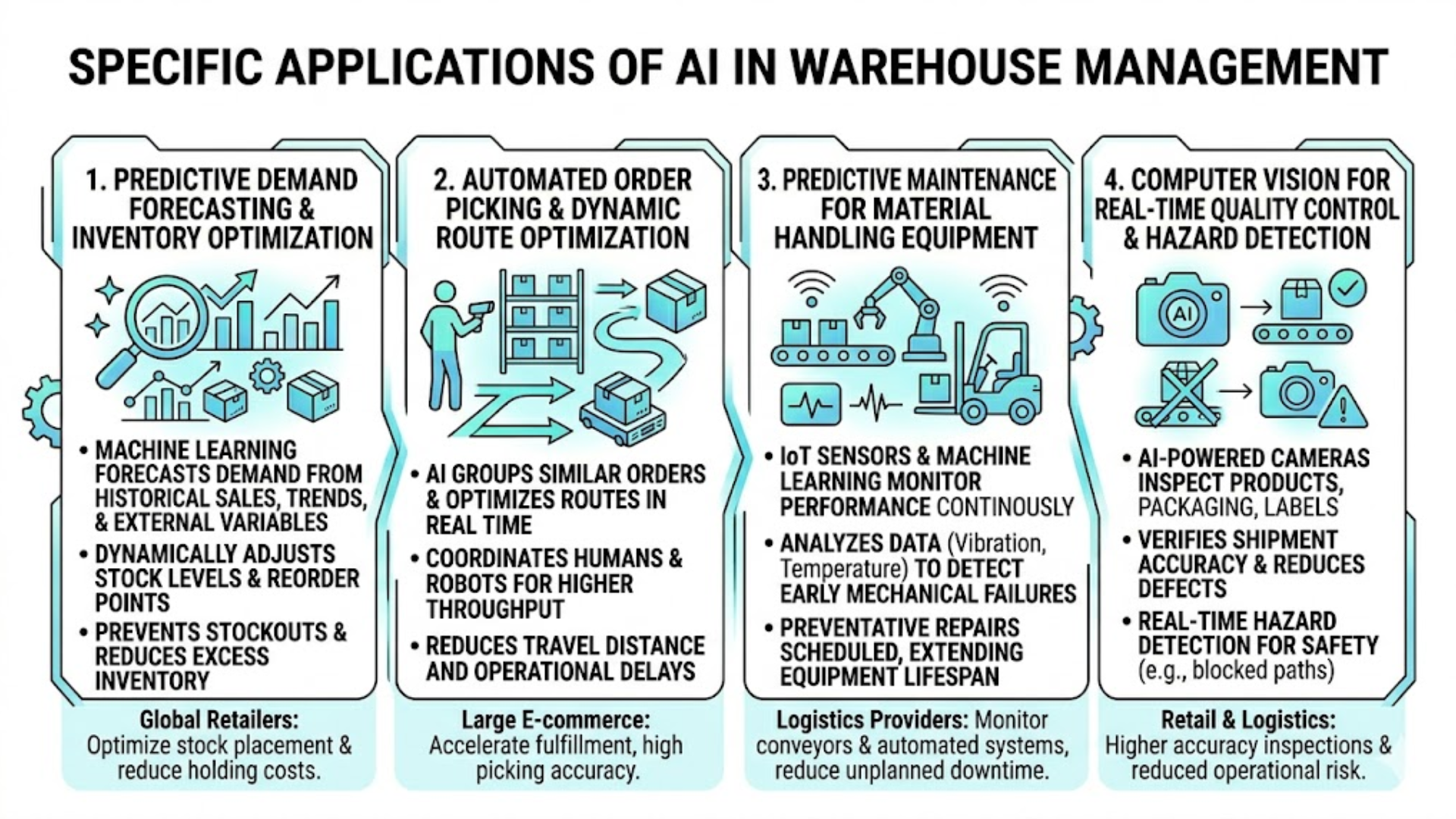
Building on core technologies, these AI use cases in Warehouse Management demonstrate how artificial intelligence solves practical operational challenges. Each application improves efficiency, accuracy, and scalability across fulfillment workflows while supporting AI warehouse automation and smart warehouse optimization.
Predictive Demand Forecasting and Inventory Optimization
Predictive analytics improves inventory planning by using machine learning to forecast demand accurately. AI analyzes historical sales data, seasonal trends, and external variables such as market changes or weather patterns. These insights allow companies to adjust stock levels dynamically and define optimal reorder points.
AI-driven demand forecasting helps companies prevent stockouts while reducing excess inventory. Businesses can maintain balanced inventory levels and improve turnover rates. This capability supports intelligent inventory management and improves supply chain stability.
Real-world examples: Major global retailers use AI-powered forecasting to optimize inventory placement across distribution networks. Companies implementing predictive analytics often report improved inventory accuracy and reduced holding costs. Improved demand visibility allows logistics teams to respond faster to fluctuations in customer behavior.
Automated Order Picking and Dynamic Route Optimization
Order picking remains one of the most resource-intensive warehouse activities. AI improves this process by grouping similar orders and optimizing picking routes in real time. Intelligent systems analyze product locations, order priority, and warehouse layout to reduce travel distance.
AI also supports coordination between human workers and autonomous mobile robots. Dynamic routing algorithms continuously calculate the fastest paths based on congestion and operational priorities. These improvements increase throughput and reduce operational delays.
Real-world examples: Large e-commerce companies use AI-powered robotics to accelerate order fulfillment and improve picking accuracy. AI-supported route optimization allows fulfillment centers to process high order volumes while maintaining consistent service levels.
Predictive Maintenance for Material Handling Equipment
Equipment downtime can disrupt warehouse productivity and delay order fulfillment. Predictive maintenance uses IoT sensors and machine learning to monitor equipment performance continuously. AI analyzes vibration patterns, temperature changes, and usage data to detect early signs of mechanical failure.
Maintenance teams receive alerts before breakdowns occur, allowing repairs to be scheduled during low-demand periods. This proactive approach reduces downtime and extends equipment lifespan.
Real-world examples: Global logistics providers use predictive maintenance to monitor conveyors, robotic systems, and automated storage infrastructure. Companies adopting this approach often reduce unexpected equipment failures and improve operational continuity.
Computer Vision for Real-Time Quality Control and Hazard Detection
Computer vision improves quality assurance by automatically inspecting products and shipments. AI-powered cameras verify product accuracy, detect packaging damage, and confirm correct labeling. These systems reduce manual inspection requirements and improve shipment accuracy.
Computer vision also enhances workplace safety by detecting hazards such as blocked pathways or unsafe equipment usage. Real-time alerts help managers respond quickly and prevent operational disruptions.
Real-world examples: Retail and logistics companies use computer vision systems to monitor warehouse workflows and improve inventory accuracy. AI-powered visual inspection systems often achieve higher detection accuracy than manual processes while reducing operational risk.
Examples of AI in Warehouse Management
The theoretical capabilities of artificial intelligence are best validated through the examination of real-world deployments by global logistics leaders. These case studies highlight the specific success metrics and tangible returns on investment achieved through strategic artificial intelligence integration.
Real-World Case Studies and Success Metrics
The following structured data provides a comparative overview of how enterprise organizations have successfully deployed artificial intelligence to solve complex warehousing and logistics challenges, along with the precise outcomes of those implementations.
| Enterprise | AI Implementation Focus | Success Metrics and Operational Outcomes | |
| Amazon | Deployed over 750,000 AI-powered autonomous robots and generative AI mapping systems across global fulfillment centers. | Achieved an estimated $4 billion in annual savings on fulfillment costs; reduced picking and packing times by 75%. | |
| DHL | Integrated AI-assisted robotic arms for order picking, computer vision for accuracy, and dynamic route planning algorithms. | Realized a 30% jump in operational efficiency; improved picking accuracy by 25%; achieved a 99.7% overall order accuracy rate. | |
| Maersk | Utilized artificial intelligence to optimize container loading, predictive maintenance on equipment, and real-time route planning. | Reduced shipping delays by 67%; generated $340 million in fuel cost savings through optimized routing and energy use. | |
| Walmart | Leveraged custom machine learning models for highly localized demand forecasting and smart inventory placement. | Improved inventory turnover rates by 10%; drastically reduced supply chain waste and prevented out-of-stock scenarios. | |
| Gather AI (at Barrett Distribution) | Implemented autonomous warehouse drones powered by computer vision for off-hour inventory auditing and cycle counting. | Generated operational savings exceeding $250,000; achieved full return on investment in less than a single year. |
These detailed examples demonstrate that when artificial intelligence is deployed at scale with clear strategic intent, it acts as a massive operational force multiplier. The data clearly indicates that investments in artificial intelligence not only yield rapid operational cost savings but fundamentally alter the velocity, capacity, and reliability of the entire supply chain network.
Innovative AI Solutions
As technology evolves, a new generation of solutions is expanding the scope of AI use cases in Warehouse Management. These innovations move beyond basic automation and enable warehouses to operate as fully adaptive, data-driven ecosystems. Advanced capabilities such as agentic AI, multimodal intelligence, and digital twins are reshaping how companies design resilient and scalable logistics operations.
Emerging AI Technologies Being Applied in Warehouse Management
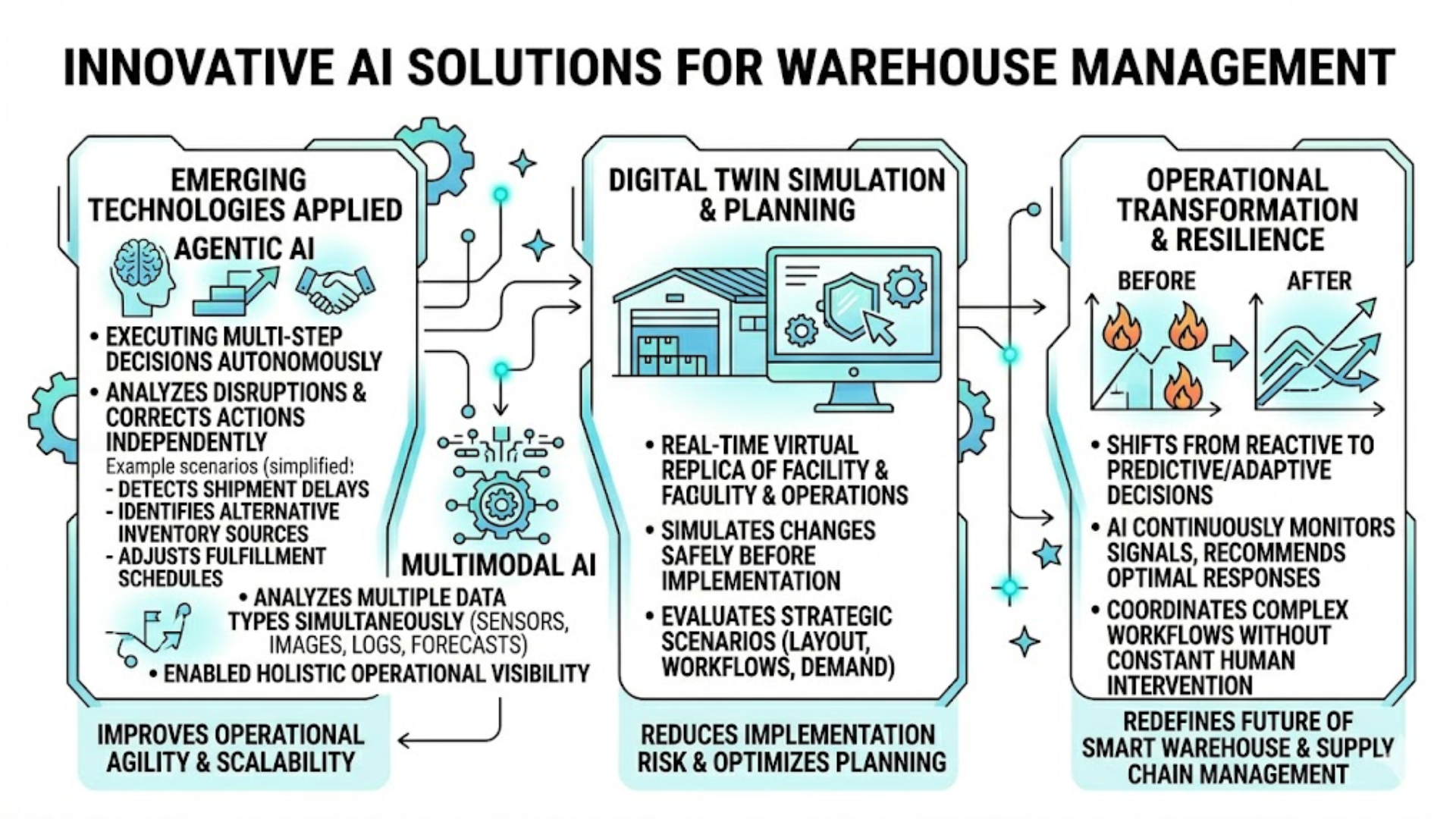
One of the most promising innovations is agentic AI, which enables systems to execute multi-step decisions autonomously. Unlike traditional AI models that only provide recommendations, agentic AI can independently analyze disruptions and take corrective action. For example, an AI agent can detect delays in inbound shipments, identify alternative inventory sources, and adjust fulfillment schedules automatically. This capability improves operational continuity and strengthens AI-driven warehouse optimization.
Another important innovation is the integration of multimodal AI with digital twin technology. Multimodal models analyze multiple data types simultaneously, including sensor readings, images, operational logs, and demand forecasts. When combined with digital twins, organizations can simulate warehouse operations in a virtual environment before making real-world changes.
Digital twins create real-time virtual replicas of warehouse facilities, allowing companies to test layout adjustments, workflow changes, or demand fluctuations safely. Businesses can simulate peak season demand spikes or supply chain disruptions to evaluate operational performance. These simulations support more accurate planning and reduce implementation risks.
How These Solutions Are Transforming Business Operations
Innovative AI solutions enable warehouses to shift from reactive operations to predictive and adaptive decision-making. Instead of responding to disruptions after they occur, AI systems continuously monitor operational signals and recommend optimal responses in advance. This capability strengthens resilience and improves long-term operational stability.
Digital twin environments allow logistics leaders to evaluate multiple strategic scenarios before implementing physical changes. AI-powered simulations support better layout planning, labor allocation, and inventory positioning. Companies adopting these technologies can improve resource utilization while maintaining high service levels.
Agentic AI further enhances operational agility by coordinating complex workflows without constant human intervention. These capabilities enable organizations to scale operations efficiently while maintaining accuracy and reliability. As adoption increases, innovative technologies continue to redefine the future of smart warehouse optimization and intelligent supply chain management.
AI-Driven Innovations Transforming Warehouse Management
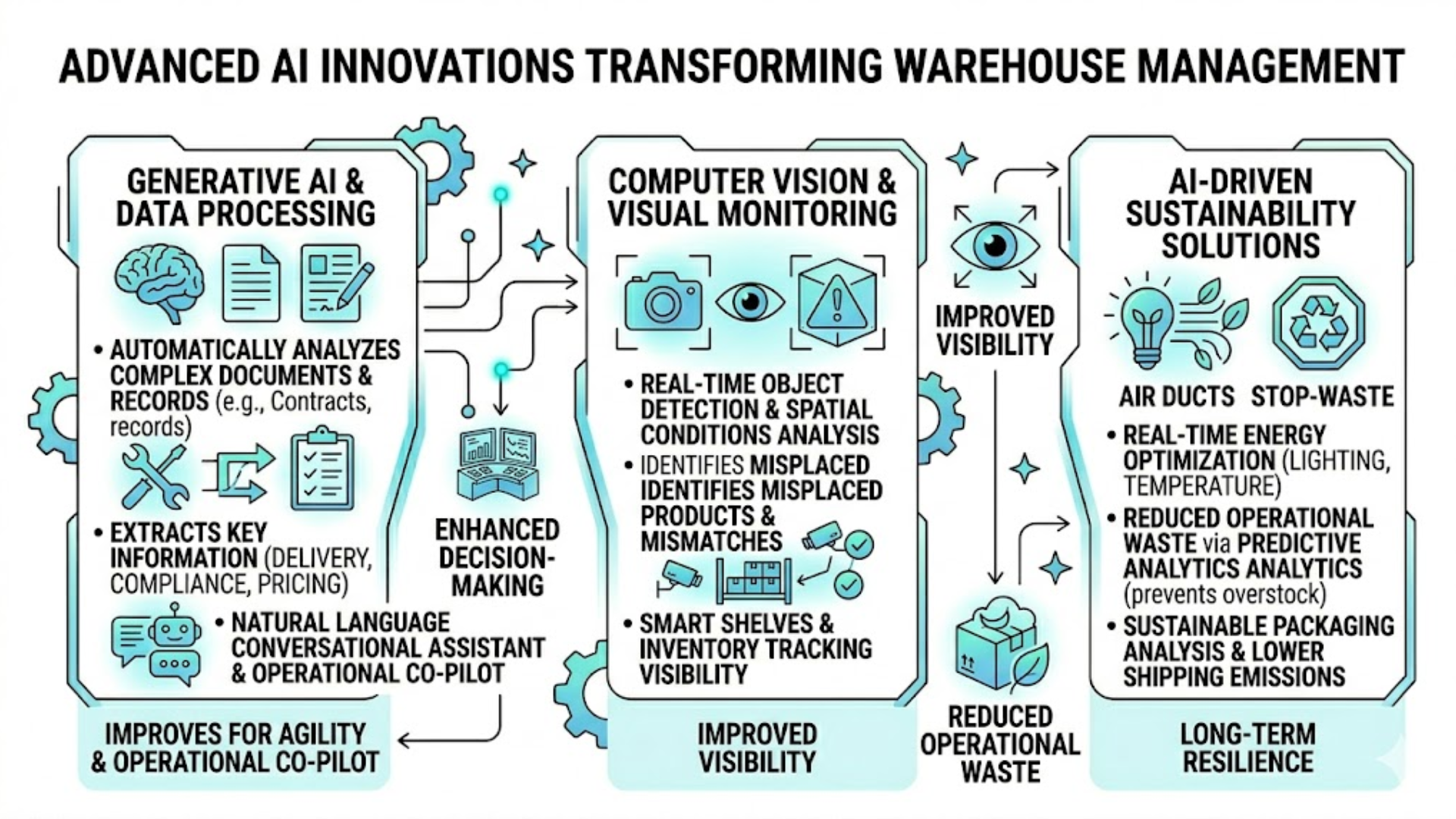
Advanced technologies continue to expand the scope of AI use cases in Warehouse Management, enabling smarter data processing, improved inventory visibility, and more sustainable logistics operations. These innovations enhance decision-making, reduce operational waste, and strengthen long-term supply chain resilience.
Emerging Technologies in AI for Warehouse Management
Generative AI is transforming how warehouses process complex and unstructured information. Large language models can analyze procurement documents, shipping records, and supplier contracts automatically. These systems extract key information such as delivery timelines, compliance requirements, and pricing conditions. As a result, generative AI reduces manual administrative work and improves document accuracy.
Generative AI also supports intelligent decision-making through conversational interfaces. Warehouse managers can ask operational questions in natural language and receive data-driven insights instantly. These AI assistants function as operational co-pilots, helping teams evaluate risks and identify optimization opportunities more efficiently.
Computer vision technology has also advanced significantly, enabling deeper visual analysis within warehouse environments. Modern systems can detect objects, monitor inventory placement, and analyze spatial conditions in real time. AI-powered visual monitoring supports intelligent inventory management by identifying misplaced products and triggering replenishment workflows automatically.
Smart shelves equipped with cameras improve inventory tracking accuracy and reduce stock discrepancies. These technologies allow warehouses to maintain real-time visibility into stock levels and product locations, improving overall operational control.
AI’s Role in Sustainability Efforts
Artificial intelligence plays a growing role in improving sustainability across warehouse operations. AI-powered building management systems optimize energy consumption by adjusting lighting, temperature, and ventilation based on real-time activity levels. These optimizations help reduce electricity usage and lower operational costs.
Predictive analytics also helps reduce waste by aligning inventory levels more closely with demand patterns. By preventing overstocking and excess production, companies reduce material waste and improve resource utilization. This capability supports more environmentally responsible supply chain practices.
AI contributes to sustainable packaging strategies by analyzing product characteristics and transportation requirements. Algorithms identify packaging designs that reduce material usage while maintaining product protection. These improvements help organizations lower shipping emissions and support circular economy initiatives.
As sustainability becomes a strategic priority, innovative technologies continue to strengthen the environmental impact of smart warehouse optimization and AI-driven logistics operations.
How to Implement AI in Warehouse Management
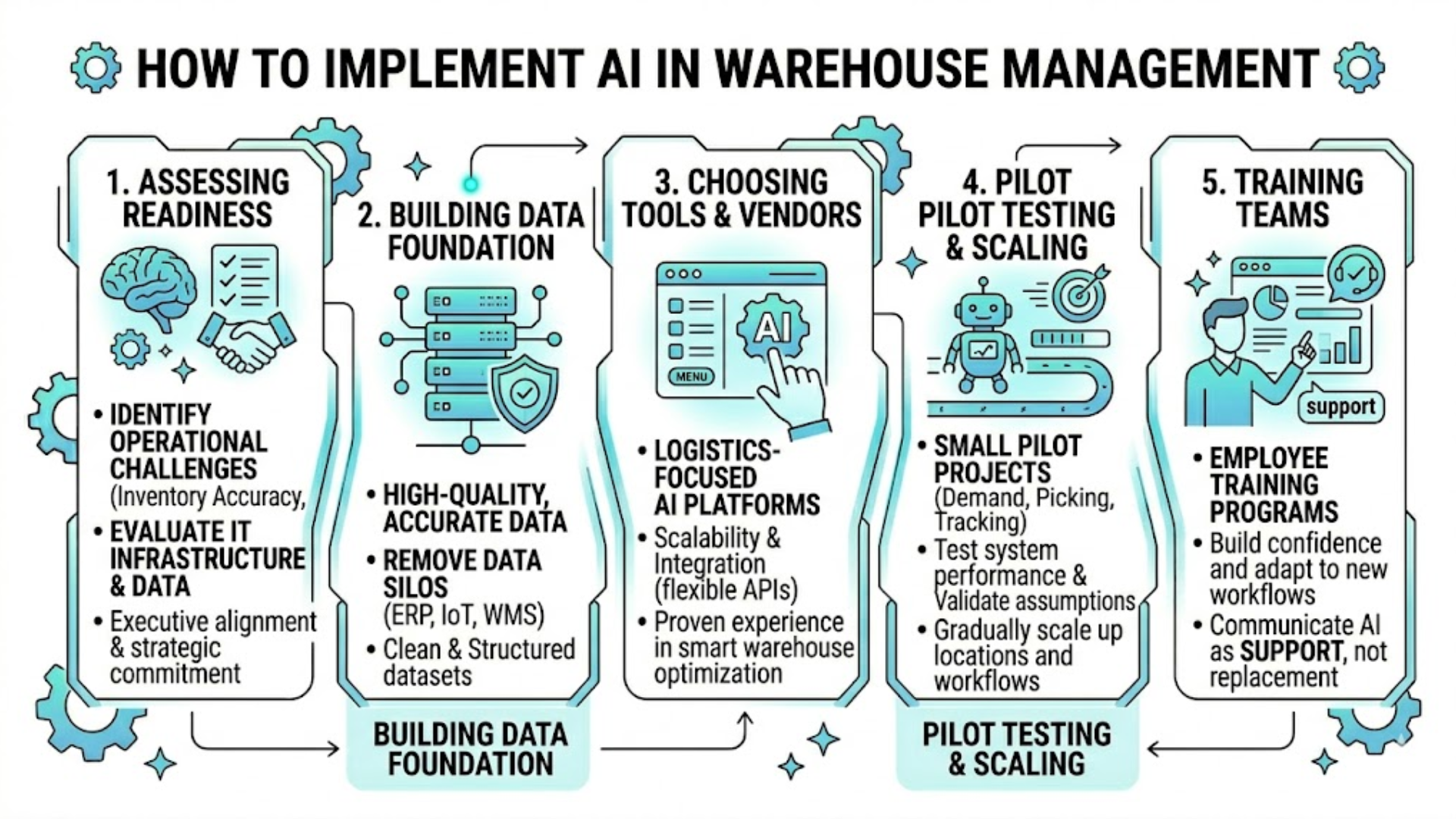
Implementing AI use cases in Warehouse Management requires a structured approach that aligns technology with business goals. Companies should focus on data readiness, system integration, and workforce adoption to ensure long-term success. A phased implementation strategy helps reduce risk while enabling scalable AI warehouse automation.
Assessing Readiness for AI Adoption
Organizations should begin by identifying operational challenges that AI can solve. Common priorities include improving inventory accuracy, reducing fulfillment delays, and increasing warehouse productivity. Clearly defined goals help ensure that AI investments generate measurable business value.
Companies should also evaluate internal capabilities, including IT infrastructure, data availability, and technical expertise. Executive alignment is critical, as AI adoption often requires long-term strategic commitment. A structured readiness assessment helps organizations prioritize the most impactful AI-driven warehouse optimization opportunities.
Building a Strong Data Foundation
High-quality data is essential for successful AI use cases in Warehouse Management. Organizations must ensure that inventory, order, and operational data are accurate, consistent, and accessible across systems. Removing data silos allows AI models to generate reliable insights and predictions.
Companies often integrate data from warehouse management systems, ERP platforms, and IoT sensors to create unified data environments. Clean and structured datasets improve forecasting accuracy and enable more effective intelligent inventory management. Strong data governance policies also help ensure security and compliance.
Choosing the Right Tools and Vendors
Selecting appropriate technology partners plays a key role in successful AI adoption. Businesses should evaluate AI platforms designed specifically for logistics and supply chain operations. Important factors include system scalability, integration capabilities, and compliance with security standards.
Solutions with flexible APIs allow smoother integration with legacy warehouse systems. Organizations should prioritize vendors with proven experience in implementing smart warehouse optimization solutions. Careful vendor selection helps reduce implementation risks and improve long-term performance.
Pilot Testing and Scaling Up
Companies should begin with small pilot projects before expanding AI across the entire warehouse network. Pilot programs allow organizations to test system performance, validate assumptions, and measure potential return on investment. Common pilot use cases include demand forecasting, robotic picking support, or automated inventory tracking.
After successful pilot testing, businesses can scale AI solutions gradually across additional workflows and locations. This phased approach helps maintain operational stability while expanding AI warehouse automation capabilities.
Training Teams for Successful Implementation
Employee readiness is essential for maximizing the value of AI technologies. Warehouse teams must understand how to interact with AI-powered systems, dashboards, and robotics tools. Training programs help employees build confidence and adapt to new workflows.
Organizations should communicate clearly how AI supports workers rather than replacing them. AI can reduce repetitive tasks, improve workplace safety, and enhance decision-making. A strong training strategy encourages adoption and ensures sustainable implementation of AI use cases in Warehouse Management.
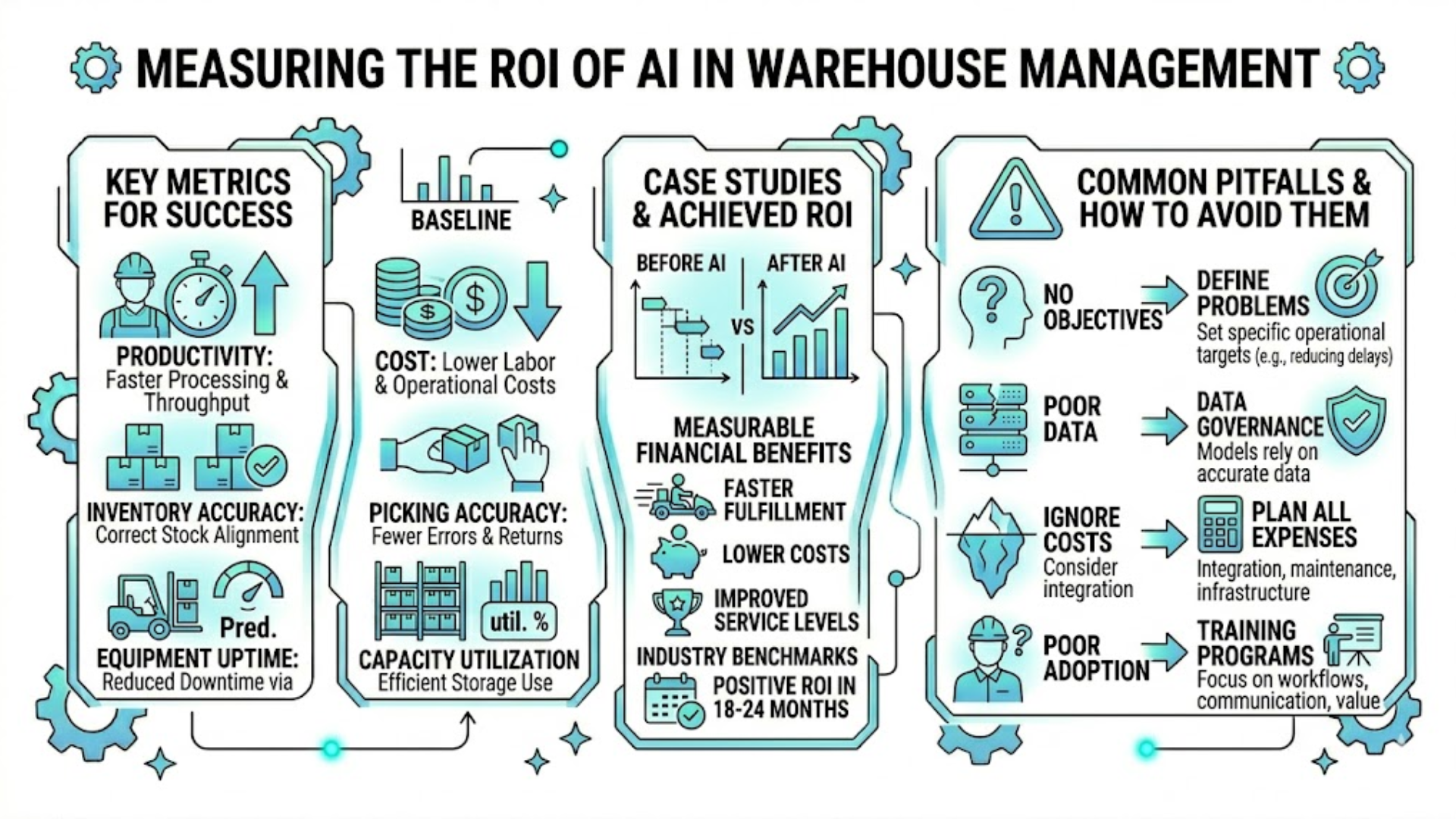
Measuring the ROI of AI in Warehouse Management
Measuring return on investment helps organizations evaluate the real impact of AI use cases in Warehouse Management. Clear performance metrics allow companies to justify technology spending, improve decision-making, and scale successful initiatives. Tracking ROI also ensures that AI warehouse automation delivers measurable operational and financial value.
Key Metrics to Track Success
Organizations should define baseline performance metrics before implementing AI solutions. Comparing performance before and after adoption provides a clear picture of improvement. Key indicators commonly used to evaluate AI-driven warehouse optimization include:
- Productivity improvement – Measures faster order processing, reduced cycle time, and increased throughput per worker or robot
- Cost reduction per order – Tracks decreases in labor costs, operational expenses, and fulfillment cost per unit
- Inventory accuracy – Evaluates alignment between physical stock levels and digital inventory records
- Order picking accuracy – Measures reduction in picking errors and return rates
- Equipment uptime – Tracks how predictive maintenance reduces unexpected downtime
- Warehouse capacity utilization – Evaluates how efficiently storage space is used through intelligent inventory management
Monitoring these metrics helps companies quantify how AI improves operational efficiency and reduces process variability.
Case Studies Demonstrating ROI
Many organizations report measurable financial benefits after implementing AI use cases in Warehouse Management. Companies adopting predictive analytics and warehouse automation often achieve faster fulfillment cycles and lower operational costs.
Industry benchmarks show that AI projects frequently achieve positive ROI within 18–24 months. Improvements often include lower inventory holding costs, higher order accuracy, and improved service levels. AI-powered forecasting and automation can reduce manual errors while supporting more consistent operational performance.
Organizations that implement smart warehouse optimization solutions often report improvements across multiple performance dimensions, including productivity, cost efficiency, and customer satisfaction. These results demonstrate how AI supports both short-term operational gains and long-term strategic value.
Common Pitfalls and How to Avoid Them
Despite the benefits, organizations may encounter challenges when measuring ROI from AI initiatives. One common mistake is implementing AI without clearly defined business objectives. AI projects should always focus on solving specific operational problems such as reducing fulfillment delays or improving inventory accuracy.
Poor data quality is another major risk. Machine learning models rely on accurate historical data to generate reliable predictions. Inconsistent or incomplete data can lead to incorrect insights and reduce system effectiveness. Companies should establish strong data governance practices before deploying AI models.
Organizations should also consider the total cost of ownership when evaluating ROI. Costs may include system integration, cloud infrastructure, and ongoing model maintenance. Planning for these expenses helps prevent unexpected budget overruns.
Finally, companies should prioritize employee adoption when implementing AI warehouse automation. Training programs and clear communication help teams understand how AI improves daily workflows. Strong change management strategies increase adoption rates and maximize the long-term value of AI investments.
Future Trends of AI in Warehouse Management
The evolution of AI use cases in Warehouse Management is accelerating as logistics networks become more digital, automated, and data-driven. Over the next decade, artificial intelligence will play a central role in building more resilient, scalable, and adaptive supply chain ecosystems.
Predictions for the Next Decade
AI adoption in logistics is expected to expand significantly as organizations invest in AI warehouse automation and predictive supply chain technologies. Market forecasts estimate strong growth in AI-powered logistics solutions, driven by increasing demand for faster fulfillment and greater operational efficiency.
One major trend is the emergence of highly automated warehouse environments that rely heavily on robotics and intelligent orchestration systems. These facilities use AI to coordinate inventory movement, optimize picking strategies, and balance order volumes dynamically. Increasing interoperability between robotics platforms will allow different automated systems to collaborate more efficiently.
AI will also support more flexible inventory strategies. Companies will increasingly combine lean inventory approaches with buffer stock strategies to improve resilience against supply chain disruptions. This hybrid approach allows organizations to maintain operational continuity while optimizing inventory costs through AI-driven demand forecasting.
How Businesses Can Stay Ahead of the Curve
Organizations that successfully adopt AI use cases in Warehouse Management typically treat AI as a long-term capability rather than a short-term technology upgrade. Building scalable data infrastructure allows companies to integrate new AI tools more easily as technology evolves.
Businesses should invest in systems that support continuous learning and ongoing optimization. Monitoring AI model performance helps ensure consistent accuracy and prevents performance decline over time. Strong data governance practices also support sustainable growth in smart warehouse optimization initiatives.
Workforce readiness is equally important. Companies that invest in employee training improve collaboration between human workers and intelligent systems. Developing data literacy across teams helps organizations fully leverage AI insights and improve operational decision-making.
Conclusion
AI use cases in Warehouse Management enable companies to improve efficiency, accuracy, and operational resilience. AI supports better inventory control, faster fulfillment, and more reliable decision-making across complex supply chains.
Although implementation requires strong data foundations and workforce readiness, the long-term benefits outweigh the challenges. Organizations that adopt AI warehouse automation early can build scalable, future-ready logistics operations and maintain a strong competitive advantage.