

1. The Growing Complexity of Financial Operations in Fintech
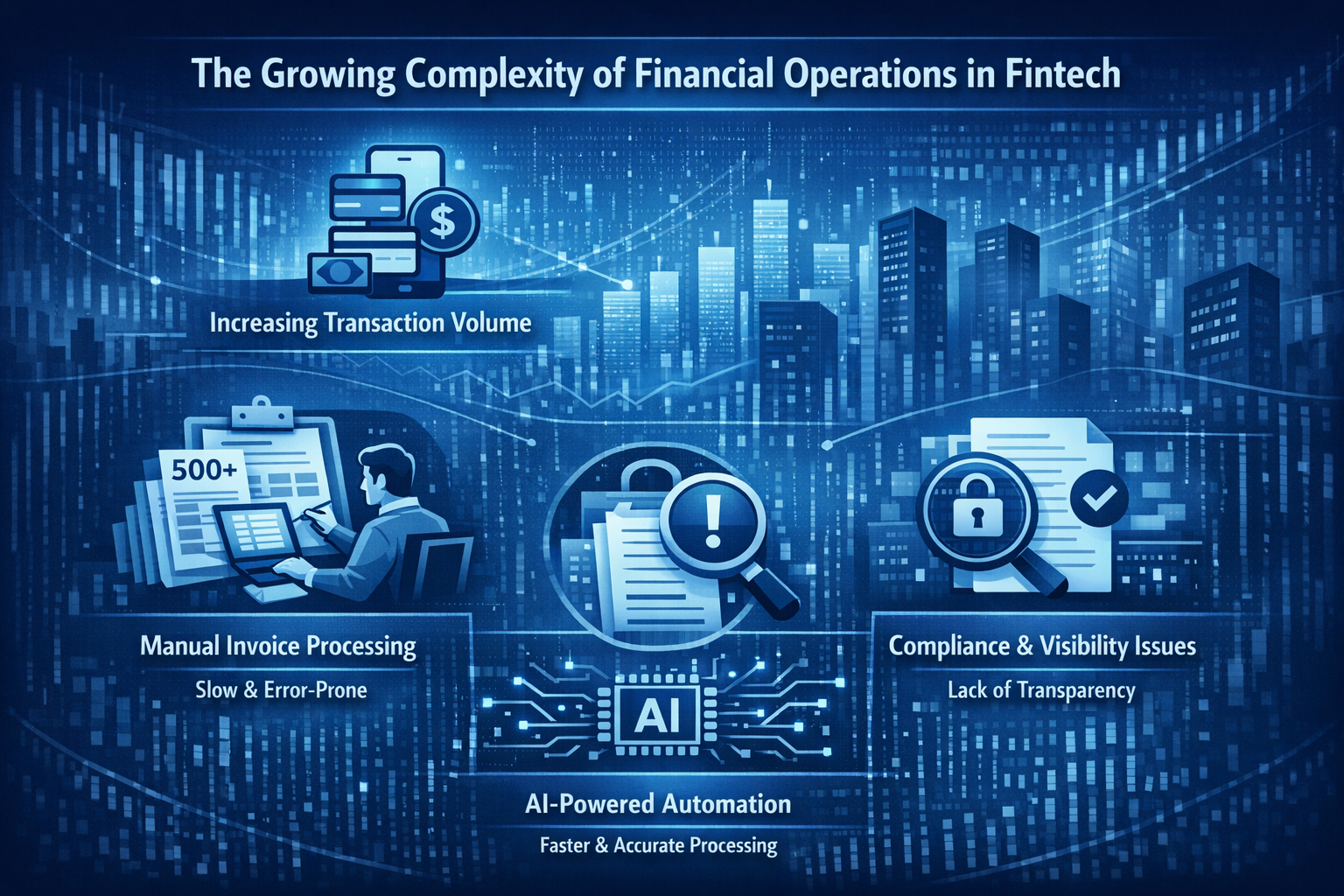
The fintech sector has grown rapidly over the past decade, transforming how businesses and consumers interact with financial services. From digital payments and lending platforms to embedded finance and neobanking, fintech companies are handling a growing volume of transactions and financial operations every day. As these organizations scale, however, the complexity of managing financial documentation – particularly invoices – has increased significantly.
For finance teams operating in fintech environments, the challenge is no longer simply processing invoices. It involves ensuring accuracy, compliance, visibility, and speed across increasingly large transaction volumes. Traditional manual workflows struggle to keep pace with this operational scale, creating bottlenecks that affect financial reporting, vendor relationships, and overall operational efficiency.
This is why many fintech companies are turning to AI-powered invoice processing systems to modernize financial workflows and automate repetitive tasks.
1.1 The Rise of Transaction Volume in Digital Finance
The rapid expansion of digital finance platforms has dramatically increased the number of financial transactions and operational documents companies must process.
According to Statista, the global digital payments market is expected to exceed $11 trillion in transaction value by 2027, reflecting the growing reliance on digital financial platforms worldwide.
As fintech companies grow, their operational ecosystems also expand. They must manage payments to vendors, cloud infrastructure providers, marketing platforms, compliance vendors, and other service providers. Each of these relationships generates invoices, contracts, and financial documentation that finance teams must verify and process.
Research from Skynova estimates that the average organization processes around 500 invoices per month.
For fast-growing fintech companies operating across multiple markets, that volume can quickly multiply. Every invoice requires data extraction, validation, approval, and integration into accounting systems before payment can be issued. As transaction volumes increase, the number of invoices that need to be processed also grows exponentially.
The result is a significant operational burden for finance teams, especially when invoice processing remains largely manual.
1.2 Why Manual Invoice Processing Is No Longer Sustainable
Manual invoice processing has traditionally relied on employees reviewing documents, entering invoice data into accounting systems, and validating the information against purchase orders or contracts. While this approach may work for smaller organizations, it quickly becomes inefficient as business operations scale.
One of the biggest issues is the time required for manual data entry and validation. According to the Resolve, manually processing a single invoice can cost between $10 and $15, while highly automated systems can reduce this cost to less than $3 per invoice.
Beyond cost, manual workflows are also prone to errors. Invoice processing errors may include incorrect data entry, duplicate payments, missing approval steps, or incorrect vendor information. These mistakes can lead to financial discrepancies, delayed payments, and compliance risks.
Research from Optimus Fintech indicates that organizations relying heavily on manual financial processes are more vulnerable to operational errors and inefficiencies, particularly when managing high transaction volumes.
Another challenge is the lack of real-time visibility into financial data. When invoices are processed manually across spreadsheets, emails, and disconnected accounting systems, finance teams often struggle to track liabilities, outstanding payments, and vendor spending accurately.
For fintech companies operating in highly regulated environments, this lack of transparency can create additional challenges during financial audits or regulatory reporting.
These limitations explain why manual invoice processing is increasingly seen as unsustainable for modern fintech operations.
1.3 The Need for Intelligent Financial Automation
To address these challenges, fintech companies are increasingly adopting AI-driven financial automation technologies that streamline document processing and reduce reliance on manual workflows.
AI-powered invoice processing systems use technologies such as optical character recognition (OCR), machine learning, and automated validation engines to extract, verify, and organize invoice data automatically. Instead of manually entering information from documents, the system captures key fields directly from invoices, validates them against predefined business rules, and routes them through automated approval workflows.
This shift toward intelligent automation is gaining momentum across financial operations. According to McKinsey, automation technologies could automate up to 42% of finance activities, including document-heavy processes such as invoice management and reconciliation.
For fintech companies, AI-powered invoice processing offers several strategic benefits: Reduced manual workload for finance teams, faster invoice validation and payment cycles, improved financial accuracy and audit readiness, greater visibility into vendor payments and liabilities.
By automating repetitive financial tasks, fintech companies can allow their finance teams to focus on higher-value activities such as financial planning, risk management, and strategic decision-making.
2. What Is AI Invoice Processing and How It Works
AI invoice processing refers to the use of artificial intelligence and document processing technologies to automatically extract, validate, and organize invoice data from digital or scanned documents.
Instead of relying on manual data entry, the system analyzes invoices using AI models, identifies key financial fields, verifies the information against predefined rules, and integrates the structured data into accounting systems for further processing.
This approach transforms traditional accounts payable workflows into automated, data-driven financial processes.
2.1 Understanding AI-Powered Invoice Processing
At the core of AI invoice processing is optical character recognition (OCR) combined with machine learning models. OCR technology enables the system to extract text from documents such as PDFs, scanned invoices, or email attachments.
Once the invoice is captured, the system identifies key invoice fields, including: vendor name, invoice number, invoice date, payment terms and line items and total amounts.
These data points are then converted into structured digital records that can be processed by financial systems.
The advantage of AI-based extraction is its ability to handle unstructured document formats. Unlike traditional rule-based systems, AI models can process invoices with varying layouts, languages, and document structures without requiring predefined templates.
This capability significantly reduces the need for manual document review.
2.2 Intelligent Validation and Matching
After extracting invoice data, the system performs automated validation checks to ensure accuracy and compliance with business rules.
These validation processes typically include: matching invoices against purchase orders or contracts, verifying invoice totals and tax calculations, detecting duplicate invoices and flagging missing or inconsistent fields
Automated rule engines can instantly detect anomalies that would otherwise require manual review. When inconsistencies are identified, the system automatically flags the invoice and routes it to the appropriate approver for further verification.
This combination of AI-driven data extraction and rule-based validation dramatically improves invoice accuracy while reducing the likelihood of duplicate payments or financial errors.
2.3 Integrating with Accounting and ERP Systems
A key advantage of AI-powered invoice processing systems is their ability to integrate with existing financial platforms.
Once invoice data has been validated, the structured information can be automatically synchronized with enterprise resource planning (ERP) systems, accounting software, or payment platforms.
This integration allows finance teams to automate the entire accounts payable workflow—from invoice receipt and validation to approval routing and payment processing.
As a result, fintech companies gain real-time financial visibility across their operations, enabling better tracking of vendor spending, outstanding liabilities, and financial commitments.
Over time, these automated workflows create a more scalable and efficient financial infrastructure that supports the rapid growth typical of fintech businesses.

3. Key Financial Challenges AI Invoice Processing Solves in Fintech
For fintech companies operating in fast-moving digital finance environments, financial operations are becoming increasingly complex. Managing invoices may seem like a routine administrative task, but in reality it sits at the center of accounts payable operations, vendor management, compliance, and financial reporting.
As fintech platforms scale and transaction volumes increase, finance teams face mounting pressure to maintain accuracy, process payments quickly, and ensure regulatory compliance. Without automation, traditional invoice workflows can become a significant operational bottleneck.
AI-powered invoice processing addresses several key challenges that fintech leaders consistently face.
3.1 Manual Workflows That Slow Down Financial Operations
One of the most persistent challenges in fintech finance teams is the reliance on manual invoice workflows. Traditional accounts payable processes typically involve multiple manual steps: receiving invoices via email or PDF, entering invoice data into accounting systems, validating the information against purchase orders, and routing invoices for approval.
These steps are both time-consuming and resource-intensive. According to research from Resolve, manual invoice approval processes typically take 20.8 days from receipt to payment. This lengthy timeline creates cash flow problems and strains vendor relationships.
Manual processing also creates verification bottlenecks. Finance staff must review each invoice individually to confirm vendor details, payment terms, and invoice totals. When organizations process hundreds or thousands of invoices per month, this process quickly becomes difficult to manage.
Operational inefficiencies in accounts payable teams can lead to several downstream problems: delayed vendor payments, missed early payment discounts, increased administrative workload or slower financial reporting cycles, …
These inefficiencies are especially problematic for fintech companies, where operational agility and financial transparency are critical to maintaining investor confidence and regulatory compliance.
3.2 Compliance and Audit Risks in Financial Documentation
Fintech companies operate in one of the most regulated sectors in the global economy. Maintaining accurate financial documentation is essential not only for internal financial management but also for meeting regulatory reporting and audit requirements.
Manual invoice handling increases the risk of financial record inaccuracies, including duplicate payments, incorrect data entry, and missing documentation. According to TRG International, duplicate payments occur in roughly 0.1% to 0.5% of invoices processed, which can represent significant financial losses for large organizations.
Beyond financial errors, incomplete documentation can also create compliance risks. Fintech organizations must maintain accurate financial records to satisfy regulatory frameworks and internal audit standards. If invoice documentation is fragmented across spreadsheets, emails, and disconnected systems, it becomes difficult to demonstrate financial transparency during audits.
This lack of centralized documentation can slow audit processes and increase compliance risks, especially when financial teams cannot easily verify payment approvals, vendor records, or transaction histories.
Automating invoice validation and document management helps fintech companies maintain consistent, traceable financial records, which is critical for regulatory reporting and operational governance.
3.3 Limited Financial Visibility Across Vendor Payments
Another major challenge in fintech finance operations is the lack of real-time visibility into vendor payments and financial liabilities.
In many organizations, invoice data is scattered across multiple systems, including: email inboxes, accounting software, spreadsheet trackers, procurement systems, …
This fragmentation makes it difficult for finance teams to obtain a unified view of outstanding invoices, upcoming payments, and vendor spending patterns.
Organizations that rely on fragmented financial systems often struggle with limited financial visibility, which can affect decision-making and operational planning. Without a centralized invoice processing system, fintech companies may find it difficult to answer critical financial questions such as:
- What liabilities are currently outstanding?
- Which vendors are awaiting payment approval?
- How much spending has been committed but not yet paid?
This lack of financial clarity can delay decision-making and hinder strategic financial planning.
AI-powered invoice processing systems address this challenge by centralizing invoice data and providing real-time tracking of financial workflows.

Explore how SmartDev partners with BFSI teams through a focused AI sprint to validate use cases, align stakeholders, and define a clear path forward before AI development begins.
SmartDev helps BFSI organizations clarify AI use cases and assess feasibility, enabling confident decisions and reducing risks before committing to AI development.
Learn how SmartDev accelerates AI initiatives, ensuring rapid deployment and reduced time to market.
Build Your AI Chatbot With Us4. How AI Invoice Processing Transforms Fintech Financial Operations
To overcome these operational challenges, many fintech companies are adopting AI-powered invoice processing solutions that automate document handling, validation, and workflow management.
These systems transform accounts payable from a manual, document-heavy process into a streamlined digital workflow, allowing finance teams to process invoices faster while maintaining higher levels of accuracy and compliance.
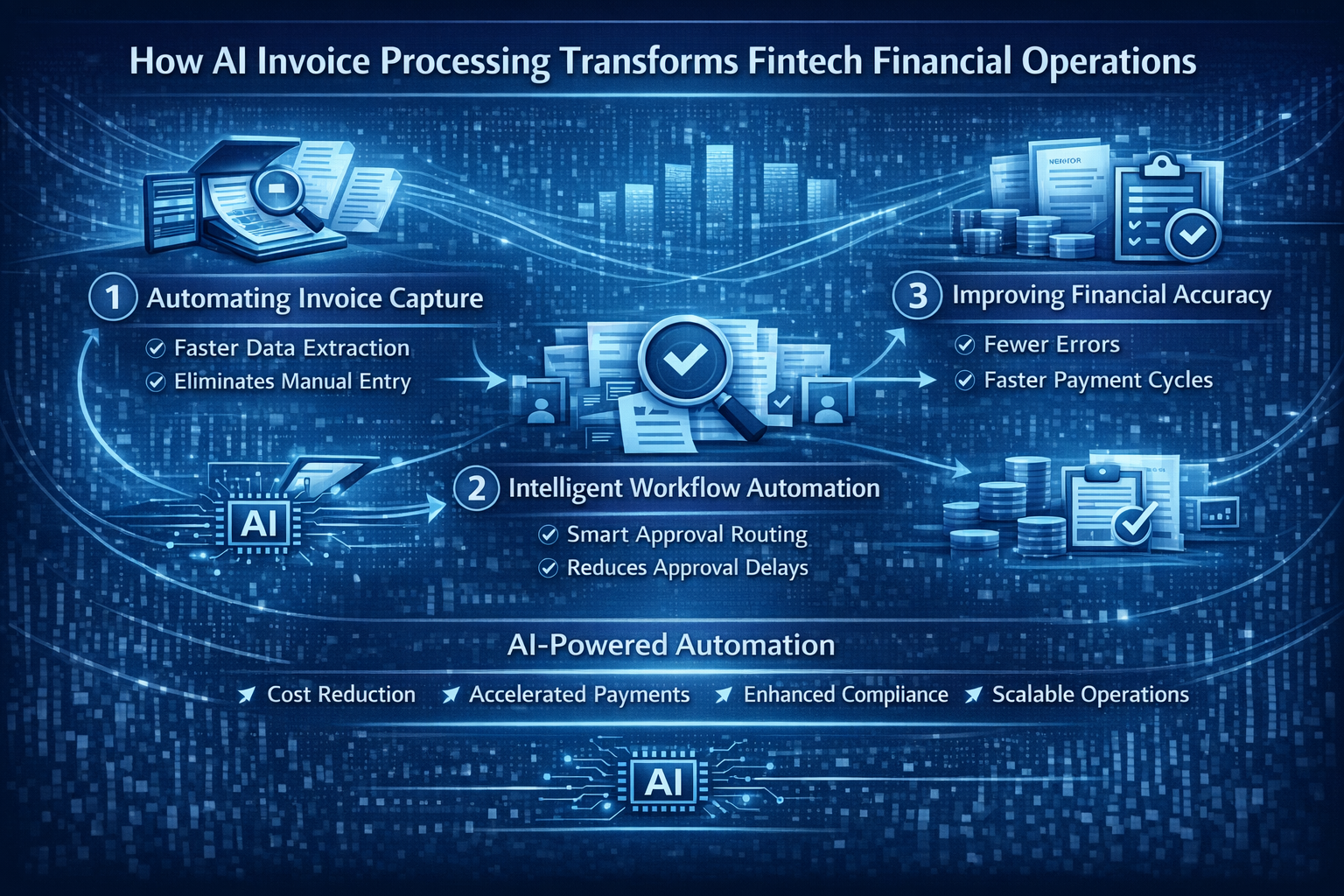
4.1 Automating Invoice Capture and Data Extraction
The first step in AI invoice automation is invoice capture and data extraction.
Using optical character recognition (OCR) and machine learning models, AI systems can extract key invoice data directly from documents such as PDFs, scanned invoices, and email attachments. This eliminates the need for manual data entry while ensuring that critical financial information is captured accurately.
Key fields extracted by AI systems typically include: vendor name, invoice number, invoice date, payment terms and invoice line items and totals
Because AI models can process unstructured documents with different layouts, they are capable of handling invoices from multiple vendors without requiring predefined templates.
This capability allows fintech companies to automatically process large volumes of invoices while significantly reducing the workload of accounts payable teams.
4.2 Intelligent Workflow Automation and Approval Routing
After invoice data is extracted, AI systems apply automated validation rules to verify the accuracy of the invoice.
These rule engines can perform tasks such as matching invoices with purchase orders, verifying payment amounts, checking vendor information and identifying duplicate invoices.
If the system detects anomalies or missing information, the invoice is flagged and routed to the appropriate approver for further review.
This smart approval routing ensures that invoices move through financial workflows efficiently while maintaining proper oversight and control. Instead of manually forwarding invoices through email chains, the system automatically assigns approvals to the relevant stakeholders based on predefined rules.
The result is a faster and more organized accounts payable workflow.
4.3 Improving Financial Accuracy and Operational Speed
One of the most significant benefits of AI-powered invoice processing is the improvement in both financial accuracy and processing speed.
Automated validation dramatically reduces the likelihood of duplicate payments, incorrect invoice data, or missed approval steps. At the same time, AI systems can process invoices in minutes rather than days, accelerating the entire accounts payable cycle.
Organizations that implement accounts payable automation can reduce invoice processing costs by up to 80% while significantly shortening processing times.
For fintech companies operating in competitive markets, these efficiency gains translate directly into operational advantages: faster vendor payments, improved financial reporting cycles, stronger compliance and audit readiness and reduced operational overhead.
By transforming invoice processing from a manual task into an intelligent automated workflow, fintech companies can build financial operations that are both scalable and resilient.
5. Case Study: Transforming Financial Document Processing with AI Invoice Automation
While the benefits of AI-powered invoice processing are increasingly recognized, real-world implementation provides the clearest evidence of its value. The following case study illustrates how a financial services organization successfully transformed its invoice verification workflow by adopting an AI-powered document processing solution.
5.1 Business Context: A Financial Advisory Firm Facing Invoice Processing Bottlenecks
A financial advisory firm based in Singapore was experiencing growing operational challenges as its business expanded. The company operated in the financial services and insurance sector, where invoice verification plays an important role in financial operations and vendor management.
Before implementing automation, the firm relied heavily on manual invoice verification carried out by experienced administrators. Every invoice required a manual “read-and-check” process where staff reviewed key fields such as: vendor information, invoice totals, payment details and supporting documentation.
This process was highly dependent on the experience and judgment of senior administrators, which created several operational issues.
First, the lack of standardized validation procedures led to inconsistent accuracy in invoice verification. Different administrators might interpret invoice data differently, resulting in variations in how invoices were checked and approved.
Second, the organization experienced operational bottlenecks during peak workload periods. Month-end processing cycles and vendor billing surges caused a spike in invoice volume. Because each invoice required manual verification and data entry, finance staff could not process invoices quickly enough to keep up with demand.
This created delays in invoice approvals and payment readiness, which in turn affected vendor relationships and financial operations.
Another significant issue was limited scalability. Since the process relied heavily on human review, invoice processing capacity was tied directly to the number of available administrators. Scaling the finance operation meant hiring additional staff, which increased operational costs.
Finally, manual invoice validation introduced financial and compliance risks. Errors in invoice checks could result in incorrect postings, payment disputes, or even improper payments. Invoice-related fraud and billing discrepancies are widely recognized risks that financial teams must actively manage.
To overcome these challenges, the firm decided to implement an AI-powered invoice extraction and validation system.
5.2 Implementing an AI-Powered Invoice Extraction and Validation System
To modernize its financial operations, the organization partnered with SmartDev to deploy an AI-assisted invoice processing solution designed to automate the invoice verification workflow.
The system introduced an intelligent invoice extraction and validation layer, powered by large language models and rule-based validation mechanisms. This technology enabled the system to automatically extract key invoice data from documents such as PDFs and scanned invoices.
Once extracted, the system applied predefined financial validation rules to ensure invoice accuracy and completeness before the invoice was marked as ready for payment.
Key validation capabilities included: checking for required invoice fields, verifying arithmetic calculations, validating vendor information, detecting inconsistencies or missing data and performing purchase-order matching where applicable (2-way or 3-way matching.
Instead of manually reviewing every invoice, administrators now received annotated outputs generated by the AI system. These outputs highlighted exactly which fields failed validation and explained why the invoice required review.
This approach transformed the role of finance administrators. Instead of spending time reviewing every invoice, staff could now focus on exception handling, reviewing only invoices flagged by the system.
Another important improvement was the standardization of validation logic. By embedding invoice checking rules directly into the system, the company converted tacit knowledge previously held by experienced staff into a repeatable and consistent automated process.
This also significantly improved training and onboarding for new administrators. Rather than relying on informal knowledge transfer, new staff could follow the standardized validation outcomes generated by the system.
5.3 Results: Faster Processing, Higher Accuracy, and Scalable Financial Operations
The implementation of the AI-powered invoice processing system produced measurable improvements across the organization’s financial workflows.
According to the results summarized in the case study, the system achieved:
- 93% document validation accuracy
- 70% reduction in human checking errors
- 40% reduction in manual review time
- 60% increase in document processing capacity
These improvements had a significant impact on the company’s financial operations.
First, the automation of invoice validation dramatically reduced the workload of finance administrators. By handling routine validation tasks automatically, the system allowed staff to focus on higher-value financial oversight activities.
Second, the improved validation accuracy reduced the likelihood of invoice errors, helping the company minimize payment discrepancies and financial risks.
Third, the increased processing capacity enabled the organization to handle higher invoice volumes without needing to expand its finance team. This made the financial operations more scalable and cost-efficient, particularly during peak invoice periods.
Most importantly, the AI system created a consistent system of record for invoice validation decisions, which strengthened financial governance and audit readiness. 
6. How Fintech Companies Can Successfully Adopt AI Invoice Processing
As fintech organizations continue to scale, adopting AI-powered financial automation is becoming a strategic priority. However, successful adoption requires careful planning and integration with existing financial workflows.
6.1 Start with High-Impact Financial Workflows
Fintech companies should begin by identifying high-volume financial processes where automation can deliver the most value.
Common starting points include: vendor invoice processing, accounts payable operations, expense management workflows and reconciliation and payment verification.
Automating these processes allows organizations to quickly reduce manual workloads while improving financial accuracy.
6.2 Integrate AI with Existing Financial Systems
For invoice automation to deliver its full benefits, it must integrate seamlessly with existing financial systems such as: ERP platforms, accounting software, procurement systems, payment platforms, …
By synchronizing validated invoice data with these systems, companies can ensure that financial information flows automatically across their operational ecosystem.
This integration creates a continuous financial workflow, from invoice capture and validation to approval routing and payment execution.
6.3 Build Scalable Financial Operations with AI
The long-term value of AI invoice processing lies in its ability to support scalable financial operations.
As fintech companies grow, invoice volumes increase along with vendor relationships, operational expenses, and compliance requirements. AI-driven automation allows organizations to manage this complexity without dramatically increasing administrative overhead.
Instead of expanding finance teams to keep pace with operational growth, fintech companies can rely on intelligent automation systems that standardize financial processes, maintain audit-ready documentation, improve operational transparency and reduce financial risks.
By transforming manual financial workflows into intelligent, automated systems, fintech companies can build a financial infrastructure capable of supporting long-term growth.
Conclusion
In an increasingly complex financial landscape, where speed, accuracy, and compliance are paramount, AI-powered invoice processing is not just an operational luxury; it is an essential tool for fintech companies aiming to scale effectively.
As we have seen, manual invoice processing introduces significant challenges, including inefficiency, error-prone workflows, compliance risks, and limited financial visibility. These issues are particularly critical in the fintech space, where companies must meet rigorous regulatory requirements while maintaining operational agility. AI-driven invoice automation solves these problems by reducing the manual workload, improving accuracy, and ensuring compliance with financial regulations such as GDPR and MiFID II.
Through the real-time validation of invoice data, automated approval workflows, and seamless ERP integration, fintech companies can achieve faster processing cycles, reduce errors, and enhance transparency. The AI-powered system enables financial teams to manage larger transaction volumes without increasing headcount, ensuring scalability as the company grows.
Moreover, by ensuring that all financial documentation is consistent, traceable, and compliant, AI-driven systems help fintech organizations maintain audit-ready operations and build trust with investors, partners, and customers. As regulatory requirements evolve and digital finance continues to grow, the role of AI in transforming financial operations will only increase.
SmartDev’s AI-powered invoice processing system has already proven its value in helping businesses overcome the challenges of manual document handling. The seamless automation and improved accuracy empower finance teams to focus on higher-value tasks, ensuring that financial operations remain aligned with best practices and regulatory standards.
Ready to leverage AI to optimize your fintech operations?
Contact SmartDev today to explore how our AI-powered invoice processing systems can help you improve your financial workflows, reduce operational costs, and ensure compliance—all while scaling for the future.