

BFSI compliance is a fundamental requirement for organizations operating in banking, financial services, and insurance. As financial ecosystems rapidly digitize, regulatory obligations have become more complex and dynamic. Institutions must now implement structured compliance frameworks supported by advanced technologies to ensure adherence to evolving legal and industry standards. The BFSI sector processes highly sensitive data, including personal identity information, financial transactions, and credit records, making compliance essential not only for avoiding penalties but also for protecting institutional credibility and customer trust. Research highlighted in the IBM banking AI report shows that financial organizations are increasingly leveraging artificial intelligence and digital platforms to improve operational performance while maintaining strict regulatory alignment.
Failure to maintain BFSI compliance can result in severe financial sanctions, legal exposure, and reputational damage that impacts long-term growth. More critically, weak compliance frameworks can increase vulnerability to fraud, cyberattacks, and data breaches, placing customers at significant risk. Modern compliance strategies now extend beyond manual audits and static documentation. They incorporate automated risk monitoring, AI-powered fraud detection, API security validation, cloud-based governance infrastructure, and continuous regulatory updates. Organizations adopting digitally enabled compliance frameworks benefit from greater operational agility, improved security posture, and faster regulatory approvals. Additional perspectives on modernization strategies can be found in Digital Transformation for BFSI.
Regulatory Framework Governing BFSI Compliance
1. Global Compliance Standards
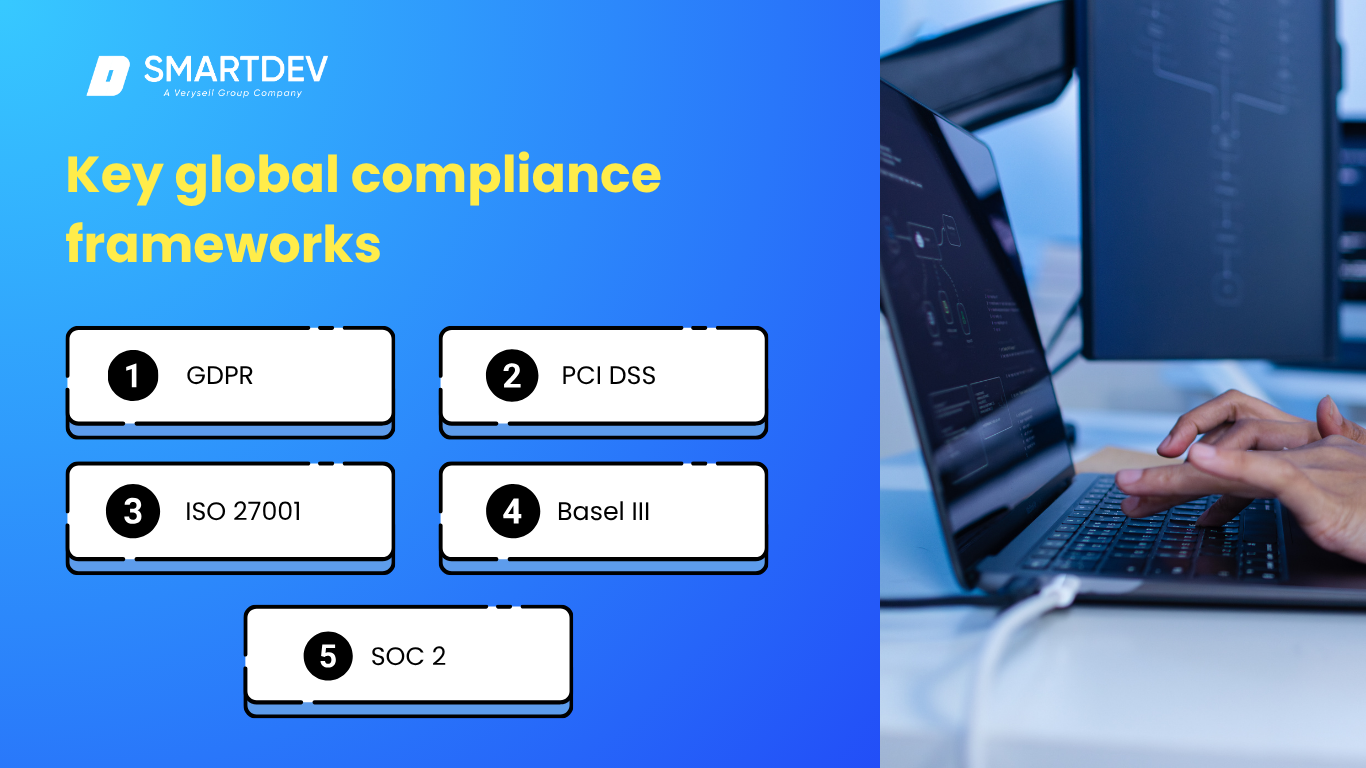 Financial institutions operate under strict international regulations designed to protect customer data, ensure financial stability, and reduce systemic risk. As digital banking expands, organizations must align with global standards to manage cybersecurity threats, fraud risks, and operational vulnerabilities.
Key global compliance frameworks include:
- GDPR – requires strict protection of personal data and transparent data usage policies
- PCI DSS – enforces secure handling of payment card information to reduce fraud risk
- ISO 27001 – establishes structured information security management processes
- Basel III – strengthens capital adequacy and risk control in banking institutions
- SOC 2 – ensures service providers maintain strong data security and privacy controls
These frameworks help organizations standardize risk governance, improve audit readiness, and build customer trust. The BFSI ecosystem is rapidly evolving due to digital transformation and fintech innovation, requiring institutions to continuously adapt their compliance strategies. The role of digital infrastructure in modern financial services is explained in Digital Transformation for BFSI, while the industry structure and scope are defined in What is BFSI domain and What is BFSI in banking.
2. Regional Regulations and Legal Requirements
Regional compliance regulations vary depending on jurisdiction, making compliance management more complex for global financial institutions. Each regulatory authority defines its own rules related to open banking, data protection, financial reporting, and cybersecurity standards.
Examples include:
- PSD2 (European Union) – requires secure APIs to enable open banking and third-party financial services integration
- Dodd-Frank Act (United States) – strengthens financial transparency and reduces systemic risk after the global financial crisis
- MAS regulations (Singapore) – support fintech innovation while maintaining strong governance standards
- RBI guidelines (India) – enforce cybersecurity resilience and financial risk monitoring requirements
Organizations operating across multiple regions must implement centralized compliance management supported by scalable infrastructure. Cloud environments designed for regulated industries help financial institutions meet security and governance requirements more efficiently. For example, regulated cloud architecture supports continuous compliance monitoring and secure data environments as discussed in Upsun compliant cloud with IBM.
3. Emerging Regulations for AI and Digital Banking
Artificial intelligence is transforming BFSI operations by improving fraud detection, credit scoring, and customer analytics. However, regulators increasingly require transparency and accountability in AI-driven decision-making systems.
Key regulatory focus areas include:
- Explainable AI models to ensure decision transparency
- Bias detection frameworks to prevent unfair lending or insurance decisions
- Responsible data governance across machine learning pipelines
- Auditability of automated decisions for regulatory review
AI adoption in financial services continues to grow as institutions seek to improve efficiency and customer experience. Research shows that AI enables faster data processing, improved risk prediction, and enhanced personalization in banking services as explained in AI in banking by Salesforce. AI-driven innovation is also reshaping financial infrastructure, enabling intelligent automation and predictive analytics across banking operations as described in AI in BFSI technology guide and market adoption trends highlighted in AI and machine learning in BFSI market.
Core Components of an Effective BFSI Compliance Strategy
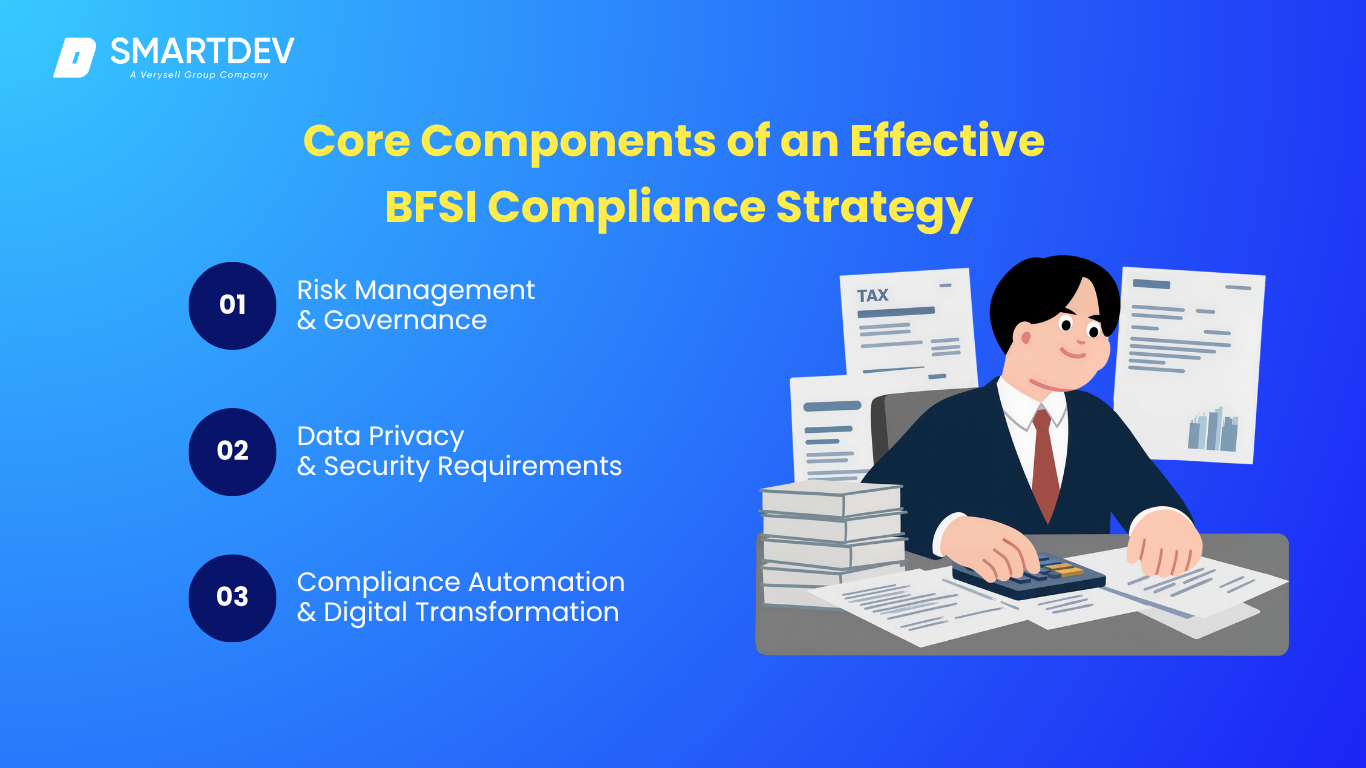 1. Risk Management and Governance
Risk management and governance form the backbone of any effective BFSI compliance strategy. Financial institutions operate in environments exposed to operational risk, cybersecurity threats, regulatory changes, and financial fraud. Without a structured governance framework, organizations may struggle to identify vulnerabilities or respond quickly to compliance breaches.
An effective governance model ensures that policies, procedures, and internal controls align with regulatory expectations. It also helps institutions maintain audit readiness and demonstrate transparency to regulatory bodies. Strong governance structures typically include defined compliance roles, risk assessment processes, incident reporting protocols, and regular policy reviews.
Risk management becomes particularly important as financial services expand into digital platforms such as mobile banking, digital wallets, and fintech ecosystems. Organizations must continuously evaluate risks related to technology adoption, third-party integrations, and evolving cyber threats.
Example: Financial institutions adopting digital platforms must integrate compliance controls into transformation strategies to reduce operational risks. A structured transformation roadmap such as the one described in Digital Transformation for BFSI helps organizations embed compliance into system architecture and governance workflows.
2. Data Privacy and Security Requirements
Data protection is one of the most critical pillars of BFSI compliance. Financial organizations handle highly sensitive information, including customer identities, financial transactions, credit histories, and insurance records. Protecting this data requires a combination of regulatory compliance, cybersecurity practices, and secure software development processes.
Security frameworks such as encryption standards, identity access management, and continuous vulnerability testing help prevent unauthorized access and data breaches. Regulatory frameworks including GDPR and PCI DSS emphasize strict protection of personal and financial information, requiring organizations to implement strong data governance mechanisms.
APIs also introduce new security risks because financial institutions increasingly rely on third-party integrations for payments, customer verification, and open banking services. Ensuring API integrity through structured validation and testing is essential to maintaining secure data exchange.
Example: Security testing methodologies such as penetration testing, regression testing, and vulnerability assessment are commonly used to ensure compliance with data protection standards. Practical implementation approaches are described in Software Testing for BFSI and API validation frameworks outlined in API Testing Platforms for BFSI.
3. Compliance Automation and Digital Transformation
Manual compliance processes are no longer sufficient to manage the complexity of modern financial regulations. Automation technologies enable organizations to continuously monitor compliance status, detect anomalies, and generate audit-ready reports in real time. Compliance automation reduces human error while improving efficiency and regulatory accuracy.
Digital transformation plays a key role in enabling automated compliance workflows. Cloud infrastructure, AI-driven analytics, and intelligent monitoring tools allow financial institutions to track regulatory changes and ensure continuous adherence to compliance requirements. Automation also supports faster product releases while maintaining regulatory alignment.
AI-powered compliance tools can analyze transaction data, identify suspicious patterns, and support fraud prevention strategies. These tools improve decision accuracy and allow organizations to respond to compliance risks proactively rather than reactively.
Example: AI adoption in financial services supports automated compliance monitoring and predictive risk detection. Implementation strategies for intelligent automation are demonstrated in AI in BFSI Technology Guide, while security-focused automation practices are explained in Automated Security Testing in BFSI.
BFSI Compliance Market Data and Industry Trends
The BFSI compliance market is expanding rapidly as financial institutions increase investment in regulatory technology (RegTech), artificial intelligence, and cloud-based compliance infrastructure. Stricter global regulations, the growth of digital banking, and rising cyber threats are forcing organizations to adopt modern compliance solutions that provide real-time monitoring and automated risk detection.
1. Rapid Growth of the RegTech Market
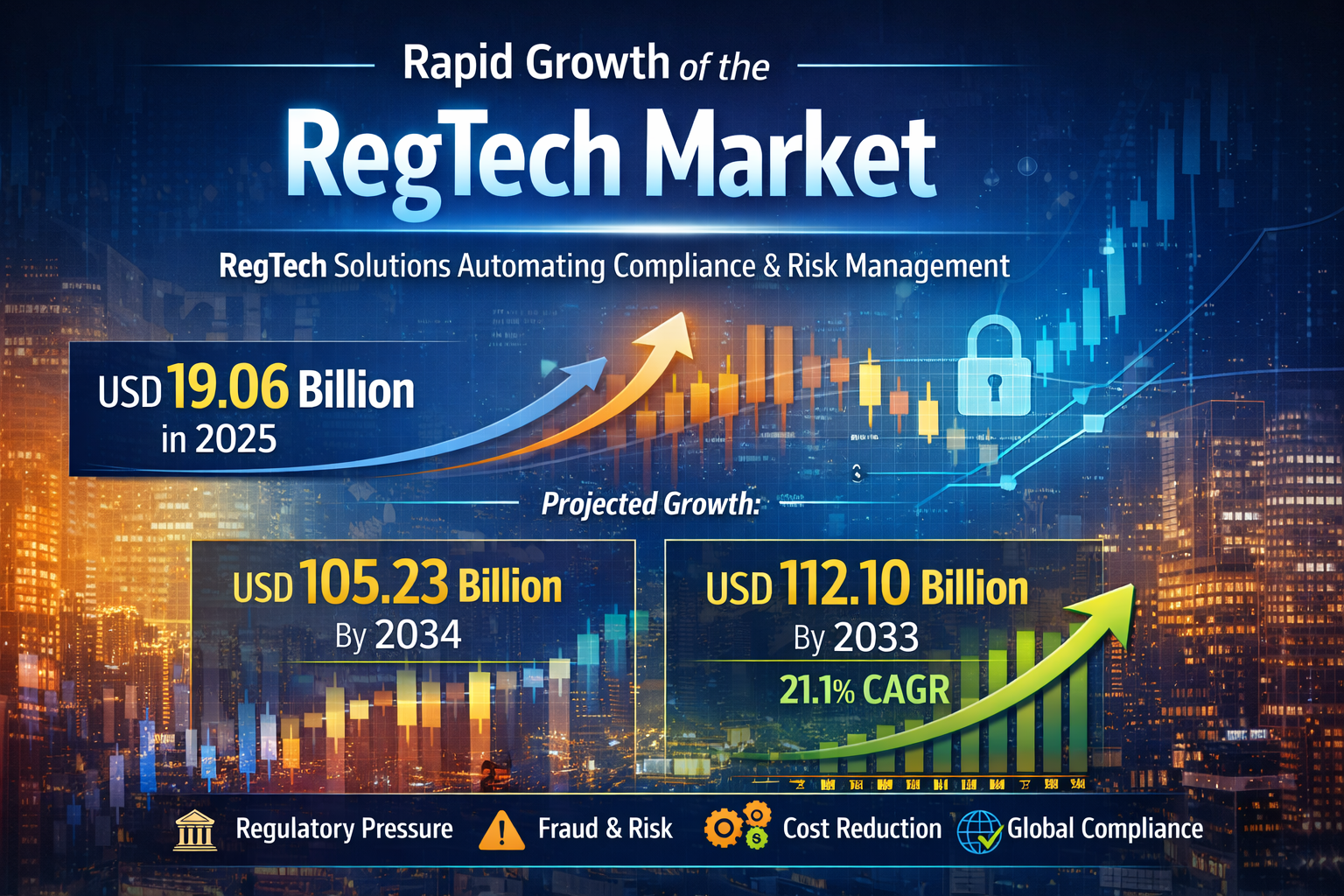 Regulatory Technology (RegTech) is one of the fastest-growing segments in the financial technology ecosystem. RegTech solutions help automate compliance workflows such as KYC verification, AML screening, transaction monitoring, and regulatory reporting.
- The global RegTech market size reached USD 19.06 billion in 2025
- The market is expected to grow to USD 105.23 billion by 2034, representing a strong long-term investment trend
- Another forecast estimates the market could reach USD 112.10 billion by 2033 with a 21.1% CAGR
This growth is driven by increased regulatory pressure, rising fraud risks, and the need to reduce manual compliance costs. Financial institutions are using RegTech tools to improve reporting accuracy and maintain continuous compliance across multiple jurisdictions.
2. AI Adoption Accelerating Compliance Automation
Artificial intelligence is playing an increasingly important role in BFSI compliance. AI systems can analyze large volumes of financial transactions in real time, helping organizations detect fraud patterns and identify compliance risks faster than traditional systems.
- The global AI in BFSI market reached USD 26.2 billion in 2024
- The market is projected to grow to USD 192.7 billion by 2034
- Financial institutions invested approximately USD 35 billion in AI technologies in 2023
AI technologies help automate key compliance functions such as:
- Fraud detection and prevention
- Credit risk modeling
- Suspicious transaction monitoring
- Regulatory reporting automation
AI also improves decision accuracy by identifying anomalies in customer behavior and financial transactions. According to AI in banking by Salesforce, AI supports faster decision-making while improving customer experience and operational efficiency.
3. Cloud Compliance Infrastructure Becoming Industry Standard
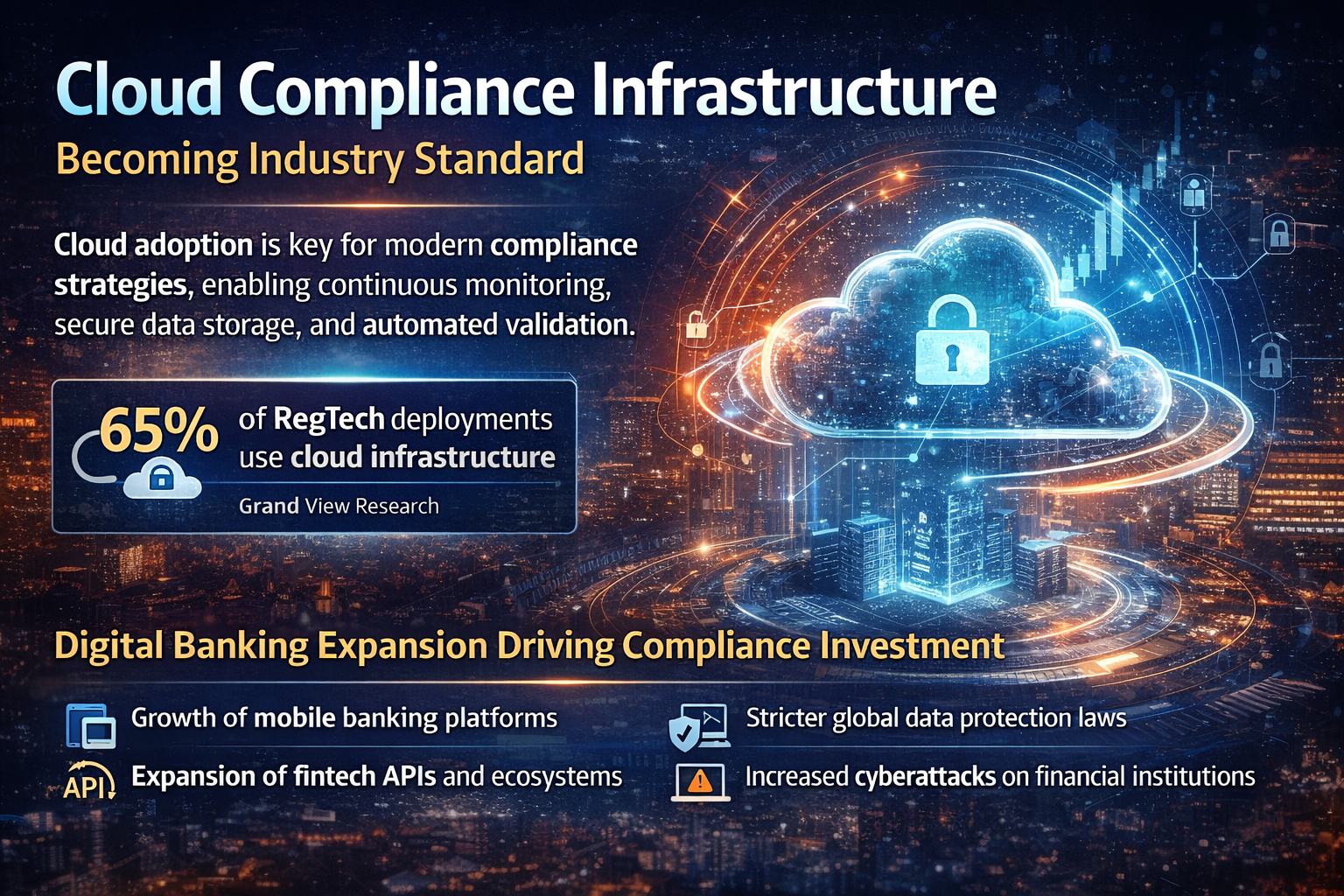 Cloud computing has become a key enabler of modern compliance strategies. Cloud-native infrastructure allows financial institutions to implement continuous monitoring, secure data storage, and automated compliance validation.
Key cloud adoption data:
- Approximately 65% of RegTech deployments use cloud infrastructure due to scalability and flexibility (Grand View Research)
- Cloud environments support real-time policy enforcement and secure storage aligned with regulatory requirements (Upsun regulated cloud architecture)
Cloud platforms also enable integration with AI tools that enhance predictive risk analytics and automate compliance monitoring processes.
4. Digital Banking Expansion Increasing Compliance Investment
The rapid growth of digital banking services, fintech applications, and mobile payments has increased the need for stronger compliance frameworks. Financial institutions must ensure secure API integrations, identity verification controls, and transaction monitoring systems meet regulatory requirements.
Key digital transformation drivers include:
- Growth of mobile banking and digital payment platforms
- Expansion of open banking APIs and fintech ecosystems
- Stricter global data protection regulations
- Increased cyberattack frequency targeting financial institutions
Digital transformation is reshaping how financial institutions manage compliance risk and regulatory reporting processes. Technologies such as AI-driven analytics and automated testing tools help organizations improve security resilience while accelerating product innovation. Implementation strategies are discussed in Digital Transformation for BFSI and AI in BFSI technology guide.
Key Insights from Current Market Data
Market statistics show that BFSI compliance is increasingly technology-driven. Financial institutions are investing heavily in AI, RegTech, and cloud infrastructure to improve regulatory accuracy and reduce compliance risks.
Major investment priorities include:
- AI-powered fraud detection systems
- Automated regulatory reporting tools
- Cloud-native compliance infrastructure
- API security testing for open banking ecosystems
- Continuous monitoring platforms for regulatory updates
These trends confirm that compliance is no longer just a legal obligation but a strategic capability that improves operational efficiency, strengthens customer trust, and supports sustainable growth in digital financial services.
Explore how SmartDev partners with BFSI teams through a focused AI sprint to validate use cases, align stakeholders, and define a clear path forward before AI development begins.
SmartDev helps BFSI organizations clarify AI use cases and assess feasibility, enabling confident decisions and reducing risks before committing to AI development.
Learn how SmartDev accelerates AI initiatives, ensuring rapid deployment and reduced time to market.
Strengthen Your BFSI Security Testing with UsBest Practices for BFSI Compliance Implementation
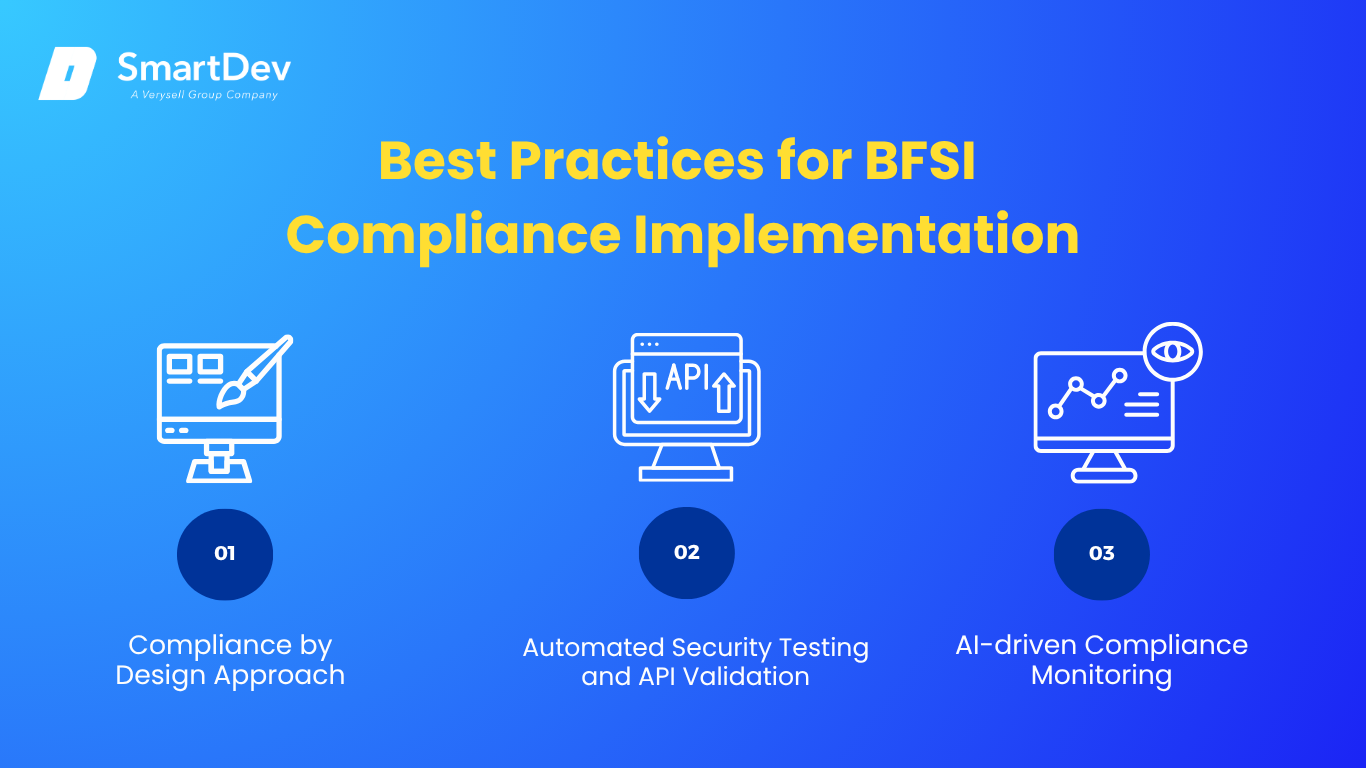 1. Compliance by Design Approach
Compliance by design means integrating regulatory requirements directly into the software development lifecycle instead of treating compliance as a final checkpoint. This approach helps BFSI organizations reduce legal risks, accelerate product approvals, and maintain consistent security standards across digital platforms.
By embedding compliance controls early, teams can ensure that systems meet data protection regulations, identity verification requirements, and audit standards from the beginning. This reduces costly fixes after deployment and improves long-term scalability.
Key implementation practices include:
- Defining compliance requirements during product architecture planning
- Integrating security validation into CI/CD pipelines
- Documenting audit trails across development stages
- Applying role-based access control to sensitive financial data
For example, structured validation processes described in BFSI app testing mobile and web guide show how early testing improves regulatory readiness and reduces vulnerabilities in digital banking applications. Organizations modernizing their infrastructure also apply compliance-first architecture as part of broader transformation initiatives outlined in Digital transformation for BFSI.
2. Automated Security Testing and API Validation
Automation plays a critical role in ensuring BFSI systems remain compliant with evolving cybersecurity and financial regulations. As financial services increasingly rely on APIs for payments, identity verification, and third-party integrations, organizations must continuously validate system security to prevent data breaches and service disruptions.
Automated testing ensures that compliance controls remain consistent across system updates while reducing manual testing effort.
Common automated testing methods include:
- Penetration testing to identify vulnerabilities in financial applications
- Regression testing to ensure updates do not introduce compliance risks
- API security testing to validate authentication and data encryption protocols
- Performance testing to maintain reliability under high transaction loads
API ecosystems are particularly important in open banking environments, where secure data exchange is required between financial institutions and external platforms. Implementation frameworks discussed in API testing platforms for BFSI highlight how structured API validation improves system reliability. Security-focused QA strategies described in Software testing for BFSI methodologies help ensure compliance with PCI DSS and ISO 27001 standards. Additional automation practices can be found in Best practices for automated security testing in BFSI.
3. AI-driven Compliance Monitoring
Artificial intelligence is increasingly used to automate compliance monitoring and improve risk detection accuracy. AI-powered systems analyze large volumes of financial data to identify anomalies, suspicious transactions, and potential regulatory violations in real time.
These technologies help financial institutions reduce manual compliance workload while improving decision accuracy across fraud detection, credit risk assessment, and transaction monitoring.
Typical AI-driven compliance capabilities include:
- Real-time fraud detection using behavioral analytics
- Predictive risk scoring models
- Automated monitoring of suspicious transactions
- Continuous compliance validation across digital systems
Machine learning models can detect unusual patterns faster than traditional rule-based systems, enabling faster response to compliance threats. AI adoption strategies described in AI in BFSI technology guide show how intelligent automation supports regulatory monitoring and operational efficiency. Market adoption trends highlighted in AI and machine learning in BFSI market demonstrate increasing investment in predictive analytics tools for compliance and risk management.
Role of Technology in BFSI Compliance
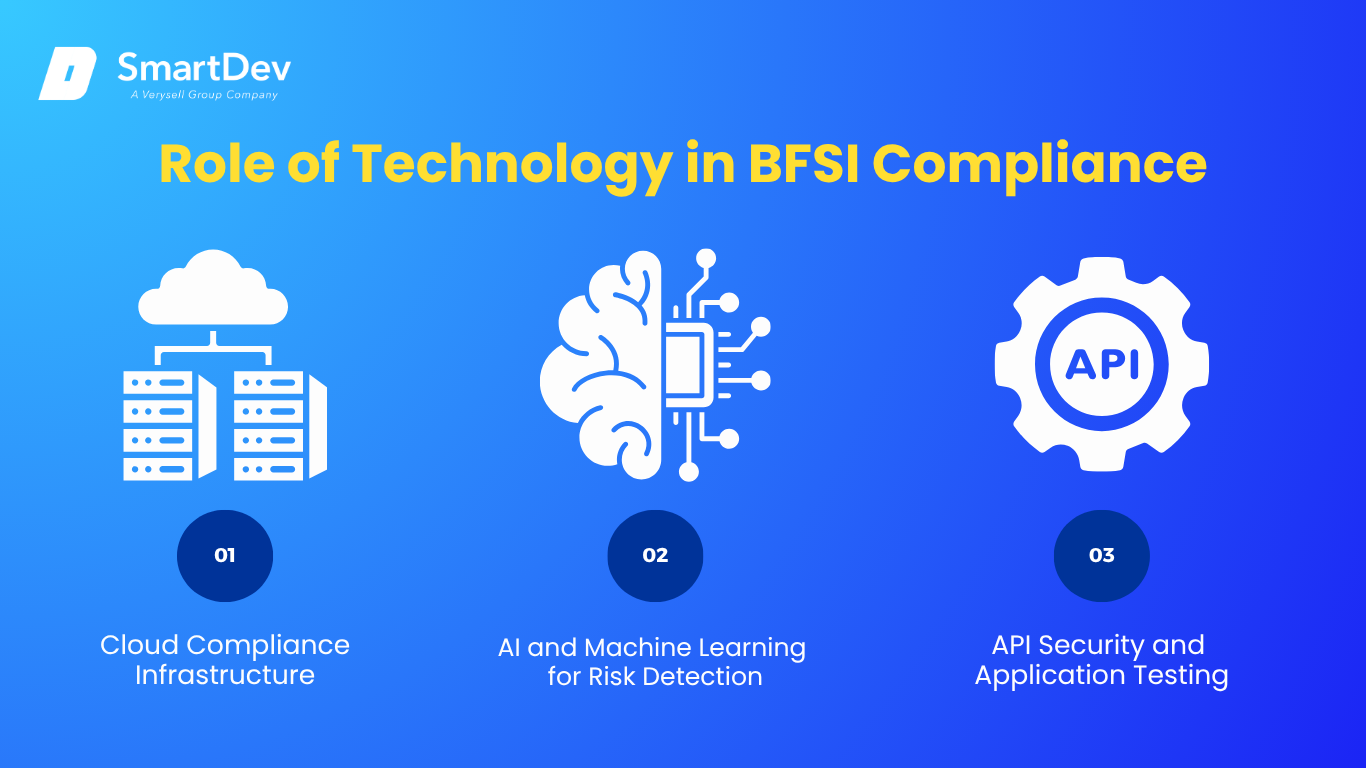 1. Cloud Compliance Infrastructure
Cloud technology has become a foundational element in modern BFSI compliance strategies because it enables financial institutions to maintain secure, scalable, and continuously monitored environments. Compared to traditional infrastructure, cloud platforms provide built-in mechanisms that support regulatory requirements related to data protection, risk management, and operational transparency. Financial institutions can centralize compliance controls, monitor system activities in real time, and ensure that sensitive financial data is protected through encryption and access control policies.
Cloud-based environments also simplify compliance audits by maintaining detailed activity logs and automated reporting systems. These capabilities allow organizations to demonstrate accountability to regulators without relying heavily on manual documentation processes. Regulated cloud architectures are designed to meet strict industry standards, helping financial organizations maintain resilience while adapting to evolving regulatory expectations. An example of how cloud infrastructure supports regulated environments can be seen in Upsun compliant cloud with IBM. Cloud adoption is often part of broader modernization initiatives that strengthen compliance frameworks through scalable digital infrastructure, as described in Digital transformation for BFSI.
2. AI and Machine Learning for Risk Detection
Artificial intelligence and machine learning technologies are significantly improving how financial institutions manage compliance risks. These technologies enable organizations to analyze large volumes of transactional and behavioral data in real time, making it easier to detect irregular activities that may indicate fraud, identity theft, or regulatory violations. Traditional rule-based compliance systems often struggle to adapt quickly to new risk patterns, while machine learning models continuously improve accuracy by learning from historical data.
AI-driven risk detection enhances decision-making processes across multiple financial operations, including anti-money laundering monitoring, credit scoring validation, and customer identity verification. Predictive analytics models help institutions identify potential risks earlier, allowing compliance teams to respond proactively rather than reactively. AI solutions also improve operational efficiency by reducing manual review workloads and enabling continuous monitoring across digital platforms. The role of intelligent automation in financial services is explained in AI in BFSI technology guide, while broader adoption of AI-driven decision systems in financial institutions is discussed in AI in banking by Salesforce.
3. API Security and Application Testing
Application programming interfaces have become essential components of digital banking ecosystems, enabling secure communication between financial platforms, mobile applications, and third-party service providers. However, increased connectivity also introduces new compliance challenges related to data integrity, authentication, and transaction security. Financial institutions must ensure that APIs meet regulatory requirements for protecting sensitive financial information and preventing unauthorized access.
Continuous testing plays a critical role in maintaining secure API ecosystems. Validation processes help ensure that authentication protocols function correctly, encryption standards protect data exchanges, and system performance remains stable during high transaction volumes. Effective testing strategies also support regulatory compliance by identifying vulnerabilities before systems are deployed in production environments.
Structured API validation frameworks described in API testing platforms for BFSI demonstrate how financial institutions can secure digital integrations across fintech ecosystems. Quality assurance methodologies outlined in Software testing for BFSI methodologies highlight how continuous application testing improves both compliance readiness and long-term system reliability.
Why Companies Should Choose SmartDev for BFSI Compliance
 Selecting the right technology partner plays a critical role in achieving sustainable BFSI compliance. Financial institutions must ensure that their systems meet strict regulatory requirements while maintaining high performance, strong security, and scalability. SmartDev provides specialized expertise in BFSI software development, testing, and digital transformation, helping organizations build compliant systems aligned with global standards.
Below are four key reasons why companies choose SmartDev as a compliance-focused technology partner.
1. Deep Expertise in BFSI Domain and Regulatory Requirements
SmartDev has strong experience working with banking, financial services, and insurance organizations, enabling teams to understand complex regulatory requirements such as data protection, transaction security, and risk governance. Industry knowledge allows SmartDev to design solutions that align with compliance standards while supporting innovation in fintech ecosystems.
Organizations operating in digital banking, payments, and financial platforms benefit from domain-specific expertise explained in What is BFSI domain and broader industry structure described in What is BFSI in banking. This expertise helps ensure that compliance requirements are integrated into system architecture from the beginning.
2. Strong QA and Security Testing Capabilities
Security testing plays a central role in maintaining compliance across financial applications. SmartDev applies structured testing methodologies that help organizations detect vulnerabilities early and maintain consistent compliance with security standards such as PCI DSS and ISO 27001.
Comprehensive testing frameworks include API testing, performance validation, and security assessment across mobile and web applications. Implementation approaches outlined in Software testing for BFSI methodologies demonstrate how structured QA processes improve reliability and reduce compliance risks. Advanced validation strategies in API testing platforms for BFSI also support secure integration across fintech ecosystems.
3. Advanced Technology Integration with AI and Automation
SmartDev supports organizations implementing AI-driven compliance monitoring and automation technologies. Intelligent automation helps financial institutions detect anomalies, monitor regulatory changes, and improve fraud detection accuracy. These capabilities reduce manual compliance workload and improve operational efficiency.
AI adoption strategies explained in AI in BFSI technology guide demonstrate how predictive analytics improves risk detection and compliance decision-making. Automation frameworks described in Best practices for automated security testing in BFSI help ensure continuous compliance validation across digital systems.
4. Proven Experience Supporting Digital Transformation in Financial Services
Digital transformation is closely connected to compliance modernization. Financial institutions adopting cloud infrastructure, API ecosystems, and AI technologies must ensure regulatory requirements are maintained throughout the transformation process. SmartDev supports organizations in building scalable infrastructure that aligns with compliance frameworks while improving performance and customer experience.
Modernization strategies described in Digital transformation for BFSI highlight how structured architecture enables continuous compliance monitoring and secure product deployment. SmartDev’s experience across payments and financial platforms also supports secure transaction processing as outlined in BFSI payments solutions.
By combining BFSI domain expertise, advanced testing capabilities, AI-driven automation, and digital transformation experience, SmartDev enables financial institutions to reduce compliance risks while accelerating innovation in highly regulated environments.
Conclusion
BFSI compliance has become a strategic priority as financial institutions navigate increasingly complex regulatory environments while accelerating digital transformation initiatives. The integration of technologies such as AI, cloud infrastructure, and automated testing frameworks is reshaping how organizations manage regulatory obligations, detect risks, and protect sensitive financial data. Institutions that embed compliance into system architecture from the beginning can improve operational resilience, strengthen customer trust, and reduce long-term compliance costs. As financial ecosystems continue to evolve, organizations must adopt proactive compliance strategies that align with both global standards and regional regulatory requirements.
Technology partners with strong BFSI expertise play an important role in supporting sustainable compliance implementation. By leveraging structured QA methodologies, AI-driven monitoring tools, and scalable cloud infrastructure, financial institutions can maintain continuous compliance while supporting innovation in digital banking and fintech services. Solutions such as those described in Digital transformation for BFSI and AI in BFSI technology guide demonstrate how modern compliance frameworks enable organizations to remain competitive in a rapidly evolving financial landscape.