
TL, DR:
- AI in fashion is not one initiative. It spans design, merchandising, commerce, operations, and circularity, and each area needs a different capability: computer vision, generative AI, forecasting models, or decision automation.
- Virtual try-on and fit recommendation currently show the clearest return because they attack a costly, well-measured problem: size-driven returns.
- Selection beats enthusiasm. Score candidate use cases on value, feasibility, risk, and time-to-value before committing budget to any single one.
- Case-study numbers travel poorly. A 90% cost cut at one retailer reflects that company’s baseline, data maturity, and category – verify transferability before you plan around someone else’s result.
- Governance is not optional overhead. Data rights, biometric consent, generated-content disclosure, and bias review all carry legal exposure under frameworks such as the EU AI Act.
- Pilots need a decision gate, not just a launch date. Define the baseline, KPI, and owner before day one, so scaling is a data-backed decision, not a guess.
- ROI measurement should match the use-case category. Commercial, product/supply-chain, and creative/operating metrics answer different questions and shouldn’t be blended into one generic “AI impact” number.
Introduction
Fashion leaders face a difficult trade-off every season. They must respond quickly to trends while avoiding costly markdowns. Meanwhile, trend cycles continue to shorten, return rates reduce margins, and design teams face growing pressure to produce more concepts in less time. As a result, AI now supports every stage of the fashion value chain, from design and merchandising to size recommendations and inventory decisions.
However, the real question is no longer whether AI works in fashion. Companies such as Zara, Stitch Fix, Nike, and Zalando have already demonstrated its value. Instead, organizations must decide which use case to prioritize first. They must also evaluate vendor claims, assess implementation risks, and prevent generative AI from creating brand, legal, or bias issues.
Therefore, this guide provides a practical framework for fashion executives, merchandising leaders, and product teams. It explains where AI creates measurable value across the fashion value chain. It also covers use-case prioritization, pilot planning, governance requirements, and performance measurement for responsible AI adoption.
For a broader view of how AI performs across other sectors, SmartDev’s AI use cases hub documents real-world implementations with measurable outcomes across more than 30 industries.
Where AI Creates Value in Fashion
AI creates value in fashion by automating five distinct functions across the value chain: design, merchandising, commerce, operations, and circularity. Each function draws on a different core technology, so the first step toward a working AI strategy is mapping capability to outcome rather than adopting AI as a single generic upgrade.
AI across the fashion value chain: design, merchandising, commerce, operations, and circularity
Design teams use generative AI and computer vision to speed up concept generation and trend spotting. Merchandising teams use forecasting models to align stock with demand. Commerce teams use recommendation engines and virtual try-on to personalize the shopping experience. Operations teams use decision automation to plan logistics and replenishment. Circularity teams use image recognition and robotics to sort and recycle textiles at scale.
AI supports every stage of the fashion value chain through different technologies and business functions. Design teams use generative AI and computer vision for trend detection and rapid concept generation. Merchandising relies on machine learning to improve demand forecasting, assortment planning, and pricing decisions. Meanwhile, commerce combines recommendation engines with computer vision to deliver personalized discovery and virtual try-on experiences. Operations apply decision automation to optimize allocation, replenishment, and logistics. Finally, circularity uses image recognition and robotics to automate fiber sorting and textile-to-textile recycling.
These capabilities also reinforce one another through continuous feedback loops. Sell-through data improves merchandising forecasts, while return and fit data refine commerce models. As a result, AI systems become more accurate over time by learning from real business outcomes instead of one-time training.
The core AI capabilities behind fashion use cases: machine learning, computer vision, generative AI, and decision automation
Four technologies do most of the work. Machine learning finds patterns in sales, browsing, and returns data to power forecasting and personalization. Computer vision reads images, video, and body dimensions to power visual search, fit, and quality inspection. Generative AI produces new text, images, or 3D assets for design, copywriting, and marketing content. Decision automation turns model output into an action, such as a reorder or a price change, with rules that define how much autonomy the system holds.
What has changed: AI-enabled discovery, content creation, and customer interaction
Three shifts separate today’s fashion AI from the AI of five years ago. First, generative models now produce usable campaign imagery, not just internal concept sketches. Second, conversational interfaces let shoppers describe what they want in plain language instead of filtering by category. Third, models increasingly act rather than only recommend, triggering a reorder or a markdown without waiting for a human to click confirm.
Evidence and adoption context
Adoption is accelerating quickly, but unevenly. The global AI-in-fashion market was valued at roughly $2.23 billion in 2024, with Precedence Research projecting growth toward $60 billion by 2034. On generative AI specifically, Business of Fashion’s State of Fashion research found 73% of fashion executives ranked it a top priority in 2024, while only 28% had moved it into active product development – a gap between intent and execution that shows up repeatedly in later sections. Morgan Stanley tracked a sharper jump on the ground: the share of consumer durables and apparel companies it classifies as AI adopters more than doubled from 20% to 44% during the first half of 2025. At the sector-value level, McKinsey estimates generative AI alone could add $150 billion to $275 billion to apparel, fashion, and luxury operating profits within three to five years.
Takeaway: AI in fashion is a portfolio of five value-chain capabilities, not one tool. Match the technology to the function before comparing vendors, and treat adoption statistics as directional context, not a promise of automatic results for your own operation.
The Highest-Value AI Use Cases for Fashion Businesses
The highest-value fashion AI use cases fall into four groups, organized by the business problem they solve rather than by the technology behind them: product development, customer experience, merchandising and supply chain, and AI-generated content. Grouping this way keeps a merchandising leader from having to evaluate a design tool against a fit-recommendation tool on the same terms.
Design, trend intelligence, and product development
Trend forecasting tools scan social platforms, runway imagery, and sales signals to identify emerging colors, silhouettes, and materials before mainstream demand appears. As a result, brands can commit design resources earlier and with greater confidence. AI-assisted design tools also generate and test hundreds of design variations from a mood board or text prompt, reducing iteration time from days to hours.
For example, IBM and Tommy Hilfiger’s collaboration with the Fashion Institute of Technology analyzed 15,000 runway and product images to inspire new collections. Forbes reports that the project cut the design-to-sample cycle by roughly 30%. Meanwhile, computer vision automatically tags product attributes such as color, pattern, and silhouette, creating consistent data for search, merchandising, and recommendation systems.
Fit, discovery, and customer experience
Virtual try-on and fit recommendation use computer vision and body-measurement models to show how garments fit before purchase. As a result, retailers can reduce online return rates caused by sizing issues. For example, Nike’s Nike Fit scans a customer’s foot with a smartphone camera and recommends shoe sizes with sub-2-millimeter accuracy. Forbes reported that the technology addresses one of the leading causes of footwear returns: sizing mismatch.
Personalized recommendation engines combine collaborative filtering with behavioral data to tailor product suggestions. Meanwhile, conversational shopping lets customers describe styles or occasions in natural language instead of browsing categories. For example, Stitch Fix combines AI recommendations with human stylists, increasing average order value by 9% while maintaining roughly two-thirds repeat-customer retention. For a deeper look at AI-powered personalization, see SmartDev’s guide to AI-driven customer experience.
Merchandising, inventory, and supply-chain decisions
Assortment, pricing, and automated merchandising tools adjust product placement, pricing, and catalog displays in near real time based on customer behavior. Meanwhile, demand forecasting, allocation, and replenishment models predict what will sell in each location. As a result, retailers can restock faster with less guesswork. For example, Zara analyzes sales across more than 7,000 stores and supports 10-to-15-day restock cycles. This approach contributes to an estimated 85% full-price sell-through rate, compared with an industry average of about 60%.
AI also strengthens the reverse side of the fashion value chain. Better fit prediction reduces returns at the source, while AI-powered sorting systems improve textile-to-textile recycling. For example, Refiberd’s hyperspectral imaging technology increases material-sorting accuracy. The company was also recognized as a CFDA Circular Fashion Innovator, highlighting its contribution to circular-fashion innovation.
Together, these capabilities improve both commercial performance and sustainability. They help retailers reduce waste, optimize inventory, and recover more value from returned products. For a deeper look at how AI transforms merchandising and the broader shopping experience, see SmartDev’s guide to AI in retail.
AI-generated fashion content and digital models
Generative AI now produces campaign imagery, product photography variations, and digital models at a speed and cost traditional photoshoots cannot match. Zalando used generative AI to produce editorial images aligned with real-time trends, and by 2024 more than 70% of its campaign visuals were AI-generated, cutting production lead time from weeks to days and reducing related costs by roughly 90%, Reuters reported.
That speed comes with a trade-off: brands using AI-generated models face growing scrutiny over authenticity and diversity, and The Guardian documented industry pushback when disclosure and labor concerns go unaddressed. Creative speed has to be paired with brand, rights, and disclosure controls, a tension Section 5 covers directly. SmartDev’s generative AI development services build disclosure and rights-review steps into content pipelines from the start.
| Use case | Business value | Data requirement | Complexity | Primary risk | Typical KPI |
|---|---|---|---|---|---|
| Trend forecasting | Earlier, better-informed design bets | Social, runway, sales signals | Medium | Bias toward visible/Western trend sources | Forecast accuracy |
| Virtual try-on & fit | Lower returns, higher purchase confidence | Body dimensions, garment specs | High | Biometric privacy, imaging bias | Return rate |
| Personalized recommendations | Higher conversion, higher AOV | Browsing & purchase history | Medium | Data protection, filter bubbles | Conversion rate, AOV |
| Demand forecasting & allocation | Lower markdowns, higher sell-through | POS, inventory, external signals | High | Model drift, data fragmentation | Sell-through, forecast error |
| AI-generated content | Faster, cheaper campaign production | Brand assets, style guidelines | Medium | Disclosure, IP, representation | Production cost, cycle time |
Takeaway: Each use case category solves a distinct business problem with a distinct data requirement and risk profile. Compare candidates against value, data readiness, and risk together, never pick a use case on projected ROI alone.
How to Choose the Right Fashion AI Use Case
Choosing the right first AI use case starts with the business constraint you most need to fix, not with the most impressive technology on the market. A retailer bleeding margin on returns should look first at fit and virtual try-on; a retailer sitting on excess inventory should look first at forecasting and allocation.
Start with the business constraint: conversion, returns, stock, speed, waste, or customer service
Name the constraint precisely before evaluating any vendor. “Improve customer experience” is too broad to act on; “cut footwear return rate by three points” is specific enough to size a use case, set a baseline, and know when a pilot has succeeded or failed.
Assess data, integration, governance, and operating readiness
A promising use case still fails if the underlying data is fragmented across disconnected systems, a common problem across fashion brands storing product, customer, and trend data in separate silos. Before funding a pilot, confirm the data exists, is accessible, and is clean enough to train or evaluate a model, and confirm who owns governance decisions once the system goes live. SmartDev’s guide on unlocking value from unstructured data covers how to prepare image, text, and video data most fashion AI use cases depend on.
Use-case prioritization scorecard: value, feasibility, risk, and time-to-value
Score every candidate use case on four dimensions: expected business value, feasibility given current data and systems, risk exposure, and time-to-value. Plotting value against feasibility gives a fast visual read on where to start, while risk and time-to-value refine the final sequencing decision.
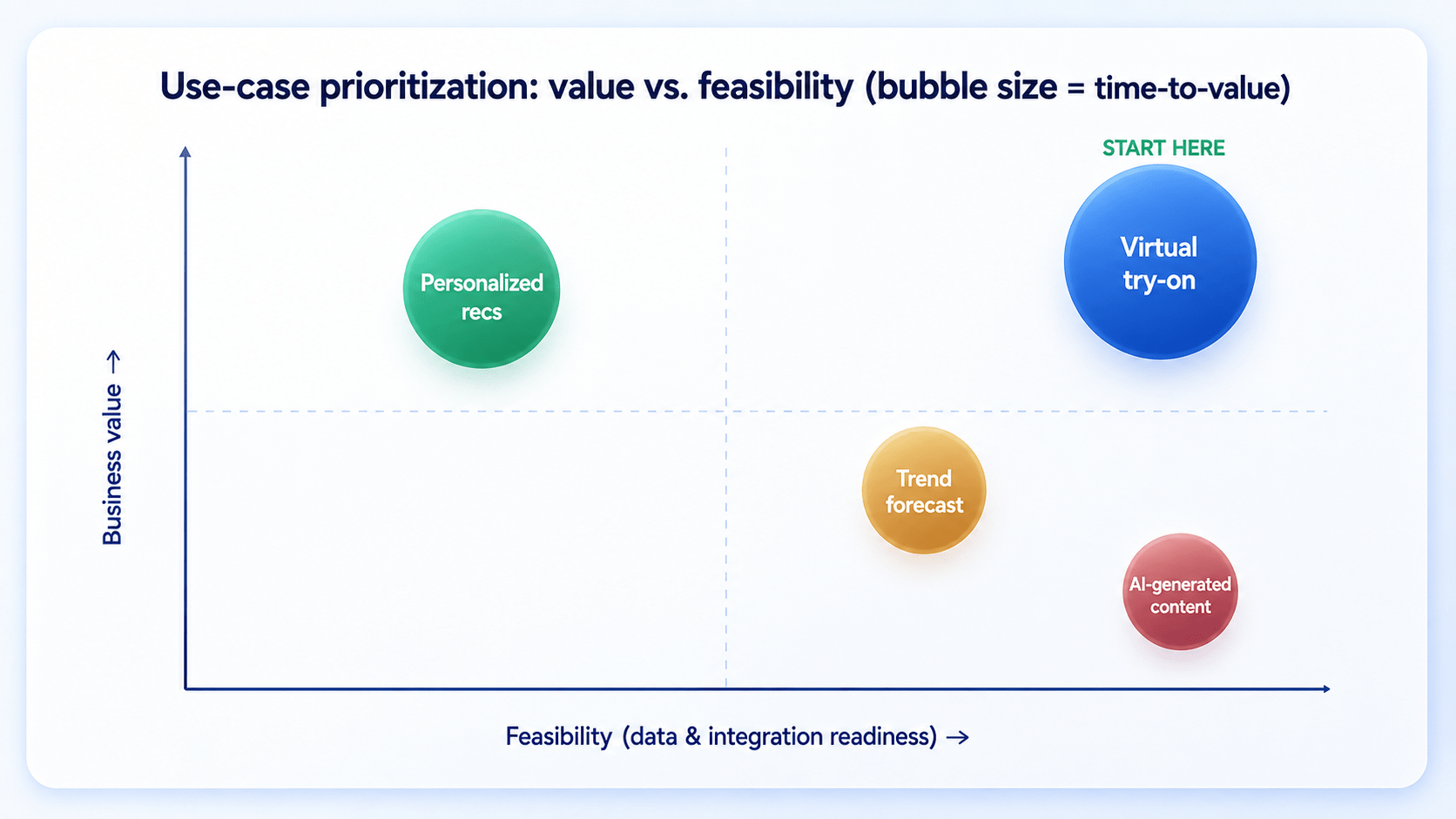
The matrix compares four common fashion AI use cases based on business value and implementation feasibility. Virtual try-on delivers the strongest combination of value and feasibility, making it the recommended starting point despite requiring a longer time to realize results. Trend forecasting offers moderate business value with relatively high implementation feasibility, while personalized recommendations provide high value but typically demand greater technical maturity and data readiness. By contrast, AI-generated content is the easiest and fastest capability to deploy, but it generally delivers lower strategic impact than the other use cases.
Bubble size represents time to value. Larger bubbles indicate longer implementation and adoption timelines, while smaller bubbles represent faster returns. This comparison helps organizations balance expected business impact against implementation effort and deployment speed when prioritizing AI investments.
Common selection mistakes to avoid
- Choosing the use case with the flashiest demo instead of the one tied to your named business constraint.
- Skipping a data-readiness check and discovering fragmentation only after the pilot has started.
- Treating a competitor’s published result as a guaranteed outcome rather than a data point to test against your own baseline.
- Funding two or three pilots at once with no shared owner, which spreads governance attention too thin.
SmartDev’s AI consulting services help fashion teams run this scoring exercise before committing engineering budget to a specific vendor or build.
Takeaway: No single AI use case is universally “best.” Score candidates on value, feasibility, risk, and time-to-value against your named business constraint, and let the scorecard, not the loudest pitch, decide what you pilot first.
Evidence From Fashion AI Deployments
The strongest evidence for fashion AI comes from documented case studies grouped by the business problem they solved, not from a list of brand names. Reading results this way makes it easier to judge whether a result would transfer to your own context.
Case studies by business problem, not by brand list
Improving fit and reducing return friction
Nike’s Nike Fit scans a customer’s foot via smartphone and recommends shoe sizing with sub-2-millimeter accuracy, targeting a return category where size mismatch has historically driven a large share of online footwear returns, per Forbes. Perfect Corp.’s AI-powered virtual try-on, deployed by Estée Lauder, delivered a 2.5-times lift in conversion while reducing returns, according to Retail Dive.
Improving personalization and product discovery
Stitch Fix blends machine learning with human stylists to curate selections, contributing to a 9% year-over-year increase in average order value and roughly a two-thirds repeat-customer rate, alongside a reported 30% drop in return rates tied to better size and style matching.
Improving forecasting, inventory, and sell-through
Zara’s inventory system tracks real-time sales across more than 7,000 stores, enabling 10-to-15-day restock cycles and an 85% full-price sell-through rate, well above the roughly 60% industry average.
Improving design and content-production workflows
The IBM–Tommy Hilfiger–FIT collaboration analyzed 15,000 runway and product images and cut the design-to-sample cycle by around 30%, Forbes reported. Zalando’s shift to generative AI for campaign imagery cut production lead time from weeks to days and reduced related costs by around 90%, per Reuters.
How to interpret case-study claims responsibly
A published result reflects one company’s baseline, category, data maturity, and market conditions. Treat every number as a hypothesis to test against your own operation, not a guaranteed outcome.
| Evidence quality signal | What it tells you | Watch for |
|---|---|---|
| Named source and date | Claim is traceable and current | Vague “industry reports show” language |
| Stated baseline | You can judge the size of the improvement | A percentage lift with no starting point |
| Comparable category and scale | Result is more likely to transfer to you | Luxury results applied to fast fashion, or vice versa |
| Disclosed limitation | Vendor or publisher is being transparent | Case studies with no caveats at all |
| Independent reporting | Claim is verified outside the vendor’s own materials | Numbers that only appear in a press release |
Takeaway: Group evidence by the problem it solves, always check the baseline behind a headline number, and treat every case study as an illustrative example until you have tested it against your own data.
Risks, Governance, and Human Oversight
Fashion AI carries six connected risk areas: data quality and ownership, privacy and biometric handling, intellectual property and disclosure, bias and representation, human accountability, and sustainability trade-offs. Strong implementation quality, not just strong technology, determines whether the resulting value holds up over time.
Data quality, data ownership, and integration constraints
Fragmented product, customer, and trend data across disconnected systems limits how accurate any AI model can be. Establishing clear data ownership and a single source of truth is a prerequisite for reliable forecasting and personalization, not a nice-to-have. SmartDev’s guide to data management covers how to build that foundation.
Privacy, consent, and sensitive biometric or behavioral data
Virtual try-on and fit tools process body measurements and, in some cases, facial or body imagery — categories that regulators increasingly treat as sensitive biometric data. Under the EU AI Act, biometric categorization systems fall under stricter obligations, and the regulation works alongside GDPR to create what the IAPP describes as a layered framework governing how biometric technologies can be used. Fashion brands deploying body-scanning or facial-analysis features need explicit consent, clear retention limits, and a documented legal basis before collection begins.
Intellectual property, creative rights, and generated-content disclosure
Generated fashion imagery and digital models raise two separate IP questions: whether the brand has rights to the training or reference material, and whether the output requires disclosure when published. Coverage from The Guardian shows how unresolved disclosure and labor questions around AI-generated models can escalate into reputational risk. Label AI-generated content clearly and route ambiguous cases to legal review before publication.
Bias, representation, and cultural relevance
Trend and recommendation models trained on unrepresentative data can systematically underweight body types, cultural styles, or markets outside the training set. Review training data composition and test model output across demographic segments before wide release, not after a complaint surfaces.
Human review, accountability, and workflow adoption
Every automated decision, from a markdown trigger to a generated ad, needs a named human owner who can review, override, or escalate it. SmartDev’s guide to AI ethics concerns lays out a four-factor method for deciding how much human oversight a given use case actually needs, based on people affected, decision stakes, data sensitivity, and system autonomy.
Sustainability trade-offs and rebound effects
AI-driven forecasting can cut overproduction and waste, but the same speed that helps a brand respond to a trend can also accelerate fast-fashion replication cycles and increase overall output if left unchecked. Pair any AI efficiency gain with an explicit sustainability guardrail, not an assumption that efficiency automatically reduces environmental impact.
Governance checkpoint checklist
- Data ownership and lineage are documented for every model input.
- Biometric or body-measurement data has explicit consent and a stated retention limit.
- AI-generated content has a disclosure and labeling policy before publication.
- Training and output data have been reviewed for representation gaps.
- A named human owner can review, override, or halt every automated decision.
- Sustainability impact is tracked alongside speed and cost metrics, not assumed.
For the fashion-specific compliance timeline under the EU’s framework, see the official EU AI Act regulatory overview and Fibre2Fashion’s practical map of tools, risks, and timelines for fashion brands.
Takeaway: Separate legal obligations from operational best practice, but treat both as required, not optional. Governance quality determines whether an AI use case remains valuable a year after launch or becomes a liability.
Implementing AI in Fashion: From Pilot to Scale
A realistic AI implementation sequence has six stages: define the problem, build the data foundation, evaluate vendors, run a controlled pilot, scale what works, and retrain teams around the new workflow. Skipping a stage is the most common reason a promising pilot never reaches production.
Define the operating problem and measurable success criterion
Restate the business constraint from Section 3 as a measurable target: a specific return-rate reduction, forecast-accuracy improvement, or cycle-time cut, with a stated baseline and deadline.
Build the required data foundation
Confirm the data your chosen use case needs is accessible, current, and clean enough to train or evaluate against. SmartDev’s data analytics services support this groundwork for fashion and retail clients building out a scalable data foundation.
Evaluate vendors, models, and integration requirements
Assess candidate vendors on fashion-specific experience, integration effort with your existing commerce and PIM systems, data ownership terms, and long-term support commitment, not only on demo quality.
Design a controlled pilot
Every pilot needs five elements defined before it starts: an owner, a workflow it plugs into, a baseline, a KPI, and a guardrail describing when the pilot must stop or escalate. Without a decision gate, a pilot tends to run indefinitely without ever producing a clear scale-or-stop answer.
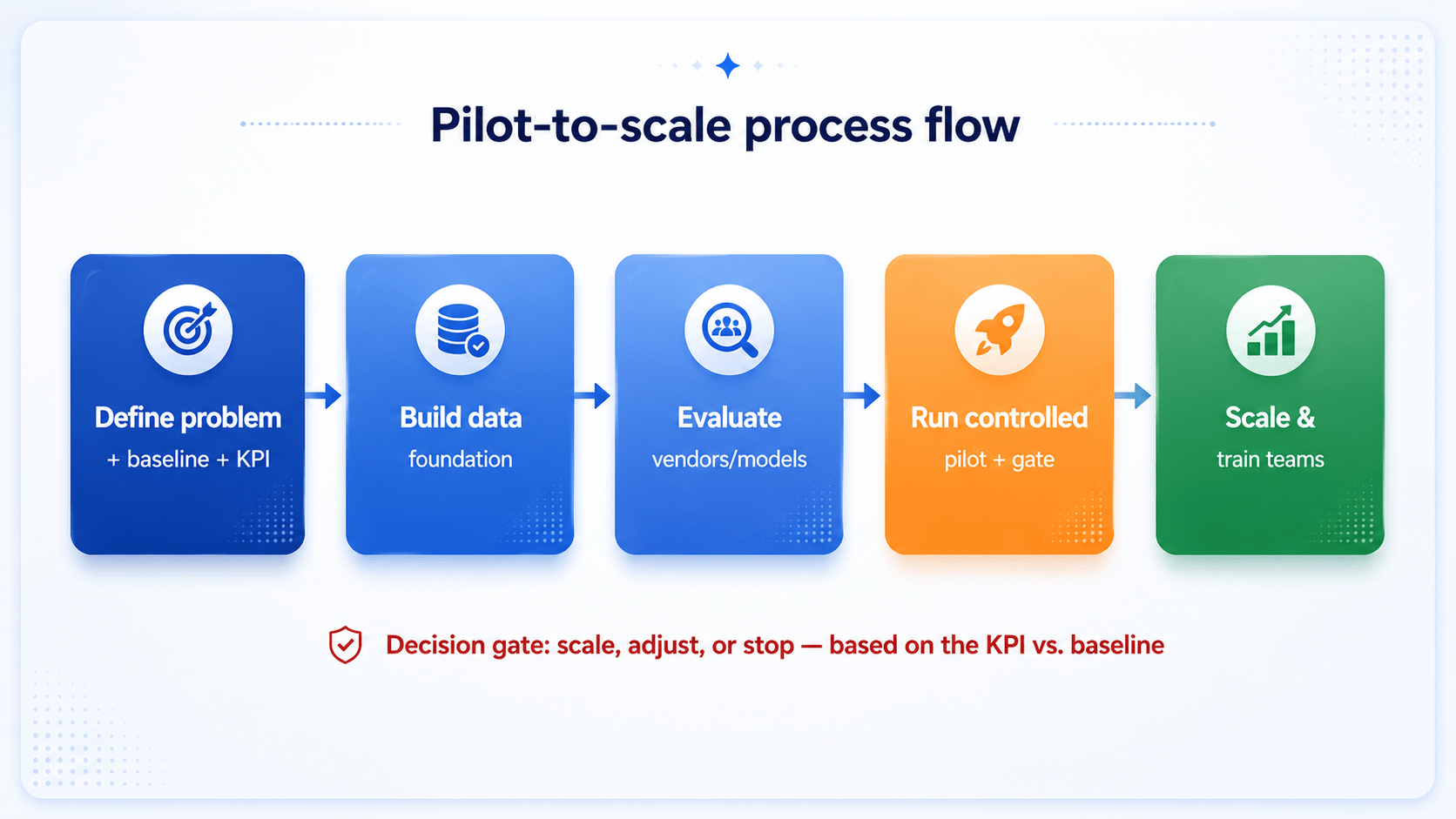
AI adoption in fashion follows a structured five-stage implementation process. Organizations first define the business problem, establish a measurable baseline, and set clear success metrics. Next, they build a reliable data foundation before evaluating vendors and AI models against business and technical requirements.
Teams then run a controlled pilot with predefined success and failure criteria. A formal decision gate determines whether to scale, refine, or stop the project based on KPI performance against the original baseline. Finally, successful pilots expand through phased deployment, supported by workforce training and change management.
Scale proven use cases across teams and markets
Scale only after the pilot clears its decision gate. Expand in stages – one additional team, category, or market at a time — so integration issues surface before they affect the whole business.
Train teams and redesign workflows around human-AI collaboration
Designers, merchandisers, and stylists need training on how to work with AI output, not just notification that a new tool exists. SmartDev’s guide on how tech leads can drive AI adoption covers the change-management side of this stage.
Takeaway: Validating a pilot and scaling a proven capability are two different decisions. Keep the decision gate explicit, so scaling reflects evidence against a baseline rather than pilot momentum alone.
Measuring ROI by Use-Case Category
Fashion AI ROI shows up differently depending on the use-case category, so measurement should follow four separate lenses: commercial metrics, product and supply-chain metrics, creative and operating metrics, and financial evaluation. Blending all of these into one generic “AI impact” figure hides which investment is actually working.
Commercial metrics: conversion, basket value, retention, and return rate
Personalization and virtual try-on use cases should be measured against conversion rate, average order value, repeat-purchase rate, and return rate. Stitch Fix’s reported 9% AOV lift and roughly 30% return-rate reduction are commercial-category results, not supply-chain results, and should be benchmarked against comparable commercial baselines.
Product and supply-chain metrics: forecast accuracy, sell-through, markdowns, stockouts, and waste
Forecasting and allocation use cases should be measured against forecast accuracy, full-price sell-through rate, markdown frequency, stockout rate, and waste volume, the metrics behind Zara’s 85% full-price sell-through figure.
Creative and operating metrics: cycle time, throughput, quality, and adoption
Design and content-generation use cases need their own lens: design-to-sample cycle time, content production throughput, output quality against brand standards, and team adoption rate. The Tommy Hilfiger–IBM collaboration’s roughly 30% cycle-time cut and Zalando’s shift from weeks to days in campaign production both belong to this category.
Financial evaluation: baseline, total cost, payback period, and scaling thresholds
Every use case needs a financial view alongside its operating metrics: the pre-AI baseline cost, the total cost of the AI solution including integration and training, the payback period, and a defined threshold that triggers a scaling decision.
| Use-case category | Baseline to set | Leading indicator | Lagging indicator | Decision threshold example |
|---|---|---|---|---|
| Personalization & try-on | Current conversion & return rate | Recommendation click-through | Conversion, AOV, return rate | Return rate down ≥3 points |
| Forecasting & allocation | Current forecast error | Model accuracy on holdout data | Sell-through, markdown rate | Forecast error down ≥20% |
| Design & content generation | Current cycle time & cost | Concepts generated per week | Cycle time, output quality score | Cycle time down ≥25% |
SmartDev’s guide to evaluating AI model performance covers how to build the accuracy and quality benchmarks behind these leading indicators.
What Is Next for AI in Fashion
Three developments deserve strategic attention without rushing to deploy: agentic AI systems that act with less human input, the continued maturing of virtual try-on and generated media, and the growing requirement to balance automation speed with governance and trust.
Agentic workflows and AI-enabled product discovery
“Agentic” AI systems can plan and execute multi-step actions, such as sourcing options, comparing prices, and completing a purchase, with limited human input at each step. Morgan Stanley projects agentic shoppers could account for 10% to 20% of U.S. e-commerce spending by 2030, worth an estimated $190 billion to $385 billion — a shift that will change how fashion brands compete for visibility inside AI-driven recommendations rather than only on a search results page.
The continuing role of virtual try-on, digital twins, and generated fashion media
Virtual try-on, fit prediction, and generated campaign imagery are already deployable today, not speculative. Digital twins of garments and shoppers, and fully generative product photography, are developing quickly but still need brand-specific validation before wide deployment.
The strategic requirement: balance automation with trust, governance, and human judgment
Faster automation raises the stakes on governance rather than removing the need for it. As agentic systems take on more autonomous action, the human-oversight and disclosure practices covered in Section 5 become more consequential, not less.
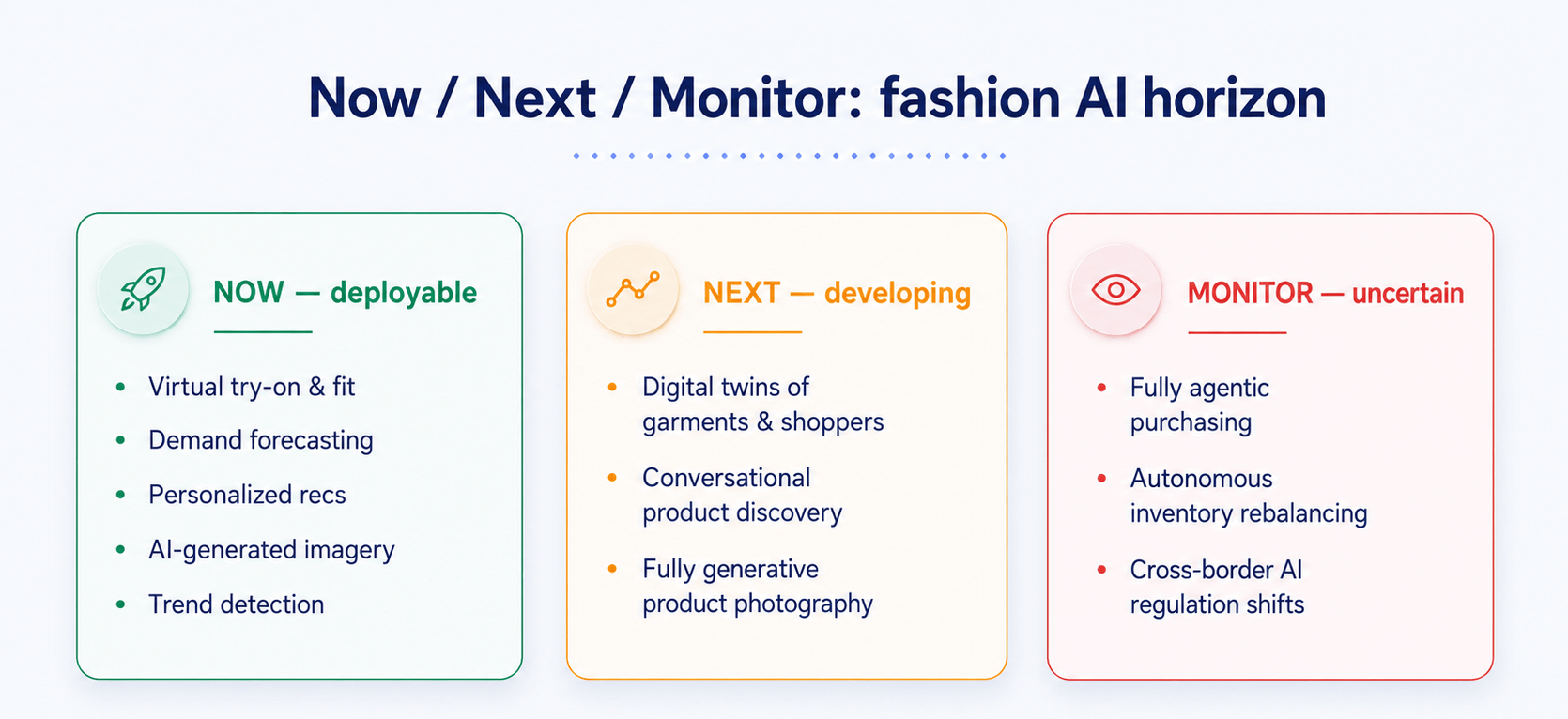
Fashion AI capabilities are maturing at different speeds, so organizations should prioritize investments accordingly. Today, technologies such as virtual try-on, demand forecasting, personalized recommendations, AI-generated imagery, and trend detection are proven enough for production deployment. These use cases already deliver measurable business value across many fashion organizations.
Meanwhile, digital twins, conversational product discovery, and fully generative product photography continue to mature. These capabilities show strong potential but still require controlled pilots and clear evaluation criteria before large-scale rollout.
Some developments remain too uncertain for immediate investment. Fully agentic purchasing, autonomous inventory rebalancing, and evolving cross-border AI regulations may reshape the industry over time. However, most organizations should monitor these trends rather than commit significant budgets today.
Takeaway: Deploy what already works, pilot what’s developing with clear evaluation criteria, and track uncertain signals like agentic commerce without committing budget to them yet.
FAQ About AI in Fashion
How is AI used in fashion?
AI is used across design, merchandising, commerce, operations, and circularity: trend forecasting, generative design, virtual try-on, personalized recommendations, demand forecasting, automated merchandising, and textile recycling all draw on machine learning, computer vision, or generative AI.
Which AI use case should a fashion retailer start with?
Start with the use case that maps directly to your most urgent business constraint — commonly returns, inventory accuracy, or design cycle time — and score it against value, feasibility, risk, and time-to-value before committing budget.
Can AI reduce returns in online fashion retail?
Yes. Virtual try-on and fit-recommendation tools address a leading cause of apparel and footwear returns — sizing mismatch — and documented deployments, such as Nike Fit, show measurable improvements in sizing accuracy and customer confidence.
What data does fashion AI need to work well?
Most use cases need clean, centralized product, customer, and transaction data, plus consistent visual data for computer-vision applications; fragmented data across disconnected systems is the most common reason a pilot underperforms.
What are the main risks of AI in fashion?
The main risks are data fragmentation, biometric privacy exposure, intellectual property and disclosure gaps around generated content, bias in trend or recommendation models, and unclear human accountability for automated decisions.
What are the risks of AI-generated fashion models?
AI-generated models raise disclosure, authenticity, and labor concerns; brands need a clear labeling policy and legal review before publishing generated imagery, particularly where it replaces human talent without transparency.
Conclusion
AI creates measurable value in fashion when it targets a specific business constraint, not when it’s adopted as a generic upgrade. The clearest wins so far sit in fit and try-on, forecasting and allocation, personalization, and generative content production, each backed by documented, sourced results rather than promotional claims.
Selection discipline, data readiness, and governance determine whether that value holds up over time. A scored use-case decision, a piloted rollout with a real decision gate, and category-specific ROI measurement turn a promising demo into a system that keeps working after launch.
Ready to validate your fashion AI opportunity?
SmartDev helps fashion and retail teams turn a promising AI use case into a scoped, governed pilot, from data readiness through implementation. Explore our AI-powered software development services, or talk to our team about your specific use case.
Contact SmartDev to discuss your fashion AI roadmap.